oil change MAZDA 6 2002 Suplement User Guide
[x] Cancel search | Manufacturer: MAZDA, Model Year: 2002, Model line: 6, Model: MAZDA 6 2002Pages: 909, PDF Size: 17.16 MB
Page 125 of 909

CONTROL SYSTEM
F1–37
F1
Without Using the SST
Caution
•The PCM terminal voltages vary with change in measuring conditions and vehicle conditions.
Always carry out a total inspection of the input systems, output systems, and PCM to determine
the cause of trouble. Otherwise, a wrong diagnosis will be made.
1. Measure the voltage at each terminal.
•If any incorrect voltage is detected, inspect the related system(s), wiring harnesses and connector(s)
referring to the Action column in the terminal voltage table.
Terminal voltage table (Reference)
Terminal Signal Connected to Test conditionVoltage
(V)Action
1A IGT1Ignition coil (No. 1,
4 cylinders)•Inspect using the wave profile.
(See F1–44 Inspection Using An
Oscilloscope (Reference).)•Inspect ignition coil
•Inspect related
harness
1B IGT2Ignition coil (No. 2,
3 cylinders)•Inspect using the wave profile.
(See F1–44 Inspection Using An
Oscilloscope (Reference).)•Inspect ignition coil
•Inspect related
harness
1C GND GND Under any condition Below 1.0•Inspect related
harness
1D GND GND Under any condition Below 1.0•Inspect related
harness
1E—— — ——
1F—— — ——
1G BARO BARO sensor Ignition switch ON (at sea level)Approx.
4.1 V•Inspect BARO sensor
•Inspect related
harness
1H—— — ——
1I—— — ——
1JManifold absolute
pressureMAP sensorIgnition switch ON (Engine OFF)Approx.
4.1•Inspect MAP sensor
•Inspect related
harness
IdleApprox.
1.5
1K Brake Brake switchBrake pedal depressed B+•Inspect brake switch
•Inspect related
harness Brake pedal released Below 1.0
1L—— — ——
1M ECT ECT sensorIgnition switch
ONECT 20 °C
{68 °F}3.04—
3.14•Inspect ECT sensor
•Inspect related
harness ECT 60 °C
{140 °F}1.29—
1.39
1N—— — ——
1O—— — ——
1P MAF MAF sensorIgnition switch ONApprox.
0.7•Inspect MAF sensor
•Inspect related
harness
Idle (after warm up)Approx.
1.3
1B 1A
1E 1D
1C 1H 1G 1J
1F 1I 1M
1L 1N 1K 1T 1Q1P 1S
1O 1R 1W1V
1Z 1Y
1X1AC1AB
1AA 1AD1U 2B 2A
2E 2D
2C 2H 2G 2J
2F 2I 2M
2L 2N 2K 2T 2Q2P 2S
2O 2R 2W2V
2Z 2Y
2X2AC2AB
2AA 2AD2U 3B 3A
3E 3D
3C 3H 3G 3J
3F 3I 3M
3L 3N 3K 3T 3Q3P 3S
3O 3R 3W3V
3Z 3Y
3X3AA3U 4B 4A
4E 4D
4C 4H 4G 4J
4F 4I 4M
4L 4N 4K 4T 4Q4P 4S
4O 4R 4W4V
4Z 4Y
4X4AC4AB
4AA 4AD4U
A6A3940W002
Page 404 of 909

J2–2
OUTLINE
OUTLINE OF CONSTRUCTIONA6E520201025203•The construction and operation of the manual transaxle is the same as those of the current A65M-R type
manual transaxle, except for the following features. (See MPV Workshop Manual supplement 1737-1*-02D.)
End Of Sie
FEATURESA6E520201025201Improved drivability
•The gear ratio has been changed.
End Of Sie
SPECIFICATIONSA6E520201025202
Bold frames:New specifications
End Of Sie
OUTLINE
Item New Mazda6 (GG, GY) Current MPV (LW)
Transaxle typeA65M-R
Transaxle control Floor-shift
Operation system Cable
Shift assistForward
Synchromesh
Reverse
Gear ratio1st 3.416
2nd 1.944 1.789
3rd 1.258 1.193
4th 0.902
5th 0.659
Reverse 3.252
Final gear ratio 3.588 4.133
OilGrade API service GL-4 or GL-5
Viscosity (All season) SAE 75W-90
Capacity (approximate quantity)
(L {US qt, Imp qt})2.30 {2.40, 2.00}
Page 493 of 909

K2–78
AUTOMATIC TRANSAXLE
Evaluation
End Of SieAUTOMATIC TRANSAXLE FLUID (ATF) INSPECTIONA6E571419001201Automatic Transaxle Fluid (ATF) Condition Inspection
1. One way of determining whether the transaxle should be replaced is by noting:
•If the ATF is muddy or varnished.
•If the ATF smells strange or unusual.
ATF Condition
Condition Possible Cause
No 1-2 up- or downshiftStuck shift solenoid C
Stuck shift valve C
Wore 2-4 brake
Trouble intermediate sensor
No 2-3 up- or downshiftStuck shift solenoid A
Stuck shift valve A
Wore high clutch
No 3-4 up- or downshiftStuck shift solenoid B
Stuck shift valve B
Wore 2-4 brake
No 4-5 up- or downshiftStuck shift solenoid A
Stuck shift valve A
Wore direct clutch
Trouble TFT
TCC non operation shiftStuck TCC solenoid valve
Stuck TCC valve
Incorrect shift pointTrouble VSS output signal
Trouble TR switch
Trouble TP signal and engine torque signal
Excessive shift shock slippageStuck pressure control solenoid
Stuck pressure regulator valve
Stuck pressure modifier valve
Stuck accumulator valve A, B, or C
Stuck 2-4 brake solenoid valve
Stuck high clutch solenoid valve
Stuck low clutch accumulator
Stuck 2-4 brake accumlator
Stuck high clutch accumlator
Stuck direct clutch accumlator
Stuck reduction accumlator
Trouble VSS
No Engine braking effect Wore reduction brake band
Stuck reduction reducing valve
Stuck reduction timing valve
Stuck reduction timing solenoid valve
Condition Possible cause
Clear dark red Normal—
Light red (pink) Contaminated with water•Broken oil cooler inside of radiator
•Poor filler tube installation:
Problem could be occurring to parts inside the
transaxle by water contamination. If necessary,
exchange transaxle.
Reddish
brownHas burnt smell and metal
specs are foundDeteriorated ATFDefect powertrain components inside of transaxle:
Specks cause wide range of problems by plugging up
in oil pipe, control valve body and oil cooler in radiator.
•When large amount of metal specks are found.
Exchange transaxle if necessary.
•Implement flushing operation as there is a
possibility to have specks plugging up oil pipe and/
or oil cooler inside of radiator.
Has no burnt smell Normal•Discoloration by oxidation
Page 609 of 909

K2–194
TROUBLESHOOTING
NO.11 SHIFT POINT IS HIGH OR LOWA6E578001030214
End Of SieNO.12 TORQUE CONVERTER CLUTCH (TCC) NON-OPERATIONA6E578001030215
Diagnostic procedure
11 Shift point is high or low
DESCRIPTION•Shift point considerably different from automatic shift diagram.
•Shift delays when accelerating.
•Shift occurs quickly when accelerating and engine speed does not increase.
POSSIBLE
CAUSE•If the transaxle does not shift abnormally, there is a malfunction of input signal to TP sensor, input/
turbine speed sensor, or VSS.
•If engine speed is high or low regardless that shifting is normal, inspect tachometer.
•Verify that output signal of TP sensor changes linearly.
Note
•Before following troubleshooting steps, make sure that Automatic Transaxle On-Board Diagnostic
and Automatic Transaxle Basic Inspection are conducted.
12 Torque converter clutch (TCC) non-operation
DESCRIPTION•TCC does not operate when vehicle reaches TCC operation range.
POSSIBLE
CAUSE•Basically, TCC does not operate when fail-safe is operating. Verify DTC at first. If TCC operates when
driving at high speeds only, the malfunction (improper adjustment) is in D and/or M ranges switch circuit
or TR switch circuit.
Note
•If the TCC or piston is stuck, inspect them. In addition, inspect the oil cooler for foreign particles
which may have mixed in with the ATF.
•TCC piston slipped, burned
—Line pressure low
•Incorrect throttle position signal
•Input/turbine speed sensor malfunction
•TFT sensor malfunction
•Sensor ground malfunction
•VSS malfunction
•Malfunction of output solenoid valve system (Sticking)
•TCC solenoid valve malfunction
•Malfunction of control valve body system (Poor operation, sticking)
•TCC piston hydraulic pressure system malfunction
•Malfunction of TP sensor (Not operating linearly)
•Malfunction of input/turbine speed sensor or VSS
Note
•Before following troubleshooting steps, make sure that Automatic Transaxle On-Board Diagnostic
and Automatic Transaxle Basic Inspection are conducted.
STEP INSPECTION ACTION
1•Turn ignition switch to ON.
•Does gear position lamp indication
correspond to selector lever position?Yes Go to next step.
No Go to symptom troubleshooting No.27 “Gear position
indicator light does not illuminate in M range”, or No.28
“Gear position indicator light illuminates in D range or P, N,
R positions”.
2•Disconnect TCM.
•Is resistance between ground terminals 1C,
1Y at TCM connector and body ground less
than 5.0 ohm?Yes Go to next step.
No Repair open ground circuit.
3•Remove torque converter.
•Inspect torque converter.
(See ATX Workshop Manual.)
•Is torque converter okay?Yes•Overhaul control valve body and repair or replace any
defective parts.
(See ATX Workshop Manual.)
•If problem remains, replace or overhaul transaxle and
repair or replace any defective parts.
(See ATX Workshop Manual.)
No•Replace torque converter.
4•Verify test results.
—If okay, return to diagnostic index to service any additional symptoms.
—If malfunction remains, inspect related Service Informations and perform repair or diagnosis.
—If vehicle repaired, troubleshooting completed.
—If vehicle not repaired or additional diagnostic information not available, replace TCM.
Page 611 of 909

K2–196
TROUBLESHOOTING
NO.15 ENGINE FLARES UP OR SLIPS WHEN ACCELERATING VEHICLEA6E578001030218
End Of SieNO.16 JUDDER UPON TORQUE CONVERTER CLUTCH (TCC) OPERATIONA6E578001030219
End Of SieNO.17 EXCESSIVE SHIFT SHOCK FROM N TO D OR N TO R POSITION/RANGEA6E578001030220
Diagnostic procedure
15 Engine flares up or slips when accelerating vehicle
DESCRIPTION•Engine flares up when accelerator pedal depressed for upshifting.
•Engine flares up suddenly when accelerator pedal depressed for downshifting.
POSSIBLE
CAUSE•Malfunction is basically the same as for No.14 “Engine flares up or slips when upshifting or
downshifting”.
—If conditions for No.14 worsen, malfunction will develop into No.15.
Note
•Before following troubleshooting steps, make sure that Automatic Transaxle On-Board Diagnostic
and Automatic Transaxle Basic Inspection are conducted.
16 Judder upon torque converter clutch (TCC) operation
DESCRIPTION•Vehicle jolts when TCC engaged.
POSSIBLE
CAUSE•Poor TCC engagement due to either slippage because TCC piston is stuck or line pressure is low.
Caution
•If the TCC or piston are stuck, inspect them. In addition, inspect the oil cooler for foreign
particles which may have mixed in with the ATF.
—Torque converter clutch piston slipped, burned
•Line pressure low
•Incorrect throttle position signal
•Malfunction of VSS
•Malfunction of input/turbine speed sensor
•Malfunction of sensor ground
•Malfunction of TCC solenoid valve
•Malfunction of control valve body
—Malfunction of torque converter
Note
•Before following troubleshooting steps, make sure that Automatic Transaxle On-Board Diagnostic
and Automatic Transaxle Basic Inspection are conducted.
17 Excessive shift shock from N to D or N to R position/range
DESCRIPTION•Strong shock felt when shifting from N to D or N to R position/range at idle.
POSSIBLE
CAUSE•Shift shock may worsen when fail-safe is operating. If no DTC is output, shift shock may worsen due to
poor operation of control valve body or sticking of clutch.
—Clutch burned (N→D: Low clutch, N→R: Reverse clutch or low and reverse brake)
•Line pressure low
•Incorrect throttle position signal
•Malfunction of TFT sensor
•Malfunction of sensor ground
•Misadjustment of throttle cable
•Malfunction of control valve body
—Poor hydraulic operation (Malfunction in range change)
—Idle speed high
—Poor tightening torque of engine mount, exhaust mount
—Line pressure high
Note
•Before following troubleshooting steps, make sure that Automatic Transaxle On-Board Diagnostic
and Automatic Transaxle Basic Inspection are conducted.
STEP INSPECTION ACTION
1•Does shift shock occur only when engine
cold?Yes Go to next step.
No Go to Step 3.
2•Inspect TFT sensor and related harness:
vibration, intermittent open/short circuit.
•Is it okay?Yes Go to next step.
No Repair or replace part if necessary.
Page 641 of 909

ELECTRONIC 4WD CONTROL SYSTEM
M–11
M
4WD solenoid control current is ON
•When the 4WD solenoid control current is ON, current flows from the 4WD CM to the 4WD solenoid, and the
coupling operates in the following manner.
1. Magnetic flux forms at the electromagnetic coil of the 4WD solenoid.
2. Due to the magnetic flux in the armature, the pilot clutch is suctioned towards the magnetic coil side and
made to engage. This causes frictional torque to generate in the pilot clutch.
3. The torque is transmitted to the pilot cam, which is engaged with the pilot clutch.
4. A rotational difference is created between the pilot cam and the main cam. Due to this relative torsion, the
cam mechanism operates, transmitting torque from the pilot cam to the ball and then to the main cam. In
this way, the push force exerted on the main clutch is amplified.
5. As the main clutch engages, the drive torque from the front wheels is transmitted to the rear wheels.
•The amount of push force exerted on the main clutch by the main cam (that is, the strength of the drive torque
transmitted to the rear wheels) changes in accordance with the proportion of the force acting upon the pilot
cam, engaged with the pilot clutch. Therefore, by changing the periodicity of the electric current from the 4WD
CM to the 4WD solenoid (ON/OFF rate of the 4WD solenoid = force acting on the pilot cam), the module
controls the transmission of drive torque to the rear wheels.
.
End Of Sie
98
75
4
3
10
11
6
12
56
7
12
A6E63222005
1 Main clutch
2Pilot clutch
3 4WD solenoid (Electromagnetic coil)
4 4WD control modure (4WD CM)
5Main cam
6Pilot cam7Ball
8Armature
9 Drive torque
10 Magnetic flux
11 Input
12 Output
Page 642 of 909
M–12
ELECTRONIC 4WD CONTROL SYSTEM
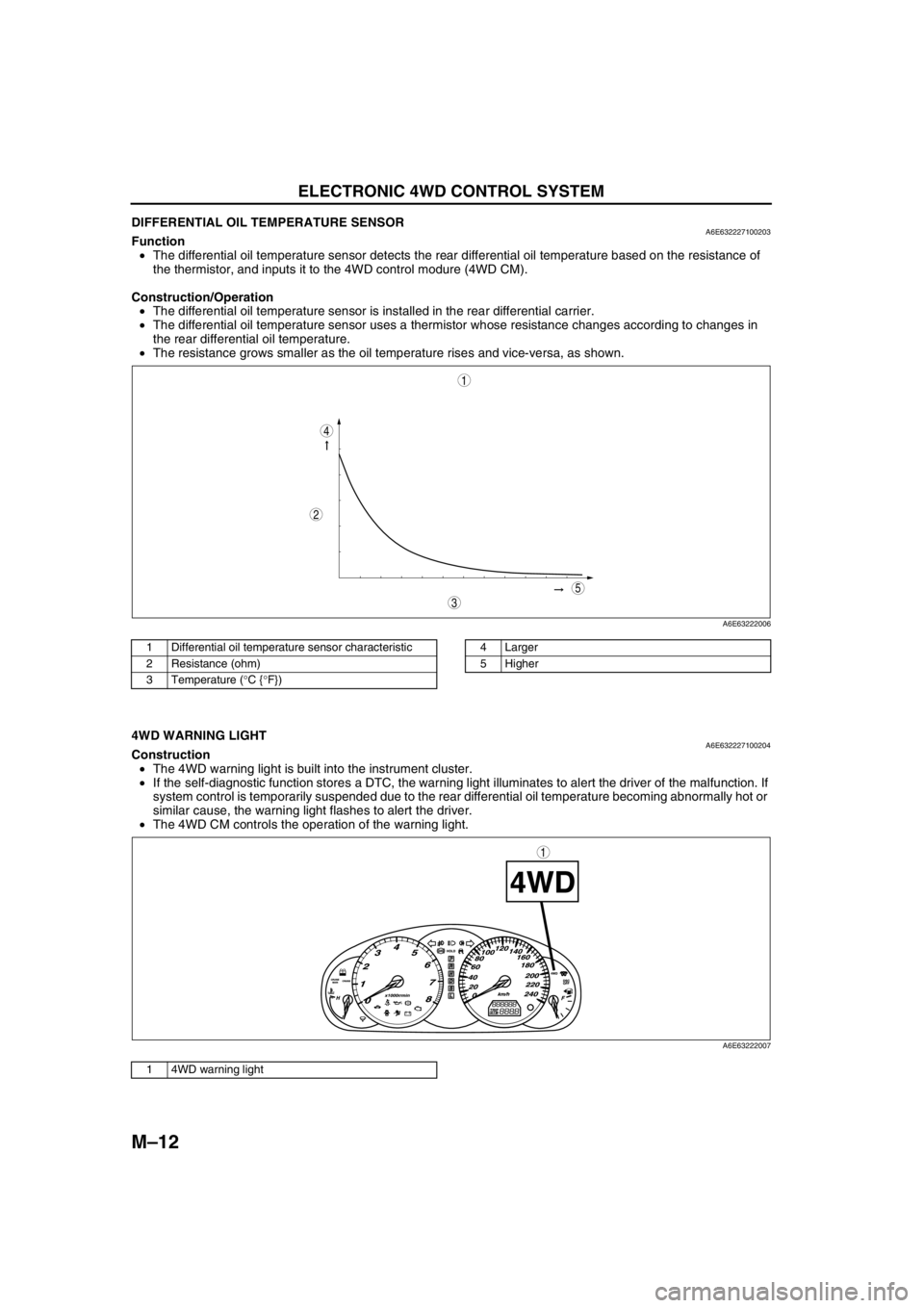
DIFFERENTIAL OIL TEMPERATURE SENSORA6E632227100203Function
•The differential oil temperature sensor detects the rear differential oil temperature based on the resistance of
the thermistor, and inputs it to the 4WD control modure (4WD CM).
Construction/Operation
•The differential oil temperature sensor is installed in the rear differential carrier.
•The differential oil temperature sensor uses a thermistor whose resistance changes according to changes in
the rear differential oil temperature.
•The resistance grows smaller as the oil temperature rises and vice-versa, as shown.
.
End Of Sie
4WD WARNING LIGHTA6E632227100204Construction
•The 4WD warning light is built into the instrument cluster.
•If the self-diagnostic function stores a DTC, the warning light illuminates to alert the driver of the malfunction. If
system control is temporarily suspended due to the rear differential oil temperature becoming abnormally hot or
similar cause, the warning light flashes to alert the driver.
•The 4WD CM controls the operation of the warning light.
.
End Of Sie
5
4
3
1
2
A6E63222006
1 Differential oil temperature sensor characteristic
2 Resistance (ohm)
3 Temperature (°C {°F})4 Larger
5 Higher
1
A6E63222007
1 4WD warning light
Page 719 of 909

OUTLINE
N–5
N
SUPPLEMENTAL SERVICE INFORMATIONA6E660201034201•The following changes have been made since publication of the Mazda6 Workshop Manual (1730-1*-02C).
Power steering fluid
•Inspection procedure has been modified.
Steering gear and linkage (MZR-CD (RF Turbo))
•Removal/installation procedure has been added.
Steering gear and linkage (4WD)
•Removal/installation procedure has been added.
Power steering oil pump (MZR-CD (RF Turbo))
•Removal/installation procedure has been added.
•Disassembly/assembly procedure has been added.
End Of Sie
OUTLINE
Page 769 of 909
REAR SUSPENSION, OUTLINE
R–7
R
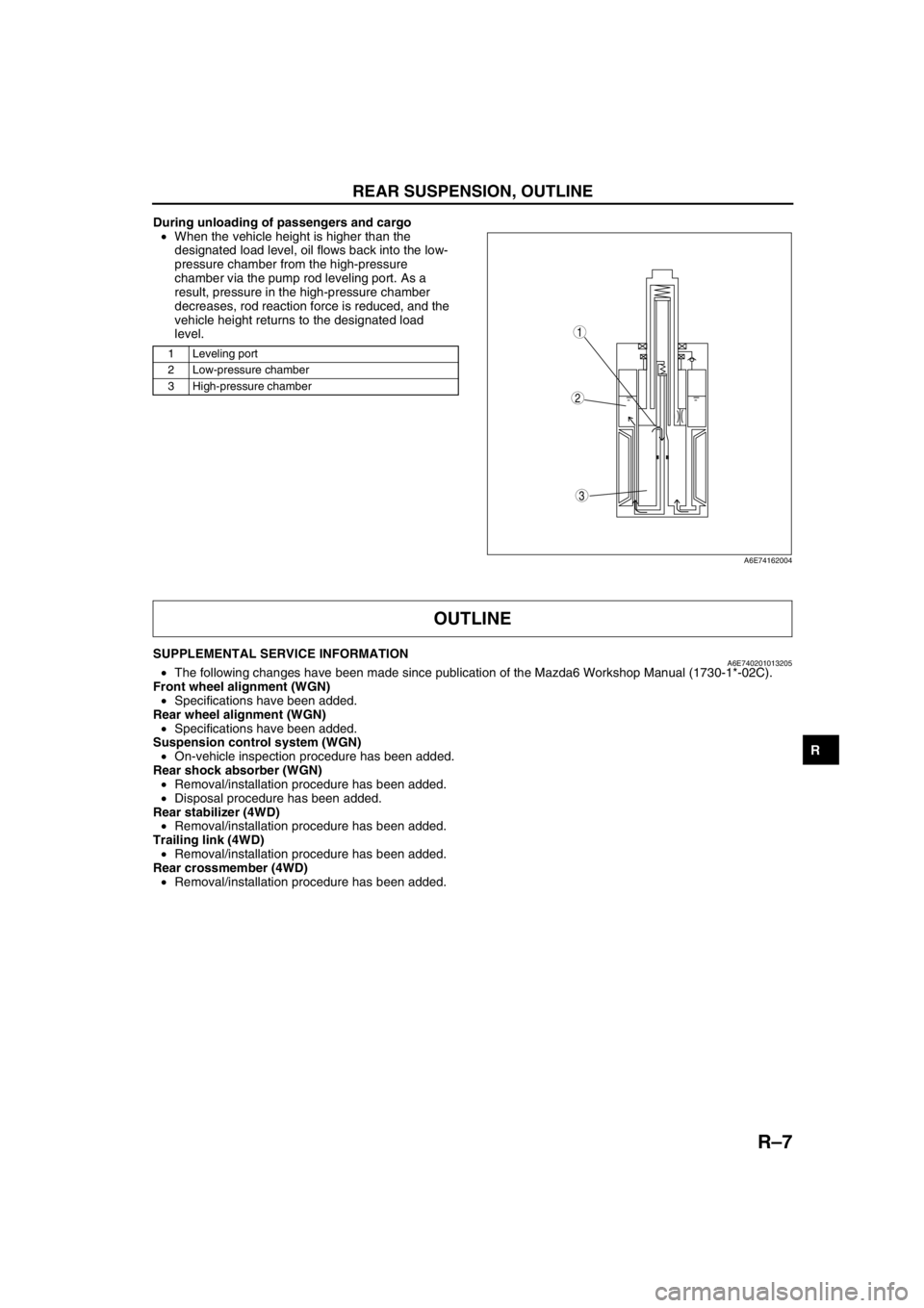
During unloading of passengers and cargo
•When the vehicle height is higher than the
designated load level, oil flows back into the low-
pressure chamber from the high-pressure
chamber via the pump rod leveling port. As a
result, pressure in the high-pressure chamber
decreases, rod reaction force is reduced, and the
vehicle height returns to the designated load
level.
.
End Of Sie
SUPPLEMENTAL SERVICE INFORMATIONA6E740201013205•The following changes have been made since publication of the Mazda6 Workshop Manual (1730-1*-02C).
Front wheel alignment (WGN)
•Specifications have been added.
Rear wheel alignment (WGN)
•Specifications have been added.
Suspension control system (WGN)
•On-vehicle inspection procedure has been added.
Rear shock absorber (WGN)
•Removal/installation procedure has been added.
•Disposal procedure has been added.
Rear stabilizer (4WD)
•Removal/installation procedure has been added.
Trailing link (4WD)
•Removal/installation procedure has been added.
Rear crossmember (4WD)
•Removal/installation procedure has been added.
End Of Sie
1 Leveling port
2 Low-pressure chamber
3 High-pressure chamber
3
1
2
A6E74162004
OUTLINE
Page 771 of 909
WHEEL ALIGNMENT
R–9
R
Total Toe-in Adjustment
1. Center the steering wheel and confirm that the vehicle wheels/tires are pointing straight.
2. Loosen the left and right tie-rod end locknuts and turn the tie-rods equally. Both tie rods are right threaded, so
turning the right tie-rod toward the front of the vehicle and the left toward the rear increases toe-in.
Note
•Turning both tie-rods one complete turn changes toe-in by about 6 mm {0.24 in} (0°36').
3. Tighten the tie-rod end locknuts to the specified torque.
Tightening torque
68.6—98.0 N·m {7.00—9.99 kgf·m, 50.6—72.2 ft·lbf}
4. Verify that the boot is not twisted, and install the boot clamp.
End Of Sie
REAR WHEEL ALIGNMENT (WGN)A6E741201016201Specification (Unloaded)*1
2WD
*
1: Engine coolant and engine oil are at specified level. Spare tire, jack and tools are in designated position.
*2: Difference between left and right must not exceed 1°30'.*3: Distance between wheel center and fender brim is 407 mm {16.02 in} (reference value).
4WD
*
1: Engine coolant and engine oil are at specified level. Spare tire, jack and tools are in designated position.
*2: Difference between left and right must not exceed 1°30'.
Note
•Adjust the toe-in after adjusting the camber.
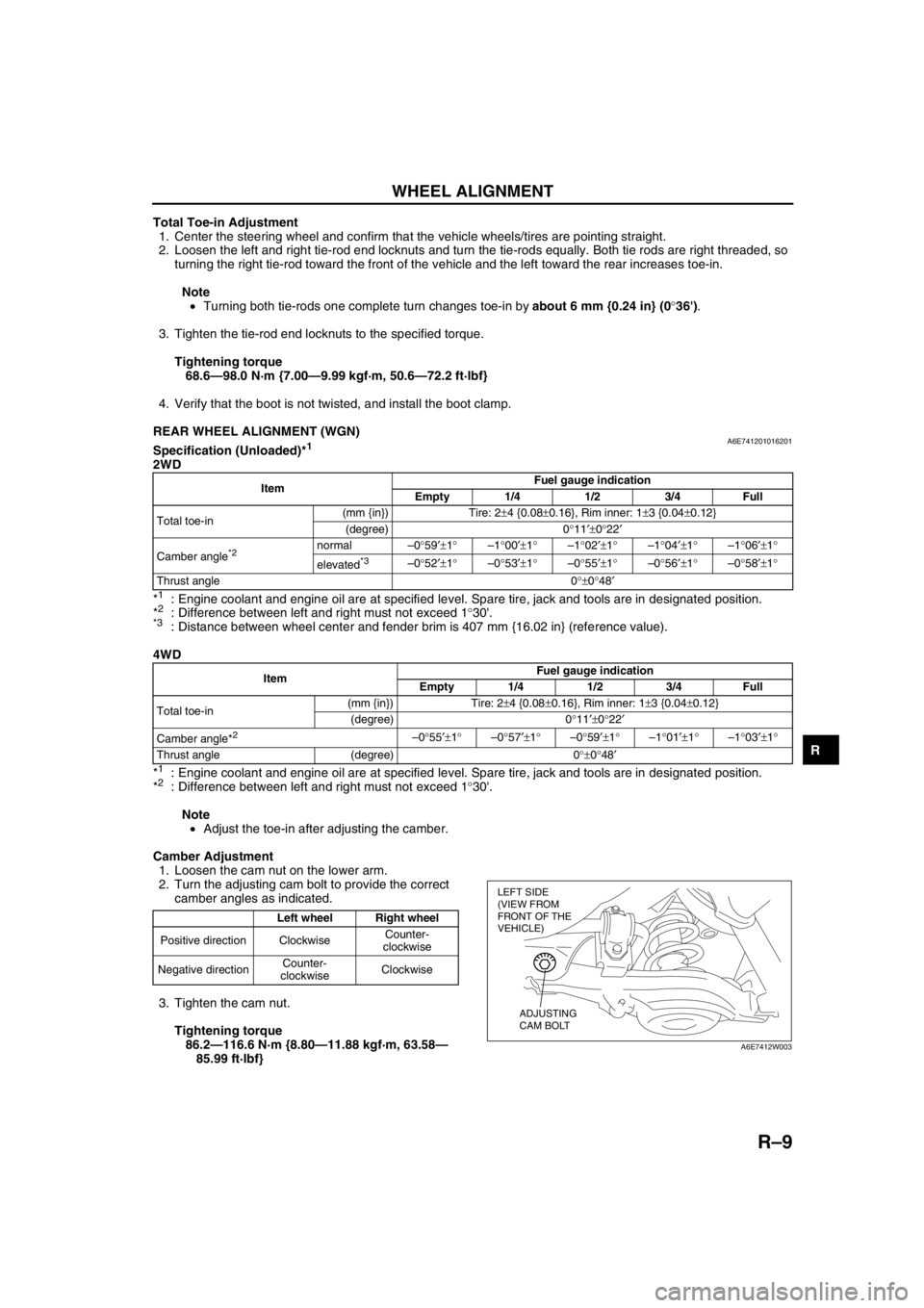
Camber Adjustment
1. Loosen the cam nut on the lower arm.
2. Turn the adjusting cam bolt to provide the correct
camber angles as indicated.
3. Tighten the cam nut.
Tightening torque
86.2—116.6 N·m {8.80—11.88 kgf·m, 63.58—
85.99 ft·lbf}
ItemFuel gauge indication
Empty 1/4 1/2 3/4 Full
Total toe-in(mm {in}) Tire: 2±4 {0.08±0.16}, Rim inner: 1±3 {0.04±0.12}
(degree) 0°11′±0°22′
Camber angle
*2 normal–0°59′±1°–1°00′±1°–1°02′±1°–1°04′±1°–1°06′±1°
elevated
*3–0°52′±1°–0°53′±1°–0°55′±1°–0°56′±1°–0°58′±1°
Thrust angle 0°±0°48′
ItemFuel gauge indication
Empty 1/4 1/2 3/4 Full
Total toe-in(mm {in}) Tire: 2±4 {0.08±0.16}, Rim inner: 1±3 {0.04±0.12}
(degree) 0°11′±0°22′
Camber angle*
2 –0°55′±1°–0°57′±1°–0°59′±1°–1°01′±1°–1°03′±1°
Thrust angle (degree) 0°±0°48′
Left wheel Right wheel
Positive direction ClockwiseCounter-
clockwise
Negative directionCounter-
clockwiseClockwise
LEFT SIDE
(VIEW FROM
FRONT OF THE
VEHICLE)
ADJUSTING
CAM BOLT
A6E7412W003