oil pressure MAZDA 6 2002 Suplement Repair Manual
[x] Cancel search | Manufacturer: MAZDA, Model Year: 2002, Model line: 6, Model: MAZDA 6 2002Pages: 909, PDF Size: 17.16 MB
Page 493 of 909

K2–78
AUTOMATIC TRANSAXLE
Evaluation
End Of SieAUTOMATIC TRANSAXLE FLUID (ATF) INSPECTIONA6E571419001201Automatic Transaxle Fluid (ATF) Condition Inspection
1. One way of determining whether the transaxle should be replaced is by noting:
•If the ATF is muddy or varnished.
•If the ATF smells strange or unusual.
ATF Condition
Condition Possible Cause
No 1-2 up- or downshiftStuck shift solenoid C
Stuck shift valve C
Wore 2-4 brake
Trouble intermediate sensor
No 2-3 up- or downshiftStuck shift solenoid A
Stuck shift valve A
Wore high clutch
No 3-4 up- or downshiftStuck shift solenoid B
Stuck shift valve B
Wore 2-4 brake
No 4-5 up- or downshiftStuck shift solenoid A
Stuck shift valve A
Wore direct clutch
Trouble TFT
TCC non operation shiftStuck TCC solenoid valve
Stuck TCC valve
Incorrect shift pointTrouble VSS output signal
Trouble TR switch
Trouble TP signal and engine torque signal
Excessive shift shock slippageStuck pressure control solenoid
Stuck pressure regulator valve
Stuck pressure modifier valve
Stuck accumulator valve A, B, or C
Stuck 2-4 brake solenoid valve
Stuck high clutch solenoid valve
Stuck low clutch accumulator
Stuck 2-4 brake accumlator
Stuck high clutch accumlator
Stuck direct clutch accumlator
Stuck reduction accumlator
Trouble VSS
No Engine braking effect Wore reduction brake band
Stuck reduction reducing valve
Stuck reduction timing valve
Stuck reduction timing solenoid valve
Condition Possible cause
Clear dark red Normal—
Light red (pink) Contaminated with water•Broken oil cooler inside of radiator
•Poor filler tube installation:
Problem could be occurring to parts inside the
transaxle by water contamination. If necessary,
exchange transaxle.
Reddish
brownHas burnt smell and metal
specs are foundDeteriorated ATFDefect powertrain components inside of transaxle:
Specks cause wide range of problems by plugging up
in oil pipe, control valve body and oil cooler in radiator.
•When large amount of metal specks are found.
Exchange transaxle if necessary.
•Implement flushing operation as there is a
possibility to have specks plugging up oil pipe and/
or oil cooler inside of radiator.
Has no burnt smell Normal•Discoloration by oxidation
Page 494 of 909
AUTOMATIC TRANSAXLE
K2–79
K2
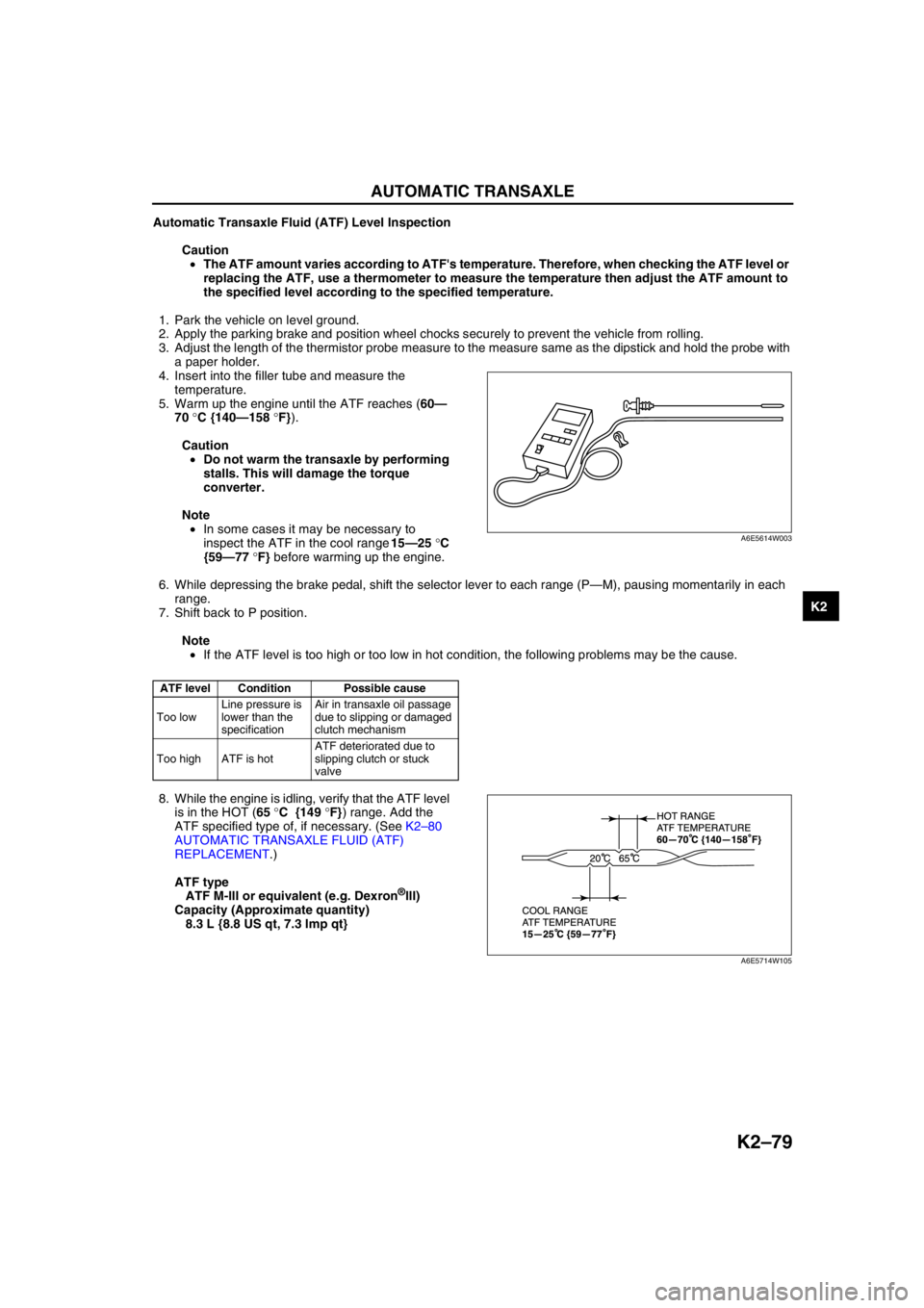
Automatic Transaxle Fluid (ATF) Level Inspection
Caution
•The ATF amount varies according to ATF's temperature. Therefore, when checking the ATF level or
replacing the ATF, use a thermometer to measure the temperature then adjust the ATF amount to
the specified level according to the specified temperature.
1. Park the vehicle on level ground.
2. Apply the parking brake and position wheel chocks securely to prevent the vehicle from rolling.
3. Adjust the length of the thermistor probe measure to the measure same as the dipstick and hold the probe with
a paper holder.
4. Insert into the filler tube and measure the
temperature.
5. Warm up the engine until the ATF reaches (60—
70 °C {140—158 °F}).
Caution
•Do not warm the transaxle by performing
stalls. This will damage the torque
converter.
Note
•In some cases it may be necessary to
inspect the ATF in the cool range 15—25 °C
{59—77 °F} before warming up the engine.
6. While depressing the brake pedal, shift the selector lever to each range (P—M), pausing momentarily in each
range.
7. Shift back to P position.
Note
•If the ATF level is too high or too low in hot condition, the following problems may be the cause.
8. While the engine is idling, verify that the ATF level
is in the HOT (65 °C {149 °F}) range. Add the
ATF specified type of, if necessary. (See K2–80
AUTOMATIC TRANSAXLE FLUID (ATF)
REPLACEMENT.)
ATF type
ATF M-III or equivalent (e.g. Dexron
®III)
Capacity (Approximate quantity)
8.3 L {8.8 US qt, 7.3 Imp qt}
End Of Sie
ATF level Condition Possible cause
Too lowLine pressure is
lower than the
specificationAir in transaxle oil passage
due to slipping or damaged
clutch mechanism
Too high ATF is hotATF deteriorated due to
slipping clutch or stuck
valve
A6E5614W003
A6E5714W105
Page 514 of 909
AUTOMATIC TRANSAXLE
K2–99
K2
AUTOMATIC TRANSAXLE AND TRANSFER REMOVAL/INSTALLATIONA6E5714190902011. Disconnect the negative battery cable.
2. Remove the battery and battery tray.
3. Remove the aircleaner component. (See Sectin F.)
4. Remove the front tires and splash shield.
5. Remove the under cover.
6. Separate the steering shaft and steering hose. (See N–13 STEERING GEAR AND LINKAGE (4WD)
REMOVAL/INSTALLATION.)
7. Remove the front auto leveling sensor. (See Section T.)
8. Drain the ATF. (See K2–80 AUTOMATIC TRANSAXLE FLUID (ATF) REPLACEMENT.)
Warning
•Improperly jacking a transaxle is dangerous. It can slip off the jack and may cause serious injury.
Caution
•To prevent the torque converter and transaxle from separating, remove the transaxle without
tilting it toward the torque converter.
9. Remove in the order shown in the figure.
10. Install in the reverse order of removal.
11. Adjust the headlight zeroset. (See Section T.)
12. Add ATF to the specified level. (See K2–80 AUTOMATIC TRANSAXLE FLUID (ATF) REPLACEMENT.)
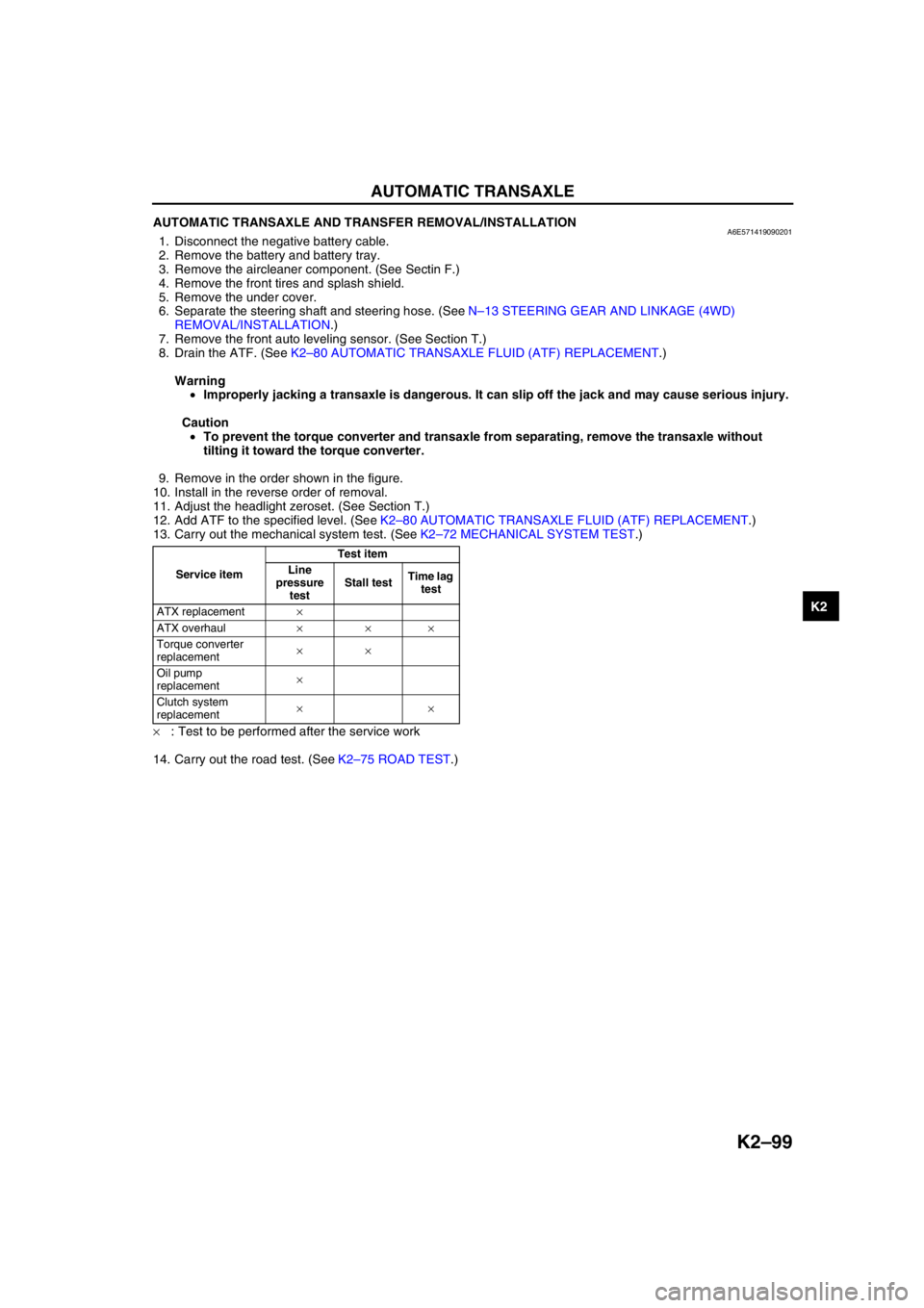
13. Carry out the mechanical system test. (See K2–72 MECHANICAL SYSTEM TEST.)
×: Test to be performed after the service work
14. Carry out the road test. (See K2–75 ROAD TEST.)
Service itemTest item
Line
pressure
testStall testTime lag
test
ATX replacement×
ATX overhaul×××
Torque converter
replacement××
Oil pump
replacement×
Clutch system
replacement××
Page 523 of 909
K2–108
AUTOMATIC TRANSAXLE
OIL COOLER REMOVAL/INSTALLATIONA6E5714199002031. Disconnect the negative battery cable.
2. Drain the ATF into a container. (See K2–80 AUTOMATIC TRANSAXLE FLUID (ATF) REPLACEMENT.)
3. Remove the radiator. (See Section E.)
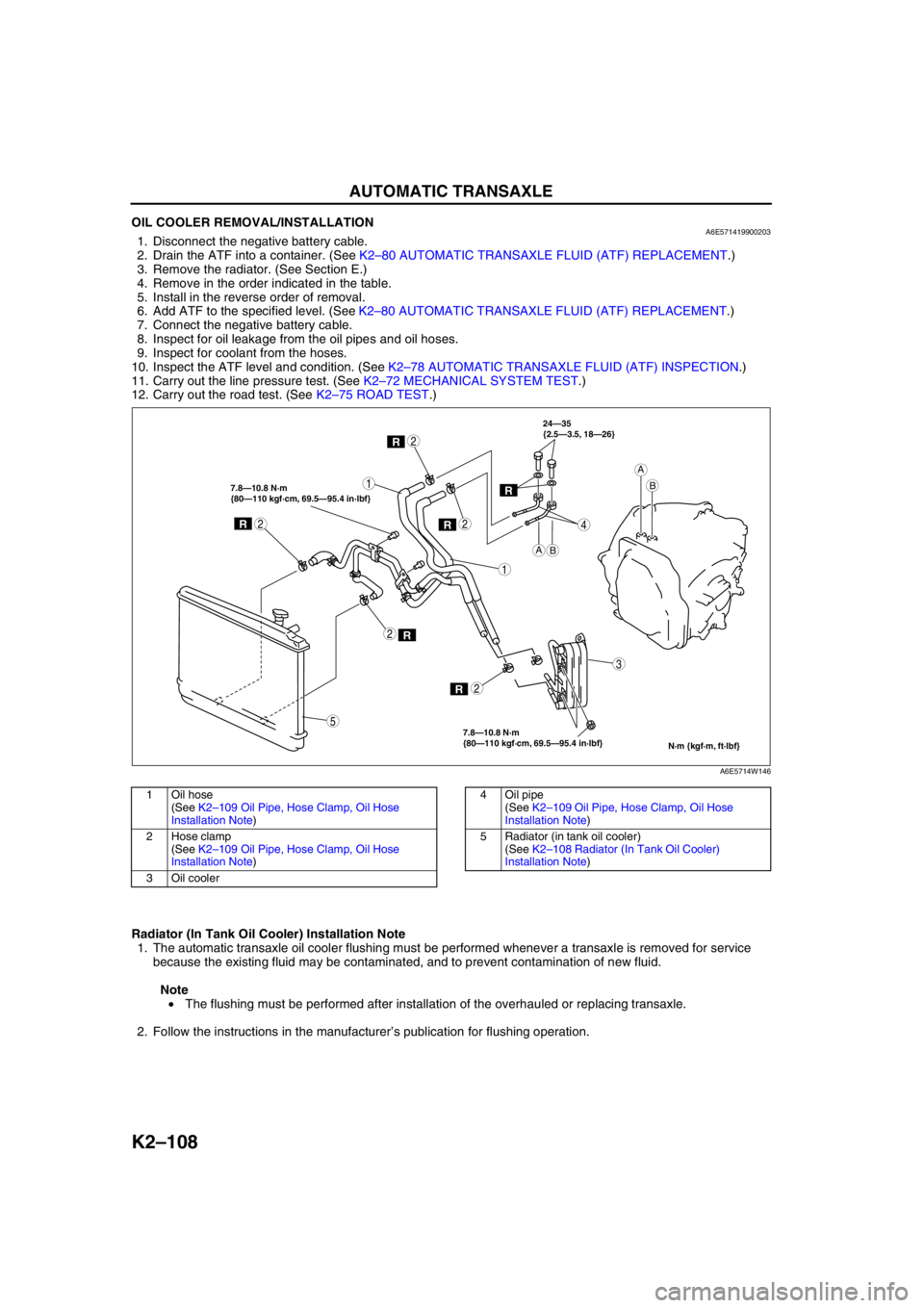
4. Remove in the order indicated in the table.
5. Install in the reverse order of removal.
6. Add ATF to the specified level. (See K2–80 AUTOMATIC TRANSAXLE FLUID (ATF) REPLACEMENT.)
7. Connect the negative battery cable.
8. Inspect for oil leakage from the oil pipes and oil hoses.
9. Inspect for coolant from the hoses.
10. Inspect the ATF level and condition. (See K2–78 AUTOMATIC TRANSAXLE FLUID (ATF) INSPECTION.)
11. Carry out the line pressure test. (See K2–72 MECHANICAL SYSTEM TEST.)
12. Carry out the road test. (See K2–75 ROAD TEST.)
.
Radiator (In Tank Oil Cooler) Installation Note
1. The automatic transaxle oil cooler flushing must be performed whenever a transaxle is removed for service
because the existing fluid may be contaminated, and to prevent contamination of new fluid.
Note
• The flushing must be performed after installation of the overhauled or replacing transaxle.
2. Follow the instructions in the manufacturer’s publication for flushing operation.
R
R
1
2
1
3
4
2
R2
R2
R
7.8—10.8 N·m
{80—110 kgf·cm, 69.5—95.4 in·lbf} 7.8—10.8 N·m
{80—110 kgf·cm, 69.5—95.4 in·lbf}24—35
{2.5—3.5, 18—26}
2
5
AB
A
B
N·m {kgf·m, ft·lbf}
R
A6E5714W146
1Oil hose
(See K2–109 Oil Pipe, Hose Clamp, Oil Hose
Installation Note)
2 Hose clamp
(See K2–109 Oil Pipe, Hose Clamp, Oil Hose
Installation Note)
3Oil cooler4 Oil pipe
(See K2–109 Oil Pipe, Hose Clamp, Oil Hose
Installation Note)
5 Radiator (in tank oil cooler)
(See K2–108 Radiator (In Tank Oil Cooler)
Installation Note)
Page 557 of 909

K2–142
ON-BOARD DIAGNOSTIC
End Of SieDTC P0740A6E577018901212
Diagnostic procedure
12VERIFY TROUBLESHOOTING OF DTC P0720
COMPLETED
•Make sure to reconnect all disconnected
connectors.
•Clear DTC from memory using WDS or
equivalent.
•Drive vehicle with vehicle speed 40 km/h {25
mph} or above for 2 second or more
•Is same DTC present?Yes Replace TCM, then go to next step.
(See K2–96 TCM REMOVAL/INSTALLATION.)
No Go to next step.
13VERIFY AFTER REPAIR PROCEDURE
•Perform “After Repair Procedure”.
(See K2–124 AFTER REPAIR PROCEDURE.)
•Is there any DTC present?Yes Go to applicable DTC inspection.
No Troubleshooting completed. STEP INSPECTION ACTION
DTC P0740 TCC system malfunction
DETECTION
CONDITION•RPM difference between crankshaft (engine speed signal) and reverse clutch drum (input/turbine speed
sensor signal) exceeds the pre-programmed value.
Diagnostic support note:
•This is continuous monitor (CCM).
•MIL illuminates if TCM detects the above malfunction conditions in two consecutive drive cycles.
•PENDING CODE is available.
•FREEZE FRAME DATA is available.
•AT warning light does not indication.
•DTC is stored in TCM memory.
POSSIBLE
CAUSE•ATF level low.
•Deteriorated ATF.
•TCC solenoid valve and pressure control solenoid stuck.
•Line pressure low.
•Oil pump malfunction.
•Control valve stuck
•Torque convert clutch malfunction
•TCM malfunction.
STEP INSPECTION ACTION
1VERIFY FREEZE FRAME DATA HAS BEEN
RECORDED
•Has FREEZE FRAME PID DATA been
recorded?Yes Go to next step.
No Record FREEZE FRAME PID DATA on repair order, then
go to next step.
2VERIFY RELATED REPAIR INFORMATION
AVAILABILITY
•Check for related Service Bulletins and/or on-
line repair information availability.
•Is any related repair information available?Yes Perform repair or diagnosis according to available repair
information.
•If vehicle is not repaired, go to next step.
No Go to next step.
3CHECK ATF CONDITION
•Turn ignition key to OFF.
•Check ATF condition.
—Clear red: Normal
—Milky: Water mixed in fluid
—Reddish brown: Deteriorated ATF
•Is it okay?
(See K2–78 Automatic Transaxle Fluid (ATF)
Condition Inspection.)Yes Go to next step.
No If ATF color milky or reddish brown, replace ATF, then go to
Step 5.
(See K2–80 AUTOMATIC TRANSAXLE FLUID (ATF)
REPLACEMENT.)
4CHECK ATF LEVEL
•Start engine.
•Warm up ATX.
•Is ATF level within specification?
(See K2–79 Automatic Transaxle Fluid (ATF)
Level Inspection.)Yes Go to next step.
No Adjust ATF level, then go to Step 9.
(See K2–79 Automatic Transaxle Fluid (ATF) Level
Inspection.)
Page 558 of 909

ON-BOARD DIAGNOSTIC
K2–143
K2
End Of Sie
5INSPECT LINE PRESSURE
•Start engine.
•Measure line pressure.
Specification
—D range, M (2GR) range
Idle: 290—490 kPa {3.0—4.9 kgf/cm
2, 43—69
psi}
Stall: 1,550—1,750 kPa {15.8—17.8 kgf/cm
2,
225—254 psi}
—M (1GR) range, R position
Idle:550—750 kPa {5.6—7.6 kgf/cm
2, 80—
109 psi}
Stall: 1,550—1,750 kPa {15.8—17.8 kgf/cm
2,
225—254 psi}
•Is line pressure within specification?
(See K2–72 Line Pressure Test.)Yes Go to next step.
No All ranges: Replace or overhaul oil pump or control valve
body, then go to Step 10.
Any ranges: Replace or overhaul automatic transaxle, then
go to Step 10.
(See K2–99 AUTOMATIC TRANSAXLE AND TRANSFER
REMOVAL/INSTALLATION.)
6CLICK TEST OF SOLENOID VALVES
•Turn ignition key to OFF.
•Disconnect terminal component No.1(12-pin).
•Apply battery voltage to terminal component
No.1 (12-pin) terminals (transaxle case side).
—TCC solenoid vale: B
—Pressure control solenoid: D
•Verify the click sounds of TCC solenoid valve
and pressure control solenoid.
•Are there click sounds?Yes Go to next step.
No Replace TCC solenoid valve or pressure control solenoid,
then go to Step 10.
(See K2–105 CONTROL VALVE BODY REMOVAL/
INSTALLATION.)
7INSPECT DIFFERENCE BETWEEN ENGINE
SPEED AND TURBINE SPEED
•Inspect difference between engine speed and
turbine speed during TCC operation in 5GR
•Drive vehicle under following condition
—TR switch position: D range
—Gear position: 5GR
—TCC solenoid valve: ON
•Is difference between engine speed (RPM PID)
and turbine speed okay?
Difference
Below 99 rpmYes Go to Step
No Go to next step.
8INSPECT OPERATION OF EACH VALVE AND
EACH SPRING
•Remove control valve body.
•Disassemble control valve body.
•Is each valve operation okay and is return
spring okay?Yes Replace torque converter, then go to next step.
No Replace control valve body, then go to next step.
(See K2–105 CONTROL VALVE BODY REMOVAL/
INSTALLATION.)
9VERIFY TROUBLESHOOTING OF DTC P0740
COMPLETED
•Make sure to reconnect all disconnected
connectors.
•Clear DTC from memory using WDS or
equivalent.
•Start engine.
•Warm up ATX.
•Drive vehicle under following condition for 10
seconds or more.
—Vehicle speed (VSS PID): Within 10—87
km/h {6—54 mph}
—Gear position: 5GR
—TR switch position: D range
—TCC solenoid valve: ON
•Is there pending code present?Yes Replace TCM, then go to next step.
(See K2–96 TCM REMOVAL/INSTALLATION.)
No Go to next step.
10VERIFY AFTER REPAIR PROCEDURE
•Perform “After Repair Procedure”.
(See K2–124 AFTER REPAIR PROCEDURE.)
•Is there any DTC present?Yes Go to applicable DTC inspection.
No Troubleshooting completed. STEP INSPECTION ACTION
Page 602 of 909

TROUBLESHOOTING
K2–187
K2
End Of Sie
Vehicle dose not move in D range, or in R position
X
X
X
XXX X
XX X
XX X
XX X XX
X
X
X X XX
XX
X XXXXXXXXX
XXX
X
X
X X
XX XXX
X
X
XX X
X
X
X X
X
X
X X
XX
X XXX X XXX
XX X 1
Excessive creep 4
No creep at all 5
Low maximum speed and poor acceleration 6
No shifting 7
Does not shift to fifth gear (5GR) 8
Abnormal shifting 9
Frequent shifting 10
Shift point is high or low 11
Torque converter clutch (TCC) non-operation 12
No kickdown 13
Engine flares up or slips when upshifting or downshifting 14
Engine flares up or slip when accelerating vehicle 15
Judder upon torque converter clutch (TCC) operation 16
Excessive shift shock from N to D or N to R position/range 17
Excessive shift shock on torque converter clutch (TCC) 19
No engine braking in 1GR position of M range 22
Transaxle overheats 23
Engine stalls when shifted to D range, or in R position 24
Engine stalls when driving at slow speeds or stopping 25
Starter does not work 26Excessive shift shock is given when upshifting and
downshifting 18
Noise occurs at idle when vehicle is stopped in all
positions/ranges 20
Noise occurs at idle when vehicle is stopped in D
range, or in R position 21
Gear position indicator light illuminates in D range or P, N,
R positions 28Gear position indicator light does not illuminate in M range
Hydraulic system
components
Control valve bodyPowertrain 27
Does not shift up in M range
29
Does not shift down in M range
Symptom item
Cause of trouble
Reduction accumulator is not operating properly
Clogging
Clogging
Clogging
Clogging
Clogging
Clogging
Clogging Clogging
Clogging
Slipping (clutch, brake) Oil cooler is not operating properly
Torque converter is not operating properly Burned (clutch, brake)
TCC piston is not operating properly TCC piston is cracking or peeling2-4 brake solenoid valve hydraulic circuit Pressure control solenoid hydraulic circuit
TCC solenoid valve hydraulic circuit
High clutch solenoid valve hydraulic circuit
Shift solenoid A hydraulic circuit
Shift solenoid B hydraulic circuit
Shift solenoid C hydraulic circuit
Neutral shift solenoid valve
Reducation timing solenoid valve
30Vehicle moves in N position 2
Vehicle moves in P position, or parking gear does not
disengage when P is disengaged 3
A6E5780W003
Page 607 of 909

K2–192
TROUBLESHOOTING
NO.8 DOES NOT SHIFT TO FIFTH GEAR (5GR)A6E578001030211
Diagnostic procedure
8 Does not shift to fifth gear (5GR)
DESCRIPTION•Vehicle does not upshift from 4GR to 5GR even though vehicle speed increased.
•Vehicle does not shift to 5GR even though accelerator pedal released in D range at 60 km/h {37 mph}.
POSSIBLE
CAUSE•Basically, TCC does not operate when fail-safe is operating. Verify DTC at first. If TCC operates when
driving at high speeds only, malfunction (improper adjustment) is in the D range switch circuit or TR
switch circuit.
Note
•If the TCC or piston is stuck, inspect them. In addition, inspect the oil cooler for foreign particles
which may have mixed in with the ATF.
—TCC piston slipped, burned
•Line pressure low
•Incorrect throttle position signal
•Malfunction of ECT sensor
•Malfunction of VSS
•Malfunction of input/turbine speed sensor
•Malfunction of sensor ground
—Malfunction of TFT sensor
•Short or open circuit in wiring
•Poor connection of connector
•Malfunction of sensor
—Malfunction of TR switch
•Selector lever adjustment incorrect
•TR switch adjustment incorrect
—Malfunction of TCC solenoid valve
•Short or open circuit in wiring
•Poor connection of connector
•Solenoid valve stuck
—Malfunction of M range switch
—Malfunction of torque converter
—Malfunction of control valve body
Note
•Before following troubleshooting steps, make sure that Automatic Transaxle On-Board Diagnostic
and Automatic Transaxle Basic Inspection are conducted.
STEP INSPECTION ACTION
1•Turn ignition switch to ON.
•Does gear position indicator light indication
correspond to selector lever position?Yes Go to next step.
No Go to symptom troubleshooting No.27 “Gear position
indicator light does not illuminate in M range” or No.28
“Gear position indicator light illuminates in D range or P, N,
R positions”.
2•Drive vehicle in D range and inspect
following:
—1–2 shift up and down
—2–3 shift up and down
—3–4 shift up and down
—4–5 shift up and down
•Are all shift-up and shift-down possible?Yes Go to next step.
NoNo shift at all:
•Go to symptom troubleshooting No.7 “No shifting”.
Abnormal shift:
•Go to symptom troubleshooting No.9 “Abnormal
shifting”.
3•Stop engine.
•Inspect shift solenoid A, B, or C circuit.
•Are they okay?Yes Go to next step.
No•Inspect for shift solenoid mechanical stuck.
(See K2–88 SOLENOID VALVE INSPECTION.)
4•Remove torque converter.
•Inspect torque converter.
(See ATX Workshop.)
•Is torque converter okay?Yes•Overhaul control valve body and repair or replace any
defective parts.
(See ATX Workshop Manual.)
—If problem remains, replace or overhaul transaxle and
repair or replace any defective parts.
(See K2–99 AUTOMATIC TRANSAXLE AND
TRANSFER REMOVAL/INSTALLATION.)
(See ATX Workshop Manual.)
No Replace torque converter.
Page 609 of 909

K2–194
TROUBLESHOOTING
NO.11 SHIFT POINT IS HIGH OR LOWA6E578001030214
End Of SieNO.12 TORQUE CONVERTER CLUTCH (TCC) NON-OPERATIONA6E578001030215
Diagnostic procedure
11 Shift point is high or low
DESCRIPTION•Shift point considerably different from automatic shift diagram.
•Shift delays when accelerating.
•Shift occurs quickly when accelerating and engine speed does not increase.
POSSIBLE
CAUSE•If the transaxle does not shift abnormally, there is a malfunction of input signal to TP sensor, input/
turbine speed sensor, or VSS.
•If engine speed is high or low regardless that shifting is normal, inspect tachometer.
•Verify that output signal of TP sensor changes linearly.
Note
•Before following troubleshooting steps, make sure that Automatic Transaxle On-Board Diagnostic
and Automatic Transaxle Basic Inspection are conducted.
12 Torque converter clutch (TCC) non-operation
DESCRIPTION•TCC does not operate when vehicle reaches TCC operation range.
POSSIBLE
CAUSE•Basically, TCC does not operate when fail-safe is operating. Verify DTC at first. If TCC operates when
driving at high speeds only, the malfunction (improper adjustment) is in D and/or M ranges switch circuit
or TR switch circuit.
Note
•If the TCC or piston is stuck, inspect them. In addition, inspect the oil cooler for foreign particles
which may have mixed in with the ATF.
•TCC piston slipped, burned
—Line pressure low
•Incorrect throttle position signal
•Input/turbine speed sensor malfunction
•TFT sensor malfunction
•Sensor ground malfunction
•VSS malfunction
•Malfunction of output solenoid valve system (Sticking)
•TCC solenoid valve malfunction
•Malfunction of control valve body system (Poor operation, sticking)
•TCC piston hydraulic pressure system malfunction
•Malfunction of TP sensor (Not operating linearly)
•Malfunction of input/turbine speed sensor or VSS
Note
•Before following troubleshooting steps, make sure that Automatic Transaxle On-Board Diagnostic
and Automatic Transaxle Basic Inspection are conducted.
STEP INSPECTION ACTION
1•Turn ignition switch to ON.
•Does gear position lamp indication
correspond to selector lever position?Yes Go to next step.
No Go to symptom troubleshooting No.27 “Gear position
indicator light does not illuminate in M range”, or No.28
“Gear position indicator light illuminates in D range or P, N,
R positions”.
2•Disconnect TCM.
•Is resistance between ground terminals 1C,
1Y at TCM connector and body ground less
than 5.0 ohm?Yes Go to next step.
No Repair open ground circuit.
3•Remove torque converter.
•Inspect torque converter.
(See ATX Workshop Manual.)
•Is torque converter okay?Yes•Overhaul control valve body and repair or replace any
defective parts.
(See ATX Workshop Manual.)
•If problem remains, replace or overhaul transaxle and
repair or replace any defective parts.
(See ATX Workshop Manual.)
No•Replace torque converter.
4•Verify test results.
—If okay, return to diagnostic index to service any additional symptoms.
—If malfunction remains, inspect related Service Informations and perform repair or diagnosis.
—If vehicle repaired, troubleshooting completed.
—If vehicle not repaired or additional diagnostic information not available, replace TCM.
Page 611 of 909

K2–196
TROUBLESHOOTING
NO.15 ENGINE FLARES UP OR SLIPS WHEN ACCELERATING VEHICLEA6E578001030218
End Of SieNO.16 JUDDER UPON TORQUE CONVERTER CLUTCH (TCC) OPERATIONA6E578001030219
End Of SieNO.17 EXCESSIVE SHIFT SHOCK FROM N TO D OR N TO R POSITION/RANGEA6E578001030220
Diagnostic procedure
15 Engine flares up or slips when accelerating vehicle
DESCRIPTION•Engine flares up when accelerator pedal depressed for upshifting.
•Engine flares up suddenly when accelerator pedal depressed for downshifting.
POSSIBLE
CAUSE•Malfunction is basically the same as for No.14 “Engine flares up or slips when upshifting or
downshifting”.
—If conditions for No.14 worsen, malfunction will develop into No.15.
Note
•Before following troubleshooting steps, make sure that Automatic Transaxle On-Board Diagnostic
and Automatic Transaxle Basic Inspection are conducted.
16 Judder upon torque converter clutch (TCC) operation
DESCRIPTION•Vehicle jolts when TCC engaged.
POSSIBLE
CAUSE•Poor TCC engagement due to either slippage because TCC piston is stuck or line pressure is low.
Caution
•If the TCC or piston are stuck, inspect them. In addition, inspect the oil cooler for foreign
particles which may have mixed in with the ATF.
—Torque converter clutch piston slipped, burned
•Line pressure low
•Incorrect throttle position signal
•Malfunction of VSS
•Malfunction of input/turbine speed sensor
•Malfunction of sensor ground
•Malfunction of TCC solenoid valve
•Malfunction of control valve body
—Malfunction of torque converter
Note
•Before following troubleshooting steps, make sure that Automatic Transaxle On-Board Diagnostic
and Automatic Transaxle Basic Inspection are conducted.
17 Excessive shift shock from N to D or N to R position/range
DESCRIPTION•Strong shock felt when shifting from N to D or N to R position/range at idle.
POSSIBLE
CAUSE•Shift shock may worsen when fail-safe is operating. If no DTC is output, shift shock may worsen due to
poor operation of control valve body or sticking of clutch.
—Clutch burned (N→D: Low clutch, N→R: Reverse clutch or low and reverse brake)
•Line pressure low
•Incorrect throttle position signal
•Malfunction of TFT sensor
•Malfunction of sensor ground
•Misadjustment of throttle cable
•Malfunction of control valve body
—Poor hydraulic operation (Malfunction in range change)
—Idle speed high
—Poor tightening torque of engine mount, exhaust mount
—Line pressure high
Note
•Before following troubleshooting steps, make sure that Automatic Transaxle On-Board Diagnostic
and Automatic Transaxle Basic Inspection are conducted.
STEP INSPECTION ACTION
1•Does shift shock occur only when engine
cold?Yes Go to next step.
No Go to Step 3.
2•Inspect TFT sensor and related harness:
vibration, intermittent open/short circuit.
•Is it okay?Yes Go to next step.
No Repair or replace part if necessary.