oil pressure MAZDA 6 2002 Suplement Owner's Guide
[x] Cancel search | Manufacturer: MAZDA, Model Year: 2002, Model line: 6, Model: MAZDA 6 2002Pages: 909, PDF Size: 17.16 MB
Page 154 of 909
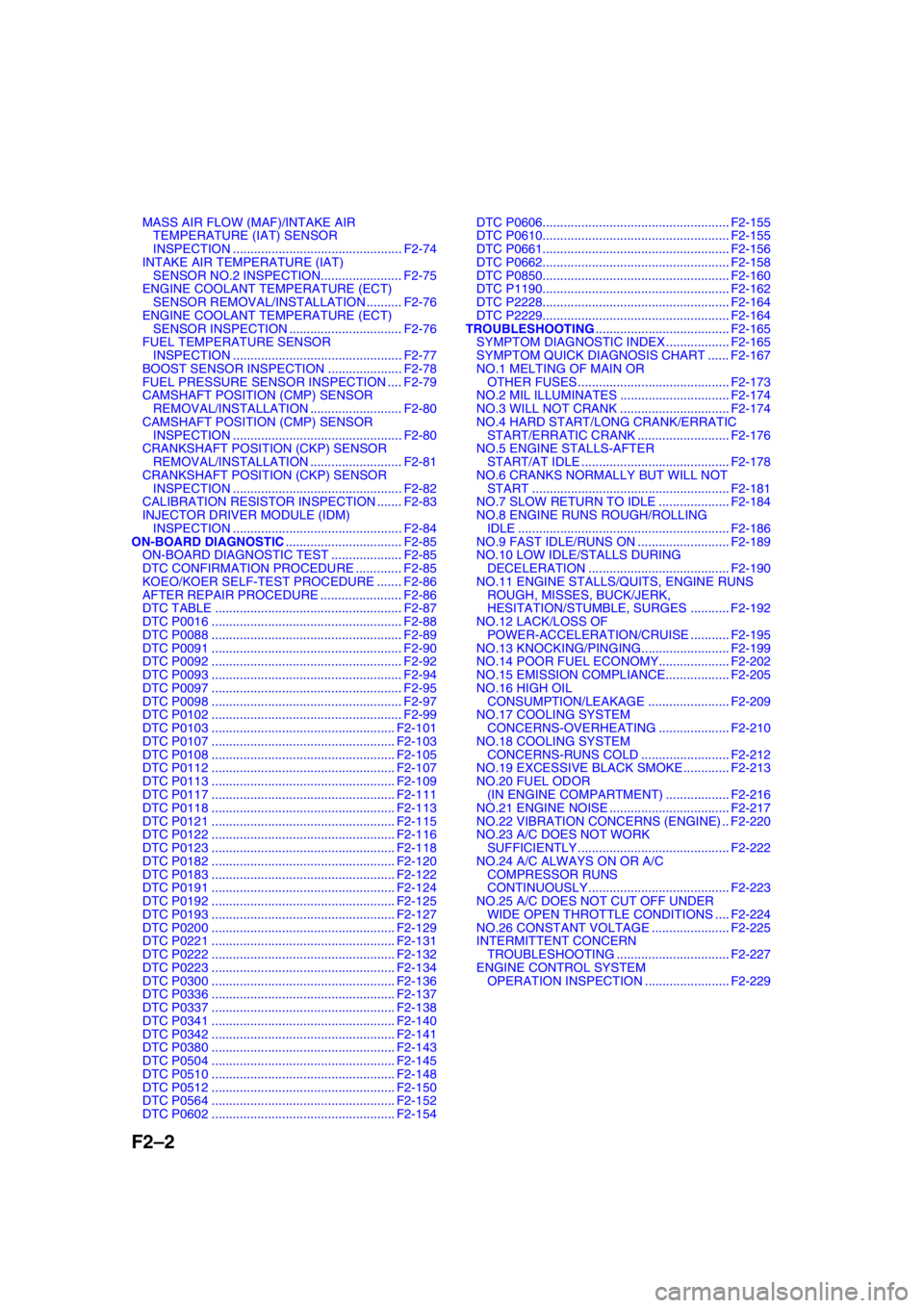
F2–2
MASS AIR FLOW (MAF)/INTAKE AIR
TEMPERATURE (IAT) SENSOR
INSPECTION ................................................ F2-74
INTAKE AIR TEMPERATURE (IAT)
SENSOR NO.2 INSPECTION....................... F2-75
ENGINE COOLANT TEMPERATURE (ECT)
SENSOR REMOVAL/INSTALLATION .......... F2-76
ENGINE COOLANT TEMPERATURE (ECT)
SENSOR INSPECTION ................................ F2-76
FUEL TEMPERATURE SENSOR
INSPECTION ................................................ F2-77
BOOST SENSOR INSPECTION ..................... F2-78
FUEL PRESSURE SENSOR INSPECTION .... F2-79
CAMSHAFT POSITION (CMP) SENSOR
REMOVAL/INSTALLATION .......................... F2-80
CAMSHAFT POSITION (CMP) SENSOR
INSPECTION ................................................ F2-80
CRANKSHAFT POSITION (CKP) SENSOR
REMOVAL/INSTALLATION .......................... F2-81
CRANKSHAFT POSITION (CKP) SENSOR
INSPECTION ................................................ F2-82
CALIBRATION RESISTOR INSPECTION ....... F2-83
INJECTOR DRIVER MODULE (IDM)
INSPECTION ................................................ F2-84
ON-BOARD DIAGNOSTIC................................. F2-85
ON-BOARD DIAGNOSTIC TEST .................... F2-85
DTC CONFIRMATION PROCEDURE ............. F2-85
KOEO/KOER SELF-TEST PROCEDURE ....... F2-86
AFTER REPAIR PROCEDURE ....................... F2-86
DTC TABLE ..................................................... F2-87
DTC P0016 ...................................................... F2-88
DTC P0088 ...................................................... F2-89
DTC P0091 ...................................................... F2-90
DTC P0092 ...................................................... F2-92
DTC P0093 ...................................................... F2-94
DTC P0097 ...................................................... F2-95
DTC P0098 ...................................................... F2-97
DTC P0102 ...................................................... F2-99
DTC P0103 .................................................... F2-101
DTC P0107 .................................................... F2-103
DTC P0108 .................................................... F2-105
DTC P0112 .................................................... F2-107
DTC P0113 .................................................... F2-109
DTC P0117 .................................................... F2-111
DTC P0118 .................................................... F2-113
DTC P0121 .................................................... F2-115
DTC P0122 .................................................... F2-116
DTC P0123 .................................................... F2-118
DTC P0182 .................................................... F2-120
DTC P0183 .................................................... F2-122
DTC P0191 .................................................... F2-124
DTC P0192 .................................................... F2-125
DTC P0193 .................................................... F2-127
DTC P0200 .................................................... F2-129
DTC P0221 .................................................... F2-131
DTC P0222 .................................................... F2-132
DTC P0223 .................................................... F2-134
DTC P0300 .................................................... F2-136
DTC P0336 .................................................... F2-137
DTC P0337 .................................................... F2-138
DTC P0341 .................................................... F2-140
DTC P0342 .................................................... F2-141
DTC P0380 .................................................... F2-143
DTC P0504 .................................................... F2-145
DTC P0510 .................................................... F2-148
DTC P0512 .................................................... F2-150
DTC P0564 .................................................... F2-152
DTC P0602 .................................................... F2-154DTC P0606..................................................... F2-155
DTC P0610..................................................... F2-155
DTC P0661..................................................... F2-156
DTC P0662..................................................... F2-158
DTC P0850..................................................... F2-160
DTC P1190..................................................... F2-162
DTC P2228..................................................... F2-164
DTC P2229..................................................... F2-164
TROUBLESHOOTING...................................... F2-165
SYMPTOM DIAGNOSTIC INDEX .................. F2-165
SYMPTOM QUICK DIAGNOSIS CHART ...... F2-167
NO.1 MELTING OF MAIN OR
OTHER FUSES ........................................... F2-173
NO.2 MIL ILLUMINATES ............................... F2-174
NO.3 WILL NOT CRANK ............................... F2-174
NO.4 HARD START/LONG CRANK/ERRATIC
START/ERRATIC CRANK .......................... F2-176
NO.5 ENGINE STALLS-AFTER
START/AT IDLE .......................................... F2-178
NO.6 CRANKS NORMALLY BUT WILL NOT
START ........................................................ F2-181
NO.7 SLOW RETURN TO IDLE .................... F2-184
NO.8 ENGINE RUNS ROUGH/ROLLING
IDLE ............................................................ F2-186
NO.9 FAST IDLE/RUNS ON .......................... F2-189
NO.10 LOW IDLE/STALLS DURING
DECELERATION ........................................ F2-190
NO.11 ENGINE STALLS/QUITS, ENGINE RUNS
ROUGH, MISSES, BUCK/JERK,
HESITATION/STUMBLE, SURGES ........... F2-192
NO.12 LACK/LOSS OF
POWER-ACCELERATION/CRUISE ........... F2-195
NO.13 KNOCKING/PINGING......................... F2-199
NO.14 POOR FUEL ECONOMY.................... F2-202
NO.15 EMISSION COMPLIANCE.................. F2-205
NO.16 HIGH OIL
CONSUMPTION/LEAKAGE ....................... F2-209
NO.17 COOLING SYSTEM
CONCERNS-OVERHEATING .................... F2-210
NO.18 COOLING SYSTEM
CONCERNS-RUNS COLD ......................... F2-212
NO.19 EXCESSIVE BLACK SMOKE ............. F2-213
NO.20 FUEL ODOR
(IN ENGINE COMPARTMENT) .................. F2-216
NO.21 ENGINE NOISE .................................. F2-217
NO.22 VIBRATION CONCERNS (ENGINE) .. F2-220
NO.23 A/C DOES NOT WORK
SUFFICIENTLY ........................................... F2-222
NO.24 A/C ALWAYS ON OR A/C
COMPRESSOR RUNS
CONTINUOUSLY........................................ F2-223
NO.25 A/C DOES NOT CUT OFF UNDER
WIDE OPEN THROTTLE CONDITIONS .... F2-224
NO.26 CONSTANT VOLTAGE ...................... F2-225
INTERMITTENT CONCERN
TROUBLESHOOTING ................................ F2-227
ENGINE CONTROL SYSTEM
OPERATION INSPECTION ........................ F2-229
Page 159 of 909

OUTLINE
F2–7
F2
End Of Sie
11 Generator
12 Oil pressure switch
13 Sedimentor switch
14 Instrument cluster
15 Neutral switch
16 Clutch switch
17 Coil
18 Brake switch
19 Brake switch 2
20 Cruise control switch
21 With cruise control system
22 PCM control relay
23 MAF/IAT sensor
24 Calibration resistor No.1
25 Fuel injector No.1
26 Calibration resistor No.2
27 Fuel injector No.2
28 Calibration resistor No.3
29 Fuel injector No.3
30 Calibration resistor No.4
31 Fuel injector No.4
32 CMP sensor
33 CKP sensor
34 EGR solenoid valve (vacuum)
35 EGR solenoid valve (vent)
36 VSC solenoid valve
37 Intake shutter solenoid valve (half)38 Intake shutter solenoid valve (full)
39 VBC solenoid valve
40 EGR control solenoid valve
41 Boost sensor
42 Accelerator position sensor
43 Idle switch
44 Fuel pressure sensor
45 ECT sensor
46 Fuel temperature sensor
47 Suction control valve
48 IAT sensor No.2
49 Cooling fan relay No.2
50 Cooling fan No.1
51 Refrigerant pressure switch (middle)
52 A/C switch
53 A/C amplifier
54 Cooling fan relay No.1
55 Cooling fan No.2
56 A/C relay
57 Refrigerant pressure switch (HI and LO)
58 Magnetic clutch
59 With A/C
60 Glow plug relay
61 Glow plug
62 Vacuum switch
63 Fuel warmer
64 With fuel warmer
Page 201 of 909
FUEL SYSTEM
F2–49
F2
(2) Apply a slight amount of clean engine oil to
the sealing surface of the fuel pump unit.
(3) Align the fuel pipe on the fuel pump unit and
quick release connector so that the tabs of the
retainer are correctly fitted into the quick
release connector. Push the quick release
connector straight into the retainer until a click
is heard.
(4) Lightly pull and push the quick release
connector a few times by hand and verify that
it can move 2.0—3.0 mm {0.08—0.11 in} and
it is connected securely.
•If the quick release connector does not
move at all, verify that O-ring is not
damaged of that is has not slipped, and reconnect the quick release connector.
2. When the retainer is removed, perform the following procedure.
End Of Sie
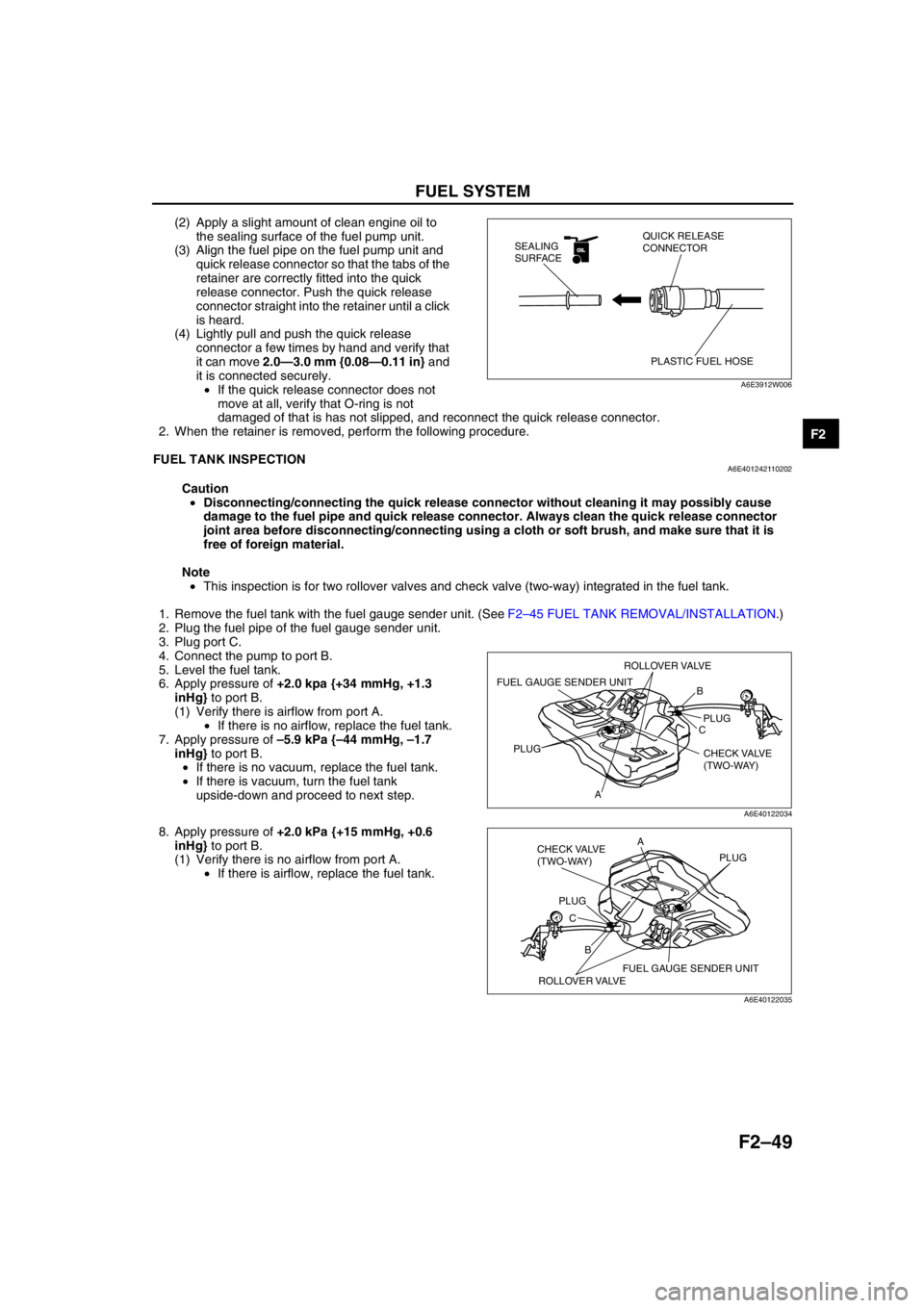
FUEL TANK INSPECTIONA6E401242110202
Caution
•Disconnecting/connecting the quick release connector without cleaning it may possibly cause
damage to the fuel pipe and quick release connector. Always clean the quick release connector
joint area before disconnecting/connecting using a cloth or soft brush, and make sure that it is
free of foreign material.
Note
•This inspection is for two rollover valves and check valve (two-way) integrated in the fuel tank.
1. Remove the fuel tank with the fuel gauge sender unit. (See F2–45 FUEL TANK REMOVAL/INSTALLATION.)
2. Plug the fuel pipe of the fuel gauge sender unit.
3. Plug port C.
4. Connect the pump to port B.
5. Level the fuel tank.
6. Apply pressure of +2.0 kpa {+34 mmHg, +1.3
inHg} to port B.
(1) Verify there is airflow from port A.
•If there is no airflow, replace the fuel tank.
7. Apply pressure of –5.9 kPa {–44 mmHg, –1.7
inHg} to port B.
•If there is no vacuum, replace the fuel tank.
•If there is vacuum, turn the fuel tank
upside-down and proceed to next step.
8. Apply pressure of +2.0 kPa {+15 mmHg, +0.6
inHg} to port B.
(1) Verify there is no airflow from port A.
•If there is airflow, replace the fuel tank.
End Of Sie
OILOIL
PLASTIC FUEL HOSE QUICK RELEASE
CONNECTOR SEALING
SURFACE
A6E3912W006
B
C
APLUG
PLUG
CHECK VALVE
(TWO-WAY)
FUEL GAUGE SENDER UNIT
ROLLOVER VALVE
A6E40122034
B CA
PLUGPLUG
CHECK VALVE
(TWO-WAY)
FUEL GAUGE SENDER UNIT
ROLLOVER VALVE
A6E40122035
Page 321 of 909

TROUBLESHOOTING
F2–169
F2
×: Applicable
Troubleshooting item
1 Melting of main or other fuses
2 MIL illuminates×× × ×
3 Will not crank
4 Hard start/long crank/erratic start/erratic crank×× ×××××××
5 Engine stalls After start/at idle×× ×××××××
6 Cranks normally but will not start×× ×××××××
7 Slow return to idle××××××××
8 Engine runs rough/rolling idle×××××××××
9 Fast idle/runs on×
10 Low idle/stalls during deceleration××××××××××
11Engine stalls/quits Acceleration/cruise× × ×××××××
Engine runs rough Acceleration/cruise× ××××××××××
Misses Acceleration/cruise× ××××××××××
Buck/jerk Acceleration/cruise/ deceleration× ××××××××××
Hesitation/stumble Acceleration× ××××××××××
Surges Acceleration/cruise× ×× ×××××××
12 Lack/loss of power Acceleration/cruise××× ×××××××××
13 Knocking/pinging××××× ××× × ×
14 Poor fuel economy××× ×××××× ×
15 Emissions compliance×××××××××××××
16 High oil consumption/leakage×
17 Cooling system concerns Overheating×
18 Cooling system concerns Runs cold
19 Excessive black smoke××× × ××× ×××
20 Fuel odor (in engine compartment)××
21 Engine noise× ××× ×
22 Vibration concerns (engine)
23 A/C does not work sufficiently
24 A/C always on or A/C compressor runs continuously
25 A/C does not cut off under wide open throttle conditions
26 Constant voltage
Turbocharger malfunctionCarge air cooler malfunctionVBC system malfunctionGlow system malfunctionIncorrect fuel injection timingIncorrect idle speedCKP sensor is damaged (e.g.: open or short circuits)CKP sensor pulse wheel is damagedImproper gap between CKP sensor and pulse wheelSupply pump malfunctionSuction control valve malfunctionFuel pressure limiter malfunctionFuel line restriction or clogging
Page 323 of 909
TROUBLESHOOTING
F2–171
F2
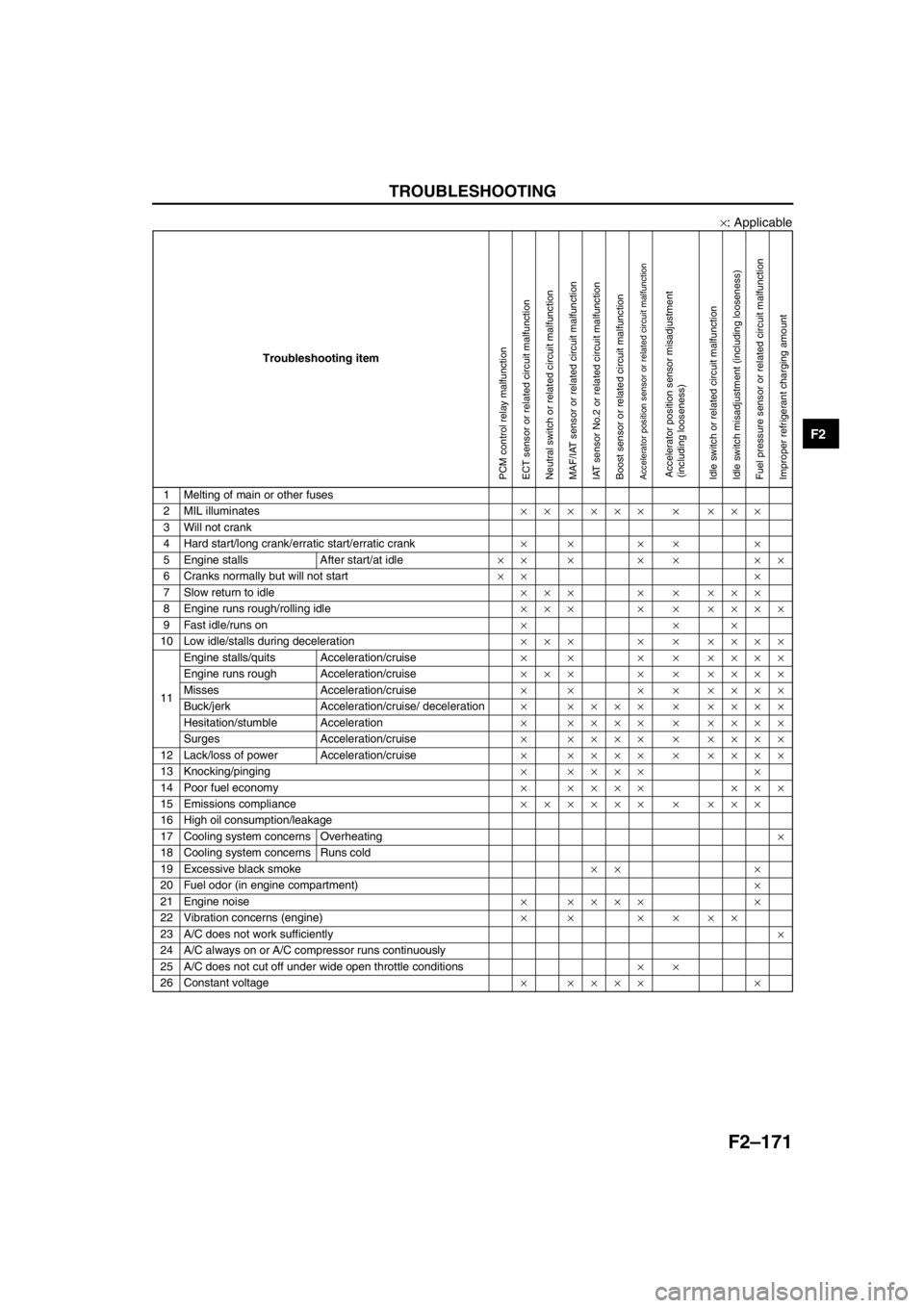
×: Applicable
Troubleshooting item
1 Melting of main or other fuses
2 MIL illuminates×××××× × ×××
3 Will not crank
4 Hard start/long crank/erratic start/erratic crank×× ×× ×
5 Engine stalls After start/at idle×× × × × ××
6 Cranks normally but will not start×× ×
7 Slow return to idle××× × × ×××
8 Engine runs rough/rolling idle××× × × ××××
9 Fast idle/runs on×××
10 Low idle/stalls during deceleration××× × × ××××
11Engine stalls/quits Acceleration/cruise× × × × ××××
Engine runs rough Acceleration/cruise××× × × ××××
Misses Acceleration/cruise× × × × ××××
Buck/jerk Acceleration/cruise/ deceleration× ×××× × ××××
Hesitation/stumble Acceleration× ×××× × ××××
Surges Acceleration/cruise× ×××× × ××××
12 Lack/loss of power Acceleration/cruise× ×××× × ××××
13 Knocking/pinging××××× ×
14 Poor fuel economy× ×××× ×××
15 Emissions compliance×××××× × ×××
16 High oil consumption/leakage
17 Cooling system concerns Overheating×
18 Cooling system concerns Runs cold
19 Excessive black smoke×× ×
20 Fuel odor (in engine compartment)×
21 Engine noise××××× ×
22 Vibration concerns (engine)×× ××××
23 A/C does not work sufficiently×
24 A/C always on or A/C compressor runs continuously
25 A/C does not cut off under wide open throttle conditions××
26 Constant voltage××××× ×
PCM control relay malfunctionECT sensor or related circuit malfunctionNeutral switch or related circuit malfunctionMAF/IAT sensor or related circuit malfunctionIAT sensor No.2 or related circuit malfunctionBoost sensor or related circuit malfunctionAccelerator position sensor or related circuit malfunctionAccelerator position sensor misadjustment
(including looseness)Idle switch or related circuit malfunctionIdle switch misadjustment (including looseness)Fuel pressure sensor or related circuit malfunctionImproper refrigerant charging amount
Page 330 of 909

F2–178
TROUBLESHOOTING
End Of Sie
NO.5 ENGINE STALLS-AFTER START/AT IDLEA6E408018881207
Diagnostic Procedure
18 Verify test results.
•If okay, return to diagnostic index to service any additional symptoms.
•If malfunction remains, replace PCM. (See F2–64 PCM REMOVAL/INSTALLATION) STEP INSPECTION RESULTS ACTION
5 ENGINE STALLS-AFTER START/AT IDLE
DESCRIPTION•Engine stops unexpectedly.
POSSIBLE
CAUSE•Poor fuel quality
•Intake-air system restriction or clogging
•Engine overheating
•A/C system improper operation
•Immobilizer system (PATS) and/or circuit malfunction (if equipped)
•PCM control relay malfunction
•Glow system malfunction
•Inadequate fuel pressure
•Fuel pressure sensor related circuit malfunction
•Suction control valve malfunction (built-in supply pump)
•Fuel pressure limiter malfunction (built-in common rail)
•Fuel leakage
•Fuel line clogging or restriction
•Fuel filter clogging or restriction
•Incorrect fuel injection timing
•Erratic signal from CKP sensor
•Erratic signal from CMP sensor
•Supply pump malfunction
•Fuel injector malfunction
•Low engine compression
•Improper valve timing
•Exhaust system and/or catalyst converter restriction or clogging
•EGR system malfunction
•ECT sensor or related circuit malfunction
•Accelerator positions sensor or related circuit malfunction
•Accelerator positions sensor misadjustment
•MAF/IAT sensor or related circuit malfunction
•V-reference voltage supply circuit malfunction
•IDM or related circuit malfunction
Warning
The following troubleshooting flow chart contains the fuel system diagnosis and repair
procedures. Read the following warnings before performing the fuel system services:
•Fuel vapor is hazardous. It can easily ignite, causing serious injury and damage. Always keep
sparks and flames away from fuel.
•Fuel line spills and leakage are dangerous. Fuel can ignite and cause serious injury or death
and damage. Fuel can also irritate skin and eyes. To prevent this, always complete “BEFORE
REPAIR PROCEDURE” and “AFTER REPAIR PROCEDURE” described in this manual.
STEP INSPECTION RESULTS ACTION
1Note
•The following test should be perform for
vehicles with immobilizer system. Go to
Step 10 for vehicles without immobilizer
system.
Connect WDS or equivalent to DLC-2.
Do following conditions appear?
•Engine is not completely started.
•DTC B1681 is displayed.YesBoth conditions appear:
Go to Step 4.
NoEither or other condition appears:
Go to next step.
2 Is coil connector securely connected to coil? Yes Go to next step.
No Connect coil connector securely.
Return to Step 1.
3 Does security light illuminate? Yes Go to next step.
No Inspect instrument cluster and wiring harness.
Page 333 of 909
TROUBLESHOOTING
F2–181
F2
End Of Sie
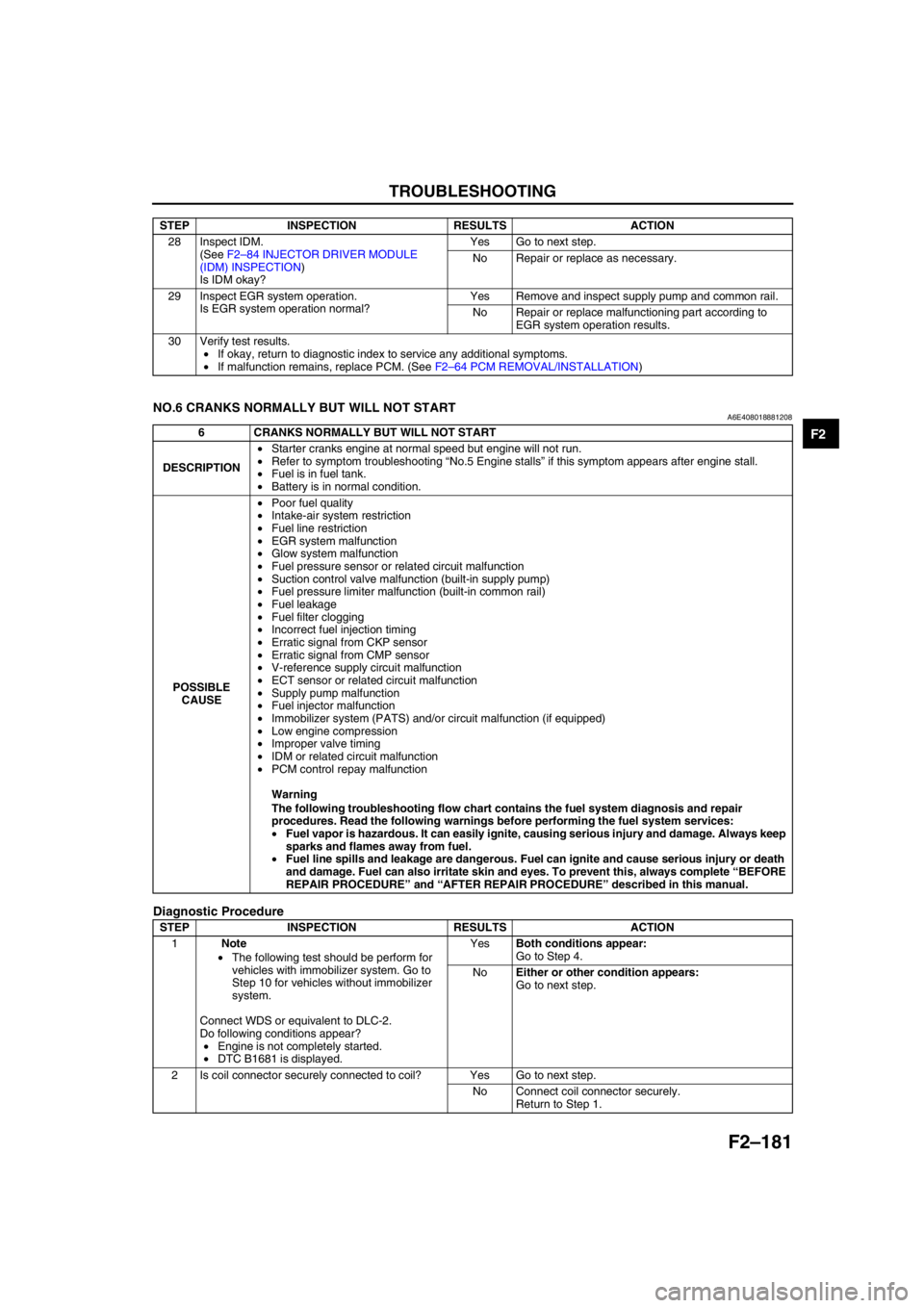
NO.6 CRANKS NORMALLY BUT WILL NOT STARTA6E408018881208
Diagnostic Procedure
28 Inspect IDM.
(See F2–84 INJECTOR DRIVER MODULE
(IDM) INSPECTION)
Is IDM okay?Yes Go to next step.
No Repair or replace as necessary.
29 Inspect EGR system operation.
Is EGR system operation normal?Yes Remove and inspect supply pump and common rail.
No Repair or replace malfunctioning part according to
EGR system operation results.
30 Verify test results.
•If okay, return to diagnostic index to service any additional symptoms.
•If malfunction remains, replace PCM. (See F2–64 PCM REMOVAL/INSTALLATION) STEP INSPECTION RESULTS ACTION
6 CRANKS NORMALLY BUT WILL NOT START
DESCRIPTION•Starter cranks engine at normal speed but engine will not run.
•Refer to symptom troubleshooting “No.5 Engine stalls” if this symptom appears after engine stall.
•Fuel is in fuel tank.
•Battery is in normal condition.
POSSIBLE
CAUSE•Poor fuel quality
•Intake-air system restriction
•Fuel line restriction
•EGR system malfunction
•Glow system malfunction
•Fuel pressure sensor or related circuit malfunction
•Suction control valve malfunction (built-in supply pump)
•Fuel pressure limiter malfunction (built-in common rail)
•Fuel leakage
•Fuel filter clogging
•Incorrect fuel injection timing
•Erratic signal from CKP sensor
•Erratic signal from CMP sensor
•V-reference supply circuit malfunction
•ECT sensor or related circuit malfunction
•Supply pump malfunction
•Fuel injector malfunction
•Immobilizer system (PATS) and/or circuit malfunction (if equipped)
•Low engine compression
•Improper valve timing
•IDM or related circuit malfunction
•PCM control repay malfunction
Warning
The following troubleshooting flow chart contains the fuel system diagnosis and repair
procedures. Read the following warnings before performing the fuel system services:
•Fuel vapor is hazardous. It can easily ignite, causing serious injury and damage. Always keep
sparks and flames away from fuel.
•Fuel line spills and leakage are dangerous. Fuel can ignite and cause serious injury or death
and damage. Fuel can also irritate skin and eyes. To prevent this, always complete “BEFORE
REPAIR PROCEDURE” and “AFTER REPAIR PROCEDURE” described in this manual.
STEP INSPECTION RESULTS ACTION
1Note
•The following test should be perform for
vehicles with immobilizer system. Go to
Step 10 for vehicles without immobilizer
system.
Connect WDS or equivalent to DLC-2.
Do following conditions appear?
•Engine is not completely started.
•DTC B1681 is displayed.YesBoth conditions appear:
Go to Step 4.
NoEither or other condition appears:
Go to next step.
2 Is coil connector securely connected to coil? Yes Go to next step.
No Connect coil connector securely.
Return to Step 1.
Page 349 of 909

TROUBLESHOOTING
F2–197
F2
13 Inspect if turbocharger turbine wheel is
damaged, cracked or interfering with housing on
vehicle.
Note
•Inspect all fins on each turbine wheel.
Is there any problem?Yes Replace turbocharger.
No Go to next step.
14 Is any engine oil found inside turbocharger
turbine housing?YesExcessive amount of oil is found:
Replace turbocharger.
Small amount of oil is found:
Wipe oil off of vehicle, then go to next step.
No Go to next step.
15 Is any engine oil found inside turbocharger
compressor hosing?Yes Wipe oil off of vehicle and install all removed parts in
Step 10. Then, go to next step.
No Turbocharger is okay.
Install all parts removed in Step10.
Then, go to next step.
16 Perform EGR system inspection.
Is EGR system okay?Yes Go to next step.
No Repair or replace malfunctioning part according to
EGR system operation results.
17 Inspect idle speed.
(See F2–34 IDLE SPEED INSPECTION)
Is idle speed correct?Yes Go to next step.
No Repair or replace malfunctioning part according to idle
speed inspection results.
18 Inspect adjustment of accelerator position
sensor and idle switch.
(See F2–72 ACCELERATOR POSITION
SENSOR INSPECTION)
(See F2–70 IDLE SWITCH INSPECTION)
Are accelerator position sensor and idle switch
adjusted correctly?Yes Go to next step.
No Adjust accelerator position sensor and idle switch
correctly.
(See F2–73 ACCELERATOR POSITION SENSOR
ADJUSTMENT)
(See F2–71 IDLE SWITCH ADJUSTMENT)
19 Visually inspect CKP sensor and teeth of pulse
wheel.
Are CKP sensor and teeth of pulse wheel okay?Yes Go to next step.
No Replace malfunctioning parts.
20 Measure gap between CKP sensor and teeth of
pulse wheel.
Specification
1.5—2.5 mm {0.059—0.098 in}
Is gap within specification?Yes Go to next step.
No Adjust CKP sensor position.
21 Visually inspect CMP sensor and teeth of pulse
wheel.
Are CMP sensor and teeth of pulse wheel okay?Yes Inspect following PIDs:
(See F2–65 PCM INSPECTION)
•ECT
•IAT
•MAF
•MAP
•RPM
If PID value is not as specified, repair or replace
malfunctioning parts.
If PID value is okay, go to next step.
No Replace malfunctioning parts.
22 Inspect fuel pressure sensor.
(See F2–79 FUEL PRESSURE SENSOR
INSPECTION)
Is fuel pressure okay?Yes Go to next step.
No Replace common rail.
23 Inspect suction control valve.
(See F2–54 SUCTION CONTROL VALVE
INSPECTION)
Is suction control valve okay?Yes Go to next step.
No Repair supply pump.
(See F2–54 SUPPLY PUMP INSPECTION) STEP INSPECTION RESULTS ACTION
Page 353 of 909

TROUBLESHOOTING
F2–201
F2
End Of Sie
14 Is any engine oil found inside turbocharger
compressor hosing?Yes Wipe oil off of vehicle and install all removed parts in
Step 10. Then, go to next step.
No Turbocharger is okay.
Install all parts removed in Step10.
Then, go to next step.
15 Perform EGR system inspection.
Is EGR system okay?Yes Go to next step.
No Repair or replace malfunctioning part according to
EGR system operation results.
16 Inspect glow system operation.
(See T–19 RELAY INSPECTION)
Is glow system operation normal?Yes Go to next step.
No Repair or replace malfunctioning part according to
glow system operation results.
17 Visually inspect CKP sensor and teeth of pulse
wheel.
Are CKP sensor and teeth of pulse wheel okay?Yes Go to next step.
No Replace malfunctioning parts.
18 Measure gap between CKP sensor and teeth of
pulse wheel.
Specification
1.5—2.5 mm {0.059—0.098 in}
Is gap within specification?Yes Go to next step.
No Adjust CKP sensor position.
19 Visually inspect CMP sensor and teeth of pulse
wheel.
Are CMP sensor and teeth of pulse wheel okay?Yes Inspect following PIDs:
(See F2–65 PCM INSPECTION)
•ECT
•IAT
•MAF
•MAP
•RPM
If PID value is not as specified, repair or replace
malfunctioning parts.
If PID value is okay, go to next step.
No Replace malfunctioning parts.
20 Is engine compression correct?
(See B2–8 COMPRESSION INSPECTION)Yes Go to next step.
No Inspect for following:
•Damaged valve seat
•Worn valve stem and valve guide
•Worn or stuck piston ring
•Worn piston, piston ring or cylinder
•Improper valve timing
Service as necessary.
21 Inspect suction control valve.
(See F2–54 SUCTION CONTROL VALVE
INSPECTION)
Is suction control valve okay?Yes Inspect following:
•Boost sensor
•MAF/IAT sensor
•IAT sensor No.2
•Fuel pressure sensor
•Accelerator position sensor
No Repair supply pump.
(See F2–54 SUPPLY PUMP INSPECTION)
22 Verify test results.
•If okay, return to diagnostic index to service any additional symptoms.
•If malfunction remains, replace PCM. (See F2–64 PCM REMOVAL/INSTALLATION) STEP INSPECTION RESULTS ACTION
Page 359 of 909

TROUBLESHOOTING
F2–207
F2
12 Inspect if turbocharger compressor wheel
locknut is loose or has fallen down inside
turbocharger.
Is there any problem?Yes Replace turbocharger.
No Go to next step.
13 Inspect turbocharger compressor wheel by
hand.
Does wheel turn easily and smoothly?Yes Go to next step.
No Replace turbocharger.
14 Inspect if turbocharger turbine wheel is
damaged, cracked or interfering with housing on
vehicle.
Note
•Inspect all fins on each turbine wheel.
Is there any problem?Yes Replace turbocharger.
No Go to next step.
15 Is any engine oil found inside turbocharger
turbine housing?YesExcessive amount of oil is found:
Replace turbocharger.
Small amount of oil is found:
Wipe oil off of vehicle, then go to next step.
No Go to next step.
16 Is any engine oil found inside turbocharger
compressor hosing?Yes Wipe oil off of vehicle and install all removed parts in
Step 10. Then, go to next step.
No Turbocharger is okay.
Install all parts removed in Step10.
Then, go to next step.
17 Perform EGR system inspection.
Is EGR system okay?Yes Go to next step.
No Repair or replace malfunctioning part according to
EGR system operation results.
18 Inspect EGR water cooler for following:
•Coolant passage clogging/restriction
•Exhaust gas clogging/restriction
Is EGR water cooler okay?Yes Go to next step.
No Service as necessary.
19 Inspect glow system operation.
(See T–19 RELAY INSPECTION)
Is glow system operation normal?Yes Go to next step.
No Repair or replace malfunctioning part according to
glow system operation results.
20 Visually inspect CKP sensor and teeth of pulse
wheel.
Are CKP sensor and teeth of pulse wheel okay?Yes Go to next step.
No Replace malfunctioning parts.
21 Measure gap between CKP sensor and teeth of
pulse wheel.
Specification
1.5—2.5 mm {0.059—0.098 in}
Is gap within specification?Yes Go to next step.
No Adjust CKP sensor position.
22 Visually inspect CMP sensor and teeth of pulse
wheel.
Are CMP sensor and teeth of pulse wheel okay?Yes Inspect following PIDs:
(See F2–65 PCM INSPECTION)
•ECT
•IAT
•MAF
•MAP
•RPM
•VSS
If PID value is not as specified, repair or replace
malfunctioning parts.
If PID value is okay, go to next step.
No Replace malfunctioning parts.
23 Inspect fuel pressure sensor.
(See F2–79 FUEL PRESSURE SENSOR
INSPECTION)
Is fuel pressure okay?Yes Go to next step.
No Replace common rail.
24 Inspect suction control valve.
(See F2–54 SUCTION CONTROL VALVE
INSPECTION)
Is suction control valve okay?Yes Go to next step.
No Repair supply pump.
(See F2–54 SUPPLY PUMP INSPECTION) STEP INSPECTION RESULTS ACTION