oil pressure MAZDA 6 2002 Suplement Service Manual
[x] Cancel search | Manufacturer: MAZDA, Model Year: 2002, Model line: 6, Model: MAZDA 6 2002Pages: 909, PDF Size: 17.16 MB
Page 367 of 909

TROUBLESHOOTING
F2–215
F2
End Of Sie
15 Inspect if turbocharger compressor wheel
locknut is loose or has fallen down inside
turbocharger.
Is there any problem?Yes Replace turbocharger.
No Go to next step.
16 Inspect if turbocharger compressor wheel by
hand.
Does wheel turn easily and smoothly?Yes Go to next step.
No Replace turbocharger.
17 Inspect if turbocharger turbine wheel is
damaged, cracked or interfering with housing on
vehicle.
Note
•Inspect all fins on each turbine wheel.
Is there any problem?Yes Replace turbocharger.
No Go to next step.
18 Is any engine oil found inside turbocharger
compressor housing?Yes Wipe oil off of vehicle and install all removed parts in
Step 15. Then, go to next step.
No Turbocharger is okay.
Install all parts removed is Step 15. Then, go to next
step.
19 Inspect suction control valve.
(See F2–54 SUCTION CONTROL VALVE
INSPECTION)
Is suction control valve okay?Yes Go to next step.
No Repair supply pump.
(See F2–54 SUPPLY PUMP INSPECTION)
20 Is engine compression correct?
(See B2–8 COMPRESSION INSPECTION)Yes Go to next step.
No Inspect for following:
•Damaged valve seat
•Worn valve stem and valve guide
•Worn or stuck piston ring
•Worn piston, piston ring or cylinder
•Improper valve timing
Service as necessary.
21 Inspect IDM.
(See F2–84 INJECTOR DRIVER MODULE
(IDM) INSPECTION)
Is IDM okay?Yes Go to next step.
No Repair or replace as necessary.
22 Inspect fuel injector.
(See F2–56 FUEL INJECTOR INSPECTION)
Is fuel injector okay?Yes Inspect following:
•Boost sensor
•Fuel pressure limiter (built-in common rail)
•Fuel pressure sensor
•Fuel return line restriction or clogging
Service as necessary.
No Repair or replace as necessary.
23 Verify test results.
•If okay, return to diagnostic index to service any additional symptoms.
•If malfunction remains, replace PCM. (See F2–64 PCM REMOVAL/INSTALLATION) STEP INSPECTION RESULTS ACTION
Page 369 of 909

TROUBLESHOOTING
F2–217
F2
NO.21 ENGINE NOISEA6E408018881223
Diagnostic Procedure
21 ENGINE NOISE
DESCRIPTION•Engine noise under hood.
POSSIBLE
CAUSE•Engine internal damage
•Timing belt displacement
•Fuel injector malfunction
•Loose attaching bolts or worn parts
•Improper drive belt tension
•Air leakage from intake-air system
•Incorrect injection timing
•Erratic signal from CKP sensor
•Erratic signal from CMP sensor
•Fuel pressure sensor or related circuit malfunction
•Boost sensor or related circuit malfunction
•Accelerator position sensor or related circuit malfunction
•MAF/IAT sensor or related circuit malfunction
•ECT sensor or related circuit malfunction
•EGR system or malfunction
•IAT sensor No.2 or related circuit malfunction
•Vacuum leakage
•Suction control valve malfunction (built-in supply pump)
•Air leakage from intake-air system
•Air in power steering fluid line
•Turbocharger operating noise
•Solenoid valve operating noise
Warning
The following troubleshooting flow chart contains the fuel system diagnosis and repair
procedures. Read the following warnings before performing the fuel system services:
•Fuel vapor is hazardous. It can easily ignite, causing serious injury and damage. Always keep
sparks and flames away from fuel.
•Fuel line spills and leakage are dangerous. Fuel can ignite and cause serious injury or death
and damage. Fuel can also irritate skin and eyes. To prevent this, always complete “BEFORE
REPAIR PROCEDURE” and “AFTER REPAIR PROCEDURE” described in this manual.
Note
•PCM checks fuel injection amount during a set interval while idling, and automatically corrects it to
maintain engine efficiency. It is normal that engine noise and vibration might be a little louder during
this process.
STEP INSPECTION RESULTS ACTION
1 Is squeal, click or chirp sound present? Yes Inspect engine oil level, solenoid valves installation or
drive belt.
No Go to next step.
2 Is rumble or grind sound present? Yes Inspect drive belt tension or power steering system
fluid level.
If okay, perform power steering fluid line air bleed.
No Go to next step.
3 Is rattle sound present? Yes Inspect location of rattle for loose parts.
No Go to next step.
4 Is hiss sound present? Yes Inspect for vacuum leakage and intake-air system
leakage.
No Go to next step.
5 Is rap or roar sound present? Yes Inspect exhaust system or loose parts.
No Go to next step.
Page 374 of 909

F2–222
TROUBLESHOOTING
NO.23 A/C DOES NOT WORK SUFFICIENTLYA6E408018881225
Diagnostic Procedure
End Of Sie
23 A/C DOES NOT WORK SUFFICIENTLY
DESCRIPTION•A/C compressor magnetic clutch does not engage when A/C switch is turned on.
POSSIBLE
CAUSE•Improper refrigerant charge amount
•Open A/C switch magnetic clutch
•Open circuit between A/C relay and A/C magnetic clutch
•Poor GND of A/C magnetic clutch
•Improper A/C magnetic clutch clearance
•Refrigerant pressure switch is stuck open
•A/C relay is stuck open
•Improper A/C cut-off control
•Open circuit between A/C switch and PCM through both refrigerant pressure switch and A/C amplifier
STEP INSPECTION RESULTS ACTION
1 Perform self-test function using WDS or
equivalent.
Turn engine switch to ON.
Retrieve any DTC.
Is DTC displayed?YesDTC is displayed:
Go to appropriate DTC test.
Communication error message is displayed:
Inspect for following:
•Open circuit between PCM control relay and PCM
terminal 53 or 79
•Open circuit PCM control relay and PCM terminal
69
•PCM control relay stuck open
•Open or poor GND circuit (PCM terminal 65, 85,
103 or 104)
•Poor connection vehicle body GND
YesNo DTC is displayed:
Go to appropriate DTC test.
2 Disconnect A/C compressor connector.
Start engine and turn A/C switch to ON.
Is there correct voltage at terminal of A/C
compressor magnetic clutch connector?
Specification
More than 10.5 VYes Inspect for GND condition of magnetic clutch on A/C
compressor.
If GND condition is okay, inspect magnetic clutch coil
for open circuit.
No Go to next step.
3 Disconnect refrigerant pressure switch
connector.
Connect jumper wire between terminals of
refrigerant pressure switch connector.
Turn engine switch to ON.
Turn A/C switch on and set blower fan at any
speed.
Measure PCM terminal 84 voltage.
Is voltage below 1.0 V?Yes Inspect refrigerant pressure switch operation.
If switch is okay, go to next step.
No Inspect for following:
•A/C switch is stuck open
•Open circuit between refrigerant pressure switch
and PCM terminal 84
•Open circuit of blower motor fan switch and
resistor (if blower motor does not operate)
•Evaporator temperature sensor and A/C amplifier
4 Inspect A/C cut-off operation.
Does A/C cut-off work properly?Yes Go to next step.
No Repair or replace malfunctioning part according to A/C
cut-off system inspection results.
5 Remove jumper wire from switch connector.
Reconnect connector to refrigerant pressure
switch.
Start engine and turn A/C switch on.
Does fan operate?Yes Inspect for stuck open A/C relay.
Replace if necessary.
No Inspect following and repair or replace as necessary:
•Refrigerant charging amount
•Seized A/C compressor
6 Verify test results.
•If okay, return to diagnostic index to service any additional symptoms.
•If malfunction remains, replace PCM. (See F2–64 PCM REMOVAL/INSTALLATION)
Page 416 of 909
![MAZDA 6 2002 Suplement Service Manual K2–1
K2
K2AUTOMATIC TRANSAXLE [JA5AX-EL]
OUTLINE.............................................................. K2-3
FEATURES ........................................................ K2-3
SPECIFICATI](/img/28/57057/w960_57057-415.png "MAZDA 6 2002 Suplement Service Manual K2–1
K2
K2AUTOMATIC TRANSAXLE [JA5AX-EL]
OUTLINE.............................................................. K2-3
FEATURES ........................................................ K2-3
SPECIFICATI")
K2–1
K2
K2AUTOMATIC TRANSAXLE [JA5AX-EL]
OUTLINE.............................................................. K2-3
FEATURES ........................................................ K2-3
SPECIFICATIONS ............................................. K2-3
AUTOMATIC TRANSAXLE.................................. K2-4
OUTLINE ........................................................... K2-4
CROSS-SECTIONAL VIEW .............................. K2-6
ELECTRONIC CONTROL SYSTEM
STRUCTURAL VIEW...................................... K2-8
AUTOMATIC TRANSAXLE CONTROL SYSTEM
WIRING DIAGRAM ....................................... K2-10
AUTOMATIC TRANSAXLE BLOCK
DIAGRAM ..................................................... K2-11
AUTOMATIC TRANSAXLE DEVICE
RELATIONSHIP CHART .............................. K2-13
POWERTRAIN DESCRIPTION ....................... K2-15
TORQUE CONVERTER DESCRIPTION......... K2-40
OIL PUMP DESCRIPTION .............................. K2-41
CENTRIFUGAL BALANCE CLUTCH
DESCRIPTION ............................................. K2-42
CONTROL VALVE BODY DESCRIPTION ...... K2-43
TRANSAXLE FLUID TEMPERATURE
(TFT) SENSOR DESCRIPTION ................... K2-45
INPUT/TURBINE SPEED SENSOR
DESCRIPTION ............................................. K2-45
INTERMEDIATE SENSOR DESCRIPTION..... K2-46
VEHICLE SPEEDOMETER SENSOR
DESCRIPTION ............................................. K2-46
SOLENOID VALVE DESCRIPTION ................ K2-47
CONTROLLER AREA NETWORK (CAN)
DESCRIPTION ............................................. K2-50
TRANSAXLE CONTROL MODULE
(TCM) DESCRIPTION .................................. K2-51
SHIFT CONTROL DESCRIPTION .................. K2-51
MANUAL MODE SHIFT CONTROL
DESCRIPTION ............................................. K2-52
LINE PRESSURE CONTROL DESCRIPTION K2-54
FEEDBACK CONTROL DESCRIPTION ......... K2-57
N-D SELECT CONTROL DESCRIPTION........ K2-59
TORQUE CONVERTER CLUTCH
(TCC) CONTROL DESCRIPTION ................ K2-59
SLOPE MODE CONTROL DESCRIPTION ..... K2-63
ON-BOARD DIAGNOSTIC (OBD)
SYSTEM DESCRIPTION.............................. K2-64
COOLING SYSTEM DESCRIPTION ............... K2-69
LOCATION INDEX............................................. K2-70
AUTOMATIC TRANSAXLE LOCATION
INDEX ........................................................... K2-70
AUTOMATIC TRANSAXLE................................ K2-72
MECHANICAL SYSTEM TEST ....................... K2-72
ROAD TEST .................................................... K2-75AUTOMATIC TRANSAXLE FLUID
(ATF) INSPECTION ...................................... K2-78
AUTOMATIC TRANSAXLE FLUID
(ATF) REPLACEMENT ................................. K2-80
TRANSAXLE RANGE (TR) SWITCH
INSPECTION ................................................ K2-80
TRANSAXLE RANGE (TR) SWITCH
REMOVAL/INSTALLATION .......................... K2-81
TRANSAXLE RANGE (TR) SWITCH
ADJUSTMENT .............................................. K2-83
TRANSAXLE FLUID TEMPERATURE
(TFT) SENSOR INSPECTION ...................... K2-84
TRANSAXLE FLUID TEMPERATURE
(TFT) SENSOR REMOVAL/INSTALLATION K2-85
INPUT/TURBINE SPEED SENSOR
INSPECTION ................................................ K2-85
INPUT/TURBINE SPEED SENSOR
REMOVAL/INSTALLATION .......................... K2-86
INTERMEDIATE SENSOR INSPECTION ....... K2-86
INTERMEDIATE SENSOR
REMOVAL/INSTALLATION .......................... K2-86
VEHICLE SPEEDOMETER SENSOR
(VSS) INSPECTION...................................... K2-87
VEHICLE SPEEDOMETER SENSOR
(VSS) REMOVAL/INSTALLATION ............... K2-87
SOLENOID VALVE INSPECTION ................... K2-88
SOLENOID VALVE
REMOVAL/INSTALLATION .......................... K2-90
TCM INSPECTION .......................................... K2-90
TCM REMOVAL/INSTALLATION .................... K2-96
AUTOMATIC TRANSAXLE AND
TRANSFER REMOVAL/INSTALLATION...... K2-99
OIL SEAL REMOVAL/INSTALLATION .......... K2-104
CONTROL VALVE BODY
REMOVAL/INSTALLATION ........................ K2-105
OIL COOLER FLUSHING .............................. K2-106
OIL COOLER REMOVAL/INSTALLATION .... K2-108
OIL COOLER DISASSEMBLY/ASSEMBLY .. K2-110
DRIVE PLATE REMOVAL/INSTALLATION... K2-112
TRANSFER....................................................... K2-114
TRANSFER OIL INSPECTION ...................... K2-114
TRANSFER OIL REPLACEMENT ................. K2-114
TRANSFER REMOVAL/INSTALLATION....... K2-115
BREATHER PLUG
REMOVAL/INSTALLATION ........................ K2-116
AUTOMATIC TRANSAXLE SHIFT
MECHANISM................................................. K2-117
SELECTOR LEVER INSPECTION ................ K2-117
SELECTOR LEVER COMPONENT
INSPECTION .............................................. K2-117
SELECTOR CABLE ADJUSTMENT .............. K2-118
SELECTOR LEVER
REMOVAL/INSTALLATION ........................ K2-119
SELECTOR LEVER
DISASSEMBLY/ASSEMBLY ...................... K2-122
ON-BOARD DIAGNOSTIC............................... K2-123
FOREWORD .................................................. K2-123 FEATURES
SERVICE
Page 457 of 909
K2–42
AUTOMATIC TRANSAXLE
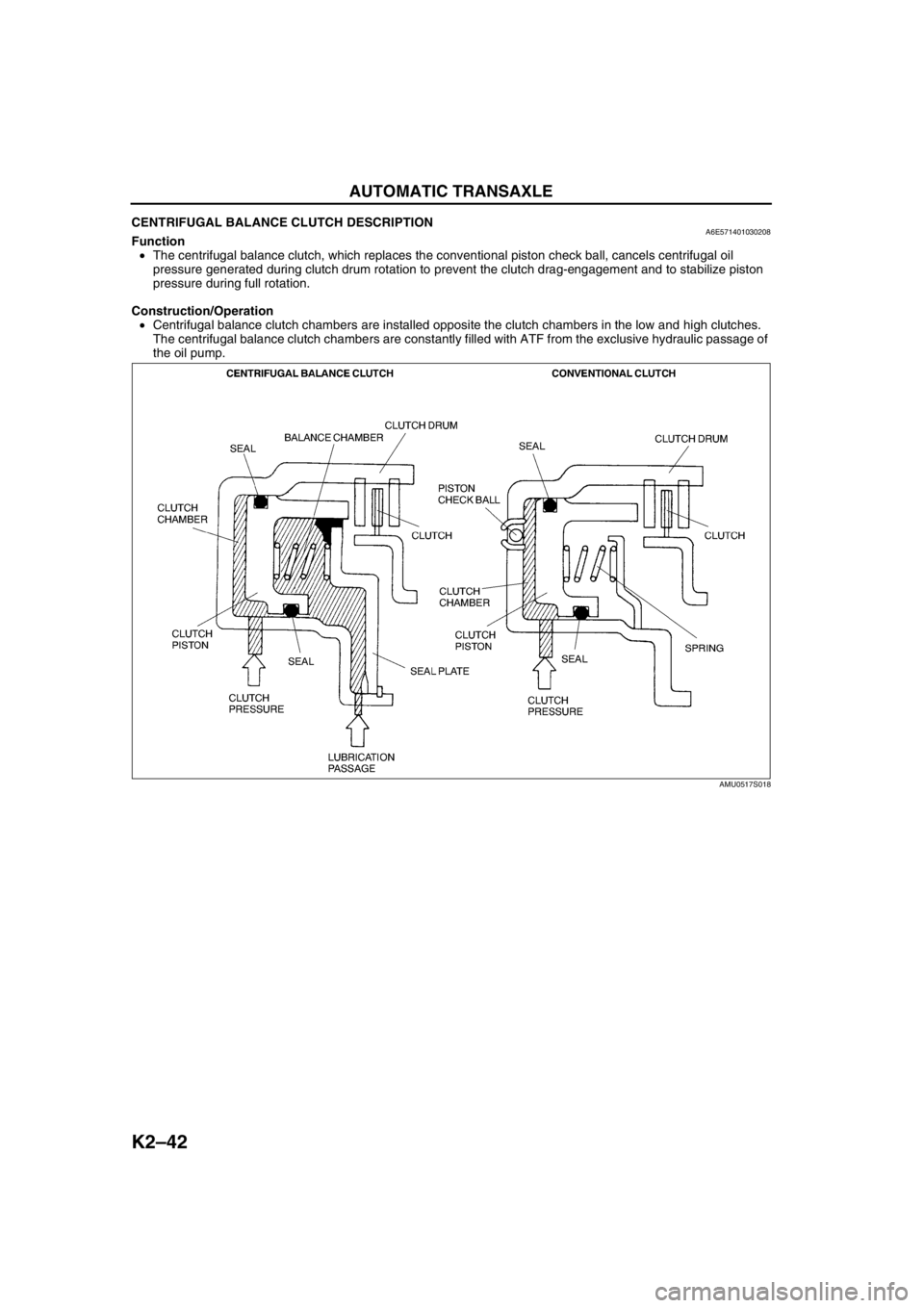
CENTRIFUGAL BALANCE CLUTCH DESCRIPTIONA6E571401030208Function
•The centrifugal balance clutch, which replaces the conventional piston check ball, cancels centrifugal oil
pressure generated during clutch drum rotation to prevent the clutch drag-engagement and to stabilize piston
pressure during full rotation.
Construction/Operation
•Centrifugal balance clutch chambers are installed opposite the clutch chambers in the low and high clutches.
The centrifugal balance clutch chambers are constantly filled with ATF from the exclusive hydraulic passage of
the oil pump.
AMU0517S018
Page 458 of 909
AUTOMATIC TRANSAXLE
K2–43
K2
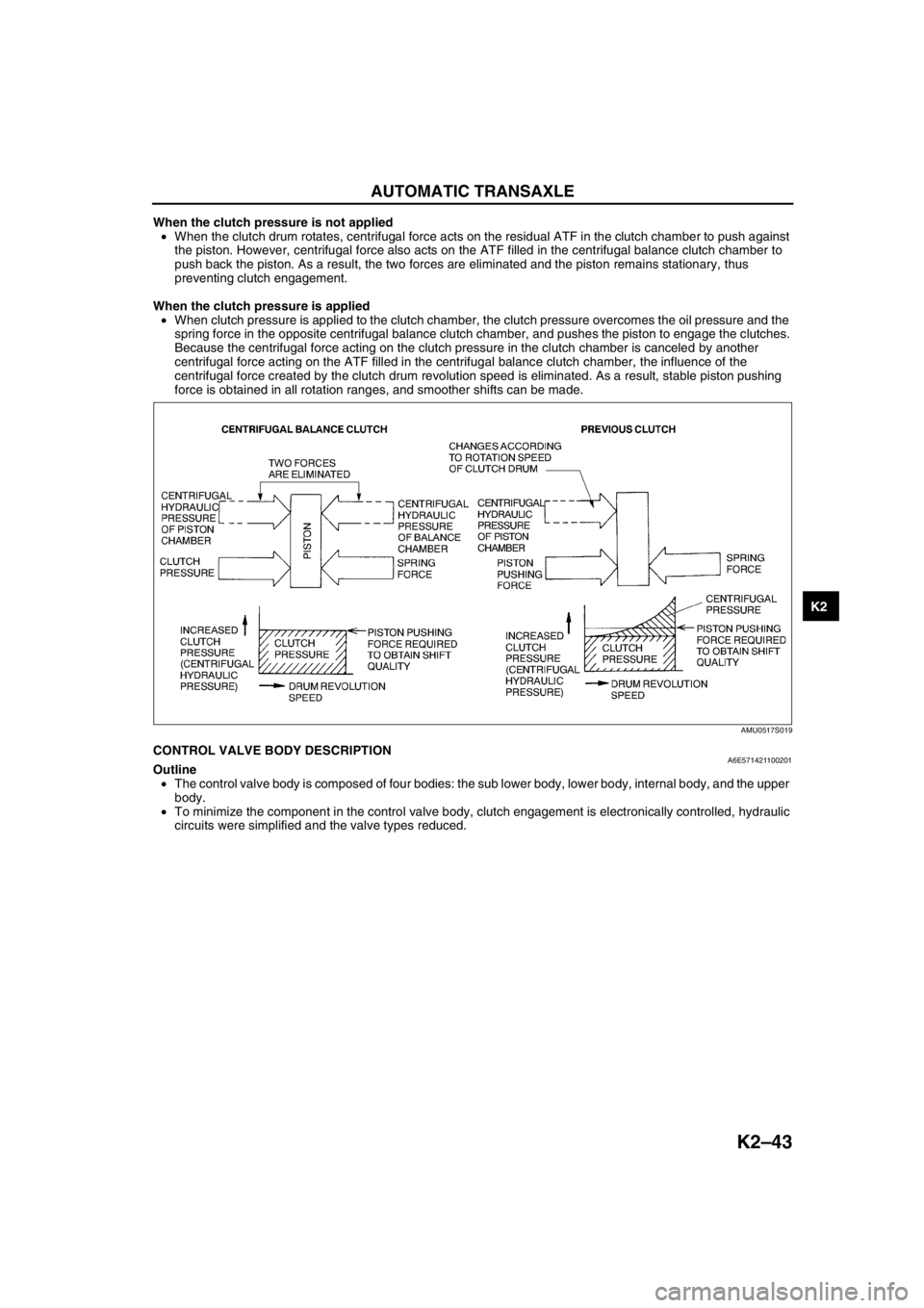
When the clutch pressure is not applied
•When the clutch drum rotates, centrifugal force acts on the residual ATF in the clutch chamber to push against
the piston. However, centrifugal force also acts on the ATF filled in the centrifugal balance clutch chamber to
push back the piston. As a result, the two forces are eliminated and the piston remains stationary, thus
preventing clutch engagement.
When the clutch pressure is applied
•When clutch pressure is applied to the clutch chamber, the clutch pressure overcomes the oil pressure and the
spring force in the opposite centrifugal balance clutch chamber, and pushes the piston to engage the clutches.
Because the centrifugal force acting on the clutch pressure in the clutch chamber is canceled by another
centrifugal force acting on the ATF filled in the centrifugal balance clutch chamber, the influence of the
centrifugal force created by the clutch drum revolution speed is eliminated. As a result, stable piston pushing
force is obtained in all rotation ranges, and smoother shifts can be made.
End Of SieCONTROL VALVE BODY DESCRIPTIONA6E571421100201Outline
•The control valve body is composed of four bodies: the sub lower body, lower body, internal body, and the upper
body.
•To minimize the component in the control valve body, clutch engagement is electronically controlled, hydraulic
circuits were simplified and the valve types reduced.
AMU0517S019
Page 464 of 909
AUTOMATIC TRANSAXLE
K2–49
K2
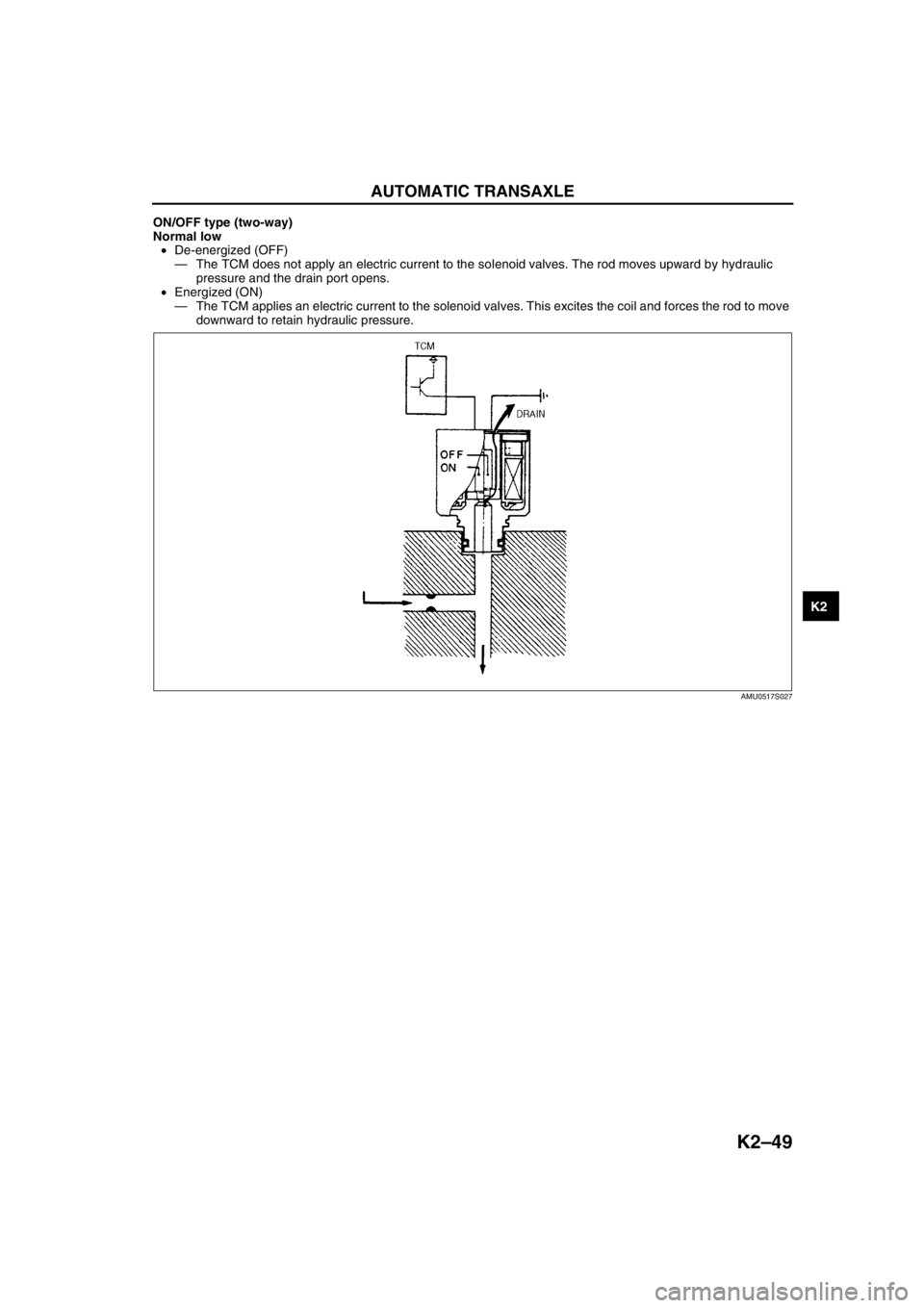
ON/OFF type (two-way)
Normal low
•De-energized (OFF)
—The TCM does not apply an electric current to the solenoid valves. The rod moves upward by hydraulic
pressure and the drain port opens.
•Energized (ON)
—The TCM applies an electric current to the solenoid valves. This excites the coil and forces the rod to move
downward to retain hydraulic pressure.
End Of Sie
AMU0517S027
Page 487 of 909
K2–72
AUTOMATIC TRANSAXLE
MECHANICAL SYSTEM TESTA6E571401030209Mechanical System Test Preparation
1. Apply the parking brake and use wheel chocks at the front and rear of the wheels.
2. Inspect the engine coolant. (See Section E.)
3. Inspect the engine oil. (See D–8 ENGINE OIL INSPECTION.)
4. Inspect the ATF levels. (See K2–79 Automatic Transaxle Fluid (ATF) Level Inspection.)
5. Inspect the idle speed and ignition timing in P position. (See F1–22 IDLE SPEED INSPECTION (4WD).)
Line Pressure Test
Note
•Line pressure cannot be measured on the JA5AX-EL automatic transaxle. Measure the low clutch
pressure in place of D and M range line pressures. Measure the reverse clutch pressure in place of R
position line pressure.
1. Engine idling.
(1) Perform mechanical system test preparation. (See K2–72 Mechanical System Test Preparation.)
Warning
•Removing the plug when the ATF is hot can be dangerous. Hot ATF can come out of the opening
and badly burn you. Before removing the square-head plug, allow the ATF to cool.
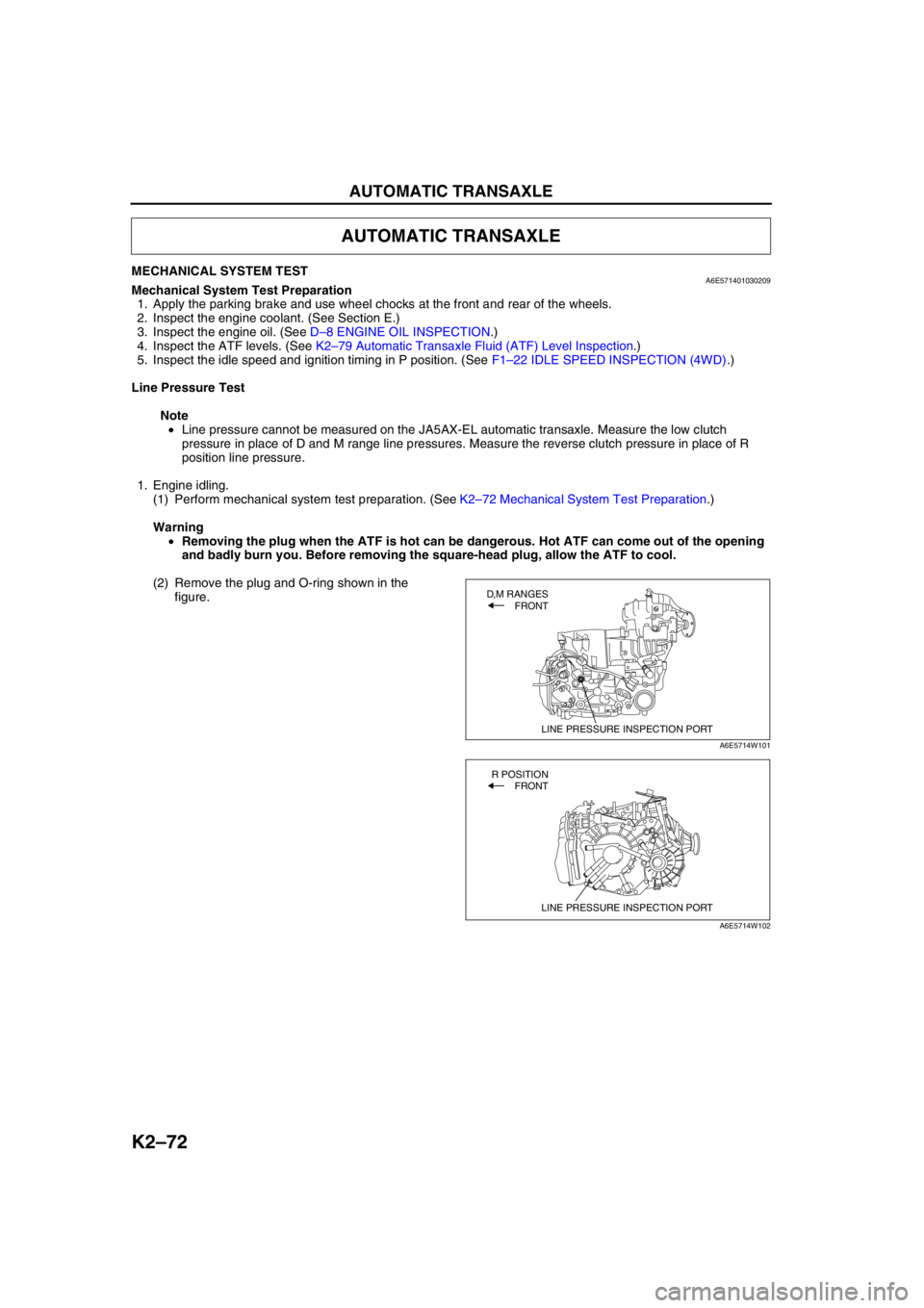
(2) Remove the plug and O-ring shown in the
figure.
AUTOMATIC TRANSAXLE
LINE PRESSURE INSPECTION PORT
D,M RANGES
FRONT
A6E5714W101
LINE PRESSURE INSPECTION PORT
R POSITION
FRONT
A6E5714W102
Page 489 of 909

K2–74
AUTOMATIC TRANSAXLE
Evaluation of line pressure test
Stall Speed Test
1. Perform mechanical system test preparation. (See K2–72 Mechanical System Test Preparation.)
2. Connect a tachometer.
3. Start the engine.
4. Shift the selector lever to D range.
Caution
•Do not maintain WOT in any gear range for more than 5 seconds or transaxle damage will occur.
•If engine speed recorded by the tachometer exceeds maximum specified rpm, release the
accelerator pedal immediately. Clutch or band slippage is indicator.
5. Firmly depress the brake pedal with the left foot, and gently depress the accelerator pedal to the floor (WOT)
with the right.
6. When the engine speed no longer increases, quickly read the engine speed and release the accelerator pedal.
7. Shift the selector the to N position and let the engine idle for 1 minute or more to cool the ATF.
8. Perform stall tests for the remaining ranges and position in the same manner.
•R position
•Mrange (1GR, 2GR)
Engine stall speed
ATF temperature : 60—70 °C {140—158 °F}
Turn off all electrical loads
2,200—2,600 rpm
9. Turn off the engine.
Evaluation of stall test
Condition Possible cause
IdleBelow specificationLow pressure in all rangesWorn oil pump
Poor operation of each solenoid
Fluid leaking from oil strainer, oil pump, pressure regulator
valve, torque converter relief valve, and/or pressure relief valve
Pressure regulator valve or pilot valve sticking
Damaged pressure regulator valve spring or pilot valve spring
Low pressure in D and M
rangeFluid leaking from hydraulic circuit of low clutch
Low pressure in R position
onlyFluid leaking from hydraulic circuit of reverse clutch
Fluid leaking from hydraulic circuit of low and reverse brake
clutch
Above specification High pressure in all rangesThrottle position sensor out of adjustment
TFT sensor malfunction
Poor operation of shift solenoid
Pilot valve sticking
Pressure reducing valve or plug sticking
Stall Below specification Low pressure in all rangesThrottle position sensor out of adjustment
Pressure control solenoid malfunction
Poor operation of shift solenoid
Pilot valve sticking
Pressure reducing valve or plug sticking
Condition Possible cause
Above specificationIn all forward ranges and R
positionInsufficient line pressure
Worm oil pump
Poor operation of low clutch
Poor adjustment or malfunction of TR switch
Oil leaking from oil pump, control valve, and/or transmission
case
Pressure regulator valve or pilot valve sticking
In all forward ranges Low clutch slippage
Low one-way clutch slippage
Reduction one-way clutch slippage
In R positionLow and reverse brake slippage
Reverse clutch slippage
Reduction brake slippage
Below specificationIn all forward ranges and R
positionEngine out of tune
One-way clutch slippage within torque converter
Page 490 of 909
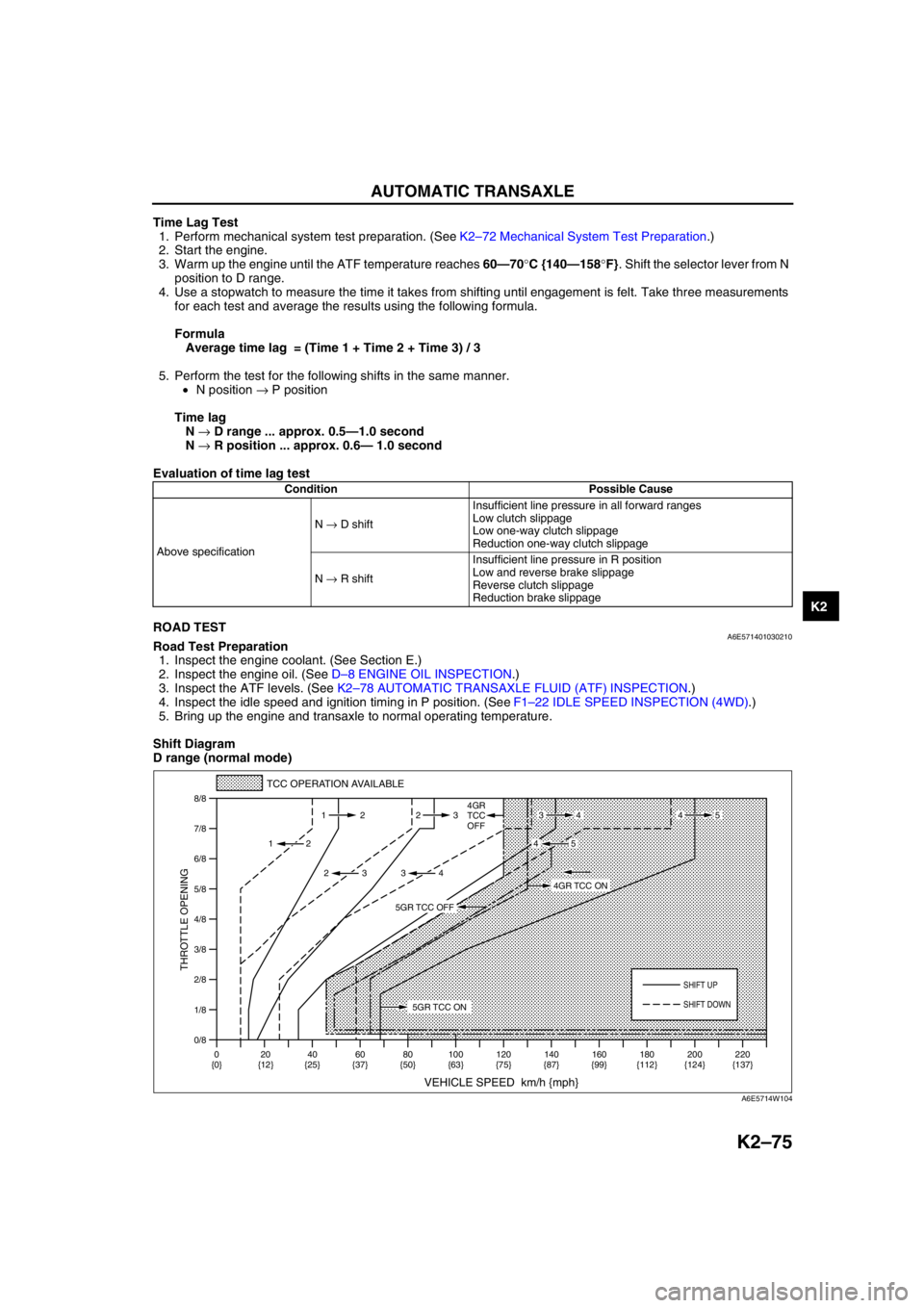
AUTOMATIC TRANSAXLE
K2–75
K2
Time Lag Test
1. Perform mechanical system test preparation. (See K2–72 Mechanical System Test Preparation.)
2. Start the engine.
3. Warm up the engine until the ATF temperature reaches 60—70°C {140—158°F}. Shift the selector lever from N
position to D range.
4. Use a stopwatch to measure the time it takes from shifting until engagement is felt. Take three measurements
for each test and average the results using the following formula.
Formula
Average time lag = (Time 1 + Time 2 + Time 3) / 3
5. Perform the test for the following shifts in the same manner.
•N position → P position
Time lag
N → D range ... approx. 0.5—1.0 second
N → R position ... approx. 0.6— 1.0 second
Evaluation of time lag test
End Of SieROAD TESTA6E571401030210Road Test Preparation
1. Inspect the engine coolant. (See Section E.)
2. Inspect the engine oil. (See D–8 ENGINE OIL INSPECTION.)
3. Inspect the ATF levels. (See K2–78 AUTOMATIC TRANSAXLE FLUID (ATF) INSPECTION.)
4. Inspect the idle speed and ignition timing in P position. (See F1–22 IDLE SPEED INSPECTION (4WD).)
5. Bring up the engine and transaxle to normal operating temperature.
Shift Diagram
D range (normal mode)
Condition Possible Cause
Above specificationN → D shiftInsufficient line pressure in all forward ranges
Low clutch slippage
Low one-way clutch slippage
Reduction one-way clutch slippage
N → R shiftInsufficient line pressure in R position
Low and reverse brake slippage
Reverse clutch slippage
Reduction brake slippage
0/8 1/8
2/8
3/8
4/8
5/8
6/8
7/8
8/8
TCC OPERATION AVAILABLE
VEHICLE SPEED km/h {mph}
THROTTLE OPENING
SHIFT UP
4GR
TCC
OFF
SHIFT DOWN
0
{0}20
{12}40
{25}60
{37}80
{50}100
{63}120
{75}140
{87}160
{99}180
{112}220
{137} 200
{124} 112 23
2
2 232
34
4534
45
5GR TCC ON
4GR TCC ON
5GR TCC OFF
A6E5714W104