oil pressure MAZDA 6 2002 Suplement Repair Manual
[x] Cancel search | Manufacturer: MAZDA, Model Year: 2002, Model line: 6, Model: MAZDA 6 2002Pages: 909, PDF Size: 17.16 MB
Page 613 of 909

K2–198
TROUBLESHOOTING
NO.20 NOISE OCCURS AT IDLE WHEN VEHICLE IS STOPPED IN ALL POSITIONS/RANGESA6E578001030223
Diagnostic procedure
End Of SieNO.21 NOISE OCCURS AT IDLE WHEN VEHICLE IS STOPPED IN D RANGE, OR IN R POSITIONA6E578001030224
End Of SieNO.22 NO ENGINE BRAKING IN 1GR POSITION OF M RANGEA6E578001030225
Diagnostic procedure
20 Noise occurs at idle when vehicle is stopped in all positions/ranges
DESCRIPTION•Transaxle noisy in all positions and ranges when vehicle idling.
POSSIBLE
CAUSE•Malfunction is in pressure solenoid or oil pump which causes a high-pitched noise to be emitted from
transaxle at idle.
Note
•If a noise is emitted during shifting only, malfunction is in shift solenoid A, B, or C.
•If a noise is emitted during shifting at certain gears only or during deceleration only, it is gear noise.
•Before following troubleshooting steps, make sure that Automatic Transaxle On-Board Diagnostic
and Automatic Transaxle Basic Inspection are conducted.
STEP INSPECTION ACTION
1•Inspect engine condition.
•Is any engine concern (e.g. Rough idle)?Yes Go to appropriate symptom troubleshooting.
(See F1–57 ENGINE SYMPTOM TROUBLESHOOTING.)
No Replace basic inspection and repair or replace any
defective parts according to inspection result.
2•Verify test results.
—If okay, return to diagnostic index to service any additional symptoms.
—If malfunction remains, inspect related Service Informations and perform repair or diagnosis.
—If vehicle repaired, troubleshooting completed.
—If vehicle not repaired or additional diagnostic information not available, replace TCM.
21 Noise occurs at idle when vehicle is stopped in D range, or in R position
DESCRIPTION•Transaxle noisy in driving ranges when vehicle idling.
POSSIBLE
CAUSE•Although the malfunction is basically the same as No.20 “Noise occurs at idle when vehicle is stopped
in all positions/ranges”, other causes may be selector lever position disparity or TR switch position
disparity.
Note
•Before following troubleshooting steps, make sure that Automatic Transaxle On-Board Diagnostic
and Automatic Transaxle Basic Inspection are conducted.
22 No engine braking in 1GR position of M range
DESCRIPTION•Engine speed drops to idle but vehicle coasts when accelerator pedal released during cruising at
medium to high speeds.
•Engine speed drops to idle but vehicle coasts when accelerator pedal released when in M range (1GR)
at low vehicle speed.
POSSIBLE
CAUSE•Clutch slipped, burned (Reduction brake)
—Line pressure low
•Malfunction of VSS
•Malfunction of input/turbine speed sensor
•Malfunction of sensor ground
•Malfunction of control valve body
—M range switch on not judged by TCM (short, or open circuit, poor operation)
•Malfunction of M range switch signal
Note
•Before following troubleshooting steps, make sure that Automatic Transaxle On-Board Diagnostic
and Automatic Transaxle Basic Inspection are conducted.
STEP INSPECTION ACTION
1•Inspect TR switch adjustment.
•Does TR switch adjusted properly?
•Select PNP PID.
•Is PNP PID reading okay when selecting
range?Yes Go to next step.
No Adjust TR switch as necessary.
(See K2–83 TRANSAXLE RANGE (TR) SWITCH
ADJUSTMENT.)
Inspect TR switch.
Repair or replace any defective parts.
Page 614 of 909
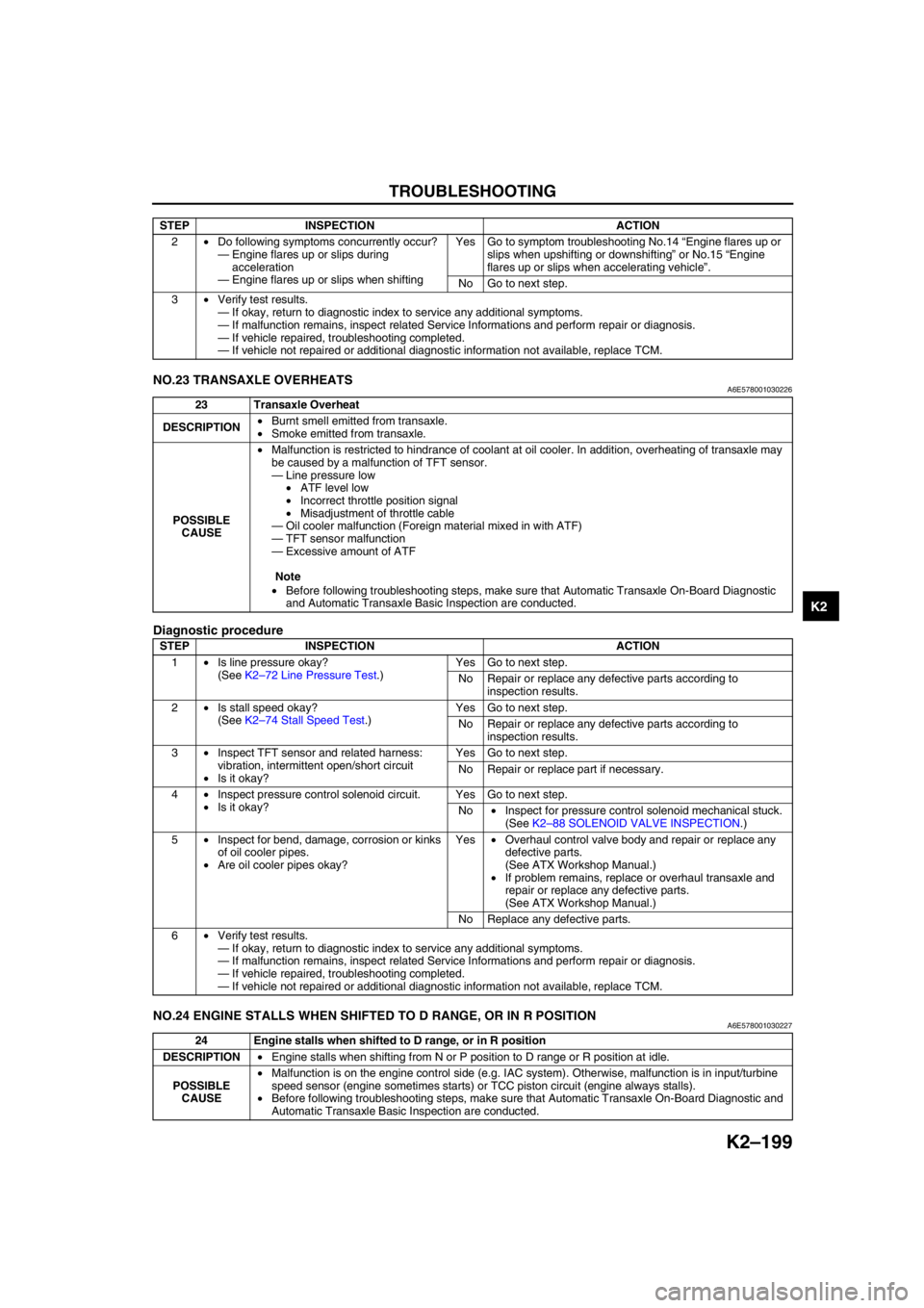
TROUBLESHOOTING
K2–199
K2
End Of SieNO.23 TRANSAXLE OVERHEATSA6E578001030226
Diagnostic procedure
End Of SieNO.24 ENGINE STALLS WHEN SHIFTED TO D RANGE, OR IN R POSITIONA6E578001030227
2•Do following symptoms concurrently occur?
—Engine flares up or slips during
acceleration
—Engine flares up or slips when shiftingYes Go to symptom troubleshooting No.14 “Engine flares up or
slips when upshifting or downshifting” or No.15 “Engine
flares up or slips when accelerating vehicle”.
No Go to next step.
3•Verify test results.
—If okay, return to diagnostic index to service any additional symptoms.
—If malfunction remains, inspect related Service Informations and perform repair or diagnosis.
—If vehicle repaired, troubleshooting completed.
—If vehicle not repaired or additional diagnostic information not available, replace TCM. STEP INSPECTION ACTION
23 Transaxle Overheat
DESCRIPTION•Burnt smell emitted from transaxle.
•Smoke emitted from transaxle.
POSSIBLE
CAUSE•Malfunction is restricted to hindrance of coolant at oil cooler. In addition, overheating of transaxle may
be caused by a malfunction of TFT sensor.
—Line pressure low
•ATF level low
•Incorrect throttle position signal
•Misadjustment of throttle cable
—Oil cooler malfunction (Foreign material mixed in with ATF)
—TFT sensor malfunction
—Excessive amount of ATF
Note
•Before following troubleshooting steps, make sure that Automatic Transaxle On-Board Diagnostic
and Automatic Transaxle Basic Inspection are conducted.
STEP INSPECTION ACTION
1•Is line pressure okay?
(See K2–72 Line Pressure Test.)Yes Go to next step.
No Repair or replace any defective parts according to
inspection results.
2•Is stall speed okay?
(See K2–74 Stall Speed Test.)Yes Go to next step.
No Repair or replace any defective parts according to
inspection results.
3•Inspect TFT sensor and related harness:
vibration, intermittent open/short circuit
•Is it okay?Yes Go to next step.
No Repair or replace part if necessary.
4•Inspect pressure control solenoid circuit.
•Is it okay?Yes Go to next step.
No•Inspect for pressure control solenoid mechanical stuck.
(See K2–88 SOLENOID VALVE INSPECTION.)
5•Inspect for bend, damage, corrosion or kinks
of oil cooler pipes.
•Are oil cooler pipes okay?Yes•Overhaul control valve body and repair or replace any
defective parts.
(See ATX Workshop Manual.)
•If problem remains, replace or overhaul transaxle and
repair or replace any defective parts.
(See ATX Workshop Manual.)
No Replace any defective parts.
6•Verify test results.
—If okay, return to diagnostic index to service any additional symptoms.
—If malfunction remains, inspect related Service Informations and perform repair or diagnosis.
—If vehicle repaired, troubleshooting completed.
—If vehicle not repaired or additional diagnostic information not available, replace TCM.
24 Engine stalls when shifted to D range, or in R position
DESCRIPTION•Engine stalls when shifting from N or P position to D range or R position at idle.
POSSIBLE
CAUSE•Malfunction is on the engine control side (e.g. IAC system). Otherwise, malfunction is in input/turbine
speed sensor (engine sometimes starts) or TCC piston circuit (engine always stalls).
•Before following troubleshooting steps, make sure that Automatic Transaxle On-Board Diagnostic and
Automatic Transaxle Basic Inspection are conducted.
Page 716 of 909

N–2
OUTLINE
OUTLINE OF CONSTRUCTIONA6E660201036201•The construction and operation of the steering system is essentially carried over from that of the current
Mazda6 (GG), except for the following features. (See Mazda6 Training Manual 3359-1*-02C.)
• Due to the addition of the MZR-CD (RF Turbo) engine, a gear-driven power steering oil pump has been
adopted. The operation of the oil pump is the same as that of the current Mazda6 (GG).
• The disassembly/assembly procedures for the steering gear and linkage of the newly equipped MZR-CD (RF
Turbo) engine, wagon and 4WD models are the same as that of the current Mazda6 (GG).
End Of Sie
FEATURESA6E660201036202Improved Steering Feel
• The fluid pressure characteristics of the power steering system has been optimized (MZR-CD (RF Turbo) and
4WD models).
End Of Sie
SPECIFICATIONSA6E660201036203
* : When reservoir tank is at maximum volume
Bold frame:New specifications
End Of Sie
OUTLINE
Item New Mazda6
(GG) (4SD, 5HB) New Mazda6 (GY) (Wagon) Current Mazda6
(GG) (4SD, 5HB)
Drive train 2WD 4WD 2WD
Steering
wheel Outer diameter
370 {14.6}
(mm {in})
Lock-to-lock 18 inch wheel specification vehicles: 2.65
Except for above: 2.75 2.75
(turns)
Steering gear
and linkage Type Rack-and-pinion
Rack stroke 18 inch wheel specification vehicles:
141.6—143.6 {5.57—5.65}
Except for above:146.8—148.8
{5.78—5.85} 146.8—148.8 {5.78—5.85}
(mm {in})
Steering
column and
shaft Shaft type Collapsible
Joint type 2-cross joint
Amount of tilt
45 {1.8}
(mm {in})
Amount of telescope
(If equipped) 50 {2.0}
(mm {in})
Powe r
steering
system Power assist type Engine speed sensing
Pow er
steering
fluid
Ty p e
M-
III or equivalent (e.g. Dexron®II)
Fluid capacity
*
(approximate
quantity) MTX (except MZR-CD (RF Turbo)):
0.80 {0.85, 0.70}
ATX: 0.87 {0.92, 0.77} MZR-CD (RF Turbo):
0.86 {0.91, 0.76} 0.89 {0.94, 0.78}
MTX:
0.80 {0.85, 0.70}
AT X :
0.87 {0.92, 0.77}
(L {US qt, Imp qt})
Page 720 of 909

N–6
ENGINE SPEED SENSING POWER STEERING
POWER STEERING FLUID INSPECTIONA6E661432040201Fluid Level Inspection
1. Inspect the power steering fluid level.
•Add fluid to the specified level as necessary.
Fluid specification
ATF M-III or equivalent (e.g. Dexron
®II)
Fluid Leakage Inspection
Caution
•If the steering wheel is kept in the fully turned position for more than 5 seconds, the fluid
temperature will rise excessively and adversely affect the oil pump.
1. Start the engine and let it idle.
2. Turn the steering wheel fully to the left and right to apply fluid pressure.
Note
•The points where fluid leakage may occur are indicated in the figure.
3. Inspect for fluid leakage.
•If fluid leakage is found, replace the related pipe or hose.
ENGINE SPEED SENSING POWER STEERING
L.H.D.
ATX
MTX
R.H.D.
ATX
MTX MZR-CD (RF Turbo)
EXCEPT MZR-CD (RF Turbo)L.H.D
R.H.D
A6E66142001
Page 721 of 909
ENGINE SPEED SENSING POWER STEERING
N–7
N
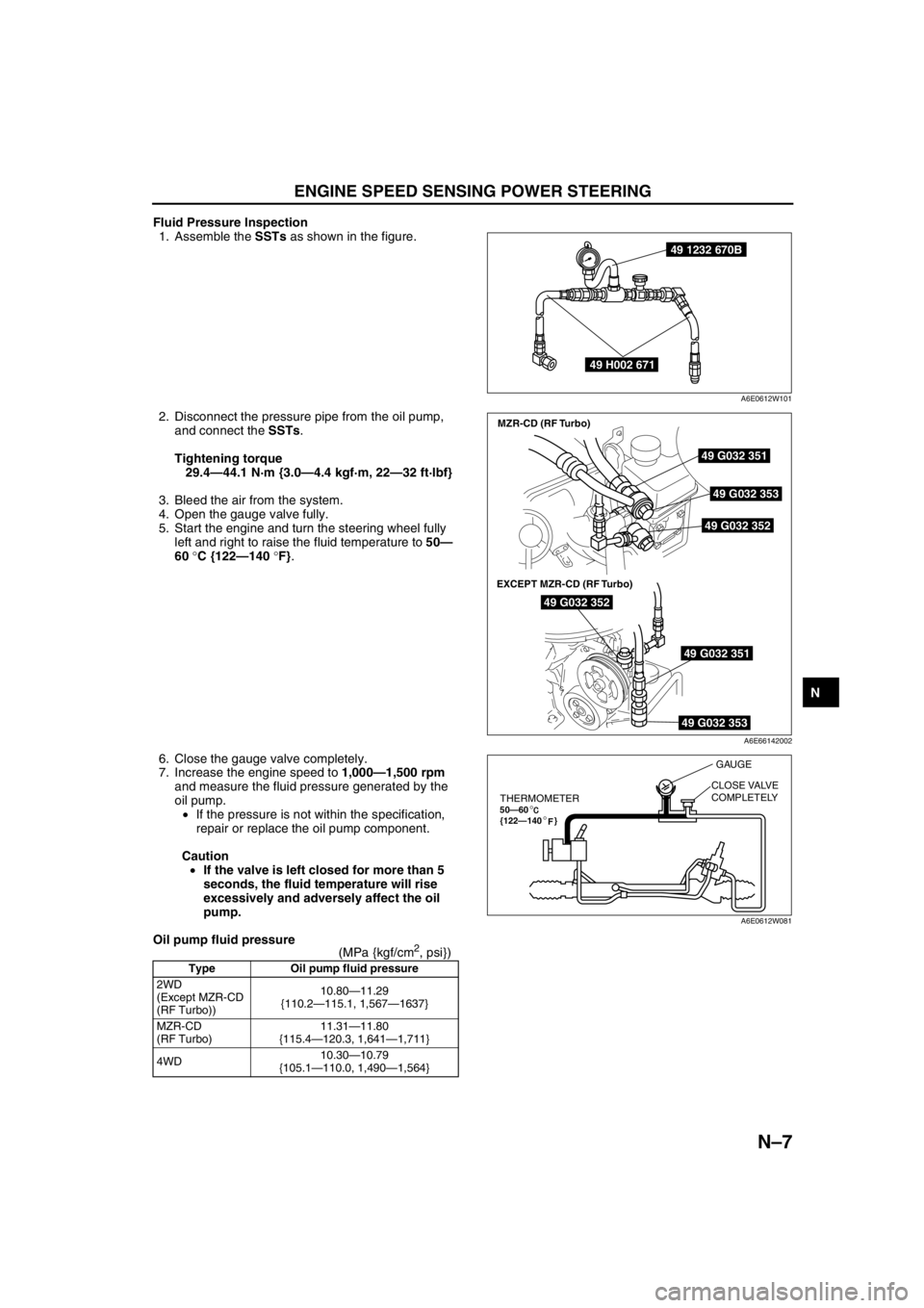
Fluid Pressure Inspection
1. Assemble the SSTs as shown in the figure.
2. Disconnect the pressure pipe from the oil pump,
and connect the SSTs.
Tightening torque
29.4—44.1 N·m {3.0—4.4 kgf·m, 22—32 ft·lbf}
3. Bleed the air from the system.
4. Open the gauge valve fully.
5. Start the engine and turn the steering wheel fully
left and right to raise the fluid temperature to 50—
60 °C {122—140 °F}.
6. Close the gauge valve completely.
7. Increase the engine speed to 1,000—1,500 rpm
and measure the fluid pressure generated by the
oil pump.
•If the pressure is not within the specification,
repair or replace the oil pump component.
Caution
•If the valve is left closed for more than 5
seconds, the fluid temperature will rise
excessively and adversely affect the oil
pump.
Oil pump fluid pressure
(MPa {kgf/cm
2, psi})
Type Oil pump fluid pressure
2WD
(Except MZR-CD
(RF Turbo))10.80—11.29
{110.2—115.1, 1,567—1637}
MZR-CD
(RF Turbo)11.31—11.80
{115.4—120.3, 1,641—1,711}
4WD10.30—10.79
{105.1—110.0, 1,490—1,564}
49 1232 670B
49 H002 671
A6E0612W101
49 G032 351
49 G032 353
49 G032 352
49 G032 352
49 G032 351
49 G032 353
MZR-CD (RF Turbo)
EXCEPT MZR-CD (RF Turbo)
A6E66142002
THERMOMETER50—60
{122—140 }°
°F
GAUGE
CLOSE VALVE
COMPLETELY
A6E0612W081
Page 722 of 909
N–8
ENGINE SPEED SENSING POWER STEERING
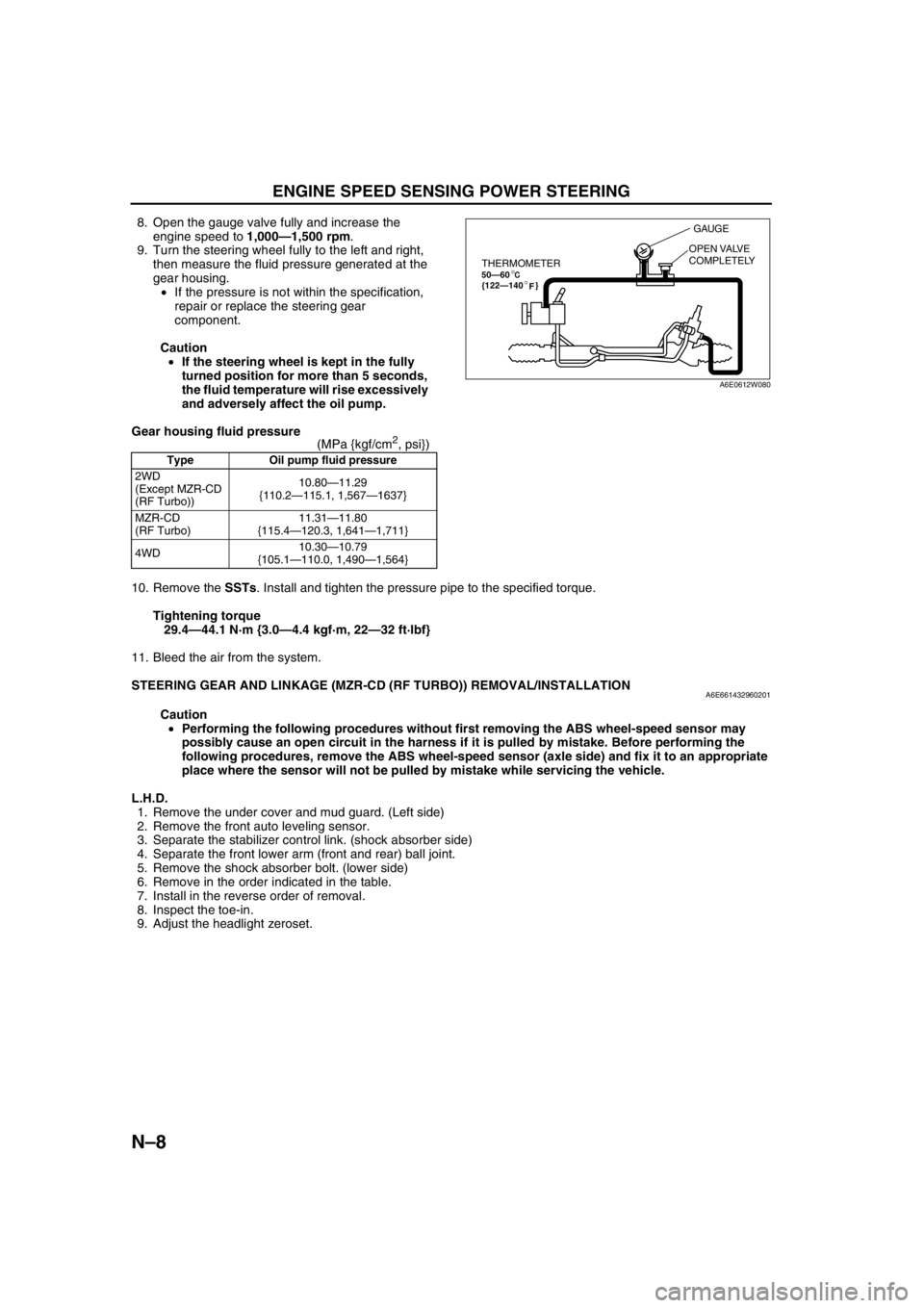
8. Open the gauge valve fully and increase the
engine speed to 1,000—1,500 rpm.
9. Turn the steering wheel fully to the left and right,
then measure the fluid pressure generated at the
gear housing.
•If the pressure is not within the specification,
repair or replace the steering gear
component.
Caution
•If the steering wheel is kept in the fully
turned position for more than 5 seconds,
the fluid temperature will rise excessively
and adversely affect the oil pump.
Gear housing fluid pressure
(MPa {kgf/cm
2, psi})
10. Remove the SSTs. Install and tighten the pressure pipe to the specified torque.
Tightening torque
29.4—44.1 N·m {3.0—4.4 kgf·m, 22—32 ft·lbf}
11. Bleed the air from the system.
End Of Sie
STEERING GEAR AND LINKAGE (MZR-CD (RF TURBO)) REMOVAL/INSTALLATIONA6E661432960201
Caution
•Performing the following procedures without first removing the ABS wheel-speed sensor may
possibly cause an open circuit in the harness if it is pulled by mistake. Before performing the
following procedures, remove the ABS wheel-speed sensor (axle side) and fix it to an appropriate
place where the sensor will not be pulled by mistake while servicing the vehicle.
L.H.D.
1. Remove the under cover and mud guard. (Left side)
2. Remove the front auto leveling sensor.
3. Separate the stabilizer control link. (shock absorber side)
4. Separate the front lower arm (front and rear) ball joint.
5. Remove the shock absorber bolt. (lower side)
6. Remove in the order indicated in the table.
7. Install in the reverse order of removal.
8. Inspect the toe-in.
9. Adjust the headlight zeroset.
Type Oil pump fluid pressure
2WD
(Except MZR-CD
(RF Turbo))10.80—11.29
{110.2—115.1, 1,567—1637}
MZR-CD
(RF Turbo)11.31—11.80
{115.4—120.3, 1,641—1,711}
4WD10.30—10.79
{105.1—110.0, 1,490—1,564}
THERMOMETER50—60
{122—140 }°
°F
GAUGE
OPEN VALVE
COMPLETELY
A6E0612W080
Page 730 of 909

N–16
ENGINE SPEED SENSING POWER STEERING
POWER STEERING OIL PUMP (MZR-CD (RF TURBO)) REMOVAL/INSTALLATIONA6E6614326502011. Remove the air cleaner.
2. Remove the battery and battery tray.
3. Remove in the order indicated in the table.
4. Install in the reverse order of removal.
.
End Of Sie
OILOILR
R
R
4
3
1
229.4—44.1
{3.00—4.49, 21.7—32.5} 18.6—25.5
{1.90—2.60,
13.8—18.8}
N·m {kgf·m, ft·lbf}
A6E66142006
1 Pressure pipe
2 Return hose3 Power steering oil pump
4 O-ring
Page 732 of 909

N–18
ENGINE SPEED SENSING POWER STEERING
Power Steering Oil Pump Component Disassembly Note
1. Secure the power pressure oil pump using the SST.
Caution
•Use the SST to prevent damage to the
pump when securing it in a vise.
Clip Disassembly Note
1. Lift up the clip tab using a flathead screwdriver.
2. Remove the clip by pushing it with a flathead
screwdriver and a hammer as shown in the figure.
Vane Assembly Note
1. Place the vanes in the rotor with the rounded
edges contacting the cam.
10 Rear pump body
(See N–19 Rear Pump Body Assembly Note)
11 Gasket
12 Cam ring
(See N–19 Cam Ring Assembly Note)13 Rotor
14 Vane
(See N–18 Vane Assembly Note)
15 Side plate
16 Power steering oil pump
49 F032 301
A6E66142010
CLIP
R
A6E66142008
A6E6316W013
Page 745 of 909
P–12
CONVENTIONAL BRAKE SYSTEM
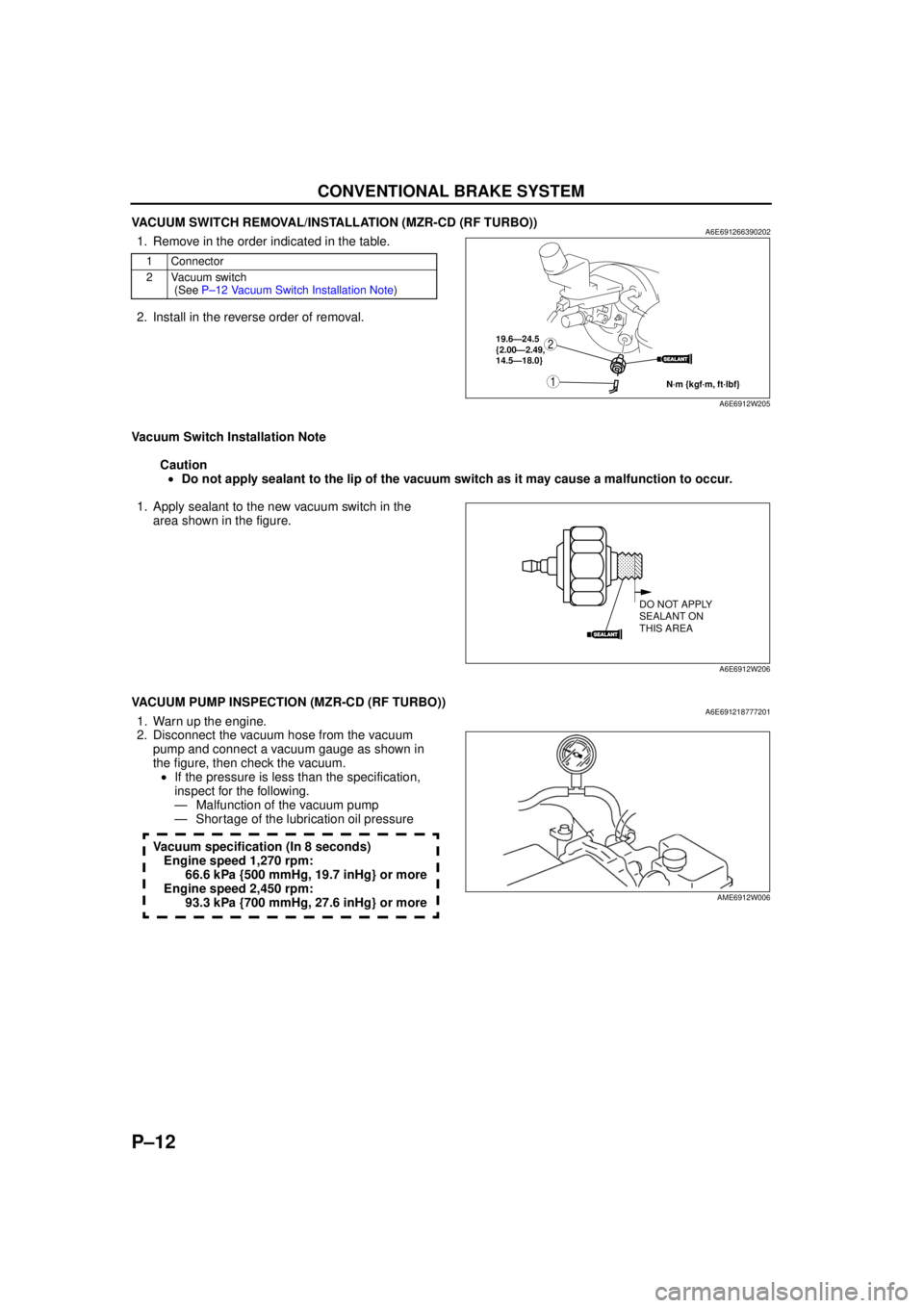
VACUUM SWITCH REMOVAL/INSTALLATION (MZR-CD (RF TURBO))A6E6912663902021. Remove in the order indicated in the table.
2. Install in the reverse order of removal.
Vacuum Switch Installation Note Caution• Do not apply sealant to the lip of the vacuum switch as it may cause a malfunction to occur.
1. Apply sealant to the new vacuum switch in the area shown in the figure.
End Of Sie
VACUUM PUMP INSPECTION (MZR-CD (RF TURBO))A6E6912187772011. Warn up the engine.
2. Disconnect the vacuum hose from the vacuum pump and connect a vacuum gauge as shown in
the figure, then check the vacuum.• If the pressure is less than the specification,
inspect for the following.
— Malfunction of the vacuum pump
— Shortage of the lubrication oil pressure
Vacuum specification (In 8 seconds) Engine speed 1,270 rpm: 66.6 kPa {500 mmHg, 19.7 inHg} or more
Engine speed 2,450 rpm: 93.3 kPa {700 mmHg, 27.6 inHg} or more
End Of Sie
1 Connector
2 Vacuum switch (See P –12 Vacu um S w itch Ins tal lat ion Note )
SEALANT
1
219.6—24.5
{2.00—2.49,
14.5—18.0}
N·m {kgf·m, ft·lbf}
A6E6912W205
SEALANT
DO NOT APPLY
SEALANT ON
THIS AREA
A6E6912W206
AME6912W006
Page 765 of 909

OUTLINE
R–3
R
SPECIFICATIONSA6E740201013203
*1: Engine coolant and engine oil are at specified level. Fuel is full. Spare tire, jack and tools are in designated position.
*
2: Difference between left and right must not exceed 1 °30'.*3: Distance between wheel center and fender brim is following. 4SD and 5HB front: 402 mm {15.82 in} (reference
value) 4SD and 5HB rear: 401 mm {15.78 in} (reference value), WGN (2WD) front: 405 mm {15.94 in}
(reference value) WGN (2WD) rear: 407 mm {16.02 in} (reference value)
Bold frames: New specifications
End Of Sie
Item Specification
New Mazda6 Current
Mazda6
GG (4SD, 5HB) GY (WGN 2WD) GY (WGN 4WD) GG (4SD, 5HB)
Engine type LF, MZR-CD
(RF Turbo) L8, LF, L3,
MZR-CD (RF Turbo) L3 L8, LF, L3
Fr o nt
suspension Type High-mount double wishbone (with double-pivoted lower arm(s))
Spring type Coil spring
Shock absorber type
Cylindrical, double-acting
(Low-pressure gas charged with rebound spring)
Stabilizer Type Torsion bar
Diameter (mm {in}) 23 {0.91}
Wheel
alignment
(Unloaded)*
1
Total toe-in (mm {in}) Tire: 2
±4 {0.08 ±0.16}, Rim inner: 1 ±3 {0.04 ±0.12}
(degree) 0 °11 ′±0°22 ′
Maximum
steering
angle inner
18 inch wheel specification vehicles: 36
°±3°
Except for above: 39 °±3°
outer 18 inch wheel specification vehicles: 30
°±3°
Except for above: 31 °±3°
Caster
angle*
2
(reference
value) normal 3
°47 ′±1° 3°40 ′±1° 3°35 ′±1° 3°47 ′±1°
elevated*33 °42' ±1° 3°35 ′±1° —3 °42' ±1 °
Camber
angle*
2
(reference
value) normal –0
°17 ′±1° –0°15 ′±1° –0°08 ′±1° –0°17 ′±1°
elevated*3–0 °10' ±1° –0°08 ′±1° —–0 °10' ±1°
Steering
axis
inclination
(reference
value) normal 5
°28 ′ 5°24 ′ 5°16 ′ 5°28 ′
elevated
*35 °18' 5 °16 ′ —5 °18'
Rear
suspension Type E-type multi-link
Spring type Coil spring
Stabilizer
Type Torsion bar
Diameter (mm {in})
4SD: 19 {0.75}
5HB: 18 {0.71}18 {0.71} 21 {0.83}
4SD: 19 {0.75}
5HB: 18 {0.71}
Shock absorber type Cylindrical,
double-acting
(Low-pressure gas charged) Cylindrical,
double-acting
(Low-pressure gas charged)/
(High-pressure
gas charged) Cylindrical,
double-acting
(High-pressure gas charged) Cylindrical,
double-acting
(Low-pressure gas charged)
Wheel
alignment
(Unloaded)*
1
Total toe-in (mm {in}) Tire: 2
±4 {0.08 ±0.16}, Rim inner: 1 ±3 {0.04 ±0.12}
(degree) 0 °11 ′±0°22 ′
Camber
angle*
2
normal –1 °13 ′±1° –1°06 ′±1° –1°03 ′±1° –1°13 ′±1°
elevated
*3–1 °05 ′±1° –0°58 ′±1° —–1 °05 ′±1°
Thrust angle (degree) 0 °±0°48 ′