oil pressure MAZDA 626 1987 Owners Manual
[x] Cancel search | Manufacturer: MAZDA, Model Year: 1987, Model line: 626, Model: MAZDA 626 1987Pages: 1865, PDF Size: 94.35 MB
Page 1120 of 1865
7C OUTLINE
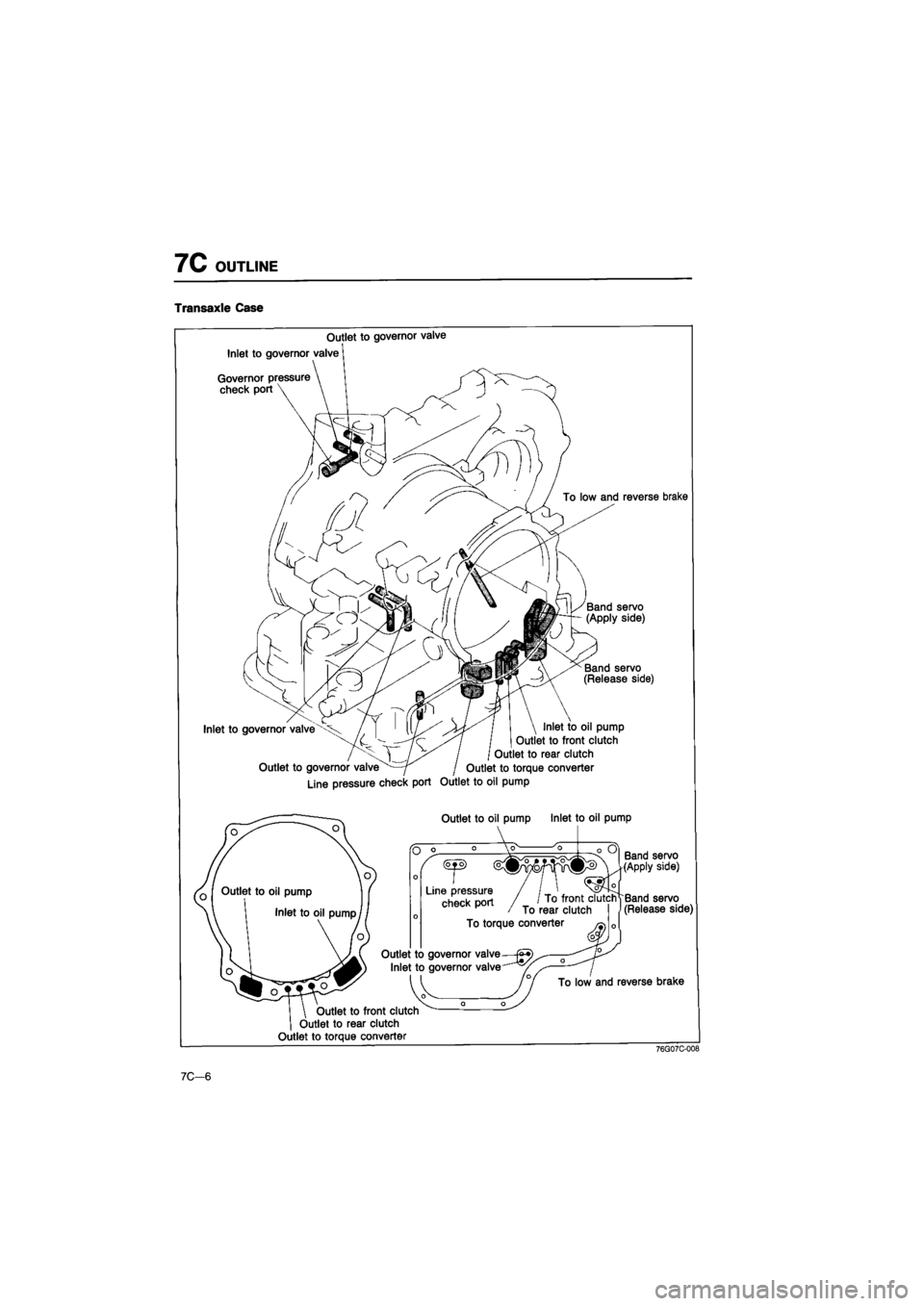
Transaxle Case
Outlet to governor valve
Inlet to governor valve'
Governor pressure
check port
To low and reverse brake
Band servo (Apply side)
Band servo (Release side)
Inlet to governor valve Inlet to oil pump
Outlet to front clutch
Outlet to rear clutch
Outlet to governor valve j Outlet to torque converter
Line pressure check port Outlet to oil pump
Outlet to oil pump Inlet to oil pump
Outlet to front clutch
Outlet to rear clutch
Outlet to torque converter
Band servo (Apply side)
Band servo (Release side)
Outlet to governor valve—
Inlet to governor valve
reverse brake
76G07C-008
7C—6
Page 1122 of 1865
7C TROUBLESHOOTING
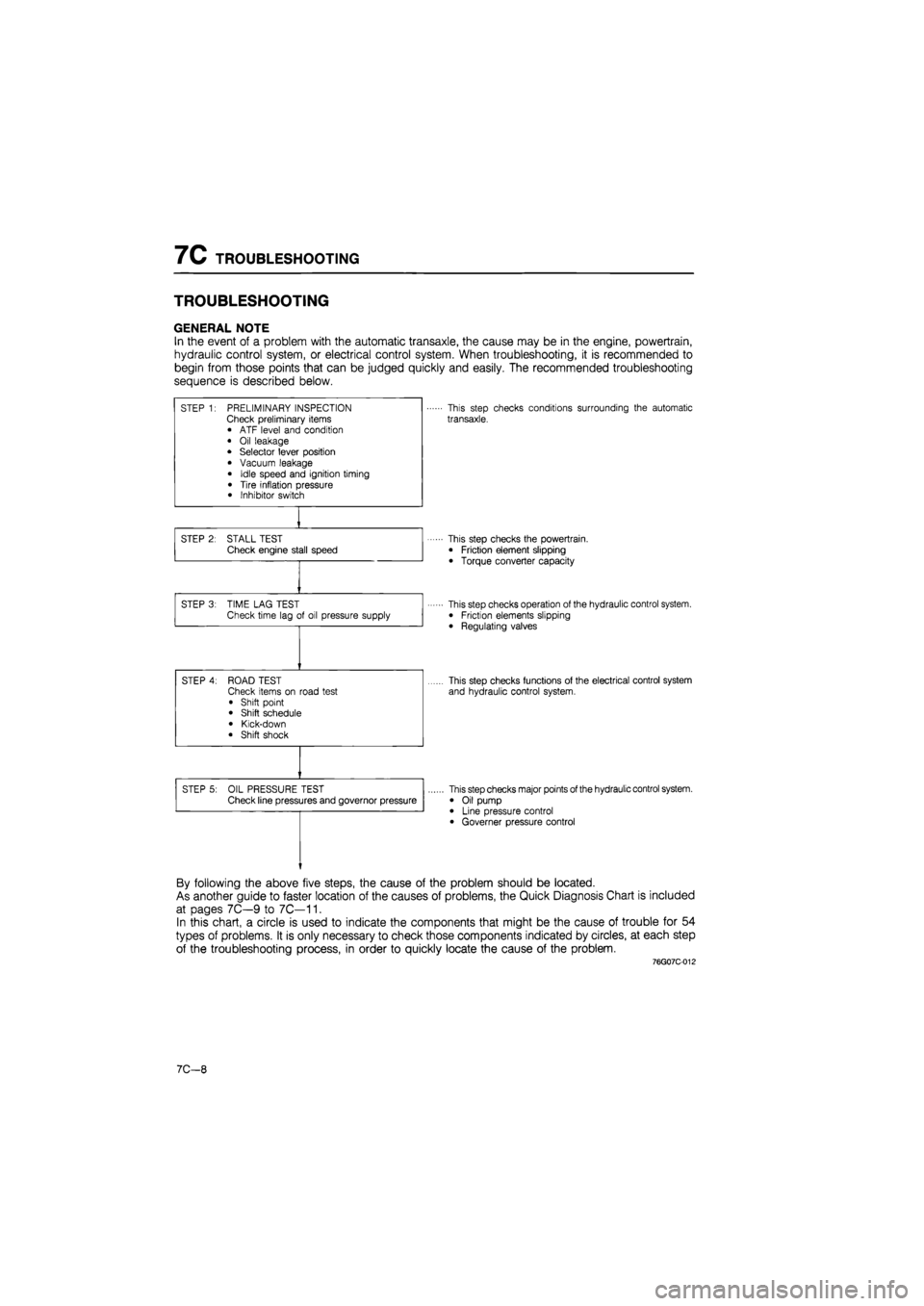
TROUBLESHOOTING
GENERAL NOTE
In the event of a problem with the automatic transaxle, the cause may be in the engine, powertrain,
hydraulic control system, or electrical control system. When troubleshooting, it is recommended to
begin from those points that can be judged quickly and easily. The recommended troubleshooting
sequence is described below.
STEP 1: PRELIMINARY INSPECTION Check preliminary items • ATF level and condition
• Oil leakage • Selector lever position
• Vacuum leakage
• Idle speed and ignition timing
• Tire inflation pressure • Inhibitor switch
This step checks conditions surrounding the automatic
transaxle.
STEP 2: STALL TEST Check engine stall speed This step checks the powertrain.
• Friction element slipping
• Torque converter capacity
STEP 3: TIME LAG TEST Check time lag of oil pressure supply This step checks operation of the hydraulic control system. • Friction elements slipping
• Regulating valves
STEP 4: ROAD TEST Check items on road test
• Shift point • Shift schedule
• Kick-down • Shift shock
This step checks functions of the electrical control system
and hydraulic control system.
STEP 5: OIL PRESSURE TEST Check line pressures and governor pressure This step checks major points of the hydraulic control system.
• Oil pump • Line pressure control • Governer pressure control
By following the above five steps, the cause of the problem should be located.
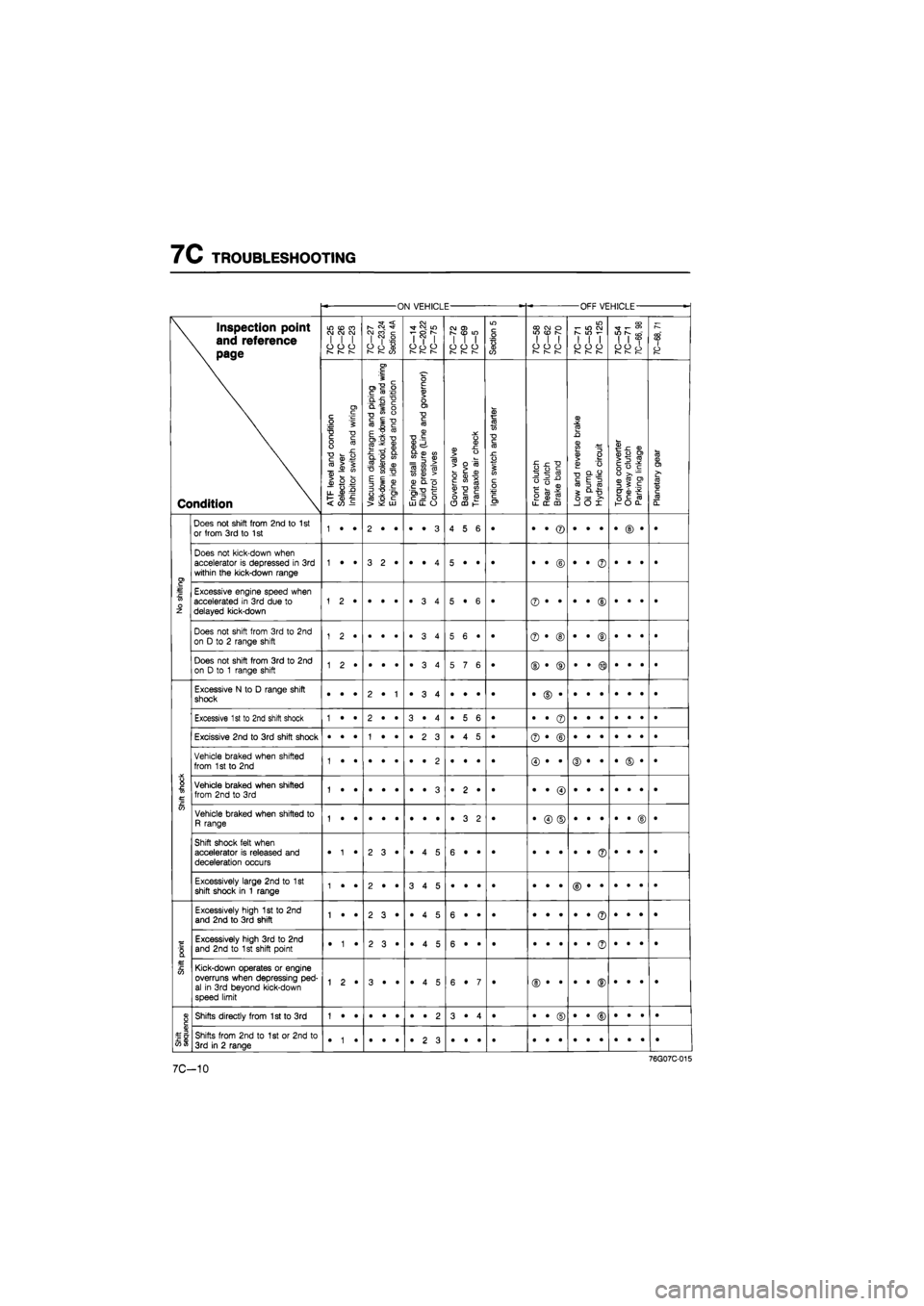
As another guide to faster location of the causes of problems, the Quick Diagnosis Chart is included
at pages 7C—9 to 7C—11.
In this chart, a circle is used to indicate the components that might be the cause of trouble for 54
types of problems. It is only necessary to check those components indicated by circles, at each step
of the troubleshooting process, in order to quickly locate the cause of the problem.
76G07C-012
7C—8
Page 1123 of 1865
TROUBLESHOOTING
7C
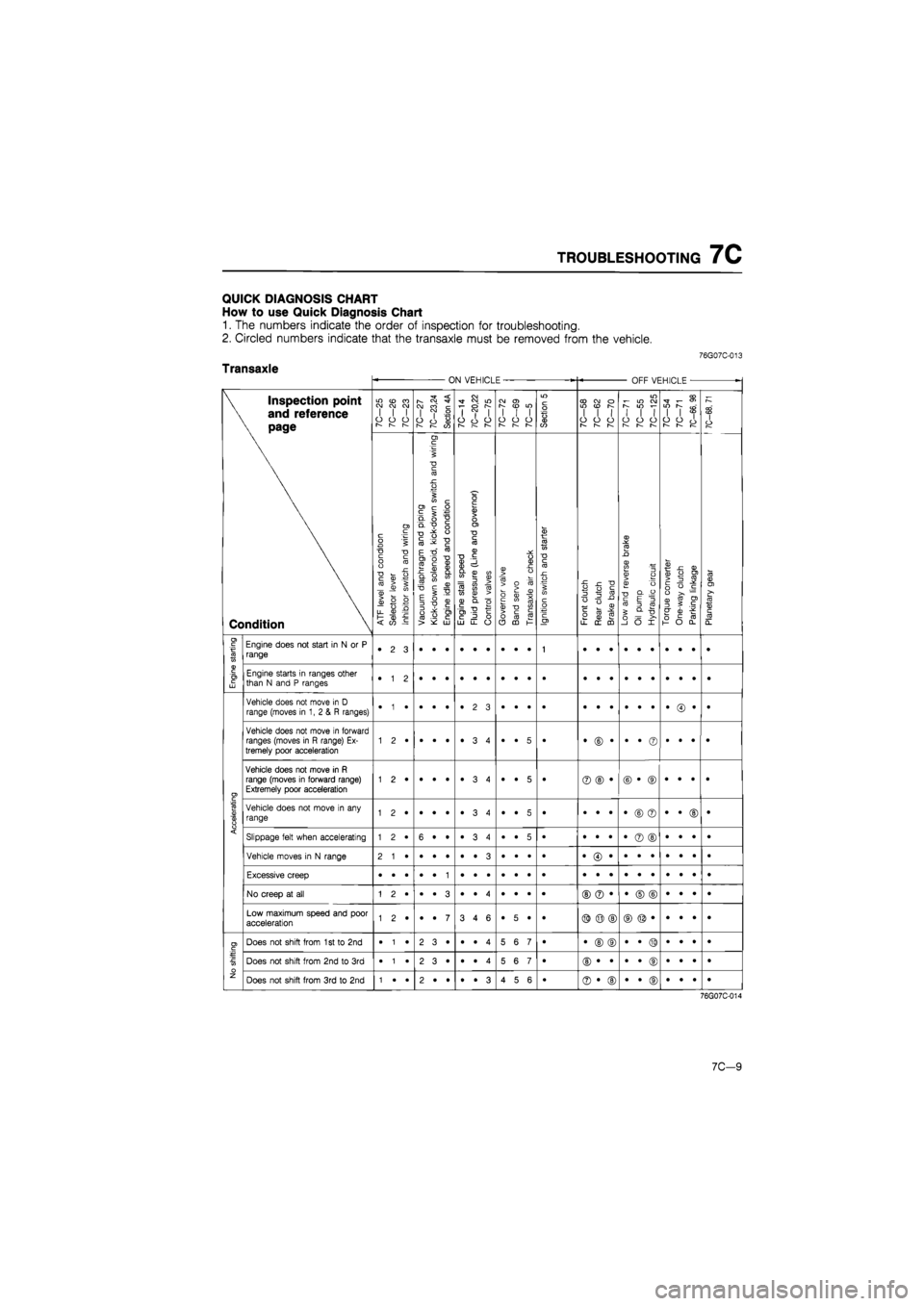
QUICK DIAGNOSIS CHART
How
to use
Quick Diagnosis Chart
1.
The
numbers indicate
the
order
of
inspection
for
troubleshooting.
2. Circled numbers indicate that
the
transaxle must
be
removed from
the
vehicle.
76G07C-013
Transaxle ON VEHICLE OFF VEHICLE
•
\ Inspection point
\
and
reference
\ page
Condition
7C-25
7C-26
7C-23
10—21
7C—23,24
Section
4A
7C-14
7C—20,22
10—lb
10-12 10—69
7C—5
Section
5
7C—58
7C-62
7C-70
7C-71
7C-55
7C-125
7C-54 7C-71
7C-66,
98
7C-68,
71
\ Inspection point
\
and
reference
\ page
Condition
ATF
level
and
condition
Selector
lever
Inhibitor
switch
and
wiring
^
Vacuum
diaphragm
and
piping
|
Kick-down
solenoid,
kick-down
switch
and
wiring
Engine
idle
speed
and
condition
Engine
stall
speed
Fluid
pressure
(Line
and
governor)
Control
valves
Governor
valve
Band
servo
Transaxle
air
check
Ignition
switch
and
starter
Front
clutch
Rear
clutch
Brake
band
Low
and
reverse
brake
Oil
pump Hydraulic
circuit
Torque
converter
One-way
clutch
Parking
linkage
Planetary
gear
I
Engine
starting
Engine does
not
start
in
N or P
range •
2 3
1
Engine
starting
Engine starts
in
ranges other than
N
and P
ranges •
1 2
Accelerating
Vehicle does
not
move
in
D
range (moves
in 1, 2 & R
ranges) •
• •
•
Accelerating
Vehicle does
not
move
in
forward ranges (moves
in R
range)
Ex-
tremely poor acceleration •
• 5
• •
© •
•
• ©
•
• •
•
Accelerating
Vehicle does
not
move
in R
range (moves
in
forward range) Extremely poor acceleration 1
2 •
•
• •
•
3 4
•
• 5
• ©
© •
©
• ©
•
• •
•
Accelerating
Vehicle does
not
move
in any
range 1
2 •
•
• •
•
3 4
•
• 5
• •
• •
•
© ©
•
• ©
•
Accelerating Slippage felt when accelerating 1
2 •
6
• •
•ST
CO
•
•
• 5
• •
• •
•
© ©
•
• •
• Accelerating
Vehicle moves
in
N
range
Accelerating
Excessive creep
Accelerating
No creep
at all
©
© •
•
© ©
•
• •
•
Accelerating
Low maximum speed
and
poor acceleration 1
2 •
•
• 7
3
4 6
•
5 •
• ©
© ©
No shifting
Does
not
shift from
1
st to 2nd
•
1 •
2
3 •
•
• 4
5
6 7
• •
© ©
•
• ©
•
• •
•
No shifting
Does
not
shift from
2nd to 3rd
•
1 •
2
3 •
•
• 4
5
6 7
•
No shifting
Does
not
shift from
3rd to 2nd
1
• •
2
• •
•
• 3
4
5 6
• ©
• ©
•
• ©
•
• •
•
76G07C-014
7C-9
Page 1124 of 1865
7C TROUBLESHOOTING
ON VEHICLE OFF VEHICLE
-
\ Inspection point
\ and reference
\ page
Condition
LO
(O
CO CJ OJ CM I
I I
O
O
CJ
r-~
r—
7C-27
7C—23,24
Section
4A
7C—14
7C—20,22
7C-75
CO
O)
I
I I
o
o o
r—
r—
Section
5
CO CO
o
WON I
I I
o
o o
1— 1—
m i-
in co
S
IO
i-
1
1 1
o
o o
—
I—
7C—54
7C-71
7C-66,
98
7C—68,
71
\ Inspection point
\ and reference
\ page
Condition
A.TF
level
and
condition
Selector
lever
Inhibitor
switch
and
wiring
Vacuum
diaphragm
and
piping
Kick-down
solenoid,
kick-down
switch
and
wiring
Engine
idle
speed
and
condition
Engine
stall
speed
Fluid
pressure
(Line
and
governor)
Control
valves
Governor
valve
Band
servo
Transaxle
air
check
Ignition
switch
and
starter
Front
clutch
Rear
clutch
Brake
band
Low
and
reverse
brake
Oil pump Hydraulic
circuit
Torque
converter
One-way
clutch
Parking
linkage
Planetary
gear
No
shifting
Does
not
shift from 2nd
to
1
st or from
3rd to
1
st 1
• •
2
• •
•
• 3
4
5 6
•
No
shifting
Does
not
kick-down when accelerator
is
depressed
in 3rd
within
the
kick-down range 1
• •
3
2*
•
• 4
5
• •
• •
• ©
•
• ©
•
• •
•
No
shifting
Excessive engine speed when accelerated
in 3rd
due
to
delayed kick-down 5
• 6
• ©
• •
•
• ©
•
• •
• No
shifting
Does
not
shift from
3rd to 2nd
on
D to
2
range shift 1
2 •
5
6 •
• ©
• ®
•
• ®
•
• •
•
No
shifting
Does
not
shift from
3rd to 2nd
on
D to 1
range shift 5
7 6
• ©
• ®
•
• ®
•
• •
•
Shift
shock
Excessive
N to
D
range shift shock •
• •
2
• 1
•
3 4
•
• •
• •
© •
•
• •
•
• •
•
Shift
shock
Excessive
1
st
to
2nd shift shock 1
• •
2
• •
3
• 4
•
5 6
• •
• ©
•
• •
•
• •
•
Shift
shock
Excissive 2nd
to 3rd
shift shock •
• •
1
• •
•
2 3
•
4 5
• ©
• ©
Shift
shock
Vehicle braked when shifted from
1
st
to 2nd
Shift
shock
Vehicle braked when shifted from 2nd
to 3rd
1
• •
•
• •
•
• 3
.
2 •
•
Shift
shock
Vehicle braked when shifted
to
R range 1
• •
•
• •
•
• •
•
3 2
• •
© ©
•
• •
•
• ©
•
Shift
shock
Shift shock felt when accelerator
is
released
and
deceleration occurs •
1 •
2
3*
•
4 5
6
• •
• •
• •
•
• ©
•
• *
•
Shift
shock
Excessively large 2nd
to 1st
shift shock
in 1
range 1
• •
2
• •
3
4 5
•
• •
•
Shift
point
Excessively high
1st to 2nd
and 2nd
to
3rd shift 1
• •
2
3 •
•
4 5
6
• •
•
Shift
point
Excessively high
3rd to 2nd
and
2nd to
1
st shift point •
1 •
2
3 •
•
4 5
6
• •
• •
• •
•
• ©
•
• •
•
Shift
point
Kick-down operates
or
engine overruns when depressing
ped-
al
in 3rd
beyond kick-down speed limit
1
2 •
3
• •
•
4 5
6
• 7
•
Shift
sequence
Shifts directly from 1st
to 3rd
1
• •
•
• •
•
• 2
3
• 4
• •
• ©
•
• ©
•
• •
•
Shift
sequence
Shifts from
2nd to 1st or
2nd
to
3rd
in
2
range •
1 •
•
• •
•
2 3
•
• •
•
7C-10
Page 1125 of 1865

TROUBLESHOOTING
7C
ON VEHICLE -OFF VEHICLE
-
\ Inspection point
\
and
reference
\ page
Condition
in cd
ra
CM CM CM
I
I I
o
o o
I—
r~—
r—
7C—27
7C—23,24
Section
4A
7C—14
7C—20,22
7C-75
CM
0>
[—
CO
LO I
I I
O
O O
r^ r—
Section
5
CD CM
O
in (D
s
I
I I
o
o o
r—
r^
w
CM
r-
m f-
I
I I
o
o o
r-— I—
r-—
7C—54
7C-71
7C—66,
98
7C-68,
71 \ Inspection point
\
and
reference
\ page
Condition
ATR
level
and
condition
Selector
lever
Inhibitor
switch
and
wiring
Vacuum
diaphragm
and
piping
Kick-down
solenoid,
kick-down
switch
and
wiring
Engine
idle
speed
and
condition
Engine
stall
speed
Fluid
pressure
(Line
and
governor)
Control
valves
Governor
valve
Band
servo
Transaxle
air
check
Ignition
switch
and
starter
Front
clutch
Rear
clutch
Brake
band
Low
and
reverse
brake
Oil
pump
Hydraulic
circuit
Torque
converter
One-way
clutch
Parking
linkage
Planetary
gear
Snift
sequence
Shifts from
1st to
2nd
or
2nd
to
3rd
in 1
range
Slipping
Practically
no
shift shock,
or
slip-page while 1st
to
2nd shifting 1
2 •
3
• •
•
4 5
•
7 6
• •
• ©
•
• ©
•
• •
•
Slipping
Pracatically
no
shift shock
or
slip-page while 2nd
to
3rd shifting 1
2 •
3
• •
•
4 5
•
7 6
•
Slipping
No shift shock
or
engine runaway
in 1 to 2
range shift 1
2 •
3
• 4
5
• 6
•
• 7
• •
• ©
•
© •
•
• •
•
Slipping
Engine runaway
or
slip when shifting
3rd to 2nd
1
• •
2
• •
•
3 4
•
5 6
• ®
• ©
•
• ®
•
• •
•
Slipping
Slippage evident when vehicle starts moving 1
2 •
5
• •
•
3 4
•
• 6
• •
• •
•
® ©
•
• •
•
Noise
Transaxle noisy
in P and N
range
Noise
Transaxle noisy
in D, 2, 1 and
R ranges •
(D •
•
© •
•
© •
©
Others
No engine brake
in 1
range •
1 •
•
• •
•
2 3
•
• 4
• •
• •
©
• ©
•
• •
•
Others
Vehicle moves
in P
range
or
parking gear
not
disengaged when
P
range disengaged
•
Others
Transaxle overheats 3
4 5
•
2 6
• ®
©
(D ©
© ©
©
• •
©
Others
White smoke from exhaust while running 1
• •
2
• •
3
4 5
•
• 6
• ®
© ©
©
© ©
©
• •
@
Others
Abnormal odor from
oil
level gauge pipe ©
® ©
©
© ®
©
• •
©
76G07C-016
Differential
Problem Probable Cause Remedy Page
Noise Insufficient fluid Add 7C—25
Low fluid quality Replace with specified
ATF
7C-25
Worn bearing Adjust
or
replace 7C-79
Contact surface
of
gears worn Replace 7C-79
Tooth surface
of
gears damaged Replace 7C-79
Contaminated
ATF
Repair
or
replace 7C-25
Differential gear damaged, excessive backlash Replace 7C-79
Excessive bearing preload Adjust 7C—94
76G07C-017
7C—11
Page 1130 of 1865

7C TROUBLESHOOTING
Evaluation
Condition Possible cause
Worn oil pump
In all ranges Insufficient line
pressure
Oil leakage from oil pump, control
valve, and/or transaxle case
Stuck pressure regulator valve
In D, 2, and 1 Rear clutch slipping
Above specification In D range only One-way clutch slipping
In 2 range only Brake band slipping
Low and reverse brake slipping
Brake band slipping
In R range only Road test to determine if cause is low and reverse brake or reverse clutch:
a) Engine braking in 1 range Front clutch b) No engine braking in 1 range .... Low and reverse brake
Within specification All shift control elements within transaxle functioning normally
Below specification Engine out of tune Below specification
One-way clutch slipping within torque converter
76G07C-026
7C—16
Page 1134 of 1865

7C TROUBLESHOOTING
STEP 5 (OIL PRESSURE TEST)
This step determines line pressure, and governor pressure to check the hydraulic components and
for oil leakage.
Line Pressure Test
Preparation
1. Connect the SST to the line pressure output point.
2. Connect a tachometer to the engine.
3. Follow the test preparation procedure show in STEP 2 (STALL TEST).
Procedure
76G07C-030
1. Start the engine and verify that the idle speed is 950-5° rpm.
2. Shift the selector lever to D range.
3. Read the line pressure at idle.
4. Depress the brake pedal firmly with the left foot, and gradually depress the accelerator pedal with
the right foot.
5. Read the line pressure as soon as the engine speed becomes constant; then release the accelera-
tor pedal.
Caution
Steps 4 to 5 must be done within 5 seconds.
5. Shift the selector lever to N range and let the engine idle for one minute or more.
6. Read the line pressure at idle and engine stall speeds for each range in the same manner.
7C—20
Page 1135 of 1865

TROUBLESHOOTING 7C
Specified line pressure:
Range Pressure kPa (kg/cm2, psi) Range
Idle Stall
D 294-392 (3-4, 43-57) 883-1079 (9—11, 128-156)
2 785—1177 (8—12, 114—171) 785-1177 (8—12, 114-171)
1 294-392 (3-4, 43—57) 883-1079 (9—11, 128—156)
R 392-687 (4-7, 57-100) 1570—1864 (16—19, 228-270)
76G07C-031
Evaluation
Condition Possible cause
Below standard
In all ranges
Worn oil pump
Below standard
In all ranges Fluid leakage from the oil pump, control valve, or transaxle case
Below standard
In all ranges
Stuck pressure regulator valve Below standard
In D, 1, 2 ranges Fluid leakage from the rear clutch or governor hydraulic circuit, or both
Below standard
In R range only Fluid leakage from the low and reverse brake hydraulic circuit
Excessive line pressure at idle Leaking or disconnected vacuum hose Excessive line pressure at idle
Leaking vacuum diaphragm
76G07C-032
76G07C-033
Vacuum
gauge Line
pressure
Governor pressure
At Atmosphere Radical line Read
& 200 mmHg pressure governor
(7.87 inHg) reduction
Line Pressure Cutback Point
1. Connect the SST to the line pressure output point
and the governor pressure output point in the trans-
axle case, and place the gauges inside the vehicle.
2. Disconnect the hose to the vacuum diaphragm,
and plug it.
3. Connect a vacuum pump to the vacuum di-
aphragm, and place the pump inside the vehicle.
4. Gradually accelerate the vehicle in D range.
5. Read the governor pressure at the point where the
line pressure suddenly drops.
6. Apply 200 mmHg (7.87 inHg) vacuum, and re-
peat steps 4 and 5.
Standard
Vacuum mmHg (InHg) Governor pressure kPa (kg/cm2, psi)
Atmospheric pressure 98-157 (1.0—1.6, 14-23)
200 (7.87) 39-98 (0.4-1.0, 6—14)
Evaluation
Incorrect pressures
1. Missing diaphragm rod or rod length incorrect, or
both.
2. Stuck valve in control valve.
76G07C-034
7C—21
Page 1175 of 1865

INSPECTION AND REPAIR 7C
9. Check the front clutch operation.
(1) Set the clutch assembly onto the oil pump.
(2) Check the front clutch operation by applying
compressed air through the fluid passage
shown.
Air pressure:
392 kPa (4.0 kg/cm2, 57 psi) max.
Caution
Apply air for no more than 3 seconds.
76G07C-150
(3) Pour ATF into the front clutch until the clutch
piston is fully submerged.
76G07C-151
(4) Check that no bubbles come from between the
piston and drum seal while applying com-
pressed air through the fluid passage shown.
Air pressure:
392 kPa (4.0 kg/cm2, 57 psi) max.
Caution
Apply air for no more than 3 seconds.
76G07C-152
7C-61
Page 1178 of 1865

7C INSPECTION AND REPAIR
5. Install the snap ring.
(1) Place the SST on the spring retainer and com-
press only enough to install the snap ring.
(2) Install the snap ring in the groove.
(3) Remove the SST.
76G07C-160
6. Install the dished plate with the beveled side fac-
ing the piston as shown; then install the drive and
driven plates.
Note
Installation order:
Driven-Drive-Driven-Drive-Driven-Drive-
Driven-Drive
7. Install the retaining plate with the step facing up-
ward; then install the snap ring.
76G07C-161
76G07C-162
7C-64
8. Check the rear clutch clearance.
(1) Measure the clearance between the snap ring
and retaining plate of the rear clutch with a feel-
er gauge.
Rear clutch clearance:
0.8—1.0 mm (0.031—0.039 in)
(2) If the clearance is not with in specification, ad-
just it by selecting a proper retaining plate.
Retaining plate sizes mm (in)
4.8 (0.189) 5.0 (0.197) 5.2 (0.205) I 5.4 (0.213)
5.6 (0.220) 5.8 (0.228) 6.0 (0.236) 6.2 (0.244)
9. Check the rear clutch operation.
(1) Assemble the front clutch, and rear clutch; then
set the clutch assembly onto the oil pump.
(2) Check the rear clutch operation by applying
compressed air through the fluid passage as
shown.
Air pressure:
392 kPa (4.0 kg/cm2, 57 psi) max.
Caution
Apply air for no more than 3 seconds.