oil pressure MAZDA 626 1987 Repair Manual
[x] Cancel search | Manufacturer: MAZDA, Model Year: 1987, Model line: 626, Model: MAZDA 626 1987Pages: 1865, PDF Size: 94.35 MB
Page 789 of 1865
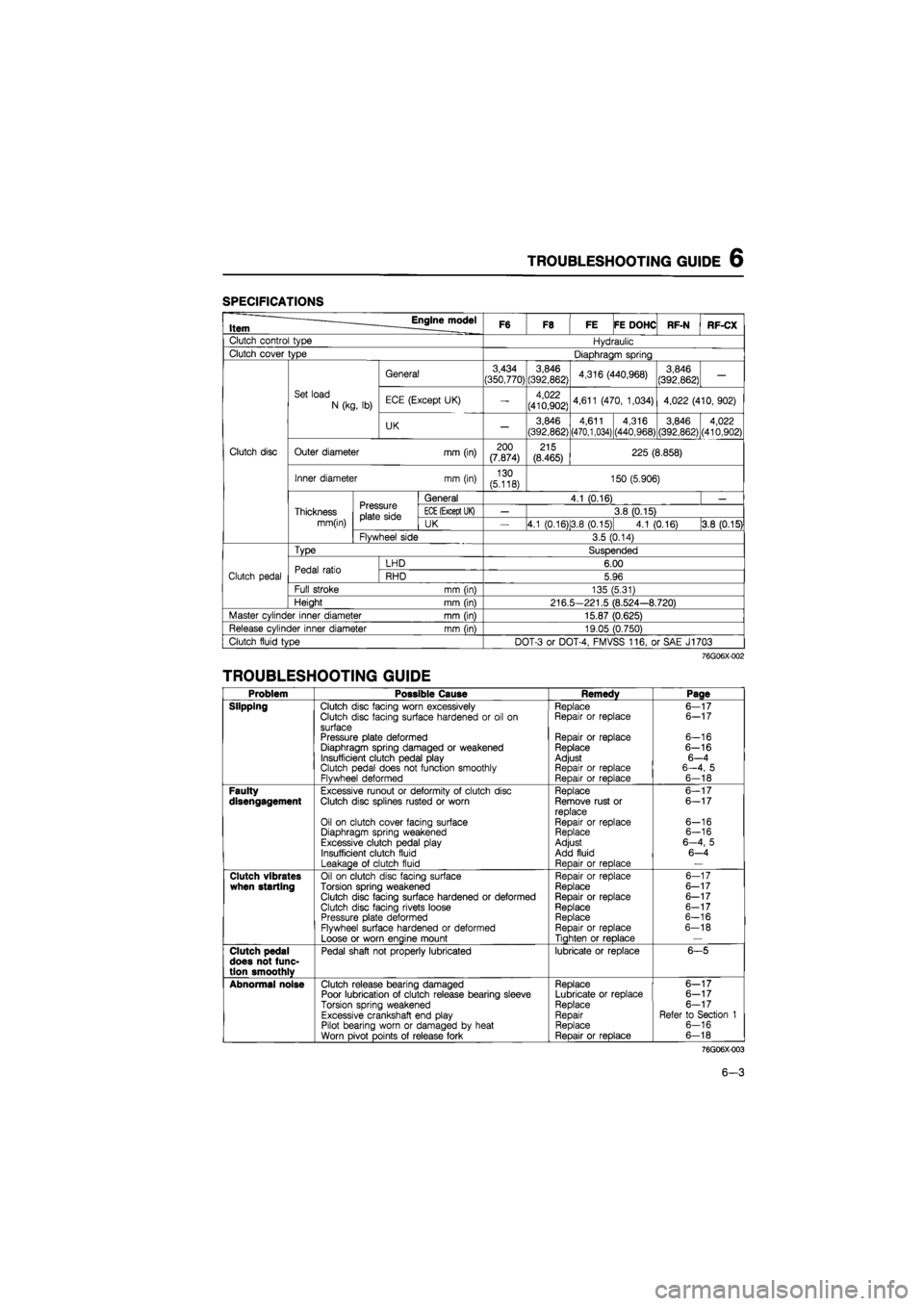
TROUBLESHOOTING GUIDE 6
SPECIFICATIONS
Item Engine model F6 F8 FE FE DOHC RF-N RF-CX
Clutch control type Hydraulic
Clutch cover type Diaphragm spring
General 3,434
(350,770) 3,846
(392,862) 4,316 (440,968) 3,846
(392,862) —
Set load
N (kg, lb) ECE (Except UK) — 4,022
(410,902) 4,611 (470, 1,034) 4,022 (410, 902)
UK — 3,846
(392,862)
4,611 (470,1,034) 4,316
(440,968)
3,846 (392,862) 4,022 (410,902)
Clutch disc Outer diameter mm (in) 200 (7.874) 215 (8.465) 225 (8.858)
Inner diameter mm (in) 130 (5.118) 150 (5.906)
Pressure plate side
General 4.1 (0.16) —
Thickness Pressure plate side
ECE
(Except UK) — 3.8 (0.15)
mm(in)
Pressure plate side UK 4.1 (0.16)13.8 (0.15) 4.1 (0.16) 3.8 (0.15)
Flywheel side 3.5 (0.14)
Type Suspended
Pedal ratio LHD 6.00
Clutch pedal Pedal ratio RHD 5.96
Full stroke mm (in) 135 (5.31)
Height mm (in) 216.5-221.5 (8.524-8.720)
Master cylinder inner diameter mm (in) 15.87 (0.625)
Release cylinder inner diameter mm (in) 19.05 (0.750)
Clutch fluid type DOT-3 or DOT-4, FMVSS 116, or SAE J1703
76G06X-002
TROUBLESHOOTING GUIDE
Problem Possible Cause Remedy Page
Slipping Clutch disc facing worn excessively Replace 6—17 Clutch disc facing surface hardened or oil on Repair or replace 6-17
surface Pressure plate deformed Repair or replace 6-16 Diaphragm spring damaged or weakened Replace 6-16 Insufficient clutch pedal play Adjust 6—4 Clutch pedal does not function smoothly Repair or replace 6—4, 5 Flywheel deformed Repair or replace 6-18
Faulty Excessive runout or deformity of clutch disc Replace 6-17 disengagement Clutch disc splines rusted or worn Remove rust or 6—17 replace Oil on clutch cover facing surface Repair or replace 6-16 Diaphragm spring weakened Replace 6-16
Excessive clutch pedal play Adjust 6—4, 5
Insufficient clutch fluid Add fluid 6-4
Leakage of clutch fluid Reoair or reDlace —
Clutch vibrates Oil on clutch disc facing surface Repair or replace 6-17 when starting Torsion spring weakened Replace 6-17 Clutch disc facing surface hardened or deformed Repair or replace 6-17
Clutch disc facing rivets loose Replace 6-17 Pressure plate deformed Replace 6-16
Flywheel surface hardened or deformed Repair or replace 6-18
Loose or worn engine mount Tighten or replace —
Clutch pedal Pedal shaft not properly lubricated lubricate or replace 6-5 does not func-tion smoothlv
Abnormal noise Clutch release bearing damaged Replace 6—17 Poor lubrication of clutch release bearing sleeve Lubricate or replace 6-17
Torsion spring weakened Replace 6-17
Excessive crankshaft end play Repair Refer to Section 1 Pilot bearing worn or damaged by heat Replace 6-16
Worn pivot points of release fork • Reoair or replace 6-18
76G06X-003
6-3
Page 867 of 1865

7B
AUTOMATIC TRANSAXLE
(Electronically Controlled and 4-Speed)
OUTLINE 7B— 2
SPECIFICATIONS 7B— 2
COMPONENT LOCATION 7B— 3
STRUCTURAL VIEW 7B— 5
OPERATION OF COMPONENTS 7B— 6
FLUID PASSAGE LOCATION 7B— 9
TROUBLESHOOTING (G4A-EL) 7B— 12
GENERAL NOTE 7B— 12
STEP 1
(WARNING CODE RETRIEVAL) 7B— 15
STEP 2
(PRELIMINARY INSPECTION) 7B— 22
STEP 3 (SIGNAL INSPECTION) 7B— 24
STEP 4 (STALL TEST) 7B— 27
STEP 5 (TIME LAG TEST) 7B— 30
STEP 6 (OIL PRESSURE TEST) 7B— 31
STEP 7 (ROAD TEST) 7B— 34
TROUBLESHOOTING (G4A-HL) 7B— 41
GENERAL NOTE 7B— 41
STEP 1
(PRELIMINARY INSPECTION) 7B— 44
STEP 2 (ELECTRICAL
SYSTEM INSPECTION) 7B— 47
STEP 3 (STALL TEST) 7B— 49
STEP 4 (TIME LAG TEST) 7B- 52
STEP 5 (ROAD TEST) 7B— 53
STEP 6 (OIL PRESSURE TEST) 7B— 58
ELECTRICAL SYSTEM
COMPONENTS 7B— 63
MODE SWITCH (G4A-EL) 7B— 63
HOLD SWITCH (G4A-EL) 7B— 63
OD OFF SWITCH (G4A-HL) 7B— 64
INHIBITOR SWITCH 7B- 65
WATER TEMPERATURE SWITCH 7B— 66
FLUID TEMPERATURE SWITCH
(G4A-EL) 7B— 66
BRAKE LIGHT SWITCH
(G4A-EL) 7B— 66
KICK-DOWN SWITCH (G4A-HL) 7B— 67
PULSE GENERATOR (G4A-EL) 7B- 68
VEHICLE SPEED SENSOR
(G4A-EL) 7B— 68
CRUISE CONTROL SWITCH
(CRUISE CONTROL UNIT) 7B— 68
IDLE SWITCH AND THROTTLE
SENSOR (G4A-EL) 7B— 68
OD RELEASE SOLENOID
VALVE (G4A-HL) 7B— 68
SOLENOID VALVES (G4A-EL) 7B— 69
NO LOAD SIGNAL (G4A-EL) 7B— 69
MODE, AND HOLD INDICATOR
LIGHT (G4A-EL) 7B— 69
OD OFF INDICATOR LIGHT
(G4A-HL) 7B— 69
EC-AT CONTROL UNIT
(G4A-EL) 7B— 69
ON-VEHICLE MAINTENANCE 7B— 71
AUTOMATIC TRANSAXLE
FLUID (ATF) 7B— 71
SELECTOR LEVER 7B— 72
THROTTLE CABLE 7B— 73
CONTROL VALVE BODY 7B— 77
OIL STRAINER 7B— 79
ADJUSTMENT OF 2-4 BRAKE
BAND 78— 80
REPLACEMENT OF
DRIVESHAFT OIL SEAL 7B— 80
OIL COOLER 7B— 81
GOVERNOR (G4A-HL) 7B— 82
REMOVAL 7B— 83
PRECAUTION 7B— 83
DISASSEMBLY 7B— 88
DISASSEMBLY-STEP 1 7B— 88
DISASSEMBLY-STEP 2 7B— 94
DISASSEMBLY-STEP 3 7B— 99
DISASSEMBLY-STEP 4 7B—103
INSPECTION AND REPAIR 7B—107
PRECAUTION 7B—107
TORQUE CONVERTER 7B—107
OIL PUMP 7B—108
CLUTCH ASSEMBLY 7B—113
SMALL SUN GEAR AND
ONE-WAY CLUTCH 7B—122
ONE-WAY CLUTCH AND
CARRIER HUB ASSEMBLY 7B-126
3-4 CLUTCH 7B—128
2-3 ACCUMULATOR 7B—132
GOVERNOR ASSEMBLY
(G4A-HL) 7B-133
LOW AND REVERSE BRAKE 7B—134
2-4 BRAKE BAND 7B—135
BAND SERVO 7B—135
OTHER INSPECTION 7B—135
CONTROL VALVE BODY
(G4A-EL) 7B-136
CONTROL VALVE BODY
(G4A-HL) 7B-155
DIFFERENTIAL 7B—177
OUTPUT GEAR 7B—181
IDLE GEAR 7B—182
BEARING COVER ASSEMBLY 7B—185
BEARING HOUSING 7B—186
ASSEMBLY 7B-187
PRECATION 7B—187
ASSEMBLY-STEP 1 7B—187
ASSEMBLY-STEP 2 7B—197
ASSEMBLY-STEP 3 7B—202
ASSEMBLY-STEP 4 7B—208
INSTALLATION 7B—215
TORQUE SPECIFICATIONS 7B—215
HYDRAULIC CIRCUIT (G4A-EL) 7B—221
HYDRAULIC CIRCUIT (G4A-HL) 7B—239
76G07B-001
Page 876 of 1865

7B OUTLINE
Transaxle Case
To governor valve
/and 2-3 accumulator
Inlet to control valve body
(governor pressure)
Outlet to torque converter
(Release side)
Outlet to torque converter
(Apply side)
Outlet to 3-4 clutch
To governor valve and 2-3 accumulator^
From governor valve (governor pressure)
To torque converter (Release side)
To torque converter (Apply side)
To 3-4 clutch
From oil pump
(To control valve body)
°Lto coasting clutch
y
To reverse clutch
To forward clutch
To low and reverse brake
To 2-4 brake apply side
CgEfey a —* To 2-4 brake release side
7B—10
76G07B-009
Page 879 of 1865

TROUBLESHOOTING (G4A-EL) 7B
By following the above seven steps, the cause of the problem should be located.
As another guide to faster location of the causes of problems, the Quick Diagnosis Chart is included
at pages 7B—13, 14.
In this chart, a circle is used to indicate the components that might be the cause of trouble for 23
types of problems. It is only necessary to check those components indicated by circles, at each step
cf the troubleshooting process, in order to quickly locate the cause of the problem.
Quick Diagnosis Chart
The Quick Diagnosis Chart shows various problems and the relationship of various components that
might be the cause of the problem.
1. Components indicated in the "Self-Diag." column are diagnosed by the EC-AT control unit self-
diagnosis function.
The EC-AT Tester can be used for easy retrieval of these signals.
2. Components indicated in the "Adjustment" column indicate that there is a possibility that the prob-
lem may be the result of an incorrect adjustment.
Check the adjustment of each component, and readjust if necessary.
3. Input and outout signals of the EC-AT control unit for the components indicated in the "EC-AT
TESTER" column can be easily checked by using of the EC-AT Tester.
4. Components indicated in the "Stall Test" column can be checked for malfunction by the results
of the stall test.
5. Components indicated in the "Time Lag Test" column can be checked for malfunction by the results
of the time lag test.
6. Components indicated in the "Oil Pressure Test" column can be checked for malfunction by the
results of the oil pressure test.
7. Components indicated in the "Road Test" column can be checked for malfunction by the results
of the road test.
8. The checking, adjusting, repair or replacement procedures for each component is described in the
page(s) noted in the "Reference Page" column.
7B—13
Page 895 of 1865
TROUBLESHOOTING (G4A-EL) 7B
7. Perform the stall test for the following ranges in the same manner.
(1) D range (4) L range
(2) D range (Hold) (5) L range (Hold)
(3) S range (Hold)
Caution
Be sure to allow sufficient cooling time between each stall test.
Engine stall speed: D.S.L range 2170—2270 rpm
R range 2130—2230 rpm
Note
The stall test can be performed with the EC-AT Tester in place of a tachometer.
Drum stall speed indication: 0 rpm
76G0/B-029
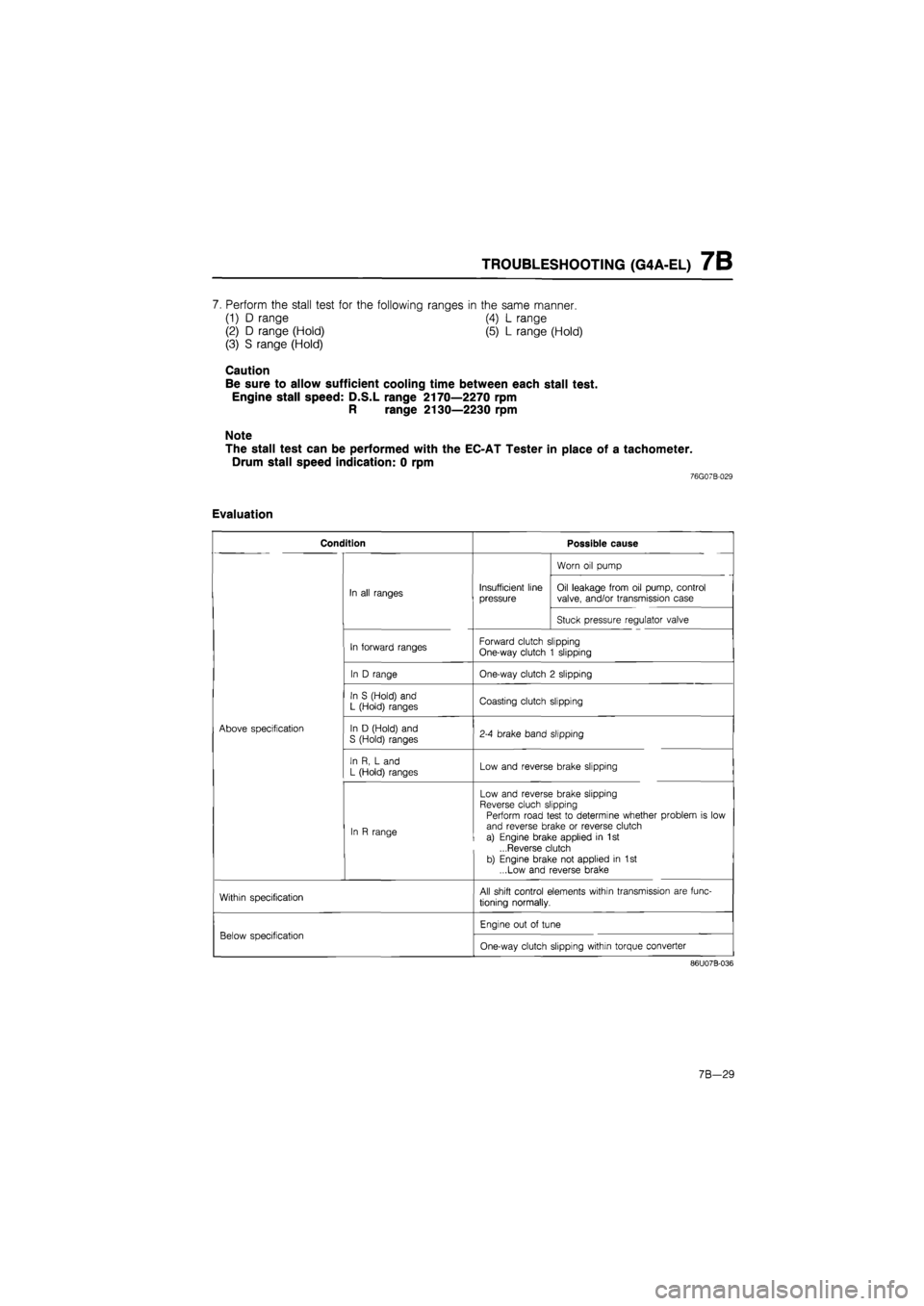
Evaluation
Condition Possible cause
Above specification
In all ranges Insufficient line
pressure
Worn oil pump
Above specification
In all ranges Insufficient line
pressure Oil leakage from oil pump, control valve, and/or transmission case
Stuck pressure regulator valve
Above specification
In forward ranges Forward clutch slipping One-way clutch 1 slipping
Above specification
In D range One-way clutch 2 slipping
Above specification
In S (Hold) and L (Hold) ranges Coasting clutch slipping
Above specification In D (Hold) and S (Hold) ranges 2-4 brake band slipping Above specification
In R, L and L (Hold) ranges Low and reverse brake slipping
Above specification
In R range
Low and reverse brake slipping Reverse cluch slipping Perform road test to determine whether problem is low and reverse brake or reverse clutch
a) Engine brake applied in 1st ...Reverse clutch
b) Engine brake not applied in 1st ...Low and reverse brake
Within specification All shift control elements within transmission are func-
tioning normally.
Below specification
Engine out of tune
Below specification One-way clutch slipping within torque converter
86U07B-036
7B-29
Page 897 of 1865
TROUBLESHOOTING (G4A-EL) 7B
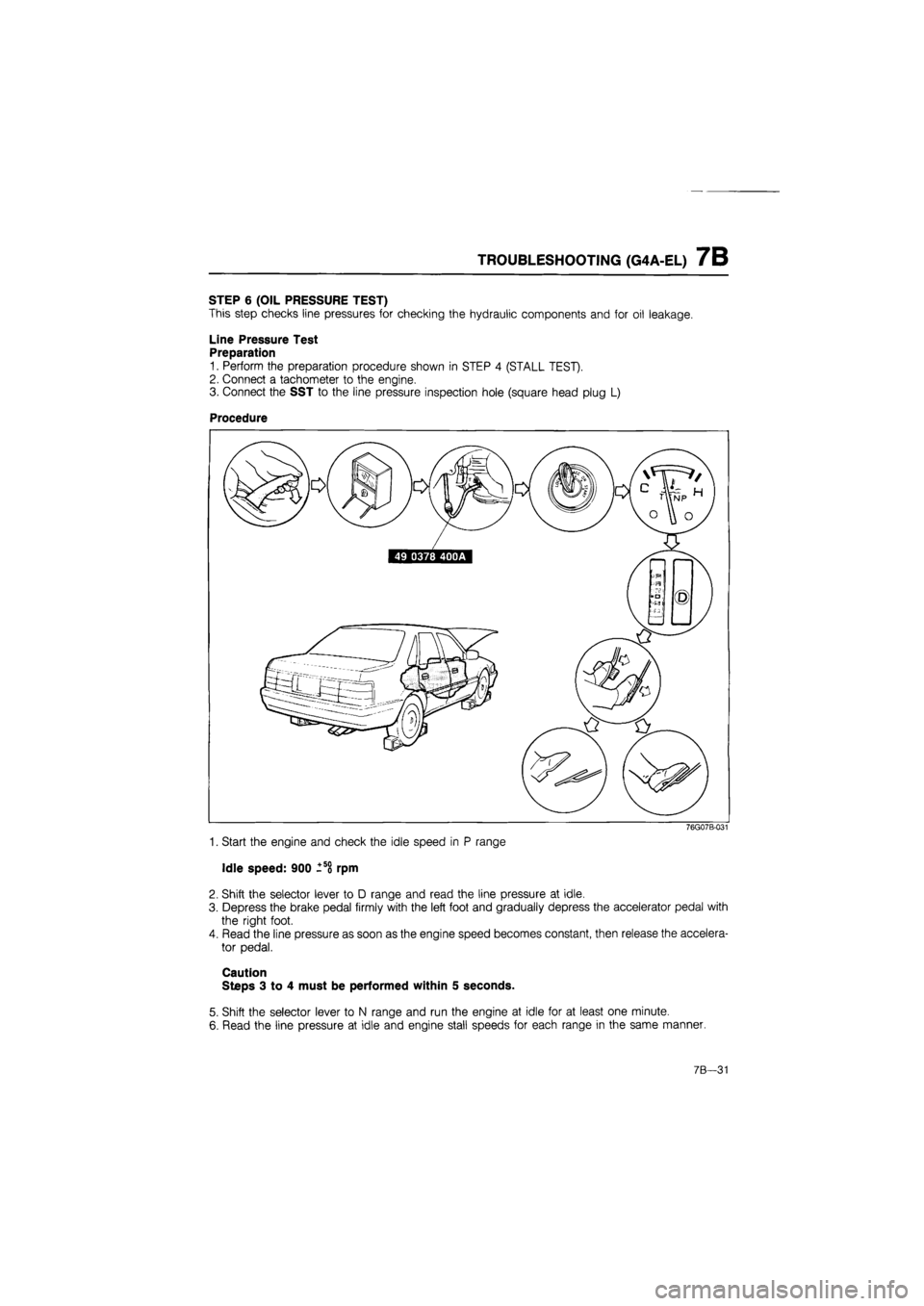
STEP 6 (OIL PRESSURE TEST)
This step checks line pressures for checking the hydraulic components and for oil leakage.
Line Pressure Test
Preparation
1. Perform the preparation procedure shown in STEP 4 (STALL TEST).
2. Connect a tachometer to the engine.
3. Connect the SST to the line pressure inspection hole (square head plug L)
Procedure
76G07B-031
1. Start the engine and check the idle speed in P range
Idle speed: 900 -so rpm
2. Shift the selector lever to D range and read the line pressure at idle.
3. Depress the brake pedal firmly with the left foot and gradually depress the accelerator pedal with
the right foot.
4. Read the line pressure as soon as the engine speed becomes constant, then release the accelera-
tor pedal.
Caution
Steps 3 to 4 must be performed within 5 seconds.
5. Shift the selector lever to N range and run the engine at idle for at least one minute.
6. Read the line pressure at idle and engine stall speeds for each range in the same manner.
7B—31
Page 898 of 1865

7B TROUBLESHOOTING (G4A-EL)
Specified line pressure:
Line pressure kPa, (kg/cm2, psi)
Range DSL R
When idling 353-432 (3.6-4.4, 51-63) 598—942 (6.1-9.6, 87—137)
At stall speed 873-1040 (8.9-10.6, 127-151) 1668-2011 (17.0-20.5, 242-292)
76G07B-032
Evaluation
Line pressure Possible location of problem
Low pressure in every position
Worn oil pump
Fluid leaking from oil pump, control valve body, or transaxle case
Pressure regulator valve sticking
Low pressure in D and S only Fluid leaking from hydraulic circuit of forward clutch
Low pressure in R only Fluid leaking from hydraulic circuit of low and reverse brake
Higher than specification
Throttle valve sticking
Throttle modulator valve sticking
Pressure regulator valve sticking
76G07B-033
7B—32
Page 907 of 1865

TROUBLESHOOTING (G4A-HL) 7B
TROUBLESHOOTING (G4A-HL)
GENERAL NOTE
In the event of a problem with the automatic transaxle, the cause may be in the engine, power train,
hydraulic control system, or electrical control system.
When troubleshooting, therefore, it is recommended to begin from those points that can be judged
quickly and easily. The recommended troubleshooting sequence is described below.
STEP 4: TIME LAG TEST
Check time lag of oil pressure supply
STEP 6: OIL PRESSURE TEST Check line, throttle, and governor pressures
This step checks conditions surrounding the automatic
transaxle.
This step checks the electrical control system.
• Function of the electrical control system
• Components
This step checks the power train. • Friction element slipping • Torque converter capacity
This step checks operation of the hydraulic control system. • Accumulators • Friction elements slipping • Regulating valves
This step checks functions of the electric control system and
hydraulic control system.
This step checks major points of the hydraulic control system.
• Oil pump • Line pressure control • Throttle pressure control
• Governer pressure control
STEP 5: ROAD TEST Check items on road test
• Shift point • Shift schedule
• Kick-down • Shift shock • Lock-up and overdrive inhibition
By following the above 6 steps, the cause of the problem should be located.
As another guide to faster location of the causes of problems, the Quick Diagnosis Chart is included
at pages 7B—42, 43.
In this chart, a circle is used to indicate the components that might be the cause of trouble for 20
types of problems. It is only necessary to check those components indicated by circles, at each step
of the troubleshooting process, in order to quickly locate the cause of the problem.
76G07B-040
7B—41
Page 908 of 1865
7B TROUBLESHOOTING (G4A-HL)
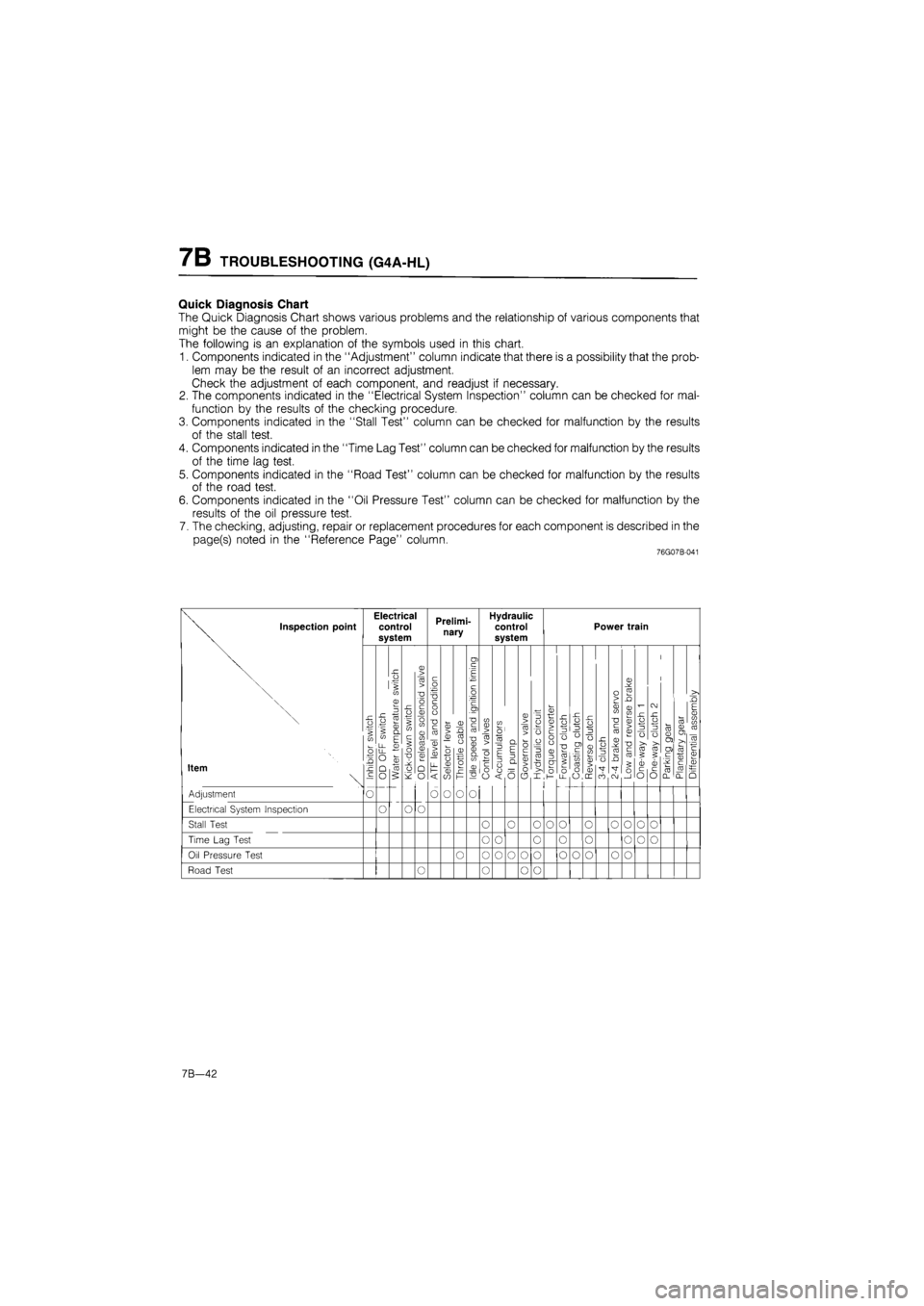
Quick Diagnosis Chart
The Quick Diagnosis Chart shows various problems and the relationship of various components that
might be the cause of the problem.
The following is an explanation of the symbols used in this chart.
1. Components indicated in the "Adjustment" column indicate that there is a possibility that the prob-
lem may be the result of an incorrect adjustment.
Check the adjustment of each component, and readjust if necessary.
2. The components indicated in the "Electrical System Inspection" column can be checked for mal-
function by the results of the checking procedure.
3. Components indicated in the "Stall Test" column can be checked for malfunction by the results
of the stall test.
4. Components indicated in the "Time Lag Test" column can be checked for malfunction by the results
of the time lag test.
5. Components indicated in the "Road Test" column can be checked for malfunction by the results
of the road test.
6. Components indicated in the "Oil Pressure Test" column can be checked for malfunction by the
results of the oil pressure test.
7. The checking, adjusting, repair or replacement procedures for each component is described in the
page(s) noted in the "Reference Page" column.
76G07B-041
Inspection point
Item
Adjustment
Electrical System Inspection
Electrical control system
JO o
II in a> ZJ i 2 : o. 5 E - £ CD _
O §
o
o
Prelimi-nary
CD t/1 ro cd
O O
o
CD ro — o o u 0) CD CO
O
Hydraulic control system
cn "o w ~ CD ro .> -a 5 CD > cl o
5 O
3 a
3 6
o
Power train
O I h
£ ro o O LL O
o > CD (fl "D c ro sz CD o JJL. "3 ro o _Q •sT co C\J
ro ro 5 ? CD CD c c O O
Stall Test
Time Lag Test
O O o o o o o o o o
o o o o o o o o
Oil Pressure Test O o o o o o o o o o o
Road Test O o o o
7B—42
Page 917 of 1865

TROUBLESHOOTING (G4A-HL) 7B
Evaluation
Condition Possible cause
Above specification
In all ranges Insufficient line pressure
Worn oil pump
Above specification
In all ranges Insufficient line pressure Oil leakage from oil pump, control valve, and/or transaxle case
Stuck pressure regulator valve
Above specification
In D 2, and 1 One-way clutch 1 slipping
Above specification
In D range only One-way clutch 2 slipping
Above specification In 2 range only 2-4 brake slipping Above specification
In R range only
Low and reverse brake slipping
Above specification
In R range only
Reverse clutch slipping
Above specification
In R range only Perform a road test, to determine if this is caused by the low and reverse brake or the reverse clutch, as follows:
a) Effective engine braking in 1 range Front clutch
b) No engine braking in 1 range Low and reverse brake
Within specification All shift control elements within transaxle are functioning
normally.
Below specification
Engine out of tune
Below specification One-way clutch slipping within torque converter
76G07B-055
7B—51