battery MAZDA 626 1987 User Guide
[x] Cancel search | Manufacturer: MAZDA, Model Year: 1987, Model line: 626, Model: MAZDA 626 1987Pages: 1865, PDF Size: 94.35 MB
Page 66 of 1865

1A REMOVAL
REMOVAL
Warning: Release the fuel pressure. (Refer to Section 4.)
1. Disconnect the negative battery cable.
2. Drain the engine oil and coolant.
3. Remove in the sequence shown in the figure referring to the removal note for specially marked parts.
76GG1A-117
1A—34
Page 67 of 1865
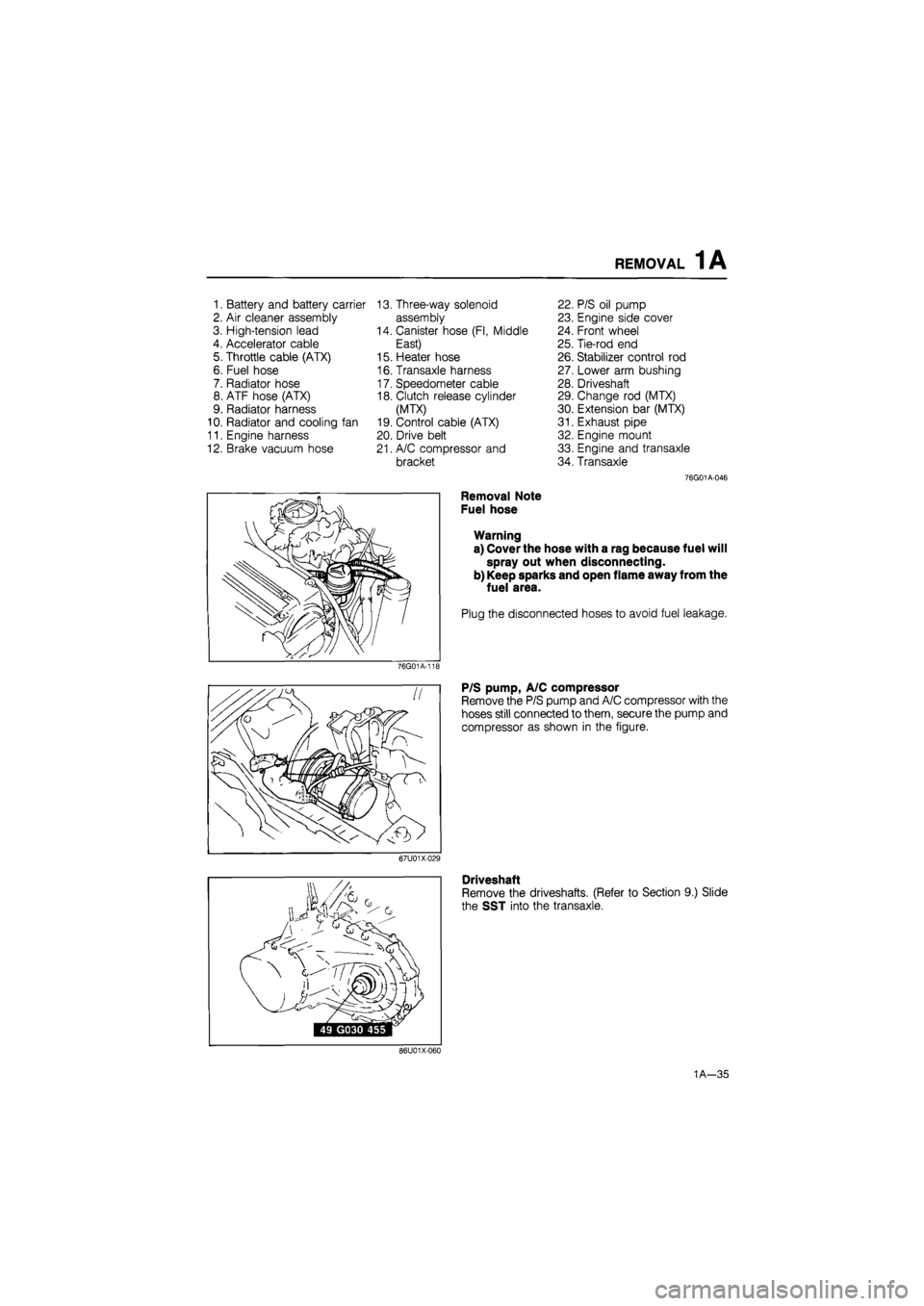
REMOVAL 1A
1. Battery and battery carrier 13. Three-way solenoid 22. P/S oil pump
2. Air cleaner assembly assembly 23. Engine side cover
3. High-tension lead 14. Canister hose (Fl, Middle 24. Front wheel
4. Accelerator cable East) 25. Tie-rod end
5. Throttle cable (ATX) 15. Heater hose 26. Stabilizer control rod
6. Fuel hose 16. Transaxle harness 27. Lower arm bushing
7. Radiator hose 17. Speedometer cable 28. Driveshaft
8. ATF hose (ATX) 18. Clutch release cylinder 29. Change rod (MTX)
9. Radiator harness (MTX) 30. Extension bar (MTX)
10. Radiator and cooling fan 19. Control cable (ATX) 31. Exhaust pipe
11. Engine harness 20. Drive belt 32. Engine mount
12. Brake vacuum hose 21. A/C compressor and 33. Engine and transaxle
bracket 34. Transaxle
76G01A-046
Removal Note
Fuel hose
Warning
a) Cover the hose with a rag because fuel will
spray out when disconnecting.
b) Keep sparks and open flame away from the
fuel area.
Plug the disconnected hoses to avoid fuel leakage.
76G01A-11E
P/S pump, A/C compressor
Remove the P/S pump and A/C compressor with the
hoses still connected to them, secure the pump and
compressor as shown in the figure.
67U01X-029
Driveshaft
Remove the driveshafts. (Refer to Section 9.) Slide
the SST into the transaxle.
86U01X-060
1A—35
Page 130 of 1865
1A INSTALLATION
76G01A-147
86U01X-199
86U01X-200
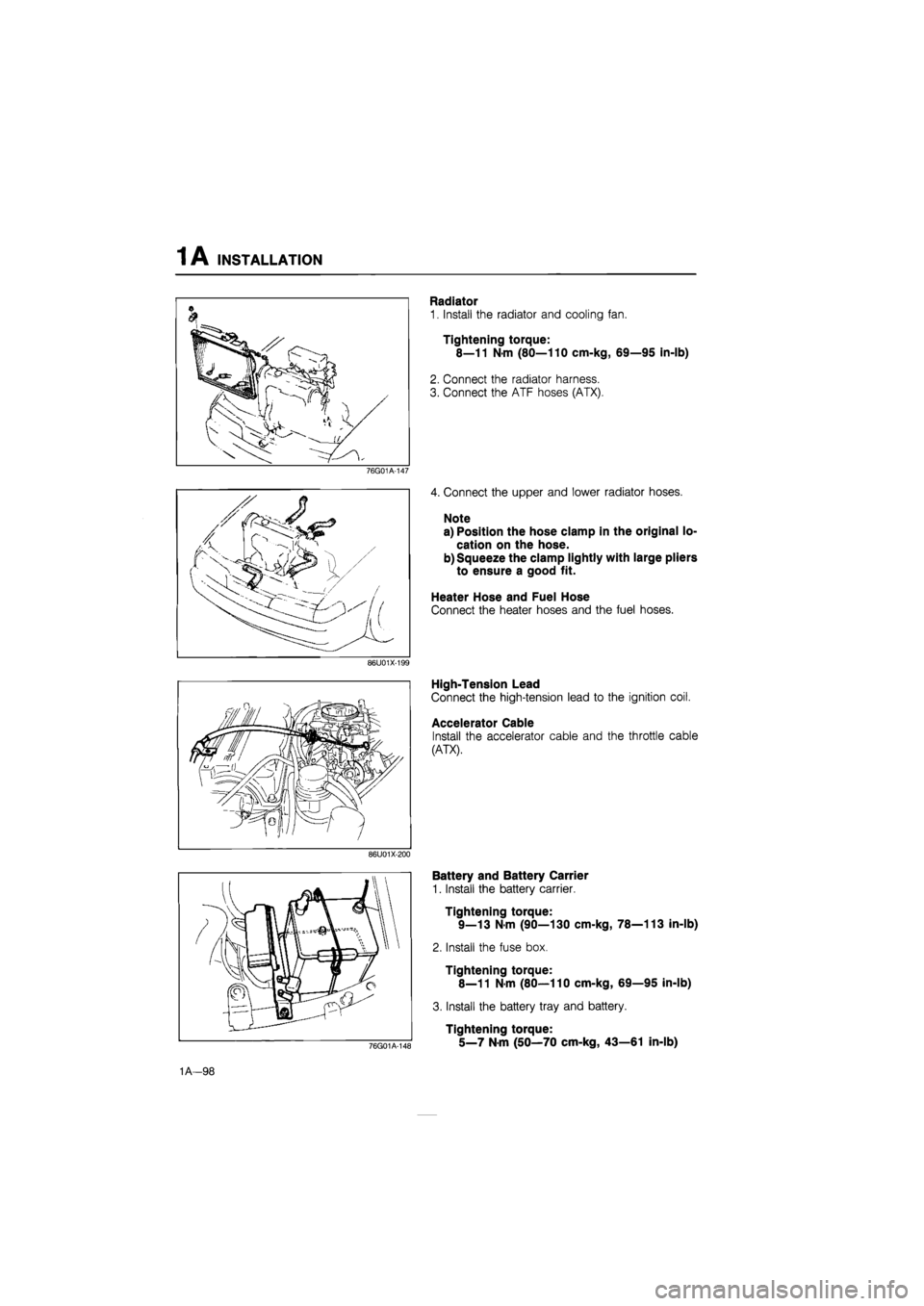
Radiator
1. Install the radiator and cooling fan.
Tightening torque:
8—11 N-m (80—110 cm-kg, 69—95 in-lb)
2. Connect the radiator harness.
3. Connect the ATF hoses (ATX).
4. Connect the upper and lower radiator hoses.
Note
a) Position the hose clamp in the original lo-
cation on the hose.
b) Squeeze the clamp lightly with large pliers
to ensure a good fit.
Heater Hose and Fuel Hose
Connect the heater hoses and the fuel hoses.
High-Tension Lead
Connect the high-tension lead to the ignition coil.
Accelerator Cable
Install the accelerator cable and the throttle cable
(ATX).
76G01A-148
Battery and Battery Carrier
1. Install the battery carrier.
Tightening torque:
9—13 N-m (90—130 cm-kg, 78—113 in-lb)
2. Install the fuse box.
Tightening torque:
8—11 N-m (80—110 cm-kg, 69—95 in-lb)
3. Install the battery tray and battery.
Tightening torque:
5_7 Nm (50—70 cm-kg, 43—61 in-lb)
1A—98
Page 136 of 1865

TUNE-UP PROCEDURE 1 B
76G01A-102
TUNE-UP PROCEDURE
Tune the engine according to the procedures
described below.
Battery
1. Check for corrosion on the terminals, or loose ca-
ble connections.
If necessary, clean the clamps and tighten firmly.
2. Check that the electrolyte level is between the UP-
PER and LOWER marks.
Add distilled water if necessary.
3. Check the specific gravity by using a hydrometer.
If the specific gravity reading is 1.200 or less,
recharge the battery. (Refer to Section 5.)
76G01A-103
Air Cleaner Element
Visually check the air cleaner element for excessive
dirt, damage, or oil. Clean or replace if necessary.
Caution
When cleaning the air cleaner element, blow
dust off from the inside completely first, then
blow from the outside.
76G01B-005
Engine Oil
Check the engine oil level and condition with the oil
level gauge.
Add oil, or change it, if necessary.
4BG01A-010
1B—5
Page 141 of 1865
1 B ON-VEHICLE INSPECTION
76G01B-017
86U01X-020
76G01B-018
Possible Cause
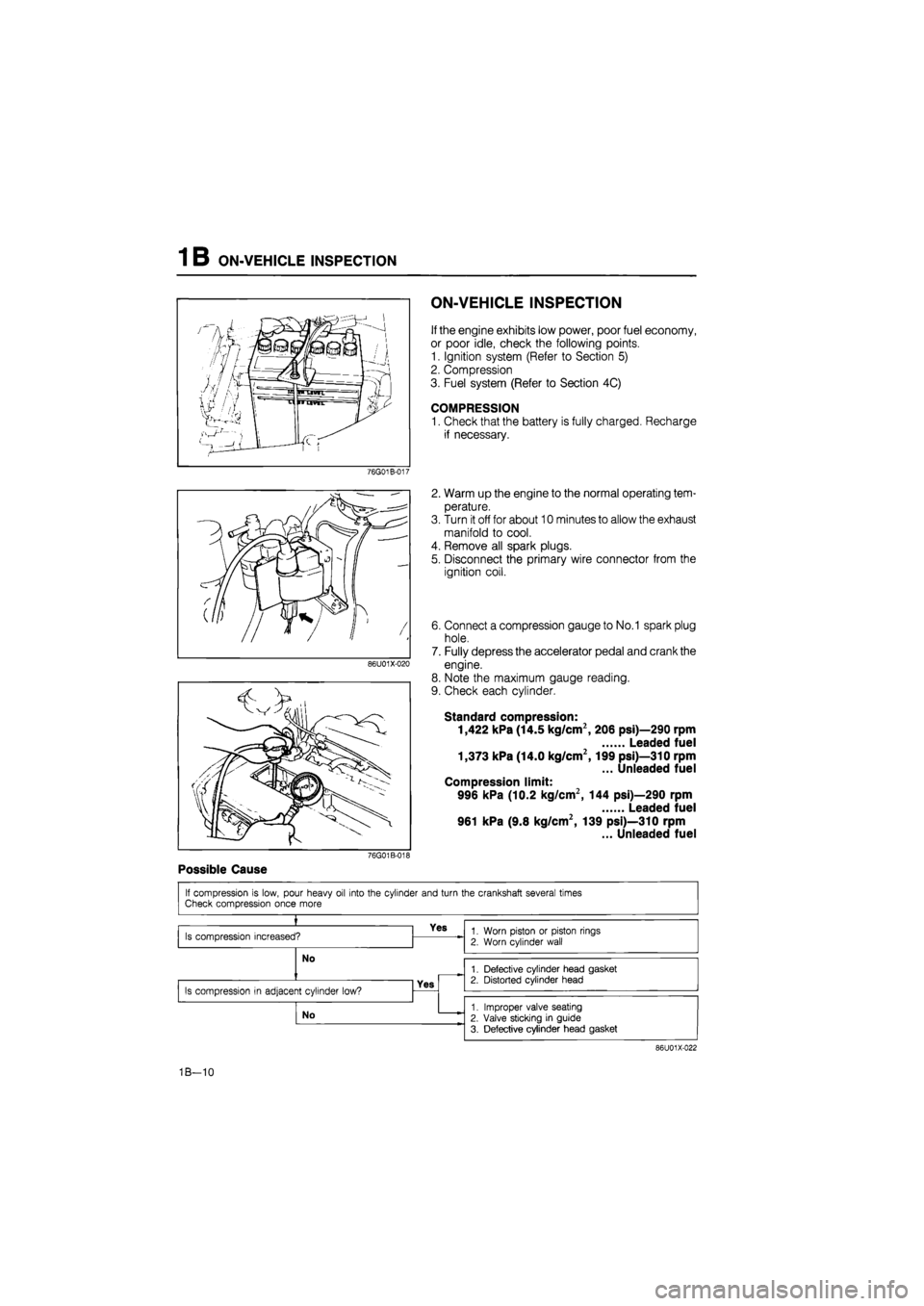
ON-VEHICLE INSPECTION
If the engine exhibits low power, poor fuel economy,
or poor idle, check the following points.
1. Ignition system (Refer to Section 5)
2. Compression
3. Fuel system (Refer to Section 4C)
COMPRESSION
1. Check that the battery is fully charged. Recharge
if necessary.
2. Warm up the engine to the normal operating tem-
perature.
3. Turn it off for about 10 minutes to allow the exhaust
manifold to cool.
4. Remove all spark plugs.
5. Disconnect the primary wire connector from the
ignition coil.
6. Connect a compression gauge to No.1 spark plug
hole.
7. Fully depress the accelerator pedal and crank the
engine.
8. Note the maximum gauge reading.
9. Check each cylinder.
Standard compression:
1,422 kPa (14.5 kg/cm2, 206 psi)—290 rpm
Leaded fuel
1,373 kPa (14.0 kg/cm2,199 psi)—310 rpm
... Unleaded fuel
Compression limit:
996 kPa (10.2 kg/cm2, 144 psi)—290 rpm
Leaded fuel
961 kPa (9.8 kg/cm2, 139 psi)—310 rpm
... Unleaded fuel
If compression is low, pour heavy oil into the cylinder and turn the crankshaft several times Check compression once more
»
Is compression increased? Yes 1. Worn piston or piston rings
2. Worn cylinder wall
No
1. Worn piston or piston rings
2. Worn cylinder wall
No 1. Defective cylinder head gasket 2. Distorted cylinder head
Is compression in adjacent cylinder low? Yes
1. Defective cylinder head gasket 2. Distorted cylinder head
Is compression in adjacent cylinder low?
No 1. Improper valve seating
2. Valve sticking in guide
3. Defective cylinder head gasket
86U01X-022
1B—10
Page 142 of 1865

ON-VEHICLE MAINTENANCE (TIMING BELT) 1 B
ON-VEHICLE MAINTENANCE
TIMING BELT
Removal
1. Disconnect the negative battery cable.
2. Remove in the sequence shown in the figure referring to the removal note for specially marked parts.
76G01A-108
76G01B-020
1. Center cover
2. High-tension lead and spark plug
3. Engine side cover
4. Drive belt
5. Crankshaft pulley
6. Engine mount bracket
7. Upper timing belt cover
8. Lower timing belt cover
9. Baffle plate
10. Timing belt tensioner
11. Timing belt tensioner spring
12. Timing belt
1B—11
Page 147 of 1865

1 B ON-VEHICLE MAINTENANCE (CYLINDER HEAD)
CYLINDER HEAD
Removal
Warning: Release the fuel pressure. (Refer to Section 4C.)
1. Disconnect the negative battery cable.
2. Drain the engine coolant.
3. Remove in the sequence shown in the figure referring to the removal note for specially marked parts.
1B—16
76G01B-034
Page 153 of 1865

1B REMOVAL
REMOVAL
Warning: Release the fuel pressure. (Refer to Section 4C.)
1. Disconnect the negative battery cable.
2. Drain the engine oil and coolant.
3. Remove in the sequence shown in the figure referring to the removal note for specially marked parts.
76G01B-036
1B—22
Page 154 of 1865

REMOVAL 1B
1. Battery and battery carrier
2. Air cleaner assembly
3. High-tension lead
4. Accelerator cable
5. Fuel hose
6. Radiator hose
7. Radiator harness
8. Radiator and electric fan
9. EGI harness
10. Engine harness
11. Brake vacuum hose
12. Canister hose (Unleaded
fuel)
13. Heater hose
14. Transaxle harness
15. Speedometer cable
16. Clutch release cylinder
17. Drive belt
18. A/C compressor and
bracket
19. P/S oil pump
20. Engine side cover
21. Front wheel
22. Tie-rod end
23. Stabilizer control rod
24. Lower arm bushing
25. Driveshaft
26. Change rod
27. Extension bar
28. Exhaust pipe
29. Engine mount
30. Engine and transaxle
31. Transaxle
76G01B-037
Removal Note
Fuel hose
Warning
a) Cover the hose with a rag because fuel will
spray out when disconnecting.
b) Keep sparks and open flame away from the
fuel area.
Plug the disconnected hoses to avoid fuel leakage.
76G01A-11£
P/S pump, A/C compressor
Remove the P/S pump and A/C compressor with the
hoses still connected to them, secure the pump and
compressor as shown in the figure.
67U01X-029
Driveshaft
Remove the driveshafts. (Refer to Section 9.) Slide
the SST into the transaxle.
86U01X-060
1B—23
Page 211 of 1865
1B INSTALLATION
76G01B-113
76G01B-114
76G01B-115
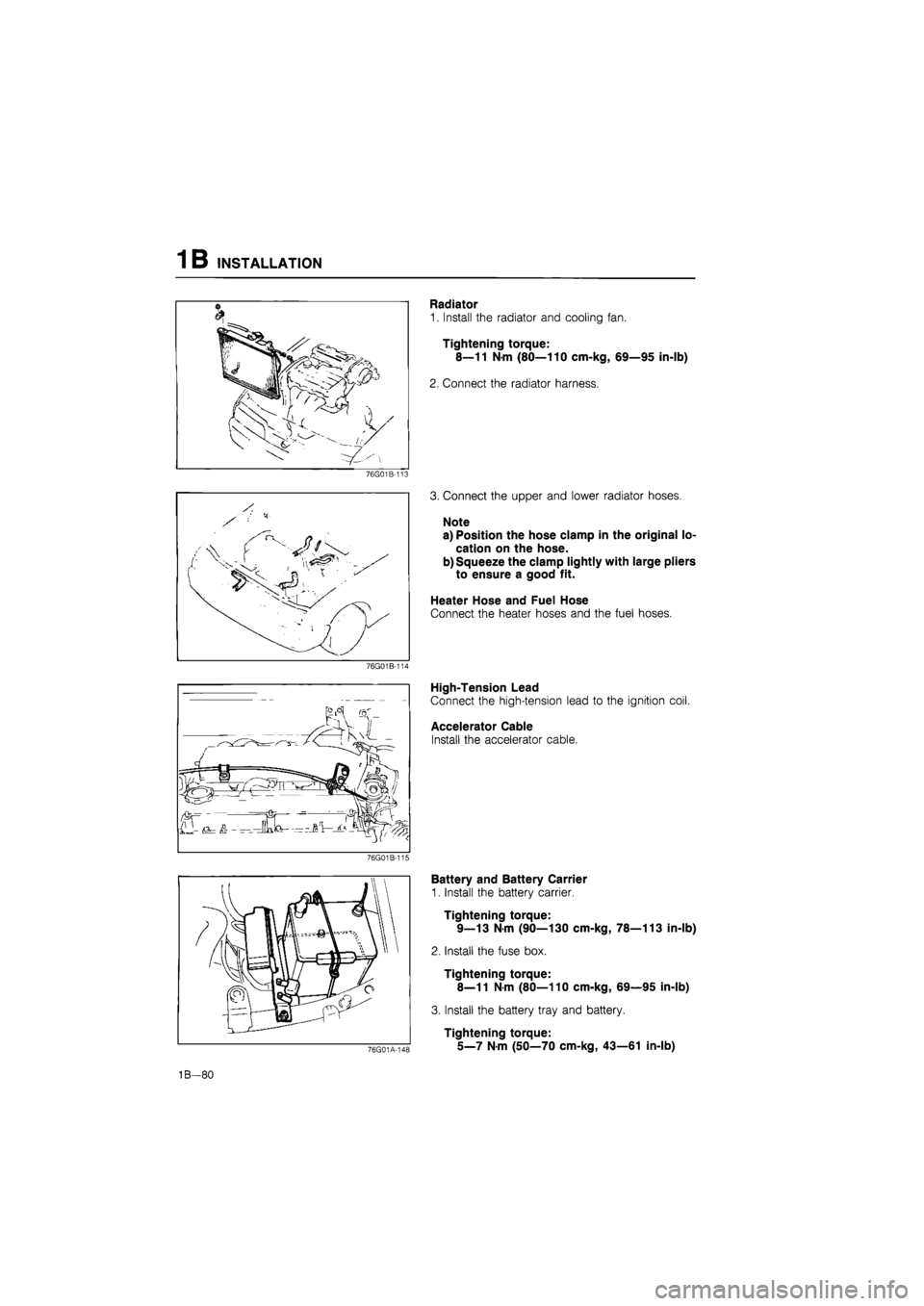
Radiator
1. Install the radiator and cooling fan.
Tightening torque:
8—11 N-m (80—110 cm-kg, 69—95 in-lb)
2. Connect the radiator harness.
3. Connect the upper and lower radiator hoses.
Note
a) Position the hose clamp in the original lo-
cation on the hose.
b) Squeeze the clamp lightly with large pliers
to ensure a good fit.
Heater Hose and Fuel Hose
Connect the heater hoses and the fuel hoses.
High-Tension Lead
Connect the high-tension lead to the ignition coil.
Accelerator Cable
Install the accelerator cable.
76G01A-148
Battery and Battery Carrier
1. Install the battery carrier.
Tightening torque:
9—13 N-m (90—130 cm-kg, 78—113 in-lb)
2. Install the fuse box.
Tightening torque:
8—11
N
m (80—110 cm-kg, 69—95 in-lb)
3. Install the battery tray and battery.
Tightening torque:
5_7
N m
(50—70 cm-kg, 43—61 in-lb)
1B—80