battery MAZDA 626 1987 Repair Manual
[x] Cancel search | Manufacturer: MAZDA, Model Year: 1987, Model line: 626, Model: MAZDA 626 1987Pages: 1865, PDF Size: 94.35 MB
Page 457 of 1865

4A CONTROL SYSTEM
Terminal
(Wire color) Connected to Condition Voltage
I
(LgB)
Idle switch Idle switch
ON
Below 1.5 V I
(LgB)
Idle switch
Idle switch OFF Battery voltage
J
— —
76G04A-174
( I
G
X
C
0
X
H F D B
F6 Engine (Singapore)
Terminal
(Wire color) Connected to Condition Voltage
A
— — —
B
(YL) Ignition coil Ignition switch
ON
and engine running Battery voltage
C
(B)
Ground
— —
D
(GB) Relay Engine speed below approx. 2,100
rpm
Below 1,5V D
(GB) Relay
Engine speed above approx. 2,100
rpm
Battery voltage
F
(BW) Ignition switch Ignition switch
ON
Battery voltage
76G04A-175
4A—92
Page 458 of 1865

CONTROL SYSTEM 4 A
76G04A-176
76G04A-177
76G04A-178
Replacement
1. Disconnect the negative battery cable.
2. Remove the front console covers (right or left).
3. Disconnect the connectors from the control unit.
4. Remove and replace the control unit.
INHIBITOR SWITCH
Inspection
1. Verify that the starter operates with the ignition
switch at START position in
P
and N positions only.
2. Check that the back-up lights illuminate when R
position selected and the ignition switch is ON.
3. If not as specified, check the following:
(1) Jack up the vehicle and support it with safety
stands.
(2) Disconnect the inhibitor switch connector.
(3) Check continuity of the switch with an
ohmmeter.
Connecting guide
Position
N
D,1,2
Connector terminal
O -O
O
O
-O
-O
O—O: indicates continuity
4. Replace if necessary.
IDLE SWITCH
Inspection
1. Warm up the engine and run it at idle.
2. Turn all accessories OFF.
3. Connect a tachometer to the engine.
4. Connect a voltmeter to the carburetor connector
F terminal.
76G04A-179
4A-93
Page 459 of 1865

4A CONTROL SYSTEM
Idle switch
Adjust screw
76G04A-180
76G04A-181
5. Increase the engine speed to more than 2,000 rpm
and decelerate gradually.
6. Check the voltage.
Specification
Engine speed
^^^
FE 8Valve—
Unleaded Fuel
& F6 Sin-
gapore
Others
At idle below 1,5V Battery voltage
Above 1,000—1,100 rpm Battery voltage below 1.5V
7. If the voltage is not within specification, turn the ad-
just screw to adjust.
VACUUM SWITCH
On-Vehicle Inspection
1. Run the engine at idle.
2. Connect a voltmeter to the vacuum switch connec-
tor terminal wire (LB).
Voltage: Approx. 12V
3. Disconnect the vacuum hose from the vacuum
switch, and plug it.
4. Check the voltage.
Voltage: Less than 1.5V
Off-Vehicle Inspection
Inspection
1. Remove the vacuum switch.
2. Connect a vacuum pump to the vacuum switch.
3. Connect an ohmmeterto the vacuum switch, and
check the continuity between the switch terminals.
Vacuum Continuity
MTX: More than 300 mmHg (11.8 inHg) No ATX: More than 200 mmHg (7.9 inHg) No
Others Yes
76G04A-182
4A—94
Page 469 of 1865

TROUBLESHOOTING GUIDE 4B
TROUBLESHOOTING GUIDE
This troubleshooting guide shows the malfunction numbers and the symptoms of various failures.
Perform troubleshooting as described below.
Possible cause
Symptom
Input sensors and switches
o>
C
0
Jh c 01
4B-14
a> 4)
E
o
4B-1S
o in c « m o E k_ 0) c.
0 <0 £
4B-16
o CO c a> 0) o E
a>
.x
co
4B-17
o 10 c a) co
4B-18
o in c a> (0
o> o> a>
a) £ a VI o E
4B-19
0 <0 c a> 0) c a> 01
S? o
4B-20
E a> in (0
o 10 A •o 0) 0> u.
4B-21
Output solenoid valves
o «
3 O) 0)
0) 0) 01
0> > 10 >
•o o c V o tt)
4B-22
0)
OI
0> > CO >
TJ
O c 0> o CO
4B-23
oc O u
o> > 75 >
•o o c a> o 05
4B-23
0 a. 3 1
2
0) > (0 >
"D O
o 0> in in a a >. £
4B-23
ffl a 3 • a>
2
a> > 10 >
"O o c a> o
CO Q. >. JO
4B-24
Fault Indicated by SST
Code No. 01 08 09 10 12 14 15 17 25 26 28 34 35
Hard start or won't start
(Cranks OK)
Engine stalls
Rough
idle
While warming up
After warming up
While warming up
After warming up
High idle speed after
warming up
TROUBLESHOOTING PROCEDURE
Note
Step 1 under symptom is to quickly determine what system or unit may be at fault by use of the SST. (Self-Diagnosis Checker 49 H018 9A1)
1st:
Check input sensors and output solenoid valves with the
SST.
(Refer
to
page 4B—10.)
2nd:
Check other switches with the
SST.
(Refer
to
page 4B—26.)
3rd:
Check the following items:
11
Poor acceleration, hesita-
tion or lack of power
Runs rough on deceleration
Afterburn in exhaust system
Poor fuel consumption
Engine stalls or rough after hot starting
Electrical system
1) Battery condition
2) Fuses
Fuel system
1) Fuel level 2) Fuel leakage
3) Fuel filter 4) Idle speed
Engine
1) Compression 2) Overheating
Ignition system
1) Ignition spark 2) Ignition timing
Intake air system
1)
Air
cleaner element 2) Vacuum
or air
leakage 3) Vacuum hose routing
4) Accelerator cable
Others
1) Clutch slippage 2) Brake dragging
Fails emission test 4th:
Check Fuel and Emission Control Systems. (Refer
to
page 4B—8.)
76G04B-003
4B—7
Page 472 of 1865

4B TROUBLESHOOTING WITH SST
INSPECTION PROCEDURE
1. Connect the SST to the check connector, (Green,
6-pin) and the negative battery terminal.
2. Set the select switch to position A.
Note
The check connector is located at the rear of
the left side wheel housing.
86U04A-011
Test connector: Green (1 pin)
3. Ground the test connector (Green, 1-pin) with a
jumper wire.
Note
The test connector is located near the Self-
Diagnosis Checker check connector.
86U04A-012
OO
uu
SELF-DIAGNOSIS CHECKER
(WPUTOft
SELECT
S*
5
o n==ru
o o o o 49 HO 18 9AI
76G04B-005
4. Turn the ignition switch ON.
5. Verify that 88 flashes on the digital display and that
the buzzer sounds for three seconds after turn-
ing the ignition switch ON.
6. If 88 does not flash, check the main relay (Refer
to page 4B—86), power supply circuit, and check
connector wiring.
7. If 88 flashes and the buzzer sounds continuously
for more than 20 seconds, replace the engine con-
trol unit and perform steps 3 and 4 again.
8. Note the code numbers and check for the causes
by referring to the check sequences shown on
pages from 4B—14 to 4B—24. Repair as
necessary.
Note
Cancel the code numbers by performing the
after-repair procedure after repairing.
AFTER-REPAIR PROCEDURE
1. Cancel the memory of malfunctions by disconnect-
ing the negative battery cable and depressing the
brake pedal for at least 2 seconds; then recon-
nect the negative battery cable.
76G04B-134
4B—10
Page 475 of 1865

TROUBLESHOOTING WITH SST 4B
CODE NUMBER
Malfunction display
Self-diagnosis Fail-safe Code
No. Output signal pattern subsystem Self-diagnosis Fail-safe
01
ON
OFF
Ignition pulse
No ignition signal
08
Air flow meter
Open
or
short circuit
Maintains basic sig-
nal
at
preset value
09
1 111
Water thermo sensor
Open
or
short circuit
Maintains constant command 35°C (95 °F)
10
Intake
air
thermo sensor (air flow meter) Open
or
short circuit
Maintains constant 20°C (68°F) command
12
£_IUILJIIL
Throttle sensor
Open
or
short circuit
Maintains constant
command
of
throttle
valve fully open
14
OFF
TL
I I nil
Atmospheric pres-
sure sensor Open
or
short circuit
Maintains constant command
of
sea level pressure
15
oTp m 11 [U
Oxygen sensor Sensor output con-tinues less than 0.55V 120 sec. after engine starts (1,500 rpm)
Cancels EG
I
feed-
back operation
17
SLJlMJl
Feedback system Sensor output
not
changed
20
sec.
af-
ter engine exceeds 1,500 rpm
Cancels EGI feed-back operation
25
^JMLJl
Solenoid valve (pres-
sure regulator)
Open
or
short circuit
26
SUUBUIL
Solenoid valve (purge control)
Open
or
short circuit 28
£ mi in nr
Solenoid valve
(EGR) Open
or
short circuit
34
^jmiUTT
Air bypass solenoid
valve (Idle-up
C)
Open
or
short circuit
35
0Nnnnj OFFU u UUU
"fin nnr
Air bypass solenoid
valve (Idle-up
B)
Open
or
short circuit
76G04B-008
Caution
a) If there is more than one failure present, the lowest number malfunction code is dis-
played first, the remaining codes are displayed sequentially.
b) After repairing a failure, turn off the ignition switch and disconnect the negative battery
cable and depress the brake pedal for at least 2 seconds to erase the memory of a mal-
function code.
4B-13
Page 484 of 1865

4B TROUBLESHOOTING WITH SST
Code No. 25 (Solenoid valve-Pressure regulator) PC: Possible Cause
Is there battery voltage
at
(RB) wire
of
solenoid valve
connector?
NO
PC: Poor connection
of
connector
or
open circuit
in
wiring harness from (RB) wire
to
main relay (for engine control unit)
YES
PC: Poor connection
of
connector
or
open circuit
in
wiring harness from (RB) wire
to
main relay (for engine control unit)
YES
NO
Is there continuity
of
solenoid valve?
NO
Replace solenoid valve
YES
Is there continuity between solenoid valve and engine control unit?
Solenoid valve Control unit
B (WR wire) 2K
NO
PC: Open circuit
in
wiring harness from solenoid valve
to
engine control unit
YES
PC:
•
Short circuit
in
wiring harness • Engine control unit malfunction
76G04B-017
Code No. 26 (Solenoid valve-Purge)
YES
PC:
•
Short circuit
in
wiring harness • Engine control unit malfunction
76G04B-018
4B—22
Page 488 of 1865
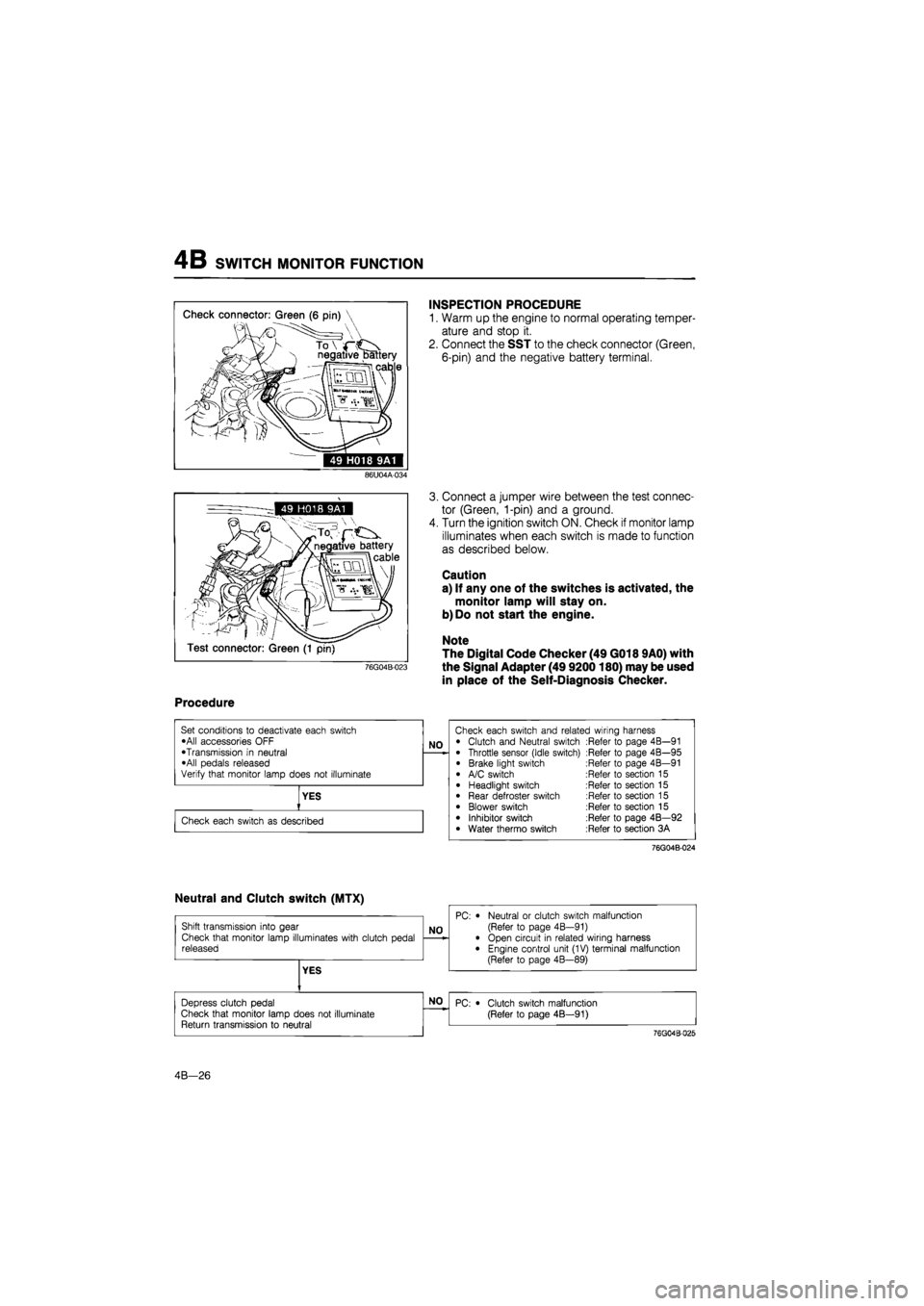
4B SWITCH MONITOR FUNCTION
49 H018 9A1
INSPECTION PROCEDURE
1. Warm up the engine to normal operating temper-
ature and stop it.
2. Connect the SST to the check connector (Green,
6-pin) and the negative battery terminal.
86U04A-034
76G04B-023
3. Connect a jumper wire between the test connec-
tor (Green, 1-pin) and a ground.
4. Turn the ignition switch ON. Check if monitor lamp
illuminates when each switch is made to function
as described below.
Caution
a) If any one of the switches is activated, the
monitor lamp will stay on.
b) Do not start the engine.
Note
The Digital Code Checker (49 G018 9A0) with
the Signal Adapter (49 9200180) may be used
in place of the Self-Diagnosis Checker.
Procedure
76G04B-024
4B—26
Page 500 of 1865

4B IDLE-UP SYSTEM
AIR VALVE
Pre-inspection
1. Start the engine and run it at idle.
2. Pinch the bypass air hose and check that the en-
gine rpm drops.
When engine still cool RPM reduced
After warming-up RPM drop within
200 rpm
3. If the speed is not reduced when cold, check the
air valve, or check for vacuum leaks at the bypass
air hose.
4. If the speed drop is more than 200 rpm when
warm, check the air valve and current to the valve.
Inspection of Terminal Voltage
1. Disconnect the connector from the valve.
2. Remove the rubber boot from the connector.
3. Start the engine and run it at idle.
4. Check that there is battery voltage at terminal (WY),
using a voltmeter.
5. If not correct, check the circuit opening relay and
wiring harness.
76G04B-046
Inspection of Air Valve
1. Check the valve for operation.
Temperature 20°C (68°F) Valve open
(When engine cool)
After warming-up Valve closed
2. Replace valve if faulty.
76G04B-047
4B—38 expert22 Arm http://rutracker.org
Page 501 of 1865
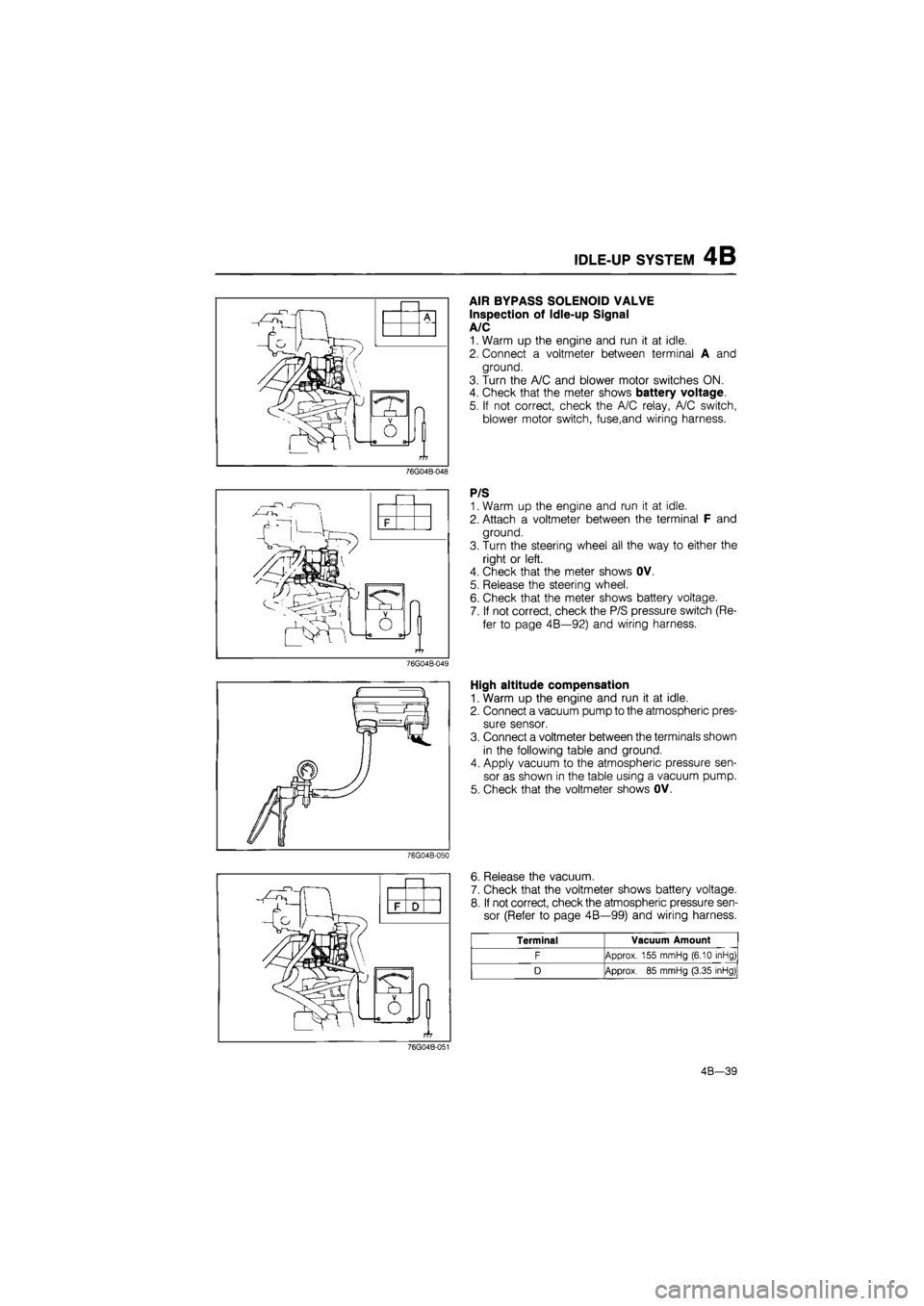
IDLE-UP SYSTEM 4B
AIR BYPASS SOLENOID VALVE
Inspection of Idle-up Signal
A/C
1. Warm up the engine and run it at idle.
2. Connect a voltmeter between terminal A and
ground.
3. Turn the A/C and blower motor switches ON.
4. Check that the meter shows battery voltage.
5. If not correct, check the A/C relay, A/C switch,
blower motor switch, fuse,and wiring harness.
76G04B-048
P/S
1. Warm up the engine and run it at idle.
2. Attach a voltmeter between the terminal F and
ground.
3. Turn the steering wheel all the way to either the
right or left.
4. Check that the meter shows OV.
5. Release the steering wheel.
6. Check that the meter shows battery voltage.
7. If not correct, check the P/S pressure switch (Re-
fer to page 4B—92) and wiring harness.
76G04B-049
High altitude compensation
1. Warm up the engine and run it at idle.
2. Connect a vacuum pump to the atmospheric pres-
sure sensor.
3. Connect a voltmeter between the terminals shown
in the following table and ground.
4. Apply vacuum to the atmospheric pressure sen-
sor as shown in the table using a vacuum pump.
5. Check that the voltmeter shows OV.
76G04B-050
J
O
6. Release the vacuum.
7. Check that the voltmeter shows battery voltage.
8. If not correct, check the atmospheric pressure sen-
sor (Refer to page 4B—99) and wiring harness.
Terminal Vacuum Amount
F Approx. 155 mmHg (6.10 inHg)
D Approx.
85
mmHg (3.35 inHg)
76G04B-051
4B-39