clutch MAZDA 626 1987 Repair Manual
[x] Cancel search | Manufacturer: MAZDA, Model Year: 1987, Model line: 626, Model: MAZDA 626 1987Pages: 1865, PDF Size: 94.35 MB
Page 586 of 1865

SWITCH MONITOR FUNCTION 4C
SWITCH MONITOR FUNCTION
Individual switches can be monitored by the SST (Self-Diagnosis checker 49 G018 9A0 or Digital
code checker 49 9200 180).
Note
The test connector must be grounded and the ignition switch ON (engine stopped).
Engine control unit
76G04C-035
Switch Self-Diagnosis Checker (Monitor lamp) Remark Switch Light ON Light OFF Remark
Clutch switch Pedal released Pedal depressed In gear
Neutral switch In gear Neutral Clutch pedal released
Idle switch Pedal depressed Pedal released —
Headlight switch ON OFF —
Rear defroster switch ON OFF —
Blower switch ON OFF Blower motor position: "3" or "4"
Water thermo switch (Elec-trical fan) Terminal disconnected Terminal connected While fan not operating
4C—25
Page 587 of 1865
4C SWITCH MONITOR FUNCTION
Check connector: (Green, 6 pin)'
N negative battery
ii cable
49 H018 9A1
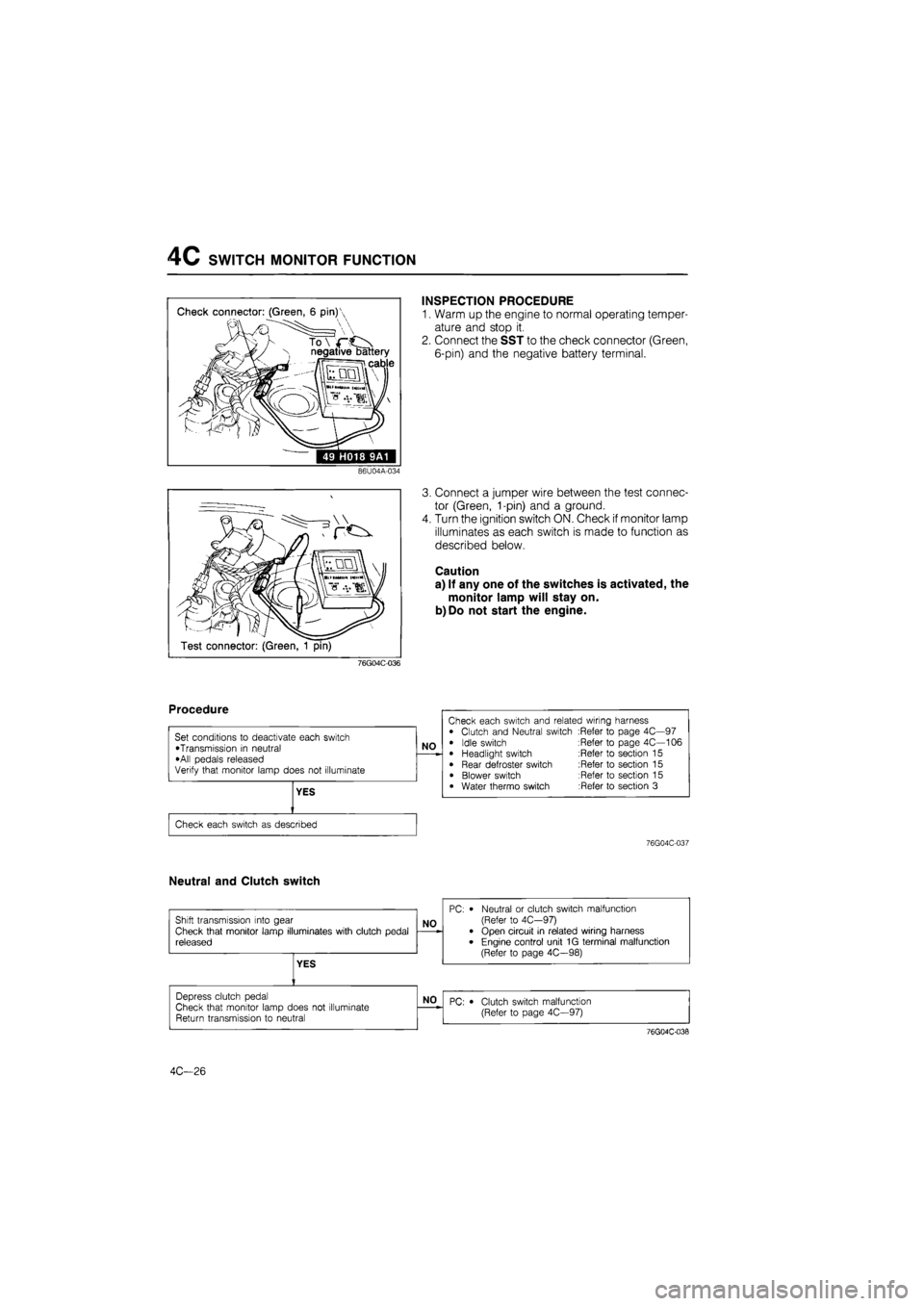
INSPECTION PROCEDURE
1. Warm up the engine to normal operating temper-
ature and stop it.
2. Connect the SST to the check connector (Green,
6-pin) and the negative battery terminal.
86U04A-034
Test connector: (Green, 1 pin)
3. Connect a jumper wire between the test connec-
tor (Green, 1-pin) and a ground.
4. Turn the ignition switch ON. Check if monitor lamp
illuminates as each switch is made to function as
described below.
Caution
a) If any one of the switches is activated, the
monitor lamp will stay on.
b)Do not start the engine.
76G04C-036
76G04C-037
Neutral and Clutch switch
4C—26
Page 606 of 1865

ISC SYSTEM 4C
COMPONENT DESCRIPTION
Component Function Remark
A/C switch Detects air conditioner operation; sends
signal to engine control unit Switch ON when air conditioner
operating
Air valve When cold, supplies bypass air into dy-namic chamber • Engine speed increased to shorten warm-up period • Thermo wax type
• Installed in BAC valve
Clutch switch Detects in-gear condition; sends signal to engine control unit Switch ON when clutch pedal released
E/L control unit Detects that E/L is being applied; sends
signal to engine control unit
Engine control unit Detects signals from input sensors and switches; controls solenoid valve (Idle speed control)
Idle switch Detects when throttle valve fully closed;
sends signal to engine control unit
Installed on throttle body
Ne signal pick-up Detects crank angle at 180° intervals; sends signal to engine control unit Installed in distributor
Neutral switch Detects in-gear condition; sends signal to engine control unit
Switch ON when in gear
P/S pressure switch Detects P/S operation; sends signal to engine control unit Switch ON when steering wheel turned right or left
Solenoid valve (Idle speed control) Controls bypass air amount • Controlled by duty signal from engine control unit • Installed in BAC valve
• Operates idle-up
Test connector For initial idle speed adjustment • Gerrn, 1-pin
• Idle speed feedback control cancelled when connector grounded
Water thermo sensor Detects coolant temperature; sends
signal to engine control unit
76G04C-078
4C—45
Page 611 of 1865

4C FUEL SYSTEM
COMPONENT DESCRIPTION
Component Function Remark
Air flow sensor Detects amount of intake air;
sends signal to engine control unit
Clutch switch Detects in-gear condition; sends signal to engine control unit Switch ON when clutch pedal released
Engine control unit Detects signals from input sensors and switches; controls injector and fuel pump operations
Fuel filter Filters fuel
Fuel pump Provides fuel to injectors • Operates while engine running
• Installed in fuel tank
Fuel pump control unit (4WS) Monitors fuel level in left section; controls transfer pump operation
G signal pick-up Detects No.1 cylinder TDC; sends signal to engine control unit Installed in distributor
Idle switch Detects when throttle valve fully closed; sends signal to engine control unit Installed on throttle body
Ignition switch (ST position) Sends engine cranking signal to engine control unit
Injector Injects fuel into intake port • Controlled by signals from engine control unit • High-ohmic injector
Intake air thermo sensor Detects intake air temperature; send signal to engine control unit
Control relay Supplies electric current to injectors fuel pump and engine control unit
Ne signal pick-up Detects crank angle at 180° intervals; sends signal to engine control unit Installed in distributor
Neutral switch Detects in-gear condition; sends signal to engine control unit
Switch ON when in gear
Oxygen sensor (Unleaded fuel) Detects oxygen concentration; sends signal to engine control unit
• Zirconia ceramic and platinum coating • Integrated heater coil
Pressure regulator Adjusts fuel pressure supplied to injectors
Pulsation damper Absorbs fuel pulsation
Throttle sensor Detects throttle valve opening angle;
sends signal to engine control unit
Installed on throttle body
Transfer pump (4WS) Pumps fuel from the left to the right side Controlled by fuel pump control unit
Transfer pump switch (4WS) Detects fuel level in left section;
sends signal to control unit
Water thermo sensor Detects coolant temperature; sends signal to engine control unit
Water thermo switch (Unleaded fuel) Detects radiator coolant temperature; sends signal to engine control unit ON: above 17°C (63°F)
76G04C-088
4C-50
Page 652 of 1865

CONTROL SYSTEM 4C
CONTROL SYSTEM
Throttle sensor
Solenoid Solenoid Idle valve valve switch (VIC) (PRC)
Solenoid
valve
control)*
Solenoid valve
'(No.1 purge control)*1
E/L control unit
Engine control unit
Control relay
Injector
Knock sensor* -
Water thermo
switch*1
"1...Unleaded fuel
*2...Leaded fuel
Oxygen Distributor Water thermo sensor*1 sensor
Clutch switch
Oxygen sensor
relay*1
Solenoid valve
(EGR)*1
/ Solenoid valve 7 (ISC)
Air flow sensor
Neutral switch
76G04C-166
The control system consists of the input devices and the engine control unit. The control unit controls
the fuel injection amount (EGI), fuel injection pressure, bypass air amount, ignition timing, switch moni-
tor function, and fail-safe function.
4C-91
Page 653 of 1865

4C CONTROL SYSTEM
RELATIONSHIP CHART
Output Devices
and
Input Devices (Unleaded fuel)
IGNITION SWITCH
(ON POSION) X X X X X O X X X X X X X X O
TEST CONNECTOR X X X O X X X X X X X X X O X
ELECTRICAL LOAD CONTROL UNIT X X X o X X X X X X X X X X X
P/S PRESSURE SWITCH X X X o X X X X X X X X X X X
A/C SWITCH X X X o X X X X X X X X O X X
IGNITION SWITCH
(STA POSITION) O O X o O X X X X O X X X O X
NEUTRAL
AND
CLUTCH SWITCH O X X o X X X X X X X X X X X
OXYGEN SENSOR o X X X X X X X X X X X X X X
WATER THERMO
SWITCH (RADIATOR) o X X X X X X X o X X X X X X
INTAKE
AIR
THERMO SENSOR X X X X X X X X X O X X X X X
WATER
THERMO SENSOR o X X o X X o o O O X X X O o
IDLE SWITCH o X X o X X X X X o X X X O X
THROTTLE SENSOR o X X X X X X X O X X X X o X
AIR FLOW SENSOR o X X X X X X o X X X X X o O
Ne SIGNAL o o X O o X X O O O o o X o O
G SIGNAL X O X X X X X X X X X X X X X
\
INPUT
DEVICE
OUTPUT
DEVICE
FUEL
INJECTION
AMOUNT FUEL
INJECTION
TIMING
AIR
VALVE
ISC
VALVE
FUEL
PUMP
CONTROL
MAIN
POWER
CONTROL
SOLENOID
VALVE
(No.1
PURGE)
SOLENOID
VALVE
(No.2
PURGE)
SOLENOID
VALVE
(EGR)
SOLENOID
VALVE
(PRESSURE
REGULATOR
CONTROL)
SOLENOID
VALVE
(VARIABLE
INERTIA
CONTROL)
OXYGEN
SENSOR
RELAY
I A/C
RELAY
IGNITER
AIR
FLOW
SENSOR
(BURN-OFF)
\
INPUT
DEVICE
OUTPUT
DEVICE
INJECTOR
BAC
VALVE
CONTROL
RELAY
SOLENOID
VALVE
(No.1
PURGE)
SOLENOID
VALVE
(No.2
PURGE)
SOLENOID
VALVE
(EGR)
SOLENOID
VALVE
(PRESSURE
REGULATOR
CONTROL)
SOLENOID
VALVE
(VARIABLE
INERTIA
CONTROL)
OXYGEN
SENSOR
RELAY
I A/C
RELAY
IGNITER
AIR
FLOW
SENSOR
(BURN-OFF)
76G04C-167
4C—92
Page 654 of 1865

CONTROL SYSTEM 4C
Output Devices and In put Devices (Leaded fuel)
IGNITION SWITCH
(ON POSITION) X X X X X O X X X X O
TEST CONNECTOR X X X O X X X X X O X
KNOCK SENSOR X X X X X X X X X o X
ELECTRICAL LOAD
CONTROL UNIT X X X O X X X X X X X
P/S PRESSURE SWITCH X X X o X X X X X X X
A/C SWITCH X X X o X X X X O X X
IGNITION SWITCH (STA POSITION) O O X o O X O X X O X
NEUTRAL AND
CLUTCH SWITCH O X X o X X X X X X X
INTAKE AIR THERMO SENSOR X X X X X X O X X X X
WATER THERMO SENSOR O X X o X X O X X O o
IDLE SWITCH o X X o X X o X X O X
VARIABLE RESISTOR (IN AIR FLOW SENSOR) o X X X X X X X X X X
AIR FLOW SENSOR o X X X X X X X X O O
Ne SIGNAL o o X O o X O o X o O
G SIGNAL X O X X X X X X X X X
INPUT
DEVICE
OUTPUT
DEVICE
FUEL
INJECTION
AMOUNT
FUEL
INJECTION
TIMING
AIR
VALVE
ISC
VALVE
FUEL
PUMP
CONTROL
MAIN
POWER
CONTROL
SOLENOID
VALVE
(PRESSURE
REGULATOR
CONTROL)
SOLENOID
VALVE
(VARIABLE
INERTIA
CONTROL)
A/C
RELAY
IGNITER
AIR
FLOW
SENSOR
(BURN-OFF)
INPUT
DEVICE
OUTPUT
DEVICE
INJECTOR
BAC
VALVE
CONTROL
RELAY
SOLENOID
VALVE
(PRESSURE
REGULATOR
CONTROL)
SOLENOID
VALVE
(VARIABLE
INERTIA
CONTROL)
A/C
RELAY
IGNITER
AIR
FLOW
SENSOR
(BURN-OFF)
76G04C-168
4C—93
Page 658 of 1865
CONTROL SYSTEM 4C
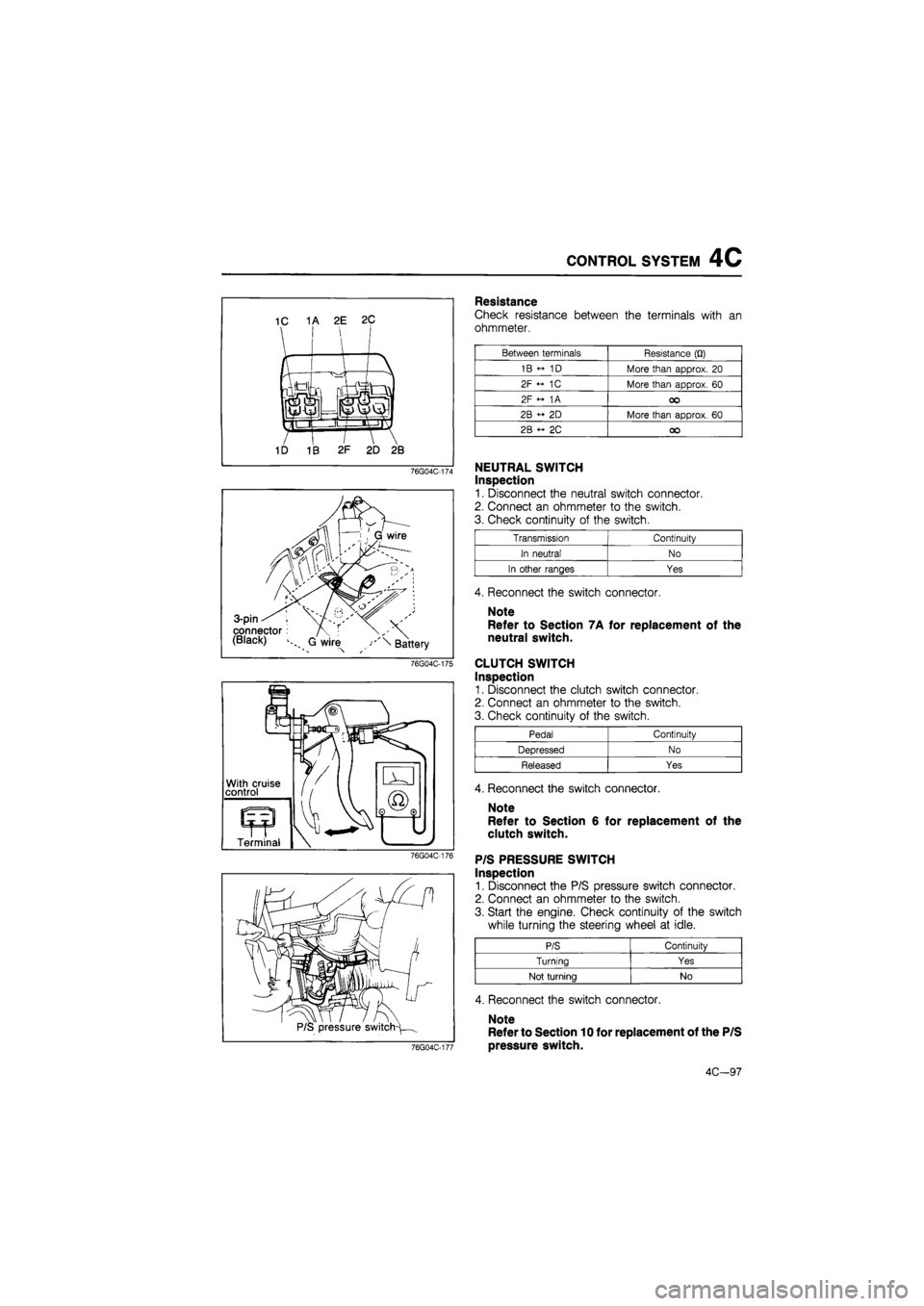
Resistance
Check resistance between the terminals with an
ohmmeter.
Between terminals Resistance (Q)
1B « 1D More than approx. 20
2F <- 1C More than approx. 60
2F « 1A oo
2B « 2D More than approx. 60
2B ~ 2C oo
NEUTRAL SWITCH
Inspection
1. Disconnect the neutral switch connector.
2. Connect an ohmmeter to the switch.
3. Check continuity of the switch.
Transmission Continuity
In neutral No
In other ranges Yes
4. Reconnect the switch connector.
Note
Refer to Section 7A for replacement of the
neutral switch.
CLUTCH SWITCH
Inspection
1. Disconnect the clutch switch connector.
2. Connect an ohmmeter to the switch.
3. Check continuity of the switch.
Pedal Continuity
Depressed No
Released Yes
4. Reconnect the switch connector.
Note
Refer to Section 6 for replacement of the
clutch switch.
P/S PRESSURE SWITCH
Inspection
1. Disconnect the P/S pressure switch connector.
2. Connect an ohmmeter to the switch.
3. Start the engine. Check continuity of the switch
while turning the steering wheel at idle.
P/S Continuity
Turning Yes
Not turning No
4. Reconnect the switch connector.
Note
Refer to Section 10 for replacement of the P/S
pressure switch.
4C-97
Page 660 of 1865

CONTROL SYSTEM 4C
Terminal Voltage
If the input and output devices wiring are normal, but the engine control unit terminal voltage is incor-
rect, replace the engine control unit.
Terminal Input Output Connection to Voltage (After warming-up) Remark Terminal Input Output Connection to Ign: ON Idle Remark
1A — — — — — —
1B o Self-Diagnosis Checker (Code No.)
For 3sec. after ignition switch OFF ->• ON: below 2.5V (Buzzer sounds) After 3sec.: approx. 12V (Buzzer does not sound)
• Using Self-Diagnosis Check-er and test con-nector grounded • Buzzer sounds: below 2.5V • Buzzer does not sound: approx. 12V
1C o
Solenoid valve (Variable inertia control) Approx. 12V
Above 5200 rpm (Unleaded fuel) or 5400 rpm (Leaded fuel): Below 2.5V
1D o Self-Diagnosis Checker (Monitor lamp)
For 3sec.after igni-tion switch OFF -» ON:
approx. 5V (light il-luminates)
After 3sec.: approx. 12V (light does not illuminate)
(Test connector grounded) approx. 5V (Test connector not grounded) Monitor lamp ON: approx. 5V Monitor lamp OFF: approx. 12V
With Self-Diagnosis
Checker
1E O Idle switch Accelerator pedal released: OV
Accelerator pedal depressed: approx. 12V
1F o A/C relay A/C switch ON: below 2.5V
A/C switch OFF: approx. 12V Blower motor ON
1G O Neutral or clutch switch
In-gear condition Clutch pedal depressed: approx. 12V Clutch pedal released: OV
MTX (Neutral: con-stant approx. 12V)
1H
(U/F) o Water thermo
switch
Approx. 12V Radiator temp.: be-low 17°C (63°R 1H
(U/F) o Water thermo
switch OV Radiator temp.:
above 17°C (63°F)
11 o Electrical load control unit E/L switch ON: below 2.5V
E/L switch OFF: approx. 10—12V
Electrical load: Rear defroster switch
Headlight switch Blower motor switch (3rd & 4th position) Electrical fan switch
1J — — — — —
1K o P/S pressure
switch
Constant approx.
12V
P/S ON: below 2.5V P/S OFF: approx. 12V
1L o A/C switch A/C switch ON: below 2.5V A/C switch OFF: aDDrox. 12V Blower motor: ON
1M o Distributor
(Ne signal) OV or 5V Approx. 2.0V
1N o Distributor (G signal) OV or 5V Approx. 1.2V
Note
Terminals labeled "U/F" are only for unleaded fuel.
4C-99
Page 676 of 1865

ON-VEHICLE MAINTENANCE 4D
INJECTION TIMING
1. Disconnect the negative battery cable.
2. Release the CSD using the screw driver.
3. Remove the cover on the clutch housing.
4. Turn the flywheel and set the indicator at TDC.
5. Disconnect the injection pipes from the injection
pump.
76G04D-008
6. Remove the hydraulic head plug from the injec-
tion pump.
7. Mount the SST into the plug hole on the hydraulic
head so the tip of the dial gauge pointer touches
the plunger end of the pump and the dial gauge
indicates approx. 2.0 mm (0.08 in).
76.G04D-009
8. Turn the crankshaft slowly counterclockwise to
30—50° BTDC.
9. Make sure the dial indicator pointer no longer
moves by slightly turning the crankshaft.
10. Set the dial gauge scale to Zero at the pointer.
76G04D-010
11. Turn the crankshaft clockwise to align the indica-
tor pin at ATDC 1° (RF-CX), TDC 0° (RF-N).
12. Read the dial gauge.
Cam lift: 0.98—1.02 mm (0.038—0.040 in)
13. If not within the specification, adjust the injection
timing. (Refer to page 4D—24.)
76G04D-011
4D-5