battery MAZDA 626 1987 Repair Manual
[x] Cancel search | Manufacturer: MAZDA, Model Year: 1987, Model line: 626, Model: MAZDA 626 1987Pages: 1865, PDF Size: 94.35 MB
Page 502 of 1865
4B IDLE-UP SYSTEM
76G04B-052
76G04B-053
76G04B-054
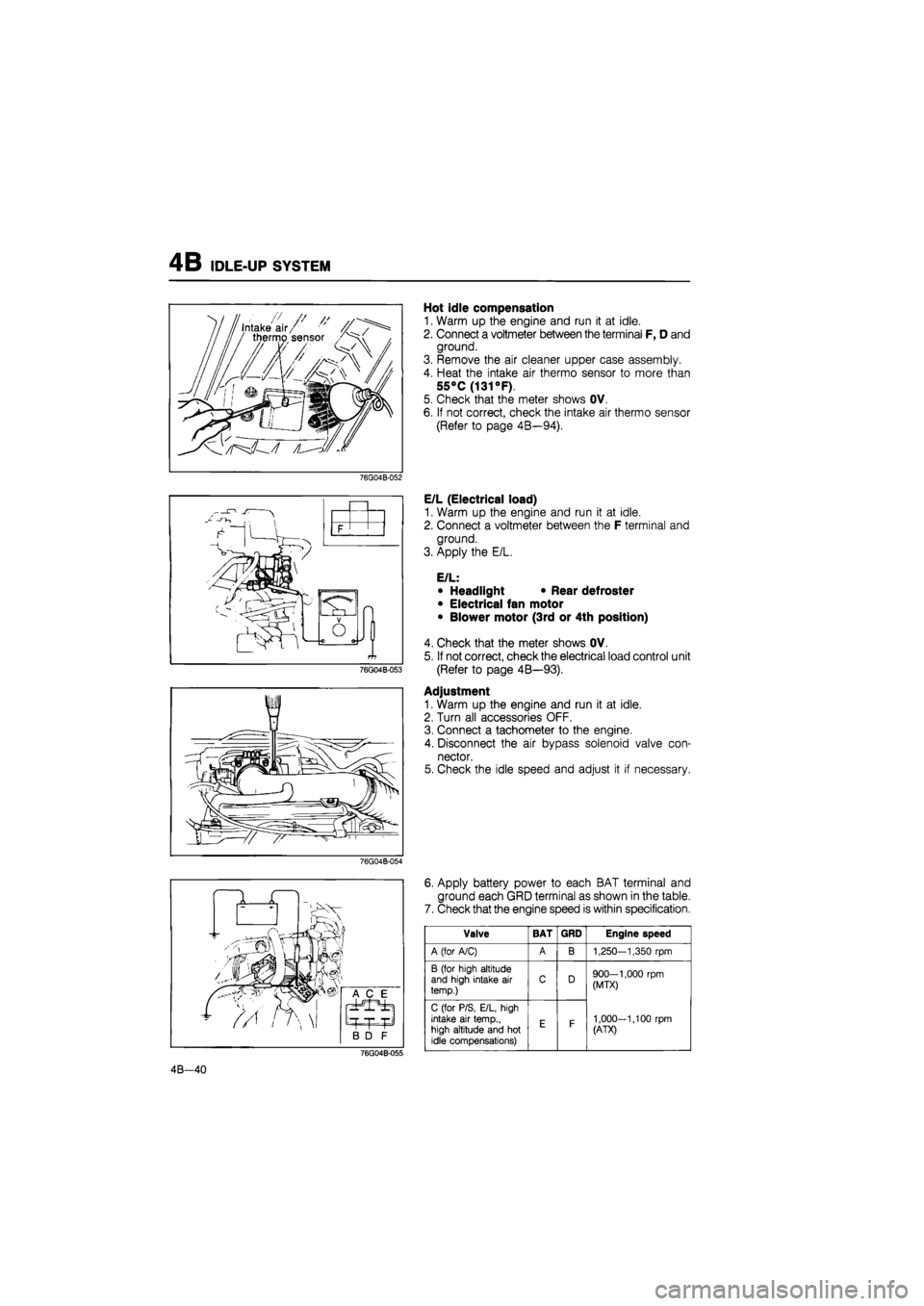
Hot idle compensation
1. Warm up the engine and run it at idle.
2. Connect a voltmeter between the terminal F, D and
ground.
3. Remove the air cleaner upper case assembly.
4. Heat the intake air thermo sensor to more than
55°C
(131
°F).
5. Check that the meter shows OV.
6. If not correct, check the intake air thermo sensor
(Refer to page 4B—94).
E/L (Electrical load)
1. Warm up the engine and run it at idle.
2. Connect a voltmeter between the F terminal and
ground.
3. Apply the E/L.
E/L:
• Headlight • Rear defroster
• Electrical fan motor
• Blower motor (3rd or 4th position)
4. Check that the meter shows OV.
5. If not correct, check the electrical load control unit
(Refer to page 4B—93).
Adjustment
1. Warm up the engine and run it at idle.
2. Turn all accessories OFF.
3. Connect a tachometer to the engine.
4. Disconnect the air bypass solenoid valve con-
nector.
5. Check the idle speed and adjust it if necessary.
6. Apply battery power to each BAT terminal and
ground each GRD terminal as shown in the table.
7. Check that the engine speed is within specification.
76G04B-055
Valve BAT GRD Engine speed
A (for A/C) A B 1,250—1,350
rpm
B (for high altitude and high intake
air
temp.) C D 900—1,000
rpm
(MTX)
1,000-1,100
rpm
(ATX)
C (for P/S, E/L, high intake
air
temp., high altitude and
hot
idle compensations)
E F
900—1,000
rpm
(MTX)
1,000-1,100
rpm
(ATX)
4B—40
Page 504 of 1865
4B FUEL SYSTEM
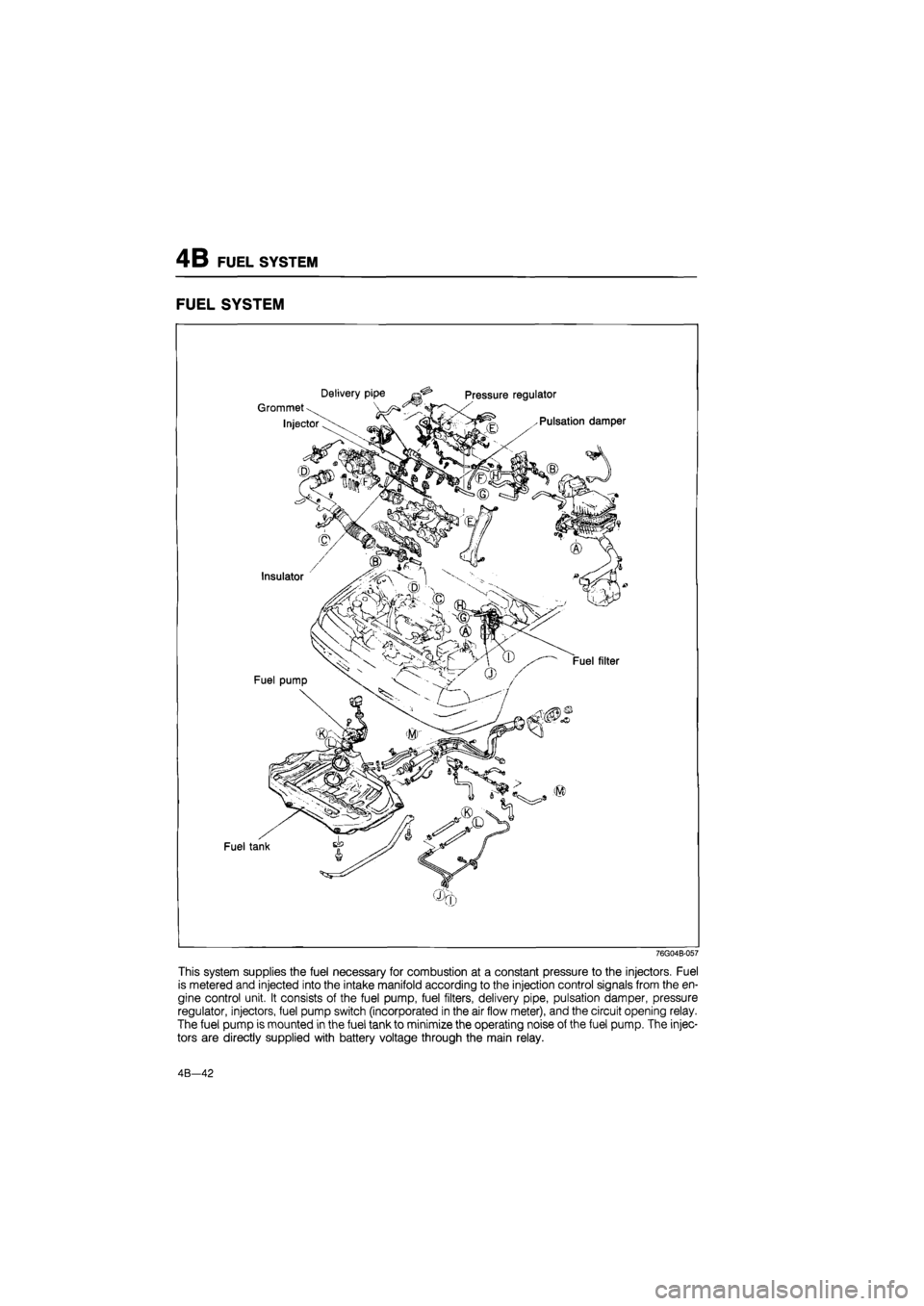
FUEL SYSTEM
76G04B-057
This system supplies the fuel necessary for combustion at a constant pressure to the injectors. Fuel
is metered and injected into the intake manifold according to the injection control signals from the en-
gine control unit. It consists of the fuel pump, fuel filters, delivery pipe, pulsation damper, pressure
regulator, injectors, fuel pump switch (incorporated in the air flow meter), and the circuit opening relay.
The fuel pump is mounted in the fuel tank to minimize the operating noise of the fuel pump. The injec-
tors are directly supplied with battery voltage through the main relay.
4B—42
Page 509 of 1865
FUEL SYSTEM 4B
Pressure .
regulator ^^ \ To multi-pressure tester
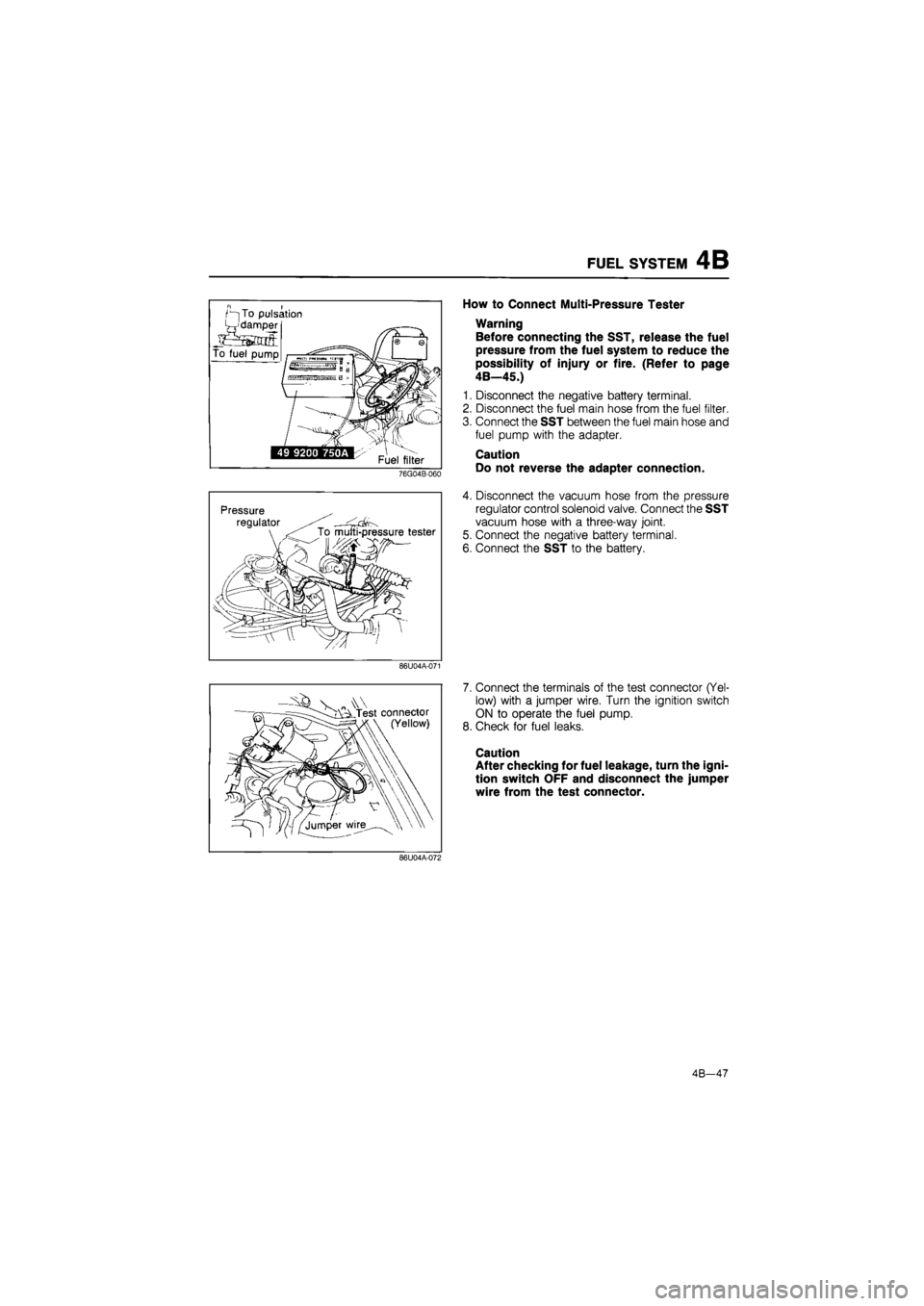
How to Connect Multi-Pressure Tester
Warning
Before connecting the SST, release the fuel
pressure from the fuel system to reduce the
possibility of injury or fire. (Refer to page
4B—45.)
1. Disconnect the negative battery terminal.
2. Disconnect the fuel main hose from the fuel filter.
3. Connect the SST between the fuel main hose and
fuel pump with the adapter.
Caution
Do not reverse the adapter connection.
4. Disconnect the vacuum hose from the pressure
regulator control solenoid valve. Connect the SST
vacuum hose with a three-way joint.
5. Connect the negative battery terminal.
6. Connect the SST to the battery.
86U04A-071
v *
- i\zLTest connector (Yellow)
7. Connect the terminals of the test connector (Yel-
low) with a jumper wire. Turn the ignition switch
ON to operate the fuel pump.
8. Check for fuel leaks.
Caution
After checking for fuel leakage, turn the igni-
tion switch OFF and disconnect the jumper
wire from the test connector.
86U04A-072
4B—47
Page 514 of 1865
4B FUEL SYSTEM
v - \\N . Test connector
VW^^^^^^AX (Yellow)
76G04B-070
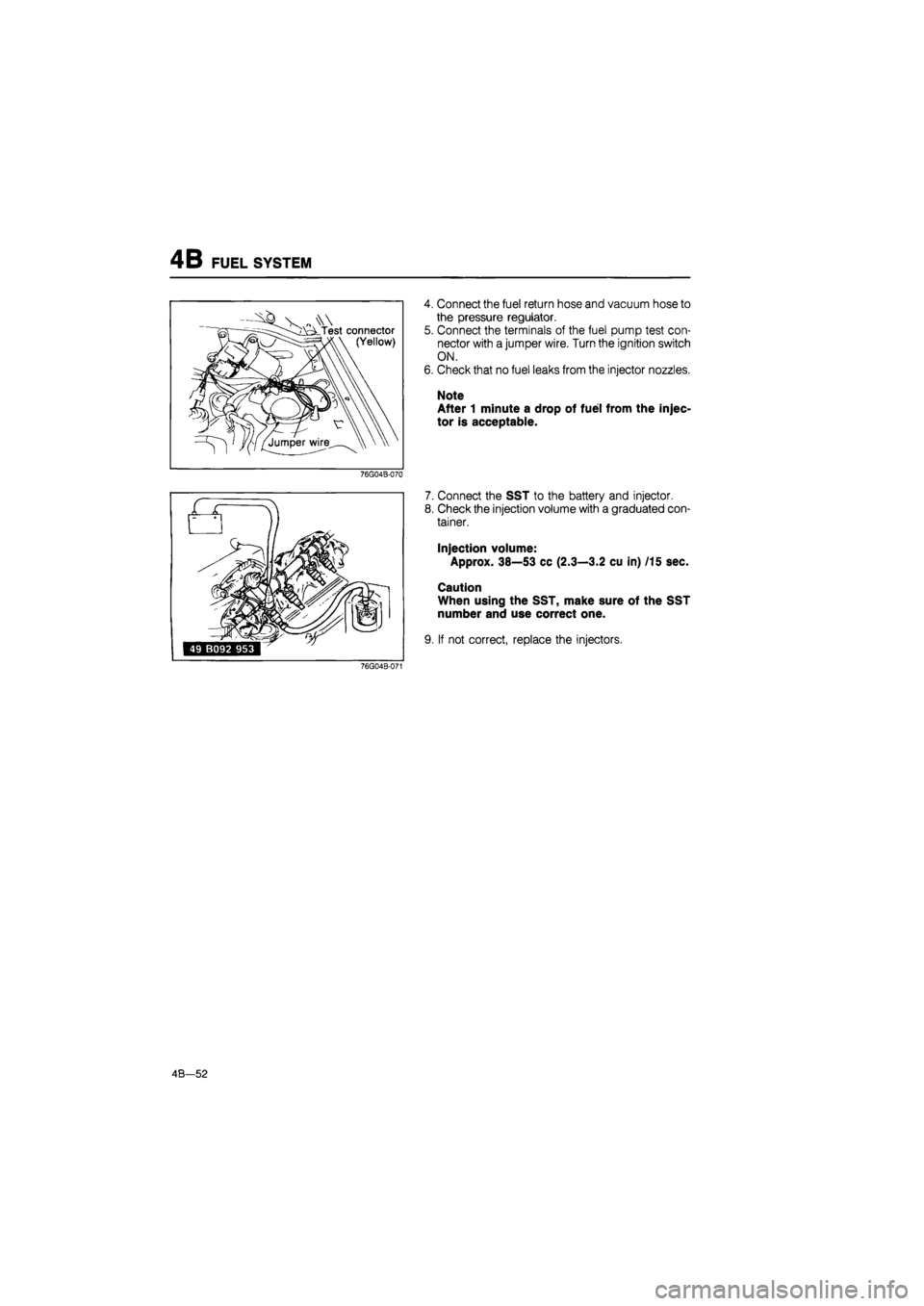
4. Connect the fuel return hose and vacuum hose to
the pressure regulator.
5. Connect the terminals of the fuel pump test con-
nector with a jumper wire. Turn the ignition switch
ON.
6. Check that no fuel leaks from the injector nozzles.
Note
After 1 minute a drop of fuel from the injec-
tor is acceptable.
7. Connect the SST to the battery and injector.
8. Check the injection volume with a graduated con-
tainer.
Injection volume:
Approx. 38—53 cc (2.3—3.2 cu in) /15 sec.
Caution
When using the SST, make sure of the SST
number and use correct one.
9. If not correct, replace the injectors.
76G04B-071
4B-52
Page 548 of 1865

4B CONTROL SYSTEM
69G04A-161
86U04A-169
76G04B-130
EGI MAIN FUSE
Inspection
Check the continuity of EGI main fuse.
MAIN RELAY
1. Check that a "clicking" sound is heard at the main
relay when turning the ignition switch ON and OFF.
2. Apply 12V and a ground to (A) and (B) terminals
of the main relay.
3. Check continuity at terminals using an ohmmeter.
-Operation
Terminals 12V Not applied 12V Applied
©- ® No continuity Continuity
CIRCUIT OPENING RELAY
Relay Circuit
1. Remove the circuit opening relay.
2. Check the circuit as described.
Terminal Checkina item Correct result
FD Resistance 0.2-300
Fc Continuity (crankinnl oo
B Voltaae (Ian: ON) Batterv voltaae
STA Voltaae (Crankincri Approx. 9V
Ei Continuity oo
Circuit Opening Relay
Apply 12V and a ground to the terminals below and
check the circuit opening relay as described.
12V Grounded Correct result
STA Ei B FP: Continuity
B Fc Fp: Battery voltage
Resistance
Check the resistance between the terminals using an
ohmmeter.
69G04A-164
Between terminals Resistance (Q)
STA <- E1 15-30
B
<-<•
Fc 80-150
B « Fp 00
4B—86
Page 550 of 1865

4B CONTROL SYSTEM
Terminal Voltage
If the input and output devices and related wiring are normal, but the engine control unit terminal volt-
age is incorrect, replace the engine control unit.
Terminal Input Output Connection to Voltage (After warming-up) Remarks Terminal Input Output Connection to IGN: ON Idle Remarks
1A — — — — —
1B o Self-Diagnosis Checker (Code number)
For 3sec. after ignition switch OFF ->• ON: below 6.2V (Buzzer sounds) After 3sec.: Battery voltage (Buzzer does not sound)
• Using Self-Diagnosis Check-er and test con-nector grounded • Buzzer sounds: below 6.2V • Buzzer does not sound: Battery voltage
1C — — — — —
1D o Self-Diagnosis Checker (Monitor lamp)
Test connector grounded
For 3sec. after igni-tion switch OFF ON:
below 6.2V (light il-luminates) After 3sec.: Battery voltage (light does not illuminate)
(Test connector grounded) approx. 10V (Test connector not grounded) Monitor lamp ON: below 6.2V Monitor lamp OFF: Battery voltage
With Self-Diagnosis
Checker
1E O Idle switch Accelerator pedal released: below 1.5V
Accelerator pedal depressed: Battery voltage
1F o A/C relay A/C switch ON: below 2.5V A/C switch OFF: Battery voltage
Blower motor ON
1G — — — — —
1H o Water thermo switch Below 1,5V Radiator temp.:
above 17°C (63°F)
11 o Electrical load con-trol unit Electrical load ON: below 1.5V Electrical load OFF: Battery voltage Electrical load: Rear defroster Headlight Blower motor (3rd & 4th position) Electrical fan
1J o Brake light switch Brake pedal released: below 1.5V
Brake pedal depressed: battery voltage
1K — — — — — —
1L o A/C switch A/C switch ON: below 1.5V
A/C switch OFF: battery voltage
Blower motor: ON
1M o Ignition coil © terminal Battery voltage *1 Battery voltage *1 Engine Signal Monitor: green and red lights flash
1N — — — — —
10 — — — —
4B-88
Page 551 of 1865

CONTROL SYSTEM 4B
Terminal Input Output Connection to Voltage (After warming-up) Remarks Terminal Input Output Connection to IGN: ON Idle Remarks
1P — — — — —
1Q — — — — —
1R — — — — —
1S o Air bypass solenoid valve (Idle-up C) and P/S pressure switch
Battery voltage While solenoid ON (Refer to page 4B—35): below 1.5V
1T — — — — —
1U — — — — —
1V 0 MTX
Neutral and clutch switch
In-gear condition Clutch pedal depressed: battery voltage Clutch pedal released: below 1,5V
Neutral: constant battery voltage
1W O Test connector Test connector grounded: below 1,5V Test connector not grounded: battery voltage Green connector, 1-pin
1X — — — — —
2A o V ref 4.5—5.5V
2B 0 Air flow meter (Vc) 6-10V
2C — — Ground (E2) Approx. OV
2D o Oxygen sensor OV 0-1.OV • Cold engine: 0V at idle • After warming-up: Increase engine speed: 0.5—1.0V Deceleration: 0—0.4V
2E 0 Air flow meter (Vs) Approx. 1.7V Approx. 3—5V Increase engine speed:
voltage increases
2F — -— — —
2G 0 Throttle sensor Accelerator pedal released:
0.4—0.6 V
2H 0 Atmospheric pres-sure sensor At sea level: approx. 4.0V
21 0 Water thermo sensor 0.3—0.6 V Engine coolant temp. 20°C (68°F): approx. 2.5V
2J o Air flow meter (In-
take air thermo
sensor)
Approx. 2.3V at 20°C (68°F)
2K o Solenoid valve (Pres-
sure regulator
control)
For 120 sec. after ignition switch OFF - ON: below 1.5V
For 120 sec. after
starting: below 1.5V
Hot condition: Cool-ant temp, above 70°C (158°F) Intake air temp, above 10°C (50°F)
2K o Solenoid valve (Pres-
sure regulator
control)
Battery voltage Other conditions
2L — — — — —
2M — — —
4B-89
Page 552 of 1865

4B CONTROL SYSTEM
Terminal Input Output Connection to Voltage (After warming-up) Remarks Terminal Input Output Connection to IGN: ON Idle Remarks
2N o Solenoid valve (EGR) Below 1,5V • Cold engine: be-low 1,5V Radiator coolant temp.—below 17°C (63°F) or Engine coolant temp.—below 70°C (158°F)
• Engine above ap-prox. 1,500 rpm: Battery voltage
20 o Air bypass solenoid valve (Idle-up B) Battery voltage While solenoid ON (Refer to page 4B-35): below 1.5 V
2P o Solenoid valve
(Purge control valve)
Battery voltage • Medium and high
load: below 1,5V
2Q — — — —
2R — — Ground (E02) Below 1,5V
3A — — Ground (E01) Below 1.5V
3B O Ignition switch (Start position) Below 1,5V While cranking: bat-
tery voltage
3C o Injector (No. 4 and No. 2) Battery voltage *1 Battery voltage *1 Engine Signal Monitor green and red lights flash
3D o Inhibitor switch "N" or "P" range: below 2.0V
Other ranges: battery voltage
ATX
3E o Injector (No. 1 and No. 3) Battery voltage *
1
Battery voltage *1 Engine Signal Monitor: green and red lights flash
3F -— — — —
3G — Ground (Ei) Below 1.5V
3H — — — —
31 o — Ma ri relay Battery voltage
3J — — Battery Battery voltage For back-up
76G04B-110
31 3G 3E 3C 3A
3J 3H 3F 3D 3B
2Q 20 2M 2K 21 2G 2E 2C 2A
2R 2P 2N 2L 2J 2H 2F 2D 2B
1W 1U 1S 1Q 10 1M 1K 11 1G 1E 1C 1A
1X 1V 1T 1R 1P 1N 1L 1J 1H 1F 1D 1B
4B—90
Page 553 of 1865

CONTROL SYSTEM 4B
Replacement
1. Disconnect the negative battery cable.
2. Remove the front console covers (right and left).
3. Disconnect the connectors from the control unit.
4. Replace the control unit.
NEUTRAL SWITCH
Inspection
1. Disconnect the neutral switch connector.
2. Connect an ohmmeter to the switch.
3. Check continuity of the switch.
Transmission Continuity
In neutral No
In other ranges Yes
4. After checking, connect the switch connector.
Note
Refer to section 7A for replacement of the
neutral switch.
CLUTCH SWITCH
Inspection
1. Disconnect the clutch switch connector.
2. Connect an ohmmeter to the switch.
3. Check continuity of the switch.
Pedal Continuity
Depressed No
Released Yes
4. After checking, connect the switch connector.
Note
Refer to section 6 for replacement of the
clutch switch.
BRAKE LIGHT SWITCH
Inspection
1. Disconnect the brake light switch connector.
2. Connect an ohmmeter to the switch.
3. Check the continuity of the switch.
Pedal Continuity
Depressed Yes
Released No
4. After checking, connect the switch connector.
Note
Refer to section 11 for replacement of the
brake switch.
4B-91
Page 555 of 1865

4B CONTROL SYSTEM
E/L CONTROL UNIT
Inspection
1. Connect a voltmeter between the E/L control unit
and ground.
2. Start the engine and check the terminal voltages
as described below.
69G04A-174
Terminal Input Output Connection to Voltage (after warm-up) Remarks Terminal Input Output Connection to Ignition switch: ON idle Remarks
A
(BW) — — Ignition switch Battery voltage
B — — — — — —
C
(B) — — Ground OV
D (LY) 0 Electrical fan relay
Battery voltage Coolant temp.: below 97°C (207°F) D (LY) 0 Electrical fan relay
Below 1,5V Coolant temp.:
above 97°C (207°F)
E
(GY) o Engine control unit
(11)
OV E/L: ON E
(GY) o Engine control unit
(11) Battery voltage E/L: OFF
F (RB) 0 Headlight switch
Battery voltage Headlight switch:
ON F (RB) 0 Headlight switch
Below 1,5V Headlight switch:
OFF
G (LB) 0 Blower motor switch
Below 1,5V Blower motor switch: ON (3rd or 4th position) G (LB) 0 Blower motor switch
Approx. 5V Others
H
(BL) 0 Rear defroster switch
Below 1,5V Rear defroster switch: ON H
(BL) 0 Rear defroster switch Battery voltage Rear defroster switch: OFF
76G04B-131
Replacement
1. Remove the engine control unit. (Refer to page
4B-91)
2. Replace the E/L control unit.
3. Install in the reverse order of removal.
4B—93