warning MAZDA CX90 2024 Owners Manual
[x] Cancel search | Manufacturer: MAZDA, Model Year: 2024, Model line: CX90, Model: MAZDA CX90 2024Pages: 687, PDF Size: 15.46 MB
Page 634 of 687
Add-On Non-GenuineParts and Accessories
Non-genuine parts and accessories for
Mazda vehicles can be found in stores.
These may fit your vehicle, but they are
not approved by Mazda for use with
Mazda vehicles. When you install
non-genuine parts or accessories, they
could affect your vehicle's
performance or safe ty systems; the
Mazda warranty doesn't cover this.
Before you install any non-genuine
parts or accessories, consult an
Authorized Mazda Dealer.
WARNING
Always consult an Authorized Mazda
Dealer before you install non-genuine
parts or accessories.
Improperly designed parts or
accessories could seriously affect your
vehicle's performance or safety
systems. This could cause you to have
an accident or increase your chances of
injuries in an accident.
Be very careful in choosing and
installing add-on electrical
equipment, such as mobile
telephones, two-way radios, stereo
systems, and car alarm systems.
Incorrectly choosing or installing
improper add-on equipment or
choosing an improper installer is
dangerous. Essential systems could be
damaged, causing engine stalling ,
air-bag (SRS) activation,
ABS/TCS/DSC inactivation, or a fire in
the vehicle.
Mazda assumes no responsibility for
death, injury, or expenses that may
result from the installation of add-on
non-genuine parts or accessories.
Specifications/Customer Information and Reporting Safety Defects
Warranty
10-25
CX-90_8KG7-EA-22L_Edition1_new 2022-11-17 16:05:04
Page 635 of 687
Cell Phones Warning
WARNING
Please comply with the legal
regulations concerning the use of
communication equipment in vehicles
in your country.
Use of any electrical devices such as
cell phones, computers, portable
radios, vehicle navigation or other
devices by the driver while the vehicle
is moving is dangerous. Dialing a
number on a cell phone while driving
also ties-up the driver's hands. Use of
these devices will cause the driver to
be distracted and could lead to a
serious accident. If a passenger is
unable to use the device, pull off the
right-of-way to a safe area before use.
If use of a cell phone is necessary
despite this warning, use a hands-free
system to at least leave the hands free
to drive the vehicle. Never use a cell
phone or other electrical devices while
the vehicle is moving and, instead,
concentrate on the full-time job of
driving.
Specifications/Customer Information and Reporting Safety Defects
Cell Phones
10-26
CX-90_8KG7-EA-22L_Edition1_new2022-11-17 16:05:04
Page 637 of 687

Traction-AA, A, B, C
The traction grades, from highest to
lowest, are AA, A, B, and C. These
grades represent the tire's ability to
stop on wet pavement as measured
under controlled conditions on
specified government test surfaces of
asphalt and concrete. A tire marked C
may have poor traction performance.
WARNING
The traction grade assigned to this tire
is based on braking (straight ahead)
traction tests and does not include
acceleration cornering (turning),
hydroplaning, or peak traction
characteristics.
Temperature-A, B, C
The temperature grades A (the
highest), B, and C, represent the tire's
resistance to the generation of heat
and its ability to dissipate heat when
tested under controlled conditions on
a specified indoor laboratory test
wheel.
Sustained high temperature can cause
the material of the tire to degenerate
and reduce tire life, and excessive
temperatures can lead to sudden tire
failure.
Grade C corresponds to a level of
performance which all passenger
vehicle tires must meet under the
Federal Motor Vehicle Safety Standard
No. 109. Grades B and A represent
higher levels of performance on the
laboratory test wheel than the
minimum required by law.
WARNING
Keep your vehicle's tires properly
inflated and not overloaded.
Driving with improperly inflated or
overloaded tires is dangerous.
Excessive speed, underinflation, or
excessive loading, either separately or
in combination, can cause heat
buildup and possible tire failure. The
temperature grade for this tire is
established for a tire that is properly
inflated and not overloaded.
These grades will be added to the
sidewalls of passenger vehicle tires
over the next several years according to
a schedule established by the NHTSA
and the tire manufacturers.
Specifications/Customer Information and Reporting Safety Defects
Uniform Tire Quality Grading System (UTQGS)
10-28
CX-90_8KG7-EA-22L_Edition1_new 2022-11-17 16:05:04
Page 639 of 687

Tire Labeling
Federal law requires tire manufacturers
to place standardized information on
the sidewall of all tires. This
information identifies and describes
the fundamental characteristics of the
tire and also provides a tire
identification number for safety
standard certification and in case of a
recall.
Information on PassengerVe h i c l e Ti re s
Please refer to the sample below.
1. SAFETY WARNING
2. Passenger car tire
3. Nominal width of tire in millimeters
4. Ratio of height to width (aspectratio)
5. Radial
6. Run-flat tire
7. Rim diameter code
8. TIN: U.S. DOT tire
identification
number
9. Load index & speed symbol
10.Severe snow conditions
11.Tire ply composition and materials used
12.Max. load rating
13.Tread wear, traction and temperature grades
14.Max. permissible inflation pressure
P215/65R15 95H is an example of a
tire size and load index rating. Here is
an explanation of the various
components of that tire size and load
index rating. Note that the tire size and
load index rating may be different from
the example.
Specifications/Customer Information and Reporting Safety Defects
Tire Information (U.S.A.)
10-30
CX-90_8KG7-EA-22L_Edition1_new 2022-11-17 16:05:04
Page 641 of 687

Tire Ply Composition and Materials
Used
The number of plies indicates the
number of layers of rubber-coated
fabric in the tire. In general, the greater
the number of plies, the more weight a
tire can support. Tire manufacturers
also must indicate the tire materials,
which include steel, nylon, polyester,
and other.
Maximum Load Rating
This number indicates the maximum
load in kilograms and pounds that can
be carried by the tire.
Maximum Permissible Inflation
Pressure
This number is the greatest amount of
air pressure that should ever be put in
the tire under normal driving
conditions.
Tread Wear, Traction and Temperature
Grades
Trea d wea r : The tread wear grade is a
comparative rating based on the wear
rate of the tire when tested under
controlled conditions on a specified
government test course. For example,
a tire graded 150 would wear one and
one-half (1 1/2) times as well on the
government course as a tire graded
100.
Tra c t i o n : The traction grades, from
highest to lowest are AA, A, B, and C.
The grades represent the tire's ability
to stop on wet pavement as measured
under controlled conditions on
specified government test surfaces of
asphalt and concrete. A tire marked C
may have poor traction performance.
Temperature: The temperature grades
are A (the highest), B and C,
representing the tire's resistance to the
generation of heat and its ability to
dissipate heat when tested under
controlled conditions on a specified
indoor laboratory test wheel.
Snow Tires
In some heavy snow areas, local
governments may require true snow
tires, those with very deeply cut tread.
These tires should only be used in pairs
or placed on all four wheels. Make
sure you purchase snow tires that are
the same size and construction type as
the other tires on your vehicle.
SAFETY WARNING
The following safety warning appears
on the tire's sidewall.
SERIOUS INJURY MAY RESULT FROM:
EXPLOSION OF TIRE/RIM ASSEMBLY
DUE TO IMPROPER
MOUNTING-MATCH TIRE
DIAMETER TO RIM DIAMETER;
NEVER EXCEED 40 psi (275 kPa) TO
SEAT BEADS-ONLY SPECIALLY
TRAINED PERSONS SHOULD
MOUNT TIRES.
TIRE FAILURE DUE TO UNDER-INFLATION/
OVERLOADING/DAMAGE-FOLLOW
OWNER'S MANUAL AND PLACARD
IN VEHICLE-FREQUENTLY CHECK
INFLATION PRESSURE AND INSPECT
FOR DAMAGE.
Specifications/Customer Information and Reporting Safety Defects
Tire Information (U.S.A.)
10-32
CX-90_8KG7-EA-22L_Edition1_new 2022-11-17 16:05:04
Page 643 of 687

Location of the Tire Label(Placard)
You will find the tire label containing
tire inflation pressure by tire size and
other important information on the
driver's side B-pillar or on the edge of
the driver's door frame.
SAMPLE
Recommended Tire
Inflation Pressure
On the tire label you will find the
recommended tire inflation pressure in
both kPa and psi for the tires installed
as original equipment on the vehicle. It
is very important that the inflation
pressure of the tires on your vehicle is
maintained at the recommended
pressure. You should check the tire
pressure regularly to insure that the
proper inflation pressure is maintained.
Refer to Tires on page 10-71.
NOTE
Tire pressures listed on the vehicle
placard or tire information label
indicate the recommended cold tire
inflation pressure, measured when the
tires are cold, after the vehicle has
been parked for at least 3 hours. As
you drive, the temperature in the tire
warms up, increasing the tire pressure.
WARNING
Always check the tire inflation
pressures on a regular basis according
to the recommended tire inflation
pressure on the tire label and in
conjunction with the information in
this owner's manual.
Driving your vehicle with
under-inflated tires is dangerous.
Specifications/Customer Information and Reporting Safety Defects
Tire Information (U.S.A.)
10-34
CX-90_8KG7-EA-22L_Edition1_new 2022-11-17 16:05:04
Page 647 of 687

Tire Rotation
To equalize tread wear, rotate the tires
every 16,000 km (10,000 miles) at the
latest or sooner if irregular wear
develops. Mazda recommends to
rotate every 8,000 km (5,000 miles) to
help increase tire life and distribute
wear more evenly.
Do not include (TEMPORARY USE
ONLY) spare tire in rotation.
Inspect the tires for uneven wear and
damage. Abnormal wear is usually
caused by one or a combination of the
following:
Incorrect tire pressureImproper wheel alignmentOut-of-balance wheelSevere braking
After rotation, inflate all tire pressures
to specification on page 10-71 and
inspect the lug nuts for tightness.
CAUTION
Rotate unidirectional tires and radial
tires that have an asymmetrical tread
pattern or studs only from front to rear,
not from side to side. Tire performance
will be weakened if rotated from side
to side.
Replacing a Tire
WARNING
Always use tires that are in good
condition.
Driving with worn tires is dangerous.
Reduced braking , steering , and
traction could result in an accident.
If a tire wears evenly, a wear indicator
will appear as a solid band across the
tread.
Replace the tire when this happens.
1. New tread
2. Worn tread
3. Tread wear indicator
You should replace the tire before the
band crosses the entire tread.
NOTE
Tires degrade over time, even when
they are not being used on the road. It
is recommended that tires generally be
replaced when they are 6 years or
older. Heat caused by hot climates or
frequent high load ing conditions can
accelerate the aging process. You
should replace the spare tire when you
replace the other road tires due to the
aging of the spare tire. The period in
which the tire was manufactured (both
week and year) is indicated by a 4-digit
number.
Refer to Tire Labeling on page 10-30.
Specifications/Customer Information and Reporting Safety Defects
Tire Information (U.S.A.)
10-38
CX-90_8KG7-EA-22L_Edition1_new 2022-11-17 16:05:04
Page 649 of 687

Ve h i c l e L o a d i n g
This section will guide you in the proper loading of your vehicle and/or trailer, to
keep your loaded vehicle weight within its design rating capability, with or without a
trailer. Properly loading your vehicle will provide maximum return of vehicle design
performance. Before loading your vehicle, familiarize yourself with the following
terms for determining your vehicle's weight ratings, with or without a trailer, from
the vehicle's Safety Certification Label and Tire and Load Information Label:
WARNING
Overloaded Vehicle.
Overloading a vehicle is dangerous. The results of overloading can have serious
consequences in terms of passenger sa fety. Too much weight on a vehicle's
suspension system can cause spring or shoc k absorber failure, brake failure, handling
or steering problems, irregular tire wear, tire failure or other damage.
Overloading makes a vehicle harder to drive and control. It also increases the
distance required for stopping. In cases of serious overloading , brakes can fail
completely, particularly on steep grades. The load a tire will carry safely is a
combination of the size of the tire, its load range, and corresponding inflation
pressure.
Never overload the vehicle and always observe the vehicle's weight ratings from the
vehicle's Safety Certification and Tire and Load Information labels.
Base Curb Weight is the weight of the ve hicle including a full tank of fuel and all
standard equipment. It does not include passengers, cargo, or optional
equipment.
Ve h i c l e C u r b We i g h t is the weight of your new vehicle when you picked it up from
your dealer plus any aftermarket equipment.
PAY LOA D
PAYLOAD
Specifications/Customer Information and Reporting Safety Defects
Tire Information (U.S.A.)
10-40
CX-90_8KG7-EA-22L_Edition1_new 2022-11-17 16:05:04
Page 652 of 687
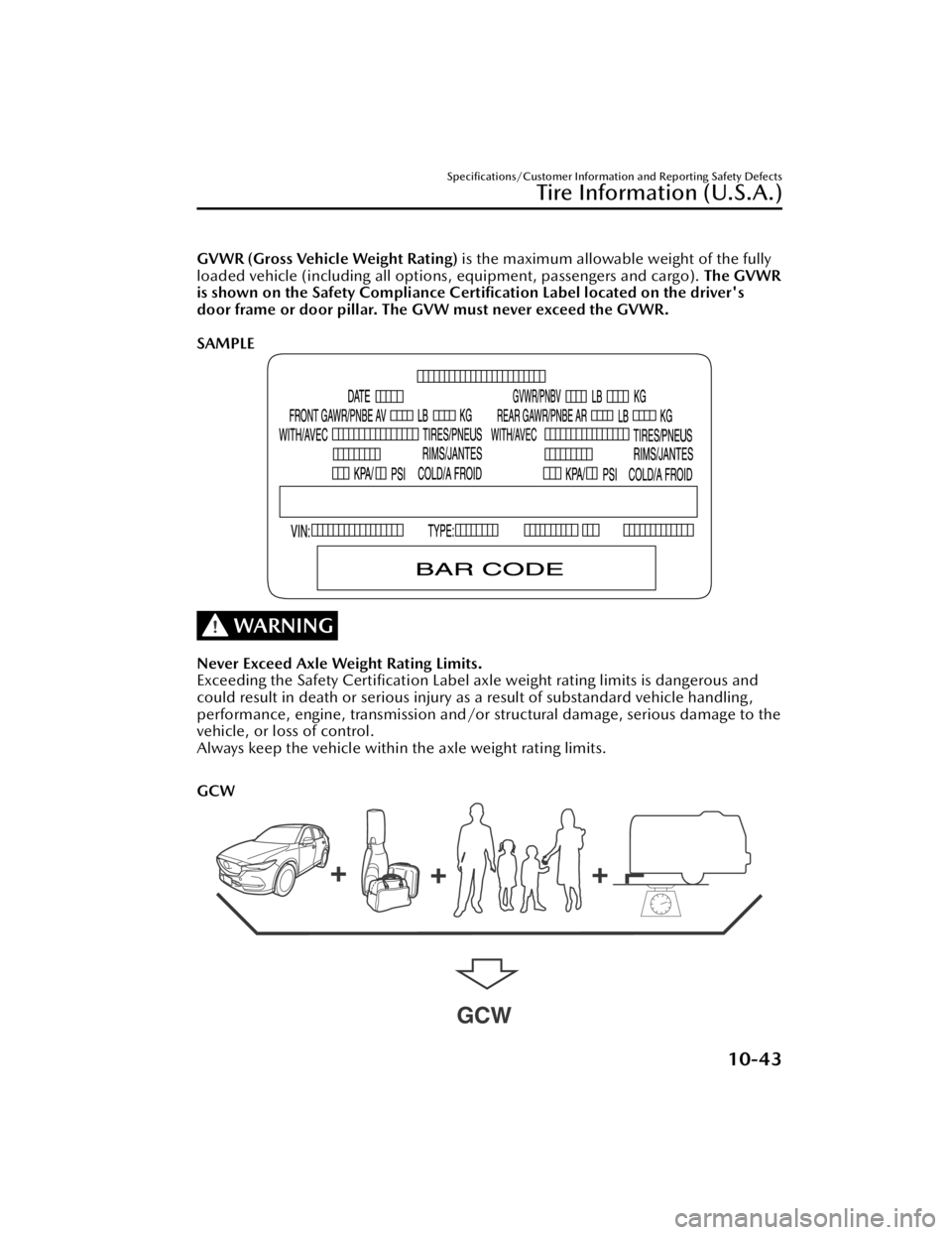
GVWR (Gross Vehicle Weight Rating) is the maximum allowable weight of the fully
loaded vehicle (including all options, equipment, passengers and cargo). The GVWR
is shown on the Safety Compliance Certification Label located on the driver's
door frame or door pillar. The GVW must never exceed the GVWR.
SAMPLE
WARNING
Never Exceed Axle Weight Rating Limits.
Exceeding the Safety Certification Label axle weight rating limits is dangerous and
could result in death or serious injury as a result of substandard vehicle handling ,
performance, engine, transmission and/or structural damage, serious damage to the
vehicle, or loss of control.
Always keep the vehicle within the axle weight rating limits.
GCW
GCW
Specifications/Customer Information and Reporting Safety Defects
Tire Information (U.S.A.)
10-43
CX-90_8KG7-EA-22L_Edition1_new 2022-11-17 16:05:04
Page 653 of 687

GCW (Gross Combination Weight) is the weight of the loaded vehicle (GVW) plus
the weight of the fully loaded trailer.
GCWR (Gross Combination Weight Rating) is the maximum allowable weight of
the vehicle and the loaded trailer - incl uding all cargo and passengers - that the
vehicle can handle without risking damage. (Important: The towing vehicle's braking
system is rated for operation at GVWR, not at GCWR. Separate functional brakes
should be used for safe control of towed vehicles and for trailers weighing more than
1,500 lbs). The GCW must never exceed the GCWR.
Maximum Loaded Trailer Weight is the highest possible weight of a fully loaded
trailer the vehicle can tow. It assumes a vehicle with only mandatory options, no
cargo (internal or external), a tongue load of 10 -15% (conventional trailer) or king
pin weight of 15 -25% (fifth-wheel trailer), and driver only (150 lbs). Consult your
dealership (or the RV and Trailer Towing Guide provided by your dealership) for
more detailed information.
Tongue Load or Fifth-Wheel King Pin Weight refers to the amount of the weight that
a trailer pushes down on a trailer hitch.
Examples: For a 5000 lb conventional trailer, multiply 5000 by 0.10 and 0.15 to
obtain a proper tongue load range of 500 to 750 lbs. For an 11,500 lb fifth-wheel
trailer, multiply by 0.15 and 0.25 to obt ain a proper king pin load range of 1,725 to
2,875 lbs.
WARNING
Never Exceed GVWR or GAWR Specifications.
Exceeding the GVWR or the GAWR specified on the certification label is dangerous.
Exceeding any vehicle rating limitation could result in a serious accident, injury, or
damage to the vehicle.
Do not use replacement tires with lower lo ad carrying capacities than the originals
because they may lower the vehicle's GVWR and GAWR limitations. Replacement
tires with a higher limit than the orig inals do not increase the GVWR and GAWR
limitations.
Never exceed the GVWR or the GAWR specified on the certification label.
Specifications/Customer Information and Reporting Safety Defects
Tire Information (U.S.A.)
10-44
CX-90_8KG7-EA-22L_Edition1_new 2022-11-17 16:05:04