Insta MAZDA MODEL 3 HATCHBACK 2020 (in English) User Guide
[x] Cancel search | Manufacturer: MAZDA, Model Year: 2020, Model line: MODEL 3 HATCHBACK, Model: MAZDA MODEL 3 HATCHBACK 2020Pages: 598, PDF Size: 89.37 MB
Page 18 of 598
Seat Precautions
▼Seat Precautions
WA R N I N G
Make sure the adjustable components of a
seat are locked in place:
Adjustable seats and seatbacks that are
not securely locked are dangerous. In a
sudden stop or collision, the seat or
seatback could move, causing injury. Make
sure the adjustable components of the seat
are locked in place by
attempting to slide
the seat forward and backward and
rocking the seatback.
Never allow children to adjust a seat:
Allowing children to adjust a seat is
dangerous as it could result in serious
injury if a child's hands or feet become
caught in the seat.
Do not drive with the seatback unlocked:
All of the seatbacks play an important role
in your protection in a vehicle. Leaving the
seatback unlocked is dangerous as it can
allow passengers to be ejected or thrown
around and baggage to strike occupants in
a sudden stop or collision, resulting in
severe injury. After adjusting the seatback
at any time, even when there are no other
passengers, rock the seatback to make sure
it is locked in place.
Adjust a seat only when the vehicle is
stopped:
If the seat is adjusted while the vehicle is
being driven, the seating posture may
become unstable and the seat could move
unexpectedly resulting in injury.
Do not modify or replace the front seats:
Modifying or replacing the front seats such
as replacing the upholstery or loosening
any bolts is dangerous. The front seats
contain air bag components essential to
the supplemental restraint system. Such
modifications could damage the
supplemental restraint system and result in
serious injury. Cons ult an Authorized
Mazda Dealer if there is any need to
remove or reinstall the front seats.
Do not drive with damaged front seats:
Driving with damaged front seats, such as
seat cushions torn or damaged down to
the urethane, is dangerous. A collision,
even one not strong enough to inflate the
air bags, could damage the front seats
which contain essential air bag
components. If there was a subsequent
collision, an air bag may not deploy which
could lead to injuries. Always have an
Authorized Mazda Dealer inspect the front
seats, front seat belt pretensioners and air
bags after a collision.
Do not drive with either front seats
reclined:
Sitting in a reclined position while the
vehicle is moving is dangerous because you
do not get the full protection from seat
belts. During sudden braking or a collision,
you can slide under the lap belt and suffer
serious internal injuries. For maximum
protection, sit well back and upright.
Essential Safety Equipment
Seats
2-2
Mazda3_8HZ1-EA-19G_Edition1_old 2019-5-17 13:49:03
Page 33 of 598
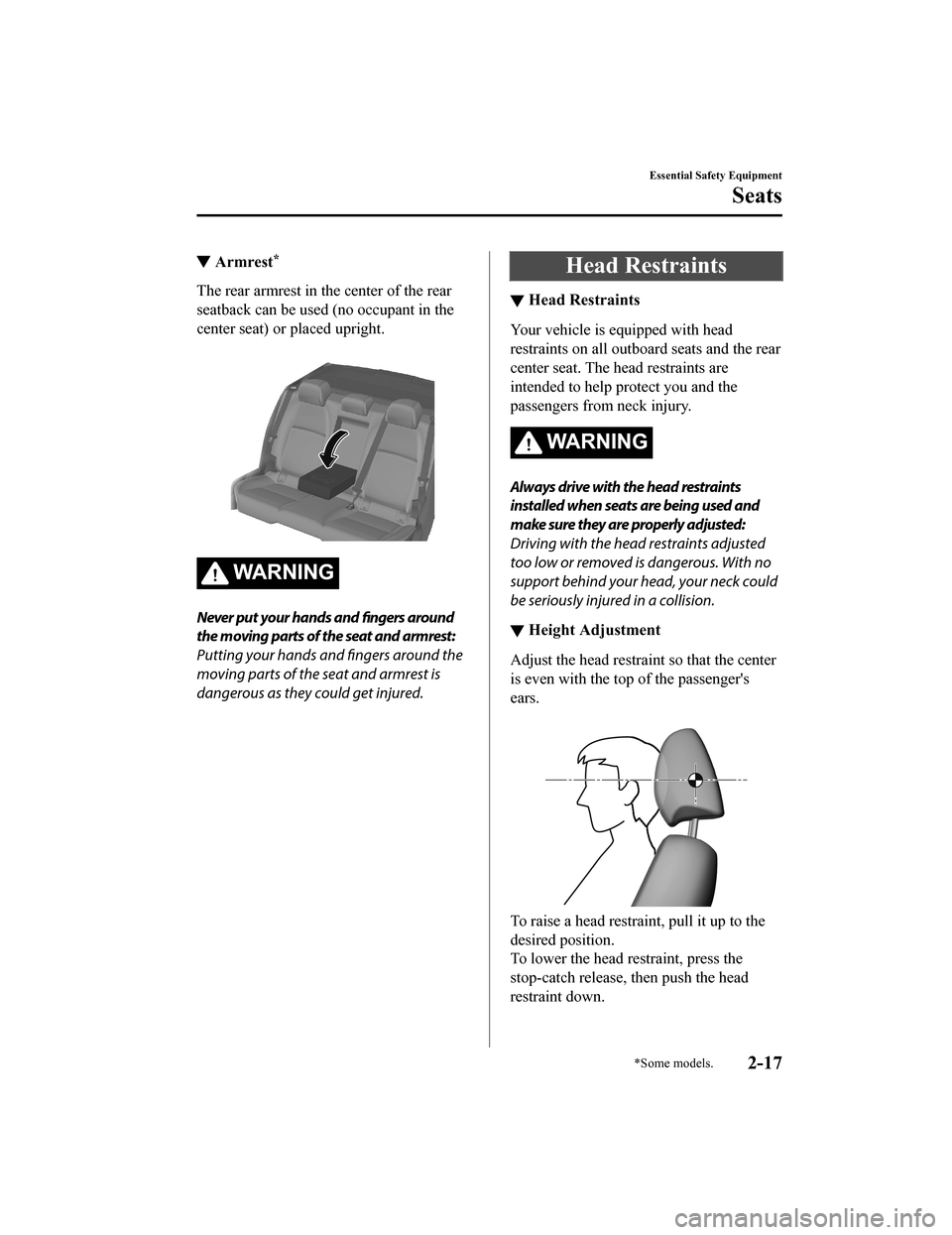
▼Armrest*
The rear armrest in the center of the rear
seatback can be used (no occupant in the
center seat) or placed upright.
WA R N I N G
Never put your hands and fingers around
the moving parts of the seat and armrest:
Putting your hands and fingers around the
moving parts of the seat and armrest is
dangerous as they could get injured.
Head Restraints
▼Head Restraints
Your vehicle is equipped with head
restraints on all outboard seats and the rear
center seat. The head restraints are
intended to help protect you and the
passengers from neck injury.
WA R N I N G
Always drive with the head restraints
installed when seats are being used and
make sure they are properly adjusted:
Driving with the head restraints adjusted
too low or removed is dangerous. With no
support behind your head, your neck could
be seriously injured in a collision.
▼Height Adjustment
Adjust the head restra
int so that the center
is even with the top of the passenger's
ears.
To raise a head restraint, pull it up to the
desired position.
To lower the head restraint, press the
stop-catch release, then push the head
restraint down.
Essential Safety Equipment
Seats
*Some models.2-17
Mazda3_8HZ1-EA-19G_Edition1_old 2019-5-17 13:49:03
Page 34 of 598
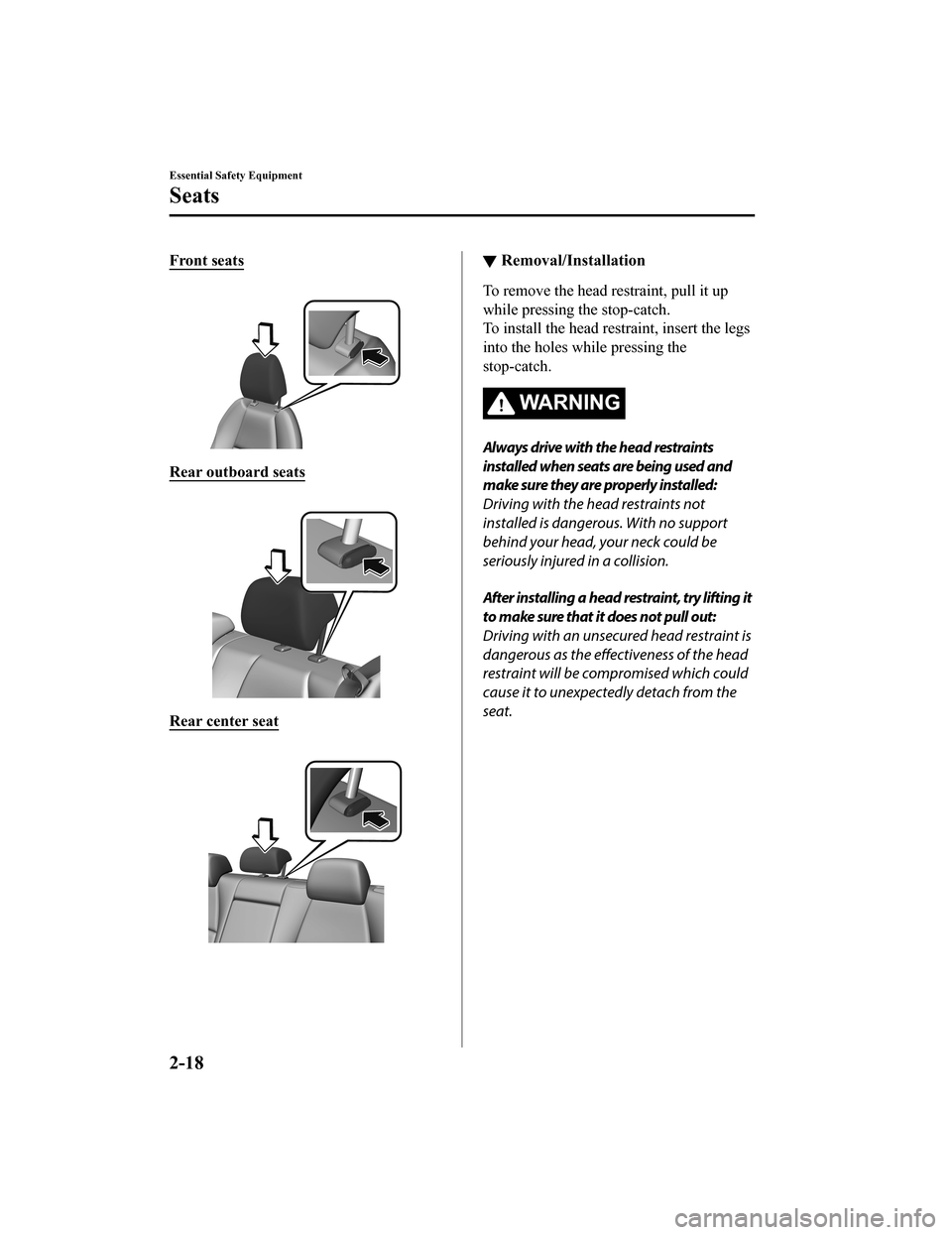
Front seats
Rear outboard seats
Rear center seat
▼Removal/Installation
To remove the head restraint, pull it up
while pressing the stop-catch.
To install the head restraint, insert the legs
into the holes while pressing the
stop-catch.
WA R N I N G
Always drive with the head restraints
installed when seats are being used and
make sure they are properly installed:
Driving with the head restraints not
installed is dangerous. With no support
behind your head, your neck could be
seriously injured in a collision.
After installing a head restraint, try lifting it
to make sure that it does not pull out:
Driving with an unsecured head restraint is
dangerous as the effectiveness of the head
restraint will be compromised which could
cause it to unexpectedly detach from the
seat.
Essential Safety Equipment
Seats
2-18
Mazda3_8HZ1-EA-19G_Edition1_old
2019-5-17 13:49:03
Page 35 of 598
CAUTION
When installing a head restraint, make
sure that it is installed correctly with the
front of the head restraint facing
forward. If the head restraint is installed
incorrectly, it could detach from the seat
during a collision and result in injury.
The head restraints on each of the front
and rear seats are specialized to each
seat. Do not switch around the head
restraint positions. If a head restraint is
not installed to its correct seat position,
the effectiveness of the head restraint
during a collision will be compromised
which could cause injury.
Essential Safety Equipment
Seats
2-19
Mazda3_8HZ1-EA-19G_Edition1_old 2019-5-17 13:49:03
Page 47 of 598
Do not leave a seat belt extender
connected to the buckle:
Leaving a seat belt extender connected to
the buckle without using the seat belt is
dangerous. When the seat belt extender is
connected to the driver's seat belt buckle
(or front passenger's seat belt buckle), the
SRS driver's (or front passenger's) air bag
system will determine that the driver (or
front passenger) is wearing the seat belt
even if the driver (or front passenger) is not
wearing it. This condition could cause the
driver's (or front passenger's) air bag to not
activate correctly and result in death or
serious injury in the event of collision.
Always wear the seat belt with the seat belt
extender.
Do not use the seat belt extender when
installing a child-restraint system on the
front or rear passenger seat:
Using a seat belt extender to fasten a
child-restraint system on any seat is
dangerous. Always follow the
child-restraint system manufacturer's
installation instructions and never use a
seat belt extender.
NOTE
When not in use, remove the seat belt
extender and store it in the vehicle. If the
seat belt extender is left connected, the
seat belt extender might get damaged as it
will not retract with the rest of the seat belt
and can easily fall out of the door when
not in use and be damaged. In addition,
the seat belt warning light will not
illuminate and function properly.
Essential Safety Equipment
Seat Belt Systems
2-31
Mazda3_8HZ1-EA-19G_Edition1_old2019-5-17 13:49:03
Page 50 of 598
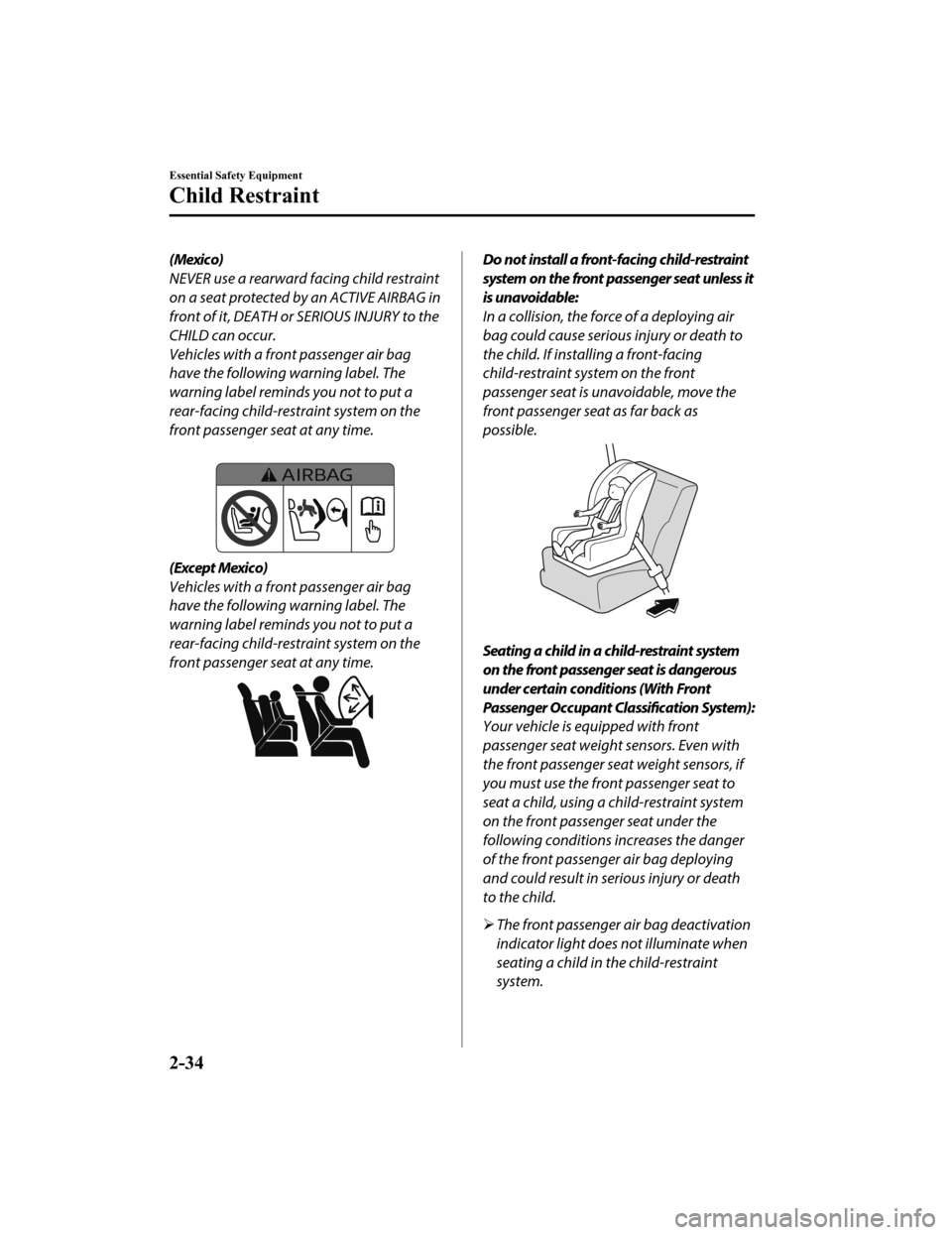
(Mexico)
NEVER use a rearward facing child restraint
on a seat protected by an ACTIVE AIRBAG in
front of it, DEATH or SERIOUS INJURY to the
CHILD can occur.
Vehicles with a front passenger air bag
have the following warning label. The
warning label reminds you not to put a
rear-facing child-restraint system on the
front passenger seat at any time.
(Except Mexico)
Vehicles with a front passenger air bag
have the following warning label. The
warning label reminds you not to put a
rear-facing child-restraint system on the
front passenger seat at any time.
Do not install a front-facing child-restraint
system on the front passenger seat unless it
is unavoidable:
In a collision, the force of a deploying air
bag could cause serious injury or death to
the child. If installing a front-facing
child-restraint system on the front
passenger seat is unavoidable, move the
front passenger seat as far back as
possible.
Seating a child in a child-restraint system
on the front passenger seat is dangerous
under certain conditions (With Front
Passenger Occupant Classification System):
Your vehicle is equipped with front
passenger seat weight sensors. Even with
the front passenger seat weight sensors, if
you must use the front passenger seat to
seat a child, using a child-restraint system
on the front passenger seat under the
following conditions increases the danger
of the front passenger air bag deploying
and could result in serious injury or death
to the child.
The front passenger air bag deactivation
indicator light does not illuminate when
seating a child in the child-restraint
system.
Essential Safety Equipment
Child Restraint
2-34
Mazda3_8HZ1-EA-19G_Edition1_old 2019-5-17 13:49:03
Page 51 of 598
Luggage or other items are placed on the
seat with the child in the child-restraint
system.
A rear passenger or luggage pushing or
pulling down on the front passenger
seatback.
Luggage or other items are placed on the
seatback or hung on the head restraint.
The seat is washed.
Liquids are spilled on the seat.
The front passenger seat is moved
backward, pushing into luggage or other
items placed behind it.
The front passenger seatback contacts
the rear seat.
Luggage or other items are placed
between the front passenger seat and
driver seat.
An electric device is put on the front
passenger's seat.
An additional electrical device, such as a
seat warmer is installed to the surface of
the front passenger seat.
Any accessories, which might increase
the total seated weight on the front
passenger seat, are attached to the front
passenger seat.
The designated positions with seat belts on
the rear seats are the safest places for
children. Always use seat belts and child
restraints.Do not allow a child or anyone to lean over
or against the side window of a vehicle
with side and curtain air bags:
It is dangerous to allow anyone to lean
over or against the side window, the area
of the front passenger seat, the front and
rear window pillars and the roof edge
along both sides from which the side and
curtain air bags deploy, even if a
child-restraint system is used. The impact
of inflation from a side or curtain air bag
could cause serious injury or death to an
out of position child. Furthermore, leaning
over or against the front door could block
the side and curtain air bags and eliminate
the advantages of supplemental
protection. With the front air bag and the
additional side air bag that comes out of
the front seat, the rear seat is always a
better location for children. Take special
care not to allow a child to lean over or
against the side window, even if the child is
seated in a child-restraint system.
Never use one seat belt on more than one
person at a time:
Using one seat belt for more than one
person at a time is dangerous. A seat belt
used in this way cannot spread the impact
forces properly and the two passengers
could be crushed together and seriously
injured or even killed. Never use one belt for
more than one person at a time and always
operate the vehicle with each occupant
properly restrained.
Essential Safety Equipment
Child Restraint
2-35
Mazda3_8HZ1-EA-19G_Edition1_old 2019-5-17 13:49:03
Page 53 of 598

Child-Restraint System Installation
▼Categories of Child-Restraint Systems
NOTE
When purchasing, ask the manufacturer of the child-restraint system which type of
child-restraint system is appropriate for your child and vehicle.
(Mexico)
Child-restraint systems are clas
sified into the following 5 groups according to the UN-R 44
regulation.
Group Age WeightSize Classification/
Fixture (CRF)
0 Up to about 9 months old Up to 10 kg (up to 22 lb) ISO/L1
ISO/L2
ISO/R1
0+ Up to about 2 years old Up to 13 kg (up to 29 lb) ISO/R1
ISO/R2
ISO/R3
1 About 8 months to 4 years old 9 kg ― 18 kg (20 lb ― 40 lb) ISO/R2
ISO/R3
ISO/F2
ISO/F2X ISO/F3
2 About 3 to 7 years old 15 kg ― 25 kg (33 lb ― 55 lb) ―
3 About 6 to 12 years old 22 kg ― 36 kg (48 lb ― 79 lb) ―
(Except Mexico)
Please comply with the legal regulations concerning the use of child-restraint systems in
your country.
▼ Child-Restraint System Types
In this owner's manual, explanation of
child-restraint systems is provided for the
following three types of popular
child-restraint systems: infant seat, child
seat, booster seat.
NOTE
Installation position is determined by
the type of child-restraint system.
Always read the manufacturer's
instructions and this owner's manual
carefully.
Essential Safety Equipment
Child Restraint
2-37
Mazda3_8HZ1-EA-19G_Edition1_old
2019-5-17 13:49:03
Page 54 of 598

Due to variations in the design of
child-restraint systems, vehicle seats
and seat belts, all child-restraint systems
may not fit all seating positions. Before
purchasing a child-restraint system, it
should be tested in the specific vehicle
seating position (or positions) where it
is intended to be used. If a previously
purchased child-restraint system does
not fit, you may need to purchase a
different one that will.
Infant seat
An infant seat provides restraint by
bracing the infant's head, neck and back
against the seating surface.
Equal to Group 0 and 0+ of the UN-R 44
and UN-R 129 regulation.
Child seat
A child seat restrains a child's body using
the harness.
Equal to Group 1 o f the UN-R 44 and
UN-R 129 regulation.
Booster seat
A booster seat is a child restraint
accessory designed to improve the fit of
the seat belt system around the child's
body.
Equal to Group 2 and 3 of the UN-R 44
and UN-R 129 regulation.
1. Full booster seat
2. Backless booster seat
When using a backless booster seat,
always install the vehicle head restraint to
the seat where the backless booster seat is
installed.
Essential Safety Equipment
Child Restraint
2-38
Mazda3_8HZ1-EA-19G_Edition1_old 2019-5-17 13:49:03
Page 55 of 598

Child-Restraint System Suitability for Various Seat
Positions Table
▼ Child-Restraint System Suitability
for Various Seat Positions Table
(Mexico)
Provided information in the tabl e shows your child-restraint system suitability for various
seating position. For installation suitability of other manufac turer child-restraint system,
carefully consult the manufacture r's instructions which accompany the child-restraint
system.
When installing a child-restraint system, the following points must be observed:
Always remove the head restraint before installing a child-restraint system. However,
when installing a backless booster seat, always install the veh icle head restraint to the seat
where the backless booster seat is installed. In addition, alwa ys use a tether strap and
attach it securely. Refer to H ead Restraints on page 2-17.
When installing a child-restrain t system to the front passenger seat, adjust the seat slide
position as far back as possible.
Refer to Adjusting the Front Passenger's Seat on page 2-13.
When it is difficult to install a child-restraint system to the front passenger seat, or the seat
belt cannot be secured to the ch ild-restraint system, perform the following operations to
adjust the seat holding the child-restraint system so that the seat belt can be secured
completely to it.
Move the seat forward or back.
Move the seatback forward or back.
Move the seat upward or downward. (Vehicles with height adjustm ent function)
When installing a child-restraint system to the rear seat, adjust the front seat position so
that the front seat does not contact the child-restraint system .
Refer to Adjusting the Driver's Seat on page 2-5.
Refer to Adjusting the Front Passenger's Seat on page 2-13.
When installing a child-restrain t system equipped with a tether, remove the head restraint.
Refer to Head Restraints on page 2-17.
An i-Size child-restra int system refers to a child-restraint sy stem which has acquired
i-Size category certification fo r the UN-R 129 regulation.
When installing a child-restraint system to the rear seat, refer to the child-restraint system
manufacturer's instructions and the Using ISOFIX Lower Anchor o n page 2-50.
Seating position Passenger Rear (Left) Rear (Center) Rear (Right)
Seating position suit‐
able for universal
belted (Yes/No) Ye s ( U F )
Ye s ( U )Ye s ( U )Ye s ( U )
Essential Safety Equipment
Child Restraint
2-39
Mazda3_8HZ1-EA-19G_Edition1_old 2019-5-17 13:49:03