wheel MAZDA MODEL 6 2017 (in English) Manual Online
[x] Cancel search | Manufacturer: MAZDA, Model Year: 2017, Model line: MODEL 6, Model: MAZDA MODEL 6 2017Pages: 578, PDF Size: 54.72 MB
Page 488 of 578
7–28
If Trouble Arises
Warning/Indicator Lights and Warning Sounds
*Some models.
SignalWarning
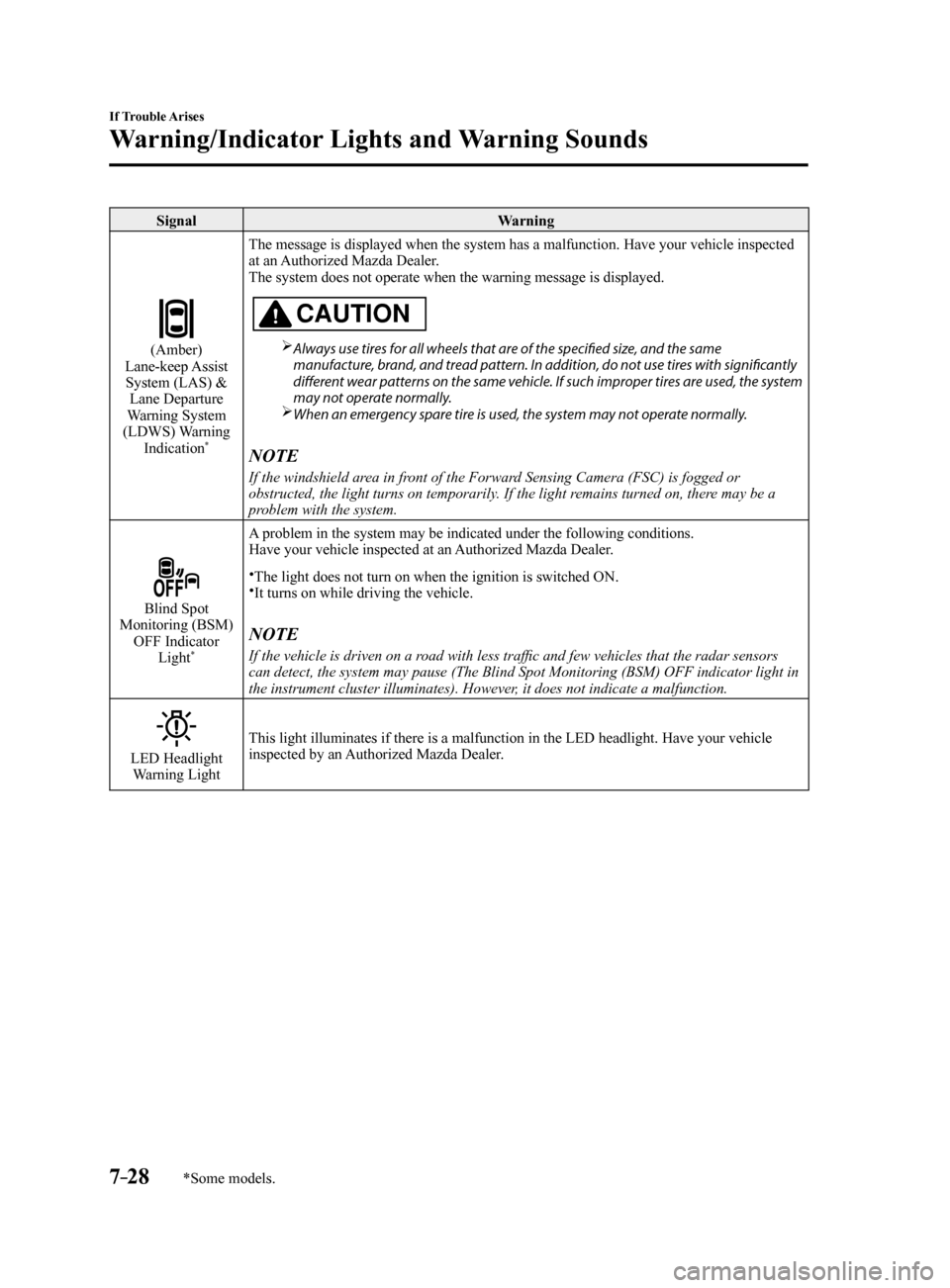
(Amber)
Lane-keep Assist System (LAS) & Lane Departure
Warning System
(LDWS) Warning Indication
*
The message is displayed when the system has a malfunction. Have your ve\
hicle inspected
at an Authorized Mazda Dealer.
The system does not operate when the warning message is displayed.
CAUTION
Always use tires for all wheels that are of the specified size, and the same
manufacture, brand, and tread pattern. In addition, do not use tires with significantly
different wear patterns on the same vehicle. If such improper tires are used, the system
may not operate normally.
When an emergency spare tire is used, the system may not operate normally.
NOTE
If the windshield area in front of the Forward Sensing Camera (FSC) is fogged or
obstructed, the light turns on temporarily. If the light remains turned on, there may be a
problem with the system.
Blind Spot
Monitoring (BSM) OFF Indicator Light
*
A problem in the system may be indicated under the following conditions.
Have your vehicle inspected at an Authorized Mazda Dealer.
The light does not turn on when the ignition is switched ON.It turns on while driving the vehicle.
NOTE
If the vehicle is driven on a road with less traffic and few vehicles that the radar sensors
can detect, the system may pause (The Blind Spot Monitoring (BSM) OFF\
indicator light in
the instrument cluster illuminates). However, it does not indicate a malfunction.
LED Headlight Warning Light This light illuminates if there is a malfunction in the LED headlight. Have your vehicle
inspected by an Authorized Mazda Dealer.
Mazda6_8FH2-EA-16F_Edition2.indb 282016/07/07 13:46:34
Page 495 of 578

7–35
If Trouble Arises
Warning/Indicator Lights and Warning Sounds
*Some models.
Message Indicated in Multi-information Display*
If there is a notification from the vehicle, a message is displayed in the multi-information
display. Check the information and take the necessary action.
(Display example)
If the warning light turns on/flashes simultaneously or a symbol is indicated in the display,
check the information regarding the warning light or symbol. (page 4-32)
DisplayContent Action to be taken
Indicated when the push button start is
pressed while the shift lever is not in the
P position. Shift the shift lever to the P position.
Indicated when the push button start is
pressed without depressing the brake
pedal.Depress the brake pedal and press the
push button start.
Indicated when the push button start is
pressed without depressing the clutch
pedal.Depress the clutch pedal and press the
push button start.
Indicated while the steering wheel is
locked.
Release the steering lock.
Indicated when the electric parking brake
switch is operated without depressing the
brake pedal.Depress the brake pedal and operate the
electric parking brake switch.
Mazda6_8FH2-EA-16F_Edition2.indb 352016/07/07 13:46:36
Page 498 of 578
7–38
If Trouble Arises
Warning/Indicator Lights and Warning Sounds
*Some models.
Request Switch Inoperable
Warning Beep (With the advanced
keyless function)
If the request switch is pressed with the
door open or ajar, or the ignition is not
switched OFF with a key being carried,
a beep will be heard outside for about 2
seconds to notify the driver that the door
or trunk lid cannot be locked.
Key Left-in-trunk Compartment
Warning Beep (With the advanced
keyless function)
If the key is left in the trunk with all the
doors locked and the trunk lid closed, a
beep will be heard outside for about 10
seconds to notify the driver that the key is
in the trunk. In this case, take out the key
by pressing the electric trunk lid opener
and opening the trunk lid. The key taken
out of the trunk may not operate because
its functions have been temporarily
stopped. To restore the key's functions,
perform the applicable procedure (page
3-9).
Key Left-in-vehicle Warning Beep
(With the advanced keyless
function)
If all the doors and trunk are locked using
another key while the key is left in the
cabin, the beep which sounds outside of
the vehicle will be heard for about 10
seconds to notify the driver that the key
is in the cabin. In this case, take out the
key by opening the door. A key taken
out of the vehicle using this method may
not operate because its functions have
been temporarily stopped. To restore the
key's functions, perform the applicable
procedure (page 3-9).
i-ELOOP Warning Beep*
If the vehicle is driven while “i-ELOOP
Charging Please don't Drive” is displayed,
a beep sound is heard. Make sure the
message is no longer displayed before
driving.
Tire Inflation Pressure Warning
Beep
The warning beep sound will be heard
for about 3 seconds when there is any
abnormality in tire inflation pressures
(page 4-159).
Blind Spot Monitoring (BSM)
System Warning Beep*
Driving forward
The warning beep operates when the turn
signal lever is operated to the side where
the Blind Spot Monitoring (BSM) warning
light is illuminated.
NOTE
A personalized function is available to
change the Blind Spot Monitoring (BSM)
warning beep sound volume.
Refer to Personalization Features on page
9-10.
Reversing
If a moving object such as a vehicle or
two-wheeled vehicle approaches on the
left or right from behind your vehicle, the
Blind Spot Monitoring (BSM) warning
sound is activated.
Mazda6_8FH2-EA-16F_Edition2.indb 382016/07/07 13:46:37
Page 526 of 578
8–24
Customer Information and Reporting Safety Defects
Uniform Tire Quality Grading System (UTQGS)
Temperature-A, B, C
The temperature grades A (the highest), B, and C, represent the tire's resistance to the
generation of heat and its ability to dissipate heat when tested under c\
ontrolled conditions on
a specified indoor laboratory test wheel.
Sustained high temperature can cause the material of the tire to degener\
ate and reduce tire
life, and excessive temperatures can lead to sudden tire failure.
Grade C corresponds to a level of performance which all passenger vehicle tires must meet
under the Federal Motor Vehicle Safety Standard No. 109. Grades B and A represent higher
levels of performance on the laboratory test wheel than the minimum required by law.
WARNING
Keep your vehicle's tires properly inflated and not overloaded:
Driving with improperly inflated or overloaded tires is dangerous. Excessive speed,
underinflation, or excessive loading, either separately or in combination, can cause heat
buildup and possible tire failure. The temperature grade for this tire is established for a
tire that is properly inflated and not overloaded.
These grades will be added to the sidewalls of passenger vehicle tires o\
ver the next several
years according to a schedule established by the NHTSA and the tire manufacturers.
The grade of tires available as standard or optional equipment on Mazda vehicles may vary
with respect to grade.
ALL PASSENGER VEHICLE TIRES MUST CONFORM TO THESE GRADES AND TO
ALL OTHER FEDERAL TIRE-SAFETY REQUIREMENTS.
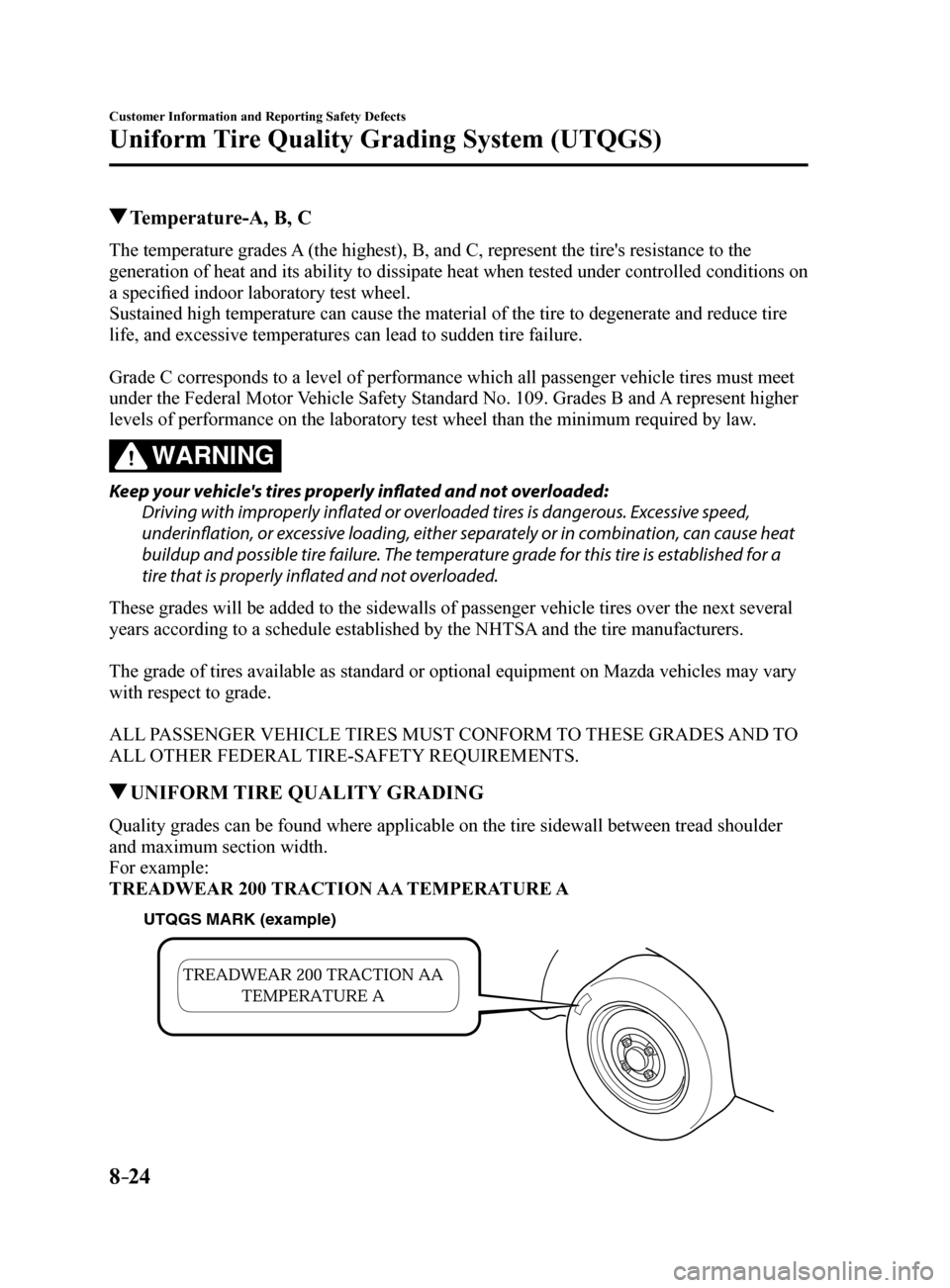
UNIFORM TIRE QUALITY GRADING
Quality grades can be found where applicable on the tire sidewall between tread shoulder
and maximum section width.
For example:
TREADWEAR 200 TRACTION AA TEMPERATURE A
UTQGS MARK (e xample)
Mazda6_8FH2-EA-16F_Edition2.indb 242016/07/07 13:46:39
Page 528 of 578
8–26
Customer Information and Reporting Safety Defects
Tire Information (U.S.A.)
P
Indicates a tire that may be installed on cars, SUVs, minivans and light trucks as designated
by the Tire and Rim Association (T&RA).
NOTE
If your tire size does not begin with a letter this may mean it is designated by ei\
ther ETRTO
(European Tire and Rim Technical Organization) or JATMA (Japan Tire Manufacturing
Association).
215
“215” is the nominal width of the tire in millimeters. This three-digit number gives the
width in millimeters of the tire from sidewall edge to sidewall edge. In\
general, the larger
the number, the wider the tire.
65
“65” is the aspect ratio. This two-digit number indicates the tire's ratio of height to width.
R
“R” is the tire construction symbol. R indicates “Radial ply construction”.
15
“15” is the wheel rim diameter in inches.
95
“95” is the Load Index. This two-or three-digit number indicates how much weight each tire
can support.
H
“H” is the speed rating. The speed rating denotes the maximum speed for which the use of
the tire is rated.
Letter RatingSpeed Rating
Q 99 mph
R 106 mph
S 112 mph
T 118 mph
U 124 mph
H 130 mph
V 149 mph
W 168
* mph
Y 186* mph
* For tires with a maximum speed capability over 149 mph, tire manufacturers sometimes use the letters ZR. For
tires with a maximum speed capability over 186 mph, tire manufacturers always use the letters ZR.
Mazda6_8FH2-EA-16F_Edition2.indb 262016/07/07 13:46:39
Page 529 of 578
8–27
Customer Information and Reporting Safety Defects
Tire Information (U.S.A.)
M S or M/S: Mud and Snow
AT: All Terrain.
AS: All Season. The “M
S” or “M/S” indicates that the tire has some functional use in mud
and snow.
U.S. DOT Tire Identification Number (TIN)
This begins with the letters “DOT” which indicates the tire meets all federal standards. The
next two numbers or letters are the plant code where it was manufactured\
, and the last four
numbers represent the week and year the tire was manufactured. For examp\
le, the numbers
457 means the 45st week of 1997. After 2000 the numbers go to four digits. For example,
the number 2102 means the 21th week of 2002. The other numbers are marketing codes
used at the manufacturer's discretion. This information is used to contact consumers if a tire
defect requires a recall.
Tire Ply Composition and Materials Used
The number of plies indicates the number of layers of rubber-coated fabric in the tire.
In general, the greater the number of plies, the more weight a tire can \
support. Tire
manufacturers also must indicate the tire materials, which include steel\
, nylon, polyester,
and other.
Maximum Load Rating
This number indicates the maximum load in kilograms and pounds that can \
be carried by the
tire.
Maximum Permissible Inflation Pressure
This number is the greatest amount of air pressure that should ever be p\
ut in the tire under
normal driving conditions.
Tread Wear, Traction and Temperature Grades
Tread wear: The tread wear grade is a comparative rating based on the wear rate of t\
he tire
when tested under controlled conditions on a specified government test course. For example,
a tire graded 150 would wear one and one-half (1 1/2) times as well on\
the government
course as a tire graded 100.
Traction: The traction grades, from highest to lowest are AA, A, B, and C. The grades
represent the tire's ability to stop on wet pavement as measured under c\
ontrolled conditions
on specified government test surfaces of asphalt and concrete. A tire marked C may have
poor traction performance.
Temperature: The temperature grades are A (the highest), B and C, representing the
tire's resistance to the generation of heat and its ability to dissipate\
heat when tested under
controlled conditions on a specified indoor laboratory test wheel.
Snow Tires
In some heavy snow areas, local governments may require true snow tires, those with very
deeply cut tread. These tires should only be used in pairs or placed on all four wheels. M\
ake
sure you purchase snow tires that are the same size and construction typ\
e as the other tires
on your vehicle.
Mazda6_8FH2-EA-16F_Edition2.indb 272016/07/07 13:46:40
Page 531 of 578
8–29
Customer Information and Reporting Safety Defects
Tire Information (U.S.A.)
11 5
“115” is the nominal width of the tire in millimeters. This three-digit number gives the width
in millimeters of the tire from sidewall edge to sidewall edge. In gener\
al, the larger the
number, the wider the tire.
70
“70” is the aspect ratio. This two-digit number indicates the tire's ratio of height to width.
D
“D” is the tire construction symbol. D indicates “diagonal ply construction”.
16
“16” is the wheel rim diameter in inches.
90
“90” is the Load Index. This two-or three-digit number indicates how much weight each tire
can support.
M
“M” is the speed rating. The speed rating denotes the maximum speed for which the use of
the tire is rated.
Letter RatingSpeed Rating
M 81 mph
Mazda6_8FH2-EA-16F_Edition2.indb 292016/07/07 13:46:40
Page 534 of 578
8–32
Customer Information and Reporting Safety Defects
Tire Information (U.S.A.)
Glossary of Terms
Tire Placard: A label indicating the OE tire sizes, recommended inflation pressure, and the
maximum weight the vehicle can carry.
Tire Identification Number (TIN): A number on the sidewall of each tire providing
information about the tire brand and manufacturing plant, tire size, and\
date of manufacture.
Inflation Pressure: A measure of the amount of air in a tire.
kPa: Kilopascal, the metric unit for air pressure.
psi: Pounds per square inch, the English unit for air pressure.
B-pillar: The structural member at the side of the vehicle behind the front door.
Original Equipment (OE): Describes components originally equipped on the vehicle.
Vehicle Load Limit: The maximum value of the combination weight of occupants and
cargo.
Bead Area of the Tire: Area of the tire next to the rim.
Sidewall Area of the Tire: Area between the bead area and the tread.
Tread Area of the Tire: Area on the perimeter of the tire that contacts the road when it's
mounted on the vehicle.
Seating capacity means the total allowable number of vehicle occupants. Seating capacity\
is described on the tire label.
Production options weight is the combination weight of installed regular production
options weighing over 2.3 kilograms in excess of the standard items whic\
h they replace,
and not previously considered in the curb weight or accessory weight, in\
cluding heavy duty
brakes, ride levelers, roof rack, heavy duty battery, and special trim.
Rim is the metal support (wheel) for a tire or a tire and tube assembly u\
pon which the tire
beads are seated.
Mazda6_8FH2-EA-16F_Edition2.indb 322016/07/07 13:46:40
Page 535 of 578
8–33
Customer Information and Reporting Safety Defects
Tire Information (U.S.A.)
Tire Maintenance
Improper or inadequate vehicle maintenance can cause tires to wear abnormally. Here are
some important maintenance points:
Tire Inflation Pressure
Inspect all tire pressure monthly (including the spare) when the tires\
are cold. Maintain
recommended pressures for the best ride, top handling, and minimum tire \
wear. Use the
pressures specified on the vehicle tire information placard or tire label for optimum service.
Tire Rotation
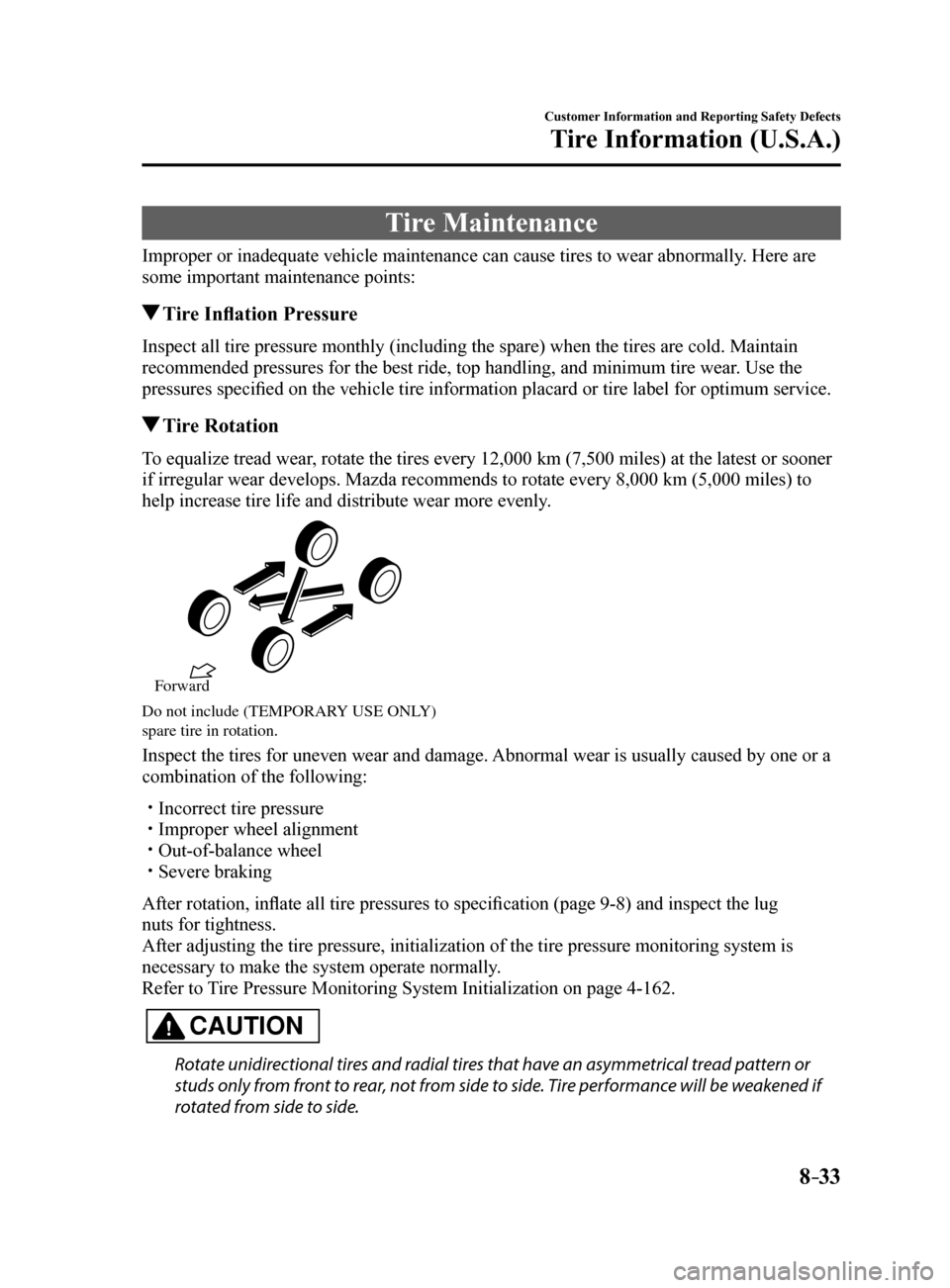
To equalize tread wear, rotate the tires every 12,000 km (7,500 miles) at the latest or sooner
if irregular wear develops. Mazda recommends to rotate every 8,000 km (\
5,000 miles) to
help increase tire life and distribute wear more evenly.
Do not include (TEMPORARY USE ONL Y) spare tire in rotation.
Forward
Inspect the tires for uneven wear and damage. Abnormal wear is usually caused by one or a
combination of the following:
Incorrect tire pressure Improper wheel alignment Out-of-balance wheel Severe braking
After rotation, inflate all tire pressures to specification (page 9-8) and inspect the lug
nuts for tightness.
After adjusting the tire pressure, initialization of the tire pressure m\
onitoring system is
necessary to make the system operate normally.
Refer to Tire Pressure Monitoring System Initialization on page 4-162.
CAUTION
Rotate unidirectional tires and radial tires that have an asymmetrical tread pattern or
studs only from front to rear, not from side to side. Tire performance will be weakened if
rotated from side to side.
Mazda6_8FH2-EA-16F_Edition2.indb 332016/07/07 13:46:40
Page 557 of 578
9–5
Specifications
Specifications
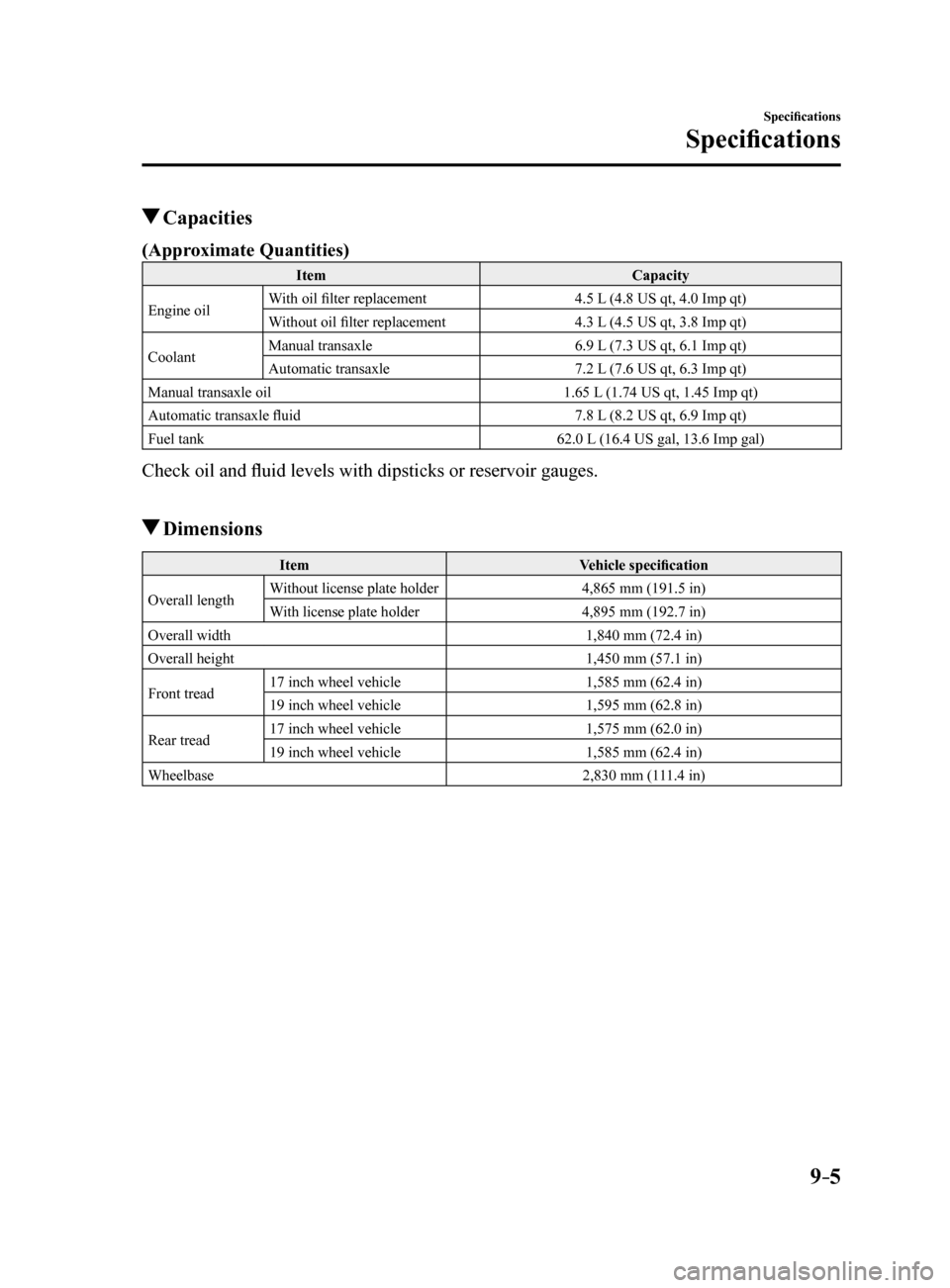
Capacities
(Approximate Quantities)
ItemCapacity
Engine oil With oil filter replacement
4.5 L (4.8 US qt, 4.0 Imp qt)
Without oil filter replacement 4.3 L (4.5 US qt, 3.8 Imp qt)
Coolant Manual transaxle
6.9 L (7.3 US qt, 6.1 Imp qt)
Automatic transaxle 7.2 L (7.6 US qt, 6.3 Imp qt)
Manual transaxle oil 1.65 L (1.74 US qt, 1.45 Imp qt)
Automatic transaxle fluid 7.8 L (8.2 US qt, 6.9 Imp qt)
Fuel tank 62.0 L (16.4 US gal, 13.6 Imp gal)
Check oil and fluid levels with dipsticks or reservoir gauges.
Dimensions
ItemVehicle specification
Overall length Without license plate holder
4,865 mm (191.5 in)
With license plate holder 4,895 mm (192.7 in)
Overall width 1,840 mm (72.4 in)
Overall height 1,450 mm (57.1 in)
Front tread 17 inch wheel vehicle
1,585 mm (62.4 in)
19 inch wheel vehicle 1,595 mm (62.8 in)
Rear tread 17 inch wheel vehicle
1,575 mm (62.0 in)
19 inch wheel vehicle 1,585 mm (62.4 in)
Wheelbase 2,830 mm (111.4 in)
Mazda6_8FH2-EA-16F_Edition2.indb 52016/07/07 13:46:48