Diff MAZDA MODEL MX-5 MIATA 2019 Owners Manual
[x] Cancel search | Manufacturer: MAZDA, Model Year: 2019, Model line: MODEL MX-5 MIATA, Model: MAZDA MODEL MX-5 MIATA 2019Pages: 553, PDF Size: 59 MB
Page 27 of 553
Do not operate a vehicle with a damaged seat belt:
Using a damaged seat belt is dangerous. An accident could damage the belt webbing of the
seat belt in use. A damaged seat belt cannot provide adequate protection in a collision. Have
an Authorized Mazda Dealer inspect all seat be lt systems in use during an accident before
they are used again.
Have your seat belts changed immediately if the pretensioner or load limiter has been
expended:
Always have an Authorized Ma zda Dealer immediately inspect the seat belt pretensioners
and air bags after any collision. Like the air bags , the seat belt pretensioners and load limiters
will only function once and must be replaced af ter any collision that caused them to deploy. A
seat belt with an expended pretensioner or load limiter is still better than wearing no seat belt
at all; however, if the seat belt pretensioner s and load limiters are not replaced, the risk of
injury in a collision will increase.
Positioning the Shoulder Portion of the Seat Belt:
Improper positioning of the shoulder portion of the seat belt is dangerous. Always make sure
the shoulder portion of the seat belt is positi oned across your shoulder and near your neck,
but never under your arm, on your neck, or on your upper arm.
Positioning the Lap Portion of the Seat Belt:
The lap portion of the seat belt worn too high is dangerous. In a collision, this would
concentrate the impact force directly on the abdominal area, causing serious injury. Wear the
lap portion of the belt snugly and as low as possible.
CAUTION
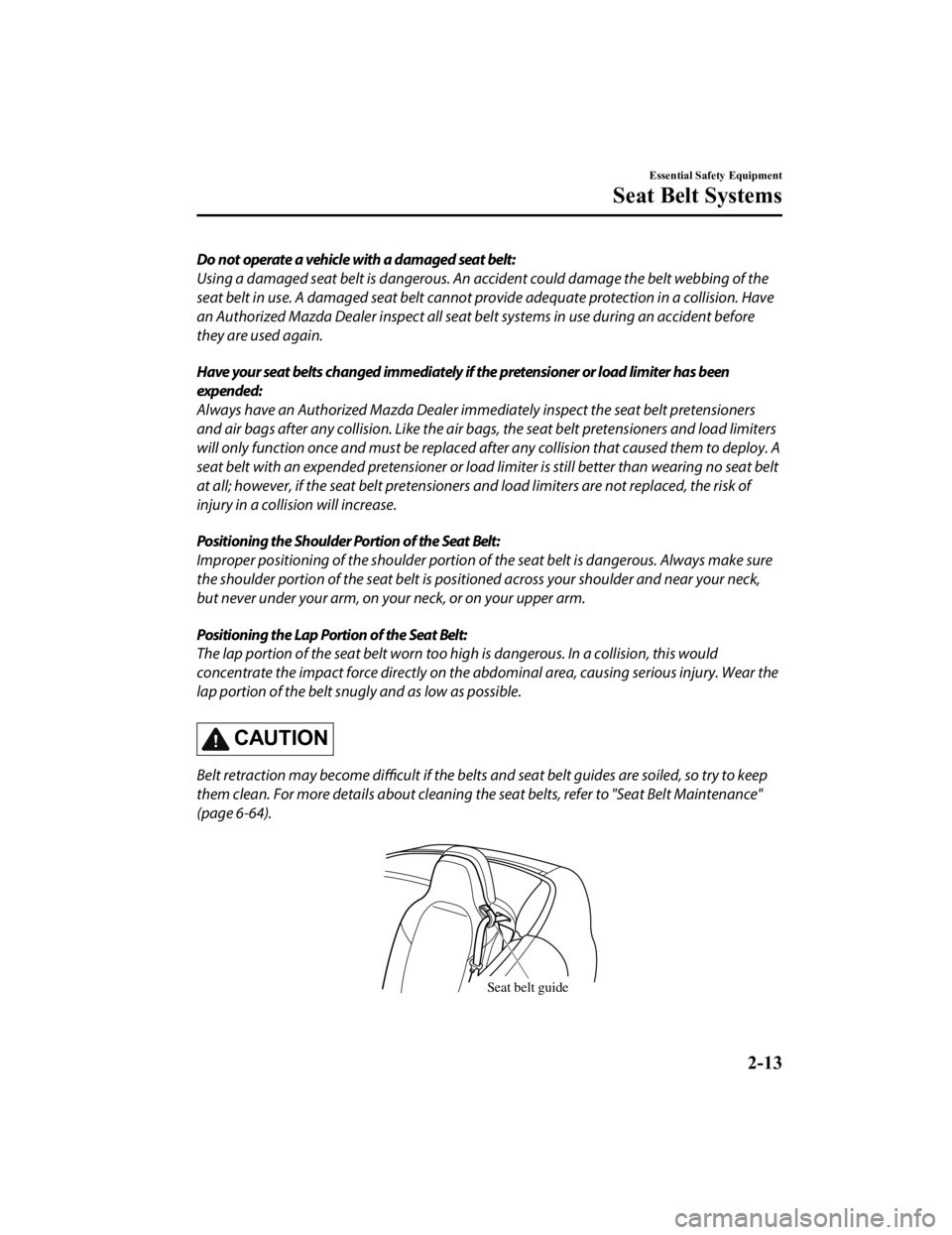
Belt retraction may become difficult if the belts and seat belt guides are soiled, so try to keep
them clean. For more details about cleaning th e seat belts, refer to "Seat Belt Maintenance"
(page 6-64).
Seat belt guide
Essential Safety Equipment
Seat Belt Systems
2-13
MX-5_8GV5-EA-18E_Edition3 2018-7-17 15:48:16
Page 33 of 553

Do not use an improper extender:
Using a seat belt extender that is for
another person or a different vehicle or seat
is dangerous. The seat belt will not provide
adequate protection and the user could be
seriously injured in an accident. Only use
the extender provided for you and for the
particular vehicle and seat. NEVER use the
extender in a different vehicle or seat. If you
sell your Mazda, do not leave your seat belt
extender in the vehicle. It could be used
accidentally by the new owner of the
vehicle. After removing the seat belt
extender, discard it. Never use the seat belt
extender in any other vehicle you may own
in the future.
Do not use an extender that is too long:
Using an extender that is too long is
dangerous. The seat belt will not fit
properly. In an accident, the seat belt will
not provide adequate protection and you
could be seriously injured. Do not use the
extender or choose one shorter in length if
the distance between the extender's buckle
and the center of the user's body is less
than 15 cm (6 in).Do not leave a seat belt extender
connected to the buckle:
Leaving a seat belt extender connected to
the buckle without using the seat belt is
dangerous. When the seat belt extender is
connected to the driver's seat belt buckle
(or passenger's seat belt buckle), the SRS
driver's (or passenger's) air bag system will
determine that the driver (or passenger) is
wearing the seat belt even if the driver (or
passenger) is not wearing it. This condition
could cause the driver's (or passenger's) air
bag to not activate correctly and result in
death or serious injury in the event of
collision. Always wear the seat belt with the
seat belt extender.
Do not use the seat belt extender when
installing a child-restraint system on the
passenger seat:
Using a seat belt extender to fasten a
child-restraint system on any seat is
dangerous. Always follow the
child-restraint system manufacturer's
installation instructions and never use a
seat belt extender.
NOTE
When not in use, remove the seat belt
extender and store it in the vehicle. If the
seat belt extender is left connected, the
seat belt extender might get damaged as it
will not retract with the rest of the seat belt
and can easily fall out of the door when
not in use and be damaged. In addition,
the seat belt warning light will not
illuminate and function properly.
Essential Safety Equipment
Seat Belt Systems
2-19
MX-5_8GV5-EA-18E_Edition3 2018-7-17 15:48:16
Page 39 of 553

Due to variations in the design of
child-restraint systems, vehicle seats
and seat belts, all child-restraint systems
may not fit all seating positions. Before
purchasing a child-restraint system, it
should be tested in the specific vehicle
seating position (or positions) where it
is intended to be used. If a previously
purchased child-restraint system does
not fit, you may need to purchase a
different one that will.
Infant seat
An infant seat provides restraint by
bracing the infant's head, neck and back
against the seating surface.
Equal to Group 0 and 0
of the UN-R 44
and UN-R 129 regulation.
Child seat
A child seat restrains a child's body using
the harness.
Equal to Group 1 of the UN-R 44 and
UN-R 129 regulation.
Booster seat
A booster seat is a child restraint
accessory designed to improve the fit of
the seat belt system around the child's
body.
Equal to Group 2 and 3 of the UN-R 44
and UN-R 129 regulation.
Essential Safety Equipment
Child Restraint
2-25
MX-5_8GV5-EA-18E_Edition3 2018-7-17 15:48:16
Page 40 of 553

Child-Restraint System Suitability for Various SeatPositions Table
(Mexico)
Provided information in the table shows your child-restraint sy stem suitability for various
seating position. For installati on suitability of other manufacturer child-restraint system,
carefully consult the manufacturer's instructions which accompa ny the child-restraint
system.
When installing a child-restrain t system, the following points must be observed:
When installing a child-restrain t system to the passenger seat, adjust the seat slide position
as far back as possible.
Refer to Adjusting the Passenger's Seat on page 2-9.
When it is diffi cult to install a child-restraint system to the passenger seat, or the seat belt
cannot be secured to the child-r estraint system, perform the following operations to adjust
the seat holding the child-restraint system so that the seat be lt can be secured completely
to it.
Move the seat forward or back.
Move the seatback forward or back.
An i-Size child-restra int system refers to a child-restraint system which has acquired
i-Size category certification for the UN-R 129 regulation.
When installing a child-restraint system to the passenger seat, refer to the child-restraint
system manufacturer's instructions.
Seating position Passenger
Seating position suitable for uni versal belted (Yes/No) No (L)
i-Size seating position (Yes/No) No
Largest suitable rearward facing fixture (R1) No
Largest suitable rearward facing fixture (R2) No
Largest suitable rearward facing fixture (R2X) No
Largest suitable rearward facing fixture (R3) No
Largest suitable forward facing fixture (F2) No
Largest suitable forward facing fixture (F2X) No
Largest suitable forward facing fixture (F3) No
Largest suitable lateral facing fixture (L1) No
Largest suitable lateral facing fixture (L2) No
Largest suitable booster fixture (B2) No
Largest suitable booster fixture (B3) No
Essential Safety Equipment
Child Restraint
2-26
MX-5_8GV5-EA-18E_Edition3 2018-7-17 15:48:16
Page 45 of 553
Supplemental Restraint System (SRS) Precautions
The front and side supplemental restraint systems (SRS) include different types of air bags.
Please verify which kinds of air bags are equipped on your vehicle by locating the
“SRS AIRBAG” location indicators. These indicators are visible in the area where the air
bags are installed.
The air bags are installed i n the following locations:
The steering wheel hub (driver air bag)
The passenger dashboard (passenger air bag)
The outboard sides of the seatbacks (side air bags)
The air bag supplemental restraint systems are designed to prov ide supplemental protection
in certain situations so seat belts are always important in the following ways:
Without seat belt usage, the air bags cannot provide adequate p rotection during an accident.
Seat belt usage is necessary to:
Keep the occupant from being thrown into an inflating air bag.
Reduce the possibility of injuri es during an accident that is not designed for air bag
inflation, such as roll-over or rear impact.
Reduce the possibility of inju ries in frontal, near frontal or side collisions that are not
severe enough to activate the air bags.
Reduce the possibility of being thrown from your vehicle.
Reduce the possibility of injuries to lower body and legs durin g an accident because the
air bags provide no protection to these parts of the body.
Essential Safety Equipment
SRS Air Bags
2-31
MX-5_8GV5-EA-18E_Edition3 2018-7-17 15:48:16
Page 53 of 553
How the SRS Air Bags Work
Your Mazda is equipped with the following types of SRS air bags. SRS air bags are
designed to work together with the seat belts to help to reduce injuries during an accident.
The SRS air bags are designed to provide further protection for passengers in addition to the
seat belt functions. Be sure to wear seat belts properly.
▼ Seat Belt Pretensioners
The seat belt pretensioners are designed to deploy in moderate
or severe frontal, near frontal
collisions.
In addition, during a side collision, the pretensioner operates . The pretensioners operate
differently depending on what types of air bags are equipped. F or more details about seat
belt pretensioner operation, refer to the SRS Air Bag Deployment Criteria (page 2-42).
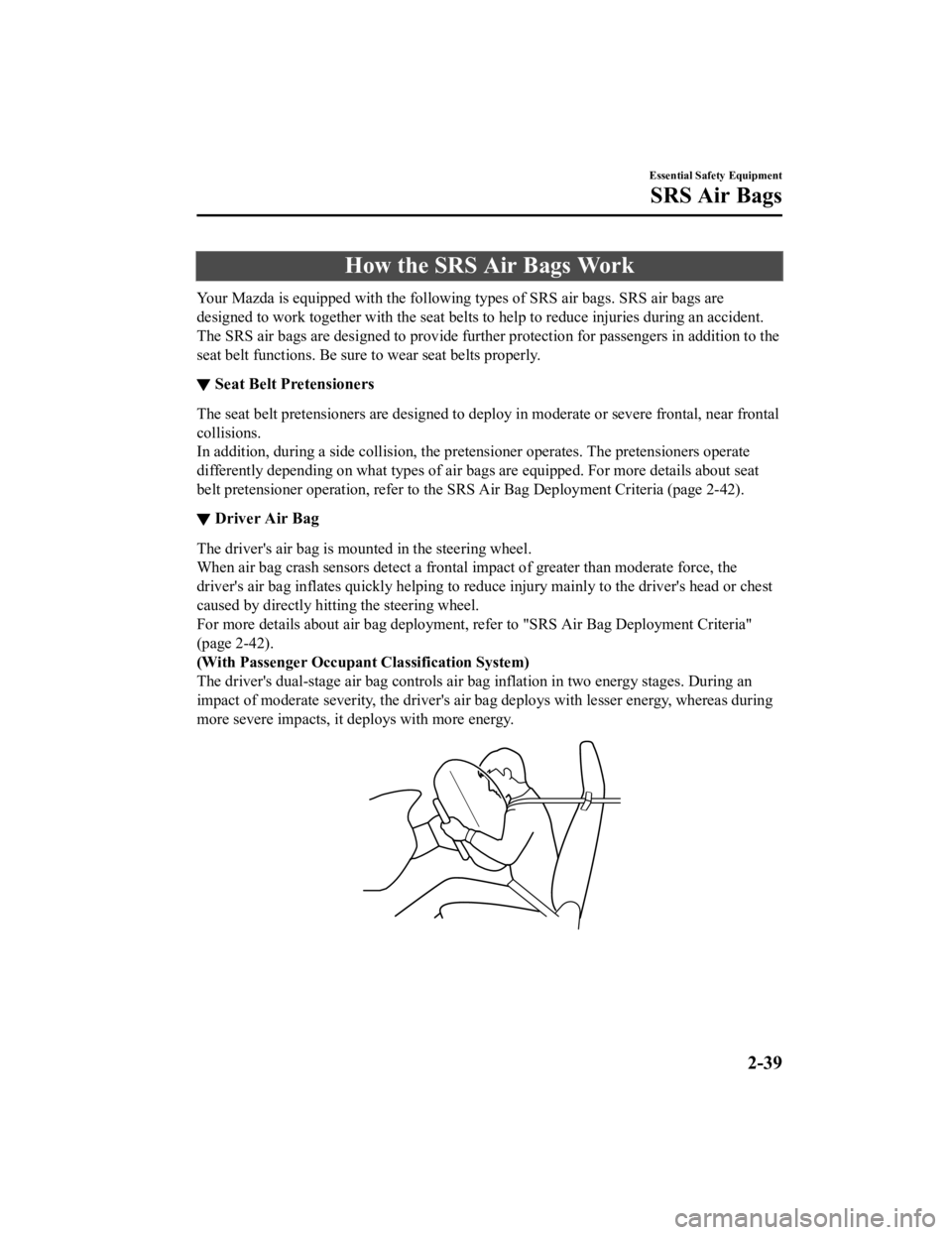
▼ Driver Air Bag
The driver's air bag is mounted in the steering wheel.
When air bag crash sensors detect a frontal impact of greater than moderate force, the
driver's air bag inflates quickly
helping to reduce injury mainly to the driver's head or chest
caused by directly hitting the steering wheel.
For more details about air bag deployment, refer to "SRS Air Ba g Deployment Criteria"
(page 2-42).
(With Passenger Occupant Classification System)
The driver's dual-stage air bag controls air bag inflation in two energy stages. During an
impact of moderate severity, the driver's air bag deploys with lesser energy, whereas during
more severe impacts, it deploys with more energy.
Essential Safety Equipment
SRS Air Bags
2-39
MX-5_8GV5-EA-18E_Edition3 2018-7-17 15:48:16
Page 60 of 553

Passenger air bag deactivation indicator light on/off condition chart
Condition detected by the pas‐
senger occupant classification system Passenger air bag de‐
activation indicator light Passenger front and
side air bags Passenger seat belt
pretensioner system
Empty (Not occupied) On Deactivated Deactivated
A child is seated in a child-re‐
straint system
*1On Deactivated Deactivated
Adult
*2Off Ready Ready
*1 The occupant classification sens or may not detect a child seated on the seat, in a child-restraint system, or a
junior seat depending on the ch ild's physical size and seated posture.
*2 If a smaller adult sits on the passenger seat, the sensors might detect the person as being a child depending on
the person's physique.
If the passenger air bag deactiv ation indicator light does not turn on when the ignition is
switched ON and does not turn on as indicated in the passenger air bag deactivation
indicator light on/off condition chart, do not allow an occupan t to sit in the passenger seat
and consult an Authorized Mazda Dealer as soon as possible. The system may not work
properly in an accident.
WA R N I N G
Do not allow an occupant in the passenger's seat to sit with a posture which makes it difficult
for the passenger occupant classification sensor to detect the occupant correctly:
Sitting in the passenger's seat with a post ure which makes it difficult for the passenger
occupant classification sensor to detect the occupant correctly is dangerous. If the passenger
occupant classification sensor cannot detect the occupant sitting on the passenger's seat
correctly, the passenger front and side air bags and pretensioner system may not operate
(non-deploy) or they may operate (deploy) accidentally. The passenger will not have the
supplementary protection of the air bags or the accidental operation (deployment) of the air
bags could result in serious injury or death.
Under the following conditions, the passenger o ccupant classification sensor cannot detect a
passenger sitting on the passenger's seat co rrectly and the deployment/non-deployment of
the air bags cannot be controlled as indicated in the passenger air bag deactivation indicator
light on/off condition chart. For example:
Essential Safety Equipment
SRS Air Bags
2-46
MX-5_8GV5-EA-18E_Edition3 2018-7-17 15:48:16
Page 96 of 553

▼Opening/Closing Windows
The window opens while the switch is pressed and it closes whil
e the switch is pulled up
with the ignition switched ON. D o not open or close both windows at the same time.
The passenger window can be opened/closed when the power window lock switch on the
driver's door is in the unlock position. Keep this switch in th e locked position while children
are in the vehicle.
Open Close
Open
Driver's window
Power window
lock switch
Passenger's
window
Close
Unlocked positionLocked position
Master control switches Passenger's window switch
NOTE
A power window may no longer open/close if you continue to press the switch after
opening/closing the power window. If the po
wer window does not open/close, wait a
moment and then operate the switch again.
The passenger windows may be opened or closed using the master control switches on the
driver's door.
The power window can be operated for about 40 seconds after the ignition is switched
from ON to ACC or off with all doors closed. If any door is opened, the power window
will stop operating.
For engine-off operation of the power window, the switch must be held up firmly
throughout window closure because the aut o-closing function will be inoperable.
When the power window lock switch is in th e locked position, the light on the passenger
power window switch turns off. The light may be difficult to see depending on the
surrounding brightness.
Before Driving
Windows
3-32
MX-5_8GV5-EA-18E_Edition3 2018-7-17 15:48:16
Page 102 of 553
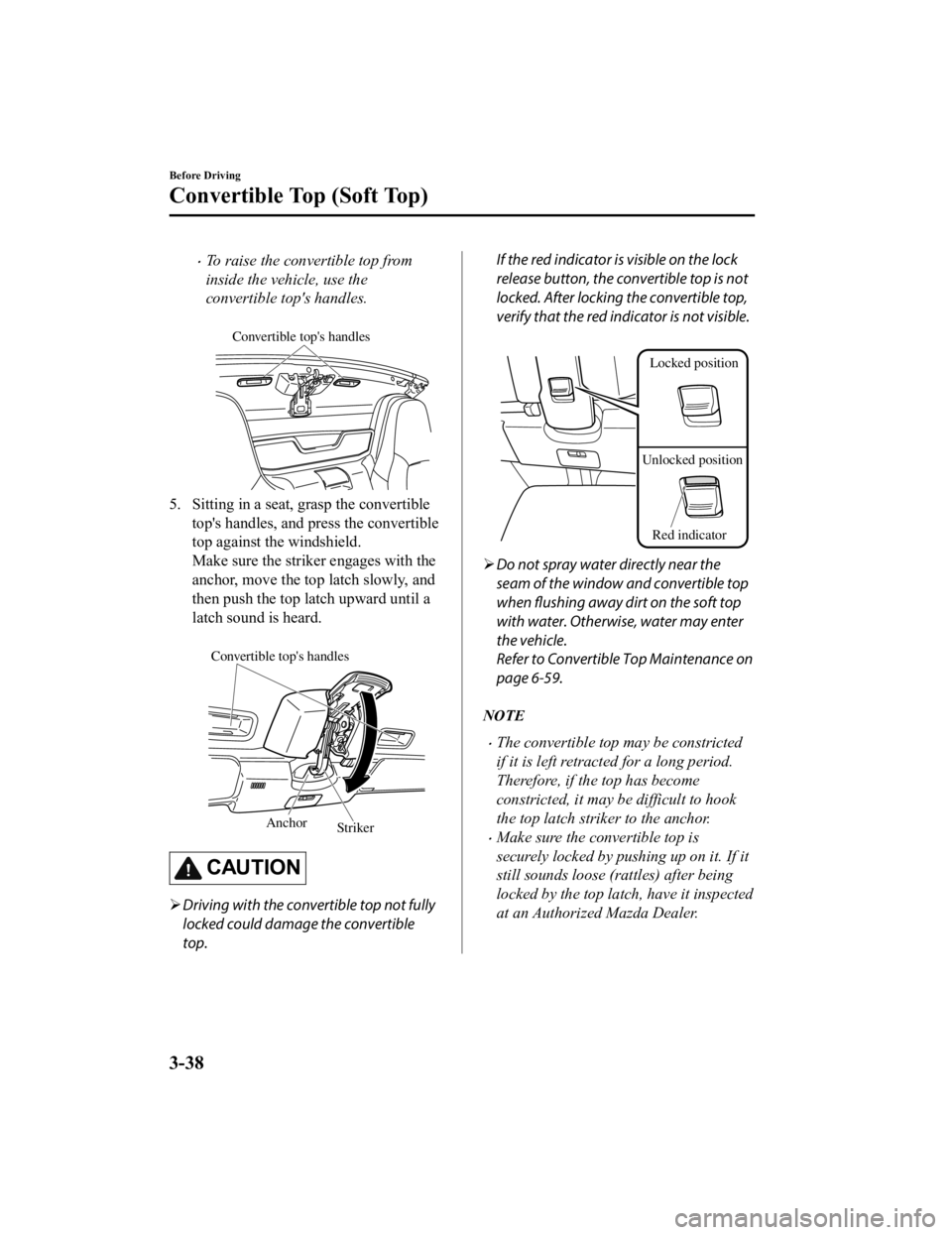
To raise the convertible top from
inside the vehicle, use the
convertible top's handles.
Convertible top's handles
5. Sitting in a seat, grasp the convertibletop's handles, and press the convertible
top against the windshield.
Make sure the strik er engages with the
anchor, move the top latch slowly, and
then push the top latch upward until a
latch sound is heard.
Convertible top's handles
Striker
Anchor
CAUTION
Driving with the convertible top not fully
locked could damage the convertible
top.
If the red indicator is visible on the lock
release button, the convertible top is not
locked. After locking the convertible top,
verify that the red indicator is not visible.
Locked position
Unlocked position Red indicator
Do not spray water directly near the
seam of the window and convertible top
when flushing away dirt on the soft top
with water. Otherwise, water may enter
the vehicle.
Refer to Convertible Top Maintenance on
page 6-59.
NOTE
The convertible top may be constricted
if it is left retracted for a long period.
Therefore, if the top has become
constricted, it may be difficult to hook
the top latch striker to the anchor.
Make sure the convertible top is
securely locked by pushing up on it. If it
still sounds loose (rattles) after being
locked by the top latch, have it inspected
at an Authorized Mazda Dealer.
Before Driving
Convertible Top (Soft Top)
3-38
MX-5_8GV5-EA-18E_Edition3 2018-7-17 15:48:16
Page 109 of 553
NOTE
The keys carry a unique electronic code.
For this reason, and to assure your
safety, obtaining a replacement key
requires some waiting time. They are
only available through an Authorized
Mazda Dealer.
Always keep a spare key in case one is
lost. If a key is lost, consult an
Authorized Mazda Dealer as soon as
possible.
If you lose a key, an Authorized Mazda
Dealer will reset the electronic codes of
your remaining keys and immobilizer
system. Bring all the remaining keys to
an Authorized Mazda Dealer to reset.
Starting the vehicle with a key that has
not been reset is not possible.
▼ Operation
NOTE
The engine may not start and security
indicator light may illuminate or flash if
the key is placed in an area where it is
difficult for the system to detect the
signal, such as on the dashboard. Move
the key to a location within the signal
range, switch the ignition off, and then
restart the engine.
Signals from a TV or radio station, or
from a transceiver or mobile telephone
could interfere with your immobilizer
system. If you are using the proper key
and the engine fails to start, check the
security indicator light.
Arming
The system is armed when the ignition is
switched from ON to off.
The security indica tor light in the
instrument cluster flashes every 2 seconds
until the system is disarmed.
Disarming
The system is disarmed when the ignition
is switched ON with the correct
programmed key. The security indicator
light illuminates for about 3 seconds and
then turns off. If the engine does not start
with the correct key, and the security
indicator light remains illuminated or
flashing, try the following:
Make sure the key is within the
operational range for signal transmission.
Switch the ignition off, and then restart the
engine. If the engine does not start after 3
or more tries, contact an Authorized
Mazda Dealer.
NOTE
If the security indicator light flashes
continuously while you are driving, do
not shut off the engine. Go to an
Authorized Mazda Dealer and have it
checked. If the engine is shut off while
the indicator light is flashing, you will
not be able to restart it.
Because the electronic codes are reset
when the immobilizer system is repaired,
the keys are needed. Make sure to bring
all the keys to an Authorized Mazda
Dealer so that they can be programmed.
Before Driving
Security System
3-45
MX-5_8GV5-EA-18E_Edition3 2018-7-17 15:48:16