light MAZDA MODEL TRIBUTE 2002 (in English) Workshop Manual
[x] Cancel search | Manufacturer: MAZDA, Model Year: 2002, Model line: MODEL TRIBUTE, Model: MAZDA MODEL TRIBUTE 2002Pages: 256, PDF Size: 2.66 MB
Page 181 of 256

Preparing your vehicle
When the battery is disconnected or a new battery is installed, the
transmission must relearn its shift strategy. As a result, the transmission
may have firm and/or soft shifts. This operation is considered normal and
will not affect function or durability of the transmission. Over time, the
adaptive learning process will fully update transmission operation.
²Use only a 12±volt supply to start your vehicle.
²Do not disconnect the battery of the disabled vehicle as this could
damage the vehicle's electrical system.
²Park the booster vehicle close to the hood of the disabled vehicle
making sure the two vehiclesdo nottouch. Set the parking brake on
both vehicles and stay clear of the engine cooling fan and other
moving parts.
²Check all battery terminals and remove any excessive corrosion before
you attach the battery cables. Ensure the vent caps are tight and
level.
²Turn the heater fan on in both vehicles to protect any electrical
surges. Turn all other accessories off.
Connecting the jumper cables
1. Connect the positive (+) booster cable to the positive (+) terminal of
the discharged battery.
Note:In the illustrations,lightning boltsare used to designate the
assisting (boosting) battery.
+–+–
Roadside Emergencies
181
Page 184 of 256

Removing the jumper cables
Remove the jumper cables in the reverse order that they were
connected.
1. Remove the jumper cable from thegroundmetal surface.
Note:In the illustrations,lightning boltsare used to designate the
assisting (boosting) battery.
2. Remove the jumper cable on the negative (-) connection of the
booster vehicle's battery.
+–+–
+–+–
Roadside Emergencies
184
Page 198 of 256
WASHING THE EXTERIOR
Wash your vehicle regularly with cool or lukewarm water and a neutral
Ph shampoo, such as Detail Wash (ZC-3±A), which is available from your
dealer.
²Never use strong household detergents or soap, such as dish washing
or laundry liquid. These products can discolor and spot painted
surfaces.
²Never wash a vehicle that is ªhot to the touchº or during exposure to
strong, direct sunlight.
²Always use a clean sponge or carwash mitt with plenty of water for
best results.
²Dry the vehicle with a chamois or soft terry cloth towel in order to
eliminate water spotting.
²It is especially important to wash the vehicle regularly during the
winter months, as dirt and road salt are difficult to remove and cause
damage to the vehicle.
²Immediately remove items such as gasoline, diesel fuel, bird droppings
and insect deposits because they can cause damage to the vehicle's
paintwork and trim over time.
²Remove any exterior accessories, such as antennas, before entering a
car wash.
²Suntan lotions and insect repellents can damage any painted
surface; if these substances come in contact with your vehicle,
wash off as soon as possible.
WAXING
Applying a polymer paint sealant to your vehicle every six months will
assist in reducing minor scratches and paint damage.
²Wash the vehicle first.
²Do not use waxes that contain abrasives.
²Do not allow paint sealant to come in contact with any non-body
(low-gloss black) colored trim, such as grained door handles, roof
racks, bumpers, side moldings, mirror housings or the windshield cowl
area. The paint sealant will ªgrayº or stain the parts over time.
Cleaning
198
Page 199 of 256

PAINT CHIPS
Your dealer has touch-up paint to match your vehicle's color. Touch-up
paint can be used to repair minor scratches to painted surfaces.
²Remove particles such as bird droppings, tree sap, insect deposits, tar
spots, road salt and industrial fallout before repairing paint chips.
²Always read the instructions before using the products.
ALUMINUM WHEELS AND COVERS
Aluminum wheel rims or covers are coated with a clearcoat paint finish.
In order to maintain their shine:
²Clean with One Step Wash and Wax Concentrate, which is available
from your local Mazda dealer.
²Never apply any cleaning chemical to hot or warm wheel rims or
covers.
²Some automatic car washes may cause damage to the finish on your
wheel rims or covers. Chemical-strength cleaners, or cleaning
chemicals, in combination with brush agitation to remove brake dust
and dirt, could wear away the clearcoat finish over time.
²Do not use hydrofluoric acid-based or high caustic-based wheel
cleaners, steel wool, fuels or strong household detergent.
²To remove tar and grease, use Extra Strength Tar and Road Oil
Removal, available from your local Mazda dealer.
ENGINE
Engines are more efficient when they are clean because grease and dirt
buildup keep the engine warmer than normal. When washing:
²Take care when using a power washer to clean the engine. The
high-pressure fluid could penetrate the sealed parts and cause
damage.
²Never spray the engine or other engine components with water. Water
will damage the engine or other engine components.
²Spray Engine Shampoo and Degreaser, available at your local Mazda
dealer, on all parts that require cleaning and pressure rinse clean.
²Cover the highlighted areas to prevent water damage when cleaning
the engine.
Cleaning
199
Page 201 of 256

windshield, rear window or the wiper blades may be the cause. These
may include hot wax treatments used by commercial car washes, tree
sap, or other organic contamination. To clean these items, please follow
these tips:
²The windshield or rear window may be cleaned with a non-abrasive
cleaner such as Ultra Clear Spray Glass Cleaner, available from your
local Mazda dealer.
²Do not use abrasives, as they may cause scratches.
²Do not use fuel, kerosene, or paint thinner to clean any parts.
²Wiper blades can be cleaned with isopropyl (rubbing) alcohol or
windshield washer solution. Be sure to replace wiper blades when they
appear worn or do not function properly.
INSTRUMENT PANEL AND CLUSTER LENS
Clean the instrument panel with a damp cloth, then dry with a dry cloth.
²Avoid cleaners or polish that increase the gloss of the upper portion of
the instrument panel. The dull finish in this area helps protect the
driver from undesirable windshield reflection.
WARNING: Do not use chemical solvents or strong detergents
when cleaning the steering wheel or instrument panel to avoid
contamination of the air bag system.
²Be certain to wash or wipe your hands clean if you have been in
contact with certain products such as insect repellent and suntan
lotion in order to avoid possible damage to the painted surfaces.
WOOD-TONE TRIM
²Clean the area with a damp cloth, then dry by wiping with a dry, soft,
clean cloth.
²Do not use household or glass cleaners as these may damage the
finish.
INTERIOR
For fabric, carpets, cloth seats, safety belts and seats equipped with side
air bags:
²Remove dust and loose dirt with a vacuum cleaner.
²Remove light stains and soil with Extra Strength Upholstery Cleaner,
available at your local Mazda dealer.
Cleaning
201
Page 207 of 256
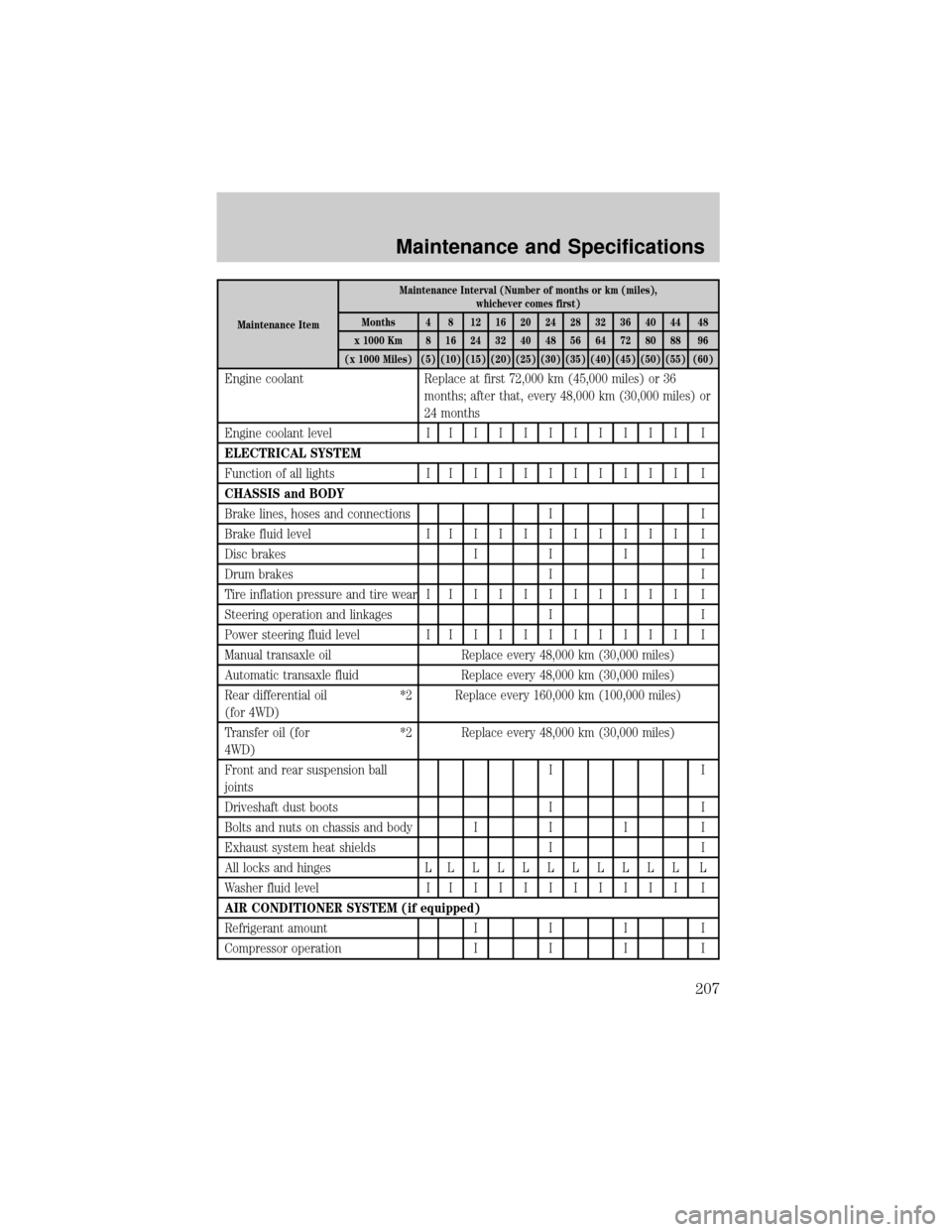
Maintenance ItemMaintenance Interval (Number of months or km (miles),
whichever comes first)
Months 4 8 12 16 20 24 28 32 36 40 44 48
x 1000 Km 8 16 24 32 40 48 56 64 72 80 88 96
(x 1000 Miles) (5) (10) (15) (20) (25) (30) (35) (40) (45) (50) (55) (60)
Engine coolant Replace at first 72,000 km (45,000 miles) or 36
months; after that, every 48,000 km (30,000 miles) or
24 months
Engine coolant level IIIIIIIIIII I
ELECTRICAL SYSTEM
Function of all lights IIIIIIIIIII I
CHASSIS and BODY
Brake lines, hoses and connections I I
Brake fluid level IIIIIIIIIII I
Disc brakes I I I I
Drum brakes I I
Tire inflation pressure and tire wear IIIIIIIIIII I
Steering operation and linkages I I
Power steering fluid level IIIIIIIIIII I
Manual transaxle oil Replace every 48,000 km (30,000 miles)
Automatic transaxle fluid Replace every 48,000 km (30,000 miles)
Rear differential oil
(for 4WD)*2 Replace every 160,000 km (100,000 miles)
Transfer oil (for
4WD)*2 Replace every 48,000 km (30,000 miles)
Front and rear suspension ball
jointsII
Driveshaft dust boots I I
Bolts and nuts on chassis and body I I I I
Exhaust system heat shields I I
All locks and hinges LLLLLLLLLLL L
Washer fluid level IIIIIIIIIII I
AIR CONDITIONER SYSTEM (if equipped)
Refrigerant amount I I I I
Compressor operation I I I I
Maintenance and Specifications
207
Page 208 of 256
*1 According to state and federal regulations, failure to perform
maintenance on these items will not void your emissions warranties.
However, Mazda recommends that all maintenance services be performed
at the recommended time or mileage (kilometrage) period to ensure
long-term reliability.
*2 If this component has been submerged in water, the oil should be
changed.
SERVICE RECOMMENDATIONS
To help you service your vehicle:
²We highlight do-it-yourself items in the engine compartment for easy
location.
²We provide a Scheduled Maintenance section which makes tracking
routine service easy.
If your vehicle requires professional service, your dealership can provide
necessary parts and service. Check your ªWarranty Informationº to find
out which parts and services are covered.
Use only recommended fuels, lubricants, fluids and service parts
conforming to specifications. Genuine Mazda parts are designed and built
to provide the best performance in your vehicle.
PRECAUTIONS WHEN SERVICING YOUR VEHICLE
Be especially careful when inspecting or servicing your vehicle. To avoid
damage and/or personal injury:
²Do not work on a hot engine.
²When the engine is running, make sure that loose clothing, jewelry or
long hair does not get caught up in moving parts.
²Do not work on a vehicle with the engine running in an enclosed
space, unless you are sure you have enough ventilation.
²Keep all lit cigarettes, open flames and other lit material away from
the battery and all fuel related parts.
If you disconnect the battery, the engine must ªrelearnº its idle
conditions before your vehicle will drive properly, as explained inBattery
in this chapter.
Maintenance and Specifications
208
Page 213 of 256
WINDSHIELD WASHER FLUID
Windshield washer fluid
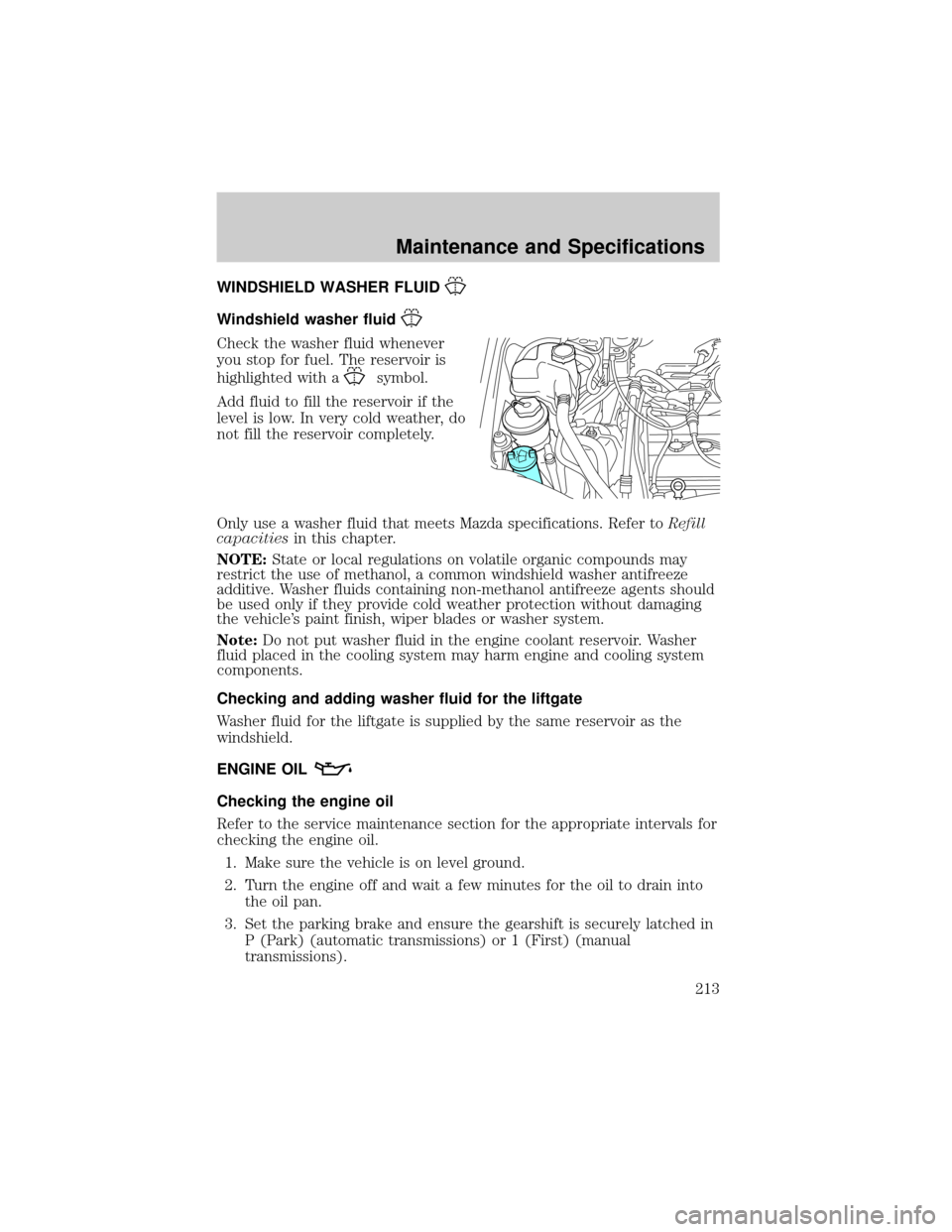
Check the washer fluid whenever
you stop for fuel. The reservoir is
highlighted with a
symbol.
Add fluid to fill the reservoir if the
level is low. In very cold weather, do
not fill the reservoir completely.
Only use a washer fluid that meets Mazda specifications. Refer toRefill
capacitiesin this chapter.
NOTE:State or local regulations on volatile organic compounds may
restrict the use of methanol, a common windshield washer antifreeze
additive. Washer fluids containing non-methanol antifreeze agents should
be used only if they provide cold weather protection without damaging
the vehicle's paint finish, wiper blades or washer system.
Note:Do not put washer fluid in the engine coolant reservoir. Washer
fluid placed in the cooling system may harm engine and cooling system
components.
Checking and adding washer fluid for the liftgate
Washer fluid for the liftgate is supplied by the same reservoir as the
windshield.
ENGINE OIL
Checking the engine oil
Refer to the service maintenance section for the appropriate intervals for
checking the engine oil.
1. Make sure the vehicle is on level ground.
2. Turn the engine off and wait a few minutes for the oil to drain into
the oil pan.
3. Set the parking brake and ensure the gearshift is securely latched in
P (Park) (automatic transmissions) or 1 (First) (manual
transmissions).
Maintenance and Specifications
213
Page 217 of 256
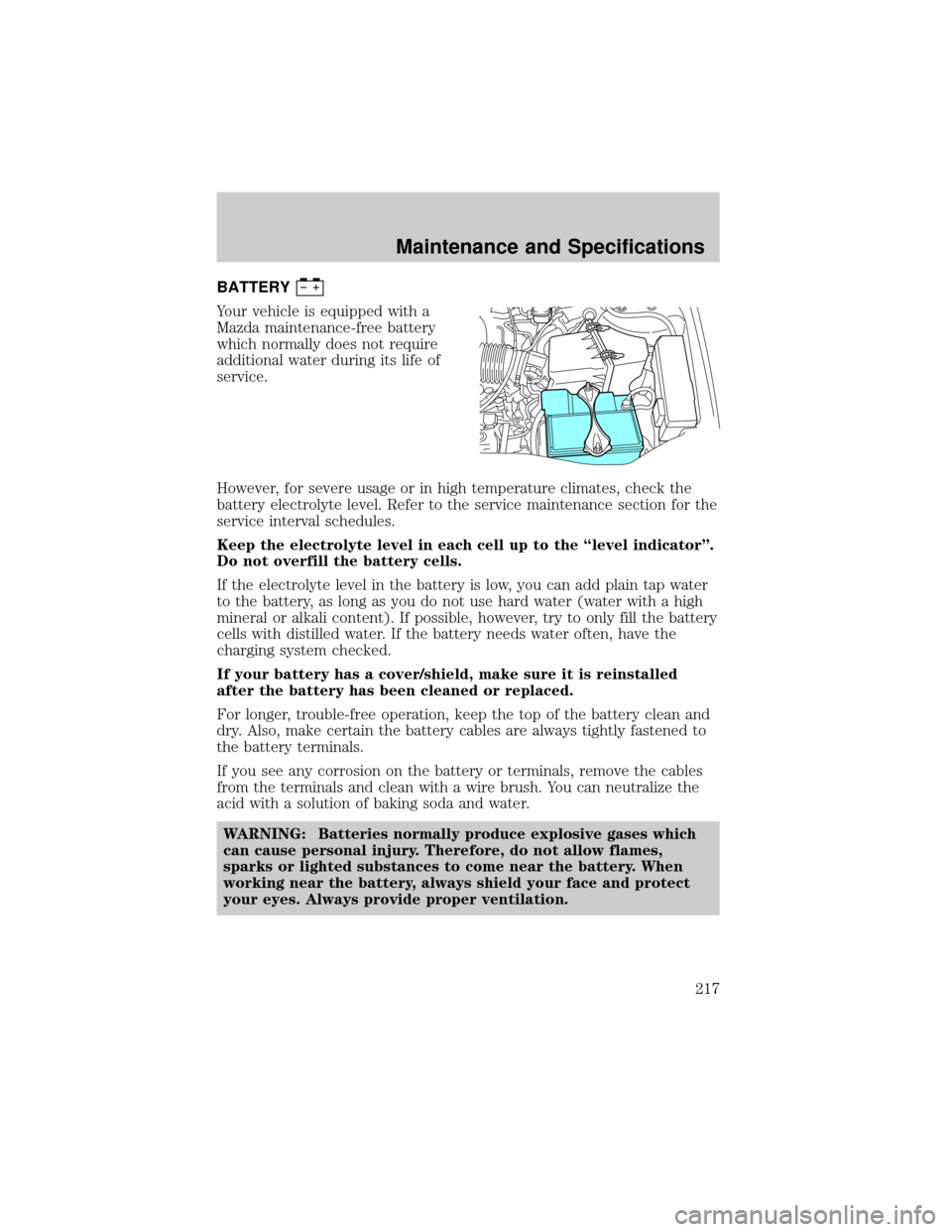
BATTERY
Your vehicle is equipped with a
Mazda maintenance-free battery
which normally does not require
additional water during its life of
service.
However, for severe usage or in high temperature climates, check the
battery electrolyte level. Refer to the service maintenance section for the
service interval schedules.
Keep the electrolyte level in each cell up to the ªlevel indicatorº.
Do not overfill the battery cells.
If the electrolyte level in the battery is low, you can add plain tap water
to the battery, as long as you do not use hard water (water with a high
mineral or alkali content). If possible, however, try to only fill the battery
cells with distilled water. If the battery needs water often, have the
charging system checked.
If your battery has a cover/shield, make sure it is reinstalled
after the battery has been cleaned or replaced.
For longer, trouble-free operation, keep the top of the battery clean and
dry. Also, make certain the battery cables are always tightly fastened to
the battery terminals.
If you see any corrosion on the battery or terminals, remove the cables
from the terminals and clean with a wire brush. You can neutralize the
acid with a solution of baking soda and water.
WARNING: Batteries normally produce explosive gases which
can cause personal injury. Therefore, do not allow flames,
sparks or lighted substances to come near the battery. When
working near the battery, always shield your face and protect
your eyes. Always provide proper ventilation.
Maintenance and Specifications
217
Page 222 of 256

WARNING: To reduce the risk of personal injury, make sure the
engine is cool before unscrewing the coolant pressure relief
cap. The cooling system is under pressure; steam and hot liquid
can come out forcefully when the cap is loosened slightly.
1. Before you begin, turn the engine off and let it cool.
2. When the engine is cool, wrap a thick cloth around the coolant
pressure relief cap on the coolant reservoir (an opaque plastic
bottle). Slowly turn cap counterclockwise (left) until pressure begins
to release.
3. Step back while the pressure releases.
4. When you are sure that all the pressure has been released, use the
cloth to turn it counterclockwise and remove the cap.
5. Fill the coolant reservoir slowly with the proper coolant mixture (see
above), to within the ªcold fill rangeº or the ªcold fullº level on the
reservoir. If you removed the radiator cap in an overflow system, fill
the radiator until the coolant is visible and radiator is almost full.
6. Replace the cap. Turn until tightly installed. (Cap must be tightly
installed to prevent coolant loss.)
After any coolant has been added, run the engine for a few minutes to
mix the coolant. Check the coolant concentration. Make sure the engine
is off and cool before removing the coolant pressure relief cap (see
preceding steps on cap removal). Check the concentration per the
Checking Engine Coolantsection. If the concentration is not 50/50
(protection to ±34ÉF/±36ÉC), drain some coolant and adjust the
concentration. It may take several drains and additions to obtain a 50/50
coolant concentration.
Whenever coolant has been added, the coolant level in the coolant
reservoir should be checked the next few times you drive the vehicle. If
necessary, add enough 50/50 concentration of engine coolant and
distilled water to bring the liquid level to the proper level.
If you have to add more than 1.0 liter (1.0 quart) of engine coolant per
month, have your dealer check the engine cooling system. Your cooling
system may have a leak. Operating an engine with a low level of coolant
can result in engine overheating and possible engine damage).
Maintenance and Specifications
222