low oil pressure MAZDA PROTEGE 1992 User Guide
[x] Cancel search | Manufacturer: MAZDA, Model Year: 1992, Model line: PROTEGE, Model: MAZDA PROTEGE 1992Pages: 1164, PDF Size: 81.9 MB
Page 283 of 1164
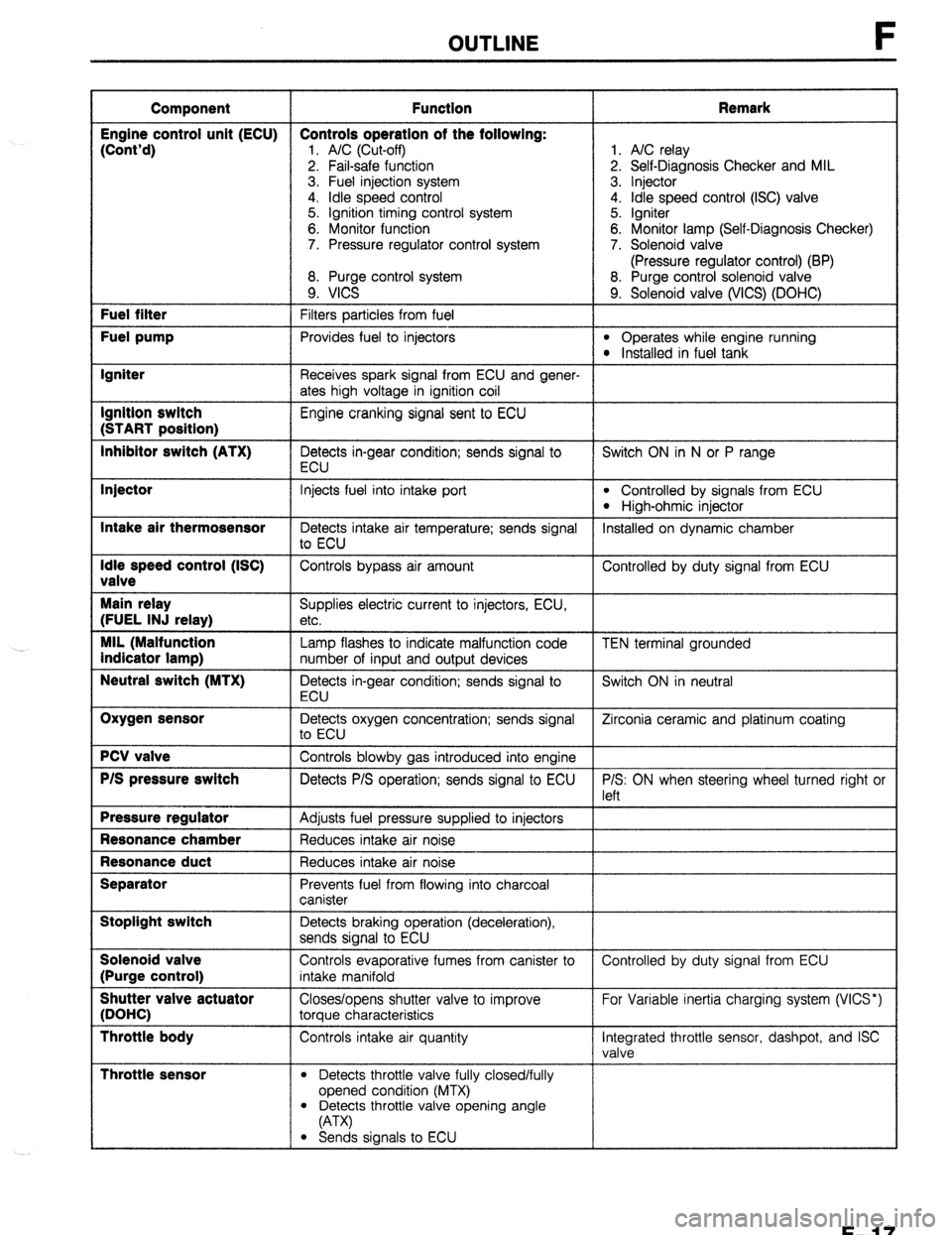
OUTLINE
Component Function Remark
Engine control unit (ECU) Controls operation of the following:
(Cont’d)
1. A/C (Cut-off) 1. A/C relay
2. Fail-safe function 2. Self-Diagnosis Checker and MIL
3. Fuel injection system 3. Injector
4. idle speed control 4. Idle speed control (ISC) valve
5. Ignition timing control system 5. Igniter
6. Monitor function 6. Monitor lamp (Self-Diagnosis Checker)
7. Pressure regulator control system 7. Solenoid valve
(Pressure regulator control) (BP)
8. Purge control system 8. Purge control solenoid valve
9. VICS 9. Solenoid valve (WCS) (DOHC) Fuel filter
Filters particles from fuel Fuel pump
Provides fuel to injectors l Operates while engine running l Installed in fuel tank Igniter
Receives spark signal from ECU and gener-
ates high voltage in ignition coil Ignition switch
Engine cranking signal sent to ECU (START position)
Inhibitor switch (ATX)
Detects in-gear condition; sends signal to Switch ON in N or P range
ECU Injector
Intake air thermosensor
Idle speed control (ISC)
valve
Main relay
(FUEL INJ relay)
MIL (Malfunction
indicator lamp)
Neutral switch (MTX)
Oxygen sensor
PCV valve
P/S pressure switch
Pressure regulator
Resonance chamber
Resonance duct
Separator
Stoplight switch
Solenoid valve
(Purge control)
Shutter valve actuator
(DOHC)
Throttle body
Throttle sensor
Injects fuel into intake port l Controlled by signals from ECU
l High-ohmic injector
Detects intake air temperature; sends signal Installed on dynamic chamber
to ECU
Controls bypass air amount Controlled by duty signal from ECU
Supplies electric current to injectors, ECU,
etc.
Lamp flashes to indicate malfunction code
number of input and output devices
Detects in-gear condition; sends signal to
ECU
Detects oxygen concentration; sends signal
to ECU
Controls blowby gas introduced into engine
Detects P/S operation; sends signal to ECU
Adjusts fuel pressure supplied to injectors
Reduces intake air noise
Reduces intake air noise
Prevents fuel from flowing into charcoal
canister
Detects braking operation (deceleration),
sends signal to ECU
Controls evaporative fumes from canister to
intake manifold
Closes/opens shutter valve to improve
torque characteristics
Controls intake air quantity
l Detects throttle valve fully closed/fully
opened condition (MTX) TEN terminal grounded
Switch ON in neutral
Zirconia ceramic and platinum coating
P/S: ON when steering wheel turned right or
left
Controlled by duty signal from ECU
For Variable inertia charging system (VICS*)
Integrated throttle sensor, dashpot, and ISC
valve
l Detects throttle valve opening angle
(A-W
l Sends signals to ECU
F-l 7
Page 650 of 1164
ENGINE SPEED SENSING POWER STEERING
23UONX-03
03UONX-032
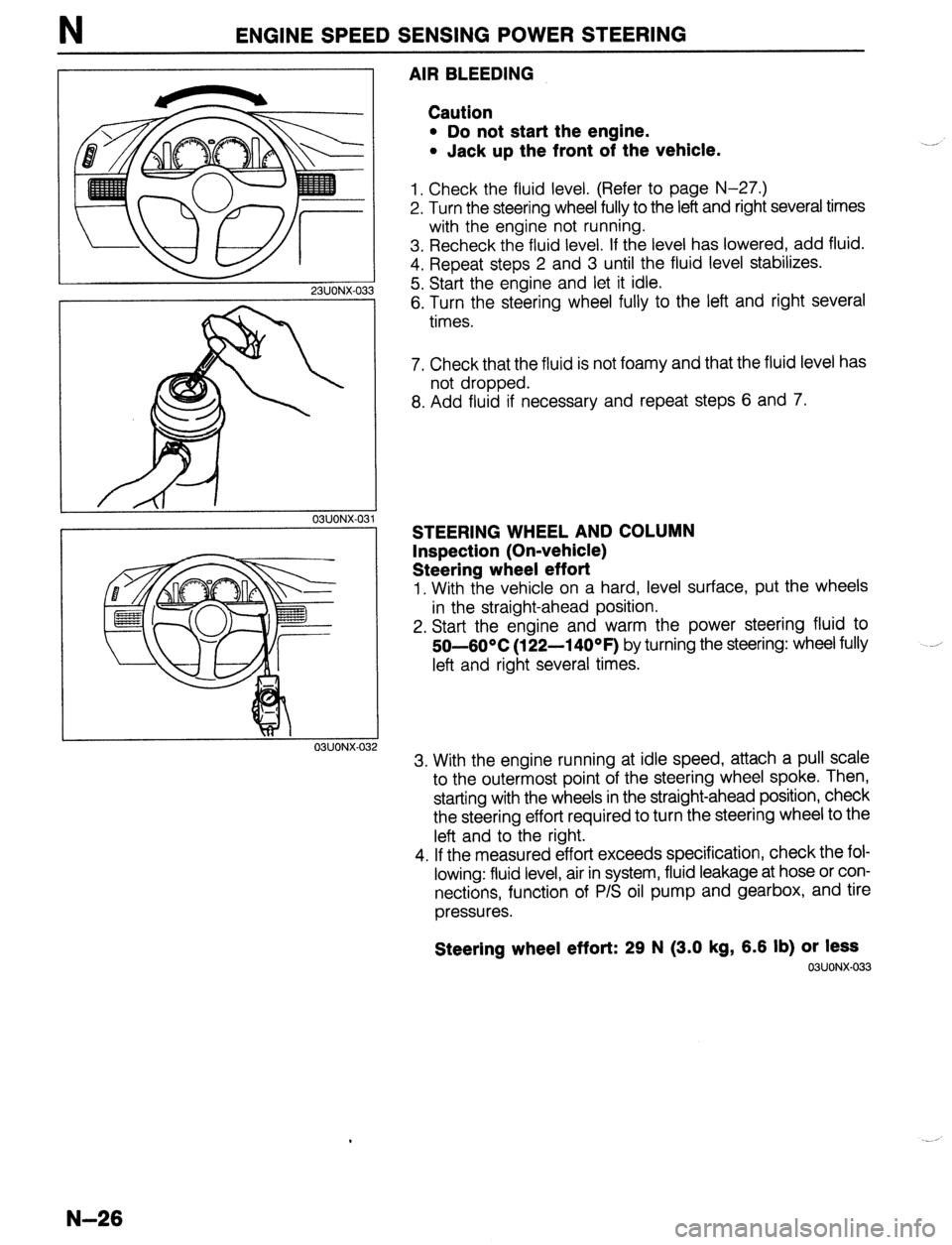
AIR BLEEDING
Caution
l Do not start the engine.
l Jack up the front of the vehicle.
1. Check the fluid level. (Refer to page N-27.)
2. Turn the steering wheel fully to the left and right several times
with the engine not running.
3. Recheck the fluid level. If the level has lowered, add fluid.
4. Repeat steps 2 and 3 until the fluid level stabilizes.
5. Start the engine and let it idle.
6. Turn the steering wheel fully to the left and right several
times.
7. Check that the fluid is not foamy and that the fluid level has
not dropped.
8. Add fluid if necessary and repeat steps 6 and 7.
STEERING WHEEL AND COLUMN
Inspection (On-vehicle)
Steering wheel effort
1. With the vehicle on a hard, level surface, put the wheels
in the straight-ahead position.
2. Start the engine and warm the power steering fluid to
50-60°C
(122-14OOF) by turning the steering: wheel fully
left and right several times.
3. With the engine running at idle speed, attach a pull scale
to the outermost point of the steering wheel spoke. Then,
starting with the wheels in the straight-ahead position, check
the steering effort required to turn the steering wheel to the
left and to the right.
4. If the measured effort exceeds specification, check the fol-
lowing: fluid level, air in system, fluid leakage at hose or con-
nections, function of P/S oil pump and gearbox, and tire
pressures.
Steering wheel effort: 29 N (3.0 kg, 6.6 lb) or less 03UONX-033
N-26
Page 652 of 1164

N ENGINE SPEED SENSING POWER STEERING
03UONXGI
23UONX-03
23UONX-OZ
THERMOMETER
-Y
23UONX-03
Inspection of fluid pressure
1. Assemble the SST as shown in the figure.
Tightening torque:
39-49 Nern (4.0-5.0 m-kg, 29-36 ft-lb)
2. Disconnect the pressure hose on the oil pump side, and
attach the SST.
Note
l Before disconnecting the hose, make marks at the
connections for proper reinstallation.
3. Bleed the air from the system. (Refer to page N-26.)
4. Open the gauge valve fully. Start the engine and turn the
steering wheel fully left and right to raise the fluid tempera-
ture to 50-60°C (122-14OOP).
5. Close the gauge valve completely. Increase the engine
speed to 1,000-l ,500 rpm and measure the fluid pres-
sure generated by the oil pump. If the pressure is below
specification, replace the oil pump assembly.
Oil pump fluid pressure:
7,356 kPa (75 kg/cm2, 1,067 psi)
Caution
l If the valve Is left closed for more than 15 seconds,
the fluid temperature will increase excessively and
adversely affect the oil pump.
6. Open the gauge valve fully again and increase the engine
speed to l,OOO-1,500 rpm.
7. Turn the steering wheel fully to the left and right and meas-
ure the fluid pressure generated by the gear housing. If the
pressure is below specification, replace the gear housing
assembly.
Gear housing fluid pressure:
7,356 kPa (75 kg/cm2, 1,067 psi)
Caution
l If the steering wheel is kept in the fully turned po-
sition for more than 15 seconds, the fluid tempera-
ture will rise excessively.
N-28
Page 662 of 1164

N ENGINE SPEED SENSING POWER STEERING
Disassembly / Inspection / Assembly
1. The following procedures show replacement of the O-rings. If a problem is found in other parts, replace
the oil pump assembly.
2. Disassemble in the order shown in the figure, referring to
Disassembly Note.
3. Inspect all parts and replace as necessary.
4. Assemble in the reverse order of disassembly, referring to
Assembly Note,
1. Suction pipe
2. O-ring
3. Pressure-switch assembly
4. O-ring
5. Connector
6. O-ring
7. Control valve
Inspection . . . . . . . . . . . . . . . . . . . . . . . . . . . . . . . . . . . page N-40
8. Spring
Inspection . . . . . . . . . . . . . . . . . . . . . . . . . . . . . . . . . . . page N-40
9. Bracket
10. Pump body (rear)
Inspection . . . . . . . . . . . . . . . . . . . . . . . . . . . . . . . . . . . page N-39
Il. O-ring _,
12. Cam ring
Assembly Note . . . . . . . . . . . . . . . . . . . . . . . . . . . page N-39
Inspection . . . . . . . . . . . . . . . . . . . . . . . . . . . . . . . . . . . page N-40
13. Vane
Assembly Note . . . . . . . . . . . . . . . . . . . . . . . . . . . page N-39
Inspection . . . . . . . . . . . . . . . . . . . . . . . . . . . . . . . . . . . page N-40
14. Rotor
Assembly Note . . . . . . . . . . . . . . . . . . . . . . . . . . page N-39
Inspection . . . . . . . . . . . . . . . . . . . . . . . . . . . . . . . . . . . page N-40
15. Side plate
Inspection . . . . . . . . . . . . . . . . . . . . . . . . . . . . . . . . . . . page N-40
16. O-ring
17. O-ring
18. Pin
19. Pump body (front)
Inspection . . . . . . . . . . . . . . . . . . . . . . . . . . . . . . . . . . . page N-39
N-38
Page 703 of 1164
WHEELS AND TIRES
WHEELS AND TIRES
SPECIAL NOTES ABOUT WHEELS AND TIRES
1. Do not use wheels or tires other than the specified types.
2. Aluminum wheels are easily scratched. When washing them, use a soft cloth, never a wire brush. If the
vehicle is steam cleaned, do not allow boiling water to contact the wheels.
3. If alkaline compounds (such as saltwater or road salts) get on aluminum wheels, wash them as soon as
possible to prevent damage. Use only a neutral detergent.
9MUOQX-004
NOTES REGARDING TIRE REPLACEMENT
Note the following points when tires are to be removed from or mounted onto the wheels.
1. Be careful not to damage the tire bead, the rim bead, or the edge of the rim.
2. Use a wire brush, sandpaper, or cloth to clean and remove all rust and dirt from the rim edge and the
rim bead.
3. When cleaning aluminum wheels, use a soft cloth, never a wire brush or sandpaper.
4. Remove any pebbles, glass, nails, and other foreign items embedded in the tire tread.
5. Be sure the air valve is installed correctly.
6. Apply a soapy solution to the tire bead and the edge of the rim.
7. After mounting a tire onto a wheel, inflate the tire to 250-300 kPa (2.55-3.06 kg/cm2, 35.55-42.66
psi). Check to be sure that the bead is seated correctly onto the rim and that there are no air leaks. Then
reduce the pressure to the specified level.
8. If a tire iron is used to change a tire on an aluminum wheel, be sure to use a piece of rubber between
the iron lever and the wheel to avoid damage to the wheel. Work should be done on a rubber mat, not
on a hard or rough surface.
03UOQX-004
23UOOX-003
TIRE
I
AIR VALVE
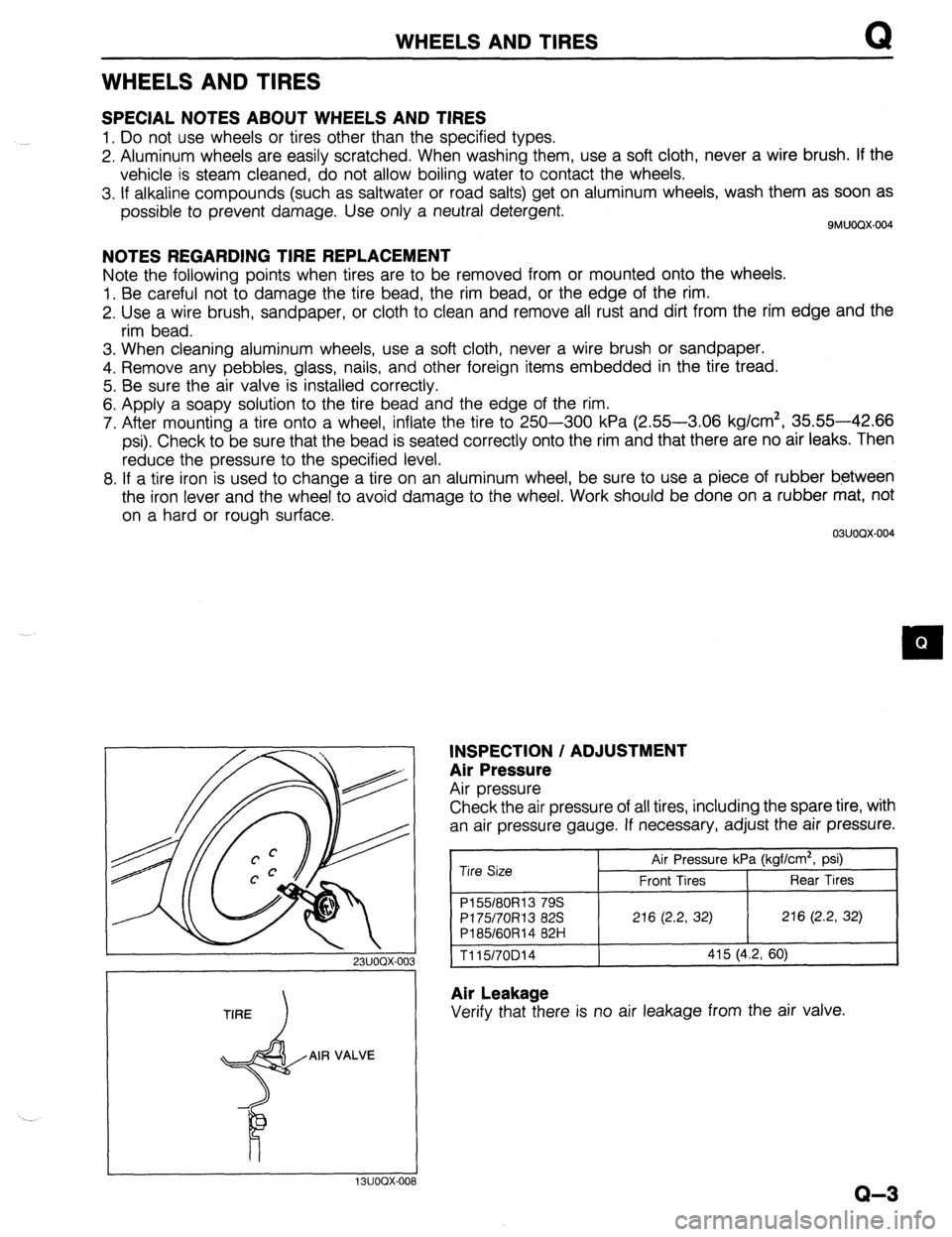
INSPECTION / ADJUSTMENT
Air Pressure
Air pressure
Check the air pressure of all tires, including the spare tire, with
an air pressure gauge. If necessary, adjust the air pressure.
Tire Size Air Pressure kPa (kgf/cm2, psi)
Front Tires Rear Tires
P155180R13 79s
PI 75/70R13 82s 216 (2.2, 32) 216 (2.2, 32)
P185/60R14 82H
1115/70D14 415 (4.2, 60)
Air Leakage
Verify that there is no air leakage from the air valve.
I I 13UOOX-008
Q-3
Page 917 of 1164
WARNING SYSTEM T
13UOTX-07
63U15X-05
, I//
‘nF -
-
-
FUEL
13UOTX.08C
- CHARGE
13UOTX-08
13UOTX-08
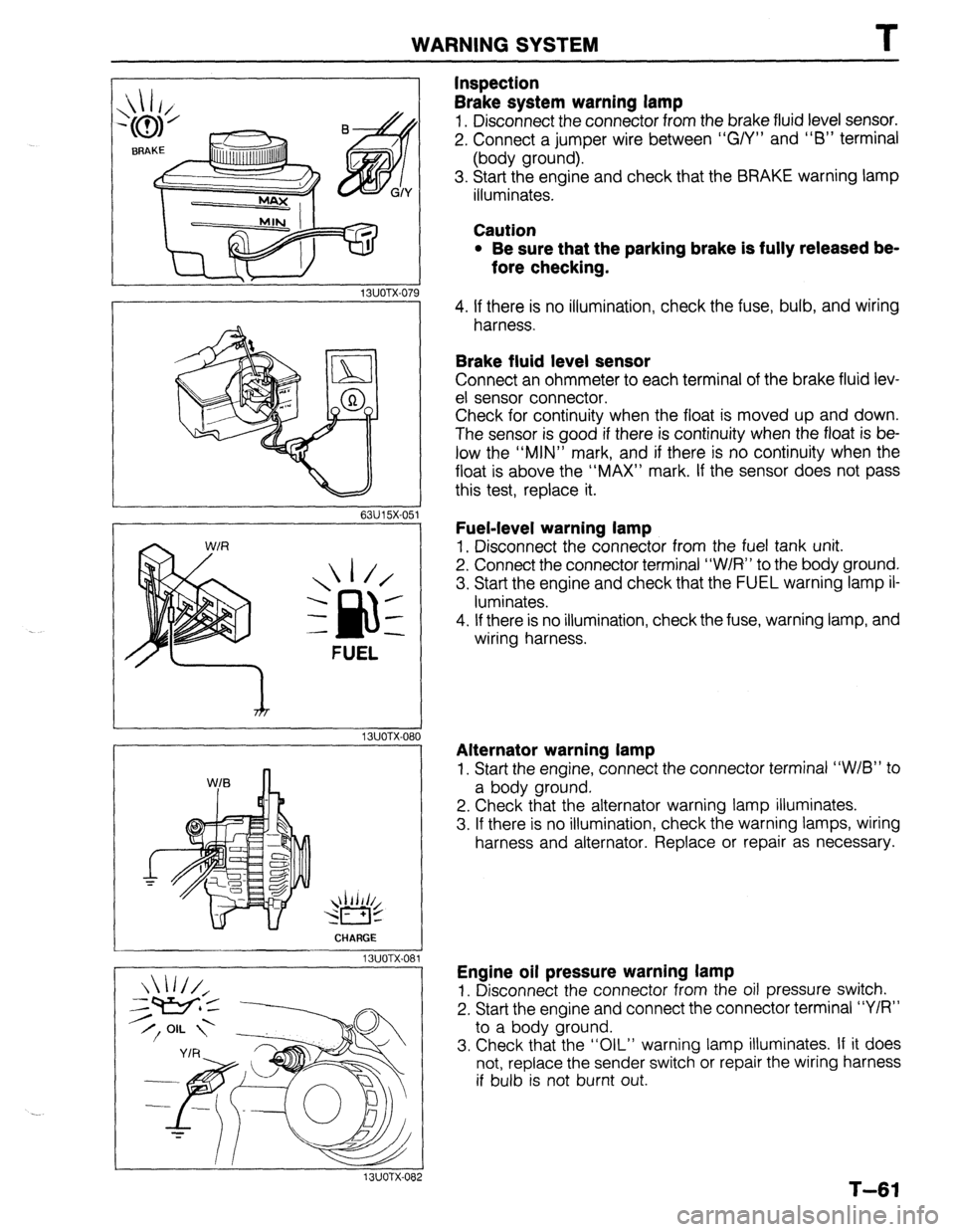
Inspection
Brake system warning lamp
1. Disconnect the connector from the brake fluid level sensor.
2. Connect a jumper wire between “G/Y” and “6” terminal
(body ground).
3. Start the engine and check that the BRAKE warning lamp
illuminates.
Caution
l Be sure that the parking brake is fully released be-
fore checking.
4. If there is no illumination, check the fuse, bulb, and wiring
harness.
Brake fluid level sensor
Connect an ohmmeter to each terminal of the brake fluid lev-
el sensor connector.
Check for continuity when the float is moved up and down.
The sensor is good if there is continuity when the float is be-
low the “MIN” mark, and if there is no continuity when the
float is above the “MAX” mark. If the sensor does not pass
this test, replace it.
Fuel-level warning lamp
1. Disconnect the connector from the fuel tank unit.
2. Connect the connector terminal “W/R” to the body ground.
3. Start the engine and check that the FUEL warning lamp il-
luminates.
4. If there is no illumination, check the fuse, warning lamp, and
wiring harness.
Alternator warning lamp
1. Start the engine, connect the connector terminal “W/B” to
a body ground.
2. Check that the alternator warning lamp illuminates.
3. If there is no illumination, check the warning lamps, wiring
harness and alternator. Replace or repair as necessary.
Engine oil pressure warning lamp
1. Disconnect the connector from the oil pressure switch.
2. Start the engine and connect the connector terminal “Y/R”
to a body ground.
3. Check that the “OIL” warning lamp illuminates. If it does
not, replace the sender switch or repair the wiring harness
if bulb is not burnt out.
T-61
Page 972 of 1164
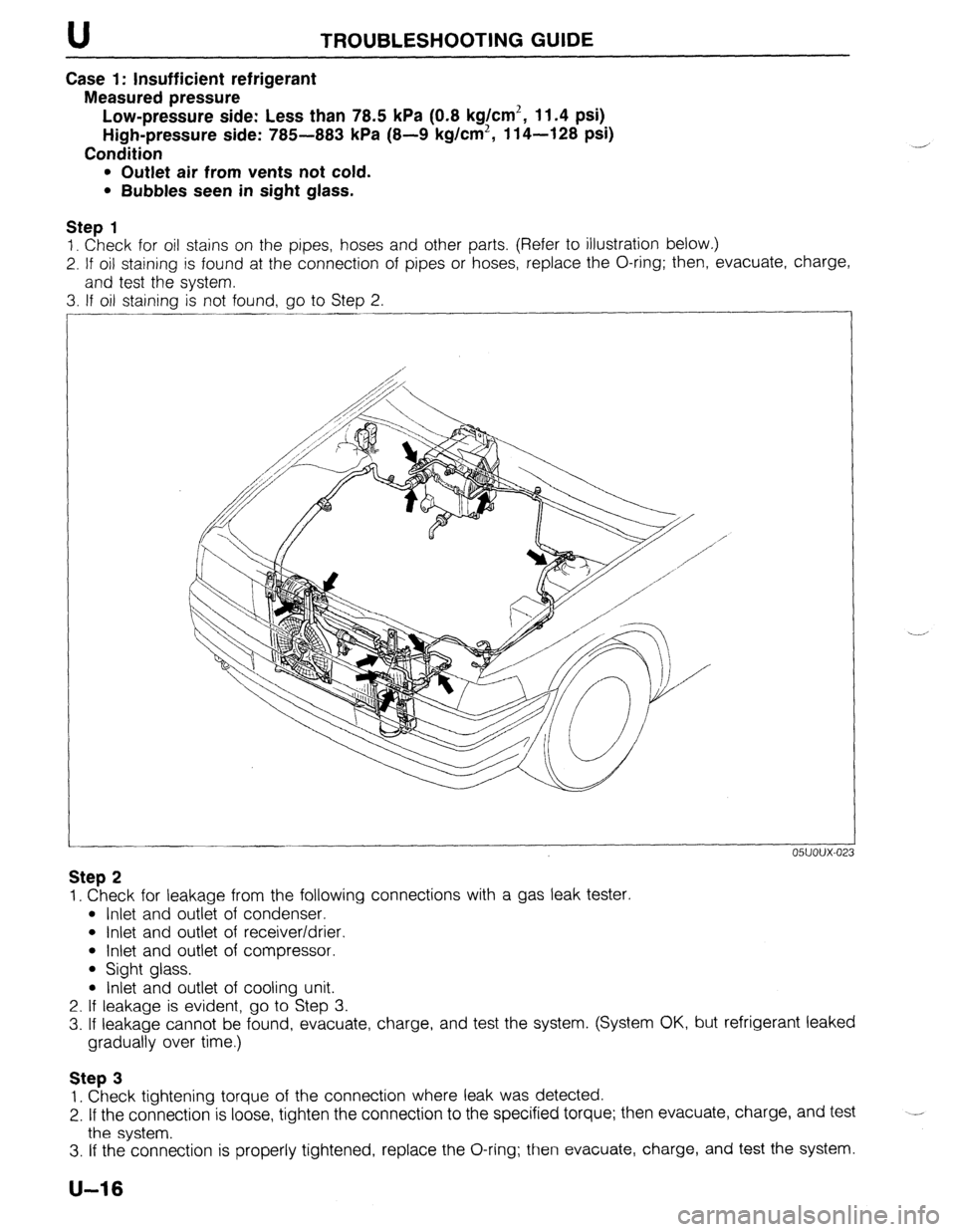
U TROUBLESHOOTING GUIDE
Case 1: Insufficient refrigerant
Measured pressure
Low-pressure side: Less than 78.5 kPa (0.8 kg/cm2, 11.4 psi)
High-pressure side: 785-883 kPa (8-9 kg/cm2, 114-128 psi)
Condition
l Outlet air from vents not cold.
l Bubbles seen in sight glass.
Step 1
1. Check for oil stains on the pipes, hoses and other parts, (Refer to illustration below.)
2. If oil staining is found at the connection of pipes or hoses, replace the O-ring; then, evacuate, charge,
and test the system.
3. If oil staining is not found, go to Step 2.
05UOUX-02
Step 2
1. Check for leakage from the following connections with a gas leak tester.
l Inlet and outlet of condenser.
l Inlet and outlet of receiver/drier.
l Inlet and outlet of compressor.
l Sight glass.
l Inlet and outlet of cooling unit.
2. If leakage is evident, go to Step 3.
3. If leakage cannot be found, evacuate, charge, and test the system. (System OK, but refrigerant leaked
gradually over time.)
Step 3
1. Check tightening torque of the connection where leak was detected.
2. If the connection is loose, tighten the connection to the specified torque; then evacuate, charge, and test
the system. --
3. If the connection is properly tightened, replace the O-ring; then evacuate, charge, and test the system.
U-16
Page 994 of 1164

U
COOLING UNIT
Removal / Installation AIR CONDITIONER
1. Discharge the refrigeration system. (Refer to page U-32.)
2. Remove the glove box, glove box cover, undercover, and instrument panel stay. (Refer to Section S.)
3. Remove the cooling unit as shown in the figure. -
Note
l Immediately plug all open fittings to keep moisture out of system.
4. Install the cooling unit in the reverse order of removal.
Note
l Position the cooling unit so that its connections match those of the heater unit and blower unit.
l Apply clean compressor oil to the O-rings before connecting the fittings.
l Do not apply compressor oil to the fitting nuts.
l When installing a new cooling unit, add compressor oil through the high-pressure pipe port
of the compressor.
Compressor oil: 50 cc (3.05 cu in)
Tightening torque
Outlet pipe: 20-29 N*m (2.0-3.0 m-kg, 14-22 ft-lb)
lnla+ nina. Q n,7n N.m (I -0-2.0 m&a. 7,7-IA ftJh IIllcvb yap”. “.” -1 . . . . . \..’ -_- __- ..~, JII .- .I .-,
23UOUX-0: -.,
1. Cooling unit
Disassembly / Assembly.. . . . . . . . . . . . page U-39
U-38
Page 1009 of 1164

AIR CONDITIONER U
CONDENSER
Removal / Installation
1. Discharge the refrigeration system. (Refer to page U-32.)
2. Remove the radiator grille. (Refer to Section S.)
3. Remove the receiver/drier. (Refer to page U-52.)
4. Remove the condenser as shown in the figure.
Note
l Insert a protector such as cardboard between the condenser and the radiator.
l Immediately plug the open fittings to keep moisture out of the system.
5. install the condenser in the reverse order of removal.
Note
l Apply clean compressor oil to the O-rings before connecting the fittings.
l Do not apply compressor oil to the fitting nuts.
l Remove the protector before installing the radiator brackets.
l When installing a new condenser, add compressor oil through the high-pressure pipe port
of the compressor.
Compressor oil: 30 cc (1.83 cu in)
Tightening torque
Condenser inlet: 15-25 N*rn (1.5-2.5 m-kg, 11-18 ft-lb)
Condenser outlet: 9.8-20 N#m (1 .O-2.0 m-kg, 7.2-14 ft-lb)
1. Radiator bracket
2. Radiator 3. Condenser
23UOUX-01
Inspection
Check for the following and repair or replace the condenser
as necessary.;
1. Cracks, damage, or refrigerant leakage.
2. Bent fins.
3. Distorted or damaged condenser inlet or outlet.
u-53
Page 1010 of 1164

AIR CONDITIONER
REFRIGERANT LINES
On-vehicle Inspection
Check for leakage at connections. (Refer to page U-32.)
Repair or replace as necessary.
Replacement
1. Discharge the refrigeration system. (Refer to page U-32.)
2. Replace the faulty pipe or hose.
Note
l Immediately plug the open fittings to keep moisture out of the system.
l Apply clean compressor oil to the O-rings before connecting the fittings.
l Do not apply compressor oil to the fitting nuts.
Tightening torque (fittings):
Location Tightening torque
0 9.8-20 N.m
(1.0-2.0 m-kg, 7.2-14 ft-lb)
0 15-25 N-m (1.5-2.5 m-kg, 11-18 ft-lb)
0 9.8-16 N.m (1.0-1.6 m-kg, 7.2-12 ft-lb)
fa 20-29 N.m
(2.0-3.0 m-ka 15-21 ft-lb)
3. Evacuate, charge, and test the refrigeration system.
1. High-pressure hose
2. Low-pressure hose
3. Cooler pipe No.1 4. Cooler pipe No.2 6. Cooler pipe No.4
5. Cooler
pipe No.3 7. Cooler pipe No.5
u-54