wheel MERCEDES-BENZ B-CLASS 2012 Service Manual
[x] Cancel search | Manufacturer: MERCEDES-BENZ, Model Year: 2012, Model line: B-CLASS, Model: MERCEDES-BENZ B-CLASS 2012Pages: 340, PDF Size: 3.09 MB
Page 104 of 340
Active:
R
if you are driving at speeds below 25 mph
(40 km/h )
and switch on the turn signal or
turn the steering wheel.
R if you are driving at speeds between
25 mph (40 km/h) and 45 mph (70 km/h)
and turn the steering wheel.
Not active: if you are driving at speeds above
25 mph (40 km/h) or switch off the turn
signal or turn the steering wheel to the
straight-ahead position.
The cornering lamp may remain lit for a short
time, but is automatically switched off after
no more than three minutes. Extended range fog lamps
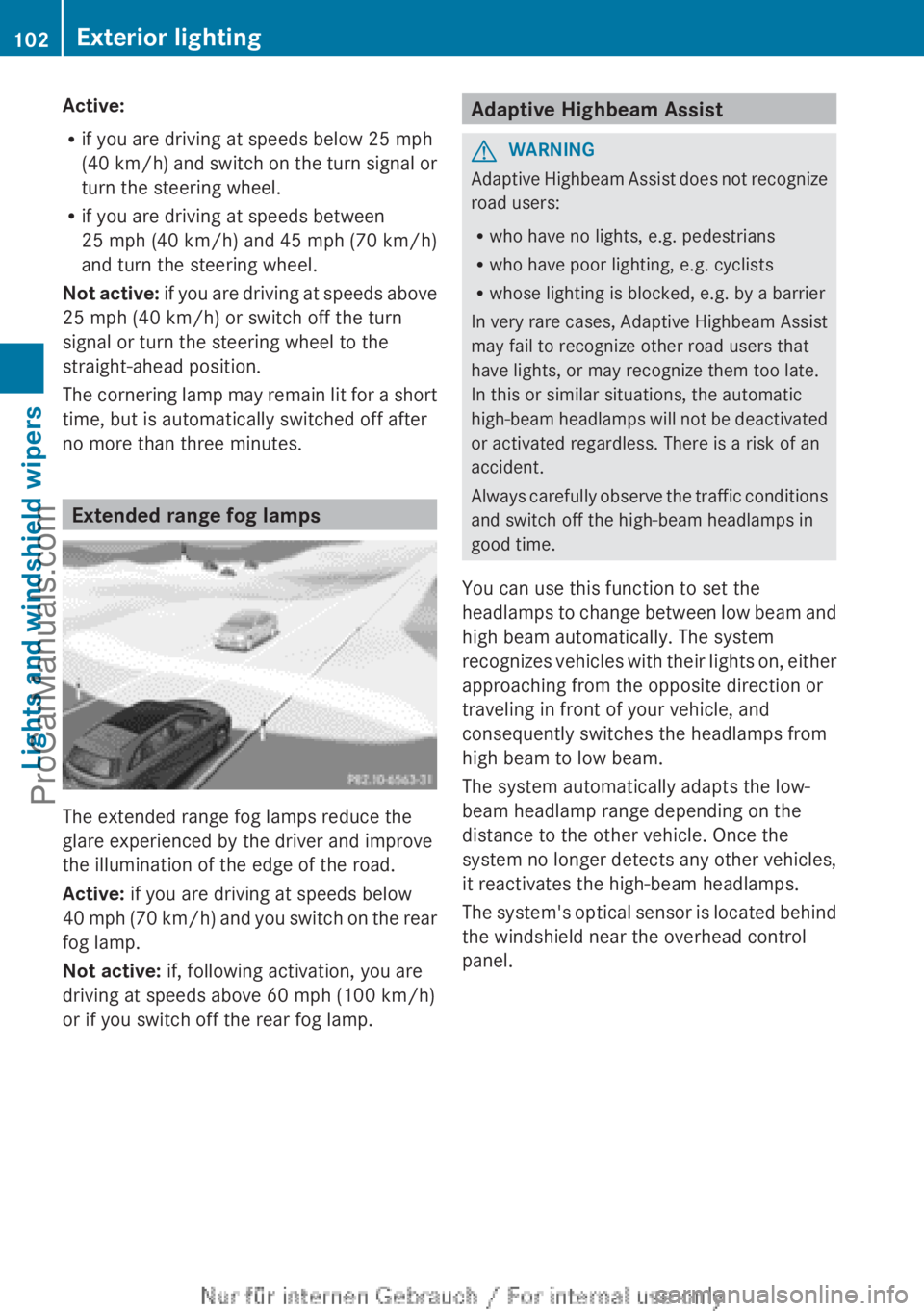
The extended range fog lamps reduce the
glare experienced by the driver and improve
the illumination of the edge of the road.
Active:
if you are driving at speeds below
40 mph (70
km/h) and you switch on the rear
fog lamp.
Not active: if, following activation, you are
driving at speeds above 60 mph (100 km/h)
or if you switch off the rear fog lamp. Adaptive Highbeam Assist
G
WARNING
Adaptive Highbeam Assist does not recognize
road users:
R who have no lights, e.g. pedestrians
R who have poor lighting, e.g. cyclists
R whose lighting is blocked, e.g. by a barrier
In very rare
cases, Adaptive Highbeam Assist
may fail to recognize other road users that
have lights, or may recognize them too late.
In this or similar situations, the automatic
high-beam headlamps will not be deactivated
or activated regardless. There is a risk of an
accident.
Always carefully observe the traffic conditions
and switch off the high-beam headlamps in
good time.
You can use this function to set the
headlamps to change between low beam and
high beam automatically. The system
recognizes vehicles with their lights on, either
approaching from the opposite direction or
traveling in front of your vehicle, and
consequently switches the headlamps from
high beam to low beam.
The system automatically adapts the low-
beam headlamp range depending on the
distance to the other vehicle. Once the
system no longer detects any other vehicles,
it reactivates the high-beam headlamps.
The system's optical sensor is located behind
the windshield near the overhead control
panel. 102
Exterior lighting
Lights and windshield wipers
ProCarManuals.com
Page 108 of 340
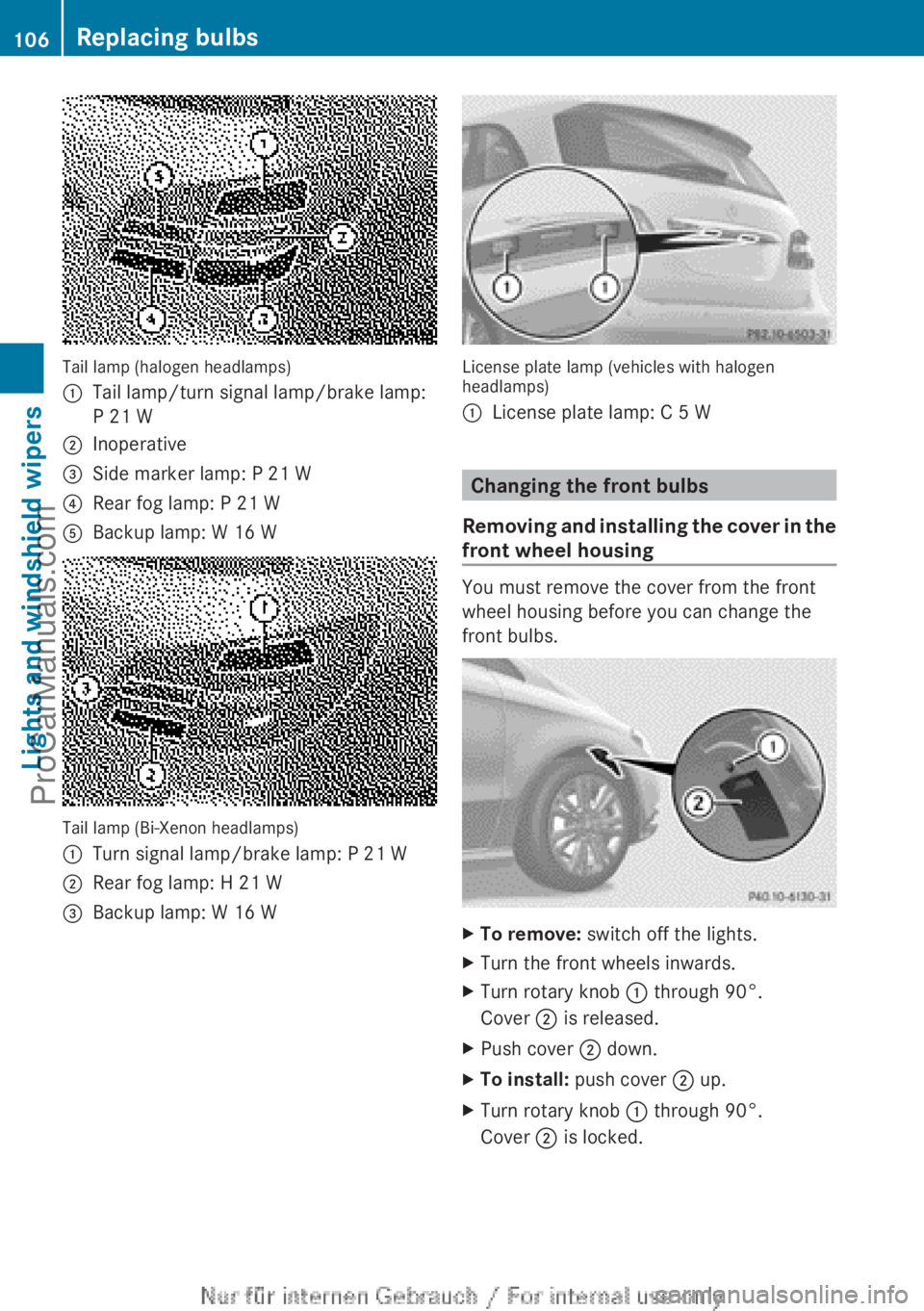
Tail lamp (halogen headlamps)
:
Tail lamp/turn signal lamp/brake lamp:
P 21 W
; Inoperative
= Side marker lamp: P 21 W
? Rear fog lamp: P 21 W
A Backup lamp: W 16 W Tail lamp (Bi-Xenon headlamps)
:
Turn signal lamp/brake lamp: P 21 W
; Rear fog lamp: H 21 W
= Backup lamp: W 16 W License plate lamp (vehicles with halogen
headlamps)
:
License plate lamp: C 5 W Changing the front bulbs
Removing and installing
the cover in the
front wheel housing You must remove the cover from the front
wheel housing before you can change the
front bulbs.
X
To remove: switch off the lights.
X Turn the front wheels inwards.
X Turn rotary knob : through 90°.
Cover ; is released.
X Push cover ; down.
X To install: push cover ; up.
X Turn rotary knob : through 90°.
Cover ; is locked.106
Replacing bulbs
Lights and windshield wipers
ProCarManuals.com
Page 109 of 340
Low-beam headlamps (halogen
headlamps)
G
WARNING
These bulbs are pressurized.
They can explode when being changed if:
R they are still hot
R they hit an object when being removed
R they are dropped
There is a risk of injury.
You should wear eye protection and clean
gloves when you are changing a bulb. If
necessary, have bulbs changed at a qualified
specialist workshop. X
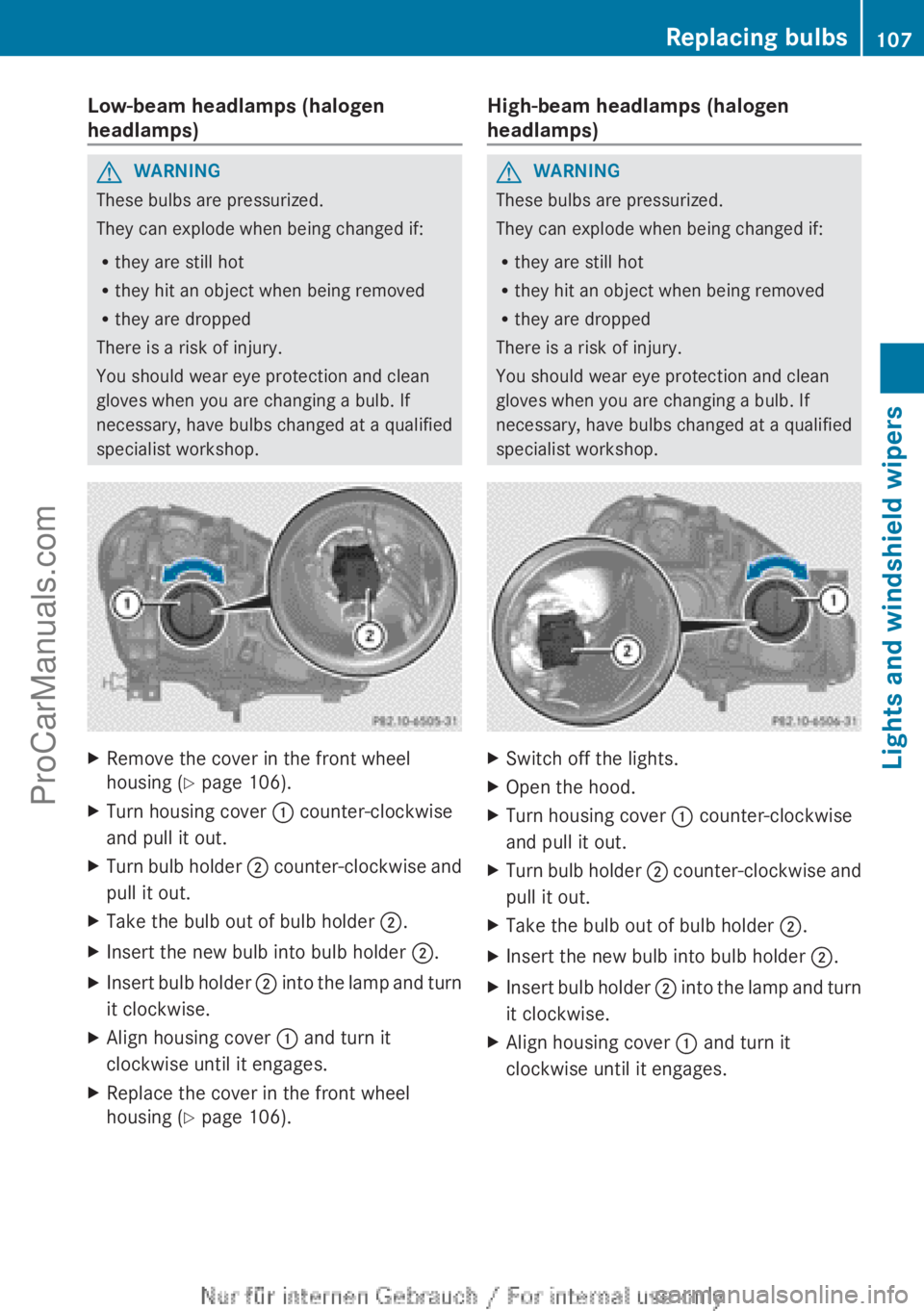
Remove the cover in the front wheel
housing ( Y page 106).
X Turn housing cover : counter-clockwise
and pull it out.
X Turn bulb holder ; counter-clockwise
and
pull it out.
X Take the bulb out of bulb holder ;
.
X Insert the new bulb into bulb holder ;.
X Insert bulb holder ;
into the
lamp and turn
it clockwise.
X Align housing cover : and turn it
clockwise until it engages.
X Replace the cover in the front wheel
housing ( Y page 106). High-beam headlamps (halogen
headlamps) G
WARNING
These bulbs are pressurized.
They can explode when being changed if:
R they are still hot
R they hit an object when being removed
R they are dropped
There is a risk of injury.
You should wear eye protection and clean
gloves when you are changing a bulb. If
necessary, have bulbs changed at a qualified
specialist workshop. X
Switch off the lights.
X Open the hood.
X Turn housing cover : counter-clockwise
and pull it out.
X Turn bulb holder ; counter-clockwise
and
pull it out.
X Take the bulb out of bulb holder ;
.
X Insert the new bulb into bulb holder ;.
X Insert bulb holder ;
into the
lamp and turn
it clockwise.
X Align housing cover : and turn it
clockwise until it engages. Replacing bulbs
107
Lights and windshield wipers Z
ProCarManuals.com
Page 133 of 340
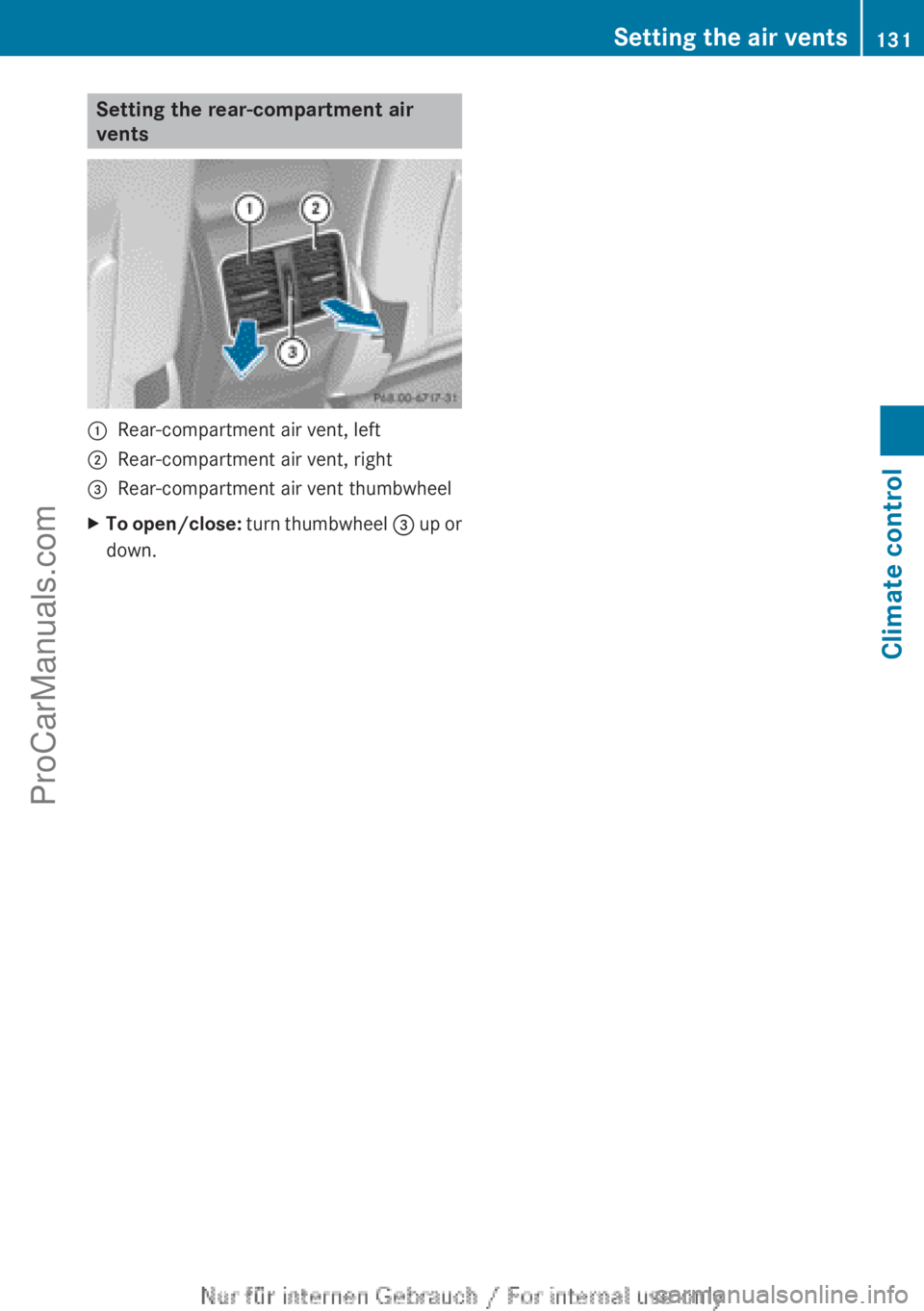
Setting the rear-compartment air
vents
:
Rear-compartment air vent, left
; Rear-compartment air vent, right
= Rear-compartment air vent thumbwheel
X To open/close: turn thumbwheel
= up or
down. Setting the air vents
131
Climate control Z
ProCarManuals.com
Page 137 of 340
Do not switch off the ignition while driving.
G
WARNING
If the parking brake has not been fully
released when driving,
the parking brake can:
R overheat and cause a fire
R lose its hold function.
There is a risk of fire and an accident. Release
the parking brake fully before driving off.
! Warm up the engine quickly. Do not use
the engine's full performance until it has
reached operating temperature.
Only shift the automatic transmission to
the desired drive position when the vehicle
is stationary.
Where possible, avoid spinning the drive
wheels when pulling away on slippery
roads. You could otherwise damage the
drive train. Key positions
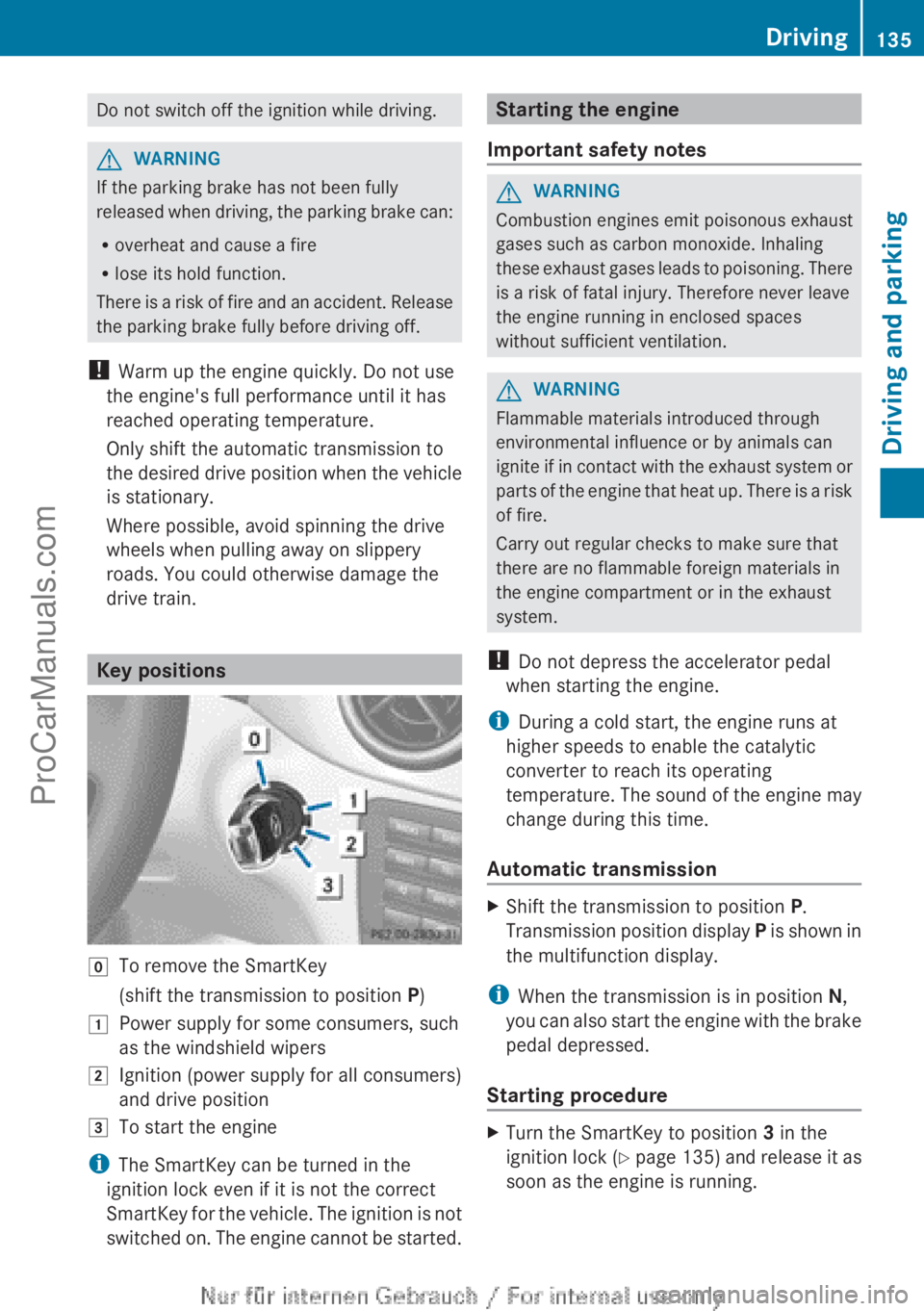
g
To remove the SmartKey
(shift the transmission to position P)
1 Power supply for some consumers, such
as the windshield wipers
2 Ignition (power supply for all consumers)
and drive position
3 To start the engine
i The SmartKey can be turned in the
ignition lock even if it is not the correct
SmartKey for the
vehicle. The ignition is not
switched on. The engine cannot be started. Starting the engine
Important safety notes G
WARNING
Combustion engines emit poisonous exhaust
gases such as carbon monoxide. Inhaling
these exhaust gases
leads to poisoning. There
is a risk of fatal injury. Therefore never leave
the engine running in enclosed spaces
without sufficient ventilation. G
WARNING
Flammable materials introduced through
environmental influence or by animals can
ignite if in
contact with the exhaust system or
parts of the engine that heat up. There is a risk
of fire.
Carry out regular checks to make sure that
there are no flammable foreign materials in
the engine compartment or in the exhaust
system.
! Do not depress the accelerator pedal
when starting the engine.
i During a cold start, the engine runs at
higher speeds to enable the catalytic
converter to reach its operating
temperature. The sound of the engine may
change during this time.
Automatic transmission X
Shift the transmission to position P.
Transmission position display
P
is shown in
the multifunction display.
i When the transmission is in position N,
you can also
start the engine with the brake
pedal depressed.
Starting procedure X
Turn the SmartKey to position 3 in the
ignition lock (
Y page 135) and release it as
soon as the engine is running. Driving
135
Driving and parking Z
ProCarManuals.com
Page 144 of 340
Remaining in neutral N
If the automatic transmission is to remain in
neutral N, e.g. for washing the vehicle in car
washes with
a
towing device, please observe
the following instructions: G
WARNING
If children are left unsupervised in the vehicle,
they could:
R open the doors, thus endangering other
people or road users.
R get out and disrupt traffic.
R operate the vehicle's equipment.
Additionally, children could set the vehicle in
motion if, for example, they:
R release the parking brake.
R shift the automatic transmission out of
parking position P.
R starting the engine.
There is a risk of an accident and injury.
When leaving the vehicle, always take the
SmartKey with you
and lock the vehicle. Never
leave children or animals unattended in the
vehicle. Always keep the SmartKey out of
reach of children.
R Make sure that the ignition is switched on.
R When the vehicle is stationary, depress the
brake pedal and keep it depressed.
R Shift to neutral N.
R Release the brake pedal.
R If the electric parking brake is engaged,
release it.
R Switch off the ignition and leave the
SmartKey in the ignition lock.
Engaging drive position D X
When the vehicle is stationary, depress the
brake pedal.
X Push the DIRECT SELECT lever down past
the first point of resistance. Transmission positions
B
Park position
Do not shift the transmission into
position P unless the vehicle is
stationary (
Y page 149). The
parking lock should
not be used as
a brake when parking. Always
apply the electronic parking brake
in addition to the parking lock in
order to secure the vehicle.
If the vehicle electronics are
malfunctioning, the transmission
may be locked in position P.
Have the vehicle electronics
checked immediately at a qualified
specialist workshop. C
Reverse gear
Only shift the transmission to
R
when the vehicle is stationary. A
Neutral
No power is transmitted from the
engine to the drive wheels.
Releasing the
brakes
will allow you
to move the vehicle freely, e.g. to
push it or tow it.
If ESP ®
is deactivated or faulty:
only shift the transmission to
position N if the vehicle is in danger
of skidding, e.g. on icy roads.
When you switch off the engine, the
automatic transmission
automatically shifts into neutral N. 7
Drive
The automatic transmission
changes gear automatically. All
forward gears are available.142
Automatic transmission
Driving and parking
ProCarManuals.com
Page 146 of 340
E Economy Comfortable, economical
driving
S Sport Sporty driving style
M Manual Manual gear shifting
Only change from automatic drive program
E or S to manual drive program
M when the
vehicle is stationary.
X Press program selector button :
repeatedly until the letter for the desired
gearshift program appears in the
multifunction display.
i The automatic transmission shifts to
automatic drive program E each time the
engine is started.
i For further information on the automatic
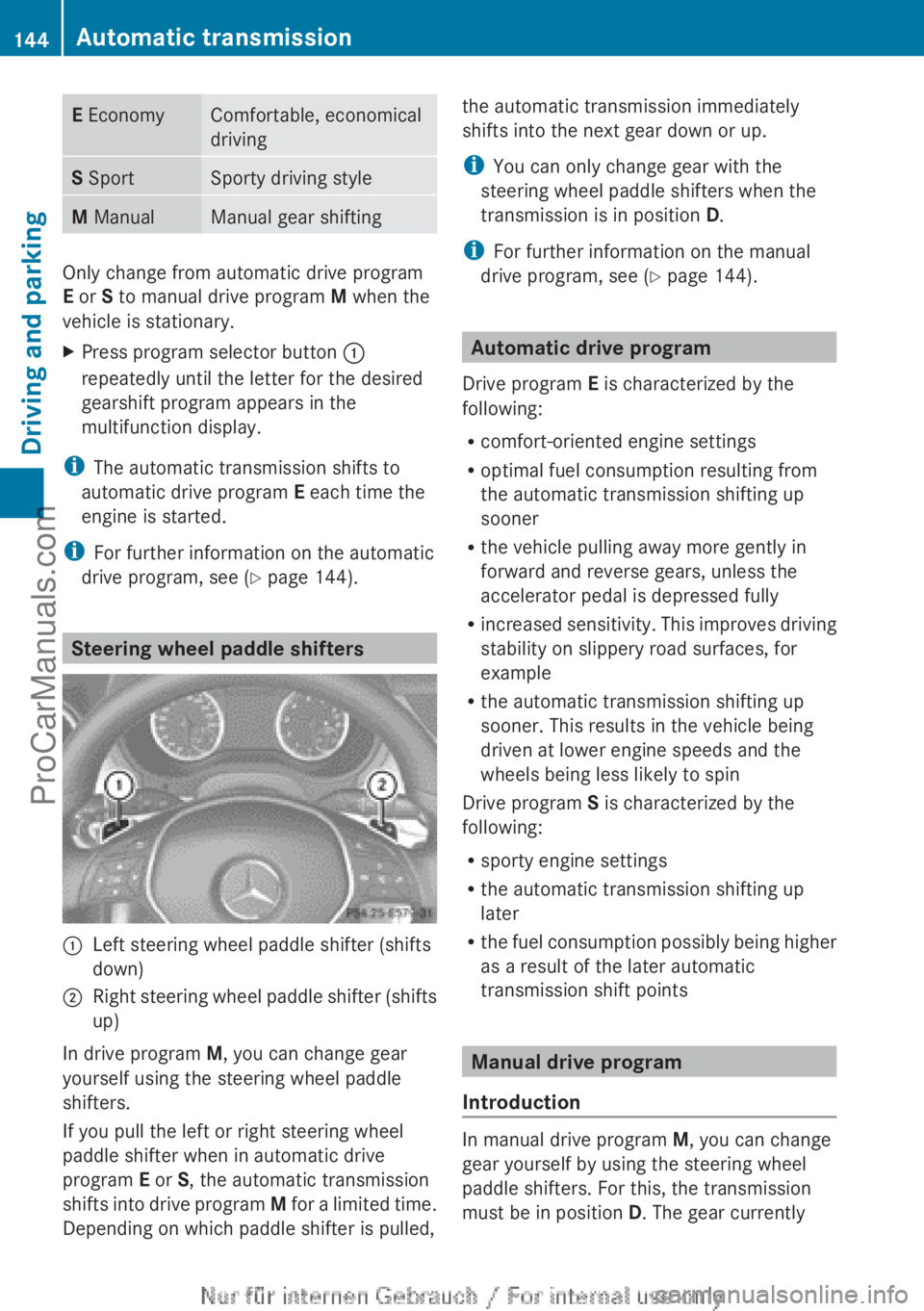
drive program, see ( Y page 144). Steering wheel paddle shifters
:
Left steering wheel paddle shifter (shifts
down)
; Right steering wheel paddle shifter (shifts
up)
In drive program M, you can change gear
yourself using the steering wheel paddle
shifters.
If you pull the left or right steering wheel
paddle shifter when in automatic drive
program E or S, the automatic transmission
shifts into drive
program M for a limited time.
Depending on which paddle shifter is pulled, the automatic transmission immediately
shifts into the next gear down or up.
i
You can only change gear with the
steering wheel paddle shifters when the
transmission is in position D.
i For further information on the manual
drive program, see ( Y page 144). Automatic drive program
Drive program E is characterized by the
following:
R comfort-oriented engine settings
R optimal fuel consumption resulting from
the automatic transmission shifting up
sooner
R the vehicle pulling away more gently in
forward and reverse gears, unless the
accelerator pedal is depressed fully
R increased sensitivity. This
improves driving
stability on slippery road surfaces, for
example
R the automatic transmission shifting up
sooner. This results in the vehicle being
driven at lower engine speeds and the
wheels being less likely to spin
Drive program S is characterized by the
following:
R sporty engine settings
R the automatic transmission shifting up
later
R the fuel consumption possibly being higher
as a result of the later automatic
transmission shift points Manual drive program
Introduction In manual drive program
M, you can change
gear yourself by using the steering wheel
paddle shifters. For this, the transmission
must be in position D. The gear currently 144
Automatic transmission
Driving and parking
ProCarManuals.com
Page 147 of 340
selected and engaged is shown in the
multifunction display.
Manual drive program
M differs from drive
programs E and S
with regard to spontaneity,
responsiveness and smoothness of gear
changes. Gear Driving situations
=
You can use the engine's braking
effect
5
To use the braking effect of the
engine on downhill gradients and
for driving:
R
on steep mountain roads
R in mountainous terrain
R in arduous conditions 4
To use the braking effect of the
engine on
extremely
steep downhill
gradients and on long downhill
stretches Switching on the manual drive program
Activating permanently
X
Press the program selector button
(Y page 143)
repeatedly until M appears in
the multifunction display.
Manual drive program M remains active
until drive program E or S is engaged.
Activating temporarily
X Pull the right or left steering wheel paddle
shifter (Y page 144).
M is shown in the multifunction display.
Manual drive program M is temporarily
active. Depending on which paddle shifter
is pulled, the automatic transmission
immediately shifts into
the next gear down
or up.
i When manual drive program M is
activated via the steering wheel paddle
shifters, the temporarily active manual
drive program M will be deactivated
automatically after a limited time, if the
driving situation permits. In this case, the automatic transmission shifts into the
automatic drive program that was last
engaged, i.e.
E or S. When driving on
downhill gradients, the temporarily active
manual drive program M will only be
deactivated if the accelerator pedal is
depressed while the vehicle is rolling
downhill.
Upshifting X
Pull the right-hand steering wheel paddle
shifter (Y page 144).
The automatic transmission
shifts up to the
next gear.
X Shift up a gear when the ^ upshift symbol
appears in the display instead of M.
i To prevent engine damage the automatic
transmission shifts up automatically:
R if the maximum engine speed on the
currently engaged gear is reached and
R you continue to accelerate.
Downshifting X
Pull the left-hand steering wheel paddle
shifter (Y page 144).
The automatic transmission
shifts down to
the next gear.
i If you slow down or stop without shifting
down, the automatic transmission
automatically shifts down.
i For maximum acceleration, pull the left-
hand steering wheel
paddle shifter until the
transmission selects the optimum gear for
the current speed.
i If the engine exceeds the maximum
engine speed when shifting down, the
automatic transmission protects against
engine damage by not shifting down. Automatic transmission
145
Driving and parking Z
ProCarManuals.com
Page 148 of 340
Kickdown
You can also use kickdown for maximum
acceleration in manual drive program
M.
X Depress the accelerator pedal beyond the
pressure point.
The transmission shifts to a lower gear
depending on the engine speed.
X Shift back up once the desired speed is
reached.
i During kickdown, you
cannot change gear
using the steering wheel paddle shifters.
i If you apply full throttle, the automatic
transmission shifts up to the next gear
when the maximum engine speed is
reached. This prevents the engine from
overrevving.
Switching off the manual drive program X
Press the program selector button
(Y page 143) repeatedly until E or S
appears in the multifunction display.
Deactivating the temporary manual drive
program
X Pull and hold the right-hand steering wheel
paddle shifter until the automatic
transmission shifts into the last active
automatic drive program: E or S.
i If manual drive
program M is deactivated,
the automatic transmission in automatic
drive program E or S may shift from the
current gear into a higher or lower gear.
This is dependent on the position of the
accelerator pedal, speed and load. 146
Automatic transmission
Driving and parking
ProCarManuals.com
Page 152 of 340
To ensure that the vehicle is secured against
rolling away unintentionally:
R
the electric parking
brake must be applied.
R the transmission must be in position P and
the transmission position display must
show P.
R the SmartKey must be removed from the
ignition lock.
R on uphill or downhill gradients, the front
wheels must be turned towards the curb. Switching off the engine
Important safety notes G
WARNING
The automatic transmission switches to
neutral position N when you switch off the
engine. The vehicle may roll away. There is a
risk of an accident.
After switching off the engine, always switch
to parking position P. Prevent the parked
vehicle from rolling away by applying the
parking brake.
Vehicles with automatic transmission X
Apply the electric parking brake.
X Shift the transmission to position P.
X Turn the SmartKey to position 0 in the
ignition lock and remove it.
The immobilizer is activated.
i If you switch the engine off with the
transmission in position R or D, the
automatic transmission shifts to N
automatically.
If you then open one of the front doors or
remove the SmartKey
from the ignition, the
automatic transmission shifts to P.
If you shift the automatic transmission to
N before switching off the engine, the
automatic transmission remains in N even
if a door is opened. i
The automatic transmission shifts to P
automatically if you:
R switch off the
engine using the SmartKey
and remove the SmartKey from the
ignition lock or
R switch off the engine using the SmartKey
and open a front door.
If you attempt to turn off the engine when the
selector lever is not in position P:
R a message appears in the multifunction
display
R a warning signal sounds Electric parking brake
General notes G
WARNING
If you leave children unsupervised in the
vehicle, they could set it in motion by, for
example:
R releasing the parking brake
R shifting the automatic transmission out of
the parking position P
R starting the engine.
They could also operate the vehicle's
equipment. There is
a risk of an accident and
injury.
When leaving the vehicle, always take the
SmartKey with you and lock the vehicle. Never
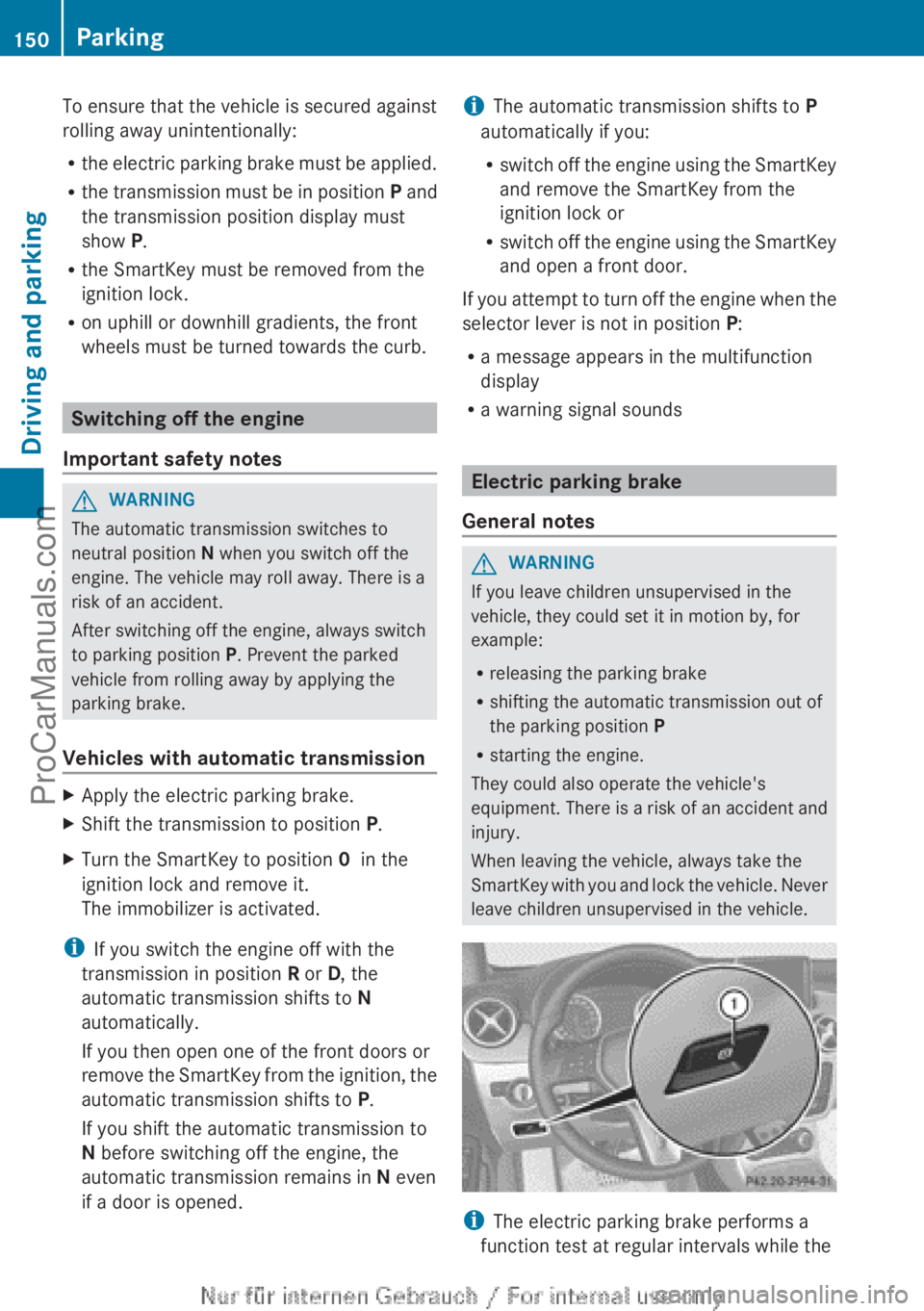
leave children unsupervised in the vehicle. i
The electric parking brake performs a
function test at regular intervals while the 150
Parking
Driving and parking
ProCarManuals.com