service MERCEDES-BENZ B-CLASS HATCHBACK 2011 User Guide
[x] Cancel search | Manufacturer: MERCEDES-BENZ, Model Year: 2011, Model line: B-CLASS HATCHBACK, Model: MERCEDES-BENZ B-CLASS HATCHBACK 2011Pages: 329, PDF Size: 7.91 MB
Page 26 of 329
If you remove the warning stickers, you or
others could be injured by failing to recognise
certain dangers.
When driving yourv ehicle observe the follow-
ing information:
R the safety notes in this manual
R the "Technical data" section in this manual
R traffic rules and regulations
R laws and safety standards pertaining to
moto rvehicles Implied warranty
! Observe the notes in these Operating
Instructions about the correct operation of
your vehicle as well as about possible dam-
age to the vehicle. Damage to your vehicle
that arises from culpable contravention of
these instructions is not covered by the
Mercedes-Benzi mplied warranty of
Daimler AG. Data stored in the vehicle
Fault data
Components critical for vehicle operation are
equipped with fault data memories as stand-
ard. There are also data storage devices
which record the technical reactions of vehi-
cle components to certain driving situations
(e.g. airbag deployment or ESP ®
interven-
tion).
This data is used exclusively to:
R assist in the rectificatio noffaults and
defects
R help Mercedes-Ben zoptimise and develop
vehicle functions
The data cannot be used to trace the vehicle's
movements.
When your vehicle is serviced by Mercedes-
Benz, this technical information can be read
out from the fault memory. This is performed
by authorised employees of the Mercedes- Ben
zservice network using special diagnos-
tic computers.
After a fault has been rectified, the informa-
tion is deleted from the memory. Other mem-
ory data is constantly overwritten. Other devices that store data
Depending on the equipment level, your vehi-
cle may feature communications and/or
entertainment systems (e.g. navigation devi-
ces, telephone systems). These allow you to
save and edit data required for the operation
of the respective device.
Further information on operation (e.g. on
deleting data) can be found in the separate
operating instructions. Introduction
23 Z
Page 41 of 329
Useful information
i This Owner's Manual describes all models
and all standard and optional equipment
available to your vehicle at the time of pub-
lication of the Owner's Manual. Country-
specific deviations are possible. Please
note that your vehicle may not be equipped
with all features described. This also
applies to safety-relevan tsystems and
functions.
i Please read the information on qualified
specialist workshops (Y page 22).Occupant safety
Important safety notes
G
WARNING
If service wor kis not carried out correctly, the
operating safety of your vehicle may be affec-
ted. This could cause you to lose control of
your vehicle and cause an accident. More-
over, the safety systems may no longer be
able to protect you or others as they are
designed to do.
Always have service work carried out at a
qualified specialist workshop. G
WARNING
Modifications to or work performed incor-
rectly on the following parts can result in the
restraint systems not functioning as intended:
R the restraint system, consisting of seat
belts and their anchorage points, belt ten-
sioners, belt force limiters and airbags
R the wiring
R networked electronic systems
Airbags and belt tensioners could fail to
deploy or be triggered in an accident despite
the deceleration force being sufficient to trig-
ger the systems, or could be triggered unin-
tentionally. For this reason, never make any
modifications to the restraint systems. Therefore, you must not tamper with elec-
tronic components or their software.
The seat belts, together with SRS (Supple-
mental Restraint System), are complemen-
tary, co-ordinated restraint systems
(Y page 39). They reduce the risk of injury
in specific, pre-defined types of accident sit-
uations and thereby increase occupant
safety. However, seat belts and airbags gen-
erally do not protect against objects pene-
trating the vehicle from the outside.
To ensure that the restraint systems can
deliver their full potential protection, make
sure that:
R the seat and head restraint are adjusted
properly (Y page 86).
R the seat belt has been fastened properly
(Y page 45).
R the airbags can inflate unrestricted if
deployed (Y page 40).
R the steering wheel is adjusted properly
(Y page 91).
R the restraint systems have not been modi-
fied.
An airbag increases the protection of vehicle
occupants wearing a seat belt. However, air-
bags are only an additional restraint system
which complements, but does not replace,
the seat belt. All vehicle occupants must wear
their seat belt correctly at all times, even if
the vehicle is equipped with airbags. The air-
bags are not deployed in all types of acci-
dents. For example, if the protective capacity
of correctly fastened seat belts is not
increased by deploying the airbags, the air-
bags will not deploy.
Airbag deployment only provides increased
protection if the seat belt is worn correctly.
The seat belt helps, firstly, to keep the vehicle
occupant in the best position in relation to the
airbag. Secondly, in a head-on collision, for
example, the seat belt prevents the vehicle
occupant from being propelledt owards the
point of impact. 38
Occupant safetySafety
Page 45 of 329
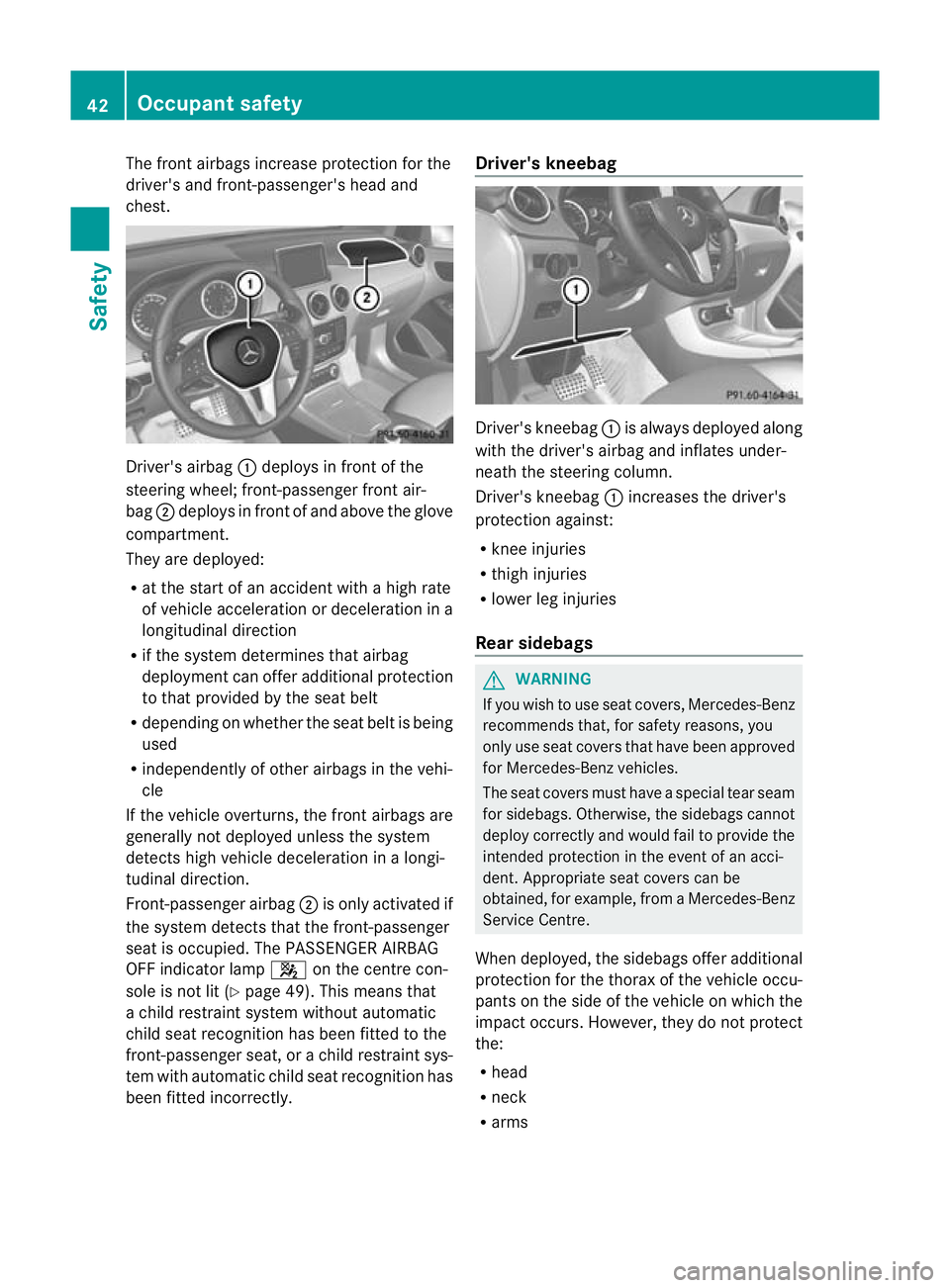
The fronta
irbags increase protection for the
driver's and front-passenger's head and
chest. Driver's airbag
:deploys in front of the
steering wheel; front-passenger front air-
bag ;deploys in front of and above the glove
compartment.
They are deployed:
R at the start of an accident with a high rate
of vehicle acceleration or deceleration in a
longitudinal direction
R if the system determines that airbag
deploymen tcan offer additional protection
to that provided by the seat belt
R depending on whether the seat belt is being
used
R independently of other airbag sinthe vehi-
cle
If the vehicle overturns, the front airbags are
generally not deployed unless the system
detects high vehicle deceleration in a longi-
tudinal direction.
Front-passenger airbag ;is only activated if
the system detects that the front-passenger
seat is occupied. The PASSENGER AIRBAG
OFF indicator lamp 4on the centre con-
sole is not lit (Y page 49). This means that
a child restraint system without automatic
child seat recognition has been fitted to the
front-passenger seat, or a child restraint sys-
tem with automatic child seat recognition has
been fitted incorrectly. Driver's kneebag
Driver's kneebag
:is always deployed along
with the driver's airbag and inflates under-
neath the steering column.
Driver's kneebag :increases the driver's
protection against:
R knee injuries
R thigh injuries
R lower leg injuries
Rear sidebags G
WARNING
If you wish to use seat covers, Mercedes-Benz
recommends that, for safety reasons, you
only use seat covers that have been approved
for Mercedes-Ben zvehicles.
The seat covers must have a special tear seam
for sidebags. Otherwise, the sidebags cannot
deploy correctly and would fail to provide the
intended protection in the event of an acci-
dent. Appropriate seat covers can be
obtained, for example, from a Mercedes-Benz
Service Centre.
When deployed, the sidebags offer additional
protection for the thorax of the vehicle occu-
pants on the side of the vehicle on which the
impact occurs .However, they do not protect
the:
R head
R neck
R arms 42
Occupant safetySafety
Page 50 of 329
You can also cancel the rear seat belt status
indicator immediately:
X
Press the aor% button on the steer-
ing wheel.
i The status indicator for the rear-compart-
men tseat belts is only available for certain
countries.
Belt tensioners, belt force limiters G
WARNING
If the seat belt tensioners have been trig-
gered, they provide no additional protection
in the event of another accident. Therefore,
have belt tensioners which have been trig-
gered replaced at a qualified specialist work-
shop.
Comply with safety regulations when dispos-
ing of belt tensioners. Any Mercedes-Benz
Service Centre can provide details of these
regulations.
! If the front-passenger seat is not occu-
pied, do not engage the seat belt tongue in
the buckle on the front-passenger seat.
Otherwise, the belt tensioner could be trig-
gered in the event of an accident.
The fron tseat belts are equipped with belt
tensioners and belt force limiters. The outer
seat belts in the rear are equipped with seat
belt tensioners.
The belt tensioners tighten the seat belts in
an accident, pulling them close against the
body.
Belt tensioners do not correct incorrect seat
positions or incorrectly fastened seat belts.
Belt tensioners do not pull vehicle occupants
back towards the backrest.
When triggered, seat belt force limiters help
to reduce the peak forc eexerted by the seat
belt on the vehicle occupant.
The front belt force limiters are synchronised
with the front airbags, which take on a part of
the deceleratio nforce. Thus, the force exer- ted on the occupant is distributed over a
greater area.
The belt tensioners can only be activated
when:
R the ignition is switched on.
R the restraint systems are operational; see
"SRS warning lamp" (Y page 39).
R the belt tongue is engaged in the buckle on
each of the three-point seat belts in the
front.
The belt tensioners on the outside seats in the
rear compartment are triggered independ-
ently of the lock status of the seat belts.
The belt tensioners are triggered depending
on the type and severity of an accident:
R in the event of a head-on or rear-end colli-
sion if the vehicle decelerates or acceler-
ates rapidly in a longitudinal direction dur-
ing the initial stages of the impact
R in the event of a side impact if the vehicle
is subjected to high lateral acceleration/
deceleration
If the airbags are deployed, you will hear a
bang, and a small amount of powder may also
be released. Only in rare cases will the bang
affect your hearing. The powder that is
released generally does not constitute a
health hazard. The 6SRS warning lamp
lights up. Children in the vehicle
Child restraint systems
Important safety notes G
WARNING
To reduce the risk of serious or even fatal
injury to the child in the event of a sudden
change in direction, braking or an accident:
R children less than 1.50 m tall and under
twelve years of age must always be secured
in special child restraint systems on a suit-
able vehicle seat. This is necessary Children in the vehicle
47Safety
Z
Page 52 of 329
Mercedes-Ben
zrecommends that you only
use the child restraint systems listed at
(Y page 60).
You can obtain further information about the
correct child restraint system from any
Mercedes-Benz Service Centre.
i It is advisable to use Mercedes-Benzc are
products to clean child restraint systems.
You can obtain informatio nabout this at
any Mercedes-Benz Service Centre.
Child seat on the front-passenger seat G
WARNING
If the front-passenger airbag is not disabled:
R a child secured in a child restraint system
on the front-passenger seat could be seri-
ously and even fatally injured by the front-
passenger airbag deploying. This is espe-
cially a risk if the child is in the immediate
vicinity of the front-passenger airbag when
it deploys.
R never secure a child on the front-passenger
seat in a rearward-facing child restraint sys-
tem. Only secure a rearward-facing child
restraint system on a suitable rear seat.
R always move the front-passenger seat to
the rearmos tposition if you secure a child
in a forward-facing child restraint system
on the front-passenger seat.
The front-passenger airbag is not disabled:
R on vehicles without automatic child seat
recognition on the front-passenger seat
R in vehicles with automatic child seat rec-
ognition in the front-passenger seat, if no
special child restraint system with trans-
ponders for automatic child seat recogni-
tion in the front-passenger seat has been
fitted
R on vehicles with automatic child seat rec-
ognition on the front-passenger seat, if the
PASSENGER AIRBAG OFF indicator lamp
4 is not lit.
To make you aware of this danger, a corre-
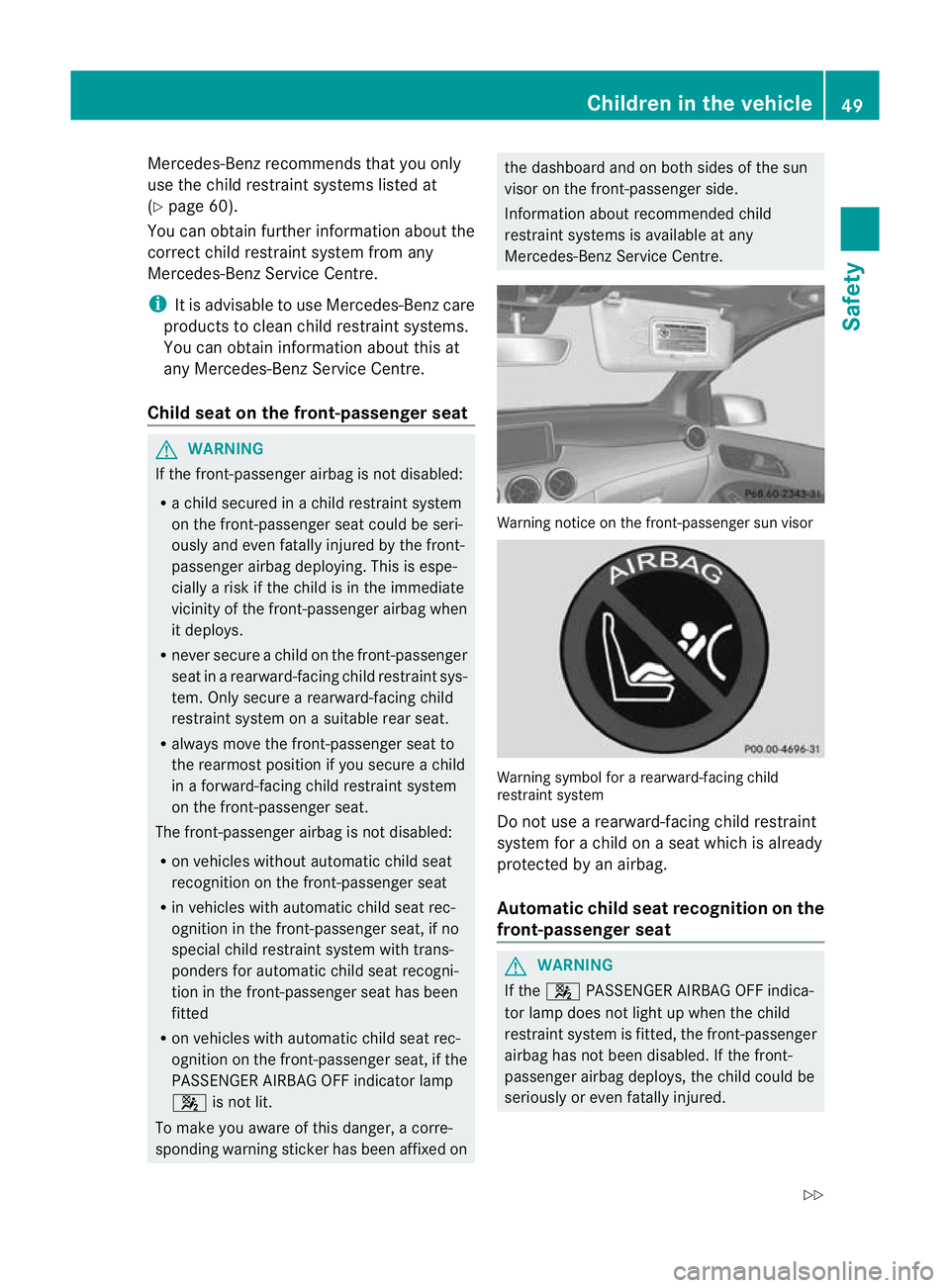
sponding warning sticker has been affixed on the dashboard and on both sides of the sun
visor on the front-passenger side.
Information about recommended child
restraint systems is available at any
Mercedes-Benz Service Centre.
Warning notice on the front-passenger sun visor
Warning symbol for a rearward-facing child
restraint system
Do not use a rearward-facing child restraint
system for a child on
aseat which is already
protected by an airbag.
Automatic child seat recognition on the
front-passenger seat G
WARNING
If the 4 PASSENGER AIRBAG OFF indica-
tor lamp does not light up when the child
restraint system is fitted, the front-passenger
airbag has not been disabled. If the front-
passenger airbag deploys, the child could be
seriously or even fatally injured. Children in the vehicle
49Safety
Z
Page 56 of 329
Problems with child seat recognition
Problem Possible causes/consequences and
M Solutions
The
4 PASSENGER
AIRBAG OFF indicator
lamp on the centre con-
sole is lit. As
pecial Mercedes-Benz child seat with a transponder for auto-
matic child seat recognition has been fitted to the front-passenger
seat. The front-passenger fron tairbag has therefore been disabled
as desired. G
Risk of injury
There is no child seat fitted to the front-passenger seat .Automatic
child seat recognition is malfunctioning.
It is also possible that the 6SRS warning lamp light sup and/
or the 4PASSENGER AIRBAG OFF indicator lamp does not light
up briefly when you switch the ignition on.
X Remove electronic equipment from the front-passenger seat,
e.g.:
R
laptop
R mobile phone
R cards with transponders, such as ski passes or access cards
If the 4 PASSENGER AIRBAG OFF indicator lamp is still lit:
X Visit a qualified specialist workshop. Integrated child seat (ICS)
Important safety notes
G
WARNING
To reduce the risk of serious or even fatal
injury to the child in the event of a sudden
change in direction, braking or an accident:
R you must follow the manufacturer's instal-
lation instructions for the child seat when
fitting the integrated child seat (ICS) pad-
ded play table and side head restraint and
when fastening the seat belt.
R do not modify the integrated child seat, the
ICS padded play table or the side head
restraint. Do not use protective covers.
R make sure that the ICS padded play table
and the side head restraints do not become trapped or damaged. This could happen
when you
- close the doors
- adjust the seat
- store the ICS padded play table and the
side head restraints
- transport heavy objects
R replace the integrated child seat, the pad-
ded play table and the side head restraints
if these were damaged or subjected to
heavy loads during an accident.
R note: children who weigh less than
12.5 kg require a different child restraint
system. Information about other child
restraint systems is available from any
Mercedes-Benz Service Centre.
R the vehicle's rear seat backrest must be
locked in position.
The integrated child seats are integrated into
the right and left-hand rear seat cushions. In Children in the vehicle
53Safety Z
Page 59 of 329
Information abouto
therchild restraint sys-
tems is available from any Mercedes-Benz
Service Centre.
! Make sure that the ICS padded play table
is not trapped or damaged, for example
when you:
R close the doors
R adjust the seat
R store the ICS padded play table or trans-
port heavy objects
Use the ICS padded play table according to
the table in the "Integrated child seat" section
(Y page 53).
You should not use the integrated child seat
with an ICS padded play table in conjunction
with a baby car seat (weight category 0) for
which a body weight of up to 10 kg is permis-
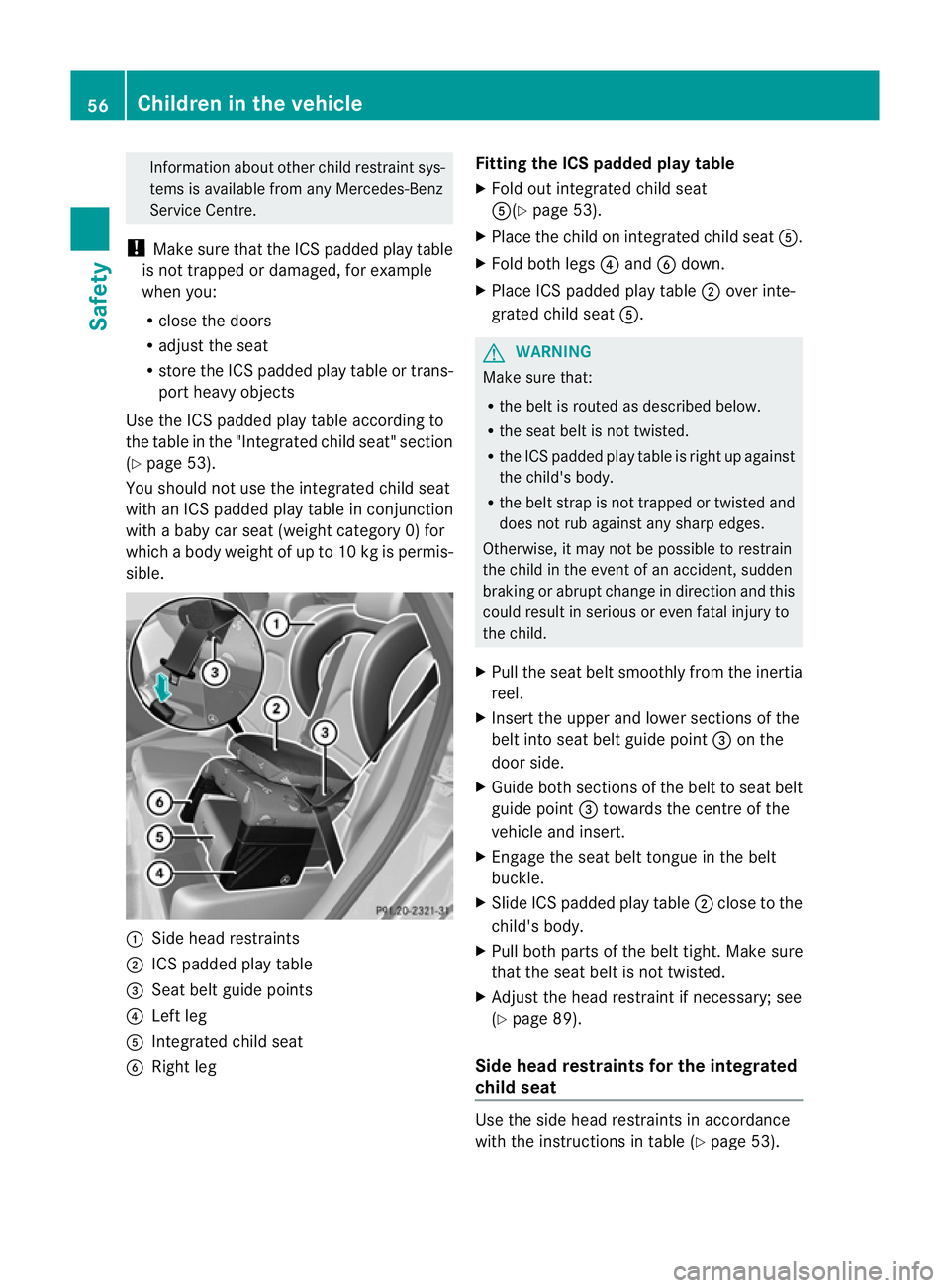
sible. :
Side head restraints
; ICS padded play table
= Seat belt guide points
? Left leg
A Integrated child seat
B Right leg Fitting the ICS padded play table
X
Fold out integrated child seat
A(Y page 53).
X Place the child on integrated child seat A.
X Fold both legs ?and Bdown.
X Place ICS padded play table ;over inte-
grated child seat A. G
WARNING
Make sure that:
R the belt is routed as described below.
R the seat belt is not twisted.
R the ICS padded play table is right up against
the child's body.
R the belt strap is not trapped or twisted and
does not rub against any sharp edges.
Otherwise, it may not be possible to restrain
the child in the event of an accident, sudden
braking or abrupt change in direction and this
could result in serious or even fatal injury to
the child.
X Pull the seat belt smoothly from the inertia
reel.
X Insert the upper and lower sections of the
belt into seat belt guide point =on the
door side.
X Guide both sections of the belt to seat belt
guide point =towards the centre of the
vehicle and insert.
X Engage the seat belt tongue in the belt
buckle.
X Slide ICS padded play table ;close to the
child's body.
X Pull both parts of the belt tight. Make sure
that the seat belt is not twisted.
X Adjust the head restraint if necessary; see
(Y page 89).
Side head restraints for the integrated
child seat Use the side head restraintsina
ccordance
with the instructions in table (Y page 53).56
Children in the vehicleSafety
Page 60 of 329

i
Should a side head restraint be required
for the second integrated child seat, this
can be ordered at any Mercedes-Benz
Service Centre. G
WARNING
If you do not secure the side head restraint at
the anchor points intended, it canno tprovide
the intended level of protection. It would then
not be possible to protect the child in the
event of an accident, sudden braking or
abrupt change in directio nand this could
result in serious or even fatal injury to the
child.
Only attach the side head restraint to the
intended anchor points on the rea rhead
restraint.
For safety reasons, Mercedes-Benz recom-
mends that you only use side head restraints
which have been approved by Mercedes-Benz
for your vehicle.
Fitting side head restraints
X Slide head restraint ;upwards and posi-
tion it upright.
X Slide side head restraints Bfrom the front
to the centre of both head restraint bars
until they engage.
Right lock verification indicator :and left
lock verification indicator =must be fol-
ded in. The red surfaces are no longer visi-
ble.
X Make sure that side head restraint Bis
engaged in both head restraint bars. X
Slide head restraint ;downwards
(Y page 89) until it rests on the upper
edge of side head restraints B.
X Guide the seat belt through seat belt guide
A on the door side on side head restraint
B.
X Secure the child (Y page 54).
i When using the integrated child seat with
the ICS padded play table, the seat belt is
not guided through the seat belt guide on
the side head restraint.
Removing the side head restraints
X Take the seat belt out of seat belt guide
A.
X Move head restraint ;upwards.
X Press left or right release button ?and pull
side head restraint Bforward to remove
it.
Right lock verification indicator :and left
lock verification indicator =fold out
briefly.
X Adjust head restraint ;(Ypage 89).
Storing the padded table and the side
head restraints G
WARNING
Secure the ICS padded play table and the side
head restraints in the vehicle as specified;
otherwise, they may come loose. In the event
of an accident, sudden braking or abrupt
change in direction, they could injure vehicle
occupants or cause damage to the vehicle.
When you are not using the ICS padded play
table and the side head restraints, store these
in a suitable place, such as the boot.
On vehicles with a TIREFIT kit, for example,
you can store the side head restraints in the
stowage compartment under the luggage
compartment floor (Y page 253). Children in the vehicle
57Safety Z
Page 107 of 329
Never use a bulb which has been dropped.
Such a bulb may break or even explode and
injure you.
Halogenb ulbs are pressurised and can
explode when you change them, particularly
if they are very hot .You should therefore wear
eye protection and gloves when you are
changing them.
There are bulbs other than the xenon bulbs
that you cannot replace. Replace only the
bulbs listed (Y page 104). Have the bulbs that
you cannot replace yourself changed at a
qualified specialist workshop.
If you require assistance changing bulbs, con-
sult a qualified specialist workshop.
Do not touch the glass tube of new bulbs with
your bare hands. Even minor contamination
can burn into the glass surface and reduce
the service life of the bulbs. Always use a lint-
free cloth or only touch the base of the bulb
when fitting.
Only use bulbs of the correc ttype.
If the new bulb still does no tlight up, consult
a qualified specialist workshop.
Bulbs and lamps are an importan taspect of
vehicle safety. You must therefore make sure
that these function correctly at all times.
Have the headlamp setting checked regularly. Overview of bulb replacement
–bulbs
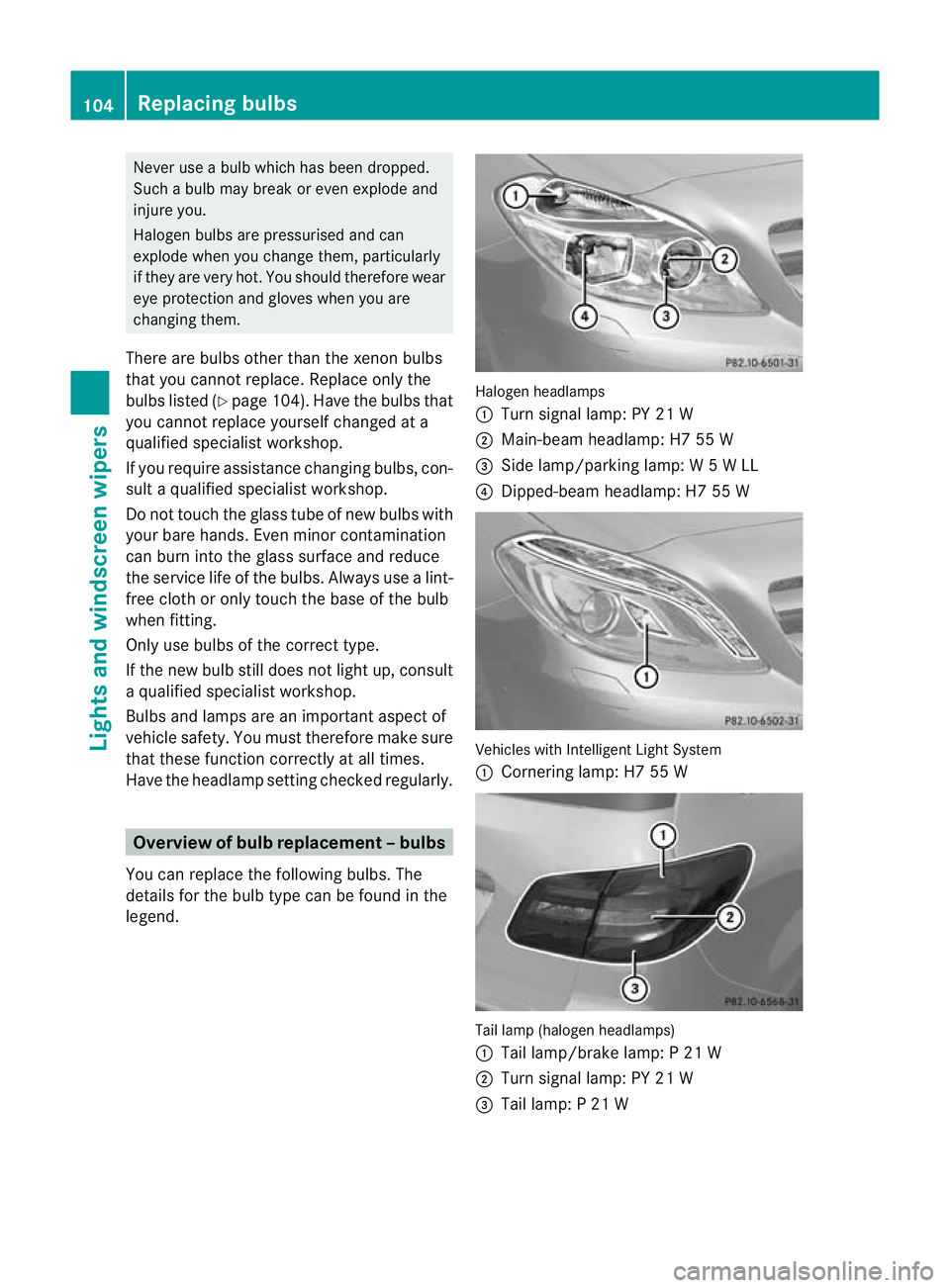
You can replace the following bulbs. The
details for the bulb type can be found in the
legend. Halogen headlamps
:
Turn signal lamp: PY 21 W
; Main-beam headlamp: H7 55 W
= Side lamp/parking lamp: W 5 W LL
? Dipped-bea mheadlamp: H7 55 W Vehicles with Intelligent Light System
:
Cornering lamp: H7 55 W Tail lamp (halogen headlamps)
:
Tail lamp/brake lamp: P 21 W
; Turn signal lamp: PY 21 W
= Tail lamp: P 21 W 104
Replacing bulbsLights and windscreen wipers
Page 117 of 329
Useful information
i This Owner's Manual describes all models
and all standard and optional equipment
available to your vehicle at the time of pub-
lication of the Owner's Manual. Country-
specific deviations are possible. Please
note that your vehicle may not be equipped
with all features described. This also
applies to safety-relevan tsystems and
functions.
i Please read the information on qualified
specialist workshops (Y page 22).Overview of climate control systems
Important safety notes
G
WARNING
Observe the settings recommended on the
following pages. The windows could other-
wise mis tup. This may preven tyou from
observing the traffic conditions, thereby caus-
ing an accident.
THERMATIC automatic climate control/
THERMOTRONIC automatic climate control
controls the temperature and the humidity of
the vehicle interior and filters out undesirable
substances from the air.
THERMATIC/THERMOTRONIC automatic cli-
mate control is only operational when the
engine is running 7
.O ptimum operation is only
achieved if you drive with the side windows
and panorama sliding sunroof closed.
i Ventilate the vehicle for a brief period
during warm weather, e.g. using the con-
venience opening feature (Y page 81). This
will speed up the cooling process and the
desired vehicle interior temperature will be
reached more quickly.
i The integrated filter can filter out most
particles of dust and completely filters out pollen.
Aclogged filter reduces the amount
of air supplied to the vehicle interior .For
this reason, you should always observe the
interval for replacing the filter, which is
specified in the Service Booklet .As it
depends on environmental conditions, e.g.
heavy air pollution, the interval may be
shorter than stated in the Service Booklet.
7 THERMOTRONIC automatic climate control: the residual heat function can only be activated/deactivated
when the ignition is switched off. 114
Overview of climate control systemsClimate control