warning MERCEDES-BENZ C-CLASS COUPE 2015 Workshop Manual
[x] Cancel search | Manufacturer: MERCEDES-BENZ, Model Year: 2015, Model line: C-CLASS COUPE, Model: MERCEDES-BENZ C-CLASS COUPE 2015Pages: 385, PDF Size: 13.12 MB
Page 78 of 385
If yourv
ehicle/trailer combination begins to
lurch, you can only stabilise the vehicle/trailer
combination by depressing the brake firmly.
ESP ®
trailer stabilisatio nisactive above speeds
of approximately 65 km/h.
ESP ®
trailer stabilisatio ndoes not work if ESP ®
is deactivated or disabled because of amalfunc-
tion.
Crosswind Assist General notes
Strong crosswind gusts can impair the road-
holding of yourv ehicle when driving straight
ahead. The crosswind driving assistance func-
tion integrated in ESP ®
noticeably reduces
these impairments.
Depending on the direction and intensity of the
side wind, ESP ®
is activated automatically.
ESP ®
intervenes with stabilising braking to
assisty ou in keeping the vehicle in the lane.
Crosswind Assist is active at vehicle speeds
above 80 km/h when driving straight aheador
cornering gently.
Important safety notes Crosswind Assist does not work if ESP ®
is deac-
tivated or disabled because of amalfunction. EBD (electroni
cbrake force distribu-
tion)
General notes EBD monitors and controls the brake pressure
on the rear wheelstoi
mprove driving stability
whileb raking.
Important safety notes i
Observe the "Important safety notes" sec-
tion (Y page 66). G
WARNING
If EBD is malfunctioning, the rear wheelsc an
lock, e.g. under full braking. This increases the risk of skidding and an accident.
You shouldt herefore adapt yourd riving style
to the different handling characteristics. Have the brake system checked at
aqualifieds pe-
cialist workshop.
Observe information regarding indicator and
warning lamps( Ypage 287) as well as display
messages (Y page 256). ADAPTIVE BRAKE
ADAPTIVE BRAKE enhances braking safety and
offers increased braking comfort. In addition to
the braking function, ADAPTIVE BRAKE also has
the HOLD function (Y page 192) and hill start
assist (Y page 149). PRE-SAFE
®
Brake
General notes PRE-SAFE
®
Brake can help you to minimise the
risk of acollision with avehicle aheadora
pedestrian, and reduce the effects of such a
collision. If PRE-SAFE ®
Brake has detected arisk
of ac ollision, you willbew arned visually and
acoustically as well as by automatic braking.
i Pay attention to the important safety notes
in the "Driving safety systems" section
(Y page 66).
PRE‑SAFE ®
Brake is only available in vehicles
with the Driving Assistance Plusp ackage.
For PRE-SAFE ®
Brake to assist you when driving,
the radars ensor system and the camera system
must be switched on and operational.
With the help of the radars ensor system and the
camera system, PRE-SAFE ®
Brake can detect
obstacle sthat are in front of yourv ehicle for an
extended period of time.
In addition, pedestrians in the path of yourv ehi-
cle can be detected.
PRE-SAFE ®
Brake detects pedestrians using
typica lcharacteristics such as the body con-
tours and posture of aperson standing upright.
i Observe the restrictions describe
dinthe
"Important safety notes" section
(Y page 76). Driving safety systems
75Safety Z
Page 79 of 385
Important safety notes
G
WARNING
PRE-SAFE ®
Brake will initially brak eyour vehi-
cle by apartial application of th ebrakes if a
danger of collision is detected. Ther emay be
ac ollision unless you brak eyourself .Even
after subsequen tfull application of th ebrakes
ac ollision canno talways be avoided, partic-
ularly when approachin gattoohigh aspeed.
Ther eisar iskofana ccident.
Always apply th ebrakes yourself and tr yto
tak eevasive action ,provide ditiss afetodo
so.
In th eevent of apartial application of th ebrakes,
th ev ehicl eisb raked wit hupto50%of th efull
braking pressure. G
WARNING
PRE-SAFE ®
Brake canno talways clearly iden-
tify objects and comple xtraffic conditions.
In these cases, PRE-SAFE ®
Brake may:
R giv eanu nnecessary warning and then
brak ethe vehicle
R neither giv eawarning no rintervene
Ther eisar iskofana ccident.
Always pay particular attention to th etraffic
situation and be read ytob rake, especially if
PRE-SAFE ®
Brake warn syou. Terminate the
intervention in anon-criti cal driving situation. G
WARNING
PRE-SAFE ®
Brake canno talways clearly iden-
tify people, especially if they are moving .In
these cases, PRE-SAFE ®
Brake canno tinter-
vene. Ther eisariskofana ccident.
Always pay particular attention to th etraffic
situation and be read ytob rake, especially if
PRE-SAFE ®
Brake warn syou.
In order to maintai nthe appropriat edistanc eto
th ev ehicl einf rontand thus preven tacollision,
you must apply th ebrakes yourself. G
WARNING
PRE-SAFE ®
Brake does no treact:
R to small people, e.g. children
R to animals
R to oncomin gvehicles
R to crossing traffic
R when cornering
As aresult ,PRE-SAFE ®
Brake may neither
giv ew arning snorinterven einall critical sit-
uations. Ther eisariskofana ccident.
Always pay careful attention to th etraffic sit-
uation and be read ytob rake.
In th eevent of snowfall or heav yrain ,detection
can be impaired.
Detection by th eradar sensor system is also
impaire dintheevent of:
R dirt on th esensor soro bscured sensors
R interferenc ebyother radar sources
R stron gradar reflections, for example, in multi-
store ycar parks
R an arrow vehicl etravellin ginfront,e.g.a
motorcycle
R av ehicl etravellin ginfrontonadifferen tline
Detection by th ecamera system is also impaired
in th eevent of:
R dirt on th ecamera or if th ecamera is covered
R glar eont hecamera system, e.g. from th esun
bein glow in th esky
R darkness
R if:
- pedestrian smoveq uickly, e.g. int othe path
of th evehicle
- thec amera system no longer detects a
pedestrian as aperson due to special cloth-
ing or other objects
- ap edestrian is concealed by other objects
- thet ypical outlin eofaperson is no tdistin-
guishable from th ebackground
Followin gdamag etothefron tend of th evehicle,
have th eradar sensor setting sand operation
checke dataq ualified specialist workshop. This
also applie stocollision sats low speeds where
there is no visible damag etothefron toft he
vehicle. 76
Driving safety systemsSafety
Page 80 of 385
Following damag
etothe windscreen, hav ethe
configuration and operation of the camera sys-
tem checked at aquali fied specialist workshop.
Function X
To activate/deactivate: activate or deacti-
vate PRE-SAFE ®
Brake in the on-board com-
puter (Y page 245).
If the PRE-SAFE ®
Brake is not activated, the
æ symbol appears in the multifunction dis-
play.
Thi sfunction will issue awarning if:
R at as peed of around 30 km/h or more ,the
distance maintaine dtothe vehicle travelling
in front is insufficient for several seconds
The · distance warning lamp then lights
up in the instrument cluster.
R at as peed of around 7km/h or more ,you
rapidl yapproach avehicle in front or apedes-
trian
An intermittent warning tone will then sound
and the ·distance warning lamp lights up
in the instrument cluster.
X Brake immediately to defuse the situation.
or X Take evasive action provide ditissafetodo
so.
The PRE-SAFE ®
Brake function can also brake
the vehicle automaticall yunder the following
conditions:
R the driver and front passenger hav ethei rseat
belts fastened
and
R the vehicle speed is between approximately
7k m/h and 200 km/h
At as peed of up to approximately 70 km/h,
PRE-SAFE ®
Brake can also detect:
R stationar yobjects in the path of your vehicle,
e.g. stopped or parked vehicles
R pedestrians in the path of your vehicle
i If there is an increased risk of
acollision,
preventive passenger protection measures
(PRE-SAFE ®
PLUS) are triggered (Y page 54).
If the risk of acollision with the vehicle in front
remains and yo udonot brake, take evasive
action or accelerate significantly ,the vehicle
may perform automatic emergency braking up
to the point of ful lbrake application. Automatic emergency braking is not performe
duntil imme-
diately prior to an imminent accident.
You can prevent the intervention of PRE-SAFE ®
Brake at any time by:
R depressing the accelerator pedal further
R activating kickdown
R releasing the brake pedal
The braking action of PRE-SAFE ®
Brake is ended
automaticall yif:
R youm anoeuvre to avoid the obstacle
R there is no longer arisk of collision
R there is no longer an obstacl edetected in
front of your vehicle STEE
RCONTROL
General notes STEER CONTROL helps yo
ubytransmitting a
noticeable steering force to the steering wheel
in the directio nrequired for vehicle stabilisation.
Thi ssteering support is provide dinparticula rif:
R both right wheels or both lef twheels are on a
we tors lippery roa dsurface whe nyou brake
R the vehicle starts to skid
Important safety notes i
Observe the "Important safety notes" sec-
tion (Y page 66).
No steering support is provide dfrom STEER
CONTROL, if:
R ESP ®
is deactivated
R ESP ®
is malfunctioning
R the steering is faulty
If ESP ®
is malfunctioning ,you will be assisted
further by the electrica lpower steering. Protection against theft
Immobiliser
The immobilise rprevents your vehicle from
being starte dwithou tthe correct key. Protection against theft
77Safety Z
Page 83 of 385
Key
Important safety notes
United Kingdom only: G
WARNING
Whe nthe doubl elocks are activated, the
door scan no longer be opened from the
inside. People in th evehicl ecan no longer get
out ,e.g.inh azardous situations. There is a
ris kofi njury.
Therefore ,donotleav eany people unsuper-
vised in th evehicle, particularly children ,eld-
erl yp eople or people in need of special assis-
tance .Don otactivat ethe doubl eloc kw hen
people are in th evehicle.
If th evehicl ehas been locke dfromt heoutside,
th ed oubl eloc kf unction is activated as stand-
ard. It is then no tpossibl etoopen th edoors
from inside th evehicle. You can deactivat ethe
doubl eloc kfunction by deactivating th einterior
motion sensor (see th eseparat emultimedia
system operating instructions). The door scan
then be opened from th einside after th evehicle
has been locke dfromt heoutside .The anti-theft
alarm system is triggered if th edoor is opened
from th einside. Switc hoff th ealarm
(Y page 78).
All countries: G
WARNING
If children are lef tunsupervised in th evehicle,
they could:
R open doors, thereby endangering other per-
son sorr oad users
R get out and be struc kbyoncomingt raffic
R operate vehicl eequipmen tand become
trapped ,for example
In addition ,the children could also set the
vehicl einm otion,for example, if they:
R release th eparking brake
R shift th eautomatic transmission out of park
position Porshift manual transmission into
neutral
R start th eengine
There is ariskofana ccidentand injury. Whe
nleaving th evehicle, always tak ethe key
wit hyou and loc kthe vehicle. Never leave
children and animals unattended in th evehi-
cle .Keept he keys out of th ereac hofc hildren. G
WARNING
If you attach heav yorlargeobjects to th ekey,
th ek eycould be unintentionally turne dinthe
ignition lock. This could caus ethe engin eto
be switched off .There is ariskofana ccident.
Do no tattach any heav yorlargeobjects to the
key. Remove any bulk ykeyrings before insert-
ing th ekeyintot he ignition lock.
! Kee
pthe keya way from stron gmagnetic
fields. Otherwise ,the remot econtro lfunction
could be affected.
Stron gmagnetic fields can occur in th evicin-
it yofp owerful electrical installations.
Do no tkeept he key:
R wit he lectronic devices, e.g. amobile phone
or another key
R wit hm etallic objects ,e.g.c oins or metal film
R inside metallic objects ,e.g.a metal case
This can affec tthe key's functionality.
Vehicles wit hKEYLESS-G Ostart function: do
no tk eept he keyo nthe parcel shelf or in the
boot .Otherwise ,the keym ay no tbed etected,
e.g. when starting th eengineu singthe Start/
Stop button.
Ac heck whichperiodically establishes aradio
connection between th evehicl eand th ekey
determine swhether avalid ke yisint hevehicle.
This occurs, for example:
R when starting th eengine
R whils tdriving
R when th eexternal door handles are touched
R during convenience closing 80
KeyOpening and closing
Page 86 of 385
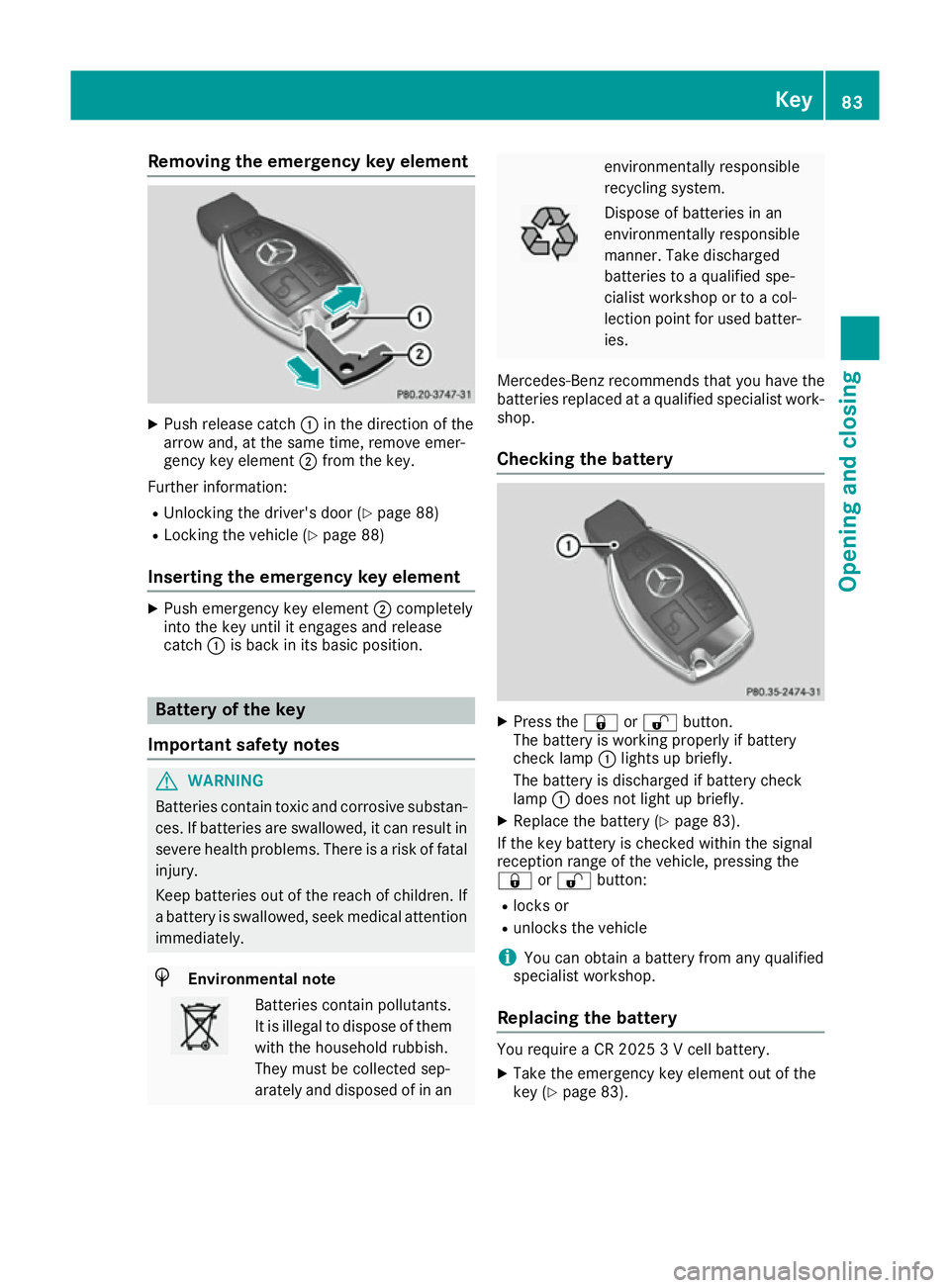
Removin
gthe emergenc ykey element X
Push release catch :in the direction of the
arrow and ,atthe same time ,remove emer-
gency key element ;from the key.
Further information:
R Unlocking the driver' sdoor(Ypage 88)
R Locking the vehicl e(Ypage 88)
Inserting the emergenc ykey element X
Push emergency key element ;completely
into the key unti litengages and release
catch :is back in its basic position. Battery of the key
Important safety notes G
WARNING
Batterie scontain toxic and corrosiv esubstan-
ces. If batteries are swallowed, it can resul tin
severe health problems .There is ariskoff atal
injury.
Kee pbatteries ou tofthe reach of children. If
ab attery is swallowed, see kmedica lattention
immediately. H
Environmental note Batterie
scontain pollutants.
It is illega ltodispose of them
with the househol drubbish.
The ym ustb ec ollected sep-
arately and disposed of in an environmentally responsible
recycling system.
Dispose of batteries in an
environmentally responsible
manner. Take discharged
batteries to
aquali fied spe-
cialist worksho portoacol-
lection point for used batter-
ies.
Mercedes-Benz recommend sthat yo uhavet he
batteries replaced at aquali fied specialist work-
shop.
Checking the battery X
Press the &or% button.
The battery is working properly if battery
check lamp :lights up briefly.
The battery is discharge difbattery check
lamp :doe snot light up briefly.
X Replace the battery (Y page 83).
If the key battery is checke dwithin the signal
reception rang eofthe vehicle, pressing the
& or% button:
R locks or
R unlocks the vehicle
i Yo
uc an obtain abattery from any qualified
specialist workshop.
Replacing the battery Yo
ur equire aCR20253Vc ellb attery.
X Take the emergency key element ou tofthe
key (Y page 83). Key
83Opening and closing Z
Page 89 of 385
Problem
Possible causes/consequences and
M
MSolutions The engine cannot be
started using the key. The on-board voltage is too low.
X Switch off non-essential consumers, e.g. seat heating or interior
lighting, and try to start the engine again.
If this does not work:
X Check the starter battery and charge it if necessary (Y page 343).
or X Jump-start the vehicle (Y page 345).
or X Consult aqualified specialist workshop. The engine cannot be
started using the Start/
Stop button. The key is in
the vehicle. The vehicle is locked.
X Unlock the vehicle and try to start the vehicle again. The key battery is discharged or nearly discharged.
X Check the key battery (Y page 83) and replace if necessary
(Y page 83).
If this does not work: X Start your vehicle with the key in the ignition lock. There is interference from
apowerful source of radio waves.
X Start your vehicle with the key in the ignition lock. You have lost
akey. X
Have the key deactivated at aqualified specialist workshop.
X Report the loss immediately to the vehicle insurers.
X If necessary, have the locks changed as well. You have lost the emer-
gency key element. X
Report the loss immediately to the vehicle insurers.
X If necessary, have the locks changed as well. Doors
Important safety notes
United Kingdom only: G
WARNING
When the double locks are activated, the
doors can no longer be opened from the
inside. People in the vehicle can no longer get out, e.g. in hazardous situations. There is a
risk of injury.
Therefore, do not leave any people unsuper-
vised in the vehicle, particularly children, eld-
erly people or people in need of special assis-
tance. Do not activate the double lock when
people are in the vehicle. If the vehicle has been locked from the outside,
the double lock function is activated as stand-
ard. It is then not possible to open the doors
from inside the vehicle. You can deactivate the
double lock function by deactivating the interior
motion sensor (see the separate multimedia
system operating instructions). The doors can
then be opened from the inside after the vehicle
has been locked from the outside. The anti-theft alarm system is triggered if the door is opened
from the inside. Switch off the alarm
(Y page 78).
All countries: 86
DoorsOpening and closing
Page 90 of 385
G
WARNING
If children are left unsupervised in the vehicle, they could:
R open doors, thereby endangering other per-
sons or road users
R get out and be struck by oncoming traffic
R operate vehicl eequipment and become
trapped, for example
In addition, the children coul dalsos et the
vehicl einm otion, for example, if they:
R release the parking brake
R shift the automatic transmission out of park
position Porshift manua ltransmission into
neutral
R start the engine
There is arisk of an accident and injury.
When leaving the vehicle, alwayst ake the key
with you and lock the vehicle. Never leave
children and animals unattended in the vehi-
cle. Keep the keys out of the reach of children. Unlocking and opening the doors
from the inside
Unite dKingdom only: if the vehiclehas been
locked with the key or with KEYLESS-GO, the
double lock function is activated as standard. It is then not possible to open the doors from
insid ethe vehicle. You can deactivate the dou-
ble lock function by deactivating the interior
motion sensor (see the Digita lOwner's Manual).
The doors can then be opened from the inside
after the vehicl ehas been locked from the out-
side .The anti-theft alarm system is triggere dif
the door is opened from the inside. Switch off
the alarm (Y page78).
For all countries except the Unite dKingdom:
You can open adoor from insid ethe vehicle
even if it has been locked. If the vehicl ehas pre-
viously been locked with the key or with KEY-
LESS-GO, opening adoor from the insid ewill
trigger the anti-theft alarm system. Switch off
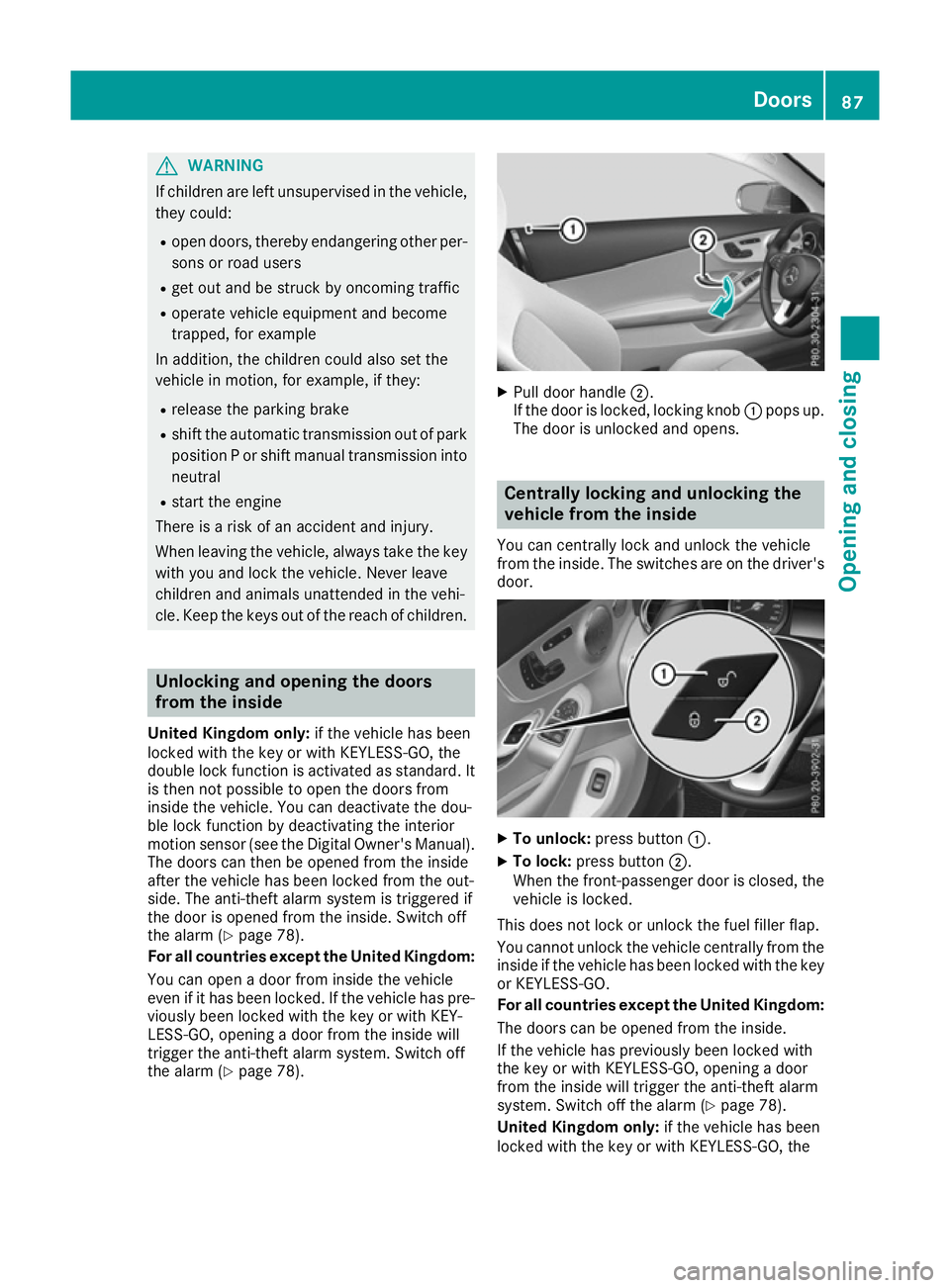
the alarm (Y page78). X
Pulld oor handle ;.
If the door is locked, locking knob :pops up.
The door is unlocked and opens. Centrally locking and unlockin
gthe
vehicle from the inside
You can centrally lock and unlock the vehicle
from the inside. The switches are on the driver's door. X
To unlock: press button :.
X To lock: press button ;.
When the front-passenge rdoor is closed ,the
vehicl eislocked.
This does not lock or unlock the fuel filler flap.
You cannot unlock the vehicl ecentrally from the
insid eifthe vehicl ehas been locked with the key
or KEYLESS-GO.
For all countries except the Unite dKingdom:
The doors can be opened from the inside.
If the vehicl ehas previousl ybeen locked with
the key or with KEYLESS-GO, opening adoor
from the insid ewillt rigger the anti-theft alarm
system. Switch off the alarm (Y page78).
Unite dKingdom only: if the vehiclehas been
locked with the key or with KEYLESS-GO, the Doors
87Opening and closing Z
Page 92 of 385
Right-hand-drive vehicle:
turn the emergency
key element in the opposite direction in both
cases.
If yo uusethe emergency key element to unlock
and ope nthe driver' sdoor, the anti-theft alarm
system will be triggered. Switch off the alarm
(Y page 78). Boot
Important safety notes
G
WARNING
Combustio nengines emi tpoisonous exhaust
gases such as carbon monoxide. Exhaust
gases can enter the vehicle interior if the boot
li diso penw hent he engine is running, espe-
ciall yift he vehicle is in motion. There is arisk
of poisoning.
Alway sswitch off the engine before opening
the boo tlid.N eve rdrive with the boo tlid
open. G
WARNING
If objects, luggage or loads are not secured or not secured sufficiently ,they could slip, tip
over or be flung around and thereby hit vehicle
occupants. There is ariskofi njury, especially
whe nbraking or abruptly changing directions.
Alway sstore objects so that they cannot be
flung around .Secure objects, luggage or
loads against slipping or tipping before the
journey.
! The boo
tlid swings upwards whe nopened.
Therefore, make sure that there is sufficient
clearance above the boo tlid.
The opening dimensions of the boo tlid can be
found in the "Vehicl edata" section
(Y page 377).
You can limit the opening angl eofthe boo tlid in
the multimedi asystem (se ethe Digital Owner's
Manual).
Do not leave the key in the boot. You could oth- erwise lock yoursel fout.
Stow luggage or loads preferabl yinthe boot.
Observe the loading guidelines (Y page 308). Obstacl
edetection with boot lid
reversin gfeature
Vehicles with boot li dremote closing fea-
ture:
The boo tlid is equipped with automatic obstacle
detection with reversing feature .Ifasolid object
blocks or restricts the boo tlid whe nautomati-
cally opening, this procedure is stopped .Ifa
solid object blocks or restricts the boo tlid when
automaticall yclosing, the boo tlid opens again
automatically. The automatic obstacl erecogni-
tion with reversing function is only an aid. It is
not asubstitute for your attentivenes swhen
opening and closing the boo tlid. G
WARNING
The reversing function doe snot react:
R to soft, light and thin objects, e.g. fingers
R over the last 8mmofthe closing path
The reversing feature cannot prevent some-
one being trapped in these situations in par-
ticular. There is ariskofi njury.
Whe nclosing make sure that no bod yparts
are in the closing area.
If someone is trapped:
R press the Fbutton on the key or
R pull or press the remote operating switch
on the driver' sdooror
R press the closing or locking button on the
boo tlid.
Vehicles with HANDS-FREE ACCESS:
It is also possible to stop the closing process by performing akicking movement under the rear
bumper. Opening and closin
gmanually
Opening X
Press the Fbutton on the key.
The boo tlid opens. Boot
89Opening and closing Z
Page 93 of 385
Closing
X
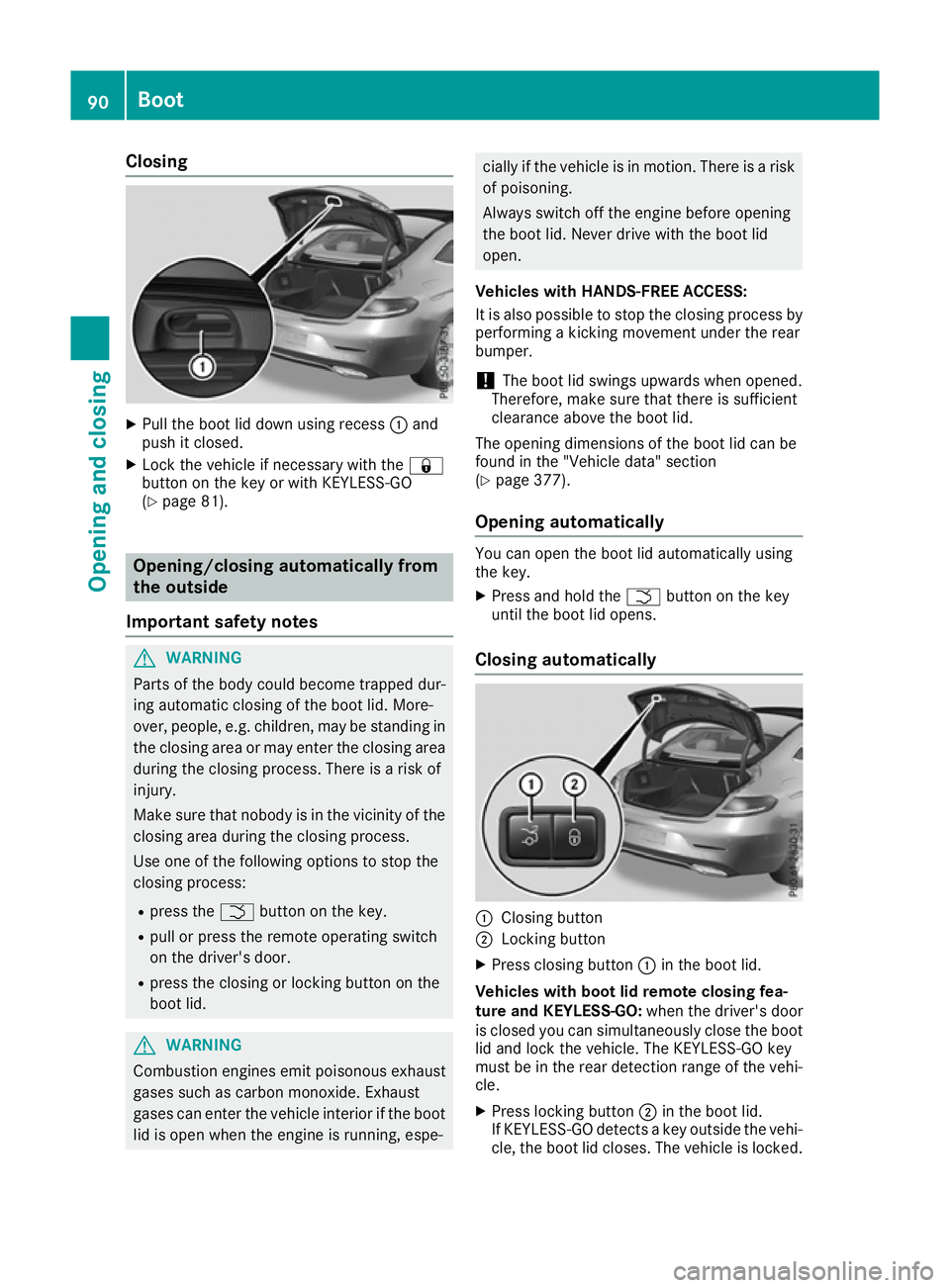
Pull th eboot lid down usin grecess :and
push it closed.
X Loc kthe vehicle if necessary wit hthe &
butto nont hekeyorw ithK EYLESS-GO
(Y page 81). Opening/closing automatically from
th eo utside
Important safety notes G
WARNING
Part soft hebody coul dbecome trapped dur-
ing automatic closin goftheboot lid. More-
over, people, e.g .children, may be standing in
th ec losin garea or may ente rthe closin garea
durin gthe closin gprocess. Ther eisariskof
injury.
Mak esure that nobody is in th evicinity of the
closin garea durin gthe closin gprocess.
Use on eofthefollowin goption stos topt he
closin gprocess:
R pres sthe F buttonont hekey.
R pull or pres sthe remot eoperatin gswitch
on th edriver' sdoor.
R pres sthe closin gorlockin gbutto nont he
boot lid. G
WARNING
Combustion engines emit poisonous exhaust
gases suc hascarbon monoxide. Exhaust
gases can ente rthe vehicle interio riftheboot
lid is open when th eengineisr unning, espe- ciall
yift hevehicle is in motion .Ther eisar isk
of poisoning.
Always switch off th eengineb efore opening
th eb oot lid. Never driv ewitht he boot lid
open.
Vehicles with HANDS-FREE ACCESS:
It is also possible to stop th eclosin gproces sby
performing akickin gmovement unde rthe rear
bumper.
! The boot lid swings upward
swhen opened.
Therefore, mak esure that there is sufficient
clearance abov ethe boot lid.
The opening dimension softheboot lid can be
foun dint he"Vehicle data" section
(Y page 377).
Opening automatically You can open th
eboot lid automaticall yusing
th ek ey.
X Press and hold the Fbuttonont hekey
until th eboot lid opens.
Closing automatically :
Closin gbutton
; Lockin gbutton
X Press closin gbutton :in th eboot lid.
Vehicles with boot lid remote closing fea-
ture and KEYLESS-GO: when thedriver' sdoor
is closed you can simultaneousl yclose th eboot
lid and loc kthe vehicle .The KEYLESS-GO key
must be in th erear detection range of th evehi-
cle.
X Press lockin gbutton ;in th eboot lid.
If KEYLESS-GO detect sakeyoutside th evehi-
cle ,the boot lid closes .The vehicle is locked. 90
BootOpening and closing
Page 94 of 385
If KEYLESS-GO detects
akey in the boot, the
boot lid opens again after it is closed.
If KEYLESS-GO detects asecond key outsid ethe
vehicle ,the boot lid remains closed.
If KEYLESS-GO detects akey in the boot before
the closing procedure starts, the boot lid
remains open. HANDS-FREE ACCESS
Important safety notes G
WARNING
The vehicle exhaust system can become very
hot. If you use HANDS-FREE ACCESS, you
could burn yourself by touching the exhaust
system. There is arisk of injury. Always
ensure that you only make aleg movement
within the detection range of sensors.
! If the key is within the rear detection range
of KEYLESS-GO, the following situations, for
example ,could leadtot he boot lid opening
unintentionally:
R using acar wash
R using ahigh-pressure cleaner
Make sure that the key is at least 3maway
from the vehicle.
General notes With KEYLESS-GO and HANDS-FREE ACCESS,
you can open or close the boot lid or stop the
procedure withou
tusing yourh ands. This is use-
ful if you have yourh ands full.Todothis, make
ak icking movement under the bumperw ith your
foot.
Observe the following points:
R Carry yourK EYLESS-GO key abouty ourp er-
son. The KEYLESS-GO key must be in the rear detection range of the vehicle.
R When making the kicking movement, make
sure that you are standing firmly on the
ground and that there is sufficient clearance
to the rear of the vehicle .You could otherwise
lose yourb alance, e.g. on ice. R
Alwayse nsure that you only make akicking
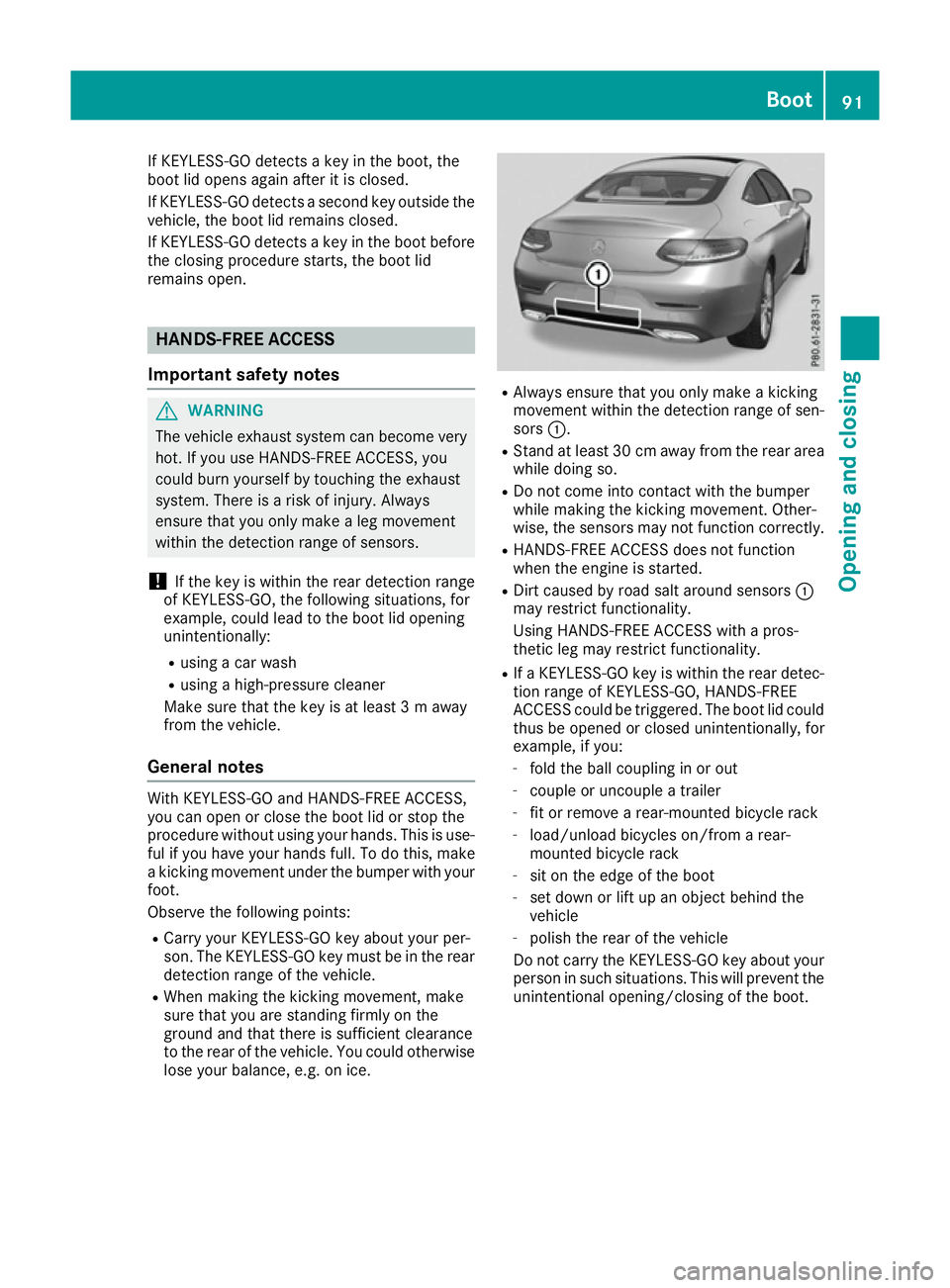
movement within the detection range of sen- sors :.
R Stand at least 30 cm awayf rom the rear area
whiled oing so.
R Do not come into contact with the bumper
whilem aking the kicking movement. Other-
wise,t he sensors may not function correctly.
R HANDS-FREE ACCESS does not function
when the engine is started.
R Dirt causedbyr oad salt around sensors :
may restrict functionality.
Using HANDS-FREE ACCESS with apros-
thetic leg may restrict functionality.
R IfaK EYLESS-GO key is within the rear detec-
tion range of KEYLESS-GO, HANDS-FREE
ACCESS could be triggered. The boot lid could
thus be opened or closed unintentionally ,for
example ,ifyou:
- fold the ballc oupling in or out
- coupleoru ncoupleatrailer
- fit or remove arear-mounted bicycl erack
- load/unload bicycles on/from arear-
mounted bicycl erack
- sit on the edge of the boot
- set down or lift up an object behind the
vehicle
- polish the rear of the vehicle
Do not carry the KEYLESS-GO key abouty our
person in such situations. This willp revent the
unintentional opening/closing of the boot. Boot
91Opening and closing Z