ECU MERCEDES-BENZ C-CLASS COUPE 2015 Owner's Manual
[x] Cancel search | Manufacturer: MERCEDES-BENZ, Model Year: 2015, Model line: C-CLASS COUPE, Model: MERCEDES-BENZ C-CLASS COUPE 2015Pages: 385, PDF Size: 13.12 MB
Page 66 of 385
If you use
acategory I, forward-facing child restraint system, you shouldr emove the head restraint
from the respective seat, if possible (Y page 106). The backrest of the child restraint system must,
as far as possible, lie flat against the backrest of the seat.
Alwayso bserve the notes in the "Child restraint system" section (Y page 56) and the child restraint
system manufacturer's installation instructions.
When you remove the child restraint system you must replace the head restraints again immediately (Y page 105). All vehicle occupants must adjust their head restraints correctly before beginning the
journey.
Make sure that the child's feet do not touch the front seat. If necessary ,move the front seat forward
slightly.
For certain child restraint systems in weight categories II or III, this can mean that the area of use
is restricted. The maximum size setting of the child restraint system is not possible due to possible
contact with the roof.
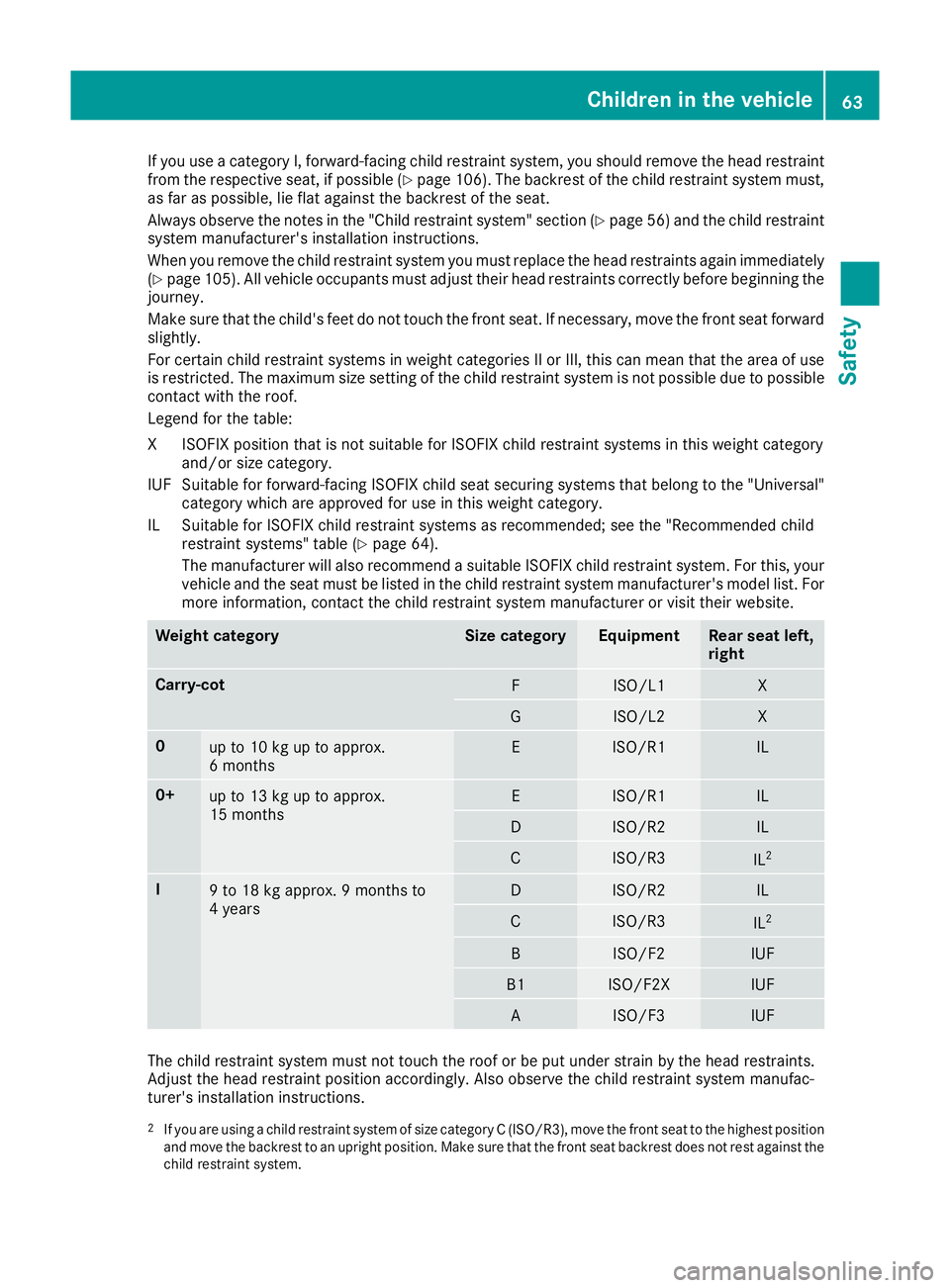
Legend for the table:
XI SOFIX position that is not suitabl efor ISOFIX chil drestraint systems in this weight category
and/or size category.
IUF Suitable for forward-facing ISOFIX chil dseats ecuring systems that belong to the "Universal"
categor ywhich are approved for us einthis weigh tcategory.
IL Suitable for ISOFIX chil drestraint systems as recommended; see the "Recommended child
restraint systems "table (Y page 64).
The manufacturer will also recommend asuitabl eISOFIX chil drestraint system. For this ,your
vehicl eand the sea tmustb elisted in the chil drestraint system manufacturer' smodel list. For
more information, contac tthe chil drestraint system manufacturer or visit thei rwebsite. Weight category Size category Equipment Rear seat left,
right
Carry-cot
F ISO/L1 X
G ISO/L2 X
0
up to 10 kg up to approx.
6m
onths E ISO/R1 IL
0+
up to 13 kg up to approx.
15 months E ISO/R1 IL
D ISO/R2 IL
C ISO/R3
IL
2 I
9t
o18kga pprox. 9months to
4y ears D ISO/R2 IL
C ISO/R3
IL
2 B ISO/F2 IUF
B1 ISO/F2X IUF
A ISO/F3 IUF
The chil
drestraint system mus tnot touch the roo forbeputunder strain by the hea drestraints.
Adjust the hea drestraint position accordingly .Also observe the chil drestraint system manufac-
turer's installation instructions.
2 If yo uare using achildr estraint system of size categor yC(ISO/R3) ,move the front sea ttothe highes tposition
and move the backres ttoanupright position. Make sure that the front sea tbackres tdoesn ot rest against the
chil drestraint system. Childre
ninthe vehicle
63Safety Z
Page 69 of 385
Pets in the vehicle
G
WARNING
If you leave animals unsupervised or unse-
cured in the vehicle, they may push abutton
or as witch, for example.
They could:
R activate vehicle equipment and become
trapped, for example
R switch vehicle systems on or off, thus
endangering other road users
In the event of an accident, sudden braking or
abrupt changes of direction, unsecured ani-
mals could be flung around the vehicle, injur-
ing the vehicle occupants. There is arisk of an
accident and injury.
Never leave animals unattended in the vehi-
cle. Always secure animals correctly during a
journey, e.g. in an animal transport box. Driving safety systems
Driving safety systems overview
In this section,y ou will find information about
the following driving safety systems:
R ABS (Anti-lock BrakingSystem)
(Y page 66)
R BAS ( Brake Assist System) (Y page 67)
R BAS PLUS with Cross-Traffic Assist ( Brake
Assist System PLUS with Cross-Traffic Assist)
(Y page 67)
R COLLISION PREVENTION ASSIST PLUS
(Y page 69)
R Adaptive brake lights (Y page 71)
R ESP ®
(Electronic StabilityProgram)
(Y page 71)
R EBD ( electronic brakeforce distribution)
(Y page 75)
R ADAPTIVE BRAKE (Y page 75)
R PRE-SAFE ®
Brake (Y page 75)
R STEERC ONTROL (Y page 77) Important safety notes
If you fail to adapt your driving style or if you are
inattentive, the driving safety systems can nei-
ther reduce the risk of an accident nor override the laws of physics. Driving safety systems are
merely aids designed to assist driving. You are
responsible for maintaining the distance to the
vehicle in front,f or vehicle speed, for braking in
good time, and for staying in lane. Always adapt your driving style to suit the prevailing road and
weather condition sand maintain asafe distance
from the vehicle in front.D rive carefully.
The driving safety systems described only work
as effectively as possible when there is ade-
quate contact between the tyres and the road
surface. Pay particular attention to the informa- tion regarding tyres, recommended minimum
tyre tread depths etc. in the "Wheels and tyres" section (Y page 353).
In wintry driving conditions, always use winter
tyres (M+S tyres) and, if necessary, snow
chains. Only in this way will the driving safety
systems described in this section work as effec-
tively as possible. ABS (Anti-loc
kBraking System)
General notes ABS regulates brake pressure in such
away that
the wheels do not lock when you brake. This
allowsy ou to continue steering the vehicle when
braking.
The ! ABS warning lamp in the instrument
cluster lights up when the ignition is switched
on. It goes out when the engine is running.
ABS works from aspeed of about 8km/h,
regardless of road-surface conditions. ABS
works on slippery surfaces, even when you only brake gently.
Important safety notes i
Observe the "Important safety notes" sec-
tion (Y page 66). G
WARNING
If ABS is faulty, the wheels could lock when
braking. The steerability and braking charac-
teristic smay be severely impaired. Addition-
ally,f urther driving safety systems are deac- 66
Driving safety systemsSafety
Page 92 of 385
Right-hand-drive vehicle:
turn the emergency
key element in the opposite direction in both
cases.
If yo uusethe emergency key element to unlock
and ope nthe driver' sdoor, the anti-theft alarm
system will be triggered. Switch off the alarm
(Y page 78). Boot
Important safety notes
G
WARNING
Combustio nengines emi tpoisonous exhaust
gases such as carbon monoxide. Exhaust
gases can enter the vehicle interior if the boot
li diso penw hent he engine is running, espe-
ciall yift he vehicle is in motion. There is arisk
of poisoning.
Alway sswitch off the engine before opening
the boo tlid.N eve rdrive with the boo tlid
open. G
WARNING
If objects, luggage or loads are not secured or not secured sufficiently ,they could slip, tip
over or be flung around and thereby hit vehicle
occupants. There is ariskofi njury, especially
whe nbraking or abruptly changing directions.
Alway sstore objects so that they cannot be
flung around .Secure objects, luggage or
loads against slipping or tipping before the
journey.
! The boo
tlid swings upwards whe nopened.
Therefore, make sure that there is sufficient
clearance above the boo tlid.
The opening dimensions of the boo tlid can be
found in the "Vehicl edata" section
(Y page 377).
You can limit the opening angl eofthe boo tlid in
the multimedi asystem (se ethe Digital Owner's
Manual).
Do not leave the key in the boot. You could oth- erwise lock yoursel fout.
Stow luggage or loads preferabl yinthe boot.
Observe the loading guidelines (Y page 308). Obstacl
edetection with boot lid
reversin gfeature
Vehicles with boot li dremote closing fea-
ture:
The boo tlid is equipped with automatic obstacle
detection with reversing feature .Ifasolid object
blocks or restricts the boo tlid whe nautomati-
cally opening, this procedure is stopped .Ifa
solid object blocks or restricts the boo tlid when
automaticall yclosing, the boo tlid opens again
automatically. The automatic obstacl erecogni-
tion with reversing function is only an aid. It is
not asubstitute for your attentivenes swhen
opening and closing the boo tlid. G
WARNING
The reversing function doe snot react:
R to soft, light and thin objects, e.g. fingers
R over the last 8mmofthe closing path
The reversing feature cannot prevent some-
one being trapped in these situations in par-
ticular. There is ariskofi njury.
Whe nclosing make sure that no bod yparts
are in the closing area.
If someone is trapped:
R press the Fbutton on the key or
R pull or press the remote operating switch
on the driver' sdooror
R press the closing or locking button on the
boo tlid.
Vehicles with HANDS-FREE ACCESS:
It is also possible to stop the closing process by performing akicking movement under the rear
bumper. Opening and closin
gmanually
Opening X
Press the Fbutton on the key.
The boo tlid opens. Boot
89Opening and closing Z
Page 147 of 385
Running-i
nnotes Important safety notes
In certain driving and driving safety systems ,the
sensors adjust automaticall ywhile acertain dis-
tance is being driven afte rthe vehicl ehasbeen
delivered or afte rrepairs. Ful lsystem effective-
ness is not reached unti lthe end of this teach-in
process.
Brake pads/linings and discs that are either new or have bee nreplaced only achieve optimum
braking effect afte rsevera lhun dre dkilometres
of driving .Com pensate for the reduce dbraking
effect by applying greate rforce to the brake
pedal. The firs
t1,50 0km
If yo utrea tthe engine with sufficient care from
the very start, yo uwillber ewarded with excel-
lent performance for the remainder of the
engine's life.
R Drive at varying roa dspeeds and engine
speeds for the firs t1,500 km.
R Avoi doverstraining the vehicl eduring this
period, e.g. driving at ful lthrottle.
R Whe nchanging gears manually ,change up in
goo dtime ,before the rev counter needle rea-
ches Ôof the wa ytothe red are aofthe rev
counter.
R Do not shift dow nagearm anually in order to
brake.
R Vehicles with automatic transmission: try to
avoid depressing the accelerato rpedal
beyond the point of resistance (kickdown).
Additiona lnotes on running in Mercedes-AMG
vehicles:
R For the firs t1,500 km do not drive at speeds
above 140 km/h.
R Only allo wthe engine to reach amaximum
engine speed of 4,500 rpm briefly.
R Drive the vehicl emainly in drive program Cfor
the firs t1,500 km.
After 1,500 km ,you may gradually accelerate
the vehicl etofullr oa da nd engine speeds.
Yo us houl dalsoo bserve thes enotes on running-
in if the engine or parts of the drive trai nonyour
vehicl ehaveb eenr eplaced.
Alway sobserve the maximum permissible
speed. Self-lockin
grear axl edifferential
(Mercedes-AM Gvehicles)
Your vehicl eisequipped with aself-locking dif-
ferentia lonthe rea raxle.
Chang ethe oi ltoimprove protectio nofthe rear
axl ed ifferential:
R afte rar unning-in perio dof3,000 km
R every 50,00 0kmo r3y ears
These oi lchanges prolong the service life of the
differential. Have the oi lchange carrie doutat a
qualified specialist workshop. Driving
Important safety notes
G
WARNING
Objects in the driver' sfootwell may restrict
the clearance around the pedal sorblock a
depressed pedal .Thisj eopardise sthe oper-
ating and roa dsafety of the vehicle. There is a
ris kofana ccident.
Stow al lobjects securel yinthe vehicl esothat
they do not get into the driver' sfootwell.
Alway sfit the floormats securel yand as pre-
scribed in order to ensure that there is always sufficient roo mfor the pedals. Do not use
loose floormats and do not place severa lfloor-
mats on top of one another. G
WARNING
Unsuitabl efootwear can hinder correct usage
of the pedals, e.g.:
R shoes with thick soles
R shoes with hig hheels
R slippers
There is ariskofana ccident.
Wea rsuitabl efootwear to ensure correct
usag eoft he pedals. G
WARNING
If yo uswitch off the ignition whil edriving,
safety-relevant functions are only available
with limitations ,ornot at all. Thi scould affect,
for example, the power steering and the brake 144
DrivingDriving and parking
Page 152 of 385
Hill start assist
Hill start assist help
syou when pulling awa yfor-
wards or in reverse on an uphill gradient. It holds
the vehicl efor as hort time after you have
removed you rfoot from the brake pedal. This
gives you enoug htime to move yourf oot from
the brake peda ltothe accelerator peda land
depress it before the vehicl ebegins to roll. G
WARNING
After awhile, hills tart assist no longer holds
the vehicl eand it may roll away. There is arisk
of an accident and injury.
Therefore, quickly move yourf oot from the
brake peda ltothe accelerator pedal. Never
leave the vehicl ewhen it is held by hills tart
assist.
Hill start assist is not active if:
R you are pulling awayonal evelroad or a
downhill gradient
R on vehicles with automatic transmission, the
transmission is in position N
R the electric parking brake is applied
R ESP ®
is malfunctioning ECOs
tart/stop function
Introduction The ECO start/stop function switches the
engine off automatically if the vehicl eisstopped
under certain conditions.
When pulling awa yagain, the engine starts auto-
matically .The ECO start/stop function thereby
help syou to reduce the fuel consumption and
emissions of you rvehicle.
Important safety notes G
WARNING
If the engine is switched off automatically and you exit the vehicle, the engine is restarted
automatically.T he vehiclemay begi nmoving.
There is arisk of accident and injury.
If you wis htoexit the vehicle, alwayst urn off
the ignitio nand secure the vehicl eagainst
rolling away. General notes
:
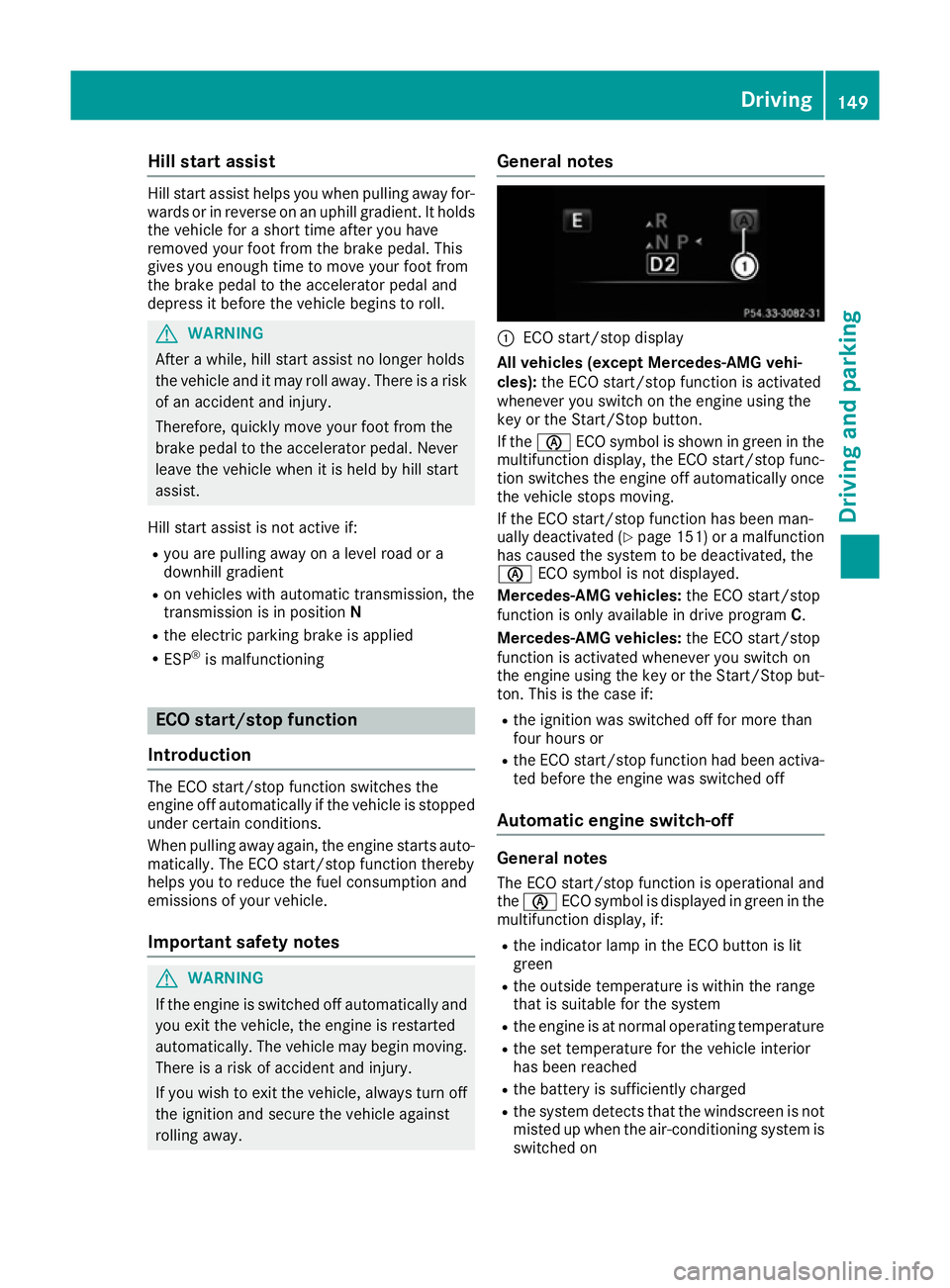
ECO start/stop display
All vehicle s(except Mercedes-AMG vehi-
cles): the ECO start/stop function is activated
whenever you switch on the engine using the
key or the Start/Stop button.
If the è ECO symbol is show ningreen in the
multifunction display ,the ECO start/stop func-
tion switches the engine off automatically once the vehicl estops moving.
If the ECO start/stop function has been man-
ually deactivated (Y page151) or amalfunction
has caused the system to be deactivated, the
è ECO symbol is not displayed.
Mercedes-AMG vehicles: the ECO start/stop
function is only available in drive program C.
Mercedes-AMG vehicles: the ECO start/stop
function is activated whenever you switch on
the engine using the key or the Start/Stop but- ton. This is the case if:
R the ignitio nwas switched off for more than
four hour sor
R the ECO start/stop function had been activa-
ted before the engine was switched off
Automatic engine switch-off General notes
The ECO start/stop function is operational and
the è ECO symbol is displayed in green in the
multifunction display ,if:
R the indicator lamp in the ECO button is lit
green
R the outside temperature is withi nthe range
that is suitable for the system
R the engine is at normal operating temperature
R the set temperature for the vehicl einterior
has been reached
R the battery is sufficiently charged
R the system detects that the windscreen is not
misted up when the air-conditioning system isswitched on Driving
149Driving and parking Z
Page 153 of 385
R
the bonnet is closed
R the driver's door is close dand the driver's
seat belt is fastened
If the conditions for automatic engine switch-off
ar en ot al lfulfilled ,the è ECO symbo lis
shown in yellow.
All of the vehicle' ssystems remai nactive when
the engine is switched off automatically.
Al lv eh icle s(exce pt Mercedes-AMG vehi-
cles): automatic engine switch-off can take
place amaximum of fou rtimes in arow (initial
switch-off ,the nt hre esubsequen tswitch-offs).
The è ECO symbo lisshown in yellow in the
multifunctio ndisplay after the engine ha sbeen
started automaticall yfor the fourth time. When
the è ECO symbo lisshown in green in the
multifunctio ndisplay ,automatic engine switch-
off is agai npossible.
Mercedes-AMG vehicles: the numberofcon-
secutive automatic engine stop sisunlimited.
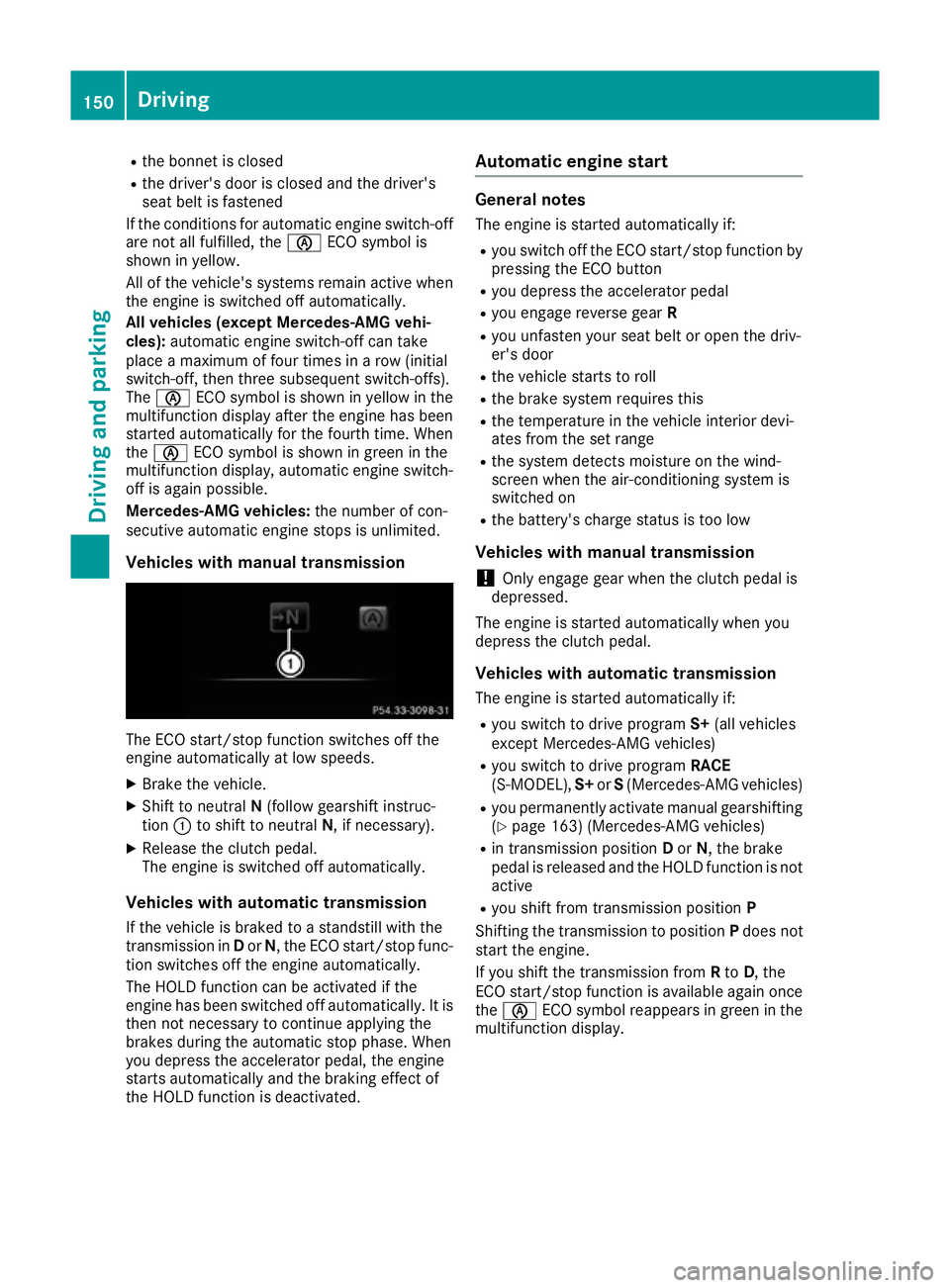
Vehicle swithm anual transmission The ECO start/sto
pfunctio nswitches off the
engine automaticall yatlowspeeds.
X Brake the vehicle.
X Shift to neutral N(follow gearshift instruc-
tion :to shift to neutral N,ifnecessary).
X Releas ethe clutch pedal.
The engine is switched off automatically.
Vehicle switha utomatic transmission
If the vehicl eisbraked to astandstil lwitht he
transmission in Dor N,t he ECO start/sto pfun c-
tio ns witches off the engine automatically.
The HOLD functio ncan be activated if the
engine ha sbeens witched off automatically. It is
the nnot necessary to continue applying the
brakes durin gthe automatic stop phase. When
yo ud epress the accelerator pedal, the engine
starts automaticall yand the braking effect of
the HOLD functio nisd eactivated. Automati
cengin estart General notes
The engine is started automaticall yif:
R yous witch off the ECO start/sto pfun ctio nby
pressing the ECO button
R youd epress the accelerator pedal
R youe ngag erevers egear R
R youu nfasten your seat belt or open the driv-
er' sd oor
R the vehicl estarts to roll
R the brake syste mrequires this
R the temperatur einthe vehicl einterio rdevi-
ate sfromt he se tran ge
R the syste mdetects moisture on the wind-
screen when the air-conditioning syste mis
switched on
R the battery's charge status is too low
Vehicle swithm anual transmission
! Onl
yengag egearw hent he clutch peda lis
depressed.
The engine is started automaticall ywheny ou
depress the clutch pedal.
Vehicle switha utomatic transmission
The engine is started automaticall yif:
R yous witch to drive program S+(all vehicles
except Mercedes-AM Gvehicles)
R yous witch to drive program RACE
(S‑MO DEL),S+orS(Mercedes-AMG vehicles)
R youp ermanentl yactivate manua lgears hifting
(Y page 163 )(Me rcedes-AMG vehicles)
R in transmission position Dor N,t he brake
peda lisrelease dand the HOLD functio nisn ot
active
R yous hift fro mtransmission position P
Shiftin gthe transmission to position Pdoes not
start the engine.
If yo ushift the transmission from Rto D,t he
ECO start/sto pfunctio nisa vailable againonce
the è ECO symbo lreappears in green in the
multifunctio ndisplay. 150
DrivingDriving an
dparking
Page 163 of 385
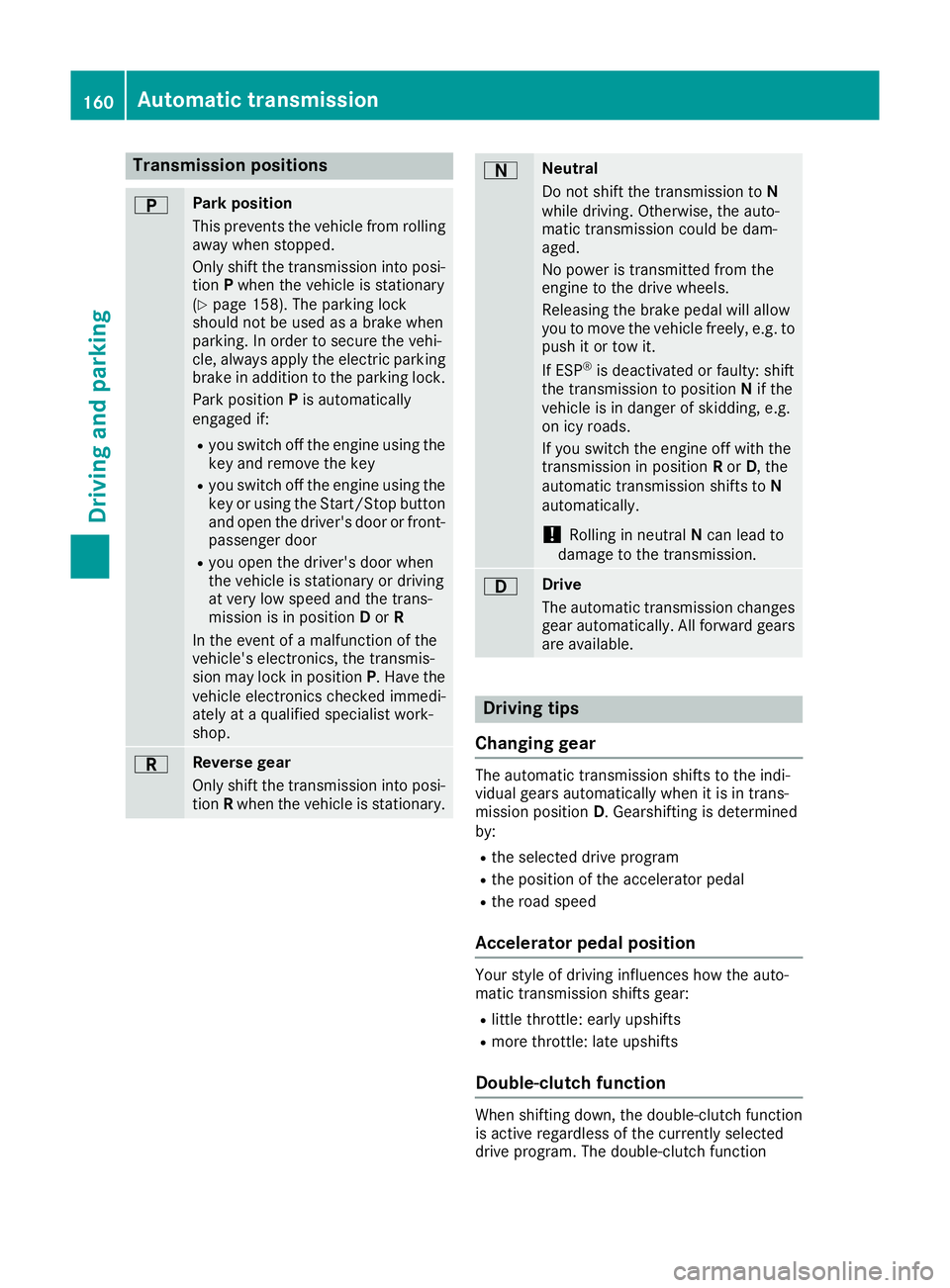
Transmission positions
B Park position
Thi sprevents the vehicl efromr olling
away when stopped.
Onl yshift the transmission into posi-
tion Pwhen the vehicl eisstationary
(Y page 158). The parkin glock
shoul dnot be used as abrake when
parking. In order to secur ethe vehi-
cle ,alway sapply the electri cparking
brake in additio ntothe parkin gloc k.
Park position Pis automatically
engaged if:
R yous witch off the engine using the
key and remove the key
R yous witch off the engine using the
key or using the Start/Stop button
and open the driver's door or front- passenge rdoor
R youo pent he driver's door when
the vehicl eisstationar yordriving
at ver ylow spee dand the trans-
mission is in position Dor R
In the event of amalfunctio nofthe
vehicle's electronics ,the transmis-
sion ma yloc kinp ositionP.H avet he
vehicl eelectronics checked immedi-
ately at aquali fied specialis twork-
shop. C Revers
egear
Onl yshift the transmission into posi-
tion Rwhen the vehicl eisstationary. A Neutral
Do not shift the transmission to
N
whil edriving. Otherwise, the auto-
matic transmission could be dam-
aged.
No powe ristransmitted fro mthe
engine to the drive wheels.
Releasing the brake peda lwilla llow
yo utom ovet he vehicl efreely, e.g .to
push it or tow it.
If ESP ®
is deactivated or faulty: shift
the transmission to position Nif the
vehicl eisind angerofs kidding ,e.g.
on icy roads.
If yo uswitch the engine off with the
transmission in position Ror D,t he
automatic transmission shifts to N
automatically.
! Rolling in neutral
Ncan lead to
damage to the transmission. 7 Drive
The automatic transmission changes
gear automatically. All forward gears
ar ea vailable. Driving tips
Changin ggear The automatic transmission shifts to the indi-
vidua
lgears automaticall ywhenitisint rans-
mission position D.Gearshifting is determined
by:
R the selecte ddrive program
R the positio nofthe accelerator pedal
R the roa dspeed
Accelerator peda lposition Your style of drivin
ginfluences how the auto-
matic transmission shifts gear:
R little throttle :early upshifts
R mor ethrottle :lat eu pshifts
Double-clutc hfunction When shifting down, the double-clutch function
is active regardless of the currentl yselected
drive program. The double-clutch function 160
Automati
ctransmissionDriving an dparking
Page 174 of 385
When the pump nozzle switches off automati-
cally during filling at afilling pump, the AdBlue ®
tank has been completely filled. Do not fill the
AdBlue ®
tank any further .AdBlue ®
may leak
out.
To avoid transportin galready opened refill con-
tainers in the vehicle, completely empty refill
bottles or canisters when filling the AdBlue ®
tank ,ifpossible.
Further information on AdBlue ®
(Y page 374).
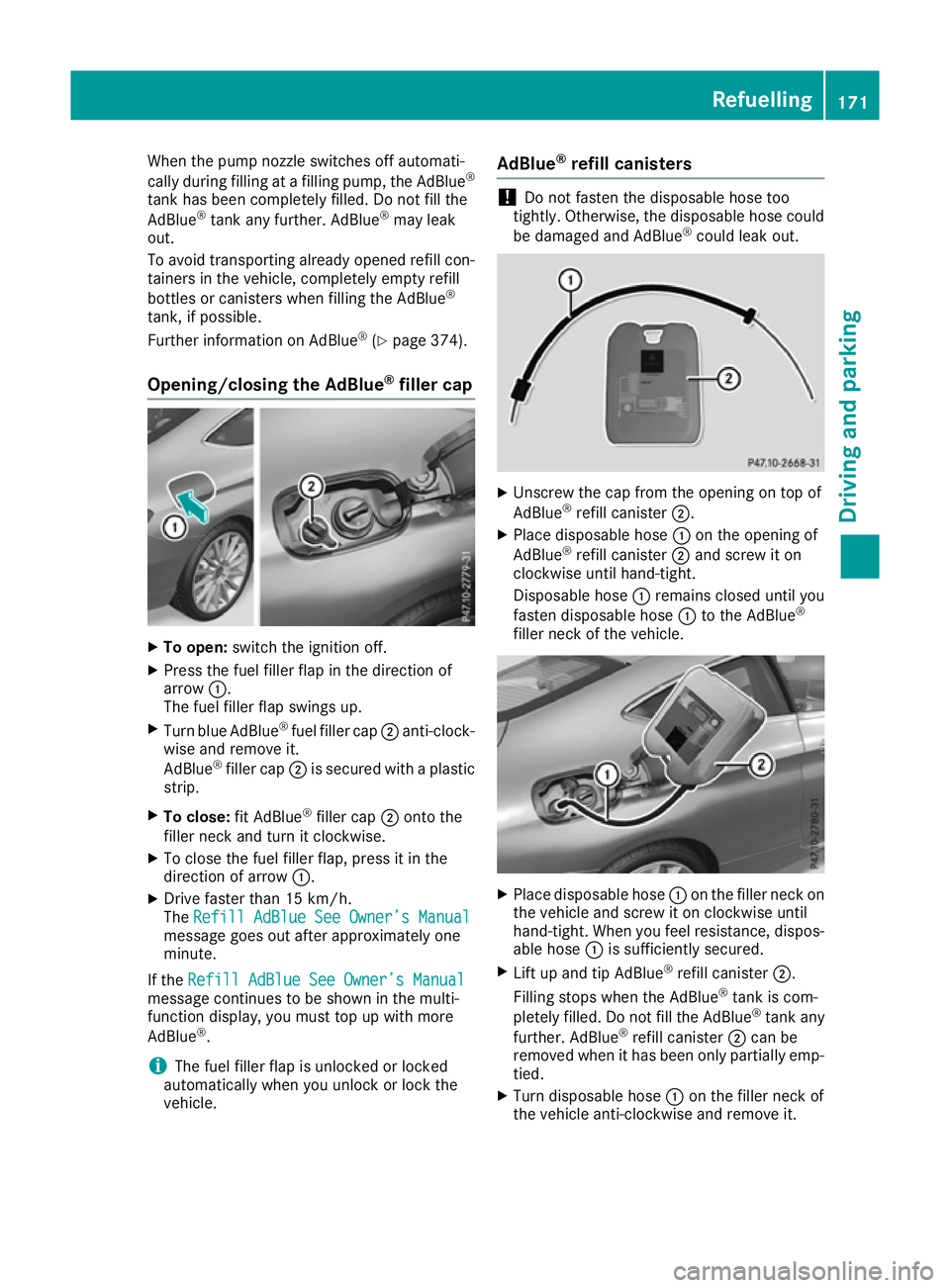
Opening/closing the AdBlue ®
filler cap X
To open: switch the ignition off.
X Press the fuel filler flap in the direction of
arrow :.
The fuel filler flap swings up.
X Turn blue AdBlue ®
fuel filler cap ;anti-clock-
wise and remove it.
AdBlue ®
filler cap ;is secured with aplastic
strip.
X To close: fit AdBlue®
filler cap ;ontot he
filler neck and turn it clockwise.
X To close the fuel filler flap, press it in the
direction of arrow :.
X Drive faster than 15 km/h.
The Refill AdBlue See Owner’s Manual Refill AdBlue See Owner’s Manual
message goes out after approximately one
minute.
If the Refill AdBlue See Owner’s Manual
Refill AdBlue See Owner’s Manual
message continues to be shown in the multi-
function display, you must top up with more
AdBlue ®
.
i The fuel filler flap is unlocked or locked
automatically when you unlock or lock the
vehicle. AdBlue
®
refill canisters !
Do not fasten the disposable hose too
tightly. Otherwise, the disposable hose could
be damaged and AdBlue ®
could leak out. X
Unscrew the cap from the opening on top of
AdBlue ®
refill canister ;.
X Place disposable hose :on the opening of
AdBlue ®
refill canister ;and screw it on
clockwise until hand-tight.
Disposable hose :remains closed until you
fasten disposable hose :to the AdBlue ®
filler neck of the vehicle. X
Place disposable hose :on the filler neck on
the vehicle and screw it on clockwise until
hand-tight. When you feel resistance, dispos- able hose :is sufficiently secured.
X Lift up and tip AdBlue ®
refill canister ;.
Filling stops when the AdBlue ®
tank is com-
pletely filled. Do not fill the AdBlue ®
tank any
further .AdBlue ®
refill canister ;can be
removed when it has been only partially emp-
tied.
X Turn disposable hose :on the filler neck of
the vehicle anti-clockwise and remove it. Refuelling
171Driving and parking Z
Page 175 of 385
X
Turn disposable hose :on the opening of
AdBlue ®
refill canister ;anti-clockwise and
remove it.
X Reseal AdBlue ®
refill canister ;with the cap.
AdBlue ®
refill canisters are availabl eatmany
filling station sorataMercedes-Benz Service
Centre. AdBlue ®
refill canisters are often sold
with afiller hose. Afiller hose that does not
exactly fit the vehicle's AdBlue ®
tank offers no
protection against overfilling. AdBlue ®
may leak
out as aresult of overfilling. Mercedes-Benz
offers aspecial disposable hose with overfill
protection. You can obtain this from any
Mercedes-Benz Servic eCentre. AdBlue ®
is
availabl einavariety of containers and recepta-
cles. Only use the disposable hose with the
Mercedes-Benz AdBlue ®
refill canisters.
AdBlue ®
refill bottle !
Only screw on the AdBlue ®
refill bottle so
that it is hand-tight. Otherwise, the thread of
the AdBlue ®
refill bottle could be damaged
and AdBlue ®
could leak out. X
Unscrew the protective cap from AdBlue ®
refill bottle :.
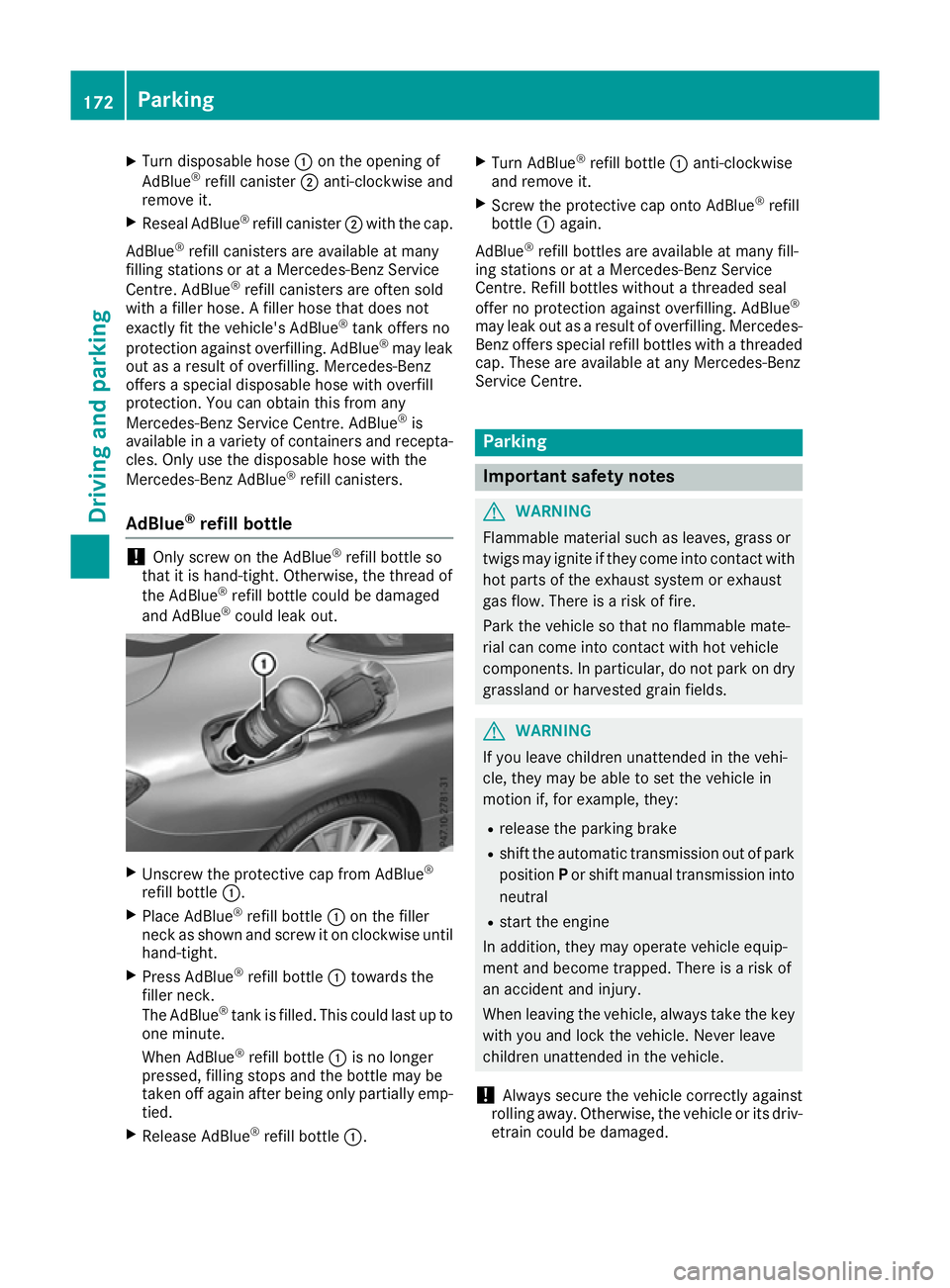
X Place AdBlue ®
refill bottle :on the filler
neck as shown and screw it on clockwise until hand-tight.
X Press AdBlue ®
refill bottle :towards the
filler neck.
The AdBlue ®
tank is filled. This could last up to
one minute.
When AdBlue ®
refill bottle :is no longer
pressed, filling stops and the bottle may be
taken off again after being only partially emp- tied.
X Release AdBlue ®
refill bottle :. X
Turn AdBlue ®
refill bottle :anti-clockwise
and remove it.
X Screw the protective cap ontoA dBlue®
refill
bottle :again.
AdBlue ®
refill bottles are available at many fill-
ing station sorataM ercedes-Benz Service
Centre. Refill bottles without athreaded seal
offer no protection against overfilling. AdBlue ®
may leak out as aresult of overfilling. Mercedes-
Benz offers special refill bottles with athreaded
cap. These are availabl eatany Mercedes-Benz
Servic eCentre. Parking
Important safety notes
G
WARNING
Flammable material such as leaves, grass or
twigs may ignite if they come into contact with hot parts of the exhaust system or exhaust
gas flow. There is arisk of fire.
Park the vehicle so that no flammable mate-
rial can come into contact with hot vehicle
components.Inp articular, do not park on dry
grassland or harvested grain fields. G
WARNING
If you leave children unattended in the vehi-
cle, they may be able to set the vehicle in
motion if, for example, they:
R release the parking brake
R shift the automatic transmission out of park
position Por shift manual transmission into
neutral
R start the engine
In addition, they may operate vehicle equip-
ment and become trapped. There is arisk of
an accident and injury.
When leaving the vehicle, alway stake the key
with you and lock the vehicle. Never leave
children unattended in the vehicle.
! Always secure the vehicle correctly against
rolling away.O therwise, the vehicle or its driv-
etrain could be damaged. 172
ParkingDriving and parking
Page 176 of 385
To ensure that the vehicle is safeguarded
against rolling away unintentionally:
R the electric parking brake must be applied
R on vehicles with manual transmission, engage
1st gear or reverse gear
R on vehicles with automatic transmission, the
transmission must be in position Pand the
key must be removed from the ignition lock
R the front wheels must be turned towards the
kerb on steep uphill or downhill gradients
R the empty vehicle must be secured at the
front axle with awheel chock or similar
object ,for example, on uphill or downhill gra-
dients
R al aden vehicle must also be secured at the
rear axle with awheel chock or similar object,
for example, on uphill or downhill gradients Switching off the engine
Important safety notes G
WARNING
The automatic transmission switches to neu-
tral position Nwhen you switch off the engine.
The vehicle may roll away.T here isarisk of an
accident.
After switching off the engine, alway sswitch
to parking position P.Prevent the parked vehi-
cle from rolling away by applying the parking
brake.
Vehicles with manual transmission X
Shift to either 1st gear or reverse gear R.
X Turn the key to position 0in the ignition lock
and remove it.
The immobiliser is activated.
X Apply the electric parking brake.
Vehicles with automatic transmission X
Apply the electric parking brake.
X Shift the transmission to position P.X
With the key: turn the key to position 0in the
ignition lock and remove it.
The immobiliser is activated.
X With the Start/Stop button: press the
Start/Stop button (Y page 145).
The engine stops and all the indicator lamps in the instrument cluster go out.
When the driver's door is closed, this corre-
sponds to key position 1.When the driver's
door is open, this corresponds to key position
0:" key removed".
If you switch the engine off with the transmis-
sion in position Ror D,t he automatic transmis-
sion shifts to Nautomatically.
With the key: if you then open the driver's door
or the front-passenger door or remove the key
from the ignition, the automatic transmission
shifts to Pautomatically.
With the Start/Stop button: if you then open
the driver's door or the front-passenger door,
the automatic transmission shifts to Pautomat-
ically.
If you want the automatic transmission to
remain in neutral N,e.g. when having the vehicle
cleaned in an automatic car wash with atowing
system:
X Vehicles with the Start-Stop button:
remove the Start-Stop button from the igni-
tion lock.
X Insert the key into the ignition lock.
X All vehicles: switch the ignition on.
X Depress the brake pedal and keep it
depressed.
X Shift to neutral N.
X Release the brake pedal.
X Release the electric parking brake.
X Switch off the ignition and leave the key in the
ignition lock.
The engine can be switched off while the vehicle is in motion by pressing and holding the Start/
Stop button for about three seconds. This func- tion operates independently of the ECO start/
stop automatic engine switch-off function. Parking
173Driving and parking Z