ECU MERCEDES-BENZ C-CLASS COUPE 2015 Workshop Manual
[x] Cancel search | Manufacturer: MERCEDES-BENZ, Model Year: 2015, Model line: C-CLASS COUPE, Model: MERCEDES-BENZ C-CLASS COUPE 2015Pages: 385, PDF Size: 13.12 MB
Page 316 of 385

Stowage well under the boot floor
! Remove the handle again before closing the
boot lid and snap it in tightly to prevent the
handle flap from protruding. Otherwise, you
could damage the handle. X
To open: pull handle :up. X
Hook handle :into rain trough ;. Roof carrier
Important safety notes G
WARNING
When aload is transported on the roof, the
vehicle's centre of gravity rises and the han-
dling changes. If you exceed the maximum
roof load, the handling as well as steering and braking characteristics are severely affected.
There is arisk of an accident.
Always observe the maximum roof load and
adapt your driving style.
You will find information on the maximum roof
load in the "Technical data" section
(Y page 377). !
Mercedes-Benz recommends that you only
use roof carriers that have been tested and
approved for Mercedes-Benz vehicles. This
helps to prevent damage to the vehicle.
Position the load on the roof carrier in such a way that the vehicle will not sustain damage
even when it is in motion.
Depending on the vehicle equipment, ensure
that when the roof carrier is fitted you can:
R raise the sliding sunroof/panorama sliding
sunroof fully
R open the boot lid fully
An incorrectly secured roof carrier or roof load
may become detached from the vehicle. You
must therefore ensure that you observe the roof
carrier manufacturer's installation instructions.
Vehicles with panoramas liding sunroof:if a
roof carrier is fitted, the panorama sliding sun-
roof cannot be opened. In order to allow venti-
lation of the vehicle interior, you can raise the
panorama sliding sunroof.
If ar oof carrier approved by Mercedes-Benz
makes contact with the panorama sliding sun-
roof, the sunroof will lower slightly but remain
raised in the rear.
Attaching the roof carrier X
Open covers :carefully in the direction of
the arrow.
X Fold covers :upwards.
X Only secure the roof carrier to the anchorage
points under covers :.
X Observe the manufacturer's installation
instructions. Stowage areas
313Stowing and features Z
Page 317 of 385
Features
Cup holders
Important safety notes Vehicles wit
hmanual transmission: G
WARNING
The cup holder canno tsecure adrinks con-
taine rinp laced urin gaj ourney. If you use a
cup holder durin gajourney, th edrinks con-
taine rcould be flun garoun dand liquid could
be spilt .Vehicl eoccupant scould come into
contact wit hthe liquid and ,inparticular, be
scalded by hot liquid. You could be distracted
from th etraffic situation and lose control of
th ev ehicle. Ther eisariskofana ccidentand
injury.
Only use th ecup holder when th evehicl eis
stationary. Only plac econtaine rs ofasuitable
siz eint hecup holder. Seal th econtaine r, in
particular when it contains hot liquid. G
WARNING
If object sinthepassenger compartmen tare
stowed incorrectly, they can slide or be
thrown aroun dand hit vehicl eoccupants. In
addition ,cupholders, open stowage spaces
and mobile phon ebrackets canno talways
retain all object stheyc ontain. Thereisar isk
of injury, particularly in th eevent of sudden
braking or asudde nchang eind irection.
R Always stow object ssothatthe yc anno tbe
thrown aroun dinsuchs ituations.
R Always mak esure that object sdonotpro-
trude from stowage spaces, parcel nets or
stowage nets.
R Close th elockable stowage spaces before
starting ajou rney.
R Always stow and secure heavy, hard ,poin-
ted, sharp-edged, fragile or bulk yobject sin
th eb oot.
! Only use th
ecup holders for containers of
th er ight siz eand whic hhave lids. The drinks
could otherwise spill. !
Do no
texposed rinks bottles in th ecup
holder in th ecentr econsol etoc ontinuous,
stron gand direct sunlight. The passenger
compartmen tinthearea of th ecentr econ-
sole can otherwise be damaged by th econ-
centrate dand reflecte dsunlight.
Observ ethe loadin gguidelines (Y page 308).
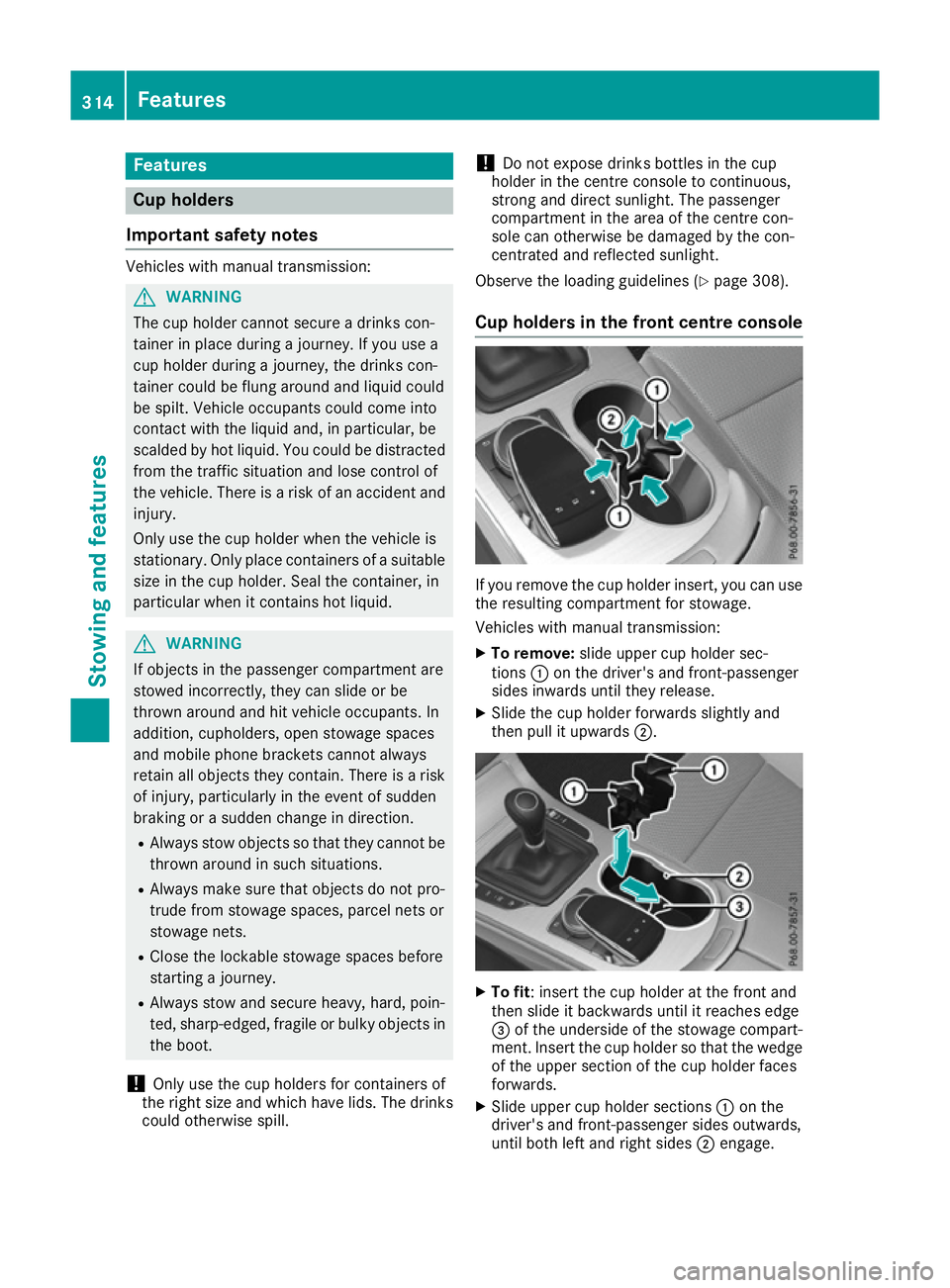
Cup holders in th efront centre console If you remove th
ecup holder insert ,you can use
th er esulting compartmen tfor stowage.
Vehicles wit hmanual transmission:
X To remove: slide upper cup holder sec-
tions :on th edriver' sand front-passenger
side sinwards until they release.
X Slide th ecup holder forwards slightly and
then pull it upwards ;. X
To fit:i nsert th ecup holder at th efront and
then slide it backwards until it reaches edge
= of th eunderside of th estowage compart-
ment. Inser tthe cup holder so that th ewedge
of th eupper section of th ecup holder faces
forwards.
X Slide upper cup holder sections :on the
driver' sand front-passenger side soutwards,
until bot hlefta nd right sides ;engage. 314
FeaturesStowing and featu
res
Page 322 of 385
for example, request an appointment or call for
help in the event of abreakdown.
The Audi o20/COMAND Online display indi-
cates that acall is active. During the call ,you
can change to the navigation menu by pressing
the NAVI button on the multimedi asystem ,for
example.
Voice outpu tisnot available in this case.
You can find more information on Mercedes-
Benz Contact in the separate multimedi asys-
tem operating instructions.
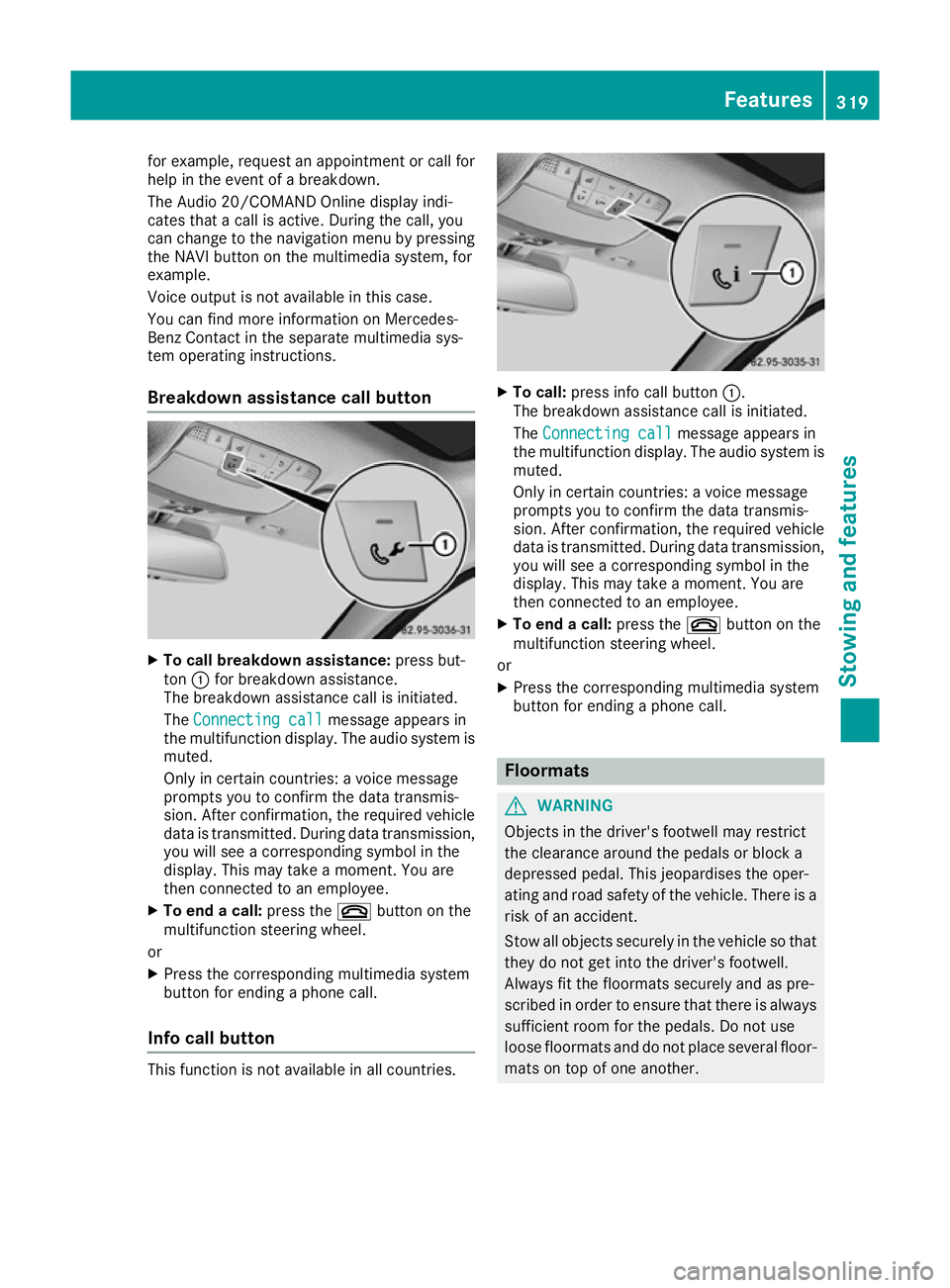
Breakdown assistance call button X
To call breakdow nassistance: press but-
ton :for breakdown assistance.
The breakdown assistance call is initiated.
The Connecting call
Connecting call message appears in
the multifunction display .The audio system is
muted.
Only in certain countries :avoice message
prompts you to confirm the data transmis-
sion. After confirmation, the required vehicle
data is transmitted. During data transmission, you wil lsee acorresponding symbol in the
display .This may take amoment. You are
then connected to an employee.
X To end acall: press the ~button on the
multifunction steering wheel.
or X Press the corresponding multimedi asystem
button for ending aphone call.
Info call button This function is not available in all countries. X
To call: press info call button :.
The breakdown assistance call is initiated.
The Connecting call Connecting call message appears in
the multifunction display .The audio syste mis
muted.
Only in certain countries :avoice message
prompts you to confirm the data transmis-
sion. After confirmation, the required vehicle
data is transmitted. During data transmission,
you wil lsee acorresponding symbol in the
display .This may take amoment. You are
then connected to an employee.
X To end acall: press the ~button on the
multifunction steering wheel.
or
X Press the corresponding multimedi asystem
button for ending aphone call. Floormats
G
WARNING
Objects in the driver's footwell may restrict
the clearance around the pedals or block a
depressed pedal. This jeopardise sthe oper-
ating and road safety of the vehicle. There is a risk of an accident.
Stow all objects securely in the vehicl esothat
they do not get into the driver's footwell.
Always fit the floormats securely and as pre-
scribe dinorder to ensure that there is always
sufficient room for the pedals. Do not use
loos efloormats and do not place severa lfloor-
mats on top of one another. Features
319Stowing and features Z
Page 327 of 385
engine or to the catalytic converter. Have
exces
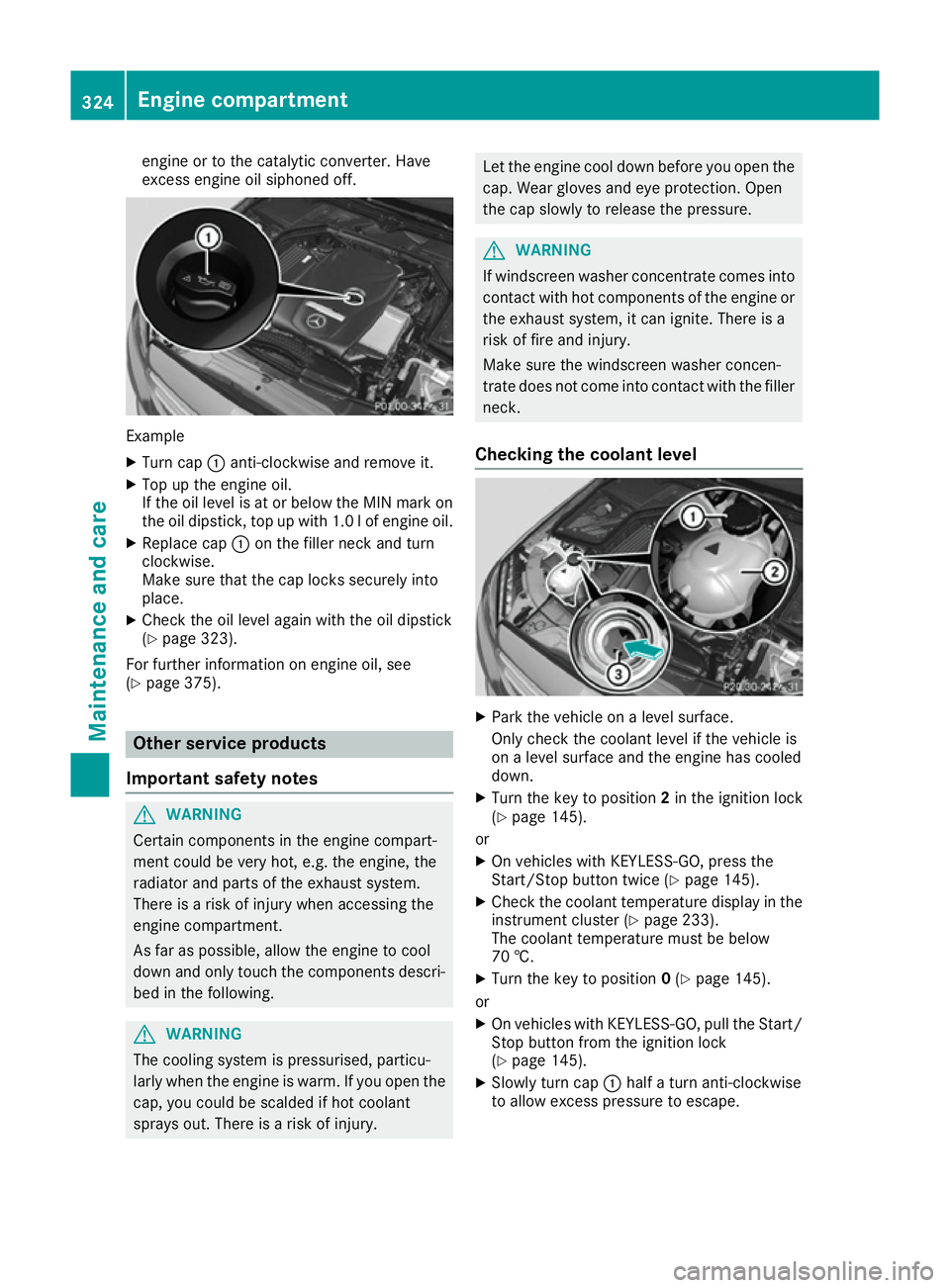
sengine oil siphoned off. Example
X Turn cap :anti-clockwise and remove it.
X Top up the engine oil.
If the oil level is at or below the MIN mark on
the oil dipstick ,top up with 1.0 lofe ngine oil.
X Replace cap :on the filler neck and turn
clockwise.
Make sure that the cap locks securely into
place.
X Check the oil leve lagain with the oil dipstick
(Y pag e323).
For further information on engine oil ,see
(Y pag e375). Other service products
Important safety notes G
WARNING
Certain components in the engine compart-
ment coul dbevery hot, e.g. the engine, the
radiator and parts of the exhaust system.
There is arisk of injury when accessing the
engine compartment.
As far as possible ,allow the engine to cool
dow nand only touch the components descri-
bed in the following. G
WARNING
The cooling system is pressurised, particu-
larl yw hen the engine is warm. If you open the
cap, you coul dbescalded if hot coolant
sprays out. There is arisk of injury. Let the engine cool dow
nbefore you open the
cap. Wea rglove sand eye protection. Open
the cap slowly to release the pressure. G
WARNING
If windscreen washer concentrate comes into contact with hot components of the engine or
the exhaust system, it can ignite. There is a
risk of fire and injury.
Make sure the windscreen washer concen-
trate does not come into contact with the filler neck.
Checking the coolan tlevel X
Park the vehicl eonalevelsurface.
Only check the coolant leve lifthe vehicl eis
on aleve lsurface and the engine has cooled
down.
X Turn the key to position 2in the ignition lock
(Y pag e145).
or
X On vehicles with KEYLESS-GO, press the
Start/Stop button twice (Y page145).
X Check the coolant temperature display in the
instrument cluster (Y page233).
The coolant temperature must be below
70 †.
X Turn the key to position 0(Y pag e145).
or
X On vehicles with KEYLESS-GO, pul lthe Start/
Stop button from the ignition lock
(Y pag e145).
X Slowl yturn cap :halfat urn anti-clockwise
to allow excess pressure to escape. 324
Engine compartmentMaintenance and care
Page 333 of 385
Alway
sswitch off the windscree nwiper sand
the ignition before cleaning the windscree nor
wipe rblade s.
! Do not pull on the wipe
rblade .Otherwise,
the wipe rblade could be damaged.
! Do not clean wipe
rblade stoo ofte nand do
not ru bthem too hard. Otherwise, the graph-
ite coating could be damaged .Thisc ould
cause wipe rnoise.
! Hol
dthe wipe rarm securel ywhenf olding
back. The windscree ncould be damaged if
the wipe rarm hits against it suddenly.
X Fol dthe wipe rarm sa wayfrom the wind-
screen (Y page 126).
X Clea nthe wipe rblade scarefull yusing adamp
cloth.
X Fol dthe windscree nwiper sbacka gain before
switching on the ignition.
Cleanin gthe exterior lighting !
Onl
yusecleaning agents or cleaning cloths
tha tare suitabl efor plastic lenses .Unsuitable
cleaning agents or cleaning cloths could
scratch or damage the plastic lenses of the
exterio rlighting.
X Clea nthe plastic lenses of the exterio rlight-
ing using awetsponge and amildc leaning
agent, e.g .Mercedes-Benz car shampo oor
cleaning cloths.
Cleanin gthe mirro rturn signal !
Onl
yusecleaning agents or cleaning cloths
tha tare suitabl efor plastic lenses .Unsuitable
cleaning agents or cleaning cloths could
scratch or damage the plastic lenses of the
mirror turn signals.
X Clea nthe plastic lenses of the mirror turn sig-
nal sint he exterio rmirror housing using awet
sponge and mil dcleaning agent, e.g.
Mercedes-Benz car shampo oorcleaning
cloths.
Cleanin gthe sensors !
If yo
uclean the sensors with ahigh-pressure
cleaner, make sure tha tyou kee pad istance
of at leas t30cmb etween the vehicl eand the
high-pressure cleane rnozzle. Information abou
tthe correct distance is availabl efrom
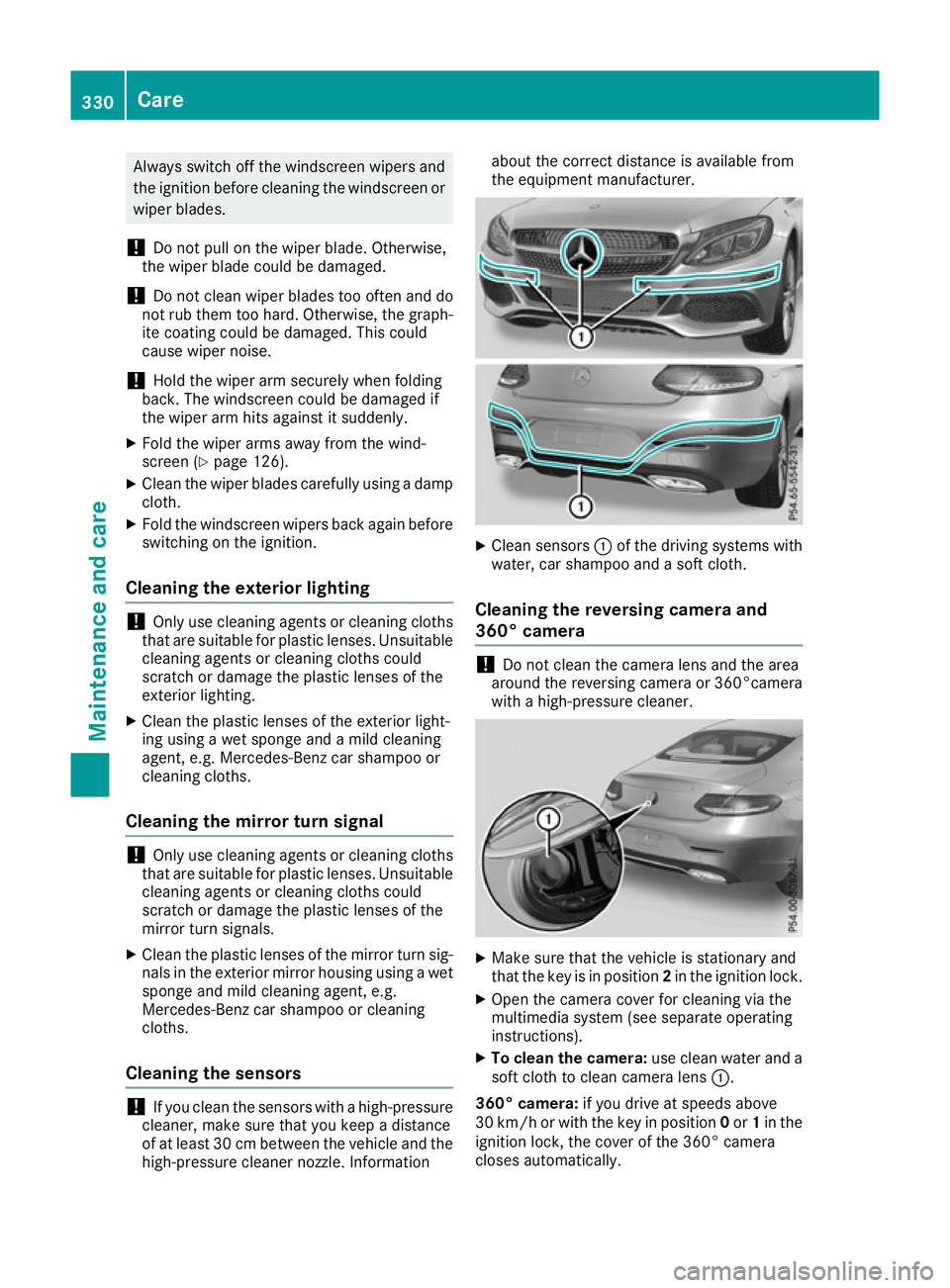
the equipment manufacturer. X
Clea nsensors :of the driving system swith
water, car shampo oand asoftc loth.
Cleanin gthe reversin gcamera and
360° camera !
Do not clean the camera lens and the area
around the reversing camera or 360°camera
with ahigh-pressure cleaner. X
Make sure tha tthe vehicl eisstationar yand
tha tthe key is in position 2in the ignition lock.
X Ope nthe camera cove rfor cleaning via the
multimedia system (se eseparate operating
instructions).
X To clean the camera: usec lean water and a
sof tcloth to clean camera lens :.
360° camera: if youdrive at speed sabove
30 km/h or with the key in position 0or 1in the
ignition lock, the cove rofthe 360° camera
closes automatically. 330
CareMaintenance and care
Page 346 of 385
Observe the service intervals in the Service
Booklet or contact
aqualified specialist work-
shop for more information.
! Alwaysh
ave work on the batteries carried
out at aqualified specialist workshop. Should
it, in exceptional circumstances, be abso-
lutely necessary to disconnect the 12-volt
battery yourself, please observe the follow-
ing:
R secure the vehicle to prevent it from rolling
away.
R switch the ignition off.
R first, disconnect the negative terminal, fol-
lowed by the positive terminal.
Vehicles with automatic transmission: the
transmission is locked in position Pafter dis-
connecting the battery.
After the work has been completed, firmly
reinstall the battery and the cover of the pos-
itive terminal.
Comply with safety precautions and take pro-
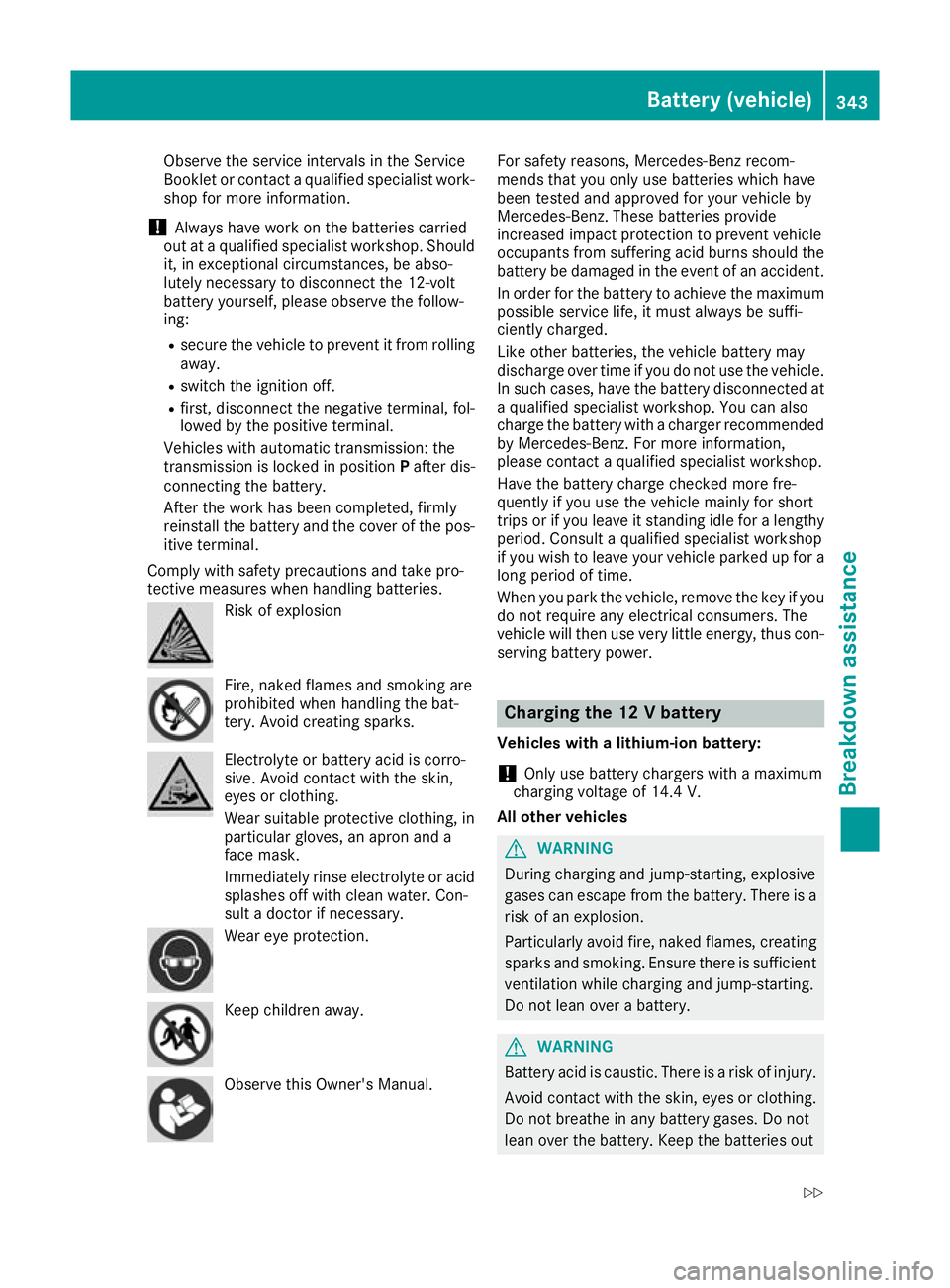
tective measures when handling batteries. Risk of explosion
Fire, naked flames and smoking are
prohibited when handling the bat-
tery. Avoid creating sparks.
Electrolyte or battery acid is corro-
sive. Avoid contact with the skin,
eyes or clothing.
Wear suitablep rotective clothing, in
particular gloves, an apron and a
face mask.
Immediately rinse electrolyte or acid
splashes off with clean water. Con-
sult adoctor if necessary. Wear eye protection.
Keep children away.
Observe this Owner's Manual. For safety reasons, Mercedes-Benz recom-
mends that you only use batteries which have
been tested and approved for your vehicle by
Mercedes-Benz.T
hese batteries provide
increased impact protection to prevent vehicle
occupants from suffering acid burns should the battery be damaged in the event of an accident.
In order for the battery to achieve the maximum possible service life, it must always be suffi-
ciently charged.
Like other batteries, the vehicle battery may
discharge over time if you do not use the vehicle.In such cases, have the battery disconnected ataq ualified specialist workshop. You can also
charge the battery with acharger recommended
by Mercedes-Benz.F or more information,
please contact aqualified specialist workshop.
Have the battery charge checked more fre-
quently if you use the vehicle mainly for short
trips or if you leave it standing idle for alengthy
period. Consult aqualified specialist workshop
if you wish to leave your vehicle parked up for a
long period of time.
When you park the vehicle, remove the key if you do not require any electrical consumers. The
vehicle will then use very little energy, thus con- serving battery power. Charging the 12
Vbattery
Vehicles with alithium-ion battery:
! Only use battery chargers with
amaximum
charging voltage of 14.4 V.
All other vehicles G
WARNING
During charging and jump-starting, explosive
gases can escape from the battery. There is a risk of an explosion.
Particularlya void fire, naked flames, creating
sparks and smoking. Ensure there is sufficient
ventilation while charging and jump-starting.
Do not lean over abattery. G
WARNING
Battery acid is caustic. There is arisk of injury.
Avoid contact with the skin, eyes or clothing.
Do not breathe in any battery gases. Do not
lean over the battery. Keep the batteries out Battery (vehicle)
343Breakdown assistance
Z
Page 349 of 385
Do not us
earapid charging devic etostart the vehicle. If your vehicle's battery is discharged, the
engine can be jump-started fro manothe rvehicl eorf romas econd battery using jum pleads.
Observe the following points:
R The battery is not accessible in al lvehicles. If the othe rvehicle's battery is not accessible ,jump-
start the vehicl eusing asecond battery or ajump-starting device.
R Vehicle swithap etrolengine: onlyjump-star tthe vehicl ewhent he engine and exhaust system
ar ec old.
R Allv eh icle sexcept vehicle swithal ithium-io nbattery: do not start the engine if the battery
is frozen. Let the battery tha wfirst.
R Jump-starting ma yonlybep erforme dusing batteries with anominal voltag eof12V.
R Onl yusejum pleads thathaveas ufficient cross-sectio nand insulate dtermina lclamps.
R If the battery is full ydischarged, leav ethe battery tha tisb eing used to jump-star tconnected for
af ew minute sbefor ea ttempting to start. Thi scharge sthe empty battery alittle.
R Make sure tha tthe two vehicles do not touch.
Make sure that:
R The jum pleads aren ot damaged.
R Non-insulated parts of the termina lclamps do not come into contact with othe rmetalparts while
the jum pleads arec onnected to the battery.
R The jum pleads canno tcome into contact with parts which can mov ewhent he engine is running,
such as the V-bel tpulle yort he fan.
X Secure the vehicl ebyapplyingthe electri cparkin gb rake.
X Automatic transmission: shift the transmission to position P.
X Manual transmission: depress the clutch peda lfully and shift to neutral.
X Make sure tha tthe ignition is switched off .All indicator lamps in the instrument cluster must be
off .W henu sing the key ,tur nt he key to position 0in the ignition lock and remove it (Y page 145).
X Switch off al lelectrical consumers ,e.g.r ea rw indo wh eating, lighting etc.
X Open the bonnet. Positio
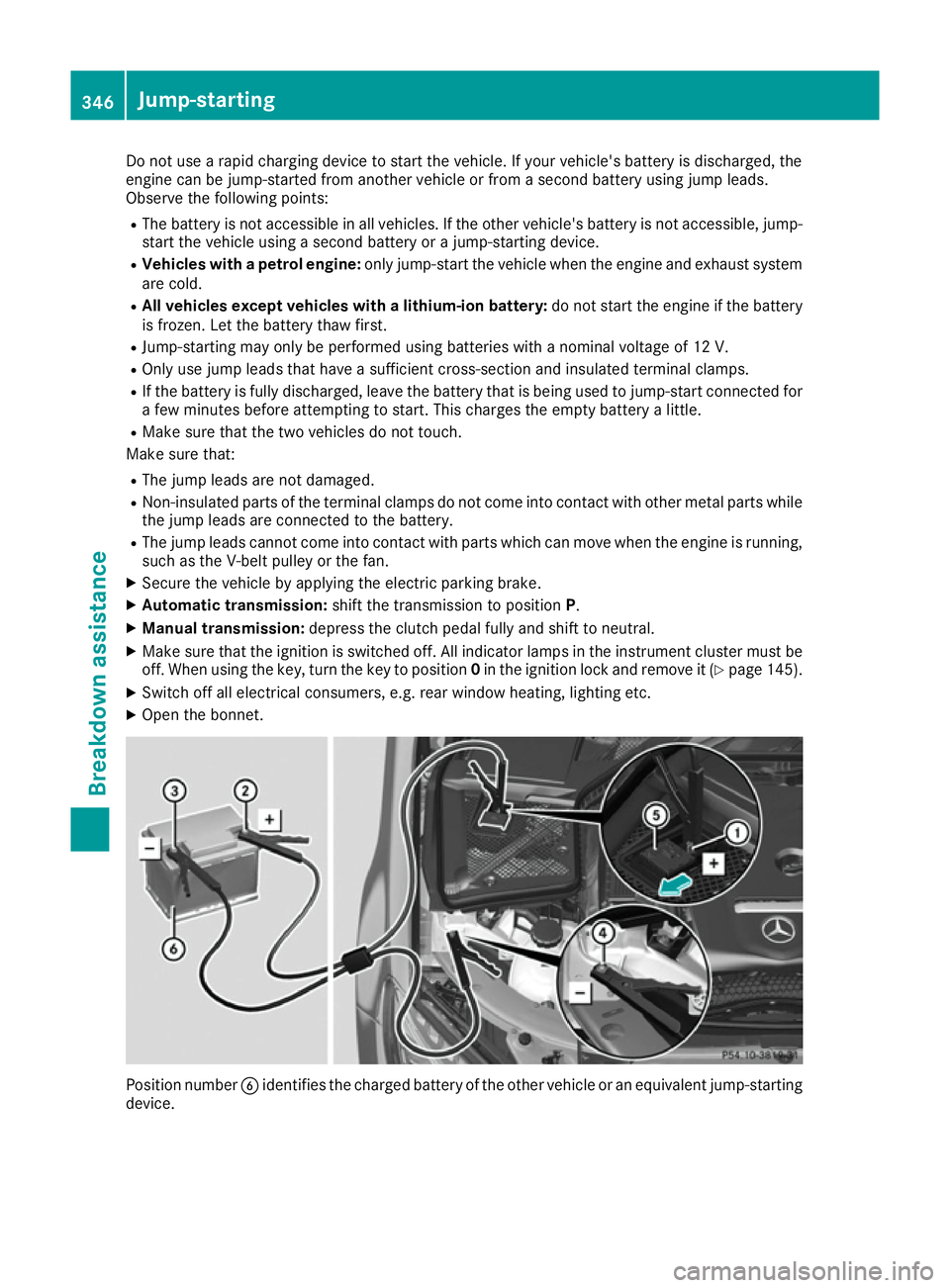
nnumber Bidentifie sthe charge dbattery of the othe rvehicl eorane quivalen tjump-starting
device. 346
Jump-startingBreakdow
nassistance
Page 350 of 385
X
Slide cover Aof positive terminal :in the direction of the arrow.
X Connect positive terminal :on your vehicl etopositive terminal ;of dono rbattery Busing the
jump lead .Alway sbegin with positive terminal :on your ow nvehicl efirst.
X Start the engine of the dono rvehicl eand run it at idling speed.
X Connect negative terminal =of dono rbattery Bto earth point ?of your vehicl eusing the jump
lead ,connecting the jump lead to dono rbattery Bfirst.
X Start the engine.
X Before disconnecting the jump leads, le tthe engines run for several minutes.
X First, remove the jump lead sfrom earth point ?and negative terminal =,then from positive
clamp :and positive terminal ;.Begine acht ime at the contacts on your ow nvehicl efirst.
X Close cover Aof positive terminal :afte rremoving the jump leads.
X Have the battery checke dataqualified specialist workshop.
Jump-starting is not considered to be anorma loperating condition.
i Jump-starting cable
sand further information regarding jump starting can be obtaine datany
qualified specialist workshop. Towin
gawayand tow-starting Important safety notes
G
WARNING
Safety relevant functions are restricted or no
longer available if:
R the engine is not running
R the brake system or power steering is mal-
functioning
R there is amalfunction in the voltag esupply
or the vehicle's electrical system
Whe nyourv ehicl eist owedawayort owed
started, yo umay require considerably more
effort to stee rand brake. There is ariskofan
accident.
In such cases us earigid towing bar. Before
being towe dawayort ow started, make sure
the steering move sfreely. G
WARNING
If the steering wheel lock is engaged ,the vehi-
cle can no longer be steered .There is ariskof
an accident.
Alway sswitch on the ignition when towing
with atow rop eorat owing bar. G
WARNING
Whe ntowing or tow-starting another vehicle
and its weigh tisg reate rthan the permissible
gross weight of your vehicle, the:
R towing ey emay be torn off
R car/traile rcombination may swerve or
eve noverturn
There is ariskofana ccident.
Whe ntowing or tow-starting another vehicle,
its weight shoul dnot be greate rthan the per-
missible gross weight of your vehicle.
Details on the permissible gross vehicl eweight
of your vehicl ecan be found on the vehicl eide n-
tification plate (Y page 370).
! Whe
nCOLLISIO NPREVENTION ASSIST
PLUS, DISTRONIC PLU Sorthe HOLD function
is activated, the vehicl ebrakes automatically
in certain situations.
To avoid damag etothe vehicle, deactivate
thes esystems in the following or similar sit-
uations:
R when towing away
R in ac ar wash
! Make sure that the electri
cparking brake is
released .Ifthe electri cparking brake is faulty,
visit aquali fied specialist workshop.
! Only secure the tow cable or tow ba
rtothe
towing eyes or, if available ,tothe traile rtow Towin
gawayand tow-starting
347Breakdown assistance Z
Page 351 of 385
hitch. You could otherwise damage the vehi-
cle.
! Observe the following points when towing
with atow rope:
R Secure the tow rope on the same side on
both vehicles.
R Make sure that the tow rope is not longer
than legallyp ermitted. Mark the tow rope in
the middle, e.g. with awhite cloth
(30 x30c m).This will make other road
users aware that avehicle is being towed.
R Only secure the tow cable to the towing
eyes or, if available, to the trailer tow hitch.
R Observe the brake lamps of the towing
vehicle while driving. Always maintain adis-
tance adistance so that the tow rope does
not sag.
R Do not use steel cables or chains to tow
your vehicle. You could otherwise damage
the vehicle.
! Do not use the trailer tow hitch for recovery
or towing. Do not use the towing eye for
recovery. This could damage the vehicle. If in doubt, have the vehicle recovered using a
crane.
! Pull away smoothly when towing away or
tow-starting avehicle. If the tractive power is
too high, the vehicles could be damaged.
! Shift the automatic transmission to
Nand
do not open the driver's or front passenger's
door during towing. The automatic transmis-
sion may otherwise shift to position P,which
could damage the transmission.
! You may tow the vehicle for
amaximum of
50km.At owing speed of 50 km/h must not
be exceeded.
For towing distances over 50 km, the entire
vehicle must be lifted up and transported.
Observe the legal requirements for the relevant countries when towing.
It is better to have the vehicle transported than
to have it towed.
If the vehicle has suffered transmission damage,
have it transported on atransporter or trailer.
Vehicles with automatic transmission: when
towing avehicle, the automatic transmission
must be in position N.Ifthe automatic trans-
mission cannot be shifted to position N,have the vehicle transported on
atransporter or
trailer.
The battery must be connected and charged.
Otherwise, you:
R cannot turn the key to position 2in the igni-
tion lock
R cannot release the electric parking brake
R cannot shift the transmission to position Non
vehicles with automatic transmission
Deactivate the automatic locking feature before towing the vehicle (Y page 88). You could oth-
erwise be locked out when pushing or towing
the vehicle.
Deactivate tow-away protection before the vehi- cle is towed away (Y page 79). Fitting/removing the towing eye
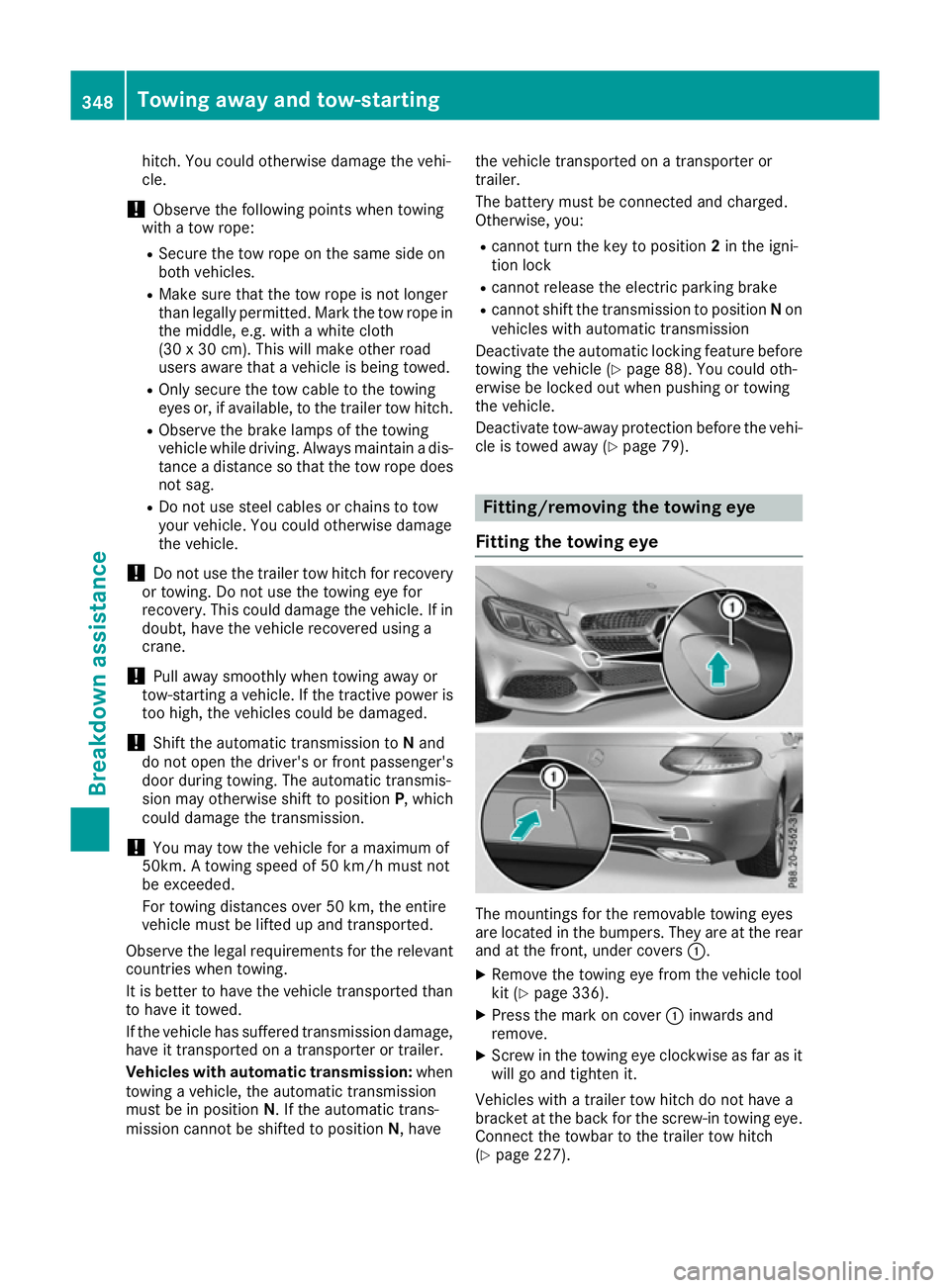
Fitting the towing eye The mountings for the removable towing eyes
are located in the bumpers. They are at the rear
and at the front,u nder covers:.
X Remove the towing eye from the vehicle tool
kit (Y page 336).
X Press the mark on cover :inwards and
remove.
X Screw in the towing eye clockwise as far as it
will go and tighten it.
Vehicles with atrailer tow hitch do not have a
bracket at the back for the screw-in towing eye. Connect the towbar to the trailer tow hitch
(Y page 227). 348
Towing away and tow-startingBreakdown assistance
Page 353 of 385
All vehicles
!
You may only secure th
evehicl ebyt he
wheels, no tbypartsoft hevehicl esuchas
axl eors teering components. Otherwise ,the
vehicl ecould be damaged.
The towin geyes or trailer to whitch can be used
to pull th evehicl eontoa trailer or transporte rif
you wish to transpor tit.
X Vehicles wit
hmanua ltra nsmission:
depress th eclutch pedal fully and engage
neutral.
X Vehicles wit
hautomatic transmission:
tur nthe keyt op osition 2in th eignition lock.
X Shift th eautomatic transmission to position
N.
As soon as th evehicle is loaded:
X Preven tthe vehicl efromr ollin gaway by
applyin gthe electric parking brake.
X Vehicles wit
hmanua ltra nsmission:
depress th eclutch pedal fully and engage first
or revers egear.
X Vehicles wit
hautomatic transmission:
shif tthe automatic transmission to position
P.
X Turn th ekeyto position 0in th eignition lock
and remove it.
X Secur ethe vehicle. Tow-starting (emergency engine
starting)
! Do no
ttow -star tvehicles wit hautomatic
transmission .You could otherwise damage
th ea utomatic transmission.
i You can fin
dinformation on "Jump-starting"
under (Y page 345).
Befor etow -starting ,the followin gconditi ons
mus tbef ulfilled:
R theb attery is connected
R thee ngineh as cooled down
R thee xhaust system has cooled down
When tow-starting ,itisimportant that you
observ ethe safet ynotes ( Ypage 347) and the
legal requirements in eac hrespective country.
X Switc hont hehazard warning lamps
(Y page 120).
X Fit th etow inge ye (Y page 348). X
Secur ethe rigid towin gbar or th etow ing
rope.
X Depress th ebrak epedal and keep it
depressed.
X Turn th ekeyto position 2in th eignition lock.
X Depress th eclutch pedal fully, engage 2nd
gear and continu etokeept he clutch pedal
fully depressed.
X Releas ethe brak epedal.
X Tow-start th evehicle.
X Releas ethe clutch pedal slowly; do not
depress th eaccelerato rpedal while doin gso.
X When th eengineh as been started, immedi-
ately depress th eclutch pedal fully and shift
to neutral.
X Pull ove ratasuitable plac eand stop th evehi-
cle safely, payin gattention to road and traffic
conditions.
X Use th eelectric parking brak etosecure the
vehicl eand preven titfromr ollin gaway.
X Remove th erigid towin gbar or towin grope.
X Remove th etow inge ye (Y page 349).
X Switc hoff th ehazard warning lamps. Electrical fuses
Important safety notes
G
WARNING
If you manipulate, bridge or replace afaulty
fus ew ithaf useofah igher amperage ,the
electric cables could be overloaded. This may result in afire. There is ariskofana ccident
and injury.
Always replace fault yfuses wit hspecifie dnew
fuses of th ecorrect amperage.
Blown fuses mus tbereplace dwithf uses of the
sam erating ,whic hy ou can recognise by the
colour and fus erating .The fus erating sare listed
in th efusea llocation chart.
The fus eallocation chart is on th efus eb ox in the
boot (Y page 352).
If th enewly inserted fus ealso blows ,havet he
caus etrace da nd rectifie dataqualified special-
ist workshop ,e.g.a Mercedes-Benz Service
Centre.
! Only use fuses that hav
ebeen approve dfor
Mercedes-Benz vehicles and whic hhavet he 350
Electrical fusesBreakdown assistance