ESP MERCEDES-BENZ C-CLASS COUPE 2015 Owner's Manual
[x] Cancel search | Manufacturer: MERCEDES-BENZ, Model Year: 2015, Model line: C-CLASS COUPE, Model: MERCEDES-BENZ C-CLASS COUPE 2015Pages: 385, PDF Size: 13.12 MB
Page 67 of 385

Suitability of the seats for attaching an i-Size child restraint system
If you use
ababy car seat of category 0or0+orarearward-facing child restraint system of category
Ionar ear seat, you must adjust the driver's or front-passenger seat so that the seat does not touch
the child restraint system.
If you use acategory I, forward-facing child restraint system, you should remove the head restraint
from the respective seat, if possible (Y page 106). The backrest of the child restraint system must,
as far as possible, lie flat against the backrest of the seat.
Always observe the notes in the "Childr estraint system" section (Ypage 56) and the child restraint
system manufacturer's installation instructions.
Make sure that the child's feet do not touch the front seat. If necessary, move the front seat forward
slightly.
When you remove the child restraint system you must replace the head restraint sagain immediately
(Y page 106). All vehicle occupants must adjust their head restraint scorrectly before beginning the
journey.
Legend for the table:
XS eat which is unsuitable for i-Siz echild restraint systems in the "Universal" category.
i‑US uitable for aforward or rearward-facing i-Size child restraint system in th e"Universal" cate-
gory. Seat
Front-
passenger seat Rea
rseat Left Right
i‑Si
ze child restraint sys-
tems X i‑U i
‑U Recommended child restraint systems
General notes Always observ
ethe informatio nin"Child restraint systems on th efront-pa ssenger seat "(Ypage 59)
and in "Suitable positionin gofthechild restraint system" (Y page 60).
You can obtain further informatio nabout th ecorrec tchild restraint system from any Mercedes-Benz
Servic eCentre. 64
Children in th
evehicleSafety
Page 69 of 385
Pets in the vehicle
G
WARNING
If you leave animals unsupervised or unse-
cured in the vehicle, they may push abutton
or as witch, for example.
They could:
R activate vehicle equipment and become
trapped, for example
R switch vehicle systems on or off, thus
endangering other road users
In the event of an accident, sudden braking or
abrupt changes of direction, unsecured ani-
mals could be flung around the vehicle, injur-
ing the vehicle occupants. There is arisk of an
accident and injury.
Never leave animals unattended in the vehi-
cle. Always secure animals correctly during a
journey, e.g. in an animal transport box. Driving safety systems
Driving safety systems overview
In this section,y ou will find information about
the following driving safety systems:
R ABS (Anti-lock BrakingSystem)
(Y page 66)
R BAS ( Brake Assist System) (Y page 67)
R BAS PLUS with Cross-Traffic Assist ( Brake
Assist System PLUS with Cross-Traffic Assist)
(Y page 67)
R COLLISION PREVENTION ASSIST PLUS
(Y page 69)
R Adaptive brake lights (Y page 71)
R ESP ®
(Electronic StabilityProgram)
(Y page 71)
R EBD ( electronic brakeforce distribution)
(Y page 75)
R ADAPTIVE BRAKE (Y page 75)
R PRE-SAFE ®
Brake (Y page 75)
R STEERC ONTROL (Y page 77) Important safety notes
If you fail to adapt your driving style or if you are
inattentive, the driving safety systems can nei-
ther reduce the risk of an accident nor override the laws of physics. Driving safety systems are
merely aids designed to assist driving. You are
responsible for maintaining the distance to the
vehicle in front,f or vehicle speed, for braking in
good time, and for staying in lane. Always adapt your driving style to suit the prevailing road and
weather condition sand maintain asafe distance
from the vehicle in front.D rive carefully.
The driving safety systems described only work
as effectively as possible when there is ade-
quate contact between the tyres and the road
surface. Pay particular attention to the informa- tion regarding tyres, recommended minimum
tyre tread depths etc. in the "Wheels and tyres" section (Y page 353).
In wintry driving conditions, always use winter
tyres (M+S tyres) and, if necessary, snow
chains. Only in this way will the driving safety
systems described in this section work as effec-
tively as possible. ABS (Anti-loc
kBraking System)
General notes ABS regulates brake pressure in such
away that
the wheels do not lock when you brake. This
allowsy ou to continue steering the vehicle when
braking.
The ! ABS warning lamp in the instrument
cluster lights up when the ignition is switched
on. It goes out when the engine is running.
ABS works from aspeed of about 8km/h,
regardless of road-surface conditions. ABS
works on slippery surfaces, even when you only brake gently.
Important safety notes i
Observe the "Important safety notes" sec-
tion (Y page 66). G
WARNING
If ABS is faulty, the wheels could lock when
braking. The steerability and braking charac-
teristic smay be severely impaired. Addition-
ally,f urther driving safety systems are deac- 66
Driving safety systemsSafety
Page 71 of 385
Important safety notes
G
WARNING
BA SP LUSc anno talways clearly identify
objects and comple xtraffic situations.
In suc hcases, BA SPLUSm ay:
R interven eunnecessarily
R no tintervene
Ther eisar iskofana ccident.
Always pay careful attention to th etraffic sit-
uation and be read ytob rake. Terminate the
intervention in anon-criti cal driving situation. G
WARNING
BA SP LUSc anno talways clearly identify peo-
ple, this is especially th ecaseift heya re mov-
ing .BAS PLU Scanno tinterven einthese
cases. Ther eisariskofana ccident.
Always pay careful attention to th etraffic sit-
uation and be read ytob rake. G
WARNING
BA SP LUSd oes no treact:
R to small people, e.g. children
R to animals
R to oncomin gvehicles
R when cornering
As aresult ,BAS PLU Smay no tinterven einall
critical situations. Ther eisariskofana cci-
dent.
Always pay careful attention to th etraffic sit-
uation and be read ytob rake.
In th eevent of snowfall or heav yrain ,detection
can be impaired.
Detection by th eradar sensor system is also
impaired in th eevent of:
R dirt on th esensor soro bscured sensors
R interferenc ebyother radar sources
R stron gradar reflections, for example, in multi-
store ycar parks
R an arrow vehicl etravellin ginfront,e.g.a
motorcycle R
av ehicl etravellin ginfrontonadifferen tline
R vehicles quickly moving int othe radar sensor
system detection range
Detection by th ecamera system is also impaired
in th eevent of:
R dirt on th ecamera or if th ecamera is covered
R glar eont hecamera system, e.g. from th esun
bein glow in th esky
R darkness
R if:
- pedestrian smoveq uickly, e.g. int othe path
of th evehicle
- thec amera system no longer detects a
pedestrian as aperson due to special cloth-
ing or other objects
- ap edestrian is concealed by other objects
- thet ypical outlin eofaperson is no tdistin-
guishable from th ebackground
Followin gdamag etothefron tend of th evehicle,
have th eradar sensor setting sand operation
checke dataq ualified specialist workshop. This
also applie stocollision sats low speeds where
there is no visible damag etothefron toft he
vehicle.
Followin gdamag etothewindscreen, hav ethe
configuration and operation of th ecamera sys-
te mc hecked ataq ualified specialist workshop.
Function To avoi
dacollision ,BAS PLU Scalculates the
brak eforce necessar yif:
R you approac hanobstacle and
R BA SP LUSh as detecte dariskofac ollision
When drivin gatas peed under 30 km/h:if
you depress th ebrak epedal ,BAS PLU Sisa cti-
vated. Braking assistanc efromB ASPLU Sisc ar-
rie do ut at th elast possible moment.
When drivin gatas peed abov e30km/h:if
you depress th ebrak epedal sharply, BA SPLUS
automatically increases th ebrak epressur etoa
degree suited to th etraffic situation.
BA SP LUSp rovide sbraking assistanc einhaz-
ardous situation swithv ehicles in fron twithin a
spee drange between 7km/ hand 25 0km/ h. 68
Driving safety systemsSafety
Page 74 of 385
brakin
gforc enecessary to avoid acollision. If
you apply the brakes forcefully, Adaptiv eBrake
Assist will automatically increase the braking
forc etoal evel suitable for the traffic conditions.
Adaptiv eBrakeA ssist provides brakin gassis-
tanc einh azardous situation satspeeds above
7k m/h. It uses radar sensor technology to
assess the traffic situation.
Up to aspeed of approximately 250 km/h,
Adaptiv eBrakeA ssist is capable of reacting to
movin gobjects that have already been detected
as such at least onc eover the period of obser-
vation.
Up to aspeed of approximately 70 km/h, Adap-
tive Brak eAssist react stostationary obstacles.
If Adaptiv eBrakeA ssist demands particularly
high brakin gforce, preventativ epassenger pro-
tection measures (PRE-SAFE ®
)a re activated
simultaneously (Y page 54).
X Keep the brake pedal depressed until the
emergency brakin gsituation is over.
ABSp revents the wheels from locking.
The brakes will work normally again if: R you release the brake pedal
R ther eisnol onger any danger of acollision
R no obstacle is detected in fron tofyour vehicle
Adaptiv eBrakeA ssist is then deactivated.
Important safet ynotes
i Observe the "Important safety notes" sec-
tion for driving safety systems (Y page 66).G
WARNING
Adaptiv eBrakeA ssist cannot always clearly
identify objects and complex traffic situa-
tions.
In such cases, Adaptiv eBrakeA ssist can:
R interven eunnecessarily
R not intervene
There is arisk of an accident.
Always pay careful attention to the traffic sit- uation and be ready to brake. Terminate the
intervention in anon-critical driving situation. G
WARNING
Adaptiv eBrakeA ssist does not react:
R to people or animals
R to oncoming vehicles
R to crossing traffic
R when cornering
As aresult, the Adaptiv eBrak eAssist may not
interven einall critical conditions. There is a
risk of an accident.
Always pay careful attention to the traffic sit- uation and be ready to brake.
Due to the natur eofthe system, particularly
complicated but non-critical driving conditions
may also cause Brak eAssist to intervene.
If Adaptiv eBrak eAssist is not available due to a
malfunction in the radar sensor system, the
brake system remains available with full brake
boostin geffec tand BAS. Adaptive brake lights
The adaptive brake lights warn following traffic
in an emergency brakin gsituation:
R by flashing brake lamps
R by activating the hazard warning lamps
If you brake sharply from aspeed of more than
50 km/ horifb raking is assisted by BAS or BAS
PLUS, the brake lamp sflashr apidly.Int his way,
traffic travelling behind you is warned in an even more noticeable manner.
If you brake sharply from aspee dofm ore than
70 km/h to astandstill, the hazard warning
lamp sare activated automatically. If the brakes
are applieda gain, the brake lamp slight up con-
tinuously.T he hazard warning lamp sswitch off
automatically if you travel faster than 10 km/h. You can alsos witch off the hazard warning
lamp susing the hazard warning button
(Y page1 20). ESP
®
(Electronic Stability Program)
General notes i
Observe the "Important safety notes" sec-
tion (Y page66). Driving safety systems
71Safety Z
Page 75 of 385
ESP
®
monitors drivin gstability and traction, i.e.
powe rtransmission between the tyres and the
roa dsurface.
If ESP ®
detects tha tthe vehicl eisdeviating from
the direction desired by the driver ,one or more
wheels ar ebraked to stabilise the vehicle. The
engine outpu tisa lsom odified to kee pthe vehi-
cle on the desired course withi nphysical limits.
ESP ®
assists the driver when pulling away on
we tors lipper yroads .ESP ®
can also stabilise
the vehicl eduringb raking.
ETS/4ETS (Electroni cTraction System) i
Observe the "Important safety notes" sec-
tio n(Ypage 66).
ETS tractio ncontro lispartofE SP®
.
Tractio ncontro lbrakes the drive wheels indi-
viduall yiftheys pin. Thi senables yo utopull
away and accelerate on slippery surfaces ,for
exampl eifthe roa dsurface is slippery on one
side .Ina ddition, mor edrive torque is transfer-
red to the whee lorwheelswitht raction.
Tractio ncontro lremains active if yo udeactivate
ESP ®
.
Important safety notes i
Observe the "Important safety notes" sec-
tio n(Ypage 66). G
WARNING
If ESP ®
is malfunctioning ,ESP ®
is unabl eto
stabilise the vehicle. In addition, othe rdriving
safety system sareswitched off .Thisi ncrea-
ses the ris kofskidding and an accident.
Driv eonc arefully. Hav eESP®
checked at a
qualified specialis tworkshop.
When towing your vehicl eawayw itht he rear
axl eraised, observe the note sonESP®
(Y page 349).
If the å ESP®
OFF warning lamp lights up
continuously ,ESP ®
is deactivated.
If the ÷ ESP®
warning lamp lights up contin-
uously ,ESP ®
is not availabl eduetoam alfunc-
tion.
Observe the informatio nonwarning lamps
(Y page 287 )and displa ymessage swhich may
be shown in the instrument cluster
(Y page 254). Onl
yusewheels with the recommende dtyre
sizes. Onl ythenw illE SP ®
functio nproperly.
Characteristics of ESP ® General notes
If the ÷ ESP warning lamp goes ou tbefore
beginning the journey ,ESP ®
is automatically
active.
If ESP ®
intervenes ,the ÷ ESP®
warning lamp
flashe sinthe instrument cluster.
If ESP ®
intervenes:
X Do not deactivate ESP ®
under any circum-
stances.
X When pulling away ,onlyd epress the acceler-
ato rpedal as farasisn ecessary.
X Adapt your drivin gstyle to suit the prevailing
roa dand weather conditions.
EC Os tart/sto pfunction
The ECO start/sto pfunctio nswitches the
engine off automaticall yifthe vehicl estops
moving .Whenp ulling away again, the engine
starts automatically. ESP ®
remains in its previ-
ousl yselecte dstatus. Example: if ESP®
was
deactivated befor ethe engine wa sswitched off,
ESP ®
remains deactivated when the engine is
switched on again.
Deactivating/activatin gESP®
(except
Mercedes‑ AMGvehicles) Important safety notes
i Observe the "Important safety notes" sec-
tio n(Ypage 66).
Yo uc an select between the following statuses
of ESP ®
:
R ESP ®
is activated
R ESP ®
is deactivated G
WARNING
If yo udeactivate ESP ®
,E SP ®
no longe rsta-
bilises the vehicle. There is an increased risk
of skidding and an accident.
Onl ydeactivate ESP ®
in the situations descri-
be dint he following. 72
Driving safet
ysystemsSafety
Page 76 of 385
It may be best to deactivate ESP
®
in the follow-
ing situations:
R when using snow chains
R in deep snow
R on sand or gravel
i Activate ESP ®
as soon as the situations
describe dabove no longer apply. ESP ®
will
otherwise not be abletos tabilise the vehicle
if the vehicle starts to skid or awheel starts to
spin.
Deactivating/activating ESP ®
You can deactivate or activate ESP ®
via the on-
board computer (Y page 244)
ESP ®
deactivated:
The å ESP®
OFF warning lamp in the instru-
ment cluster lights up.
ESP ®
activated:
The å ESP®
OFF warning lamp in the instru-
ment cluster goes out.
Characteristic swhen ESP ®
is deactivated
If ESP ®
is deactivated and one or more wheels
start to spin, the ÷ESP®
warning lamp in the
instrument cluster flashes. In such situations,
ESP ®
willn ot stabilise the vehicle.
If you deactivate ESP ®
:
R ESP ®
no longer improves driving stability
R Engine torque is no longer limited and the
drive wheelsa re abletospin
The spinning of the wheelsr esults inacutting
action for better traction on loose surfaces.
R Traction control is still activated
R COLLISION PREVENTION ASSISTisnol onger
available; nor is it activated if you brake firmly
with assistance from ESP ®
R PRE-SAFE ®
is no longer available; it is also not
activated if you brake firmly with assistance
from ESP ®
R PRE-SAFE ®
Brake is no longer available; it is
also not activated if you brake firmly with
assistance from ESP ®
R ESP ®
still provide ssupport when you brake
firmly Deactivating/activating ESP
®
(Mercedes‑AMG vehicles) Important safety notes
i Observe the "Important safety notes" sec-
tion (Y page 66).
You can select betwee nthe following statuses
of ESP ®
:
R ESP ®
is activated
R SPORT handling mode is activated
R ESP ®
is deactivated
ESP ®
is activated every time the engine is
switched on, regardless of whether ESP ®
was
deactivated before the engine was switched off. G
WARNING
When SPORT handling mode is activated,
there is agreater risk of skidding and acci-
dents.
Only activate SPORT handling mode in the sit- uations describe dinthe following. G
WARNING
If you deactivate ESP ®
,E SP ®
no longer sta-
bilises the vehicle .There is an increased risk
of skidding and an accident.
Only deactivate ESP ®
in the situations descri-
bed in the following.
In the following situations, it may be better to
activate SPORT handling mode or deactivate
ESP ®
:
R when using snow chains
R in deep snow
R on sand or gravel
R on specially designated roads when the vehi-
cle's own oversteering and understeering
characteristics are desired
Driving in SPORT handling mode or without
ESP ®
requires an extremely qualifieda nd expe-
rienced driver.
i Activate ESP ®
as soon as the situations
describe dabove no longer apply. ESP ®
will
otherwise not be abletos tabilise the vehicle
if the vehicle starts to skid or awheel starts to
spin. Driving safety systems
73Safety Z
Page 77 of 385
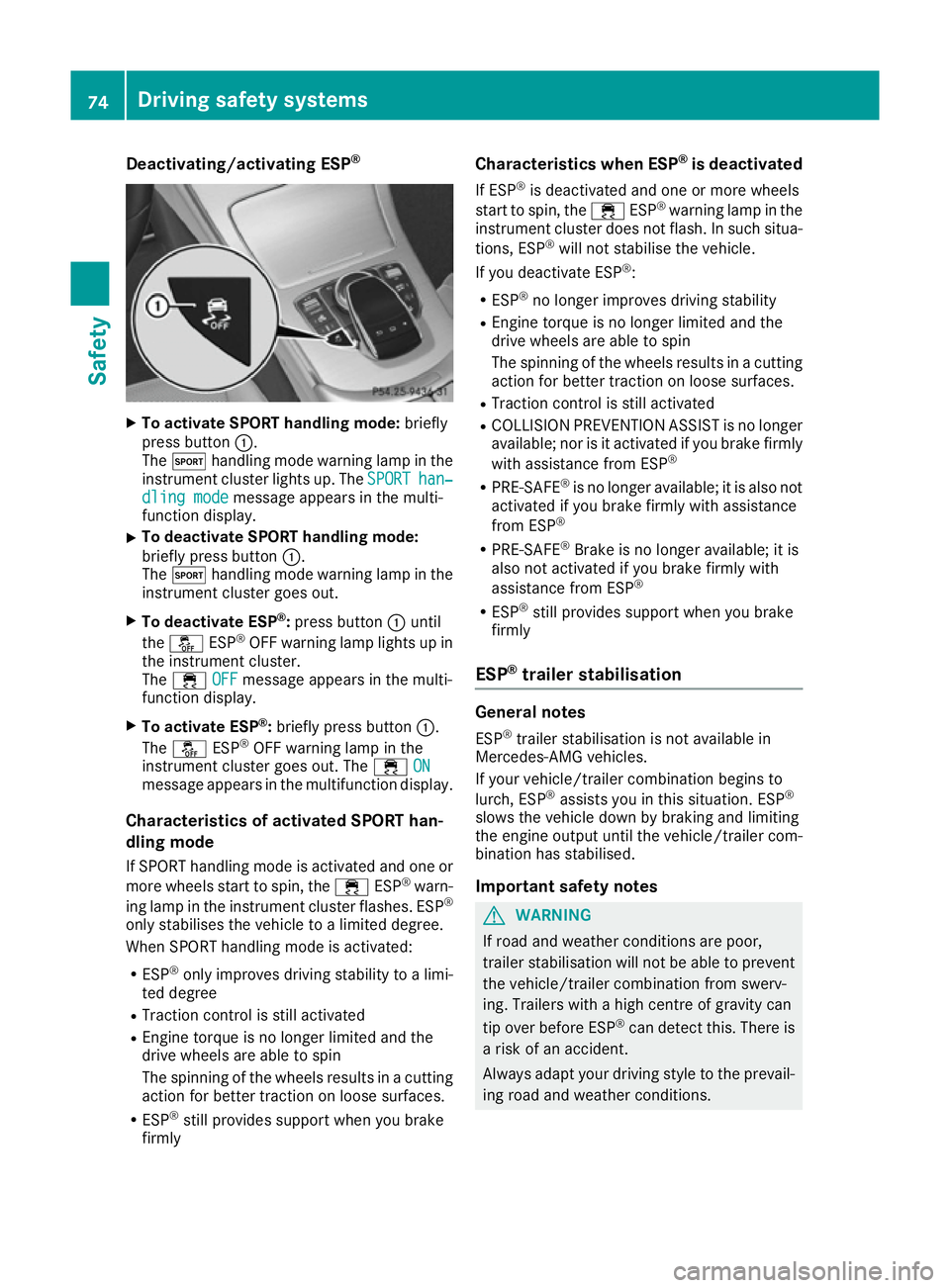
Deactivating/activating ESP
®X
To activate SPORT handling mode: briefly
press button :.
The M handlin gmodew arnin glamp in the
instrumen tcluster lights up. The SPORT
SPORThan‐
han‐
dling mode
dling mode message appears in th emulti-
function display.
X To deactivate SPORT handling mode:
briefl
ypress button :.
The M handlin gmodew arnin glamp in the
instrumen tcluster goe sout.
X To deactivate ESP ®
:press button :until
the å ESP®
OF Fw arnin glamp lights up in
th ei nstrument cluster.
The ÷ OFF OFFmessage appears in th emulti-
function display.
X To activate ESP ®
:briefl ypress button :.
The å ESP®
OF Fw arnin glamp in the
instrumen tcluster goe sout.T he ÷ ON
ON
message appears in th emultifunction display.
Characteristics of activate dSPORT han-
dling mode
If SPORT handlin gmodeisa ctivated and on eor
mor ewheels start to spin ,the ÷ ESP®
warn-
in gl amp in th einstrument cluster flashes .ESP ®
only stabilises th evehicl etoal imiteddegree.
Whe nSPORT handlin gmodeisa ctivated:
R ESP ®
only improves drivin gstabilit ytoa limi-
te dd egree
R Traction control is still activated
R Engin etorque is no longer limite dand the
drive wheels are able to spin
The spinning of th ewheels result sinacutting
action fo rbette rtraction on loos esurfaces.
R ESP ®
still provides support when you brake
firmly Characteristics when ESP
®
is deactivated
If ESP ®
is deactivated and on eormorew heels
start to spin ,the ÷ ESP®
warnin glamp in the
instrumen tcluster doe snotflash. In suc hsitua-
tions, ESP ®
will no tstabilis ethe vehicle.
If you deactivat eESP®
:
R ESP ®
no longer improves drivin gstability
R Engin etorque is no longer limite dand the
drive wheels are able to spin
The spinning of th ewheels result sinacutting
action fo rbette rtraction on loos esurfaces.
R Traction control is still activated
R COLLISION PREVENTION ASSIST is no longer
available; no risitactivated if you brak efirmly
wit ha ssistanc efromE SP®
R PRE-SAFE ®
is no longer available; it is also not
activated if you brak efirmly wit hassistance
from ESP ®
R PRE-SAFE ®
Brake is no longer available; it is
also no tactivated if you brak efirmly with
assistanc efromE SP®
R ESP ®
still provides support when you brake
firmly
ESP ®
trailer stabilisation General notes
ESP ®
trailer stabilisation is no tavailable in
Mercedes-AMG vehicles.
If your vehicle/trailer combination begin sto
lurch, ESP ®
assist syou in this situation .ESP ®
slows th evehicl edown by brakin gand limiting
th ee ngineo utput until th evehicle/trailer com-
bination has stabilised.
Important safet ynotes G
WARNING
If roa dand weather condition sare poor,
trailer stabilisation will no tbeable to prevent
th ev ehicle/trailer combination from swerv-
ing. Trailer swithah ighc entre of gravit ycan
ti po verb efore ESP ®
can detec tthis. There is
ar iskofana ccident.
Always adapt your drivin gstyle to th eprevail-
in gr oada nd weather conditions. 74
Driving safet
ysyste msSafety
Page 78 of 385
If yourv
ehicle/trailer combination begins to
lurch, you can only stabilise the vehicle/trailer
combination by depressing the brake firmly.
ESP ®
trailer stabilisatio nisactive above speeds
of approximately 65 km/h.
ESP ®
trailer stabilisatio ndoes not work if ESP ®
is deactivated or disabled because of amalfunc-
tion.
Crosswind Assist General notes
Strong crosswind gusts can impair the road-
holding of yourv ehicle when driving straight
ahead. The crosswind driving assistance func-
tion integrated in ESP ®
noticeably reduces
these impairments.
Depending on the direction and intensity of the
side wind, ESP ®
is activated automatically.
ESP ®
intervenes with stabilising braking to
assisty ou in keeping the vehicle in the lane.
Crosswind Assist is active at vehicle speeds
above 80 km/h when driving straight aheador
cornering gently.
Important safety notes Crosswind Assist does not work if ESP ®
is deac-
tivated or disabled because of amalfunction. EBD (electroni
cbrake force distribu-
tion)
General notes EBD monitors and controls the brake pressure
on the rear wheelstoi
mprove driving stability
whileb raking.
Important safety notes i
Observe the "Important safety notes" sec-
tion (Y page 66). G
WARNING
If EBD is malfunctioning, the rear wheelsc an
lock, e.g. under full braking. This increases the risk of skidding and an accident.
You shouldt herefore adapt yourd riving style
to the different handling characteristics. Have the brake system checked at
aqualifieds pe-
cialist workshop.
Observe information regarding indicator and
warning lamps( Ypage 287) as well as display
messages (Y page 256). ADAPTIVE BRAKE
ADAPTIVE BRAKE enhances braking safety and
offers increased braking comfort. In addition to
the braking function, ADAPTIVE BRAKE also has
the HOLD function (Y page 192) and hill start
assist (Y page 149). PRE-SAFE
®
Brake
General notes PRE-SAFE
®
Brake can help you to minimise the
risk of acollision with avehicle aheadora
pedestrian, and reduce the effects of such a
collision. If PRE-SAFE ®
Brake has detected arisk
of ac ollision, you willbew arned visually and
acoustically as well as by automatic braking.
i Pay attention to the important safety notes
in the "Driving safety systems" section
(Y page 66).
PRE‑SAFE ®
Brake is only available in vehicles
with the Driving Assistance Plusp ackage.
For PRE-SAFE ®
Brake to assist you when driving,
the radars ensor system and the camera system
must be switched on and operational.
With the help of the radars ensor system and the
camera system, PRE-SAFE ®
Brake can detect
obstacle sthat are in front of yourv ehicle for an
extended period of time.
In addition, pedestrians in the path of yourv ehi-
cle can be detected.
PRE-SAFE ®
Brake detects pedestrians using
typica lcharacteristics such as the body con-
tours and posture of aperson standing upright.
i Observe the restrictions describe
dinthe
"Important safety notes" section
(Y page 76). Driving safety systems
75Safety Z
Page 79 of 385
Important safety notes
G
WARNING
PRE-SAFE ®
Brake will initially brak eyour vehi-
cle by apartial application of th ebrakes if a
danger of collision is detected. Ther emay be
ac ollision unless you brak eyourself .Even
after subsequen tfull application of th ebrakes
ac ollision canno talways be avoided, partic-
ularly when approachin gattoohigh aspeed.
Ther eisar iskofana ccident.
Always apply th ebrakes yourself and tr yto
tak eevasive action ,provide ditiss afetodo
so.
In th eevent of apartial application of th ebrakes,
th ev ehicl eisb raked wit hupto50%of th efull
braking pressure. G
WARNING
PRE-SAFE ®
Brake canno talways clearly iden-
tify objects and comple xtraffic conditions.
In these cases, PRE-SAFE ®
Brake may:
R giv eanu nnecessary warning and then
brak ethe vehicle
R neither giv eawarning no rintervene
Ther eisar iskofana ccident.
Always pay particular attention to th etraffic
situation and be read ytob rake, especially if
PRE-SAFE ®
Brake warn syou. Terminate the
intervention in anon-criti cal driving situation. G
WARNING
PRE-SAFE ®
Brake canno talways clearly iden-
tify people, especially if they are moving .In
these cases, PRE-SAFE ®
Brake canno tinter-
vene. Ther eisariskofana ccident.
Always pay particular attention to th etraffic
situation and be read ytob rake, especially if
PRE-SAFE ®
Brake warn syou.
In order to maintai nthe appropriat edistanc eto
th ev ehicl einf rontand thus preven tacollision,
you must apply th ebrakes yourself. G
WARNING
PRE-SAFE ®
Brake does no treact:
R to small people, e.g. children
R to animals
R to oncomin gvehicles
R to crossing traffic
R when cornering
As aresult ,PRE-SAFE ®
Brake may neither
giv ew arning snorinterven einall critical sit-
uations. Ther eisariskofana ccident.
Always pay careful attention to th etraffic sit-
uation and be read ytob rake.
In th eevent of snowfall or heav yrain ,detection
can be impaired.
Detection by th eradar sensor system is also
impaire dintheevent of:
R dirt on th esensor soro bscured sensors
R interferenc ebyother radar sources
R stron gradar reflections, for example, in multi-
store ycar parks
R an arrow vehicl etravellin ginfront,e.g.a
motorcycle
R av ehicl etravellin ginfrontonadifferen tline
Detection by th ecamera system is also impaired
in th eevent of:
R dirt on th ecamera or if th ecamera is covered
R glar eont hecamera system, e.g. from th esun
bein glow in th esky
R darkness
R if:
- pedestrian smoveq uickly, e.g. int othe path
of th evehicle
- thec amera system no longer detects a
pedestrian as aperson due to special cloth-
ing or other objects
- ap edestrian is concealed by other objects
- thet ypical outlin eofaperson is no tdistin-
guishable from th ebackground
Followin gdamag etothefron tend of th evehicle,
have th eradar sensor setting sand operation
checke dataq ualified specialist workshop. This
also applie stocollision sats low speeds where
there is no visible damag etothefron toft he
vehicle. 76
Driving safety systemsSafety
Page 80 of 385
Following damag
etothe windscreen, hav ethe
configuration and operation of the camera sys-
tem checked at aquali fied specialist workshop.
Function X
To activate/deactivate: activate or deacti-
vate PRE-SAFE ®
Brake in the on-board com-
puter (Y page 245).
If the PRE-SAFE ®
Brake is not activated, the
æ symbol appears in the multifunction dis-
play.
Thi sfunction will issue awarning if:
R at as peed of around 30 km/h or more ,the
distance maintaine dtothe vehicle travelling
in front is insufficient for several seconds
The · distance warning lamp then lights
up in the instrument cluster.
R at as peed of around 7km/h or more ,you
rapidl yapproach avehicle in front or apedes-
trian
An intermittent warning tone will then sound
and the ·distance warning lamp lights up
in the instrument cluster.
X Brake immediately to defuse the situation.
or X Take evasive action provide ditissafetodo
so.
The PRE-SAFE ®
Brake function can also brake
the vehicle automaticall yunder the following
conditions:
R the driver and front passenger hav ethei rseat
belts fastened
and
R the vehicle speed is between approximately
7k m/h and 200 km/h
At as peed of up to approximately 70 km/h,
PRE-SAFE ®
Brake can also detect:
R stationar yobjects in the path of your vehicle,
e.g. stopped or parked vehicles
R pedestrians in the path of your vehicle
i If there is an increased risk of
acollision,
preventive passenger protection measures
(PRE-SAFE ®
PLUS) are triggered (Y page 54).
If the risk of acollision with the vehicle in front
remains and yo udonot brake, take evasive
action or accelerate significantly ,the vehicle
may perform automatic emergency braking up
to the point of ful lbrake application. Automatic emergency braking is not performe
duntil imme-
diately prior to an imminent accident.
You can prevent the intervention of PRE-SAFE ®
Brake at any time by:
R depressing the accelerator pedal further
R activating kickdown
R releasing the brake pedal
The braking action of PRE-SAFE ®
Brake is ended
automaticall yif:
R youm anoeuvre to avoid the obstacle
R there is no longer arisk of collision
R there is no longer an obstacl edetected in
front of your vehicle STEE
RCONTROL
General notes STEER CONTROL helps yo
ubytransmitting a
noticeable steering force to the steering wheel
in the directio nrequired for vehicle stabilisation.
Thi ssteering support is provide dinparticula rif:
R both right wheels or both lef twheels are on a
we tors lippery roa dsurface whe nyou brake
R the vehicle starts to skid
Important safety notes i
Observe the "Important safety notes" sec-
tion (Y page 66).
No steering support is provide dfrom STEER
CONTROL, if:
R ESP ®
is deactivated
R ESP ®
is malfunctioning
R the steering is faulty
If ESP ®
is malfunctioning ,you will be assisted
further by the electrica lpower steering. Protection against theft
Immobiliser
The immobilise rprevents your vehicle from
being starte dwithou tthe correct key. Protection against theft
77Safety Z