lock MERCEDES-BENZ C-CLASS SALOON 2014 Owners Manual
[x] Cancel search | Manufacturer: MERCEDES-BENZ, Model Year: 2014, Model line: C-CLASS SALOON, Model: MERCEDES-BENZ C-CLASS SALOON 2014Pages: 489, PDF Size: 14.88 MB
Page 359 of 489
Warning/
indicator
lamp
N N
Signal type
Possible causes/consequences and M
MSolutions !
N
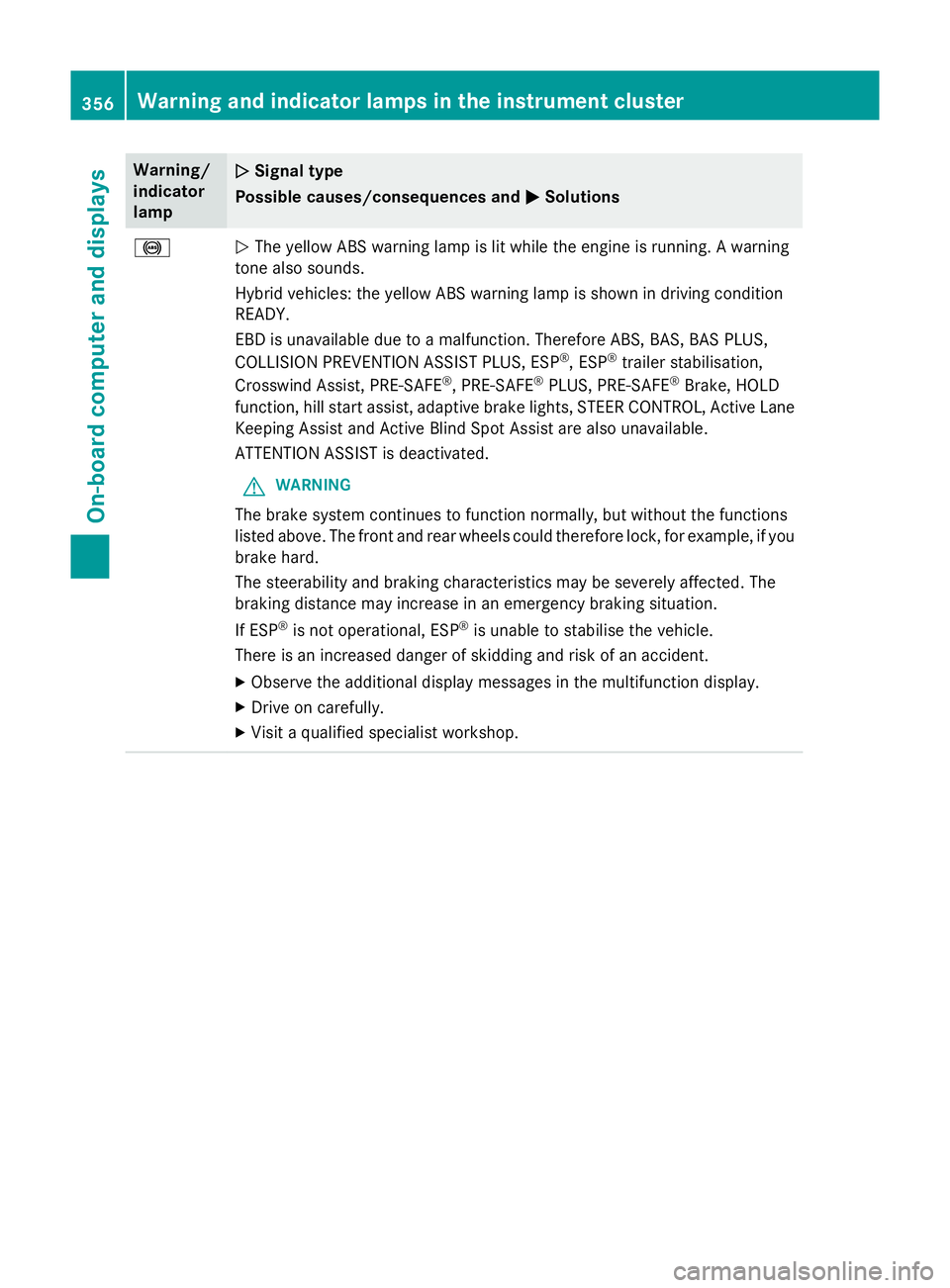
The yellow ABS warning lamp is lit while the engine is running. A warning
tone also sounds.
Hybrid vehicles: the yellow ABS warning lamp is shown in driving condition
READY.
EBD is unavailable due to a malfunction. Therefore ABS, BAS, BAS PLUS,
COLLISION PREVENTION ASSIST PLUS, ESP ®
, ESP ®
trailer stabilisation,
Crosswind Assist, PRE‑SAFE ®
, PRE‑SAFE ®
PLUS, PRE‑SAFE ®
Brake, HOLD
function, hill start assist, adaptive brake lights, STEER CONTROL, Active Lane
Keeping Assist and Active Blind Spot Assist are also unavailable.
ATTENTION ASSIST is deactivated.
G WARNING
The brake system continues to function normally, but without the functions
listed above. The front and rear wheels could therefore lock, for example, if you
brake hard.
The steerability and braking characteristics may be severely affected. The
braking distance may increase in an emergency braking situation.
If ESP ®
is not operational, ESP ®
is unable to stabilise the vehicle.
There is an increased danger of skidding and risk of an accident.
X Observe the additional display messages in the multifunction display.
X Drive on carefully.
X Visit a qualified specialist workshop. 356
Warning and indicator lamps in the instrument clusterOn-board computer and displays
Page 360 of 489
Warning/
indicator
lamp
N N
Signal type
Possible causes/consequences and M
MSolutions J÷
å!
N
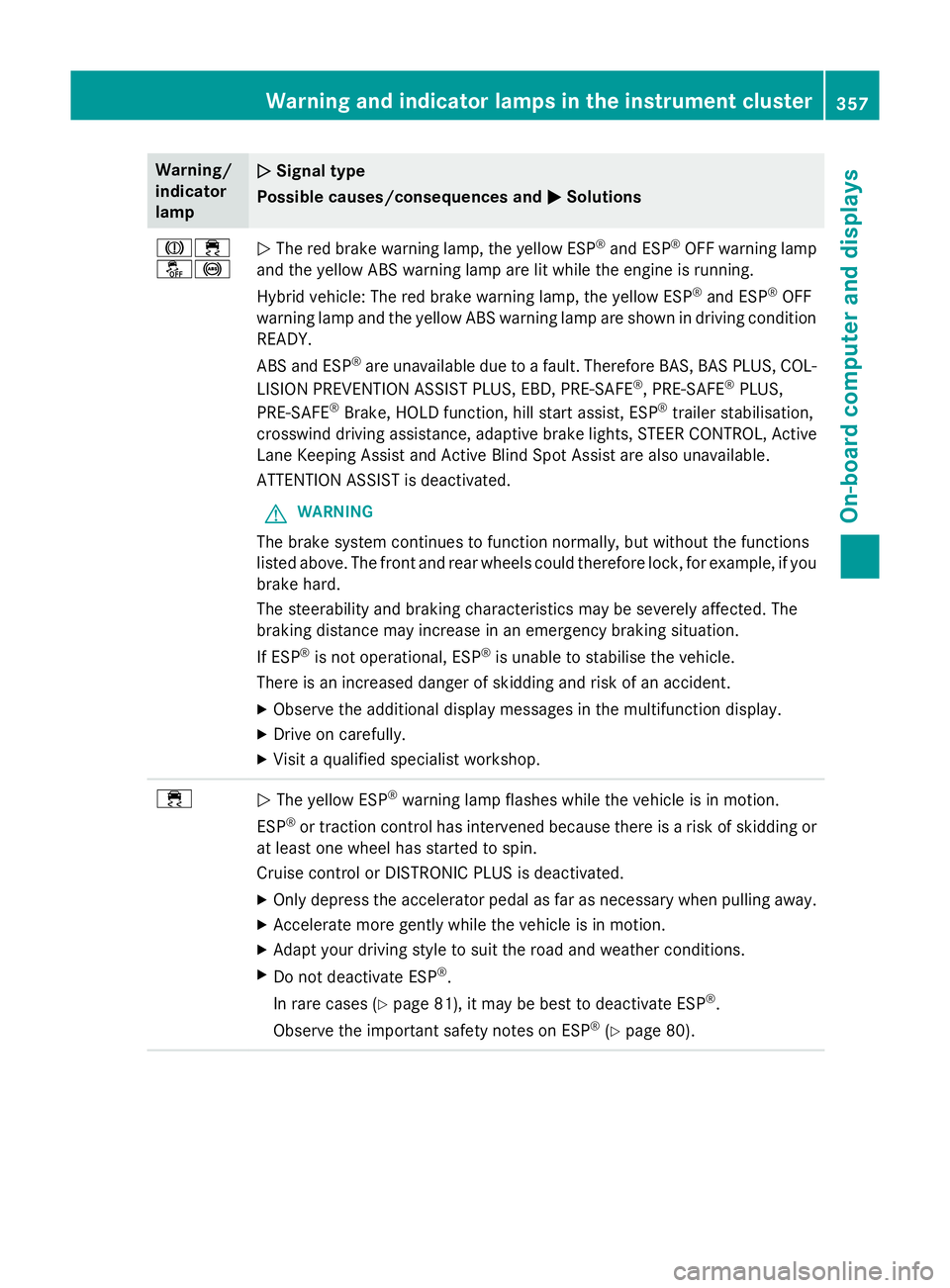
The red brake warning lamp, the yellow ESP ®
and ESP ®
OFF warning lamp
and the yellow ABS warning lamp are lit while the engine is running.
Hybrid vehicle: The red brake warning lamp, the yellow ESP ®
and ESP ®
OFF
warning lamp and the yellow ABS warning lamp are shown in driving condition READY.
ABS and ESP ®
are unavailable due to a fault. Therefore BAS, BAS PLUS, COL-
LISION PREVENTION ASSIST PLUS, EBD, PRE ‑SAFE®
, PRE‑SAFE ®
PLUS,
PRE‑SAFE ®
Brake, HOLD function, hill start assist, ESP ®
trailer stabilisation,
crosswind driving assistance, adaptive brake lights, STEER CONTROL, Active Lane Keeping Assist and Active Blind Spot Assist are also unavailable.
ATTENTION ASSIST is deactivated.
G WARNING
The brake system continues to function normally, but without the functions
listed above. The front and rear wheels could therefore lock, for example, if you
brake hard.
The steerability and braking characteristics may be severely affected. The
braking distance may increase in an emergency braking situation.
If ESP ®
is not operational, ESP ®
is unable to stabilise the vehicle.
There is an increased danger of skidding and risk of an accident.
X Observe the additional display messages in the multifunction display.
X Drive on carefully.
X Visit a qualified specialist workshop. ÷
N
The yellow ESP ®
warning lamp flashes while the vehicle is in motion.
ESP ®
or traction control has intervened because there is a risk of skidding or
at least one wheel has started to spin.
Cruise control or DISTRONIC PLUS is deactivated.
X Only depress the accelerator pedal as far as necessary when pulling away.
X Accelerate more gently while the vehicle is in motion.
X Adapt your driving style to suit the road and weather conditions.
X Do not deactivate ESP ®
.
In rare cases (Y page 81), it may be best to deactivate ESP ®
.
Observe the important safety notes on ESP ®
(Y page 80). Warning and indicator lamps in the instrument cluster
357On-board computer and displays Z
Page 364 of 489
Warning/
indicator
lamp
N N
Signal type
Possible causes/consequences and M
MSolutions ?
N
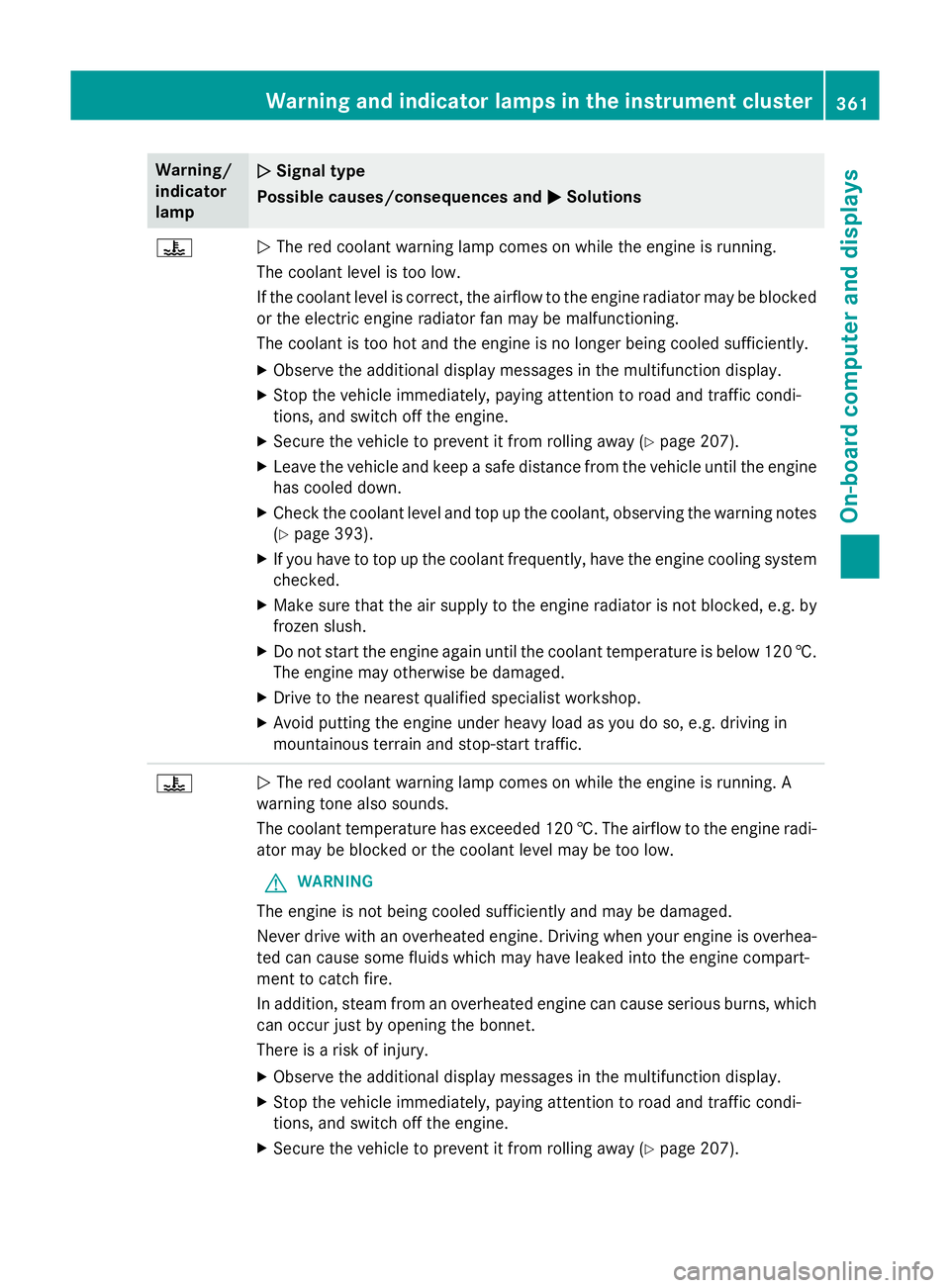
The red coolant warning lamp comes on while the engine is running.
The coolant level is too low.
If the coolant level is correct, the airflow to the engine radiator may be blocked
or the electric engine radiator fan may be malfunctioning.
The coolant is too hot and the engine is no longer being cooled sufficiently.
X Observe the additional display messages in the multifunction display.
X Stop the vehicle immediately, paying attention to road and traffic condi-
tions, and switch off the engine.
X Secure the vehicle to prevent it from rolling away (Y page 207).
X Leave the vehicle and keep a safe distance from the vehicle until the engine
has cooled down.
X Check the coolant level and top up the coolant, observing the warning notes
(Y page 393).
X If you have to top up the coolant frequently, have the engine cooling system
checked.
X Make sure that the air supply to the engine radiator is not blocked, e.g. by
frozen slush.
X Do not start the engine again until the coolant temperature is below 120 †.
The engine may otherwise be damaged.
X Drive to the nearest qualified specialist workshop.
X Avoid putting the engine under heavy load as you do so, e.g. driving in
mountainous terrain and stop-start traffic. ?
N
The red coolant warning lamp comes on while the engine is running. A
warning tone also sounds.
The coolant temperature has exceeded 120 †. The airflow to the engine radi- ator may be blocked or the coolant level may be too low.
G WARNING
The engine is not being cooled sufficiently and may be damaged.
Never drive with an overheated engine. Driving when your engine is overhea-
ted can cause some fluids which may have leaked into the engine compart-
ment to catch fire.
In addition, steam from an overheated engine can cause serious burns, which
can occur just by opening the bonnet.
There is a risk of injury.
X Observe the additional display messages in the multifunction display.
X Stop the vehicle immediately, paying attention to road and traffic condi-
tions, and switch off the engine.
X Secure the vehicle to prevent it from rolling away (Y page 207).Warning and indicator lamps in the instrument cluster
361On-board computer and displays Z
Page 365 of 489
Warning/
indicator
lamp
N N
Signal type
Possible causes/consequences and M
MSolutions X
Leave the vehicle and keep a safe distance from the vehicle until the engine
has cooled down.
X Check the coolant level and top up the coolant, observing the warning notes
(Y page 393).
X If you have to top up the coolant frequently, have the engine cooling system
checked.
X Make sure that the air supply to the engine radiator is not blocked, e.g. by
frozen slush.
X If the coolant temperature is below 120 †, you can continue driving to the
nearest qualified specialist workshop.
X Avoid putting the engine under heavy load as you do so, e.g. driving in
mountainous terrain and stop-start traffic. Hybrid system
Warning/
indicator
lamp
N N
Signal type
Possible causes/consequences and M
MSolutions J
N
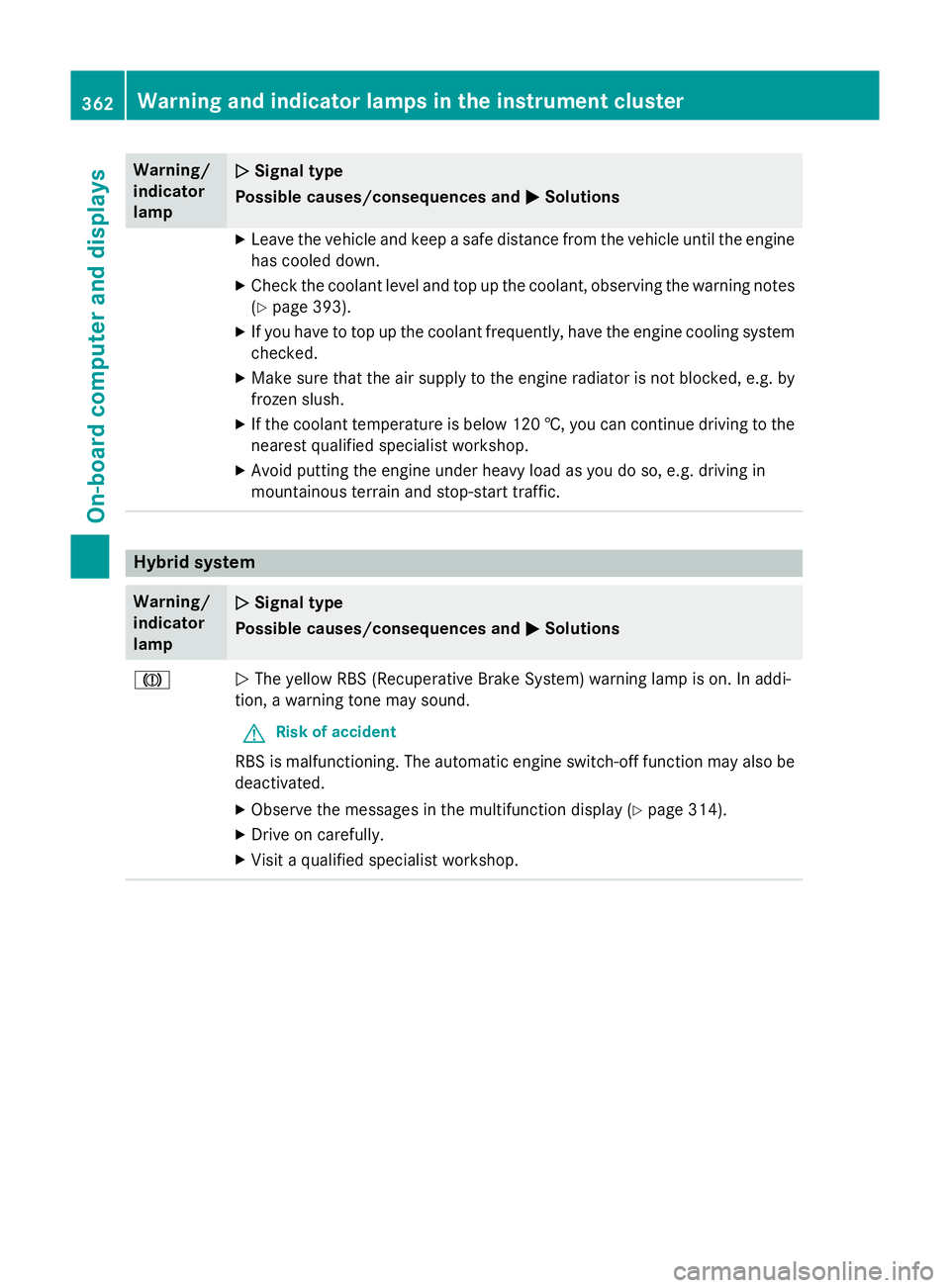
The yellow RBS (Recuperative Brake System) warning lamp is on. In addi-
tion, a warning tone may sound.
G Risk of accident
RBS is malfunctioning. The automatic engine switch-off function may also be deactivated.
X Observe the messages in the multifunction display (Y page 314).
X Drive on carefully.
X Visit a qualified specialist workshop. 362
Warning and indicator lamps in the instrument clusterOn-board computer and displays
Page 372 of 489
R
Close lockable stowage compartments
while driving.
R Stow and secure objects that are heavy,
hard, pointy, sharp-edged, fragile or too
large in the boot.
Observe the loading guidelines (Y page 368).
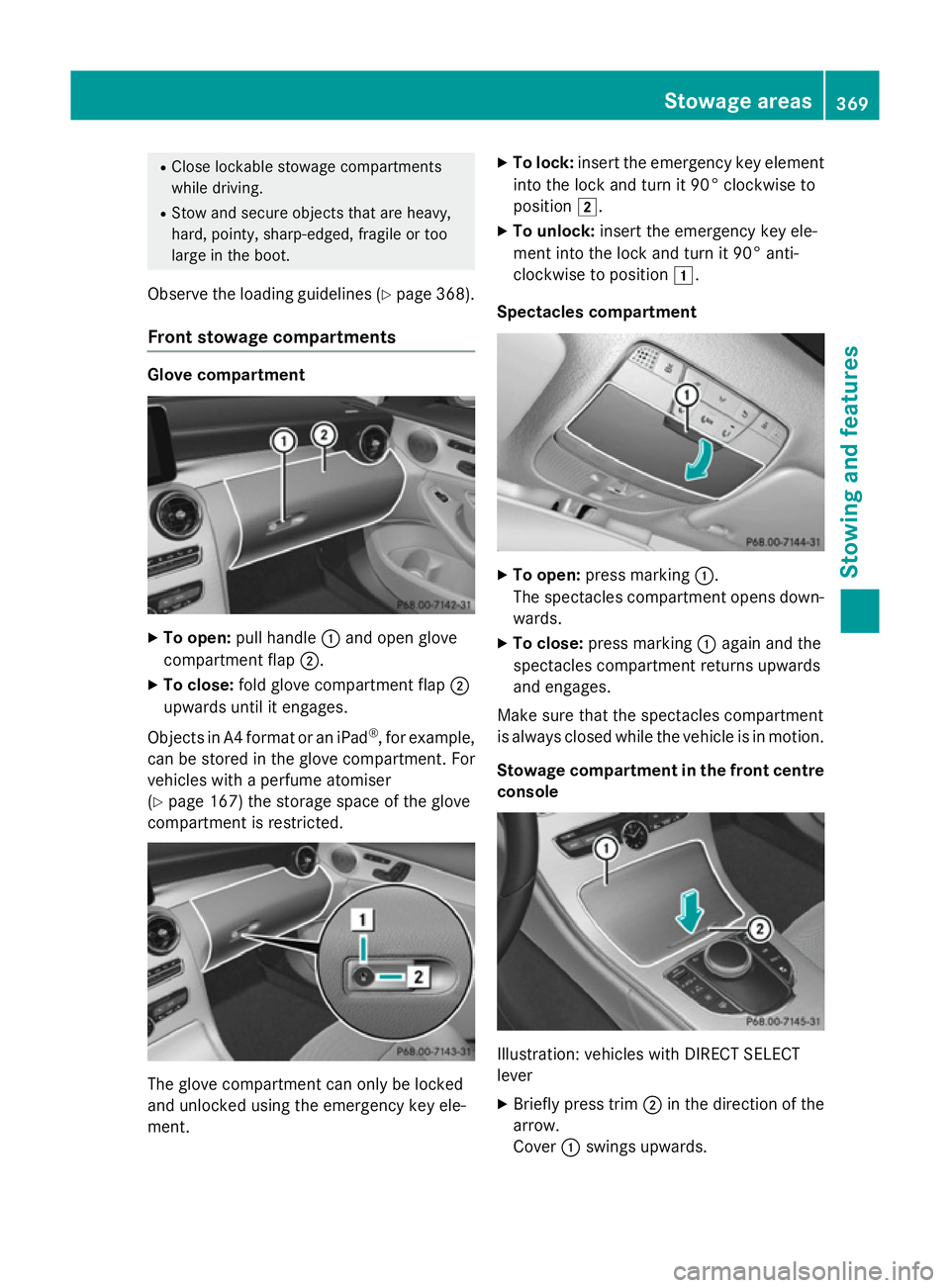
Front stowage compartments Glove compartment
X
To open: pull handle :and open glove
compartment flap ;.
X To close: fold glove compartment flap ;
upwards until it engages.
Objects in A4 format or an iPad ®
, for example,
can be stored in the glove compartment. For
vehicles with a perfume atomiser
(Y page 167) the storage space of the glove
compartment is restricted. The glove compartment can only be locked
and unlocked using the emergency key ele-
ment. X
To lock: insert the emergency key element
into the lock and turn it 90° clockwise to
position 2.
X To unlock: insert the emergency key ele-
ment into the lock and turn it 90° anti-
clockwise to position 1.
Spectacles compartment X
To open: press marking :.
The spectacles compartment opens down- wards.
X To close: press marking :again and the
spectacles compartment returns upwards
and engages.
Make sure that the spectacles compartment
is always closed while the vehicle is in motion.
Stowage compartment in the front centre
console Illustration: vehicles with DIRECT SELECT
lever
X Briefly press trim ;in the direction of the
arrow.
Cover :swings upwards. Stowage areas
369Stowing and features Z
Page 375 of 489
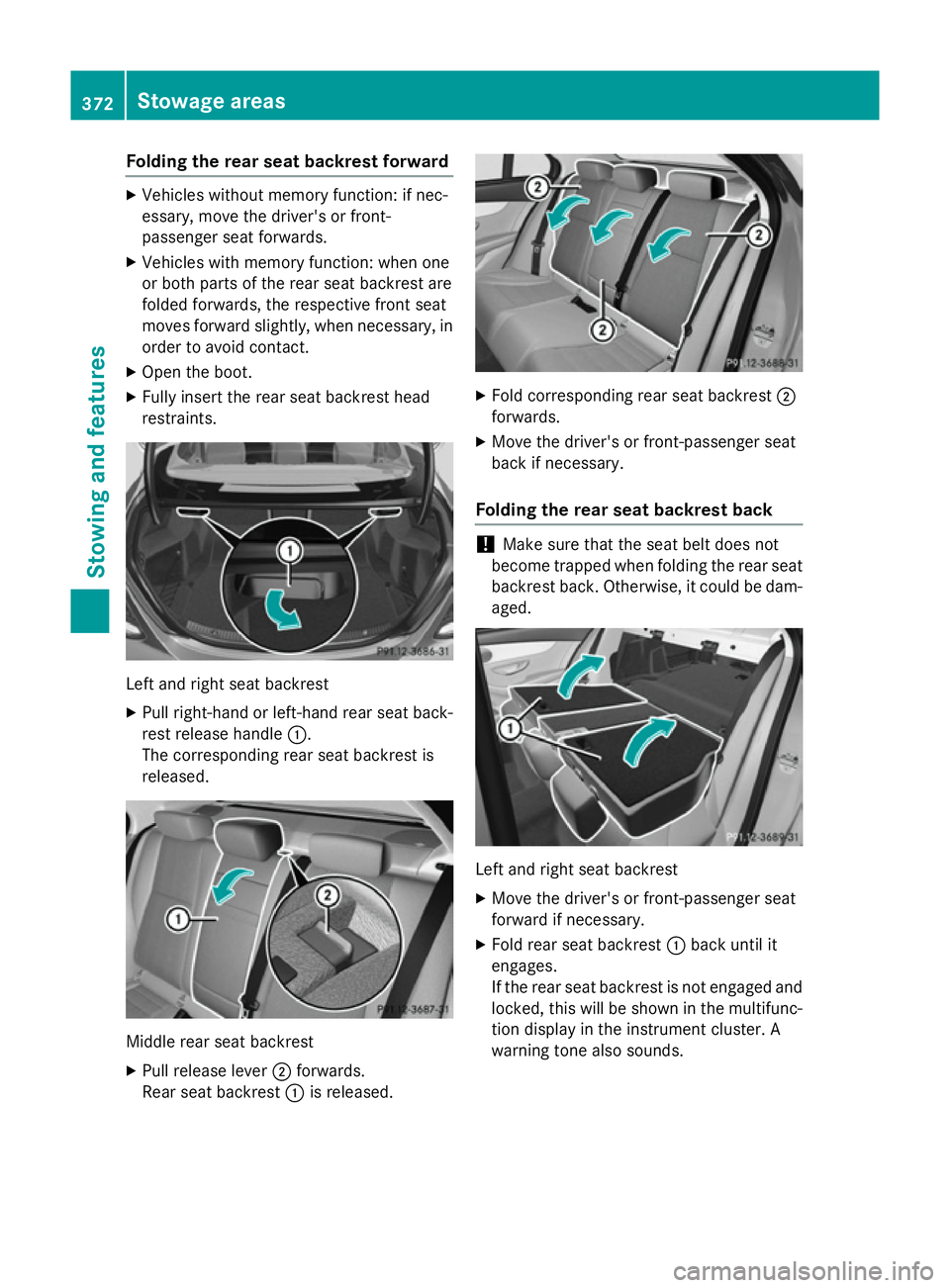
Folding the rear seat backrest forward
X
Vehicles without memory function: if nec-
essary, move the driver's or front-
passenger seat forwards.
X Vehicles with memory function: when one
or both parts of the rear seat backrest are
folded forwards, the respective front seat
moves forward slightly, when necessary, in order to avoid contact.
X Open the boot.
X Fully insert the rear seat backrest head
restraints. Left and right seat backrest
X Pull right-hand or left-hand rear seat back-
rest release handle :.
The corresponding rear seat backrest is
released. Middle rear seat backrest
X
Pull release lever ;forwards.
Rear seat backrest :is released. X
Fold corresponding rear seat backrest ;
forwards.
X Move the driver's or front-passenger seat
back if necessary.
Folding the rear seat backrest back !
Make sure that the seat belt does not
become trapped when folding the rear seat backrest back. Otherwise, it could be dam- aged. Left and right seat backrest
X Move the driver's or front-passenger seat
forward if necessary.
X Fold rear seat backrest :back until it
engages.
If the rear seat backrest is not engaged and
locked, this will be shown in the multifunc-
tion display in the instrument cluster. A
warning tone also sounds. 372
Stowage areasStowing and featu
res
Page 376 of 489

Middle rear seat backrest
X
Move the driver's or front-passenger seat
forward if necessary.
X Fold seat backrest :back until it engages.
Red lock status indicator ;is no longer
visible.
X Adjust the head restraints if necessary
(Y page 121).
X Move the driver's or front-passenger seat
back if necessary.
If you do not need the through-loading fea-
ture, you should always engage the rear seat
backrests. This will prevent unauthorised
access to the boot from the vehicle interior.
Locking the centre rear seat backrest In order to prevent the boot from being
accessed by unauthorised persons, the
centre seat backrest can be locked using a
catch. The centre seat backrest can only be
folded forward together with the left seat
backrest. X
To lock: fold the left and centre seat backr-
ests forward. Make sure that the centre and
left seat backrests are engaged and joined
together.
X Slide catch :upwards.
The release mechanism of the centre seat
backrest is locked.
X To unlock: fold back the left and centre
seat backrests.
X Slide catch :downwards from inside the
boot. Securing a load
Lashing eyelets General notes
Observe the following notes on securing
loads:
R Observe the loading guidelines
(Y page 368).
R Secure the load using the lashing eyelets.
R Distribute the load on the lashing eyelets
evenly.
R Do not use elastic straps or nets to secure
a load. These are only intended as an anti-
slip protection for light loads.
R Do not route lashing materials across sharp
edges or corners.
R Pad sharp edges for protection.
Boot Saloon with through-loading feature in the rear
bench seat Stowage areas
373Stowing and features Z
Page 378 of 489

X
Pull the box out by handle :in the direc-
tion of the arrow all the way to the stop.
X To lower the load surface: push the
centre of load surface ;down by hand in
the direction of the arrow until load sur-
face ;has reached the desired position
and the box is the desired size.
X To raise the load surface: press switch
=.
Load surface ;of the box moves up auto-
matically.
X To stow the box: push the box in by han-
dle :all the way to the stop.
Removing and fitting Example
X To install: insert retainer ;of box :into
slots = X
Raise box :and press hooks Ainto
anchorage ?as far as they will go.
X Turn left-hand rotating catch Banti-clock-
wise and right-hand rotating catch B
clockwise by 90°. X
To remove: turn left-hand rotating catch
B clockwise and right-hand rotating catch
B anti-clockwise by 90°.
X Move box :downwards and pull it out
from anchorages ?.
Store the EASY-PACK boot box on a flat sur-
face after removal, e.g. on a suitable shelf. Stowage well under the boot floor
! Remove the handle again before closing
the boot lid and snap it in tightly to prevent
the handle flap from protruding. Otherwise,
you could damage the handle. The TIREFIT kit, the vehicle tool kit, etc. are
located in the stowage compartment.
X To open: pull handle :up. X
Hook handle :into rain trough ;. Stowage areas
375Stowing and features Z
Page 380 of 489
!
Only use the cup holders for containers of
the right size and which have lids. The
drinks could otherwise spill. G
WARNING
If you do not correctly store objects in the
vehicle interior, they can slip or be flung
around, thus striking vehicle occupants.
There is a risk of injury, especially when brak- ing or abruptly changing directions.
R Always store objects so that they cannot be
flung around in these or in similar situa-
tions.
R Always make sure that objects do not pro-
trude from stowage compartments, lug-
gage nets or stowage nets.
R Close lockable stowage compartments
while driving.
R Stow and secure objects that are heavy,
hard, pointy, sharp-edged, fragile or too
large in the boot.
Observe the loading guidelines (Y page 368).
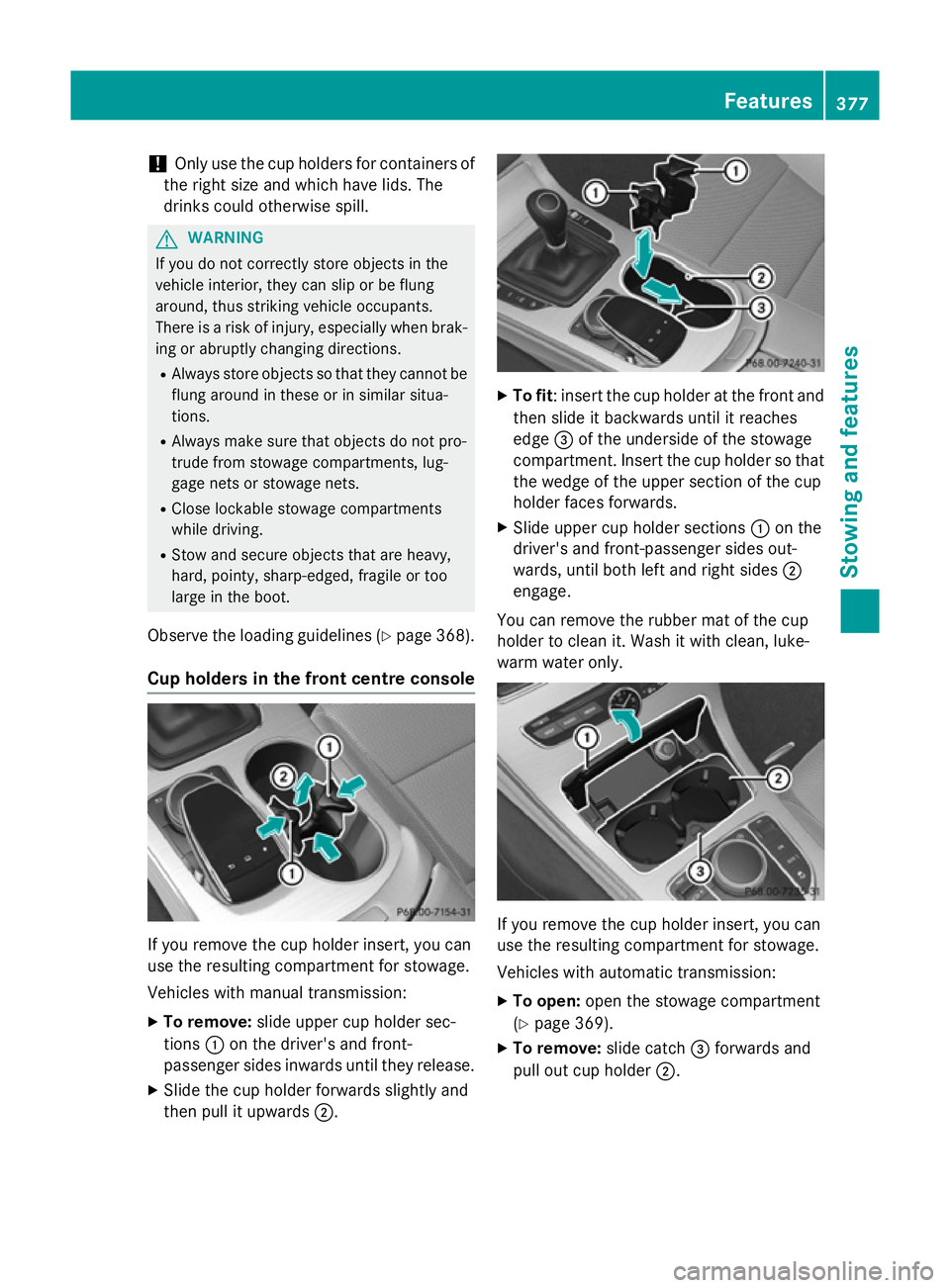
Cup holders in the front centre console If you remove the cup holder insert, you can
use the resulting compartment for stowage.
Vehicles with manual transmission:
X To remove: slide upper cup holder sec-
tions :on the driver's and front-
passenger sides inwards until they release.
X Slide the cup holder forwards slightly and
then pull it upwards ;. X
To fit: insert the cup holder at the front and
then slide it backwards until it reaches
edge =of the underside of the stowage
compartment. Insert the cup holder so that
the wedge of the upper section of the cup
holder faces forwards.
X Slide upper cup holder sections :on the
driver's and front-passenger sides out-
wards, until both left and right sides ;
engage.
You can remove the rubber mat of the cup
holder to clean it. Wash it with clean, luke-
warm water only. If you remove the cup holder insert, you can
use the resulting compartment for stowage.
Vehicles with automatic transmission:
X
To open: open the stowage compartment
(Y page 369).
X To remove: slide catch=forwards and
pull out cup holder ;. Features
377Stowing and features Z
Page 382 of 489
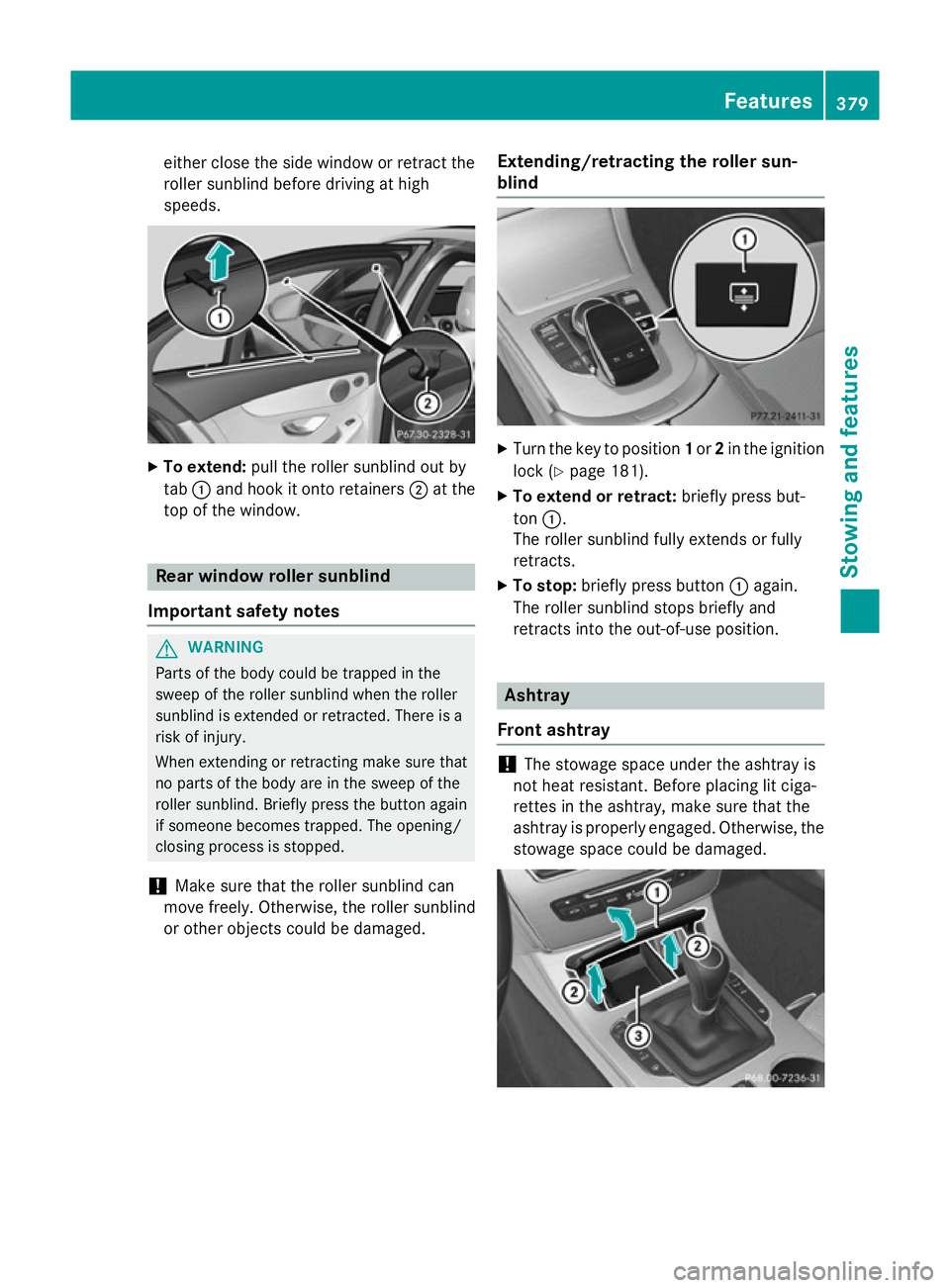
either close the side window or retract the
roller sunblind before driving at high
speeds. X
To extend: pull the roller sunblind out by
tab :and hook it onto retainers ;at the
top of the window. Rear window roller sunblind
Important safety notes G
WARNING
Parts of the body could be trapped in the
sweep of the roller sunblind when the roller
sunblind is extended or retracted. There is a
risk of injury.
When extending or retracting make sure that
no parts of the body are in the sweep of the
roller sunblind. Briefly press the button again if someone becomes trapped. The opening/
closing process is stopped.
! Make sure that the roller sunblind can
move freely. Otherwise, the roller sunblind
or other objects could be damaged. Extending/retracting the roller sun-
blind X
Turn the key to position 1or 2in the ignition
lock (Y page 181).
X To extend or retract: briefly press but-
ton :.
The roller sunblind fully extends or fully
retracts.
X To stop: briefly press button :again.
The roller sunblind stops briefly and
retracts into the out-of-use position. Ashtray
Front ashtray !
The stowage space under the ashtray is
not heat resistant. Before placing lit ciga-
rettes in the ashtray, make sure that the
ashtray is properly engaged. Otherwise, the
stowage space could be damaged. Features
379Stowing and features Z