steering wheel MERCEDES-BENZ CLS-Class 2014 W218 User Guide
[x] Cancel search | Manufacturer: MERCEDES-BENZ, Model Year: 2014, Model line: CLS-Class, Model: MERCEDES-BENZ CLS-Class 2014 W218Pages: 382, PDF Size: 5.36 MB
Page 46 of 382
If you sell yourv
ehicle, it is important that you
make the buyer aware of this safety
information .Besure to give the buyer this
Operator's Manual.
If the air bags are deployed, you will hear a
bang, and asmall amount of powder may also
be released. Only in rare cases will the bang
affect your hearing. The powder that is
released generally does not constitute a
health hazard and does not indicat ethat there
is af ire in the vehicle. The dust might cause
some temporary breathin gdifficulty for
people with asthma or other breathing
trouble. To avoid this, you may wish to get out
of the vehicle as soon as it is safe to do so.
You can also open the window to allow fresh
air to enter the vehicle interior. The 0012SRS
warning lamp lights up.
The air bag installation location sare
identified by the AIR BAG symbol.
The air bags are deployed if the air bag control
unit detects the need for deployment. Only in
the event of such asituation will the air bags
provide their supplemental protection.
If the driver and fron tpassenger do no twear
their seat belts, it is not possible for the air
bags to provide their supplemental
protection.
In the event of other types of impacts and
impacts below air bag deployment
thresholds, the air bags will not deploy. The
driver and passenger will then be protected
to the extent possible by aproperly fastened
seat belt. Aproperl yfastened seat beltisa lso
needed to provide the best possible
protection in arollover.
Air bags provide additional protection; they
are not, however, asubstitute for seat belts.
All vehicle occupants must fasten their seat
belts regardless of whether your vehicle is
equipped with air bags or not.
It is important for your safety and that of your
passenger to have deployed air bags replaced
and to have any malfunctioning air bags
repaired. This will help to make sure the air
bags continue to perform their protective function for the vehicle occupants in the
event of
acrash.
i After an air bag has been deployed, have
the vehicle towed to the nearest qualified
specialist workshop, even if your vehicle is
ready to drive.
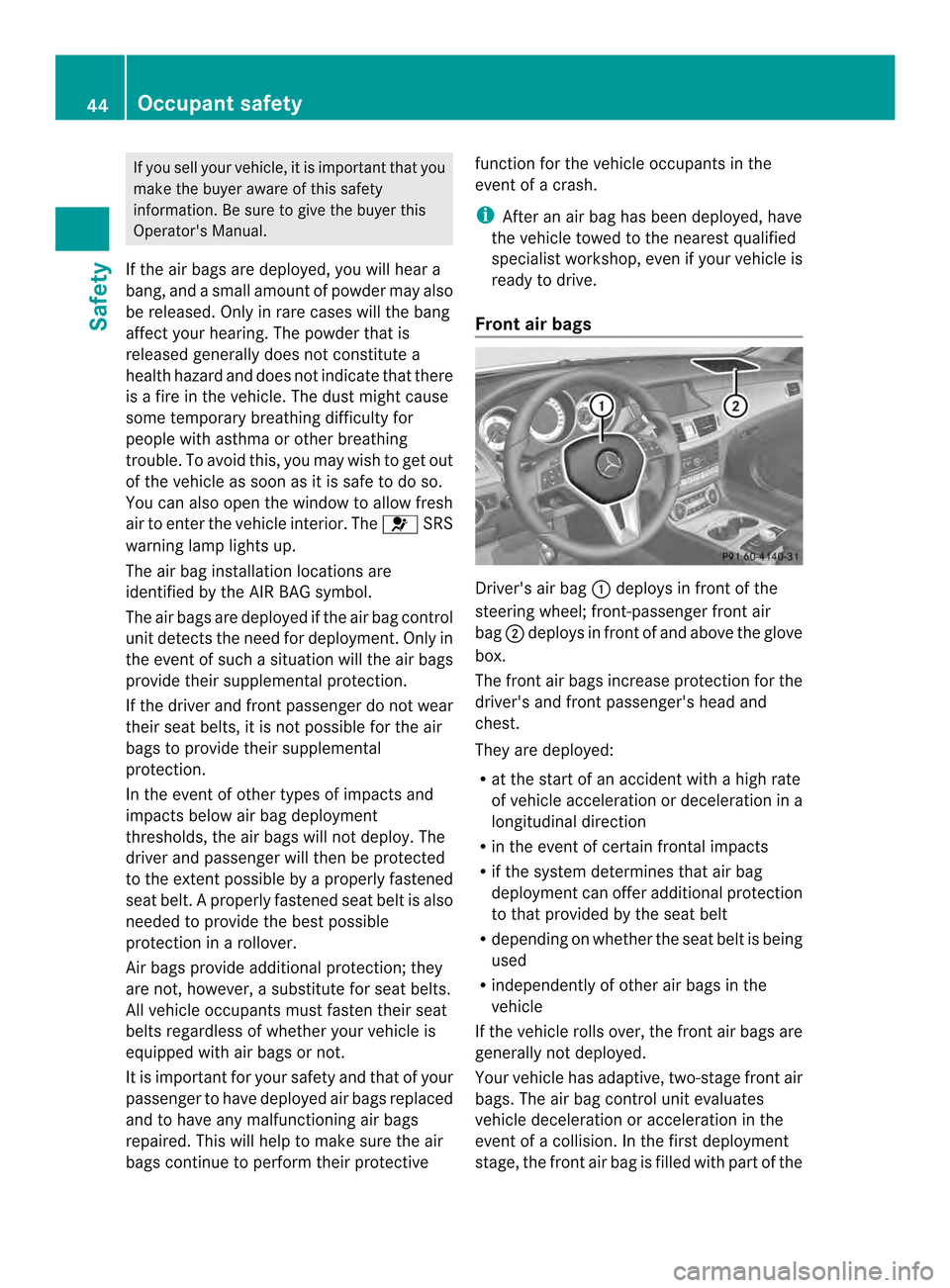
Front air bags Driver's air bag
001Adeploysinf ront of the
steering wheel; front-passenger front air
bag 0010deploysinf ront of and above the glove
box.
The front air bags increase protection for the
driver's and front passenger's head and
chest.
They are deployed:
R at the start of an accident with ahigh rate
of vehicle acceleration or deceleration in a
longitudinal direction
R in the event of certain frontal impacts
R if the system determines that air bag
deployment can offer additional protection
to that provided by the seat belt
R depending on whether the seat belt is being
used
R independently of other air bags in the
vehicle
If the vehicle rolls over, the front air bags are
generally not deployed.
Your vehicle has adaptive, two-stage front air
bags. The air bag control unit evaluates
vehicle deceleration or acceleration in the
event of acollision. In the first deployment
stage, the front air bag is filled with part of the 44
Occupant safetySafety
Page 68 of 382

X
To activate/deactivate: press button0010.
If indicator lamp 001Ais lit, operatio nofthe
rear side windows is disabled. Operation is
only possible using the switches in the
driver's door. If indicator lamp 001Ais off,
operation is possible using the switches in
the rear compartment. Driving safety systems
Overview of driving safety systems
In this section, you will find information about
the following driving safety systems:
R ABS ( Anti-lock BrakingSystem)
(Y page 66)
R BAS ( Brake Assist System) (Y page 67)
R BAS PLUS ( BrakeAssist System Plus)
(Y page 67)
R ESP ®
(Electronic StabilityProgram)
(Y page 68)
R EBD ( Electronic Brake force Distribution)
(Y page 71)
R ADAPTIVE BRAKE (Y page 72)
R PRE-SAFE ®
Brake (Y page 72) Important safety notes
If you fail to adapt your driving style or
become distracted, the driving safety
systems can neither reduce the risk of
accident nor override the laws of physics.
Driving safety systems are merely aids
designed to assist driving. You are responsible for the distance to the vehicle in
front,f
or vehicle speed and for braking in
good time. Always adapt your driving style to
suit the prevailing road, weather and traffic
conditionsa nd maintain asafe distanc efrom
th ev ehicle in front. Drive carefully.
i The driving safety systems describe donly
work as effectivel yaspossible when there
is adequat econtac tbetween th etires and
th er oad surface. Pleas epay special
attentio ntothenote sont ires,
recommende dminimu mtire tread depths,
etc .(Ypage 334).
In wintry drivin gconditions, always use
winter tires (M+S tires) and if necessary,
sno wchains. Only in this way will the
drivin gsafet ysystems described in this
section work as effectively as possible. ABS (Anti-lock Brakin
gSystem)
Important safety notes i
Observe the "Importan tsafet ynotes"
sectio n(Ypage 66). G
WARNING
If ABSisf aulty, the wheels could lock when
braking. The steerability and braking
characteristics may be severely impaired.
Additionally, further driving safety systems
are deactivated. There is an increased danger
of skidding and accidents.
Drive on carefully.H ave ABS checked
immediately at aqualified specialist
workshop.
When ABS is malfunctioning, other systems,
including driving safety systems, will also
become inoperative. Observe the information
on the ABS warning lamp (Y page 267) and
displaym essages which may be shown in the
instrument cluster (Y page 238).
ABS regulates brake pressure in such away
that the wheels do not lock when you brake.
This allows you to continue steering the
vehicle when braking. 66
Driving safety systemsSafety
Page 72 of 382
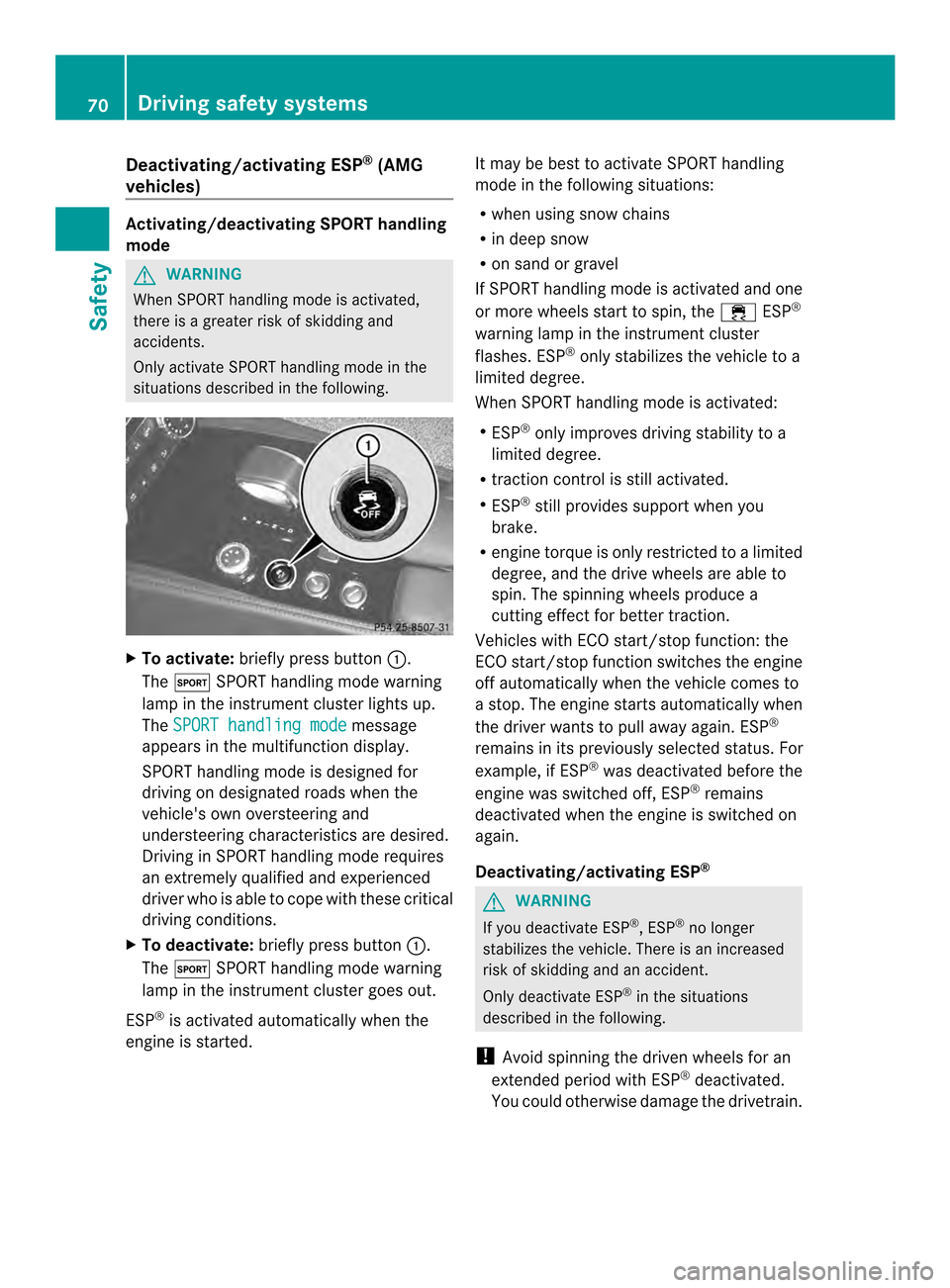
Deactivating/activating ESP
®
(AMG
vehicles) Activating/deactivating SPORT handling
mode G
WARNING
Whe nSPORT handling mode is activated,
there is agreater risk of skidding and
accidents.
Only activat eSPORT handling mode in the
situations described in the following. X
To activate: briefly press button 001A.
The 0005 SPORT handling mode warning
lamp in the instrument cluster lights up.
The SPORT handling mode message
appears in the multifunction display.
SPORT handling mode is designed for
driving on designated roads when the
vehicle's own oversteering and
understeering characteristics are desired.
Drivin ginSPORT handling mode requires
an extremely qualified and experienced
driver who is able to cope with these critical
driving conditions.
X To deactivate: briefly press button 001A.
The 0005 SPORT handling mode warning
lamp in the instrument cluster goes out.
ESP ®
is activated automatically when the
engine is started. It may be best to activat
eSPORT handling
mode in the following situations:
R when using snow chains
R in deep snow
R on sand or gravel
If SPORT handling mode is activated and one
or more wheels start to spin, the 0011ESP®
warning lamp in the instrument cluster
flashes. ESP ®
only stabilizes the vehicle to a
limited degree.
When SPORT handling mode is activated:
R ESP ®
only improves driving stability to a
limited degree.
R traction control is still activated.
R ESP ®
still provides support when you
brake.
R engine torque is only restricted to alimited
degree, and the drive wheels are able to
spin. The spinnin gwheels produce a
cutting effect for better traction.
Vehicles with ECO start/stop function: the
ECO start/stop function switches the engine
off automatically when the vehicle comes to
as top. The engine start sautomatically when
the driver wants to pull away again. ESP ®
remains in its previously selected status. For
example, if ESP ®
was deactivated before the
engine was switched off, ESP ®
remains
deactivated when the engine is switched on
again.
Deactivating/activating ESP ® G
WARNING
If you deactivate ESP ®
,E SP ®
no longer
stabilizes the vehicle. There is an increased
risk of skidding and an accident.
Only deactivate ESP ®
in the situations
described in the following.
! Avoid spinnin gthe driven wheels for an
extended period with ESP ®
deactivated.
You could otherwise damage the drivetrain. 70
Driving safety systemsSafety
Page 73 of 382
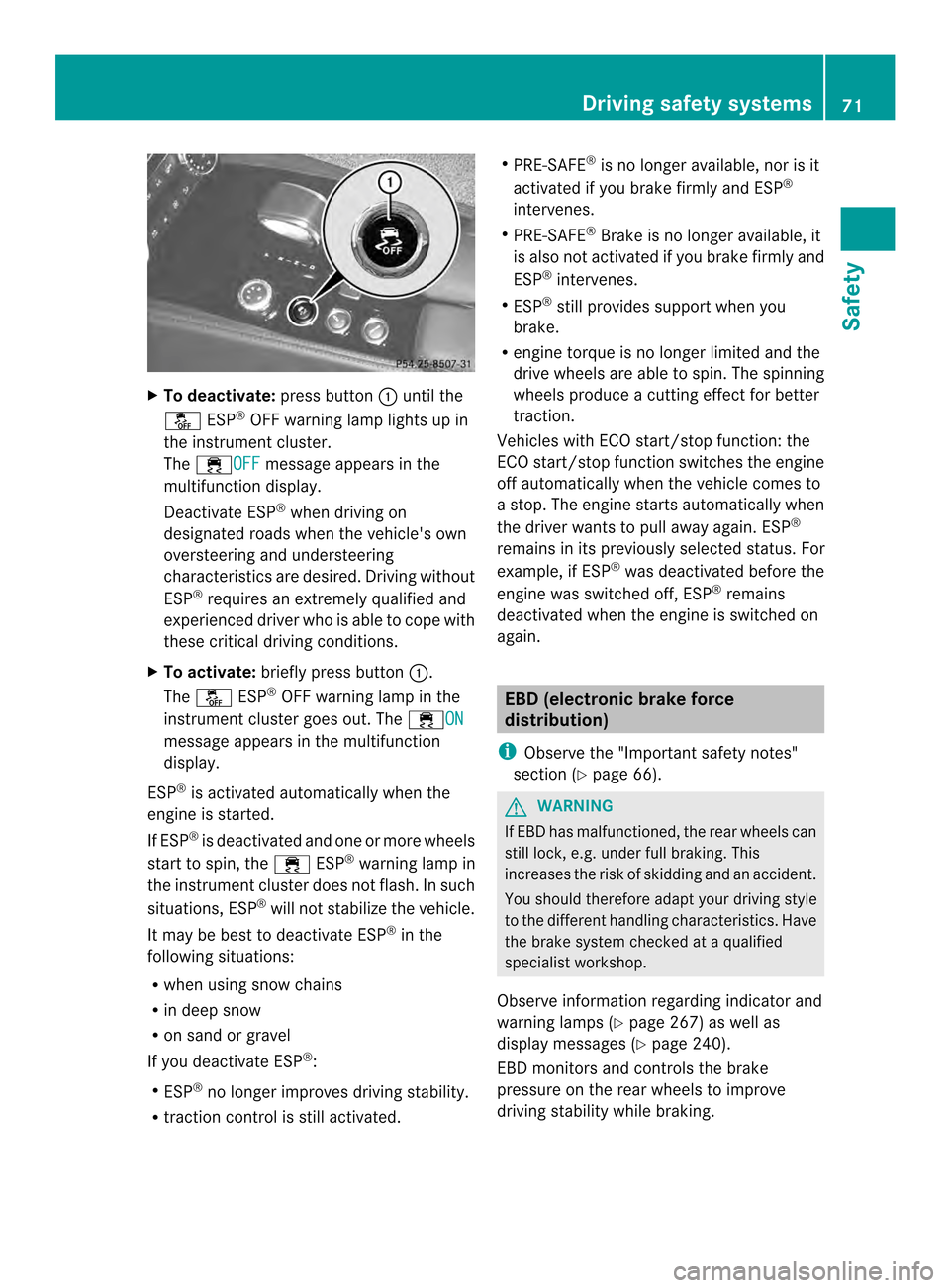
X
To deactivate: press button001Aunti lthe
0009 ESP®
OFF warning lamp lights up in
the instrument cluster.
The 0011OFF message appear
sinthe
multifunctio ndisplay.
Deactivate ESP ®
when drivin gon
designated roads when the vehicle's own
oversteerin gand understeering
characteristics are desired. Drivin gwithout
ESP ®
require sanextremely qualified and
experienced drive rwho is able to cope with
these critical driving conditions.
X To activate: briefly press button 001A.
The 0009 ESP®
OFF warning lamp in the
instrumentc luster goes out. The 0011ON message appears in the multifunction
display.
ESP ®
is activated automatically when the
engine is started.
If ESP ®
is deactivated and one or mor ewheels
start to spin ,the 0011 ESP®
warnin glamp in
the instrumen tcluster does not flash. In such
situations, ESP ®
will not stabilize the vehicle.
It may be best to deactivat eESP®
in the
followin gsituations:
R when using sno wchains
R in deep snow
R on sand or gravel
If you deactivat eESP®
:
R ESP ®
no longer improves drivin gstability.
R traction control is still activated. R
PRE-SAFE ®
is no longer available, nor is it
activated if you brak efirmly and ESP ®
intervenes.
R PRE-SAFE ®
Brake is no longer available, it
is also not activated if you brak efirmly and
ESP ®
intervenes.
R ESP ®
still provides support when you
brake.
R engine torque is no longer limited and the
drive wheels are able to spin .The spinning
wheels produce acuttin geffect for better
traction.
Vehicles with ECO start/stop function: the
ECO start/stop function switches the engine
off automatically when the vehicle comes to
as top. The engine starts automatically when
the driver wants to pull away again. ESP ®
remains in its previously selected status. For
example, if ESP ®
was deactivated before the
engine was switched off, ESP ®
remains
deactivated when the engine is switched on
again. EBD (electronic brake force
distribution)
i Observe the "Important safety notes"
section (Y page 66). G
WARNING
If EBD has malfunctioned, the rear wheels can
still lock, e.g. under full braking. This
increases the risk of skidding and an accident.
You should therefore adapt your driving style
to the different handling characteristics. Have
the brake system checked at aqualified
specialist workshop.
Observe information regarding indicator and
warning lamps (Y page 267) as well as
displaym essages (Y page 240).
EBD monitors and controls the brake
pressure on the rear wheels to improve
driving stability while braking. Driving safety systems
71Safety Z
Page 99 of 382
Useful information
..............................98
Correct driver's seat position ............98
Seats .................................................... 99
Steering wheel .................................. 106
Mirrors ............................................... 109
Memor yfunction .............................. 112 97Seats, steering wheel and mirrors
Page 100 of 382
Useful information
i This Operator's Manual describes all
models and all standard and optional
equipment of your vehicle available at the
time of publication of the Operator's
Manual. Country-specific differences are
possible. Please not ethat your vehicle may
not be equipped with all features
described. This also applies to safety-
related system sand functions.
i Read the information on qualified
specialist workshops: (Y page 26).Correct driver's seat position
G
WARNING
You could lose contro lofyour vehicle if you
do the following while driving:
R adjust the driver' sseat, head restraint,
steering wheel or mirrors
R faste nthe seat belt
There is arisk of an accident.
Adjust the driver's seat, head restraint,
steering wheel and mirror and fasten your
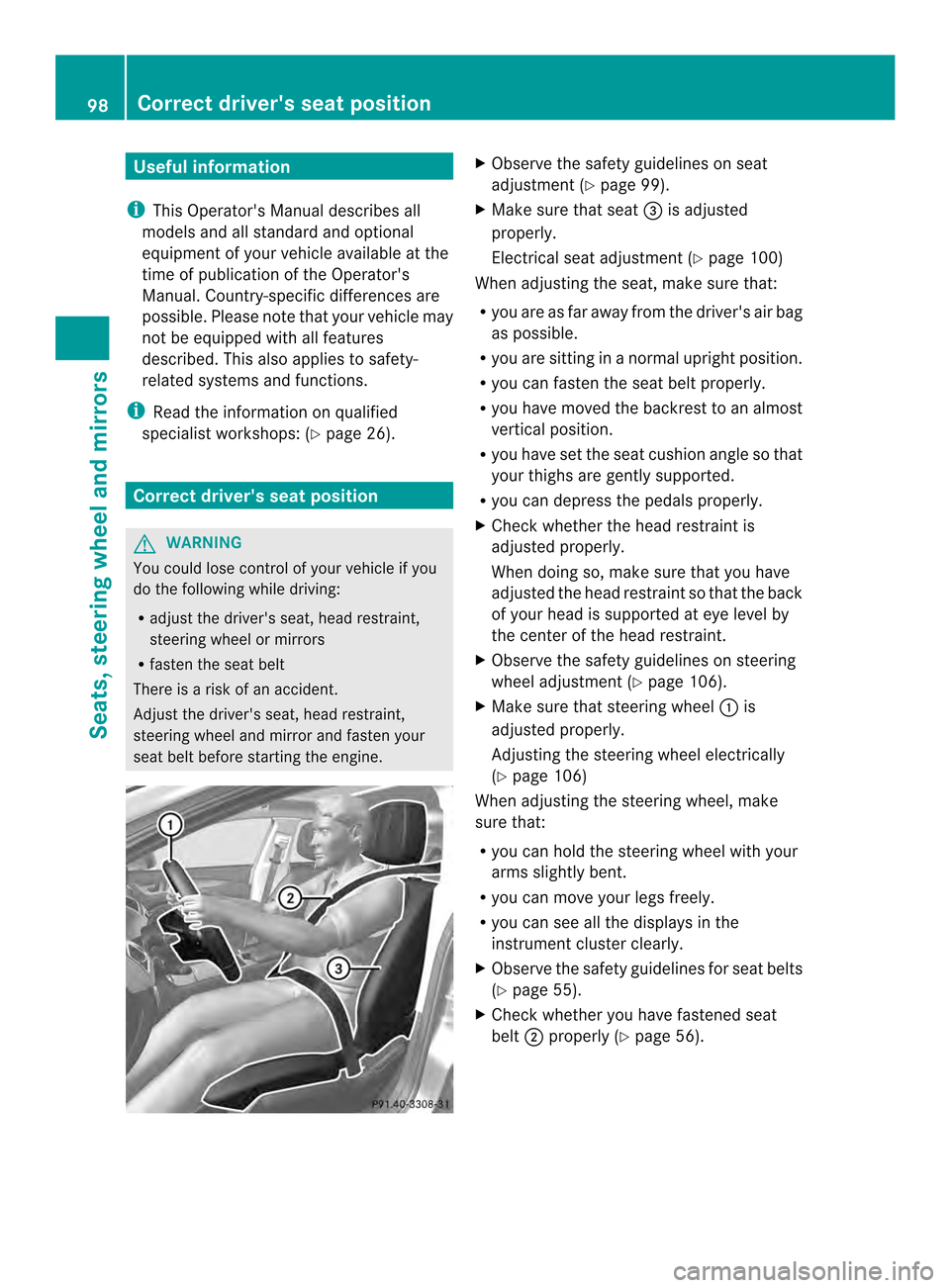
seat belt before startingt he engine. X
Observe the safety guidelines on seat
adjustment (Y page 99).
X Make sure that seat 0024is adjusted
properly.
Electrical seat adjustment (Y page 100)
When adjusting the seat, make sure that:
R you are as far away from the driver's air bag
as possible.
R you are sitting in anormal upright position.
R you can fasten the seat belt properly.
R you have moved the backrest to an almost
vertical position.
R you have set the seat cushion angle so that
your thighs are gently supported.
R you can depress the pedals properly.
X Check whether the head restraint is
adjusted properly.
When doing so, make sure that you have
adjusted the head restraint so that the back
of your head is supported at eye level by
the center of the head restraint.
X Observe the safety guidelines on steering
wheel adjustment (Y page 106).
X Make sure that steering wheel 001Ais
adjusted properly.
Adjustingt he steering wheel electrically
(Y page 106)
When adjusting the steering wheel, make
sure that:
R you can hold the steering wheel with your
arms slightly bent.
R you can move your legs freely.
R you can see all the displays in the
instrumentc luster clearly.
X Observe the safet yguideline sfor seat belts
(Y page 55).
X Check whether you have fastened seat
belt 0010properly (Y page 56). 98
Correct driver'
sseat positionSeats, steering wheel and mirrors
Page 101 of 382
The seat belt should:
R
fit snugly across your body
R be routed across the middle of your
shoulder
R be routed in your pelvic area across the hip
joints
X Before starting off, adjust the rear-view
mirror and the exterior mirrors in such a
way that you have agood view of road and
traffic conditions (Y page 109).
X Vehicles with amemor yfunction: save
the seat, steerin gwheel and exterior mirror
settings with the memory function
(Y page 112). Seats
Important safety notes
G
WARNING
Children could become trapped if they adjust
the seats, particularly when unattended.
There is arisk of injury.
When leaving the vehicle, alway stake the
SmartKey with you and lock the vehicle. Never
leave children unsupervised in the vehicle. G
WARNING
You could lose control of your vehicle if you
do the following while driving:
R adjust the driver's seat, head restraint,
steerin gwheel or mirrors
R fasten the seat belt
There is arisk of an accident.
Adjust the driver's seat, head restraint,
steerin gwheel and mirror and fasten your
seat belt before starting the engine. G
WARNING
If you adjust the seat height carelessly, you or
other vehicle occupant scould be trapped and
thereby injured. Children in particular could
accidentally press the electrical seat adjustmen
tbutton sand become trapped.
Ther eisar iskofi njury.
While moving the seats, make sure tha tyour
hands or other body parts do not get under
the lever assembly of the seat adjustment
system. G
WARNING
When you adjust aseat, you or other vehicle
occupant scould become trapped, e.g. on the
seat guide rail. There is arisk of injury.
Make sure when adjusting aseat that no one
has any body parts in the sweep of the seat. G
WARNING
If head restraints are not installed and
adjusted correctly, they cannot provide
protection as intended. There is an increased
risk of injury in the head and neck area, e.g.
in the event of an accident or when braking.
Always drive with the head restraints
installed. Befor edriving off, make sure for
every vehicle occupant that the center of the
head restraint supports the back of the head
at about eye level. G
WARNING
The seat belt does not offer the intended level
of protection if the backrest is not in the
upright position .When braking or in the event
of an accident, you could slide underneath the
seat belt and sustain abdomen or neck
injuries, for example. This poses an increased
risk of injury or even fatal injury.
Adjust the seat properly before beginning
your journey. Always make sure that the seat
is in the upright position. G
WARNING
According to accident statistics, children are
safer when properly restrained on the rear
seats than on the front-passenger seat. Thus,
we strongly recommendt hat children be
placed in the rear seat whenever possible.
Regardless of seating position, children 12
years old and under must be seated and Seats
99Seats, steering wheela nd mirrors
Z
Page 102 of 382

properly secured in an appropriately sized
child restraint system or booster seat
recommended for the size and weight of the
child. For additional information ,see the
"Children in the vehicle" section.
Ac hild's risk of serious or fatal injuries is
significantly increased if the child restraints
are not properly secured in the vehicle and/
or the child is not properly secured in the child
restraint.
! To avoid damage to the seats and the seat
heating, observe the following information:
R keep liquids from spilling on the seats. If
liquidiss pilled on the seats, dry them as
soon as possible.
R if the seat covers are damp or wet, do not
switch on the seat heating. The seat
heating should also not be used to dry
the seats.
R clean the seat covers as recommended;
see "Interior care".
R do not transport heavy loads on the
seats. Do not place sharp objectsont he
seat cushions, e.g. knives, nails or tools.
The seats should only be occupied by
passengers, if possible.
R when the seat heating is in operation, do
not cover the seats with insulating
materials, e.g. blankets, coats, bags,
seat covers, child seats or booster seats.
! Make sure that there are no objectsint he
footwell or behind the seats when resetting
the seats. There is arisk that the seats
and/or the objectsc ould be damaged.
i The head restraintsint he front seats are
installed with the NECK-PRO system
(Y page 53). For this reason, it is not
possible to remove the head restraints
from the front seats.
For more information ,contact aqualified
specialist workshop.
i Further related subjects: Adjusting the seats
001A
Head restraint height
0010 Seat cushion angle
0024 Seat height
0021 Seat fore-and-aft adjustment
001E Backrest angle
i If PRE-SAFE ®
is triggered, the front-
passenger seat will be moved to abetter
position if it was previously in an
unfavorable position.
i You can store the seat settings using the
memory function (Y page 112).
i Vehicles with the through-loading
feature: if you fold down arear seat
backrest, the respective front seat is
moved forwards slightly in order to avoid
contact. Adjusting the head restraints
Important safety notes G
WARNING
You could lose control of your vehicle if you
do the following while driving:
R adjust the driver's seat, head restraint,
steering wheel or mirrors
R fasten the seat belt
There is arisk of an accident.
Adjust the driver's seat, head restraint,
steering wheel and mirror and fasten your
seat belt before startingt he engine.100
SeatsSeats, steering wheela
nd mirrors
Page 103 of 382

G
WARNING
If headr estraints are not installed and
adjusted correctly, they cannot provide
protection as intended. There is an increased
risk of injury in the heada nd neck area,e.g.
in the event of an accident or when braking.
Always drive with the headr estraints
installed. Before driving off, make sure for
every vehicl eoccupant that the center of the
head restraint supports the back of the head
at about eye level.
General notes Observe the important safety guidelines for
seats (Y page99).
Do not rotate the headr estraints of the front
and rear seats. Otherwise, you cannot adjust
the height and angle of the headr estraints to
the correct position.
Adjusting the height of the head
restraints electrically X
To adjust the head restraint height: slide
switch for headr estraint adjustment 001Aup
or downint he direction of the arrow. Adjusting the luxury head restraints X
To adjust the side bolsters of the head
restraint: pushorpullr ight or left-hand
side bolster 001Ainto the desired position.
X To adjust the angle of the head
restraint: pushorpullt he headr estraint in
the direction of arrow 0010.
i Adjust the headr estraint so that the back
of yourh ead is as close to the head
restraint as possible.
Rear seat head restraints Important safet
ynotes G
WARNING
For your protection ,drive only with properly
positioned head restraints.
Adjust the head restraint ssothat they are as
close as possible to your head. This will
reduce the potential for injury to the head and
neck in the event of an accident or similar
situation.
Whenever the rear seats are occupied, only
drive the vehicle with the head restraints
installed and engaged. Head restraint sare
intended to help reduce injuries during an
accident. Seats
101Seats, steering wheel and mirrors Z
Page 104 of 382

Adjusting th
erears eat hea drestraint
angle X
Pull or push th etop of th ehead restraint
until it is in th edesired position.
Removing and installing th erears eat
hea drestraints G
WARNING
If head restraints are not installe dand
adjusted correctly, they cannot provide
protection as intended. Ther eisanincreased
risk of injury in th ehead and nec karea, e.g.
in th eeven tofana ccidentorwhen braking.
Always driv ewith th ehead restraints
installed. Before driving off ,makes ure for
ever yvehicle occupant that th ecenter of the
head restrain tsupports th eback of th ehead
at about eye level.
! Mak esure that th erear window roller
sunblin dhas been retracte dbefore the rear
head restraint sare removed. You could
otherwise damage the roller sunblind. X
To remove: pull the head restraint up to
the stop.
X Press release catch 001Aand pull the head
restraint out of the guides.
X To re-install: insert the head restraint so
that the notches on the bar are on the left
when viewed in the direction of travel.
X Push the head restraint down until you hear
it engage in position. Adjusting the multicontour seat
The multicontour seat function is only
available for vehicles in Canada. 001A
To adjust the thigh cushion
0010 To adjust the backrest contour in the
lumbar region
0024 To adjust the backrest contour in the
upper back region
0021 To adjust the side bolsters of the seat
backrest
You can adjust the contour of the fron tseats
individually so as to provide optimum support
for your back and sides.
X Turn the SmartKey to position 2in the
ignition lock (Y page 147).102
SeatsSeats, steering wheel and mirrors