start stop button MERCEDES-BENZ CLS-Class 2014 W218 Owner's Guide
[x] Cancel search | Manufacturer: MERCEDES-BENZ, Model Year: 2014, Model line: CLS-Class, Model: MERCEDES-BENZ CLS-Class 2014 W218Pages: 382, PDF Size: 5.36 MB
Page 311 of 382
X
Park the vehicle on alevel surface.
Only check the coolant level when the
vehicle is on alevel surface and the engine
has cooled down.
X Turn the SmartKey to position 2in the
ignition lock (Y page 147).
On vehicles with KEYLESS-GO, press the
Start/Stop button twice (Y page 147).
X Check the coolant temperature display in
the instrument cluster.
The coolant temperature must be below
158 ‡(70 †).
X Turn the SmartKey to position
0(Y page 147) in the ignition lock.
X Slowly turn cap 001Ahalf aturn counter-
clockwise to allow excess pressure to
escape.
X Turn cap 001Afurther counter-clockwise and
remove it.
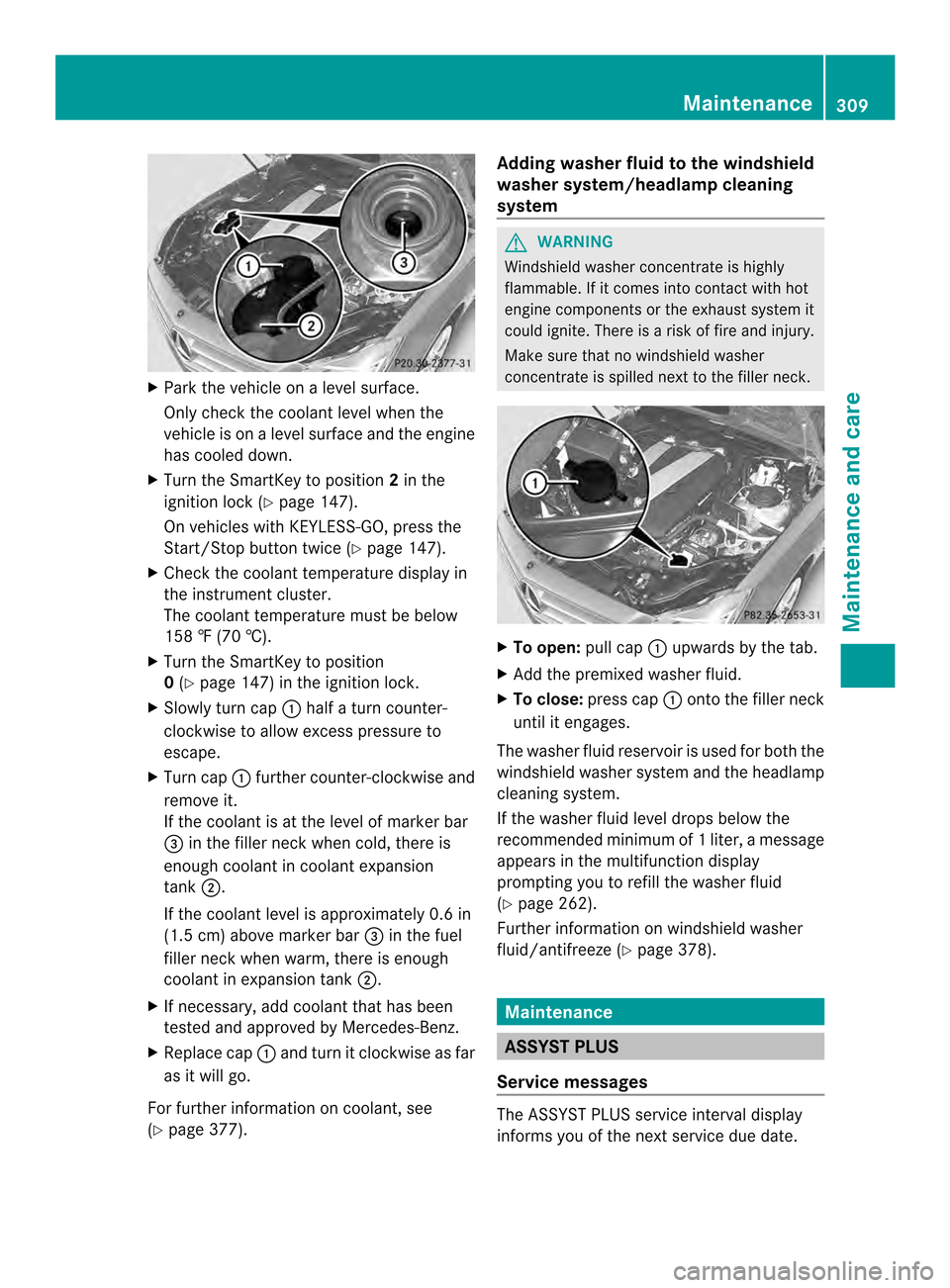
If the coolant is at the level of marker bar
0024 in the filler neck when cold, there is
enough coolant in coolant expansion
tank 0010.
If the coolant level is approximately 0.6 in
(1.5 cm) above marker bar 0024in the fuel
filler neck when warm, there is enough
coolant in expansion tank 0010.
X If necessary, add coolant that has been
tested and approved by Mercedes-Benz.
X Replace cap 001Aand turn it clockwise as far
as it will go.
For further information on coolant ,see
(Y page 377). Adding washer fluid to the windshield
washer system/headlam
pcleaning
system G
WARNING
Windshield washer concentrate is highly
flammable. If it comes int ocontac twith hot
engin ecomponent sorthe exhaust syste mit
could ignite. There is ariskoff ire and injury.
Make sure that no windshield washer
concentrate is spilled nex ttothe filler neck. X
To open: pull cap001Aupwards by the tab.
X Add the premixed washer fluid.
X To close: press cap 001Aontothe filler neck
until it engages.
The washer fluid reservoir is used for both the
windshield washer system and the headlamp
cleaning system.
If the washer fluid level drops below the
recommended minimum of 1liter ,am essage
appears in the multifunction display
promptin gyou to refill the washer fluid
(Y page 262).
Further information on windshield washer
fluid/antifreeze (Y page 378). Maintenance
ASSYST PLUS
Service messages The ASSYS
TPLUS service interval display
inform syou of the nex tservice due date. Maintenance
309Maintenance and care Z
Page 314 of 382
Do not remove the SmartKe
yfromt he
ignition lock. Do not open the driver's
door or front-passenge rdoor when the
engine is switched off. Otherwise, the
automatic transmission selects park
position Pautomatically and locks the
wheels. You can prevent this by shifting
the automatic transmission to N
beforehand.
R Vehicles with KEYLESS-GO:
Do not open the driver's door or front-
passenger door when the engine is
switched off. Otherwise, the automatic
transmission selects park position P
automatically and locks the wheels.
Observe the following to make sure that the
automatic transmission stays in position N:
X Make sure the vehicle is stationary and the
ignition is switched off.
X Turn the SmartKey to position 2in the
ignition lock (Y page 147).
Use the SmartKey instead of the Start/
Stop button on vehicles with KEYLESS-GO.
X Depress and hold the brake pedal.
X Shift the automatic transmission to
position N.
X Release the brake pedal.
X Release the electric parking brake.
X Switch off the ignition and leave the
SmartKey in the ignition lock.
You can wash the vehicle in an automatic car
wash from the very start.
If the vehicle is very dirty, pre-wash it before
cleaning it in an automatic car wash.
After using an automatic car wash, wipe off
wax from the windshield and the wiper
blades. This will prevent smears and reduce
wiping noises caused by residue on the
windshield.
Washing by hand In some countries, washing by hand is only
allowe
datspecially equipped washing bays. Observe the legal requirements in all
countries concerned.
X
Do not use hot water and do not wash the
vehicle in direct sunlight.
X Use asoft sponge to clean.
X Use amild cleaning agent, such as acar
shampoo approved by Mercedes-Benz.
X Thoroughly hose down the vehicle with a
gentle jet of water.
X Do not point the water jet directly towards
the air inlet.
X Use plenty of water and rinse out the
sponge frequently.
X Rinse the vehicle with clean water and dry
thoroughly with achamois.
X Do not let the cleaning agent dry on the
paintwork.
When using the vehicle in winter, remove all
traces of road salt deposits carefully and as
soon as possible.
Power washers G
WARNING
The water jet from acircular jet nozzle (dirt
blasters) can cause invisible exterior damage
to the tires or chassis components.
Component sdamaged in this way may fail
unexpectedly. There is arisk of an accident.
Do not use power washers with circular jet
nozzles to clean the vehicle. Have damaged
tires or chassis components replaced
immediately.
! Always maintain adistance of at least
11.8in( 30 cm) between the vehicl eand the
powe rwasher nozzle. Information about
th ec orrec tdistanc eisavailabl efromt he
equipmen tmanufacturer.
Mov ethe power washe rnozzle around
when cleaning your vehicle.
Do not aim directly at any of the following:
R tires
R door gaps, roof gaps, joints, etc.
R electrical components 312
CareMaintenance and care
Page 323 of 382
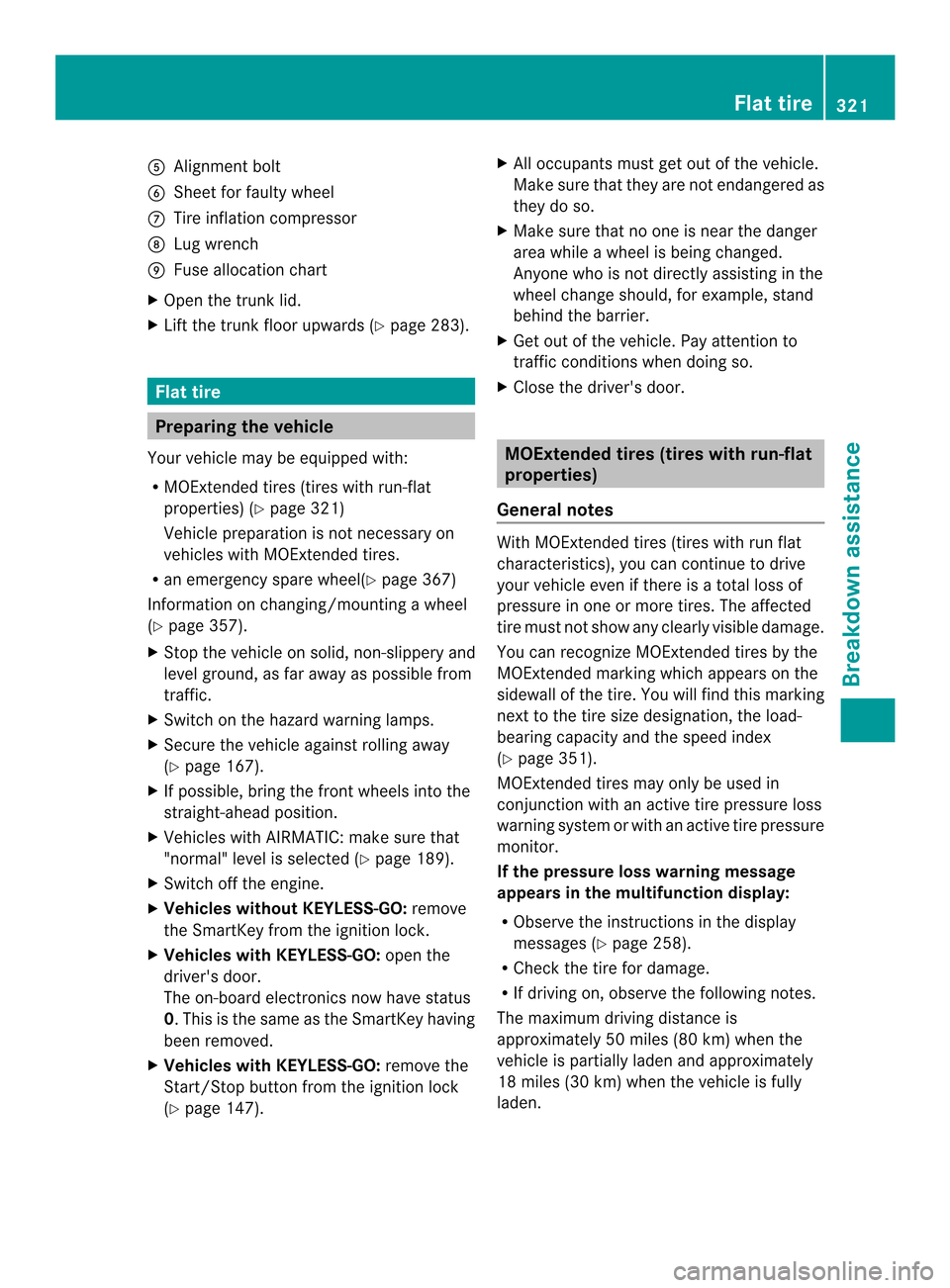
001E
Alignment bolt
0025 Sheet for faulty wheel
0009 Tire inflation compressor
0016 Lugw rench
001D Fusealloc ation chart
X Ope nthe trunk lid.
X Lift the trunk floor upwards (Y page 283).Flat tire
Preparing the vehicle
Your vehicle may be equipped with:
R MOExtended tires (tires with run-flat
properties) (Y page 321)
Vehicle preparation is not necessary on
vehicles with MOExtended tires.
R an emergency spare wheel(Y page 367)
Information on changing/mounting awheel
(Y page 357).
X Stop the vehicle on solid, non-slippery and
level ground, as far away as possible from
traffic.
X Switch on the hazard warning lamps.
X Secure the vehicle against rolling away
(Y page 167).
X If possible, bring the front wheels into the
straight-ahead position.
X Vehicles with AIRMATIC: make sure that
"normal" level is selected (Y page 189).
X Switch off the engine.
X Vehicles without KEYLESS-GO: remove
the SmartKey from the ignition lock.
X Vehicles with KEYLESS-GO: open the
driver's door.
The on-board electronicsn ow have status
0.T his is the same as the SmartKey having
been removed.
X Vehicles with KEYLESS-GO: remove the
Start/Stop button from the ignition lock
(Y page 147). X
All occupants must get out of the vehicle.
Make sure that they are not endangered as
they do so.
X Make sure that no one is near the danger
area while awheel is being changed.
Anyone who is not directly assisting in the
wheel change should, for example, stand
behind the barrier.
X Get out of the vehicle. Pay attention to
traffic conditionsw hen doing so.
X Close the driver's door. MOExtended tires (tires with run-flat
properties)
General notes With MOExtended tires (tires with run flat
characteristics), you can continue to drive
your vehicle even if there is
atotal loss of
pressure in one or more tires. The affected
tire must not show any clearly visible damage.
You can recognizeM OExtended tires by the
MOExtended marking which appears on the
sidewall of the tire. You will find this marking
next to the tire size designation, the load-
bearing capacity and the speed index
(Y page 351).
MOExtended tires may only be used in
conjunction with an active tire pressure loss
warning system or with an active tire pressure
monitor.
If the pressurel oss warning message
appearsint he multifunction display:
R Observe the instructions in the display
messages (Y page 258).
R Check the tire for damage.
R If driving on, observe the following notes.
The maximum driving distance is
approximately 50 miles (80 km) when the
vehicle is partially laden and approximately
18 miles (30 km) when the vehicle is fully
laden. Flat tire
321Breakdown assistance
Page 330 of 382
X
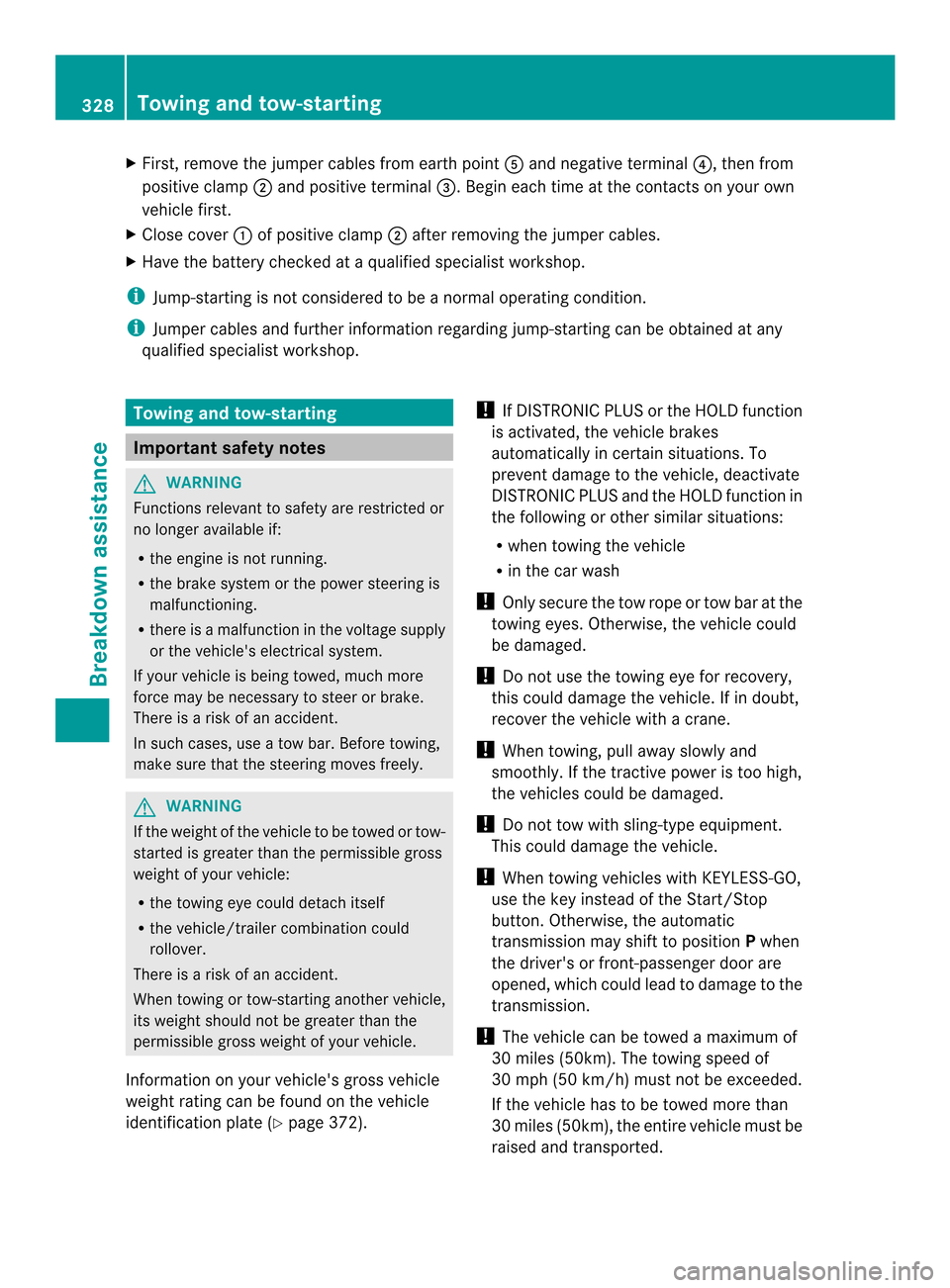
First, remove the jumper cable sfrom earth point 001Eand negative terminal 0021,then from
positiv eclamp 0010and positiv eterminal 0024.Begine acht ime at the contacts on your own
vehicle first.
X Close cover 001Aof positiv eclamp 0010afte rremoving the jumper cables.
X Have the battery checke dataqualified specialist workshop.
i Jump-startin gisnot considered to be anormal operatin gcondition.
i Jumper cables and further information regardin gjump-starting can be obtained at any
qualified specialist workshop. Towing and tow-starting
Importan
tsafet ynotes G
WARNING
Function srelevant to safety are restricted or
no longer available if:
R the engin eisnot running.
R the brake system or the power steering is
malfunctioning.
R ther eisam alfunction in the voltage supply
or the vehicle's electrical system.
If your vehicle is being towed, much more
forc emay be necessary to steer or brake.
There is arisk of an accident.
In such cases, use atow bar. Befor etowing,
make sure that the steering moves freely. G
WARNING
If the weight of the vehicle to be towed or tow-
started is greater than the permissible gross
weight of your vehicle:
R the towin geye could detach itself
R the vehicle/trailer combination could
rollover.
There is arisk of an accident.
When towin gortow-starting another vehicle,
its weight should not be greater than the
permissible gross weight of your vehicle.
Information on your vehicle's gross vehicle
weight ratin gcan be found on the vehicle
identification plate (Y page 372). !
If DISTRONIC PLUS or the HOLD function
is activated, the vehicle brakes
automatically in certain situations. To
preven tdamage to th evehicle ,deactivate
DISTRONI CPLUS and the HOLD function in
the following or other similar situations:
R when towing the vehicle
R in the car wash
! Only secure the tow rope or tow bar at the
towing eyes. Otherwise ,the vehicle could
be damaged.
! Do not use the towing eye for recovery,
this could damage the vehicle .Ifindoubt,
recover the vehicle with acrane.
! When towing, pulla wayslowly and
smoothly .Ifthe tractive power is too high,
the vehicles could be damaged.
! Do not tow with sling-type equipment.
This could damage the vehicle.
! When towing vehicles with KEYLESS-GO,
use the key instead of the Start/Stop
button. Otherwise, the automatic
transmission may shift to position Pwhen
the driver's or front-passenger door are
opened, which could lead to damage to the
transmission.
! The vehicle can be towed amaximum of
30 miles (50km). The towing speed of
30 mph (50 km/h) must not be exceeded.
If the vehicle has to be towed more than
30 miles (50km), the entire vehicle must be
raised and transported. 328
Towing and tow-startingBreakdown assistance
Page 332 of 382
X
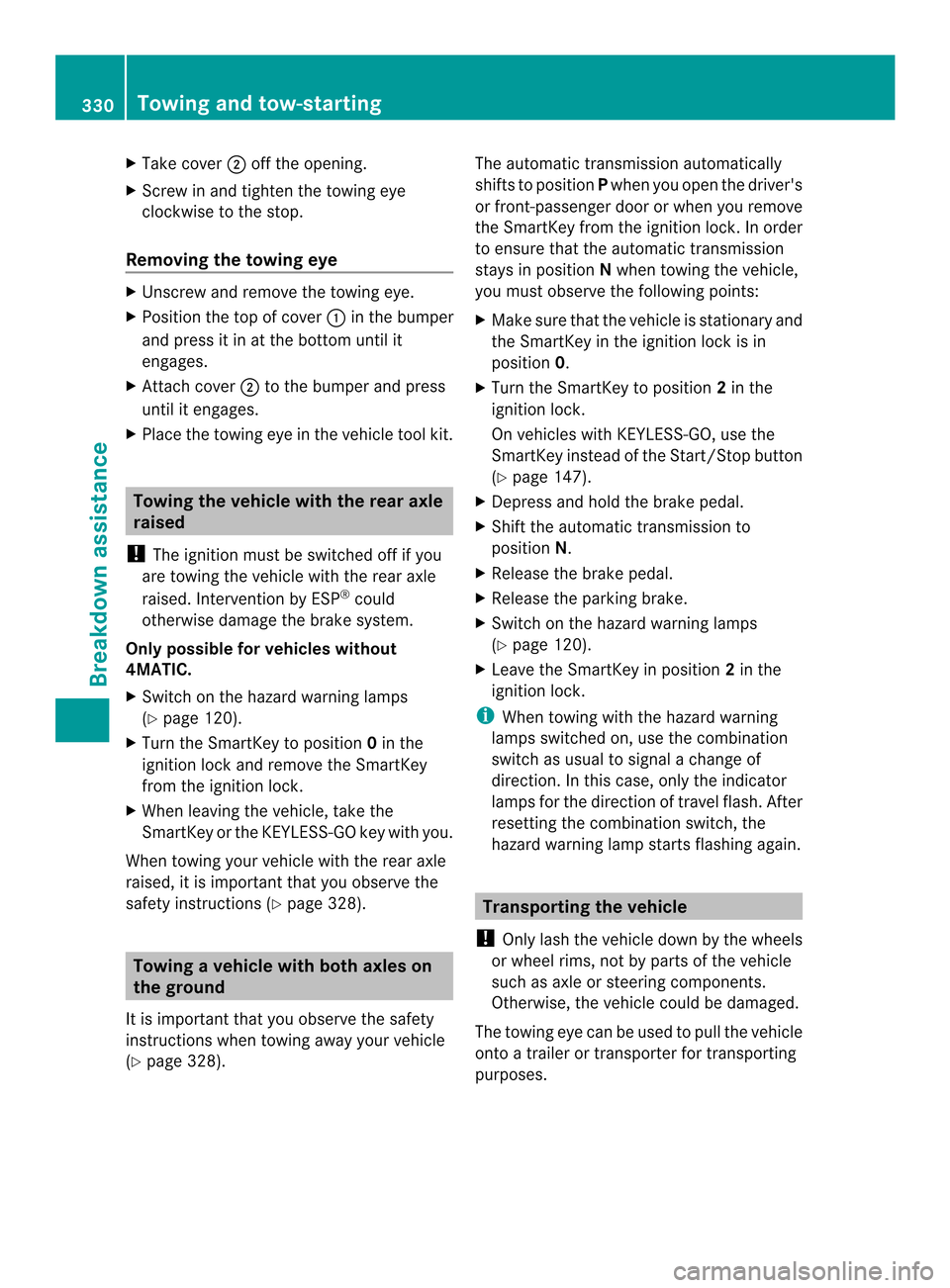
Take cover 0010off the opening.
X Screw in and tighten the towing eye
clockwise to the stop.
Removing the towing eye X
Unscrew and remove the towing eye.
X Position the top of cover 001Ain the bumper
and press it in at the bottom until it
engages.
X Attach cover 0010to the bumper and press
until it engages.
X Place the towing eye in the vehicle tool kit. Towing the vehicle with the rear axle
raised
! The ignition must be switched off if you
are towing the vehicle with the rear axle
raised. Intervention by ESP ®
could
otherwise damage the brake system.
Only possible for vehicles without
4MATIC.
X Switc hont he hazard warning lamps
(Y page 120).
X Turn the SmartKey to position 0in the
ignition lock and remove the SmartKey
from the ignition lock.
X When leaving the vehicle, take the
SmartKey or the KEYLESS-GO key with you.
When towing your vehicle with the rear axle
raised, it is importan tthat you observe the
safety instructions (Y page 328).Towing
avehicle with both axles on
th eg round
It is importan tthat you observe the safety
instructions when towing away your vehicle
(Y page 328). The automatic transmission automatically
shifts to position
Pwhen you open the driver's
or front-passenger door or when you remove
the SmartKey from the ignition lock. In order
to ensure that the automatic transmission
stays in position Nwhen towing the vehicle,
you must observe the following points:
X Make sure that the vehicle is stationary and
the SmartKey in the ignition lock is in
position 0.
X Turn the SmartKey to position 2in the
ignition lock.
On vehicles with KEYLESS-GO, use the
SmartKey instead of the Start/Stop button
(Y page 147).
X Depress and hold the brake pedal.
X Shift the automatic transmission to
position N.
X Release the brake pedal.
X Release the parking brake.
X Switch on the hazard warning lamps
(Y page 120).
X Leave the SmartKey in position 2in the
ignition lock.
i When towing with the hazard warning
lamps switched on, use the combination
switch as usualtos ignalachange of
direction. In this case, only the indicator
lamps for the direction of travel flash. After
resetting the combination switch, the
hazard warning lamp starts flashing again. Transporting the vehicle
! Only lash the vehicle down by the wheels
or wheel rims, not by parts of the vehicle
such as axle or steering components.
Otherwise, the vehicle could be damaged.
The towing eye can be used to pull the vehicle
onto atrailer or transporter for transporting
purposes. 330
Towing and tow-startingBreakdown assistance
Page 360 of 382

to the tire
sorchassiscomponents.
Components damage dinthisw ayma yfail
unexpectedly .There is arisk of an accident.
Do not use power washers with circular jet
nozzles to clean the vehicle. Have damaged
tires or chassis components replaced
immediately. Mounting
awheel
Preparing the vehicle X
Stop the vehicle on solid, non-slippery and
leve lground.
X Apply the parking brake.
X Bring the front wheels into the straight-
ahead position.
X Shift the transmission to position P.
X Vehicles with AIRMATIC :make sure that
"normal" leve lisselecte d(Ypage 189).
X Switch off th eengine.
X Vehicles without KEYLESS-GO: remove
th eS martKey from th eignition lock.
X Vehicles with KEYLESS-GO: open the
driver' sdoor.
The on-board electronics no whave status
0.T his is the same as the SmartKey having
been removed.
X Vehicles with KEYLESS-GO: remove the
Start/Stop button from the ignition lock
(Y page 147).
X If included in the vehicle equipment,
remove the tire-change tool kit from the
vehicle (Y page 320).
X Secure the vehicle to prevent it from rolling
away. Securing the vehicle to prevent it from
rolling away If your vehicle is equipped with
awheel chock,
it can be found in the tire-change tool kit
(Y page 320).
The folding wheel chock is an additional
safety measure to prevent the vehicle from
rolling away,f or example when changing a
wheel.
X Fold both plates upwards 001A.
X Fold out lower plate 0010.
X Guidet he lugs on the lower plate fully into
the openings in base plate 0024. Securing the vehicle on level ground
X
On level ground: place chocksorother
suitable items under the front and rear of
the wheel that is diagonallyo pposite the
wheel you wish to change. 358
Changing
awheelWheels and tires