wheel MERCEDES-BENZ E-CLASS CABRIOLET 2010 User Guide
[x] Cancel search | Manufacturer: MERCEDES-BENZ, Model Year: 2010, Model line: E-CLASS CABRIOLET, Model: MERCEDES-BENZ E-CLASS CABRIOLET 2010Pages: 333, PDF Size: 7.64 MB
Page 26 of 333
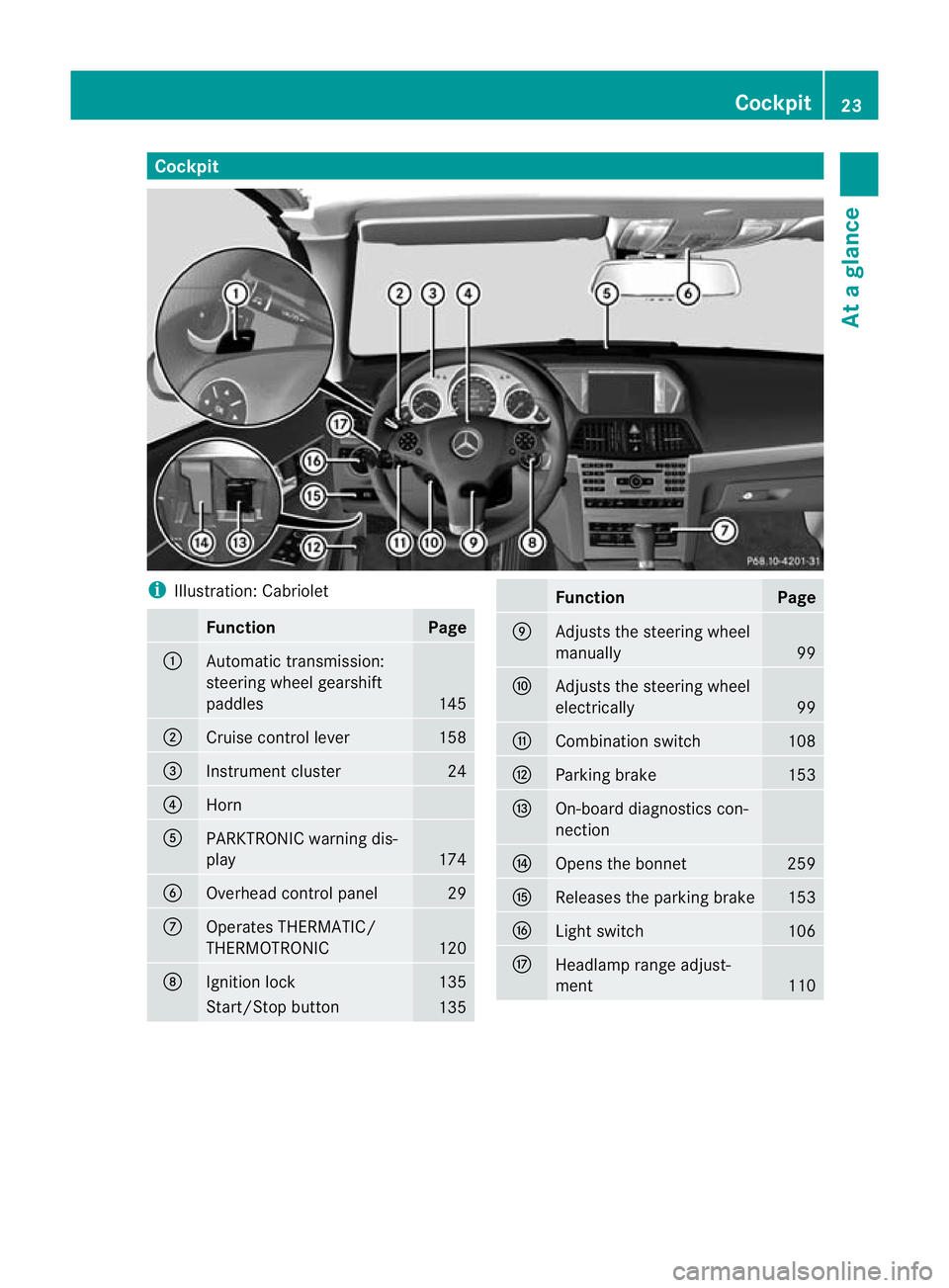
Cockpit
i
Illustration: Cabriolet Function Page
:
Automatic transmission:
steering wheel gearshift
paddles
145
;
Cruise control lever 158
=
Instrumen
tcluster 24
?
Horn
A
PARKTRONI
Cwarning dis-
play 174
B
Overhead con
trol panel 29
C
Operate
sTHERMATIC/
THERMOTRONIC 120
D
Ignition lo
ck 135
Start/Stop button
135 Function Page
E
Adjusts the steering wheel
manually
99
F
Adjusts the steering wheel
ele
ctri cally 99
G
Combination swi
tch 108
H
Parking brake 153
I
On-board diag
nostics con-
nection J
Open
sthe bonnet 259
K
Release
sthe parking brake 153
L
Ligh
tswitch 106
M
Headlam
prange adjust-
ment 110Cockpit
23Atag lance
BA 20 7ECE ÄJ 2010/1a; 1; 2, en-GB
mkalafa Version: 3.0.2.11 2010-01-26T13:03:22+01:00-Seite23
Page 29 of 333
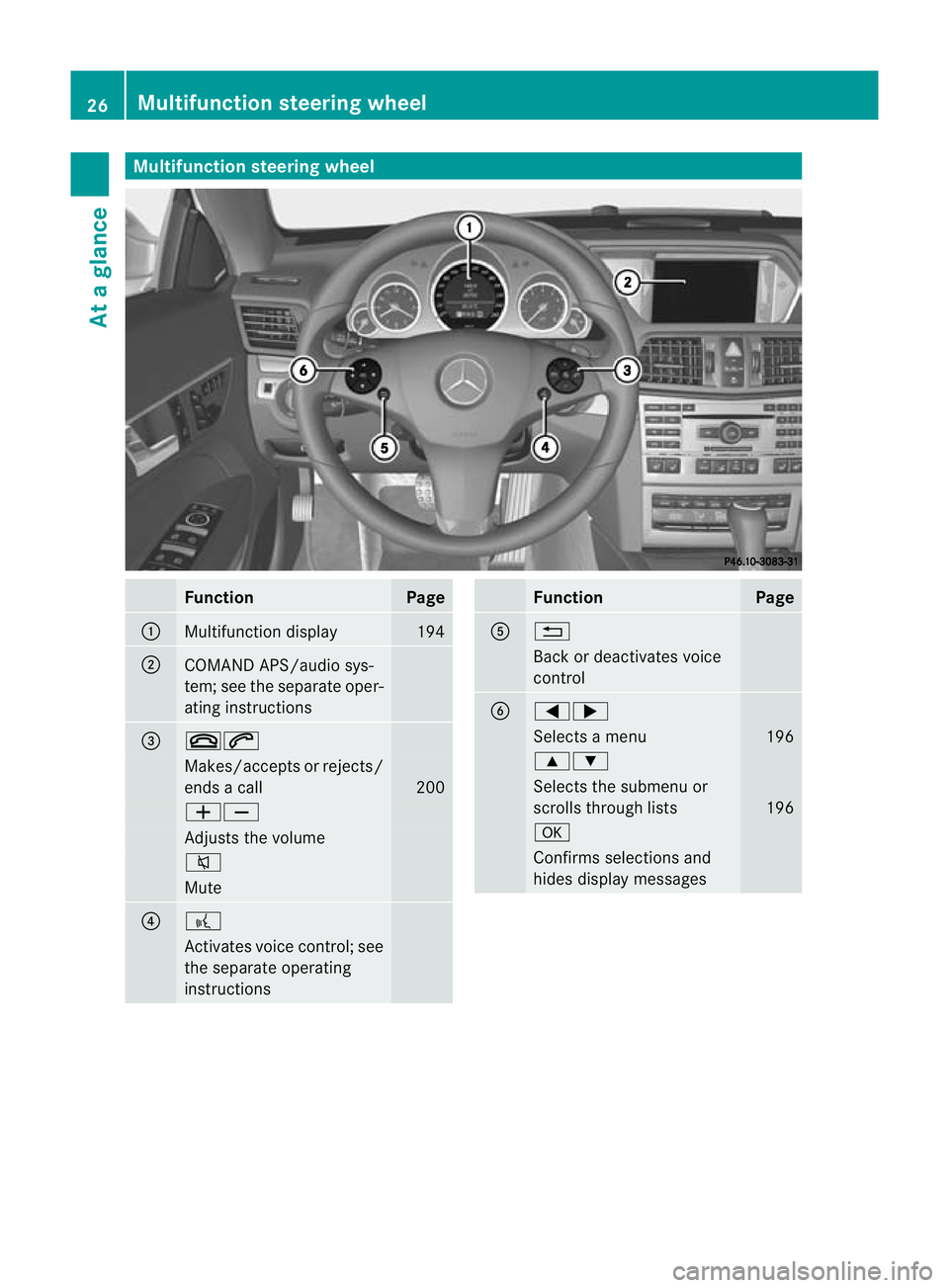
Multifunctio
nsteering wheel Function Page
:
Multifunction dis
play 194
;
COMAND APS/audi
osys-
tem; see the sep arate oper-
ating instructions =
~6
Makes/accepts or rejects/
ends
acall 200
WX
Adjusts the volume
8
Mute
?
?
Activates voice control; see
the separate operating
instructions Function Page
A
%
Back or deactivates voice
control
B
=;
Selects
amenu 196
9:
Selects the submenu or
scrolls through lists
196
a
Confirms selection
sand
hid esdisplay messages 26
Multifunction steering wheelAt
ag lance
BA 20 7ECE ÄJ 2010/1a; 1; 2, en-GB
mkalafa Version: 3.0.2.11 2010-01-26T13:03:22+01:00-Seite 26
Page 33 of 333
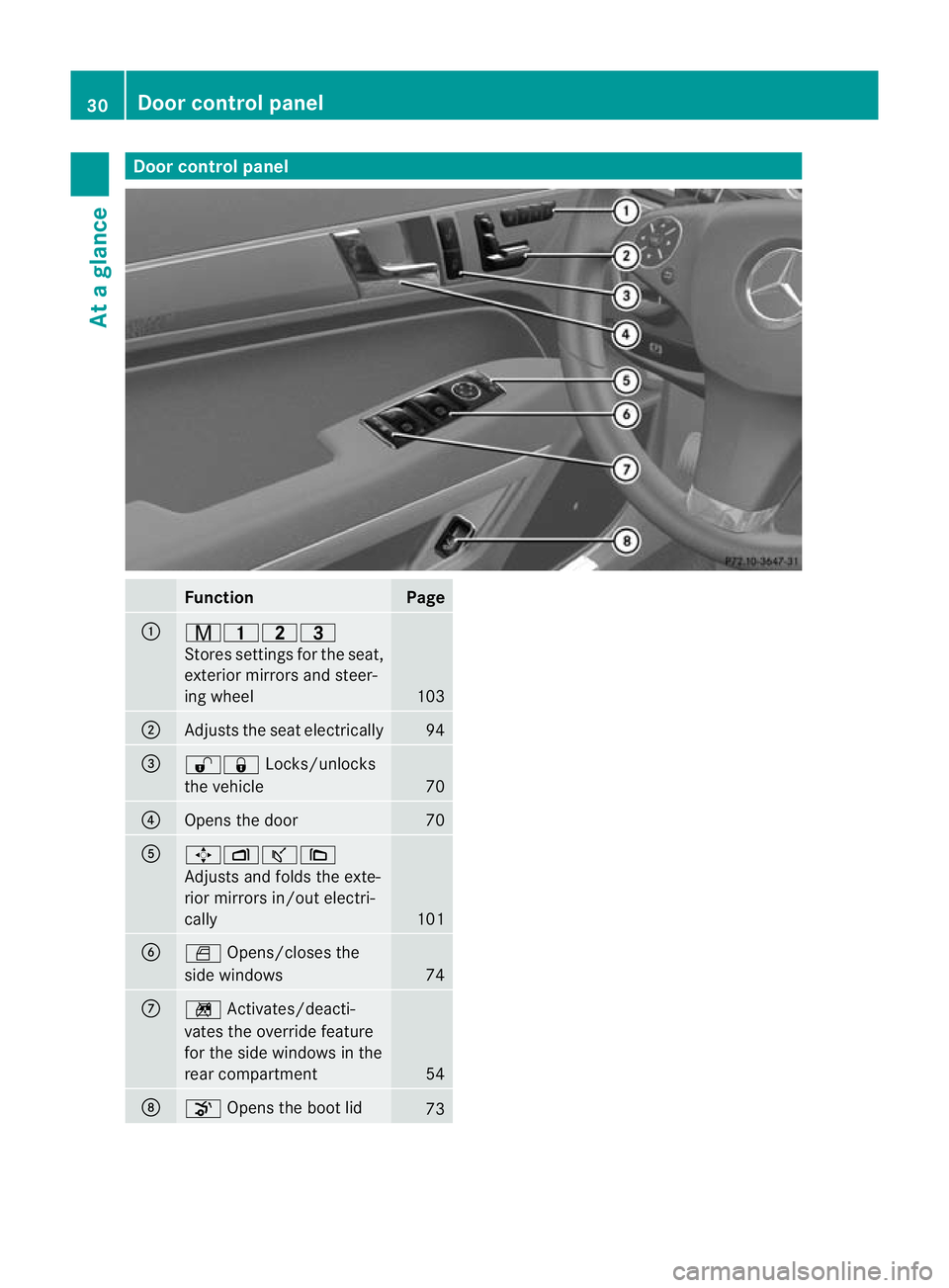
Door control panel
Function Page
:
r4
5=
Stores se ttingsfor the seat,
exterior mirrors and steer-
ing wheel 103
;
Adjusts the seat electrically 94
=
%&
Locks/unlocks
the vehicle 70
?
Opens the door 70
A
7Zª\
Adjusts and folds the exte-
rior mirrors in/out electri-
cally
101
B
W
Opens/closes the
side windows 74
C
n
Activates/deacti-
vates the override feature
for the side windows in the
rear compartment 54
D
o
Opens the boot lid 7330
Doo
rcontrol panelAt ag lance
BA 20 7ECE ÄJ 2010/1a; 1; 2, en-GB
mkalaf aV ersion: 3.0.2.11
2010-01-26T13:03:22+01:00
-Seite 30
Page 35 of 333
Vehicl
eequipment
i Thismanua ldesc ribe sallthe standard
and optional equipment of your vehicle
which wa savailable at th etime of pur-
chase. Countr y-specif ic differences are
possible. Bear in mind tha tyour vehicle
ma ynot featur eall function sdescribed
here. Occupant safety
Important safet
ynotes
Seat belts, together with belt tensioners, belt
forc elimiter sand airbags, are complemen-
tary, coordi nated restraint systems. They
reduce the risk of injur yinspecific ,pre-
define dtypes of accident situa tions and
thereby increase occupan tsafety. However,
seat belts and airbags generally do not pro-
tec tagainst objec tspenetratin gthe vehicle
from the outside.
To ensur ethat the restraint system scan
deliver their full potential protection, make
sure that:
R the seat and head restraint are adjusted
properly (Y page 92).
R the seat belt has been fastened properly
(Y page 41)
R the airbags can inflate unrestricted if
deployed (Y page 34)
R the steering wheel is adjusted properly
(Y page 92)
R the restraint systems have not been modi-
fied.
i An airbag increases the protection of
vehicle occupant swearing aseat belt. As
such they are only an additional restraint
system which complemen ts,b ut does not
replace, the seat belt. All vehicle occupants
must wear their seat belt correctly at all
times, even if the vehicle is equipped with
airbags. Airbags are not deployed in all
types of accidents, e.g. in situations where
airbag deployment would not increase the protection afforded by
acorrectly worn
seat belt. Airbag deployment only provides
increased protection if the seat belt is worn
correctly, because:
R the seat belt helps to keep the vehicle
occupan tinthe best position in relation
to the airbag
R for example, in ahead-on collision ,the
seat belt can mor eadequately prevent
the occupant from being propelled
towards the point of the impact, and is
thus better suited to prevent injury.
Therefore, in accident situations where an
airba gisd eployed, it only provides protec-
tion in addition to the seat belt if the seat
belt is being worn correctly. G
Risk of accident and inju
ry
Always have maintenance work carried out at
aq ualified specialist workshop which has the
necessary specialist knowledg eand tool sto
carry out the work required.
Mercedes-Benz recommends that you use a
Mercedes-Benz Service Centre for thi spur-
pose.
In particular, work relevant to safety or on
safety-related systems must be carried out at
aq ualified specialist workshop .Ifthis wor kis
not carried out correctly, the operating safety
of your vehicl emay be affected. There is arisk
of an accident and injury. G
Risk of injury
The restrain tsystem may not work as inten-
ded if the following components have been
modified or work on thes ecomponents has
not been performed correctly:
R restraint system ,consisting of the seat
belts and anchorages, belt tensioners, belt
force limiters, airbags
R wiring
R networked electronic systems
Airbags or belt tensioners coul dthen fail, e.g.
in the even tofanaccident in which the decel-
eratio nforc ew ould normally be high enough
to trigger the systems, or they coul dbetrig- 32
Occupant safetySafety
BA 207 ECE ÄJ 2010/1a; 1; 2, en-GB
mkalafa
Version: 3.0.2.11 2010-01-26T13:03:22+01:00-Seite 32
Page 38 of 333
R
Vehicl eoccupant s–inparticular ,children
–m ust not lean their head in the area of the
window where:
- Coupé: the sidebag/windowbag
deploys.
- Cabriolet: the sidebag/headbag
deploys.
R Rearward-facin gchild rest raint systems
must not be fitted to the front-passenger
seat unless the front-passenger fron tair-
bag has been disabled. On the front-
passenger seat, the front-passenger front
airbag is onl ydisabled if achild restraint
system with automatic chil dseat recogni-
tion is fitted to the front-passenger seat.
The 4 PASSENGER AIRBA GOFF indica-
tor lamp must be continuou slyl it.
If the front-passenge rseat of your vehicle
does not have automati cchild seat recog-
nition, or your rearward-facin gchild
rest raint system does not have automatic
child seat recognition, children must be
secured in achild rest raint system on a
suitable seat in the rear. If you secure a
forward-facin gchild rest raint system to the
front-passenger seat, you must move the
front-passenger seat as far back as possi-
ble.
R Make sure there are no heavy or sharp-
edged objects in pockets of clothing.
R Do not lean forwards, e.g. over the cover of
the driver's/front-passenger fron tairbag,
particularly when the vehicle is in motion.
R Do not put your feet on the dashboard.
R Only hold the steerin gwheel by the rim.
This allow sthe airbag to deploy fully. You
coul dbei njured if the airbag is deployed
and you are holding the inside of the steer-
ing wheel.
R Do not lean on the doors/rear sidewalls
from the inside.
R Make sure that there are no people, ani-
mals or obje ctsb etween the vehicle occu-
pants and the area of deployment of the
airbag. R
Do not place any objects between the seat
back rest and the door.
R Do not hang any har dobjects, for example,
coat hangers, on the grab handles or coat
hooks.
R Do not atta chaccessories such as drinks
can holders to the doors/rear sidewalls.
It is not possible to rule out arisk of injuries
caused by an airbag due to the high speed at
which the airbag must deploy. G
Risk of injury
The airbag' sfunctionality can only be assured
if the following parts are not covered and no
badge sorstickers are attached to them:
R padded steerin gwheel boss
R knee airbag cover below the steerin gcol-
umn
R front-passenger fron tairbag cover
R outer side of fron tseat bolsters
R side tri mnexttot he rea rseat back rest
R Cabriolet :door trim G
Risk of inju
ry
As mall amo untofp owder is released when
an air bagisd eployed. The powder could
cause short-term breathing difficulties in peo-
ple with asthma or other respirator yprob-
lems.
In order to prevent bre athing difficulties ,you
should leave the vehicle as soon as it is safe
to do so. You can also open the window to
allow fresh air to enter the interior .The pow-
der does not constitute ahealth hazar dand
doe snot indicat ethat ther eisaf ire in the
vehicle. G
Risk of injury
The airbag parts are hot after the airbag has
been deployed. Do not touch them as you
could burn yourself.
Have the airbags replaced at aqualified spe-
cialist workshop .Otherwise, occupants are
not protected by the airbags in the event of
another accident. Occupant safety
35Safety
BA 207 ECE ÄJ 2010/1a; 1; 2, en-GB
mkalafa Version:3.0.2.11
2010-01-26T13:03:22+01:00
-Seite 35 Z
Page 39 of 333
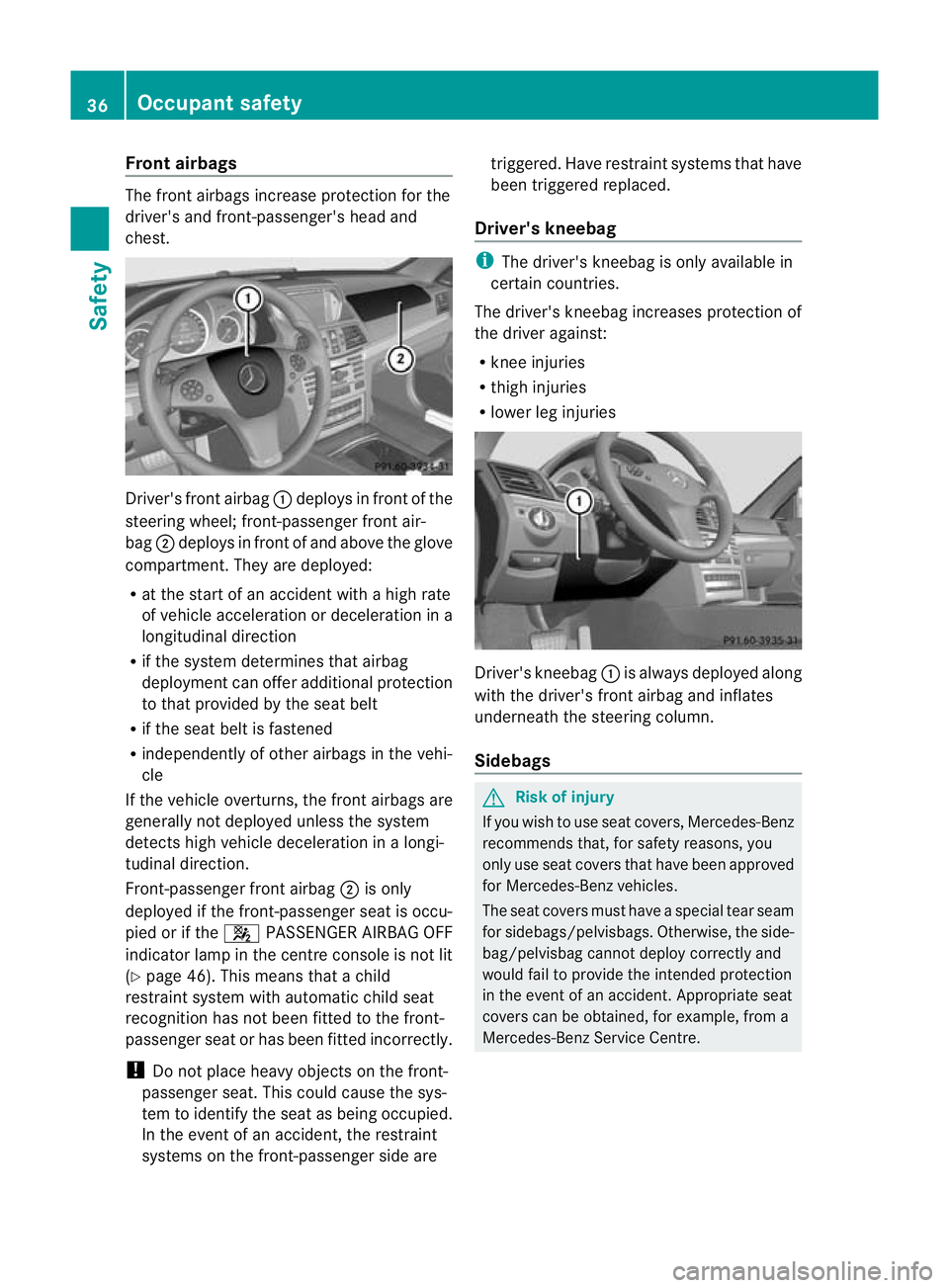
Fron
tairbags The fron
tairbags increase protection for the
driver' sand front-passenger' shead and
chest. Driver
's front air bag:deploys in front of the
steerin gwheel; front-passenger front air-
bag ;deploys in front of and above the glove
compartment .They ar edeployed:
R at the star tofanaccident with ahigh rate
of vehicle acceleration or deceleration in a
longitudinal dire ction
R if the system determines that airbag
deploymen tcan offer additional protec tion
to that provide dbytheseat belt
R if th eseat belt is fastened
R independently of other airbag sinthe vehi-
cle
If the vehicle overturns ,the front airbags are
generally not deployed unless the system
detec tshigh vehicle deceleration in alongi-
tudinal direction.
Front-passenger front airbag ;is only
deployed if the front-passenger seat is occu-
pied or if the 4PASSENGER AIRBA GOFF
indicato rlamp in the centre console is not lit
(Y page 46). This means that achild
restraint system with automatic chil dseat
recognition has not been fitted to the front-
passenger seat or has been fitted incorrectly.
! Do not place heavy object sonthe front-
passenger seat. This could cause the sys-
tem to identify the seat as being occupied.
In the even tofanaccident, the restraint
systems on the front-passenger sid eare triggered
.Have restraint systems that have
been triggered replaced.
Driver's kneebag i
The driver' skneebag is only available in
certain countries.
The driver's kneebag increases protection of
the driver against:
R knee injuries
R thig hinjuries
R lowe rleg injuries Driver's kneebag
:is always deployed along
with the driver' sfront airbag and inflates
underneath th esteering column.
Sidebags G
Risk of injury
If you wish to use seat covers, Mercedes-Benz
recommends that, for safety reasons ,you
only use seat covers that have been approved
for Mercedes-Ben zvehicles.
The seat cover smust have aspecial tear seam
for sidebags/pelvisbags. Otherwise, the side-
bag/pelvisbag cannot deploy correctly and
would fail to provide the intended protection
in the event of an accident. Appropriate seat
cover scan be obtained, for example, from a
Mercedes-Benz Service Centre. 36
Occupant safetySafety
BA 207 ECE ÄJ 201
0/1a; 1; 2, en-GB
mkalafa Version: 3.0.2.11 2010-01-26T13:03:22+01:00-Seite 36
Page 58 of 333
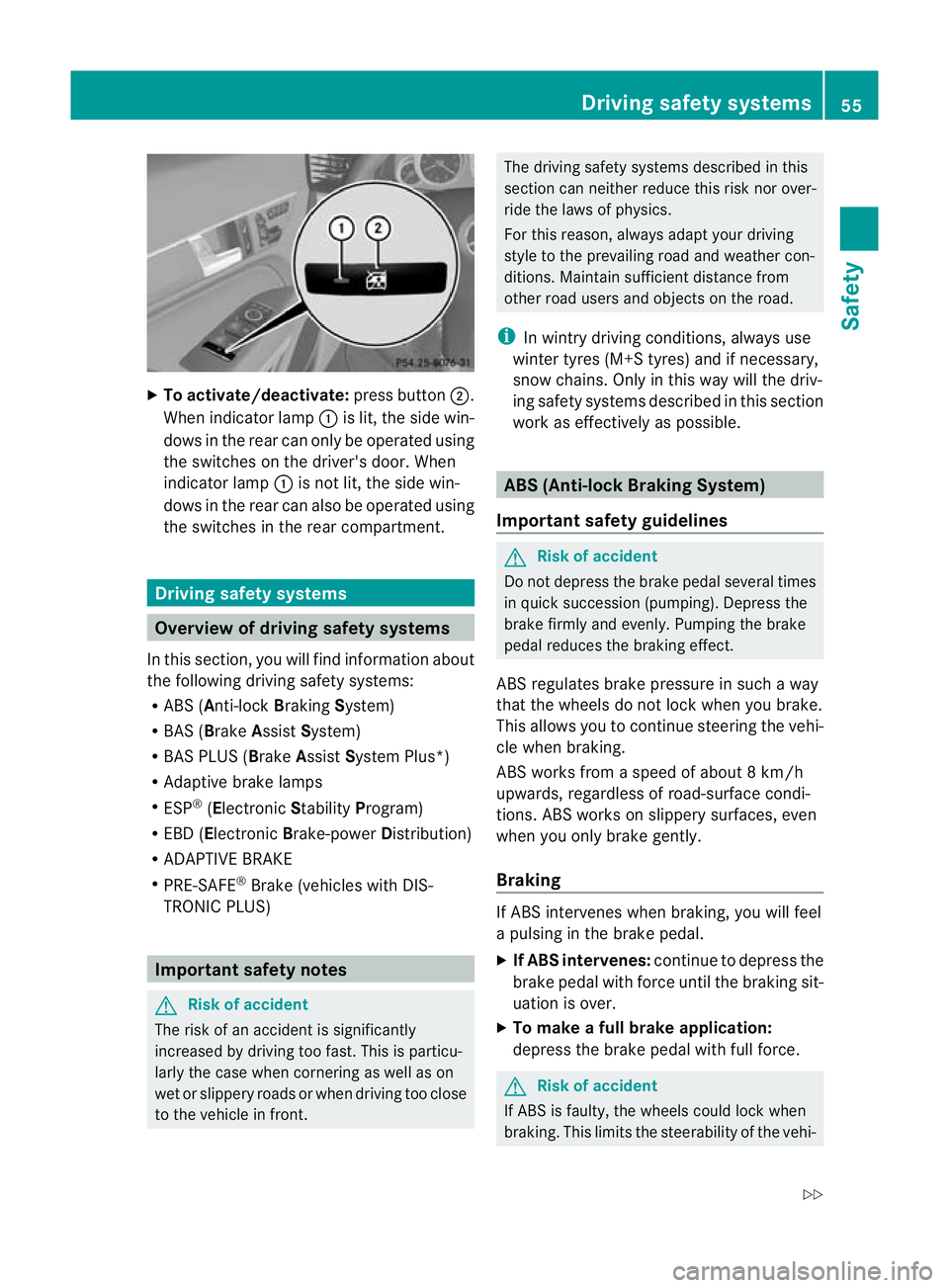
X
To activate/deactivate: press button;.
Whe nindicato rlamp :is lit, the side win-
dows in the rear can only be operated using
the switches on the driver' sdoor .When
indicator lamp :is not lit, the side win-
dows in the rea rcan also be operated using
the switches in the rear compartment. Driving safety systems
Overview of driving safety systems
In this section, you will find information about
the following driving safety systems:
R ABS ( Anti-lock BrakingSystem)
R BAS ( Brake Assist System)
R BAS PLUS ( BrakeAssist System Plus*)
R Adaptive brake lamps
R ESP ®
(Electronic StabilityProgram)
R EBD ( Electronic Brake-power Distribution)
R ADAPTIVE BRAKE
R PRE-SAFE ®
Brake (vehicles with DIS-
TRONIC PLUS) Important safety notes
G
Risk of accident
The risk of an accident is significantly
increased by driving too fast. This is particu-
larly the case when cornerin gaswell as on
wet or slippery roads or when driving too close
to the vehicle in front. The driving safet
ysystems described in this
sectio ncan neither reduce this risk nor over-
ride the laws of physics.
For this reason, always adapt your driving
style to the prevailing road and weather con-
ditions. Maintain sufficient distance from
other road users and objects on the road.
i In wintry driving conditions, always use
winter tyres (M+S tyres) and if necessary,
snow chains. Only in this way will the driv-
ing safety systems described in this section
work as effectively as possible. ABS (Anti-loc
kBrakin gSystem)
Im portan tsafety guidelines G
Ris
kofa ccident
Do not depress the brak epedal several times
in quick succession (pumping). Depress the
brak efirmly and evenly. Pumping the brake
pedal reduces the braking effect.
ABS regulates brake pressure in such away
that the wheels do not lock when you brake.
This allows you to continue steerin gthe vehi-
cle when brakin g.
AB Sw orksfrom aspeed of about 8km/h
upwards, regardless of road-surface condi-
tions. ABS works on slippery surfaces, even
when yo uonly brake gently.
Braking If ABS intervenes whe
nbraking, yo uwill feel
ap ulsing in the brake pedal.
X If ABS intervenes: continue to depressthe
brake pedal with for ceuntil the braking sit-
uation is over.
X To mak eafull brake application:
depress th ebrake peda lwith full force. G
Risk of accident
If ABS is faulty, the wheels could lock when
braking. This limits the steerability of the vehi- Driving safet
ysystems
55Safety
BA 207 ECE ÄJ 2010/1a; 1; 2, en-GB
mkalafa Version: 3.0.2.11 2010-01-26T13:03:22+01:00 -Seite 55 Z
Page 59 of 333
cle whe
nbraking and th ebraking dist ance
may increas e.
If ABS is de activated due to amalfunction,
then BAS and ESP are als odeactivated. There
is an increase drisk of you rvehicle skidding in
cer tain situations.
You should always adapt your drivin gstyle to
suit the prevailing road and weather condi-
tions.
The pulsating brake pedal can be an indica-
tion of hazardous road conditions and func-
tions as areminder to take extra car ewhile
driving. BAS (Br
akeA ssist)
BA So perates in emergency braking situa-
tions. If you depress the brak epedal quickly,
BAS automatically boosts the braking for ce,
thus shortening the stopping distance.
X Keep the brake peda lfirmly depressed until
the emergency brakin gsituation is over.
ABS prevents the wheels from locking.
The brakes will function as usual onc eyou
release the brake pedal. BA Sisd eactiva ted. G
Risk of accident
If BAS has malfunctioned, the braking system
remains available with ful lbrake boosting
effect. However, braking force is not auto-
matically increased in emergency braking sit-
uations and th estoppi ngdistanc emay
increase. BAS PLUS (Brake Assis
tPLUS)
BAS PLU Sprovide sbraking assistance in haz-
ardou ssituation sand use sradar senso rtech-
nology to assess the traffic situation. G
Risk of accident
BAS PLU Siso nly an aid to assist you when
driving. You are responsible for maintaining a
safe distanc efrom other vehicles ,for the vehi-
cle' sspeed and for braking in good time. Alway
spay attention to the traffic conditions.
Otherwise, you may recognise dangers too
late, cause an acciden tand injure yourself
and others.
BAS PLUS can detect obstacle sthat ar einthe
pat hofyour vehicle for an extended period of
time. Should you appr oachad etected obsta-
cle quickly, BA SPLUSc alculates the braking
force necessary to avoid arear-end collision.
Should you additionally apply th ebrakes, BAS
PLUS wil lautomatically increase the braking
force to alevel suitabl efor the traffic condi-
tions.
If BA SPLUS demands particularl yhigh brak-
ing force, PRE-SAFE ®
is activated simultane-
ously.
X Keep the brak epedal depressed until the
emergency braking situation is over.
AB Sp revents th ewheels fr om lockin g.
The bra kesw ill work normally again when:
R you release the brak epedal
R no obstacle is detected in fr ontof your
vehicle
R there is no longer any danger of arear-end
collision
BA SP LUS is then deactivated.
At speeds up to appro ximately 70 km/h ,BAS
PLU Scan also detect stationary obstacles,
for example, stopped or parked vehicles.
The radar sensor system is switched off auto-
matically in the vicinit yofradio telescope
facilities (Y page 324).
For BA SPLUS to assist yo uwhen driving, the
radar sensor system must be switched on and
operational. You can chec kthis by activating
DI ST RONIC PLUS (Y page 160) or via the
"rada rsensor "function in the on-board com-
puter (Y page 208). G
Risk of accident
Only clearly identified obstacles will initiate
brakin gassistanc ebyBAS PLUS. In particular,
the dete ction of obstacles can be restricted if
there is: 56
Drivin
gsafety systemsSafety
BA 207 ECE ÄJ 2010/1a; 1; 2, en-GB
mkalafa Version: 3.0.2.11
2010
-01-26T13:03:22+01:00 -Seite 56
Page 60 of 333
R
dirt on the sensor sorthe sensor sare cov-
ered
R sno worh eavy rain
R interferenc ebyother radar sources
R strong radar reflections, for example in
multi-storey car parks
BA SP LUS does no treact to people or ani-
mals, oncomin gvehicles and crossin gtraffic.
BAS PLUS may not detect narrow vehicles
such as motorcycle sand vehicles driving on
ad ifferen tline.
Following acollision or collision-related dam-
age to the fron tend of the vehicle, have the
configuratio nand operatio nofthe radar sen-
sors chec kedataM ercedes-Ben zService
Centre.
If BAS PLU Sisn ot available due to amalfunc-
tion in the radar senso rsystem, the brake
syste mremains available with ful lbrake
boostin geffect and BAS. Adaptiv
ebrake lamps
i Adaptive brake lamps are only available in
certain countries.
If you brake sharply from aspeed of more
than 50 km/ horifbraking is assisted by BAS
or BAS PLUS, th ebrake lamp sflash rapidly.
In this way, traffic travelling behind you is
warned in an even more noticeable manner.
If you brake sharply from aspeed of more
than 70 km/ htoastandstill, the hazard warn-
ing lamps are activated automatically .Ifthe
brakes ar eapplied again, the brak elamps
light up continuously .The hazard warning
lamps switc hoff automatically if you travel
faster than 10 km/h .You can also switc hoff
th eh azard warning lamps using the hazard
warning switch button (Y page 110). ESP
®
(Electronic Stability Program)
Important safety notes If ESP
®
detect sthat the vehicle is deviating
from the direction desired by the driver ,one
or more wheels are braked to stabilis ethe
vehicle. If necessary, the engin eoutput is also
modified to keep the vehicle on the desired
course within physical limits. ESP ®
assists
the driver when pulling away on wet or slip-
pery roads. ESP ®
can also stabilise the vehi-
cle during braking.
If ESP ®
intervenes, the äwarning lamp
flashes in the instrument cluster. G
Risk of accident
If the ä warning lamp in the instrument
cluster flashes, proceed as follows:
R do not deactivate ESP ®
under any circum-
stances.
R only depress the accelerator pedal as far as
necessary when pulling away.
R adapt your driving style to suit the prevail-
ing road and weather conditions.
Otherwise ,the vehicle coul dskid.
ESP ®
cannot reduce the risk of an accident if
you drive too fast. ESP ®
cannot override the
laws of physics.
! The ignition must be switched off if you
are towing the vehicl ewith the front/rear
axle raised. Interven tion by ESP ®
coul doth-
erwise damage the brake system.
i Only use wheels with the recommended
tyre sizes. Only then will ESP ®
function
properly.
ETS (Electronic Traction Support) Traction control is part of ESP
®
.
Traction control brakes the drive wheels indi-
viduall yifthey spin. This enables you to pull
away and accelerate on slipper ysurfaces, for
example if the road surface is slippery on one
side. Driving safety systems
57Safety
BA 207 ECE ÄJ 2010/1a; 1; 2, en-GB
mkalafaV ersion: 3.0.2.11
2010-01-26T13:03:22+01:00
-Seite 57 Z
Page 61 of 333
Traction control remains active if you deacti-
vat
eE SP®
. G
Risk of accident
Tractio ncontrol can notreduce the risk of an
accident if you driv etoo fast .Traction con trol
can noto verride th elaws of physics.
Deactivating/activating ESP ®ESP
®
is activated automatically when the
engine is running.
It may be best to deactivate ESP ®
in the fol-
lowing situations:
R when using snow chains
R in deep snow
R on sand or gravel G
Risk of accident
Activate ESP ®
as soon as the situations
described above no longer apply. ESP ®
will
otherwise not be able to stabilis ethe vehicle
if the vehicle star tsto skid or awheel star ts
to spin.
If you deactivate ESP ®
:
R ESP ®
no longer improves driving stability.
R the engine's torque is no longer limited and
the drive wheels can spin. The spinnin gof
the wheels results in acutting action, which
provides better grip.
R traction control is still activated.
R ESP ®
still provides support when you
brake.
If ESP ®
is deactivated and one or more wheels
start to spin, the äwarning lamp in the
instrument cluster flashes .Insuch situations,
ESP ®
will not stabilise the vehicle.
X To deactivate:(Y page 203).
The å warning lamp in the instrument
cluster lights up. G
Risk of accident
If the å warning lamp in the instrument
cluster lights up when the engine is running, ESP
®
is deactivated or is unavailable due to a
malfunc tion. The risk that your vehicle may
star ttos kid then increase sincertain situa-
tions.
Alway sadapt your driving style to the prevail-
ing road and weather conditions.
X To activate:(Y page 203).
The å warning lamp in the instrument
cluster goes out.
ESP ®
trailer stabilisation If your trailer begins to lurch, you can only
stabilise the vehicle/
trailer combination by
depressing the brake firmly.
In this situation, ESP ®
assists you and can
detect if the trailer begins to lurch. ESP ®
slows the vehicle down by brakin gand limit-
ing the engine output until the vehicle/trailer
combination has stabilised.
Traile rstabilisatio nisa ctive above speed sof
about 65 km/h. G
Risk of accident
If road and weather conditions are poor,
trailer stabilisatio nwill not be able to prevent
the trailer from swerving and will thus be
unable to reduce the risk of an accident .Trail-
ers wit hahigh centr eofgravity can tip over
before ESP ®
can detec tthis.
Trailer stabilisation does not work if ESP ®
is
deactivated or disable dbecause of amal-
function. EBD (Electronic Brake-force Distribu-
tion)
EBD monitors and controls the brake pres-
sure on the rear wheels to improve driving
stability while braking. G
Risk of accident
If EBV is malfunctioning, the brake system is
still available with full brake boosting effect.
However, the rear wheels can still lock, e.g. 58
Driv
ings afety systemsSafety
BA 207 ECE ÄJ 2010/1a; 1; 2, en-GB
mkalafa Version: 3.0.2.11 2010-01-26T13:03:22+01:00-Seite 58