wheel MERCEDES-BENZ E-CLASS CABRIOLET 2010 Owner's Guide
[x] Cancel search | Manufacturer: MERCEDES-BENZ, Model Year: 2010, Model line: E-CLASS CABRIOLET, Model: MERCEDES-BENZ E-CLASS CABRIOLET 2010Pages: 333, PDF Size: 7.64 MB
Page 107 of 333
X
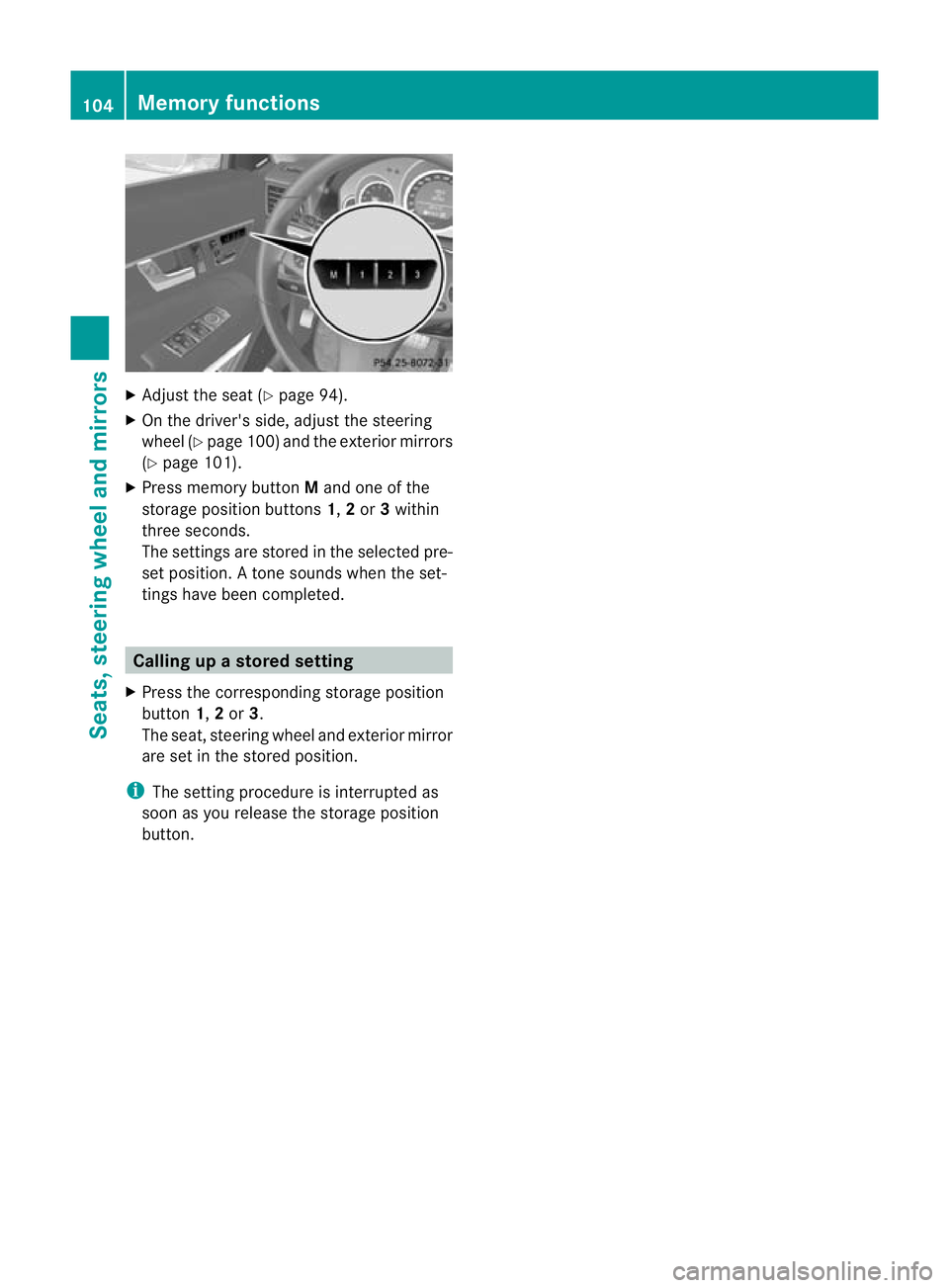
Adjust the sea t(Ypage 94).
X On the driver' sside, adjust the steering
wheel (Y page 100 )and the exterio rmirrors
(Y page 101).
X Press memory button Mand one of the
storage position buttons 1,2or 3within
three seconds.
The settings are stored in the selected pre-
set position .Atone sounds when the set-
tings have been completed. Calling up
astore dsetting
X Pres sthe co rresponding storage position
button 1,2or 3.
The seat ,steerin gwheel and exteri or mirror
are set in the store dposition.
i The settin gprocedure is interrup tedas
soon as you release the storage position
but ton. 104
Memory functionsSeats, steering wheel and mirrors
BA 207 ECE ÄJ 2010/1a; 1; 2, en-GB
mkalafa
Version: 3.0.2.11 2010-01-26T13:03:22+01:00-Seite1 04
Page 114 of 333
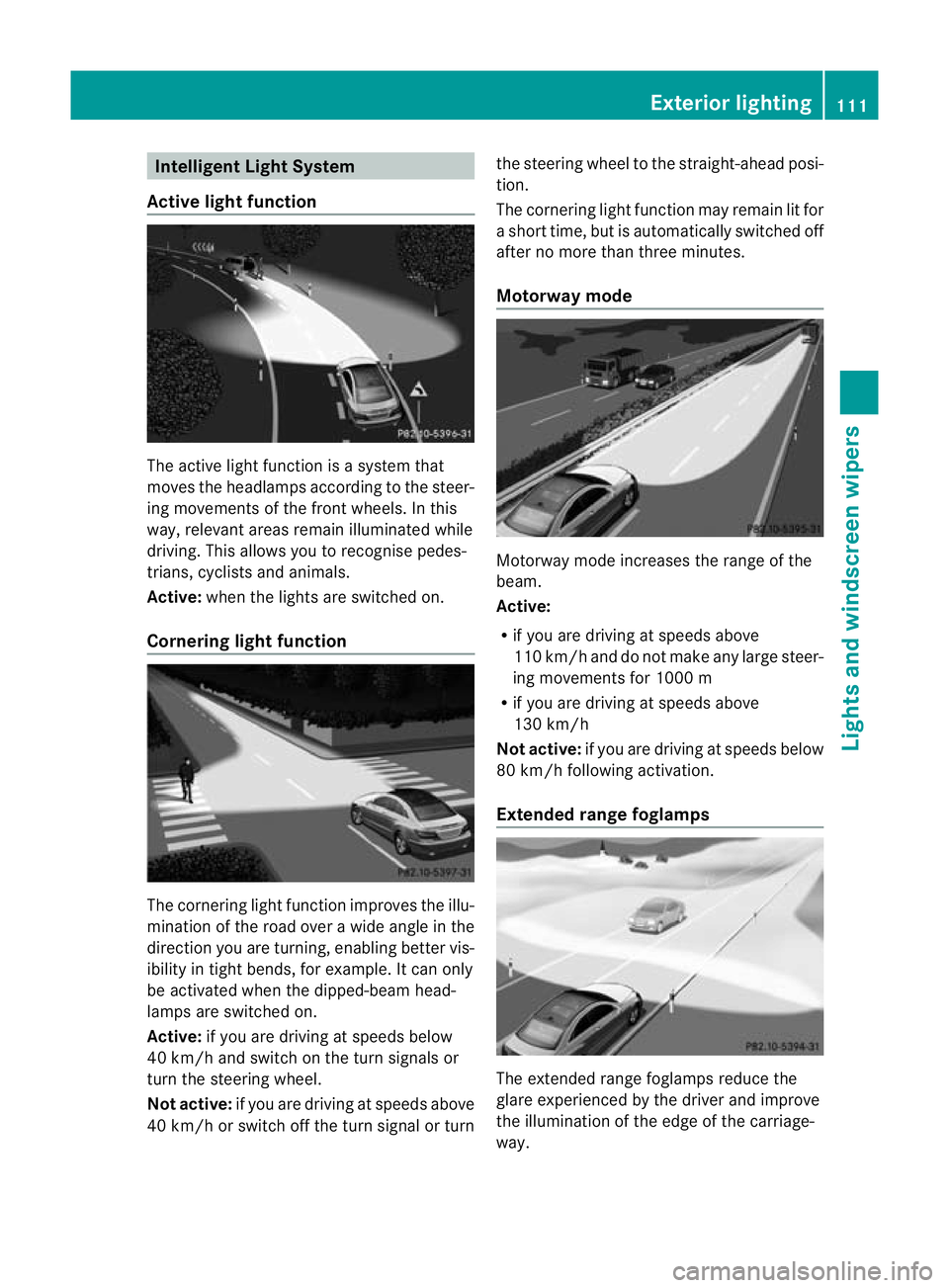
Intelligent Light System
Active light function The active light fun
ction is asystem that
moves the headlamps according to the steer-
ing movement softhe front wheels. In this
way, relevant areas remain illuminated while
driving. This allows you to recognise pedes-
trians, cyclists and animals.
Active: when the lights ar eswitched on.
Cornering light function The cornering light func
tion improves the illu-
mination of the roa dover awide angle in the
direction you are turning, enabling better vis-
ibility in tight bends, for example. It can only
be activated when the dipped-bea mhead-
lamps are switched on.
Active: if you are driving at speeds below
40 km /hand switch on the turn signals or
turn the steering wheel.
Not active: if you are driving at speeds above
40 km/ horswitch off the turn signal or turn the steerin
gwheel to the straight-ahea dposi-
tion.
The cor nering ligh tfunction may remain lit for
as hort time, but is automatically switc hed off
after no more than three minutes.
Motorway mode Motorway mode inc
reases the range of the
beam.
Active:
R if you are driving at speeds above
110 km/ hand do not make any large steer-
ing movements for 1000 m
R if yo uare drivin gatspeed sabove
130 km/h
Not active: if youare drivin gatspeed sbelow
80 km/h following activation.
Extended rang efogla mps The extende
drange foglamps reduce the
glar eexperience dbythe driver and im prove
the illumin ationoft he edge of the carriage-
way. Exterior lighting
111Lights and windscreen wipers
BA 207ECE ÄJ 2010 /1a;1;2,e n-GB
mkalafa Version: 3.0.2.11 2010-01-26T13:03:22+01:00-Seite 111 Z
Page 133 of 333

Adjusting th
eair vents
Important safety notes G
Ris
kofi njury
Ver yhot or ver ycold ai rcan flo wfromt he air
vents. This coul dcause burns or frostbite to
bare skin in the immediate vicinity of the
vents. Keep bare skin away from these air
outlets. If necessary, direct the airflow away
to ad ifferent area of the vehicle interior.
In order to ensure the direct flow of fresh air
through the air vent sinto the vehicl einterior,
please observe the following notes:
R keep the air inlet between the windscreen
and the bonne tfree of blockages ,such as
ice, snow or leaves
R never cover the vent sorair inlet and outlet
grilles in the vehicle interior
i For vir tually draught-free ventilation,
adjust the sliders of the air vents to the
centr eposition.
Setting th ecentr eair vents :
Centre air vent, left
; Centre air vent, right
= Centre ven tthumbwheel, right
? Centre ven tthumbwheel, left
X To open/close: turnthumbwheels =
and ?up or down. Setting th
eside air vents X
To open/close: turnthumbwheel =up or
down.
i Side window demister vent :is never
completely shut, even if side air vent ;is
shut.
Setting th eair vents in the glove com-
partment When automatic climate control is activated,
the glove compartmen
tcan be ventilated, for
instance to cool its con tents.The level of air-
flo wd epends on the airflow and air distribu-
tion settings.
! Close the air ven twhen heating the vehi-
cle.
At high outside temperatures, open the air
ven tand activate the "cooling with air dehu-
midification" function. Otherwise, temper-
ature-sensitive items stored in the glove
compartment could be damaged. :
Air vent thumbwheel
; Air vent 130
Operating climate control systemsClimate control
BA 207 ECE ÄJ 2010/1a; 1; 2, en-GB
mkalafa
Version: 3.0.2.11 2010-01-26T13:03:22+01:00-Seite 130
Page 134 of 333

X
To open/close: turn thumbwheel :
clockwis eoranti-clockwise.
Setting the rear-compartment air vents Setting the centre vents in the rear com-
partment
:
Rear-compartment air vent thumbwheel
; Rear-compartment air vent, right
= Rear control panel for THERMOTRONIC
luxury 3-zone automati cclimate control
? Rear-compartment air vent ,left
X To open/close: turnthumbwheel :up or
down.
Setting th eAIRSCARF vents G
Risk of injury
Very hot air can flow out of the AIRSCARF
vents in the head restraint swhen AIRSCARF
is in operation .This can cause burns on unpro-
tec teds kin near the AIRSCARF vents. Lower
the heating output in goo dtime, when neces-
sary. You can adjust the blower output of AIR-
SCARF vents
:using the AIRSCARF button
(Y page 98). Operating climate control systems
131Climatecontrol
BA 20 7ECE ÄJ 2010 /1a;1;2,e n-GB
mkalafa Version: 3.0.2.11 2010-01-26T13:03:22+01:00-Seite 131 Z
Page 137 of 333

Vehicl
eequipment
i Thismanua ldesc ribe sallthe standard
and optional equipment of your vehicle
which wa savailable at th etime of pur-
chase. Countr y-specif ic differences are
possible. Bear in mind tha tyour vehicle
ma ynot featur eall function sdescribed
here. Running-in notes
Important safet
yinstructions G
Risk of accident
New brake pads/lini ngso nly have optimal
braking performance after several hundred
kilome tres. Un tilt hen ,compensate for this by
applying greater force to the brake pedal. This
also applies when brake pads/linings or
brake discs have been changed. Th
ef irst 1500 km
The mor eyou look after the engin ewhen it is
new, the happier you will be with its perform-
anc eint he future.
R Therefore, drive at varying speeds and
engin espeeds for the first 1500 km.
R Avoi doverstrainin gthe vehicle during this
period, e.g. drivin gatfull throttle.
R Change gear in good time, at the latest
when the rev counter needle is 2
/ 3 of the
way to the red area in the rev counter dis-
play.
R Do not manually shift to alower gear to
brake the vehicle.
Vehicles with automatic transmission:
R If possible, do not depress the accelerator
pedal past the point of resistanc e(kick-
down).
R Only select shift ranges 3,2or 1whe ndriv-
ing slowly, e.g .inmountainou sterrain. Af
ter1 500 km, you may gradually bring the
vehicl euptof ull road and engine speeds.
i Also observe these running-in notes when
the vehicle's engine, front-axle transmis-
sion or differential have been replaced. Driving
Important safety notes
G
Risk of accident
Do not place any objects in the driver' sfoot-
well. If you use afloormat or carpet in the
driver's footwell, make sure that it is correctly
secured and that there is sufficient clearance
for the pedals.
Do not place several floormats on top of one
another.
Loose object sorthe floormats coul dother-
wise get caught between the pedals if you
accelerate or brake suddenly. You will then
not be able to brake, declutch or accelerate
as intended. Thi scould lead to accident sand
injury. G
Risk of accident
Do not chang edown for additional engine
brakin gonas lippery road surface. This could
cause the drive wheels to lose their grip and
the vehicle could skid. This could cause you
to lose control of your vehicle and cause an
accident.
! Warm up the engine quickly. Do not use
the engine's full performanc euntil it has
reache doperating temperature.
Only set the automatic transmission to the
respective driv eposition swhen the vehicle
is stationary.
Where possible, avoid spinnin gthe drive
wheels when pulling away on slippery
roads. Otherwise, you could damage the
drive train. 134
DrivingDriving and pa
rking
BA 20 7ECE ÄJ 2010 /1a; 1; 2, en-GB
mkalafa Version: 3.0.2.11 2010-01-26T13:03:22+01:00 -Seite 134
Page 140 of 333

!
Change gear in good time and avoid spin-
ning the wheels. Otherwise, you could dam-
age the vehicle.
i Follow the shift recommendations in the
multifunction displa yfor an economical
drivin gstyle.
i The vehicle locks centrally once you have
pulled away. The locking knobs in the doors
drop down.
You can ope nthe doors from the insid eat
any time.
You can also deactivate the automatic lock-
ing feature (Y page 208).
Automatic transmission i
It is only possibl etoshift the transmission
from position Pto the desired position if
you depress the brake pedal. Onl ythen is
the select or lever lock released.
X Depress th ebrake peda land keep it
depressed.
X Shift the transmissio ntoposition Dor R.
X Release the parkin gbrake (Y page 153).
X Releas ethe brake pedal.
X Carefully depress the accelerator pedal.
i The vehicle lock scentrally onc eyou have
pulled away .The lockin gknobs in the doors
drop down.
You can open the doors from the inside at
any time.
You can also deactivat ethe automatic lock-
ing featur e(Ypage 20 8).
i Upshif tstake place at higher engine
speeds after acold star t.This helps the
catalytic converter to reach its operating
temperature mor equickly.
Hill star tassist G
Risk of accident
Never leav ethe vehicle when it is held by hill
star tassist. Af tera pproximately one second, hill start assist will no longer brak
eyour vehi-
cle and it coul droll away.
Hill star tassist helps you when pulling away
forwards or in reverse on an uphil lgradient.
It hold sthe vehicle for ashort tim eafter you
have removed you rfoot from the brake pedal.
This gives you enough tim etomove your foot
from the brake pedal to the accelerator pedal
and depress it befor ethe vehicle begin sto
roll.
X Take your foo toff th ebrake pedal.
i Once yo uhave taken your foot off the
brake pedal, the vehicle is held for around
one second.
X Pull away.
Hill start assis twill not function if:
R you are pulling away on alevel road or a
downhill gradient.
R on vehicles with automatic transmission,
the transmission is in position N
R the vehicle is secured with the parking
brake.
R ESP ®
is malfunctioning. Switching off the engine
Important safety instructions G
Risk of accident
If the engin eisn ot run ning, there is no power
assistance for the steerin gand brakes. Steer-
ing and braking will then require significantly
greate reffort.
As aresult, yo umight lose contr olof the vehi-
cle, cause an acc identand injure yoursel fand
others.
Therefore, do not switch off the engine while
yo ua re driving. Dri
ving
137Driving and parking
BA 207 ECE ÄJ 2010/1a ;1;2,en-GB
mkalafa Version: 3.0.2.11 2010-01-26T13:03:22+01:00-Seite 137 Z
Page 145 of 333

For further information abou
tthe ECO start/
stop func tion (Y page 138). Engaging reverse gear
! Only engage reverse gear when the vehi-
cle is stationary, otherwise the transmis-
sion coul dbedamaged.
i The ECO start/stop function is not avail-
able when reverse gear is engaged.
More information about the ECO start/
stop function (Y page 138).
X Move the gear lever firmly to the left
beyond the point of resistance and then
forwards. Shift recommendation
The gearshift recommendations assis tyou in
adopting an economical drivin gstyle. The rec-
ommended gear is shown in the multifunction
display. X
Shift gear according to the gearshift rec-
ommendation :shown in the multifunc-
tion displa yofthe instrumen tcluster. Automatic transmission
Important safety notes
G
Risk of accident
The movemen tofthe pedals must not be
impaired in any way. Do not keep any objec ts in the driver's footwell. Make sure that floor-
mats or carpets are correctly secured and
that there is sufficient clearance for the ped-
als.
Do not place several floormats on top of one
another. G
Risk of accident
Do not change down for additional engine
braking on aslippery road surface. This could
cause the drive wheels to lose their grip and
the vehicle could skid. This could cause you
to lose control of your vehicle and cause an
accident. Selector lever
Overview of transmission positions Selector lever
P
Park position with selector lever lock
R Reverse
N Neutral
D Drive 142
Automatic transmissionDriving and parking
BA 207 ECE ÄJ 2010/1a; 1; 2, en-GB
mkalafa
Version: 3.0.2.11
2010-01-26T13:03:22+01:00
-Seite 142
Page 148 of 333

Steering wheel gearshif
tpaddles :
Left-hand steerin gwheel gearshift paddle
; Right-han dsteering whee lgearshif tpad-
dle
In the automatic drive program, you can
restric torderestrict the shift range by using
the steerin gwheel gearshift paddles or the
selector lever (Y page 145).
In the manua ldrive program, yo ucan change
gear using the steering wheel gearshift pad-
dles or the selector lever (Y page 145).
i You can only change gear with the steer-
ing wheel gearshift paddle swhen the trans-
mission is in position D.Automatic drive program
Drive program Eis characterised by the fol-
lowing:
R optimal fuel consumption resultin gfrom
th ea utomatic transmission shifting up
sooner
R the vehicle pulling away more gently in
forward and reverse gears, unless the
accelerator pedal is depressed fully
R increased sensitivity; this improves driving
stability on slippery road surfaces, for
example.
R the automatic transmission shifting up
sooner, which results in the vehicle being
driven at lower engine speeds and the
wheel sbeing less likely to spin Drive program
Sis characterised by the fol-
lowing:
R sporty engine and suspension configura-
tion
R the vehicle pulling away in first gear
R the automatic transmission shiftin gup
later
R the fuel consumption possibly being higher
as aresult of the later automatic transmis-
sion shift points Shif
tranges
Introduction When the automatic trans
mission is in posi-
tion D,itisp ossible to restric torderestrict
the shift range (Y page 145).
The shift range selected is shown in the mul-
tifunction display .The automatic transmis-
sion shift sonly as far as the selected gear. Driving situations
=
You can use the engi
ne'sbraking
effect. 5
To use the brakin
geffect of the
engine on do wnhill gradients and
for driving:
R on steep mounta inroads
R in mountainou sterrain
R in arduous conditions 4
To use the braking effect of the
engine on extremely steep downhill
gradients and long downhill
stretches
Restricting th
eshift range X
Press th eselector lever to the left towards
D– .
or
X Pull left -hand steering wheel gearshift pad-
dle.
The shift range is restricted. Automatic transmission
145Driving and parking
BA 207 ECE ÄJ 2010/1a; 1; 2, en-GB
mkalafa Version:3.0.2.11
2010-01-26T13:03:22+01:00
-Seite 145 Z
Page 149 of 333

i
In order to preven tthe engin efrom over-
revving, th eautomatic transmission does
not shift down when the engine spee dis
too high.
i If the maximum engine speed for the shift
range is reached and you continue to accel-
erate, the automatic transmission shifts up
in order to prevent the engine from over-
revving, even if the shift range is restricted.
Derestricting the shift range X
Briefly press the selector lever to the right
towards D+.
or
X Pul lright-hand steering whee lgearshift
paddle.
The shift range is derestric ted.
Clearing the shif trang erestriction X
Press and hold the selector lever towards
D+ until Dis shown onc emore in the mul-
tifunction display.
or
X Pull and hold the right -hand steering wheel
gearshift paddle until Dis shown again in
the multifunction display.
The automatic transmissio nshift sfrom the
curre ntshif trange directly to D.
Selectin gthe ideal shift range X
Press th eselector lever to the left towards
D– and hold it in position.
or
X Pull the left -hand steering wheel gearshift
paddle and hold it in position.
The automatic transmissio nshift stot he
gear whic hallows ideal acceleration and
deceleration .Todothis, the automatic
transmission shift sdown one or more
gears. Manua
ldrive program
Switchin gonthe man ualdrive program Manual drive program
Mcan be selected
using the program selector button. You can
change gears using the steerin gwheel gear-
shift paddle sorthe selector lever in manual
drive program Mif the transmission is in posi-
tion D.The gear selected is shown in the mul-
tifunc tion display.
X Press the program selector button
(Y page 144) repeatedly until Mappears in
the multifunction display.
Upshifting X
Briefl ypres sthe selector lever to the right
towards D+.
or
X Pull the right-hand steering wheel gearshift
paddle (Y page 145).
The automatic transmission shift suptothe
nex tgear.
Downshifting X
Briefly press the selector lever to the left
towards D–.
or
X Pull the left-hand steerin gwheel gearshift
paddle (Y page 145).
The automatic transmission shift sdown to
the next gear.
i If you desire maximum acceleration ,push
the selector lever to the left or pull and hold
the left-hand steering wheel gearshift pad-
dle until the transmission shifts to the opti-
mal gear for the current speed. 146
Automatic transmissionDrivin
gand pa rking
BA 20 7ECE ÄJ 2010 /1a;1;2,e n-GB
mkalafa Version: 3.0.2.11 2010-01-26T13:03:22+01:00-Seite 146
Page 156 of 333

Problem Possible causes/consequences and
M Solutions
X
Consult aqualified specialist workshop. Parking
Important safety notes
G
Risk of accident
Only remove the key from the ignition lock
when the vehicle is stationary, as you cannot
steer the vehicle when the key is removed.
Never leave children unsupervised in the vehi-
cle. They could release the parking brake. This
could lead to aserious or fatal accident. G
Risk of fire
Make sure that the exhaust system does not
under any circumstances com einto contact
with easily ignitable material such as dry grass
or petrol .Otherwise, the flammable material
may ignite and set the vehicle on fire.
To ensure that the vehicle is secured against
rolling away unintentionally:
R the parking brake must be appl ied.
R on vehicles wit hmanual transmission,
engage first gear or reverse gear.
R on vehicles with automatic transmission,
the transmissio nmust be in position Pand
the key must be removed from the ignition
lock.
R on steep uphill or downhill gradients, turn
the front wheel stowards the kerb. Parking brake
X
To ap ply:depress parking brake ;firmly.
The J indicator lamp in the instrument
cluster lights up if the engine is running.
X To release: depress the brak epedal and
keep it depressed.
X Pull release handle :.
The J indicator lam pint he instrument
cluster goes out. Parking
153Driving and pa rking
BA 20 7ECE ÄJ 2010 /1a;1;2,e n-GB
mkalafa Version: 3.0.2.11 2010-01-26T13:03:22+01:00-Seite 153 Z