ESP MERCEDES-BENZ E-CLASS CABRIOLET 2011 User Guide
[x] Cancel search | Manufacturer: MERCEDES-BENZ, Model Year: 2011, Model line: E-CLASS CABRIOLET, Model: MERCEDES-BENZ E-CLASS CABRIOLET 2011Pages: 353, PDF Size: 8.42 MB
Page 25 of 353
are listed in th
eoriginal purchase agreement
of your vehicle .Should you have any ques-
tions concerning equipment and operation,
please consult aMercedes-Ben zService
Centre. Operating safety
Safet
ynotes G
WARNING
All work on the vehicle and, in particular, work
relevant to safety or on safety-related sys-
tems must be carried out at aqualified spe-
cialist workshop. The specialist workshop
must have the necessary specialist knowl-
edge and tools to carry out the work required.
Mercedes-Benz recommends that you use a
Mercedes-Benz Service Centr efor this pur-
pose. G
WARNING
Some safety systems only function when the
engin eisrunning. You should therefore never
switch off the engin ewhen driving. Otherwise,
the safety systems of your vehicle may not
function correctly and as aresult will no lon-
ger protec tyou and other persons as inten-
ded. In addition, there is arisk that you may
lose control of your vehicle and thus cause an
accident. G
WARNING
Work carried out incorrectly, or alterations
made to the vehicle, e.g. re-routing of cables
under coverings, could cause the safety sys-
tems of your vehicle to stop working properly.
The safety systems would thus no longer pro-
tect you and other persons as intended. In
addition, there is arisk that you may lose con-
trol of your vehicle and thus cause an acci-
dent.
All work and alterations to the vehicle, e.g.
installations or modifications, should there-
fore be carried out at aqualifie dspecialist
workshop. G
WARNING
If work on electronic equipmen tand its soft-
ware is carried out incorrectly, this equipment
could stop working .The electronic systems
are networked via interfaces. Tampering with
these electronic systems could cause mal-
functions in systems which have not been
modified. Malfunctions such as these can
seriously jeopardise the vehicle's operating
safety and therefore your own safety.
You should therefore have all work and mod-
ifications to electronic components carried
out at aqualified specialist workshop. Qualified specialist workshop
Aq ualified specialist worksho phas th enec-
essary specialist knowledge, tools and quali-
fication stocorrectly carry out th ework
required on your vehicle. This is especially the
cas efor work relevan ttosafety.
Observ ethe information in th eServic eBook-
let.
Always have th efollowin gwork carried out at
aq ualified specialist workshop:
R work relevan ttosafety
R servic eand maintenance work
R repair work
R alterations, installation work and modifica-
tions
R work on electronic components
Mercedes-Ben zrecommends that you use a
Mercedes-BenzS ervice Centre. Vehicle registration
Mercedes-Benzm ay ask its Service Centres
to carry out technical inspection soncertain
vehicles to improve their quality or safety.
If you did not purchase your vehicle from an
authorised specialist dealer and your vehicle
has never been inspected at aMercedes-
BenzS ervice Centre, it is possible that your
vehicle is not registered in your name with 22
Introduction
Page 26 of 353
Mercedes-Benz. Mercedes-Ben
zcan only
inform you about vehicle checksifith as your
registration data.
It is advisabletor egister your vehicle with a
Mercedes-Ben zService Centre.
Inform Mercedes-Ben zassoon as possible
abouta ny change in address or vehicl eown-
ership. Correc
tuse G
WARNING
Various warning stickers are affixed to your
vehicle. Their purpose is to draw your atten-
tion ,and the attention of others ,tovarious
dangers. Therefore, do not remove any warn-
ing stickers unless the sticker clearly states
that you may do so.
If you remove the warning stickers, you or
others could be injured by failing to recognise
certain dangers.
Observe the following information when using
your vehicle:
R the safety notes in this manual
R the "Technical data" section in this manual
R national road traffic regulations
R national road traffic licensin gregulations Implied warranty
! Follow the instructions in this manual
about the proper operation of your vehicle
as well as about possible vehicle damage.
Damage to your vehicle that arises from
culpable contravention sagainst these
instructions are not covered either by
Mercedes-Benz implied warranty or by the
New or Used-Vehicle Warrant yof
Daimler AG. Data stored in the vehicle
Fault data
Components critical for vehicle operation are
equipped with fault data memories as stand-
ard. There are also data storage devices
which recor dthe technical reactions of vehi-
cle componentstoc ertain driving situations
(e.g. airbag deployment or ESP ®
interven-
tion).
This data is used exclusively to:
R assist in the rectification of faults and
defects
R help Mercedes-Benz optimise and develop
vehicle functions
The data cannot be used to trac ethe vehicle's
movements.
When your vehicle is serviced by Mercedes-
Benz ,this technical information can be read
out from the fault memory. This is performed
by authorised employees of the Mercedes-
Benz service network using special diagnos-
tic computers.
After afault has been rectified, the informa-
tion is deleted from the memory. Other mem-
ory data is constantly overwritten. Other devices thats
tore data
Depending on the equipment level, your vehi-
cle may feature communication sand/or
entertainment systems (e.g. navigation devi-
ces, telephon esystems). These allow you to
save and edit data required for the operation
of the respective device.
Further information on operation (e.g. on
deleting data) can be found in the separate
operating instructions. Introduction
23 Z
Page 33 of 353
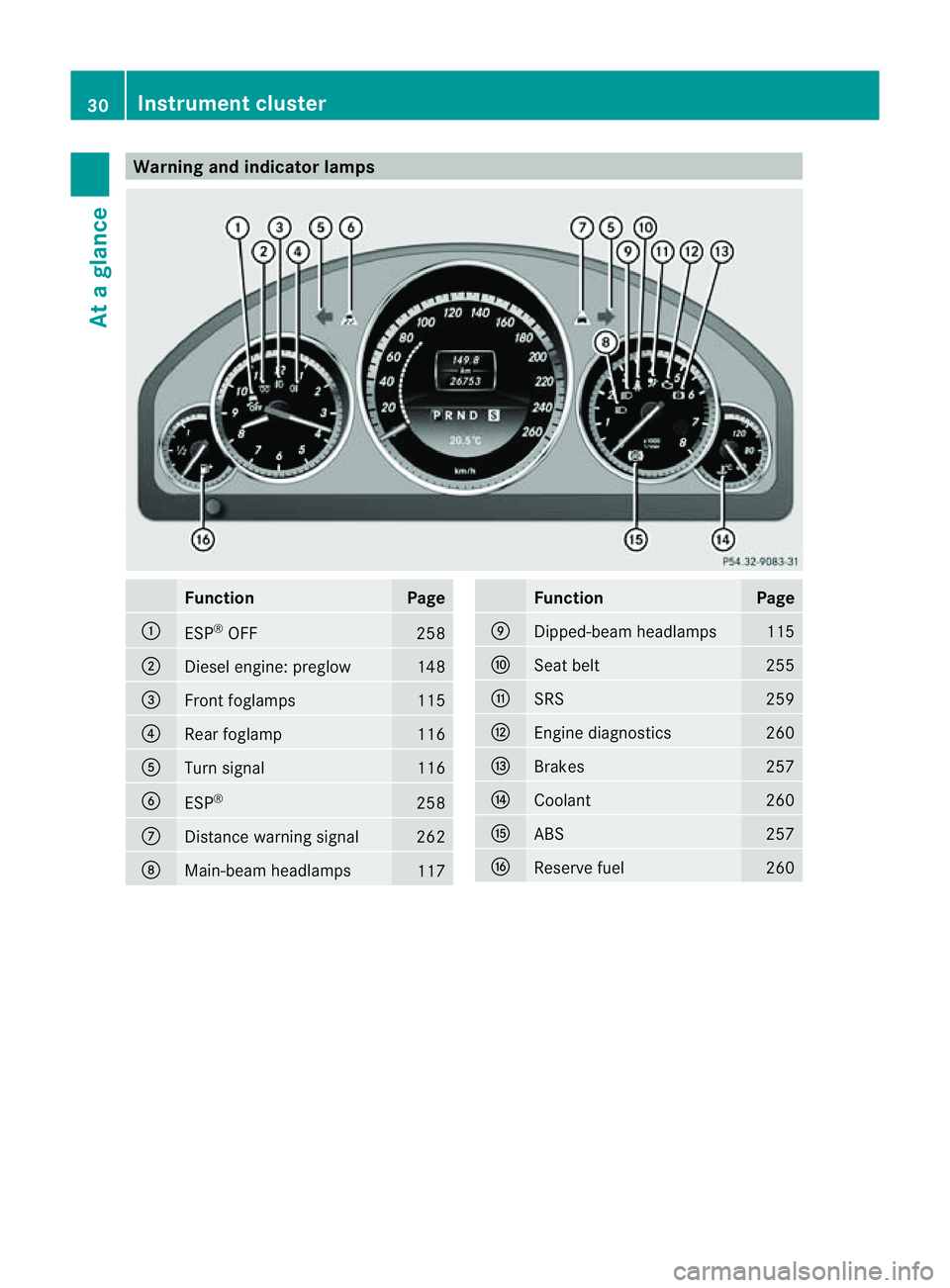
Warning and indicator lamps
Function Page
:
ESP
®
OFF 258
;
Diesel engine: preglow 148
=
Front foglamps 115
?
Rea
rfoglamp 116
A
Turn signal 116
B
ESP
® 258
C
Distance warning signal 262
D
Main-beam headlamps
117 Function Page
E
Dipped-beam headlamps 115
F
Seat belt 255
G
SRS 259
H
Engine diagnostics 260
I
Brakes 257
J
Coolant 260
K
ABS 257
L
Reserve fuel 26030
Instrument clusterAt
ag lance
Page 42 of 353
G
WARNING
Modifications to or work performe dincor-
rectly on the following parts can result in the
restraint systems not functioning as intended:
R the restraint system, consisting of seat
belts and their anchorage points, beltt en-
sioners, belt forc elimiters and airbags
R the wiring
R networked electronic systems
Airbags and belt tensioners could fail to
deploy or be triggered in an acciden tdespite
the deceleration forc ebeing sufficien ttotrig-
ger the systems, or could be triggered unin-
tentionally. For this reason, never make any
modifications to the restraint systems.
Therefore, you must not tamper with elec-
tronic components or their software. SRS (Supplemental Restraint System)
Introduction SRS consist
sof:
R the 6 SRS warning lamp
R airbags
R airbag control unit (with crash sensors)
R belt tensioners
R belt force limiters
SRS reduces the risk of occupant scoming
into contact with the vehicle's interior in the
event of an accident .Itcan also reduce the
effect of the forces to which occupant sare
subjected during an accident.
SRS warning lamp SRS functions are checked regularly when
you switch on the ignition and when the
engine is running. Therefore, malfunctions
can be detected in good time.
The 6 SRS warning lamp in the instrument
cluster lights up when the ignition is switched
on. It goes out no later than afew seconds
after the engine is started. G
WARNING
If SRS is malfunctioning, individual systems
may be activated unintentionally or may not
be triggered in the event of an accident with
ah igh rate of vehicle deceleration.
Am alfunction has occurred if:
R the 6 SRS warning lamp does not light
up when the ignition is switched on.
R the engine is runnin gand the 6SRS
warning lamp does not go out after afew
seconds.
R the engine is runnin gand the 6SRS
warning lamp lights up again.
In this case, have SRS checked immediately
at aq ualified specialist workshop. Mercedes-
Benz recommends that you use aMercedes-
Benz Service Centre for this purpose.
In particular, work relevant to safety or on
safety-related systems must be carried out at
aq ualified specialist workshop.
Triggering of belt tensioners, belt force
limiters and airbags During the first stage of
acollision, the airbag
control unit evaluates important physical
data relating to vehicle deceleration or accel-
eration, such as:
R duration
R direction
R magnitude
Based on the evaluation of this data, the air-
bag control unit pre-emptively triggers the
belt tensioners in the first stage.
i The belt tensioners can only be triggered
if the seat belt tongues are correctly
engaged in the seat belt buckles.
If there is an even higher rate of vehicle decel-
eration or acceleration in alongitudinal direc-
tion, the front airbags are also deployed.
Your vehicle has adaptive, two-stage front air-
bags. The airbag control unit evaluates vehi-
cle deceleration or acceleration in the event
of ac ollision. In the first deployment stage, Occupant safety
39Safety Z
Page 43 of 353
the front airba
gisfilledwith enoug hpropel-
lant ga storeducethe risk of injuries .The
front airbag is fully deployed if asecond
deployment threshold is exceeded within a
few milliseconds.
The belt tensioner and airbag triggering
thresholds are variable and are adapted to the
rate of deceleration or acceleration of the
vehicle. This process is pre-emptive in nature.
The triggering process must take place in
good time at the start of the collision.
i Airbags are not deployed in all types of
accidents. Also, not all airbags are
deployed together in an accident. The dif-
ferent airbag systems work independently
of each other.
How the airbag system works is deter-
mined by the severity of the collision detec-
ted, especiallyt he vehicle deceleration or
acceleration, and the apparent type of acci-
dent:
R head-on collision
R side impact
R rear impact
R Cabriolet: overturn
The rate of vehicle deceleration or accelera-
tion and the direction of the force are essen-
tially determined by:
R the distribution of forces during the colli-
sion
R the collision angle
R the deformation characteristics of the vehi-
cle
R the characteristics of the object with which
the vehicle has collided
Factors which can only be seen and measured
after acollision has occurred do not play a
decisive role in the deployment of an airbag,
nor do they provide an indication of airbag
deployment.
The vehicle may be deformed significantly,
e.g. the bonnet or the wing, without an airbag
being deployed. This is the case if only parts
which are relatively easily deformed are affec- ted and the rate of deceleration is not high.
Conversely, airbags may be deployed even
though the vehicle suffers only minor defor-
mation. This is the case if, for example, very
rigid vehicle parts such as longitudinal body
members are hit, and sufficient deceleration
occurs as
aresult. Airbags
Important safety notes Airbag deployment slows down and restricts
the movement of the vehicle occupant.
If the airbags are deployed, you will hear a
bang and asmall amount of powder may also
be released. Only in rare cases will the bang
affect your hearing. The powder that is
released generally does not constitute a
health hazard. The 6SRS warning lamp
lights up.
The airbag installation locations are identified
by the AIRBAG symbol. G
WARNING
Airbags provide additional protection; they
are not, however, asubstitute for seat belts.
Observe the following notes to reduce the risk
of serious or even fatal injury caused by airbag
deployment:
R All vehicle occupants –inparticular ,preg-
nan twome n–m ust wear their seat belt
correctly at all times and lean back against
th eb ackrest, whic hshoul dbep ositioned
as close to th evertical as possible. The
head restraint must support th eback of the
head at about eye level.
R Always secure childre nless than 1.50mt all
and unde r12years of age in suitable child
restraint systems.
R All vehicle occupant smust select aseat
position that is as far away from the airbag
as possible. The driver's seat position must
allow the vehicle to be driven safely. The
driver's chest should be as far away from 40
Occupant safetySafety
Page 44 of 353
the centr
eofthe driver's airba gcove ras
possible.
R Mov ethe front-passenge rseat as far back
as possible. This is especially important if
you have secured achild in achild restraint
system on the front-passenger seat.
R Vehicle occupant s–inparticular ,children
–m ust no tlean their heads in the area of
the window where:
- Coupé: the sidebag/windowbag
deploys.
- Cabriolet: the sidebag/headbag
deploys.
R Rearward-facin gchild restraint systems
must not be fitted to the front-passenger
seat unless the front-passenger airbag has
been disabled. On the front-passenger
seat, the front-passenger airbag is disabled
if ac hild restraint system with automatic
child seat recognition is fitted to the front-
passenger seat. The 4PASSENGER
AIRBA GOFF indicator lamp must be con-
tinuously lit.
If the front-passenger seat of your vehicle
does not have automatic child seat recog-
nition ,oryour rearward-facing child
restraint system does not have automatic
child seat recognition, children must be
secured in achild restraint system on a
suitable seat in the rear. If you secure a
forward-facing child restraint system to the
front-passenger seat, you must move the
front-passenger seat as far back as possi-
ble.
R Make sure there are no heavy or sharp-
edged objects in pockets of clothing.
R Do not lean forwards, e.g. over the cover of
the driver's/front-passenger airbag, partic-
ularly when the vehicle is in motion.
R Do not put your feet on the dashboard.
R Only hold the steerin gwheel by the rim.
This allows the airbag to deploy fully. You
could be injured if the airbag is deployed
and you are holding the inside of the steer-
ing wheel. R
Do not lean on the doors/rear sidewalls
from the inside.
R Make sure that there are no people, ani-
mals or objects between the vehicle occu-
pants and the area of deployment of the
airbag.
R Do not place any objects between the seat
backrest and the door.
R Do not hang any hard objects, for example,
coat hangers, on the grab handles or coat
hooks.
R Do not attac haccessories such as drinks
can holders to the doors/rear sidewalls.
It is not possible to rule out arisk of injury
being caused by an airbag due to the high
speed at which the airbag must be deployed. G
WARNING
Airbag functionality can only be assured if the
following parts are not covered and no badges
or stickers are attached to them:
R padded steerin gwheel boss
R kneebag cover below the steerin gcolumn
R front-passenger airbag cover
R outer side of fron tseat bolsters
R side trim nexttot he rear seat backrest
R Cabriolet: door trim G
WARNING
As mall amount of powder is released when
an airbag is deployed. The powder could
cause short-term breathing difficulties in peo-
ple with asthma or other respiratory prob-
lems.
In order to prevent breathing difficulties, you
should leave the vehicl eassoon as it is safe
to do so. You can alsoo pen the windowto
allow fresh air to enter the interior. The pow-
der does not constitute ahealth hazard and
does not indicat ethat there is afire in the
vehicle. Occupant safety
41Safety Z
Page 50 of 353
wearin
gbulky clothing, e.g .awinter coat.
The shoulde rbelt section must be routed
across the centre of your shoulder –onno
account across your neck or under your
arm –and pulled tight against your upper
body .The lap belt must always pass across
your lap as low down as possible, i.e. over
your hip joints–n ot across your abdomen.
If necessary, push down the belt strap
slightly and then retighten it in the roll-up
direction.
R Do not route the belt strap across sharp
edges or fragile objects, especially if these
are located on or in your clothing, e.g. spec-
tacles, pens, keys, etc. The seat belt strap
could be damaged and tear in an accident,
and you or other vehicle occupant scould
be injured.
R Only one person should use each seat belt
at any one time. Children must never travel
sittin gont he lap of other occupants. It
would not be possible to restrain the child
in the event of asudden change in direc-
tion, braking or an accident .This could
result in severe or even fatal injuries to the
child and other occupants.
R Persons less than 1.50 mtall cannot wear
the seat belts correctly. For this reason,
secure persons less than 1.50 mtall in spe-
cially designed ,suitable restraint systems.
R Children less than 1.50 mtall or unde r12
years of age canno twear the seat belts
properly. Therefore, they should alway sbe
secured in asuitable child restraint system
on asuitable vehicle seat. You can find
more information under "Children in the
vehicle" in the "Safety" section of the Own-
er's Manual. Follow the manufacturer's
installation instructions when fitting achild
restraint system.
R Do not secure any objects with aseat belt
if the seat belt is also being used by one of
the vehicle's occupants. G
WARNING
The seat belt does not offer the intended level
of protection unless the backrest is almost
vertical. Under certain circumstances, this
could cause severe or even fatal injuries in the
event of an accident.
Befor estarting ajourney, make sure that the
seat is properly adjusted and that the back-
rest is almost vertical. G
WARNING
Ad irtyord amaged seat belt or aseat belt that
has been subjected to aload in an accident
or which has been modified no longer offers
the intended level of protection. Under certain
circumstances, this could cause sever eor
even fatal injuries in the even tofanaccident.
For this reason, check regularly that the seat
belts are not damaged or dirty.
Alway shaved am aged sea tbelts or seat belts
that have been subjected to aload in an acci-
dent replaced at aqualified specialist work-
shop. Consult aqualified specialist workshop
which has the necessary specialist knowledge
and tools to carry out the work required.
Mercedes-Benz recommends that you use a
Mercedes-Benz Service Centr efor this pur-
pose.
For safety reasons, Mercedes-Benz recom-
mends that you only use seat belts which have
been approved by Mercedes-Benz for your
vehicle.
Fastening seat belts The seat-belt extender for the driver and front
passenger helps you fasten your seat belt. Occupant safety
47Safety Z
Page 51 of 353
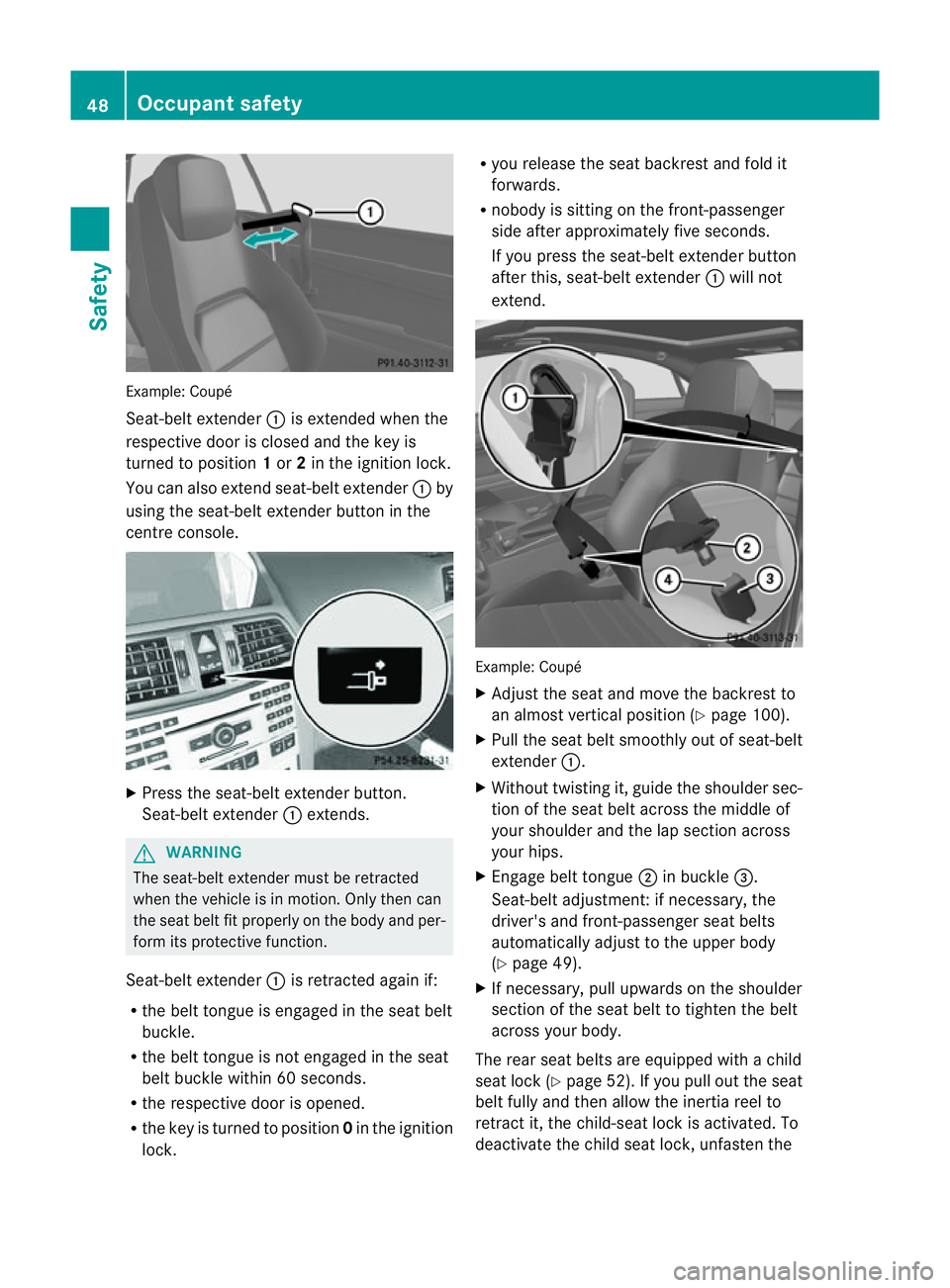
Example: Coupé
Seat-belt extender
:is extende dwhent he
respective door is closed and the key is
turned to position 1or 2in the ignition lock.
Yo uc an also extend seat-belt extender :by
using the seat-belt extende rbutton in the
centre console. X
Press th eseat-belt extender button.
Seat-belt extender :extends. G
WARNING
The seat-belt extender must be retracted
when th evehicl eisinm otion.Only then can
the sea tbelt fit properly on the body and per-
form its protective function.
Seat-belt extender :is retracted again if:
R the belt tongue is engaged in the seat belt
buckle.
R the belt tongue is not engaged in the seat
belt buckle within 60 seconds.
R the respective door is opened.
R the key is turned to position 0in the ignition
lock. R
you release the seat backrest and fold it
forwards.
R nobody is sitting on the front-passenger
side after approximately five seconds.
If you press the seat-belt extender button
after this, seat-belt extender :will not
extend. Example: Coupé
X
Adjust the seat and move the backrest to
an almost vertical position (Y page 100).
X Pull the seat belt smoothly out of seat-belt
extender :.
X Without twistin git, guide the shoulder sec-
tion of the seat belt across the middle of
your shoulder and the lap section across
your hips.
X Engage belt tongue ;in buckle =.
Seat-belt adjustment:ifn ecessary, the
driver's and front-passenger seat belts
automatically adjust to the upper body
(Y page 49).
X If necessary, pull upwards on the shoulder
section of the seat belt to tighten the belt
across your body.
The rear seat belts are equipped with achild
seat lock (Y page 52). If you pull out the seat
belt fully and then allow the inertia reel to
retract it, the child-seat lock is activated. To
deactivat ethe child seat lock, unfasten the 48
Occupant safetySafety
Page 55 of 353
tem could heat up and the child could burn
herself/himself on them.
If ac hild opens adoor, the child or othe rper-
sons could be injured as aresult. They could
get out and injure themselves or be injured by
ap assing vehicle.
Also observe the notes on HOLD .Relevant
information can be found in the index. G
WARNING
Unsecured or incorrectly positioned loads
increase the risk of injury for children and all
other occupant sinthe event of:
R an accident
R ab raking manoeuvre
R as udden change of direction
Do not carry heavy or hard objects in the vehi-
cle interior unless they are secured. You will
find further information under "Loading guide-
lines" in the index.
Child seat lock The seat belts on the rear seats are fitted with
ac
hild seat lock. When enabled, the child-
seat lock function ensures that the belt does
not slacken oncet he child seat is secured.
Installing achild restraint system:
X Always comply with the manufacturer's
installation instructions.
X Pull the seat belt smoothly from the inertia
reel.
X Engage the seat belt tongue in the belt
buckle.
Activating the child seat lock:
X Pull the seat belt out fully and let the inertia
reel retract it again.
While the seat belt is retracting, you should
hear aratchetin gsound. The child-seat lock
function is enabled.
X Push down on the child restraint system to
take up any slack. Removing
achild restraint system/deactivat-
ing the child seat lock:
X Always comply with the manufacturer's
installation instructions.
X Press the seat belt release button and
guide the belt tongue to the belt outlet.
The child-seat lock function is deactivated.
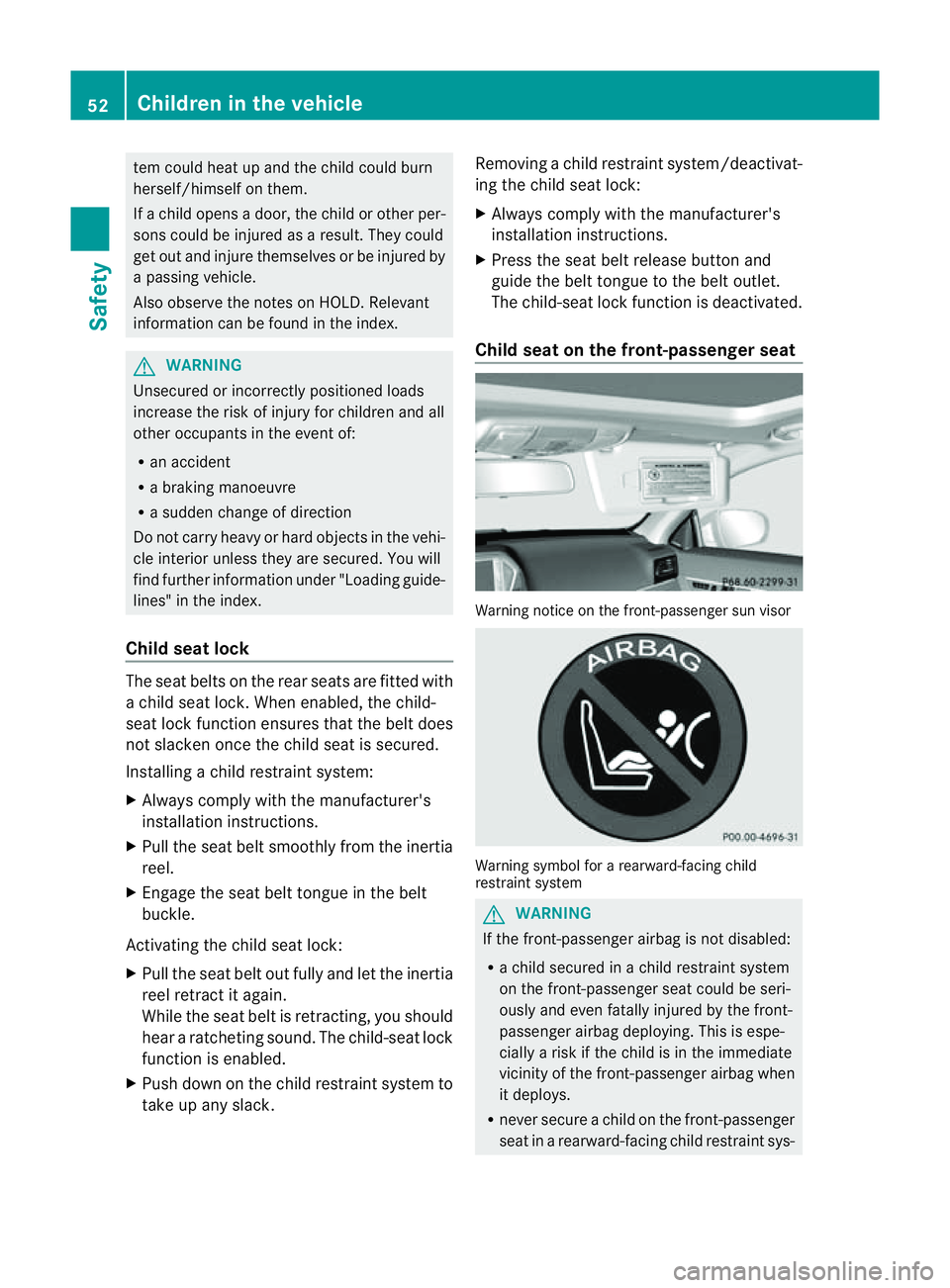
Child seat on the front-passenger seat Warning notice on the front-passenger sun visor
Warning symbol for
arearward-facing child
restraint system G
WARNING
If the front-passenger airbag is not disabled:
R ac hild secured in achild restraint system
on the front-passenger seat could be seri-
ously and even fatally injured by the front-
passenger airbag deploying. This is espe-
cially arisk if the child is in the immediate
vicinit yofthe front-passenger airbag when
it deploys.
R never secure achild on the front-passenger
seat in arearward-facing child restraint sys- 52
Children in thev
ehicleSafety
Page 64 of 353
Child-proof locks
Important safety notes G
WARNING
Do no tleave children unsupervised in the
vehicle, even if they are secured in achild
restraint system. They could injure them-
selves on parts of the vehicle. They could also
be seriously or even fatally injured by pro-
longed exposure to extreme heat or cold.
Do not expose the child restraint system to
direct sunlight. Parts of the child restraint sys-
tem could heat up and the child could burn
herself/himself on them.
If ac hild opens adoor, the child or other per-
sons could be injured as aresult. They could
get out and injure themselves or be injured by
ap assing vehicle.
Also observe the notes on HOLD .Relevant
information can be found in the index.
Override feature for the rear side win-
dows G
WARNING
Activate the override switch for the rear side
windows if children are travellin ginthe vehi-
cle. Otherwise, the children could open the
side windows while the vehicle is movin gand
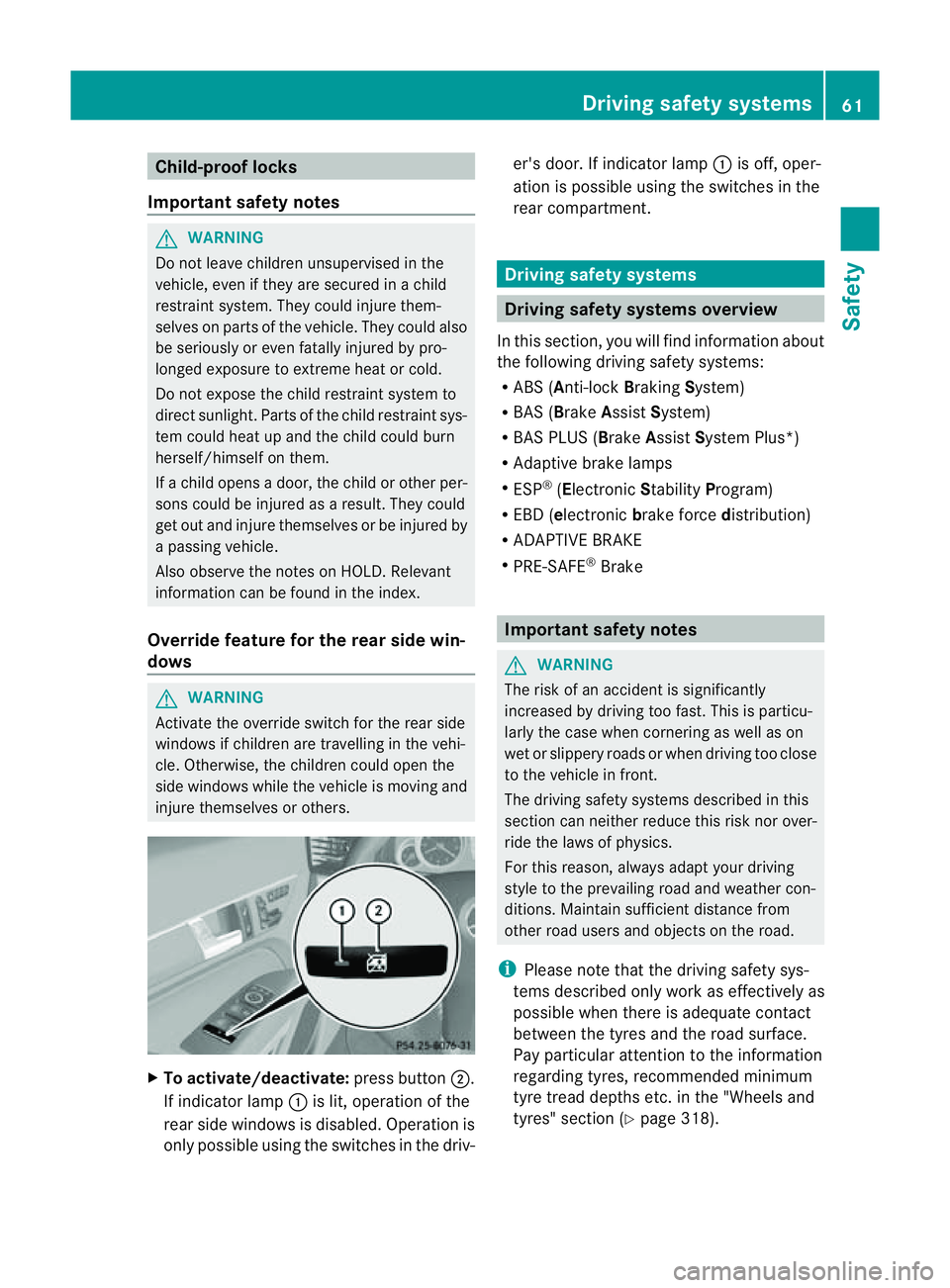
injure themselves or others. X
To activate/deactivate: press button;.
If indicator lamp :is lit, operation of the
rear side windows is disabled. Operation is
only possible using the switches in the driv- er's door. If indicator lamp
:is off, oper-
ation is possible using the switches in the
rear compartment. Driving safety systems
Driving safety system
soverview
In this section, you will find information about
the following driving safety systems:
R ABS (Anti-lock BrakingSystem)
R BAS (Brake AssistSystem)
R BAS PLUS ( BrakeAssist System Plus*)
R Adaptive brake lamps
R ESP ®
(Electronic StabilityProgram)
R EBD( electronic brake force distribution)
R ADAPTIV EBRAKE
R PRE-SAFE ®
Brake Important safety notes
G
WARNING
The risk of an acciden tissignificantly
increased by driving too fast. This is particu-
larly the case when cornering as well as on
wet or slippery roads or when driving too close
to the vehicle in front.
The driving safety systems described in this
section can neither reduce this risk nor over-
ride the laws of physics.
For this reason, always adapty our driving
style to the prevailing road and weather con-
ditions. Maintain sufficient distance from
other road users and object sonthe road.
i Please notet hat the driving safety sys-
tems described only work as effectively as
possible when there is adequate contact
between the tyres and the road surface.
Pay particular attention to the information
regarding tyres, recommended minimum
tyre tread depths etc. in the "Wheels and
tyres" section (Y page 318). Driving safety systems
61Safety Z