lock MERCEDES-BENZ E-CLASS SALOON 2015 Owners Manual
[x] Cancel search | Manufacturer: MERCEDES-BENZ, Model Year: 2015, Model line: E-CLASS SALOON, Model: MERCEDES-BENZ E-CLASS SALOON 2015Pages: 497, PDF Size: 16.23 MB
Page 329 of 497
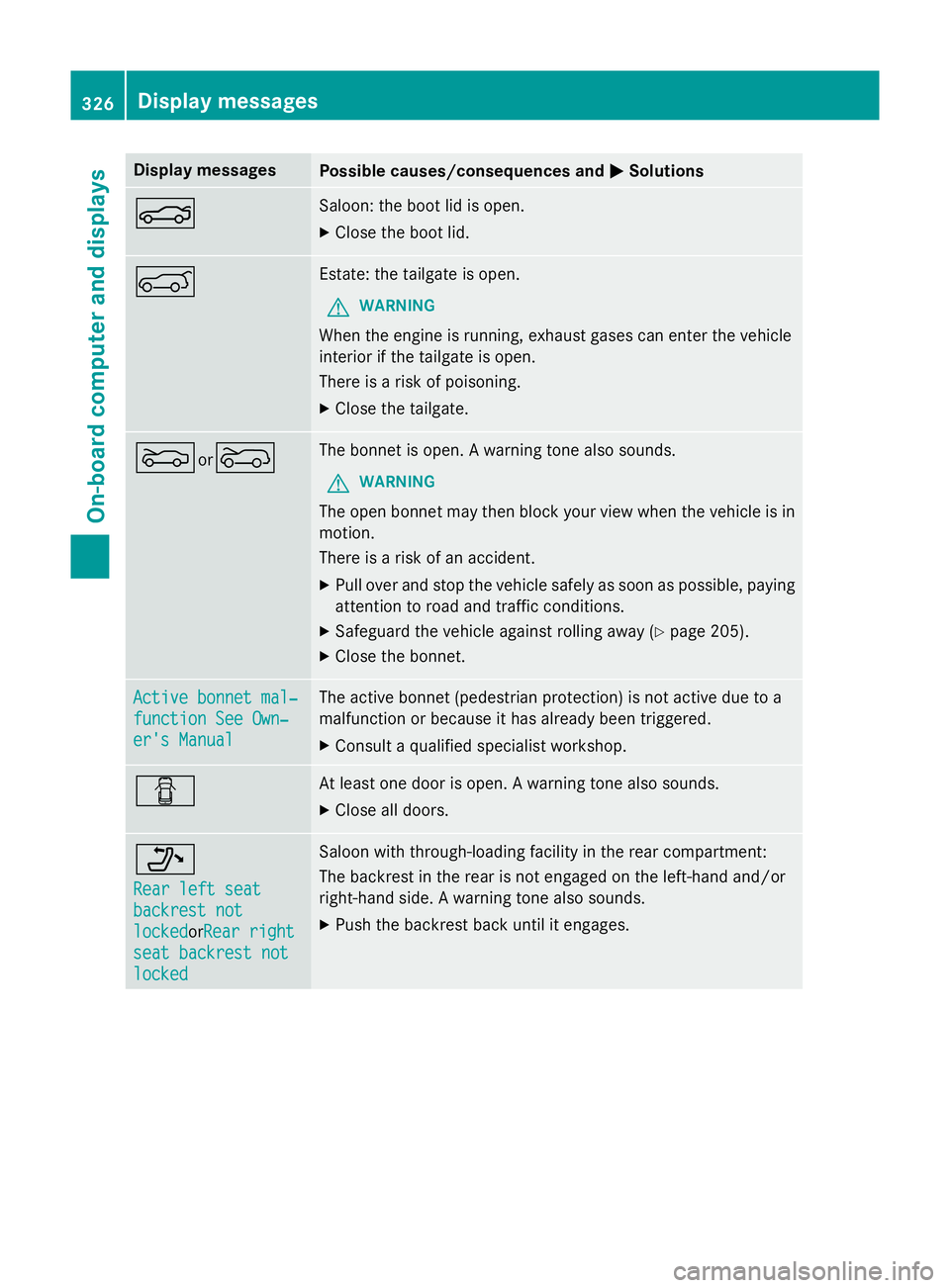
Display messages
Possible causes/consequences and
M
MSolutions N Saloon
:the boo tlid is open.
X Clos ethe boo tlid. A Estate: th
etailgat eisopen.
G WARNING
Whe nthe engin eisrunning ,exhaus tgase scan ente rthe vehicle
interio rifthetailgat eisopen.
There is ariskofp oisoning.
X Clos ethe tailgate. Mor
? The bonne
tisopen.Aw arnin gtonea lso sounds.
G WARNING
The open bonne tmay then bloc kyour vie wwhen th evehicl eisin
motion.
There is ariskofana ccident.
X Pull ove rand stop th evehicl esafely as soo naspossible, paying
attention to roa dand traffic conditions.
X Safeguar dthe vehicl eagainst rollin gaway (Y page 205).
X Clos ethe bonnet. Active bonnet mal‐ Active bonnet mal‐
function See Own‐ function See Own‐
er'
sM anual
er' sM anual The active bonne
t(pedestrian protection )isnotactive due to a
malfunction or because it has already been triggered.
X Consult aqualified specialist workshop. C At leas
tone doo riso pen.Aw arnin gtonea lso sounds.
X Clos eall doors. _
Rea
rl efts eat
Rea rl efts eat
backrest not backrest not
locked locked orRear right
Rea rr ight
sea tb ackrest not
sea tb ackrest not
locked
locked Saloon wit
hthrough-loading facilit yint he rear compartment:
The backrest in th erear is no tengage dont heleft-han dand/or
right-hand side .Awarnin gtonea lso sounds.
X Push th ebackrest bac kuntil it engages. 326
Display
messagesOn-boardcomputer an ddisplays
Page 330 of 497
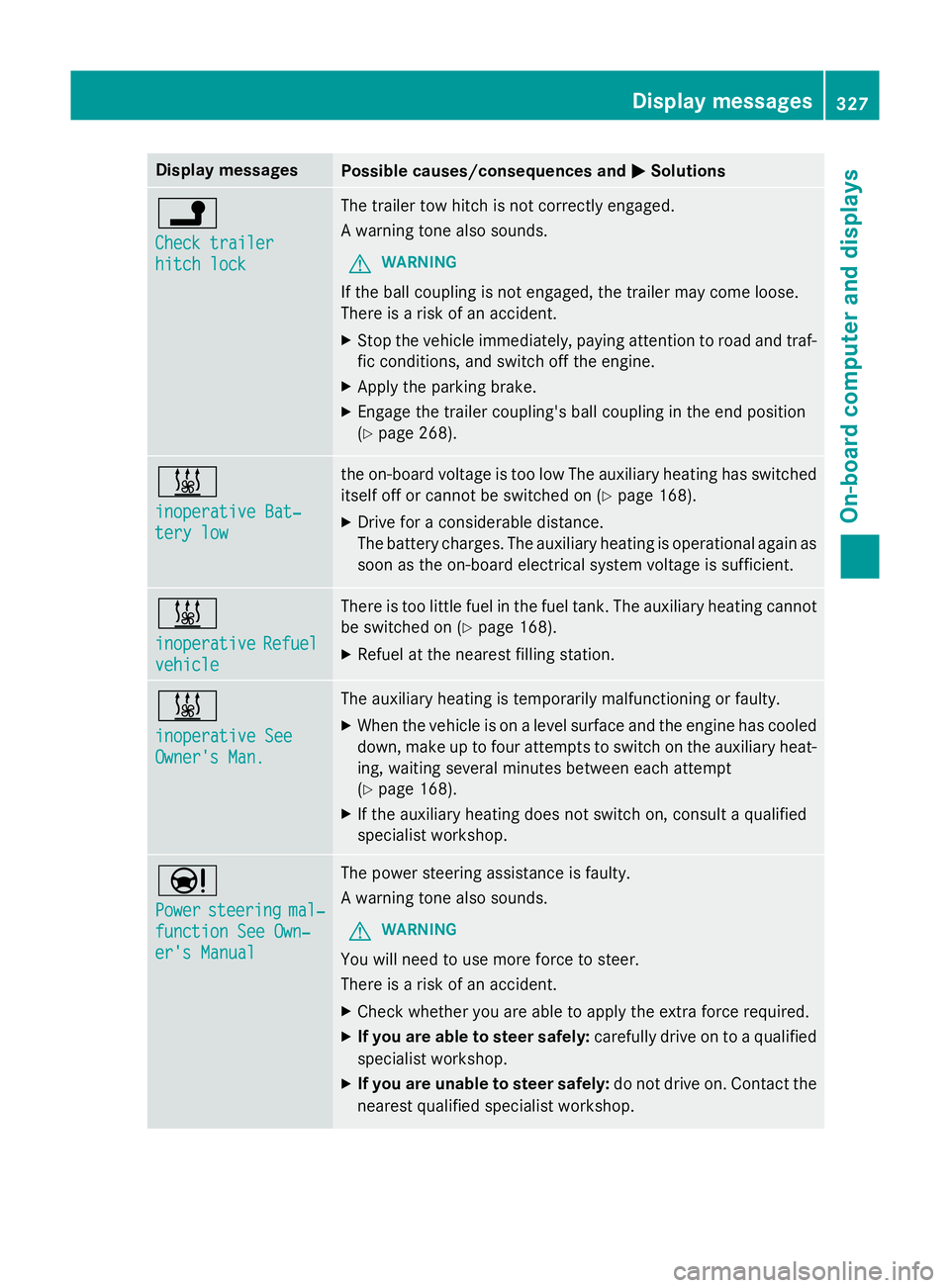
Display messages
Possible causes/consequences and
M
MSolutions j
Check trailer Check trailer
hitch lock hitch lock The trailer to
whitch is no tcorrectly engaged.
Aw arnin gtonea lso sounds.
G WARNING
If th eball couplin gisnotengaged, th etrailer may come loose.
There is ariskofana ccident.
X Stop th evehicl eimmediately, payin gattention to roa dand traf-
fic conditions, and switch of fthe engine.
X Apply th eparkin gbrake.
X Engage th etrailer coupling's ball couplin gintheendp osition
(Y page 268). &
inoperative Bat‐ inoperative Bat‐
ter
yl ow
ter yl ow th
eo n-bo ardv oltag eistoolow The auxiliar yheatin ghas switched
itself of forcannotbes witched on (Y page 168).
X Drive fo raconsid erable distance.
The battery charges. The auxiliar yheatin gisoperational again as
soo nast heon-boar delectrica lsystem voltag eissufficient. &
inoperative inoperative
Refuel
Refuel
vehicle
vehicle There is to
olittl efue lint hefuel tank. The auxiliar yheatin gcannot
be switched on (Y page 168).
X Refuel at th eneares tfillin gstation. &
inoperative See inoperative See
Owner'
sMan.
Owner' sMan. The auxiliar
yheatin gistemporarily malfunctionin gorfaulty.
X Whe nthe vehicl eisonal evel surfac eand th eengineh as cooled
down ,makeuptof oura ttempts to switch on th eauxiliar yheat-
ing, waitin gseveral minute sbetween eac hattempt
(Y page 168).
X If th eauxiliar yheatin gdoes no tswitch on ,consu ltaq ualified
specialist workshop. Ð
Power Power
steering
steering mal‐
mal‐
function See Own‐
function See Own‐
er' sM anual
er' sM anual The powe
rsteerin gassistanc eisfaulty.
Aw arnin gtonea lso sounds.
G WARNING
You will need to use mor eforce to steer.
There is ariskofana ccident.
X Chec kwhether you are able to apply th eextra forcerequired.
X If you ar eabletos teer safely: carefully drive on to aqualified
specialist workshop.
X If you ar eunable to steer safely: do notdrive on .Contac tthe
neares tqualified specialist workshop. Display
messages
327On-boardcomputer an ddisplays Z
Page 331 of 497
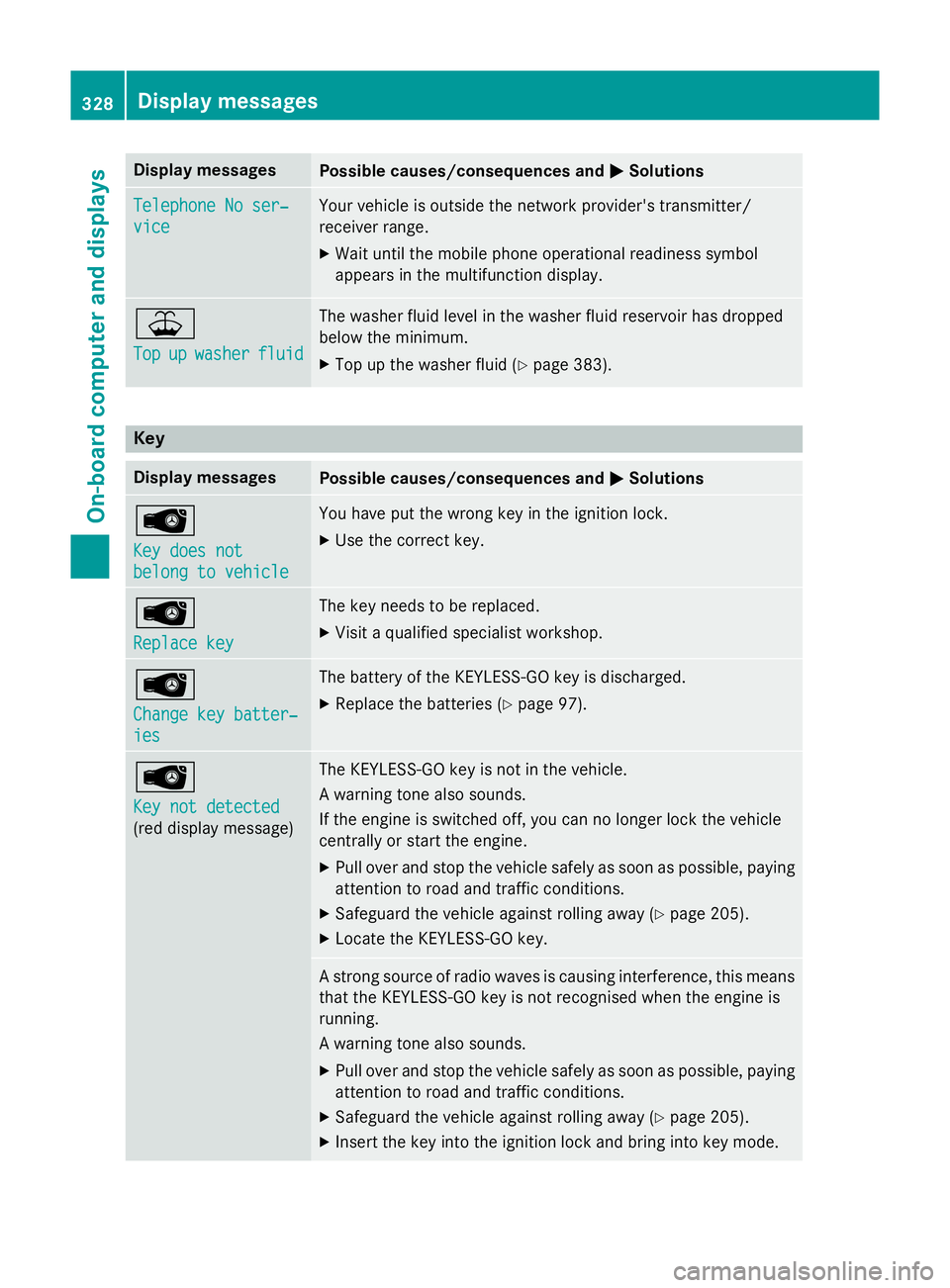
Display messages
Possible causes/consequences and
M
MSolutions Telephone No ser‐
Telephone No ser‐
vice vice Your vehicl
eisoutside th enetwo rk provider' stransmitter/
receiver range.
X Wait until th emobile phone operational readiness symbol
appears in th emultifunction display. ¥
Top Top
up
upwasher
washer fluid
fluid The washer flui
dlevel in th ewasher flui dreservoir has dropped
belo wthe minimum.
X Top up th ewasher flui d(Ypage 383). Key
Display messages
Possible causes/consequences and
M
MSolutions Â
Key doe
snot
Key doe snot
belong to vehicle belong to vehicle You hav
eput th ewrong ke yint he ignition lock.
X Use th ecorrect key. Â
Replac
ekey
Replac ekey The ke
yneeds to be replaced.
X Visit aqualified specialist workshop. Â
Change key batter‐ Change key batter‐
ies ies The battery of th
eKEYLESS-GO ke yisdischarged.
X Replac ethe batterie s(Ypage 97). Â
Key not detected Key not detected
(re
dd isplay message) The KEYLESS-GO ke
yisnotin th evehicle.
Aw arnin gtonea lso sounds.
If th eengineiss witched off, you can no longer loc kthe vehicle
centrall yorstart th eengine.
X Pull ove rand stop th evehicl esafely as soo naspossible, paying
attention to roa dand traffic conditions.
X Safeguar dthe vehicl eagainst rollin gaway (Y page 205).
X Locate th eKEYLESS-GO key. As
tron gs ource of radi owave sisc ausin ginterfe rence, this means
that th eKEYLESS-GO ke yisnotrecognised when th eengineis
running.
Aw arnin gtonea lso sounds.
X Pull ove rand stop th evehicl esafely as soo naspossible, paying
attention to roa dand traffic conditions.
X Safeguar dthe vehicl eagainst rollin gaway (Y page 205).
X Inser tthe keyintot he ignition loc kand bring into ke ymode. 328
Display
messagesOn-boardcomputer an ddisplays
Page 335 of 497
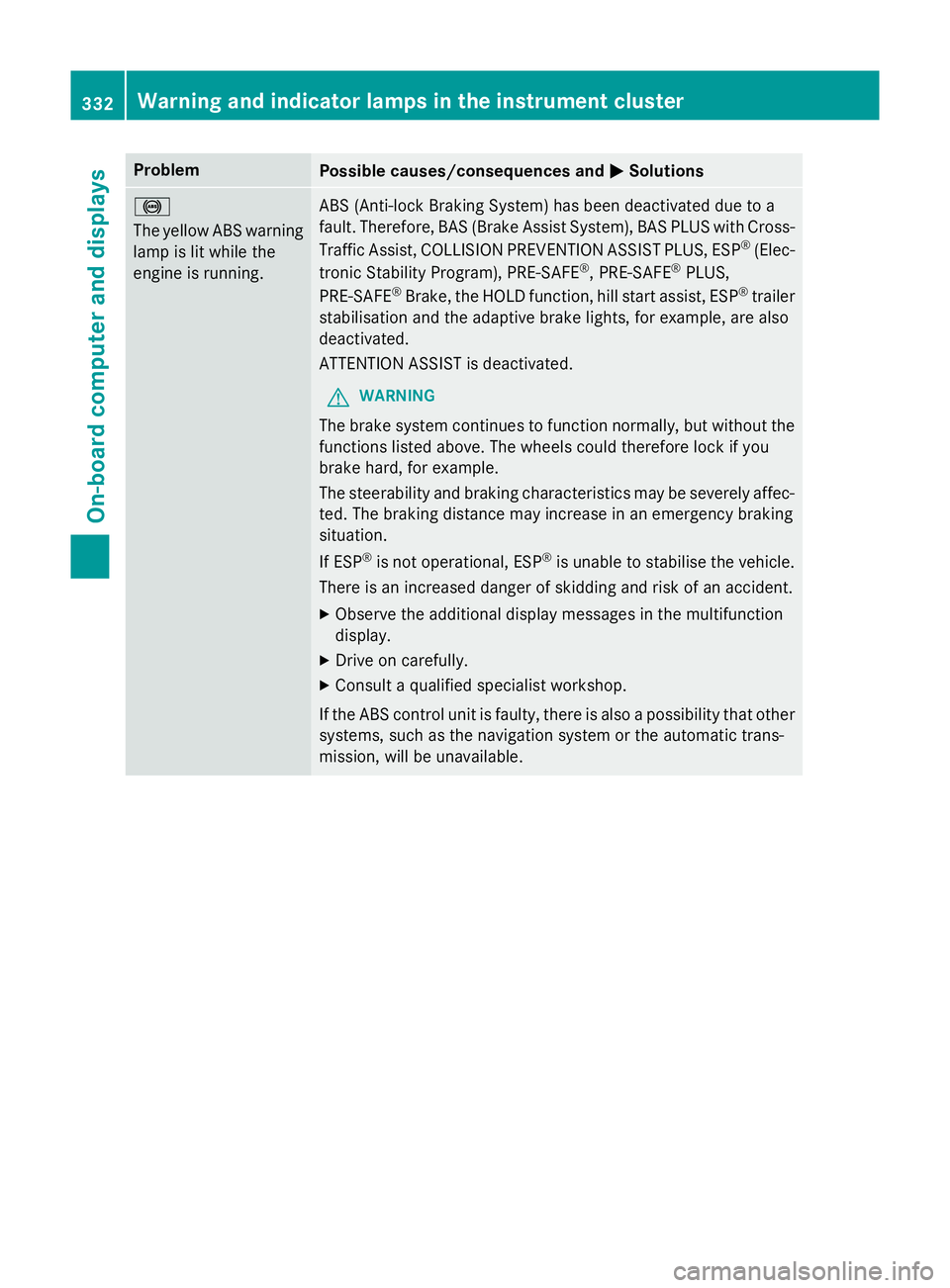
Problem
Possible causes/consequences and
M
MSolutions !
The yellowA
BS warning
lamp is lit while the
engine is running. ABS (Anti-lock Braking System) has been deactivated due to a
fault. Therefore, BAS (Brake Assist System), BAS PLUS with Cross-
Traffic Assist, COLLISION PREVENTION ASSIST PLUS, ESP ®
(Elec-
tronic Stability Program), PRE‑ SAFE®
,P RE‑SAFE ®
PLUS,
PRE‑SAFE ®
Brake, the HOLD function, hill start assist, ESP ®
trailer
stabilisation and the adaptive brake lights, for example, are also
deactivated.
ATTENTION ASSIST is deactivated.
G WARNING
The brake system continues to function normally, but without the functions listed above. The wheels could therefore lock if you
brake hard, for example.
The steerability and braking characteristics may be severely affec-ted. The braking distance may increase in an emergency braking
situation.
If ESP ®
is not operational, ESP ®
is unable to stabilise the vehicle.
There is an increased danger of skidding and risk of an accident.
X Observe the additional display messages in the multifunction
display.
X Drive on carefully.
X Consult aqualified specialist workshop.
If the ABS control unit is faulty, there is also apossibility that other
systems, such as the navigation system or the automatic trans-
mission, will be unavailable. 332
Warning and indicator lampsint
he instrument clusterOn-board computer and displays
Page 336 of 497
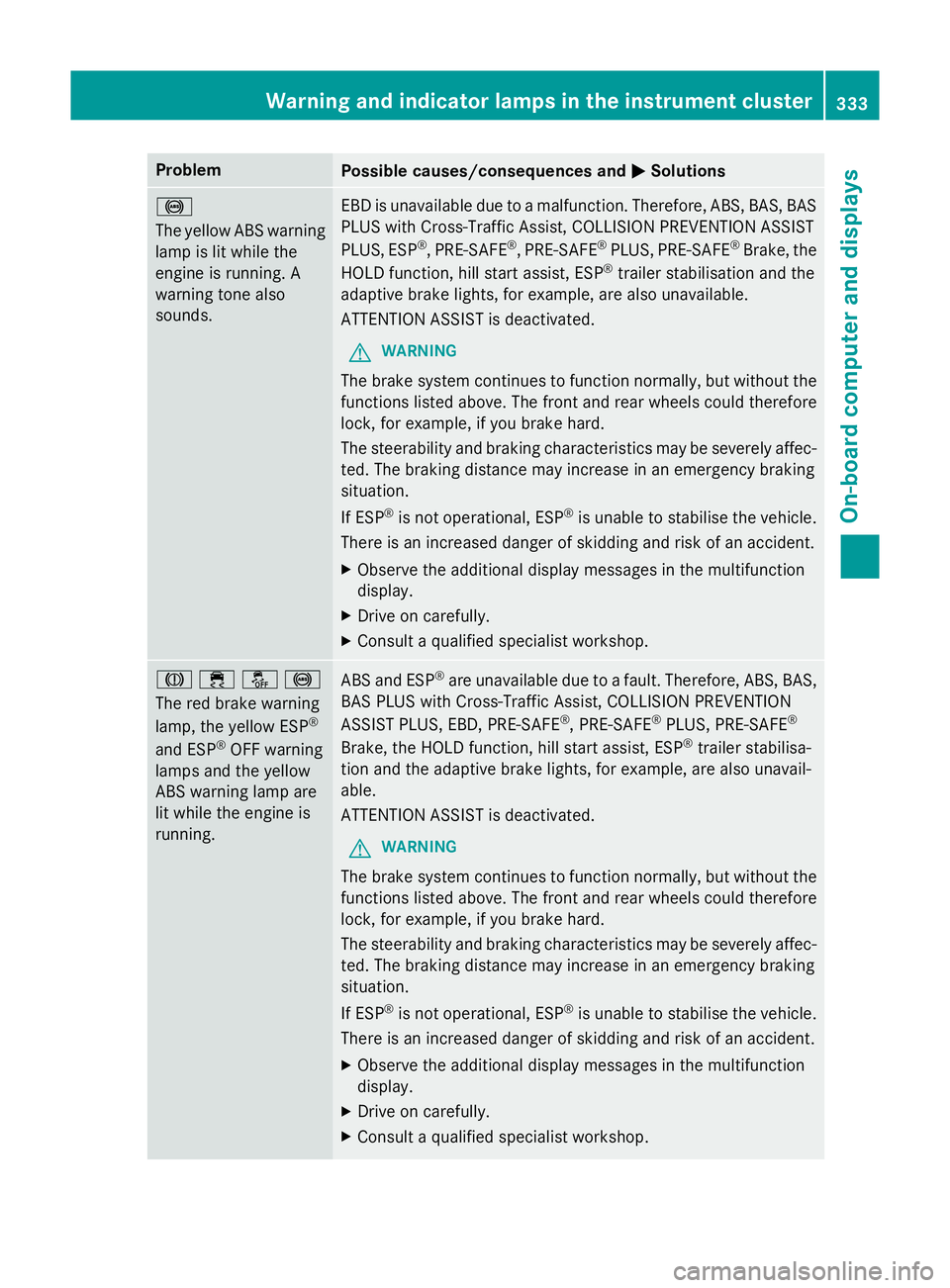
Problem
Possible causes/consequences and
M
MSolutions !
The yellowA
BS warning
lamp is lit while the
engine is running. A
warning tone also
sounds. EBD is unavailable due to
amalfunction .Therefore, ABS,B AS,BAS
PLUS with Cross-Traffic Assist, COLLISION PREVENTION ASSIST
PLUS, ESP ®
,P RE-SAFE ®
,P RE-SAFE ®
PLUS, PRE‑SAFE ®
Brake, the
HOLD function, hill start assist, ESP ®
trailer stabilisation and the
adaptive brake lights, for example, are also unavailable.
ATTENTION ASSIST is deactivated.
G WARNING
The brake system continues to function normally, but without the functions listed above. The front and rear wheels could therefore
lock, for example, if you brake hard.
The steerability and braking characteristics may be severely affec-ted. The braking distance may increase in an emergency braking
situation.
If ESP ®
is not operational, ESP ®
is unable to stabilise the vehicle.
There is an increased danger of skidding and risk of an accident.
X Observe the additional display messages in the multifunction
display.
X Drive on carefully.
X Consult aqualified specialist workshop. J
֌!
The red brake warning
lamp, the yellow ESP ®
and ESP ®
OFF warning
lamps and the yellow
ABS warning lamp are
lit while the engine is
running. ABS and ESP
®
are unavailabl edue to afault. Therefore, ABS,B AS,
BAS PLUS with Cross-Traffic Assist ,COLLISION PREVENTION
ASSIST PLUS, EBD,P RE-SAFE®
,P RE-SAFE ®
PLUS, PRE‑SA FE®
Brake, the HOLD function, hill start assist, ESP ®
trailer stabilisa-
tion and the adaptive brake lights, for example, are also unavail-
able.
ATTENTION ASSIST is deactivated.
G WARNING
The brake system continues to function normally, but without the functions listed above. The fronta nd rear wheels could therefore
lock, for example, if you brake hard.
The steerability and braking characteristics may be severely affec- ted. The braking distanc emay increase in an emergenc ybraking
situation.
If ESP ®
is not operational, ESP ®
is unable to stabilise the vehicle.
There is an increased danger of skidding and risk of an accident.
X Observe the additional display messages in the multifunction
display.
X Drive on carefully.
X Consult aqualified specialist workshop. Warning and indicator lampsint
he instrument cluster
333On-board computer and displays Z
Page 340 of 497
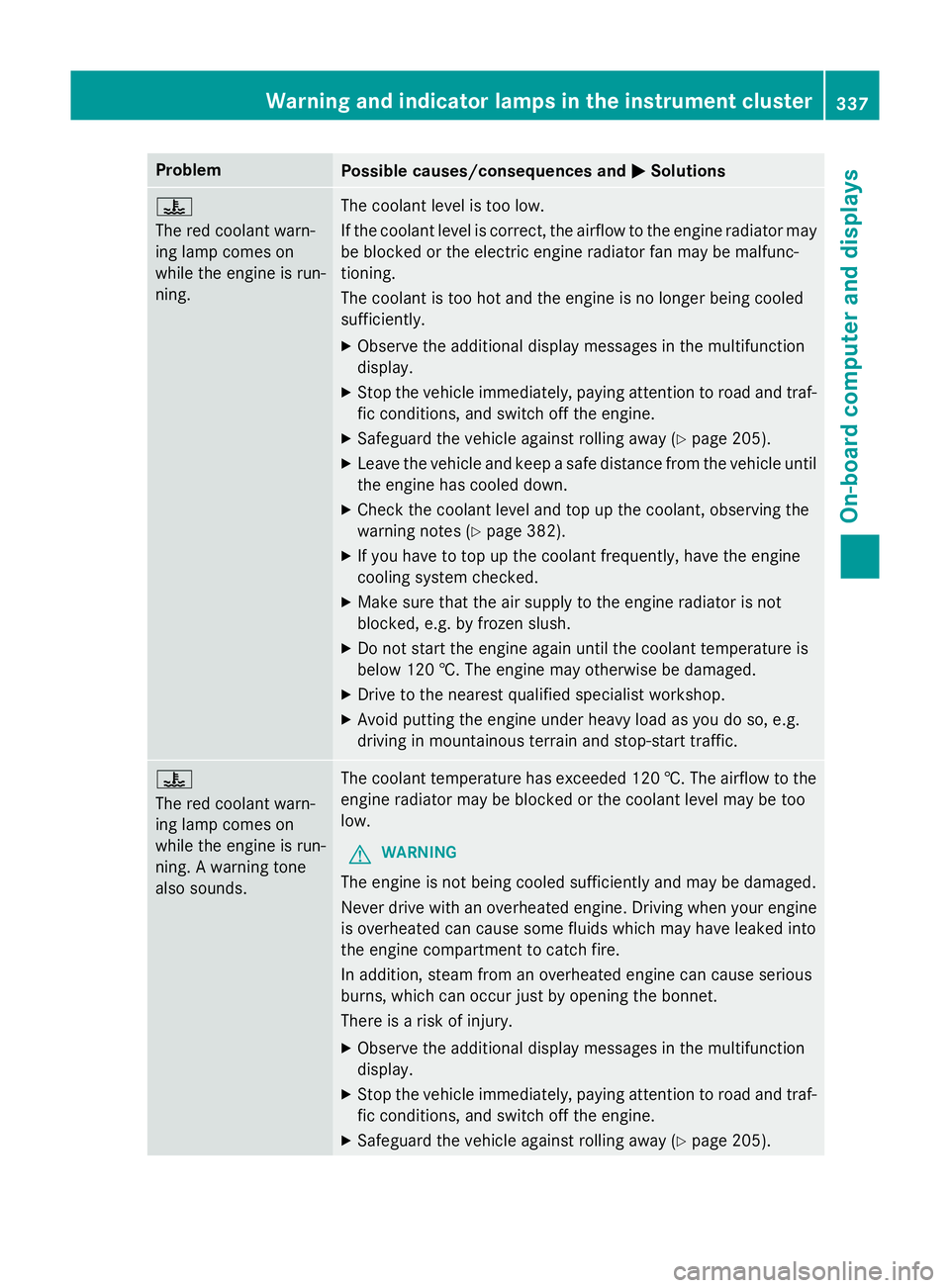
Problem
Possible causes/consequences and
M
MSolutions ?
The red coolant warn-
ing lamp comes on
while the engine is run-
ning.
The coolant level is too low.
If the coolant level is correct,t
he airflow to the engine radiator may
be blocked or the electric engine radiator fan may be malfunc-
tioning.
The coolant is too hot and the engine is no longer being cooled
sufficiently.
X Observe the additional display messages in the multifunction
display.
X Stop the vehicle immediately, paying attention to road and traf-
fic conditions, and switch off the engine.
X Safeguard the vehicle against rolling away (Y page 205).
X Leave the vehicle and keep asafe distance from the vehicle until
the engine has cooled down.
X Check the coolant level and top up the coolant, observing the
warning notes (Y page 382).
X If you have to top up the coolant frequently, have the engine
cooling system checked.
X Make sure that the air supply to the engine radiator is not
blocked, e.g. by frozen slush.
X Do not start the engine again until the coolant temperature is
below 120 †. The engine may otherwise be damaged.
X Drive to the nearest qualified specialist workshop.
X Avoid putting the engine under heavy load as you do so, e.g.
driving in mountainous terrain and stop-start traffic. ?
The red coolant warn-
ing lamp comes on
while the engine is run-
ning.
Awarning tone
also sounds. The coolant temperature has exceeded 120 †. The airflow to the
engine radiator may be blocked or the coolant level may be too
low.
G WARNING
The engine is not being cooled sufficiently and may be damaged.
Never drive with an overheated engine. Driving when your engine is overheated can cause some fluids which may have leaked into
the engine compartmen ttocatch fire.
In addition, steam from an overheated engine can cause serious
burns, which can occur just by opening the bonnet.
There is arisk of injury.
X Observe the additional display messages in the multifunction
display.
X Stop the vehicle immediately, paying attention to road and traf-
fic conditions, and switch off the engine.
X Safeguard the vehicle against rolling away (Y page 205).Warning and indicator lampsint
he instrument cluster
337On-board computer and displays Z
Page 341 of 497
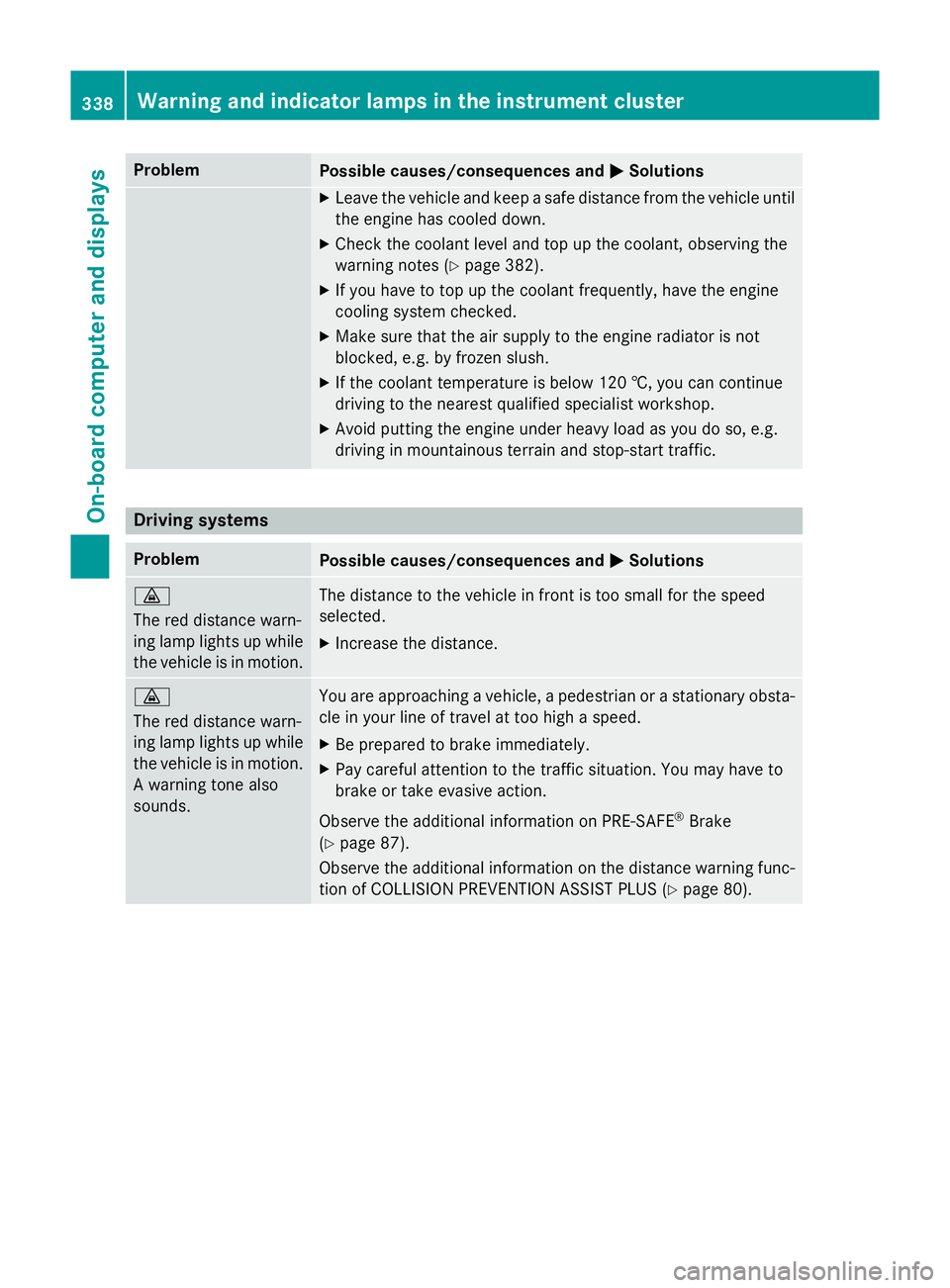
Problem
Possible causes/consequences and
M
MSolutions X
Leave the vehicle and keep asafe distance from the vehicle until
the engine has cooled down.
X Check the coolant level and top up the coolant, observing the
warning notes (Y page 382).
X If you have to top up the coolant frequently, have the engine
cooling system checked.
X Make sure that the air supply to the engine radiator is not
blocked, e.g. by frozen slush.
X If the coolant temperature is below 120 †, you can continue
driving to the nearest qualified specialist workshop.
X Avoid putting the engine under heavy load as you do so, e.g.
driving in mountainous terrain and stop-start traffic. Driving systems
Problem
Possible causes/consequences and
M MSolutions ·
The red distance warn-
ing lamp lights up while
the vehicle is in motion. The distance to the vehicle in front is too small for the speed
selected.
X Increase the distance. ·
The red distance warn-
ing lamp lights up while
the vehicle is in motion. Aw arning tone also
sounds. You are approaching
avehicle, apedestrian or astationary obsta-
cle in your line of travel at too high aspeed.
X Be prepared to brake immediately.
X Pay careful attention to the traffic situation. You may have to
brake or take evasive action.
Observe the additional information on PRE‑ SAFE®
Brake
(Y page 87).
Observe the additional information on the distance warning func-
tion of COLLISION PREVENTION ASSIST PLUS (Y page 80).338
Warning and indicator lampsint
he instrument clusterOn-board computer and displays
Page 345 of 497
Useful information
i This Owner's Manual describes all mod-
els, series and optional equipment for your
vehicle that were available at the time of
going to press. National variation sare pos-
sible. Not ethat your vehicle may not be
equipped with all of the function sdescri-
bed. This is also the case for system sand
function srelevan ttosafety.
i Read the information on qualified special-
ist workshops: (Y page 27). Stowage areas
Loading guidelines
G
WARNING
If objects, luggage or loads are not secured or not secured sufficiently, they could slip, tip
over or be flung around and thereby hit vehicle
occupants .There is arisk of injury, especially
when brakin gorabruptly changing directions.
Always stor eobjects so that they cannot be
flung around. Secure objects, luggage or
loads against slipping or tippin gbefore the
journey. G
WARNING
Combustion engines emit poisonous exhaust
gases such as carbon monoxide. Exhaust
gases can enter the vehicle interior if the boot
lid/tailgat eisopen when the engin eisrun-
ning, especially if the vehicle is in motion.
There is arisk of poisoning.
Always switc hoff the engin ebefore opening
the boot lid/tailgate. Never drive with the
boot lid/tailgat eopen. G
WARNING
The exhaust tail pipe and tail pipe trim can
becom every hot. If you come int ocontact
with thes eparts of the vehicle, you could burn
yourself. There is arisk of injury. Always be particularly careful around the
exhaust tail pipe and the tail pipe trim .Allow
thes ecomponents to cool down before touch-
ing them.
The handling characteristic sofaladen vehi-
cle are dependen tonthe distribution of the
load within the vehicle. For this reason ,you
should observ ethe following notes when
transporting aload:
R neve rexceed the maximum permissible
gross vehicle weight or the permissible axle loads for the vehicle (includin goccupants).
R the boot/luggage compartment is the pre-
ferred place to stor eobjects.
R position heavy loads as far forwards as pos-
sible and as low down in the boot/luggagecompartment as possible.
R the load must not protrude above the upper
edge of the seat backrests.
R always place the load against the rear or
fron tseat backrests .Make sure that the
seat backrests are securely locked into
place.
R always place the load behind unoccupied
seats if possible.
R use the lashing eyelets and the luggage
net stot ransport loads and luggage.
R only use lashing eyelets and fastenin gcom-
ponents that are suitable for the weight and size of the load.
R when transporting objects in the luggage
compartment,t he combined luggage cover
and net must always be installed (luggage
compartment cove rand safet ynet).
R secure the load with sufficiently strong and
wear-resistan tlashing material. Pad sharp
edges for protection.
i Load restraint
sare available at any quali-
fied specialist workshop, e.g. aMercedes-
Ben zService Centre. 342
Stowage areasStowing and features
Page 346 of 497
Stowage compartments
Important safety notes G
WARNING
If objectsint he passenger compartmen tare
stowed incorrectly, they can slide or be
thrown around and hit vehicle occupants.
There is arisk of injury, particularly in the
event of sudden braking or asudden change
in direction.
R Always stow objectssot hat they cannot be
thrown around in such situations.
R Always make sure that objectsdon ot pro-
trude from stowage spaces, luggage nets or stowage nets.
R Close the lockable stowage spaces while
driving.
R Always stow and secure heavy, hard, poin-
ted, sharp-edged, fragile or bulky objectsin
the boot/luggage compartment.
Observe the loading guidelines (Y page 342).
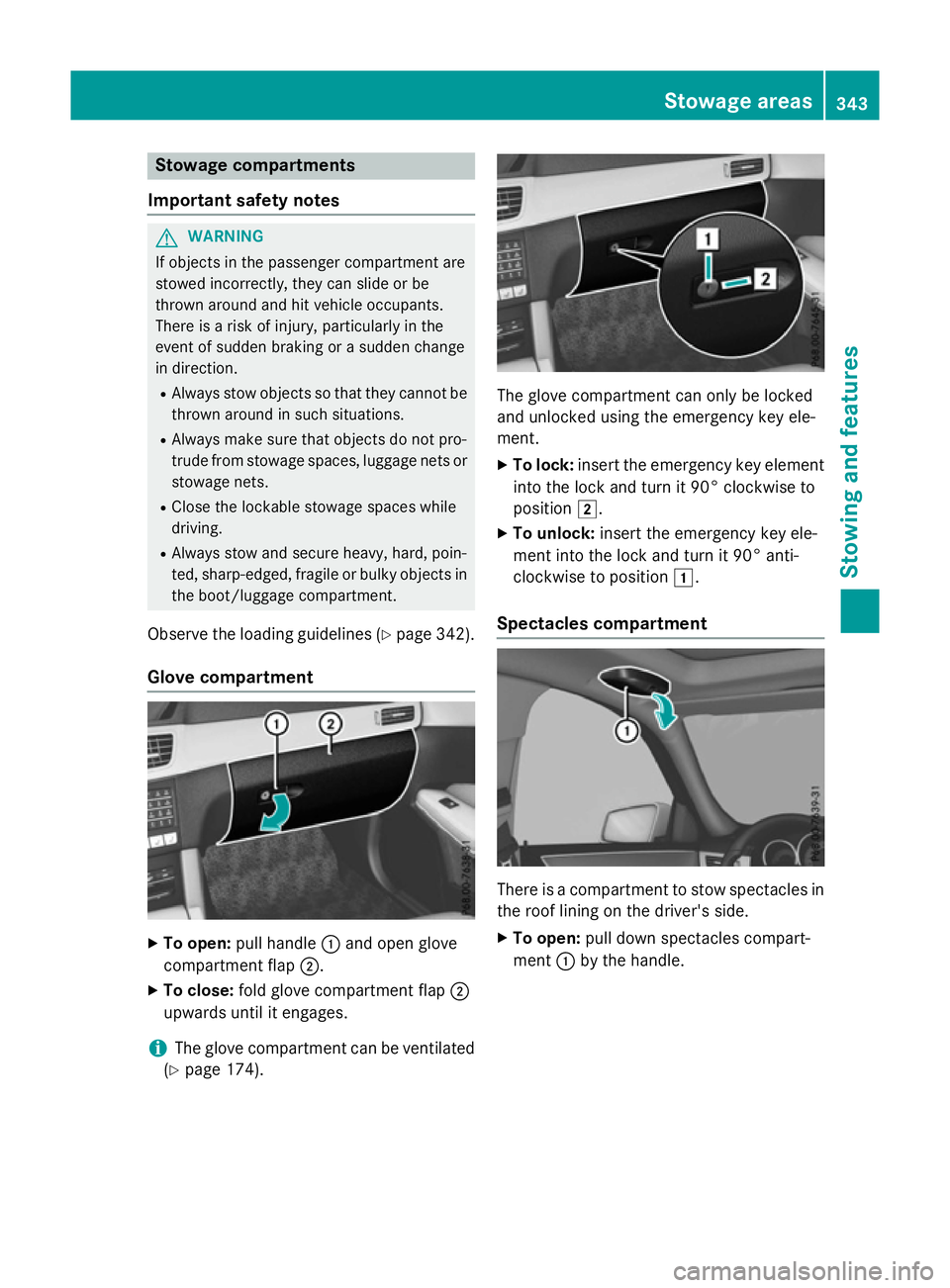
Glove compartment X
To open: pull handle :and open glove
compartmen tflap ;.
X To close: fold glove compartmen tflap ;
upwards until it engages.
i The glove compartmen
tcan be ventilated
(Y page 174). The glove compartmen
tcan only be locked
and unlocked using the emergency key ele-
ment.
X To lock: insert the emergency key element
into the lock and turn it 90° clockwise to
position 2.
X To unlock: insert the emergency key ele-
ment into the lock and turn it 90° anti-
clockwise to position 1.
Spectacles compartment There is
acompartmen ttostow spectacles in
the roof lining on the driver's side.
X To open: pull down spectacles compart-
ment :by the handle. Stowage areas
343Stowing and features Z
Page 352 of 497
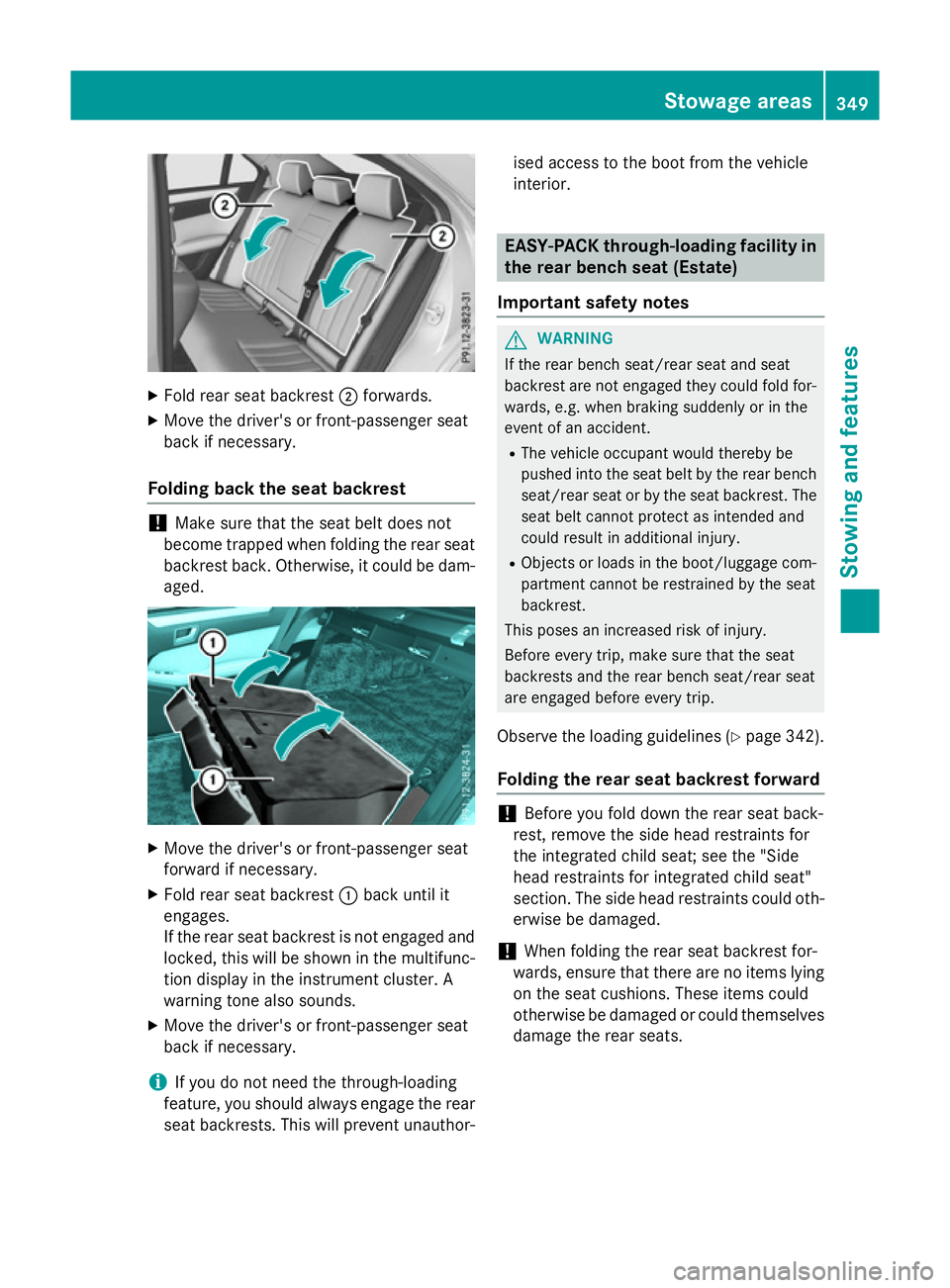
X
Fold rea rseatb ackrest ;forwards.
X Move the driver' sorfront-passenger seat
back if necessary.
Folding bac kthe seat backrest !
Make sure that the sea
tbeltd oesn ot
become trapped whe nfolding the rea rseat
backrest back. Otherwise, it could be dam- aged. X
Move the driver' sorfront-passenger seat
forward if necessary.
X Fold rea rseatb ackrest :back unti lit
engages.
If the rea rsea tb ackrest is not engaged and
locked, this will be shown in the multifunc-
tion display in the instrument cluster. A
warning tone also sounds.
X Move the driver' sorfront-passenger seat
back if necessary.
i If yo
udon ot need the through-loading
feature ,you shoul dalway sengage the rear
sea tbackrests. Thi swillp revent unauthor- ise
da ccess to the boo tfrom the vehicle
interior. EASY-PACK through-loadin
gfacility in
the rear benc hseat(Es tate)
Important safety notes G
WARNING
If the rea rbench seat/rea rseata nd seat
backrest are not engaged they could fol dfor-
wards, e.g. whe nbraking suddenl yorinthe
event of an accident.
R The vehicle occupant would thereby be
pushe dinto the sea tbeltb ythe rea rbench
seat/rea rseatorb ythe sea tbackrest. The
sea tbeltc annot protect as intended and
could result in additiona linjury.
R Objects or loads in the boot/luggage com-
partment cannot be restrained by the seat
backrest.
Thi sp oses an increase driskofi njury.
Befor eevery trip ,make sur ethat the seat
backrests and the rea rbench seat/rea rseat
are engaged before every trip.
Observe the loading guidelines (Y page 342).
Folding the rear seat backres tforward !
Befor
eyou foldd ownthe rea rseatb ack-
rest, remove the sid eheadr estraints for
the integrate dchilds eat; see the "Side
hea drestraints for integrate dchilds eat"
section. The sid eheadr estraints could oth-
erwise be damaged.
! Whe
nfolding the rea rseatb ackrest for-
wards, ensure that there are no item slying
on the sea tcushions .These item scould
otherwise be damaged or could themselves
damag ethe rea rseats. Stowage areas
349Stowingand features Z