ESP MERCEDES-BENZ GL SUV 2012 Owners Manual
[x] Cancel search | Manufacturer: MERCEDES-BENZ, Model Year: 2012, Model line: GL SUV, Model: MERCEDES-BENZ GL SUV 2012Pages: 441, PDF Size: 10.66 MB
Page 385 of 441
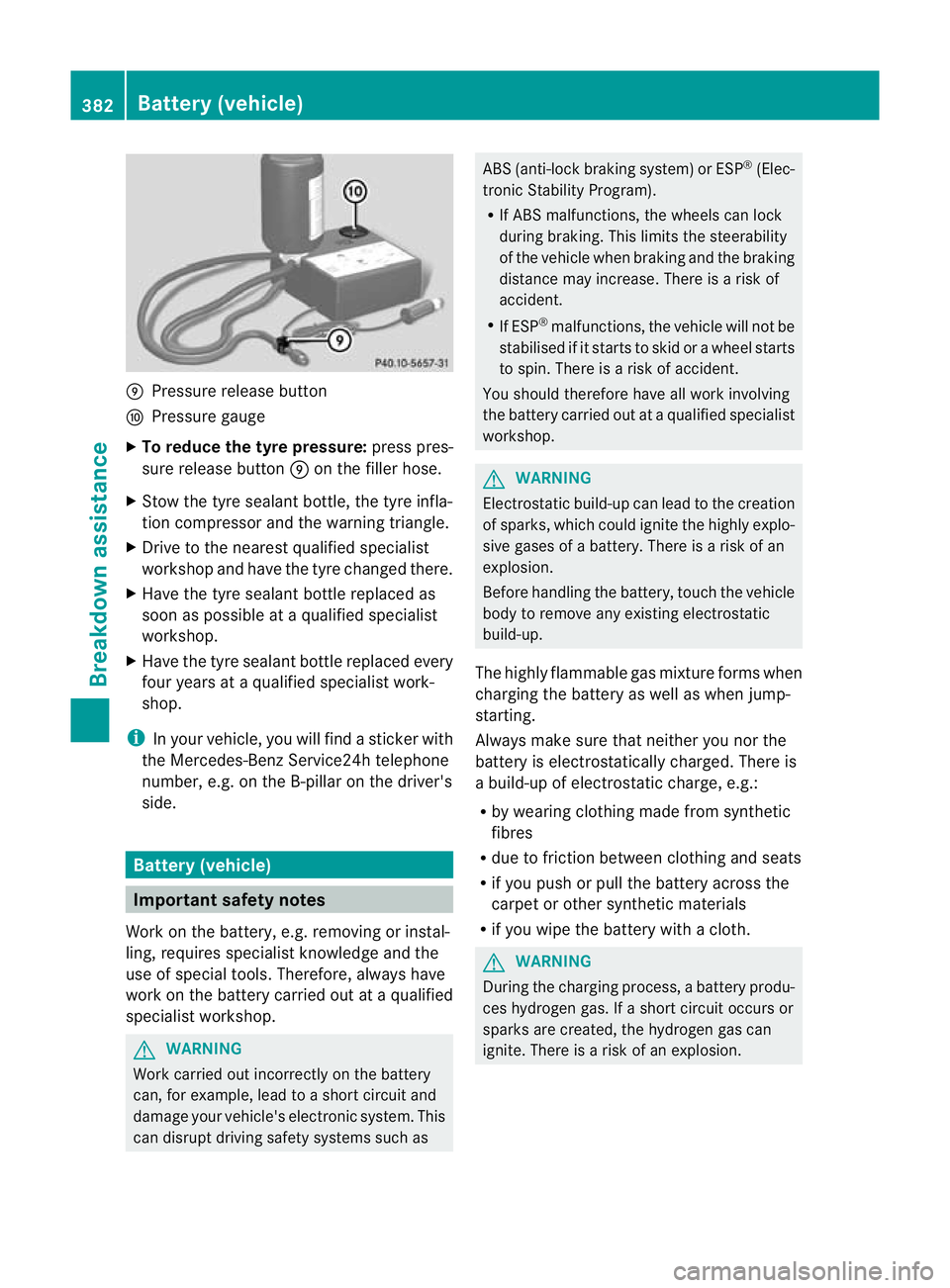
E
Pressur erelease button
F Pressur egauge
X To reduce the tyr epressure: press pres-
sure releas ebutton Eon the filler hose.
X Stow the tyre sealant bottle, the tyre infla-
tion compressor and the warning triangle.
X Drive to the nearest qualified specialist
worksho pand have the tyre changed there.
X Have the tyre sealant bottle replace das
soon as possible at aqualified specialist
workshop.
X Have the tyre sealant bottle replaced every
four years at aqualified specialist work-
shop.
i In your vehicle, you will find asticker with
the Mercedes-Benz Service24h telephone
number, e.g. on the B-pillar on the driver's
side. Battery (vehicle)
Important safety notes
Work on the battery, e.g. removin gorinstal-
ling ,requires specialist knowledge and the
use of special tools. Therefore, always have
work on the batter ycarried out at aqualified
specialist workshop. G
WARNING
Work carried out incorrectly on the battery
can, for example, lead to ashort circui tand
damage your vehicle's electronic system. This
can disrupt driving safety systems such as ABS (anti-lock braking system) or ESP
®
(Elec-
tronic Stability Program).
R If ABS malfunctions ,the wheels can lock
during braking. This limits the steerability
of the vehicle when brakin gand the braking
distance may increase. There is arisk of
accident.
R If ESP ®
malfunctions, the vehicle will not be
stabilised if it start stoskid or awheel star ts
to spin. There is arisk of accident.
You should therefore have all work involving
the batter ycarried out at aqualified specialist
workshop. G
WARNING
Electrostatic build-up can lead to the creation
of sparks, which could ignite the highly explo-
sive gases of abattery. There is arisk of an
explosion.
Befor ehandling the battery, touch the vehicle
body to remove any existing electrostatic
build-up.
The highly flammable gas mixture forms when
charging the battery as well as when jump-
starting.
Always make sure that neither you nor the
batter yiselectrostatically charged. There is
ab uild-up of electrostatic charge, e.g.:
R by wearing clothing made from synthetic
fibres
R due to friction betwee nclothin gand seats
R if you pus horpull the batter yacross the
carpe torother synthe ticm aterials
R if you wipe the batter ywithacloth. G
WARNING
Durin gthe charging process, abatter yprodu-
ces hydroge ngas. If ashort circui toccurs or
sparks are created, the hydroge ngas can
ignite. There is arisk of an explosion. 382
Battery (vehicl
e)Breakdown assistance
Page 386 of 441
R
Make sur ethat the positive terminal of a
con nected battery doe snot com einto con-
tact with vehicl eparts.
R Never place metal objects or tools on abat-
tery.
R It is important that you observe the descri-
bed order of the battery terminals when
connectin gand disconnectin gabattery.
R When jump-starting, make sure that the
battery poles with identical polarity are
connected.
R It is particularly important to observe the
described order when connectin gand dis-
connectin gthe jum pleads.
R Never connect or disconnect the battery
terminals while the engine is running. G
WARNING
Bat tery acid is caustic. There is arisk of injury.
Avoid contact with the skin, eyes or clothing.
Do not inhale any battery gases. Do not lean
over the battery. Keep children away from
batteries. Wash battery acid immediately with
water and seek medical attention. H
Environmental note Batteries contain pollutants.
It is illegal to dispose of them
with the household rubbish.
They must be collected sep-
arately and dispose
dofinan
environmen tally responsible
recycling system. Dispose of batteries in an
environmentally responsible
manner
.Take discharged
batteries to aqualified spe-
cialist workshop or to acol-
lection point for used batter-
ies.
! Hav ethe battery chec kedr egularly at a
qualified specialist workshop.
Observ ethe service intervals in the Service
Booklet or con tact aq ualified specialist
worksho pfor mor einformation. !
You should have all work involving the
battery carried out at aqualified specialist
workshop. In the exceptional case that it is
necessar yfor you to disconnect th ebattery
yourself, mak esure that:
R you switc hoff the engine and remove the
key. On vehicles with KEYLESS-GO,
ensure that the ig nition is switched off.
Chec kthat all the indicator lamps in the
instrumen tcluster are off. Otherwise,
electronic components, such as the
alternator, may be damaged.
R you first remov ethe negativ eterminal
clam pand then the positive terminal
clamp. Never swap the terminal clamps.
Otherwise, the vehicle's electronic sys-
tem may be damaged.
R the transmissio nislocke dinp osition P
after disconnectin gthe battery .The vehi-
cle is secured against rolling away. You
can then no longer mov ethe vehicle.
The battery and the cover of the positive
termi nalclamp must be fitted securely dur-
ing operation.
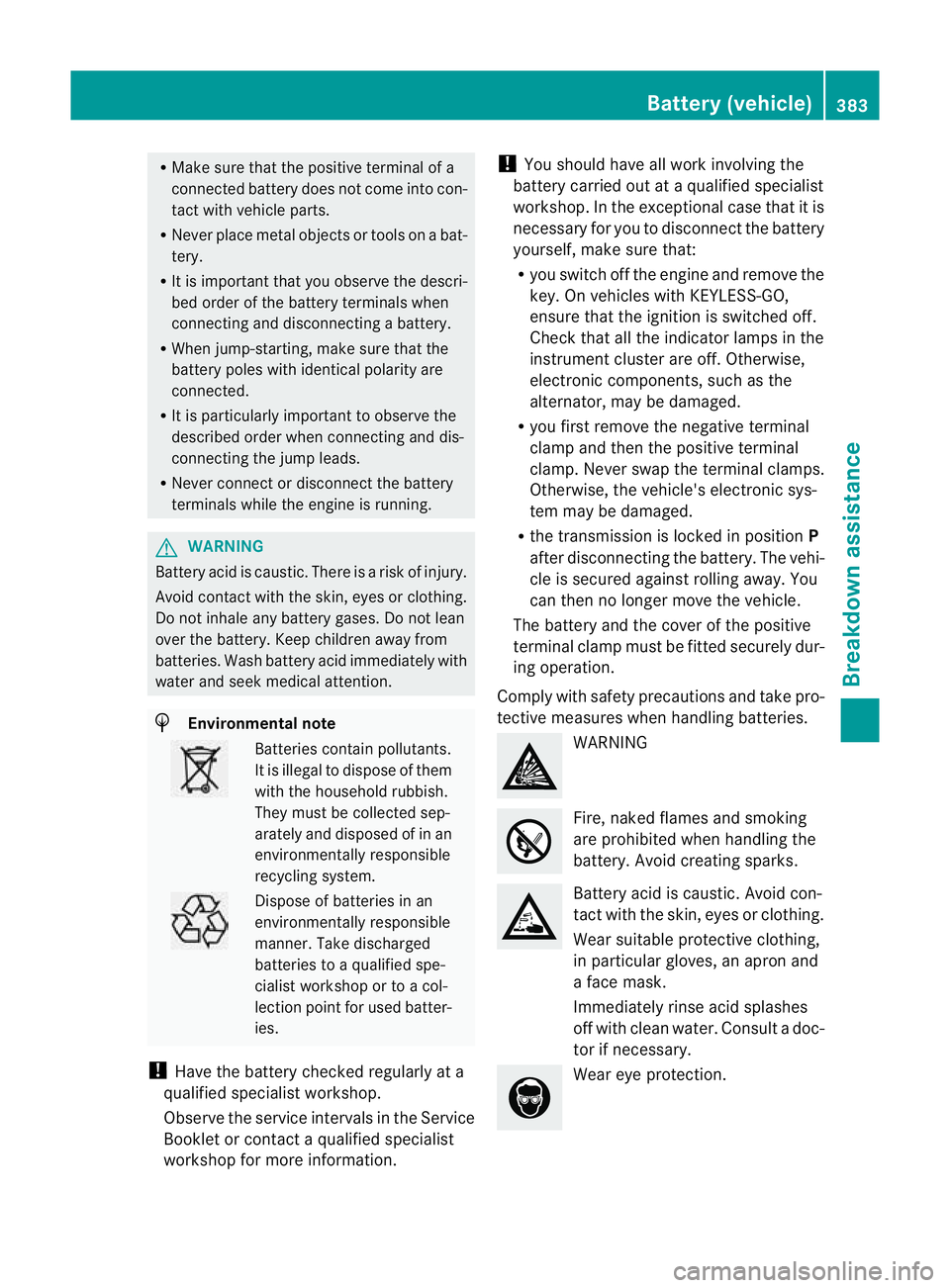
Comply with safety precautions and take pro-
tective measures when handling batteries. WARNING
Fire, naked flames and smoking
are prohibited when handling the
battery
.Avoi dc reating sparks. Battery aci
discaustic. Avoid con-
tact with the skin, eyes or clothing.
Wear suitable protective clothing,
in particular gloves, an apron and
af ace mask.
Immediately rinse acid splashes
off with clean water. Consult adoc-
tor if necessary. Wear eye protection. Ba
ttery (vehicle)
383Breakdown assistance Z
Page 394 of 441
switch, the hazard warnin
glamps start
flashing again. Transporting the vehicle
! Only lash the vehicle down by the wheels
or wheel rims, not by parts of the vehicle
such as axle or steering components. Oth-
erwise, the vehicle could be damaged.
The towing eyes or trailer tow hitch can be
used to pull the vehicle onto atrailer or trans-
porter if yo uwish to transport it.
X Turn the key to position 2in the ignition
lock.
X Shift the automatic transmission to posi-
tion N.
As soon as the vehicle is loaded:
X Prevent the vehicle from rolling away by
applying the electric parkin gbrake.
X Shift th eautomatic transmission to posi-
tion P.
X Turn the key to position 0in the ignition
lock and remove it.
X Secure the vehicle. Information for 4MATIC vehicles
! Vehicles with 4MATIC must not be towed
with the front or rear axle raised; otherwise,
the transmission may be damaged.
If the vehicle has transmission damage or
damage to the front or rear axle, have it trans-
ported on atransporter or trailer.
In the even tofdamage to the ele ctrical
system
If the battery is defective, the automatic
transmission will be locked in position P.To
shif tthe automatic transmission to position
N,y ou must provide power to the vehicle's
electrical system in the same way as when
jump-starting (Y page 386).
Hav ethe vehicle transported on atransporter
or trailer. Recov
ering avehicle that ha sbecome
stuck
! When recovering atrapped vehicle ,donot
je rk the vehicle or pull it at an angle. If the
tractive powe rist oo high, th evehicles
could be damaged.
If th edrive wheels ge ttrapped on loose or
muddy ground, recover th evehicle with the
utmost care, especially so if the vehicle is
laden.
Never attempt to recover avehicle with a
trailer atta ched.
Pull out the vehicle backwards, if possible,
using the tracks it made when it became
stuck. Tow-starting (emergency engine
starting)
! Vehicles with automatic transmission
must not be tow-star ted. Otherwise, you
could damage the automatic tra nsmission.
You ca nfind information on "Jump-starting"
at (Y page 386). Electrical fuses
Important safet
ynotes G
WARNING
Only use fuses that have been approved for
Mercedes-Benz vehicles and which have the
correct fuse ratin gfor the system scon-
cer ned. Do not attempt to repair or bridge
faulty fuses. Usin gfuses which have not been
approved or attempting to repair or bridge
faulty fuses could cause the fuse to be over-
loaded and result in afire. Have the cause
traced and rectified at aqualified specialist
workshop.
! Only use fuses marked with an "S" for the
fuse box in the engine compartment and
under the rear bench seat. Components or
systems could othe rwise be damaged. Electrical fuses
391Breakdown assistance Z
Page 399 of 441
Usefu
linfor mati on
i This Owner's Manual describes all mod-
els, series and optional equipment for your
vehicle that were available at the time of
going to press. National variation sare pos-
sible. Note that your vehicl emay not be
equippe dwith all of the function sdescri-
bed. This is also the case for system sand
functions relevant to safety.
i Read the information on qualified special-
ist workshops: (Y page25). Impo
rtantsafety notes G
WARNING
If wheels and tyres of the wron gsize are used,
the wheel brakes or suspension components
may be damaged. There is arisk of accident.
Always replac ewheels and tyr es with those
that fulfil th especifications of the original part
(designation ,manufacturer, model). G
WARNING
Af lat tyre severely impair sthe driving, steer-
ing and bra king characteristics of the vehicle.
There is arisk of accident.
Tyres withou trun-flat characteristics:
R do not drive with aflat tyre.
R immediately replac ethe fla ttyre with your
emergenc yspare wheel or spare wheel, or
consult aqualified specialist workshop.
Tyres with run-flat characteristics:
R pay attention to the information and warn-
ing notices on MOExtended tyre s(tyres
with run-flat charac teristics).
Accessorie sthat ar enot approved for your
vehicle by Mercedes-Ben zorare not be ing
use dcorrectly can impair the operating
safety. Before purchasing and using non-approved
accessories, visi
taqualified specialist work-
sho pand enquire about:
R suitability
R leg alstipulations
R factory recommendations
Information on the dimensions and types of
wheels and tyres for your vehicle can be
found in the "Wheel/tyre combinations" sec-
tion (Y page 409).
Information on air pressure for the tyres on
your vehicle can be found:
R on the tyre pressure label on the fuel filler
flap (Y page 175)
R in the "Tyre pressure" section
R under "Tyre pressure" (Y page 399)
Modification work on the brake system and
wheels is not permitted. The use of wheel
spacers or brake dust shields is not permit-
ted. This invalidates the general operating
permit for the vehicle.
i Further information on wheels and tyres
can be obtained at any qualified specialist
workshop. Operation
Information on driving
Check the tyre pressures when the vehicle is
heavily laden and, if necessary, adjust.
While driving, pay attention to vibrations,
noises and unusual handling charac teristics,
e.g .pulling to one side .This ma yindicate that
the wheels or tyres are damaged. If you sus-
pect that atyre is defective, reduce your
speed immediately. Stop the vehicle as soon
as possibl etocheckthe wheels and tyres for
damage. Hidden tyr edamage could also be
causing the unusual handling characteristics.
If you find no signs of damage, have the tyres
and wheel schecked at aqualified specialist
workshop.
When parking your vehicle, make sure that
the tyres do not get deformed by the kerb or 396
OperationWheels and tyres
Page 401 of 441
Observe the notes on the emergenc
yspare
wheel (Y page 414). MOExtended tyres (tyres with run-flat
characteristics)
With MOExtended tyres (tyres with run-flat
characteristics), you can continue to drive
your vehicle even if there is atotal loss of
pressure in one or mor etyres.
MOExtended tyres may only be used in con-
junction with an active tyre pressure loss
warning syste morwith an activ etyre pres-
sure monitor and on wheels specificall ytes-
ted by Mercedes-Ben z.
No tes on driving with MOExtended tyres with
af lat tyre (Y page 378).
i Vehicles with MOExtended tyres are not
equipped with aTIREFIT kit at th efactory.
It is therefore recommended that you addi-
tionally equi pyour vehicle with aTIREFIT kit
if yo ufit tyres that do not featur erun-flat
characteristics, e.g. winter tyres. ATIREFIT
kit can be obtaine dfrom aqualified spe-
cialist workshop. Winter operation
General notes
Have your vehicle winterproofed at aqualified
specialist worksho patthe onset of winter.
Observ ethe notes in the "Changin gawheel"
section (Y page 404). Driving wit
hsummer tyres
At temperatures belo w+7† ,summer tyres
lose elasticity and therefore traction and
braking power. Change the tyres on your vehi-
cle to M+S tyres .Using summer tyres at very
cold temperatures could cause tears to form,
thereby damaging the tyres permanently.
Mercedes-Benz cannot accept responsibility
for this typ eofdamage. M+S tyres
G
WARNING
M+S tyres with atyre tread depth of less than
4mma re not su itable for use in winter as they
do not provid esufficient traction. There is a
risk of accident.
M+S tyres with atrea ddepth of less than
4mmm ust be replaced.
At temperatures below +7 †, use winter tyres
or all-seas ontyres.B oth types of tyr eare
identified by th eM+S marking.
Onl ywinter tyres bearing the isnowflake
symbol in addition to the M+S marking pro-
vide the best possible grip in wintr yroad con-
ditions.
Only these tyres will allow drivin gsafety sys-
tems such as ABS and ESP ®
to function opti-
mally in winter. Thes etyres have been devel-
ope dspecifically for driving in snow.
Use M+S tyres of the same mak eand tread
on all wheels to maintain safe handling char-
acteris tics.
Alway sobserv ethe maximum permissible
speed specifie dfor the M+S tyres you have
fit ted.
If you fit M+S tyres that have alower maxi-
mu mp ermissible speed than that of the vehi-
cle, affix acorresponding warnin glabel in the
driver' sfield of vision. This can be obtained
at aq ualified specialist workshop.
Under these circumstances, you should also
restrict the maximum spee dofthe vehicle
usin gpermanen tSPEEDTRONIC so that it
does not exceed the maximu mpermissible
speed for the M+S tyres(Y page 198).
When you have fit tedt he M+S tyres:
X Chec kthe tyr epressures (Y page 399).
X Restart th etyre pressure monitor
(Y page 403).
X Restart the tyre pressure los swarning sys-
tem (Y page 401).
For more information on driving with the
emergenc yspare wheel, see (Y page 414).398
Winter opera
tionWheels and tyres
Page 402 of 441
Snow chains
G
WARNING
If you hav efitted snow chains to the front
wheels, they may scrape against the vehicle
body or chassis components. This could
cause damage to the vehicle or the tyres.
There is arisk of an accident.
To avoid hazardous situations:
R never fit snow chains on the fron twheels
R fit snow chains to the rea rwheels in pairs.
! You must driv eatraised vehicle level if
snow chains have been fitted. The vehicle
could otherwise be damaged. Observe the
information in the "AIRMATIC package"
section.
! Do not use the Adaptive Damping System
(ADS )sports mode if you have fit teds now
chains .The vehicle could otherwise be
damaged.
! On some tyr esizes there is not enough
space for snow chains. In order to prevent
damage to the vehicle or the tyres, observe
the "Tyre and wheel combinations" section
under "Tyres and wheels".
For safety reasons, Mercedes-Benz recom-
mends that you only use snow chains that
have been specially approved for your vehicle
by Mercedes-Benz, or that are of acorre-
spondin gstandard of quality.
If you intend to fit snow chains ,please bear
the following points in mind:
R only use snow chains when the road sur-
face is completely snow-covered. Remove
the snow chains as soon as possible when
you come to aroad that is not snow- cov-
ered.
R do not exceed the maximu mpermissible
speed of 50 km /h. R
local regulations may restric tthe use of
snow chains. Observ ethe appropriate reg-
ulations if you wish to fit snow chains.
R snow chains cannot be fitted to all wheel-
tyr ec ombinations. Permissible wheel-tyre
combination s(Ypage 409).
i You may wish to deactivat eESP®
when
pull inga way with snow chains fitted
(Y page 67). This way you can allow the
wheels to spin in acontrolled manner ,ach-
ieving an increased driving force (cutting
action).
For more information on driving with the
emergency spare wheel, se e(Ypage 414). Ty
re pr essure Tyr
epressure specifications G
WARNING
Tyres with too low or too high tyre pressure
contain the following hazards:
R they can burst, in particular if the vehicle is
heavily laden or when driven at high
speeds.
R the tyres can wear excessively and/or
unevenly, which can severely impair tyre
traction.
R the driving, steering and braking character-
istics may be severely impaired.
There is arisk of accident.
Follow recommended tyre inflation pressures
and check the pressure of all the tyres includ-
ing the spare wheel:
R at least every two weeks
R if the load changes
R before beginning along journey
R for changed operatin gconditions, e.g. off-
road driving
If necessary ,correct the tyr epressure. G
WARNING
If you fit unsuitabl eaccessories onto tyre
valves ,the tyr evalves may be overloaded and Tyr
epressure
399Wheels and ty res
Z
Page 404 of 441
i
The tyr epressure values given for low
load sare minimum values which offe ryou
good rid ecomfor tcharacteristics.
However ,you can also use the values given
for higher loads. These ar epermissible and
will not adversely affect the running of the
vehicle. Ty
re pr essur eloss warning system
Important safety notes While the vehicle is in motion, the tyre pres-
sure loss warnin gsystem monitors the set
tyre pressure using the rotational speed of
the wheels. This enable sthe system to detect
significant pressur eloss in atyre. If the speed
of rotation of awheel changes as aresult of
al oss of pressure, acorrespondin gwarning
message will appea rinthe multifunction dis-
play.
The tyr epressure warning system does not
warn yo uofani ncorrectly set tyre pressure.
Observe the notes on the recommended tyre
pressure (Y page399).
Th et yre pressure los swarning system does
not replace the need to regularly check your
vehicle's tyre pressures, since an even loss of
pressure on several tyres at the same time
cannot be detected by the tyre pressure loss
warning system.
The tyre pressure monitor is not able to warn
you of asudden loss of pressure, e.g. if the
tyre is penetrated by aforeign objec t. Inthe
event of asudden loss of pressure, bring the
vehicle to ahalt by braking carefully. Avoid
abrupt steering manoeuvres.
The function of the tyre pressure loss warning
system is limited or delayed if:
R snow chains are fitted to your vehicle's
tyres.
R road conditions are wintry.
R you are driving on sand or gravel.
R you adopt avery sporty driving style (cor-
nering at high speeds or driving with high
rates of acceleration). R
you are towing avery heavy or large trailer.
R you are driving with aheavy load (in the
vehicle or on the roof).
Resta rting the ty re pressur eloss warn-
ing system Restart the tyre pressure loss warnin
gsystem
if you have:
R changed the tyre pressure
R changed the wheels or tyres
R fitted new wheels or tyres
X Before restarting, make sure that the tyre
pressures are set properly on all four tyres
for the respective operating conditio ns.
The recommended tyr epressures can be
found in th etable on the fuel filler flap.
The tyre pressure loss warning system can
only give reliabl ewarnings if you have set
the correct tyre pressure. If an incorrect
tyre pressure is set, these incorrec tvalues
will be monitored.
X Also observ ethe notes in the sectionon
tyre pressures (Y page 399).
X Make sure tha tthe key is in posi-
tion 2(Ypage 159) in the ignition lock.
X Press the =or; button on the steer-
ing wheel to selec tthe Serv. menu.
X Press the 9or: button to select
Tyre pressure .
X Press the abutton.
The RunF lat Indicator active Restart with OK message appe
arsint he
multifunction display.
If yo uwish to confirm the resta rt:
X Press the abutton.
The Tyre press. no wOK? message
appe arsint he multifunction display.
X Press the 9or: button to select
Yes .
X Press the abutton.
The RunF lat Indicator restarted message appe
arsint he multifunction dis-
play. Ty
re pressure
401Wheelsand ty res Z
Page 405 of 441
After
ateach-in period ,the tyr epressure
loss warning system wil lmonitor the set
tyr ep ressures of all fou rtyres.
If you wish to cancel the restart:
X Press the %button.
or
X If the Tyrepress. now OK? message
appears ,use the 9or: button to
select Cancel .
X Press the abutton.
The tyr epressure values stored at th elast
restar twill continue to be monitored. Tyr
epressur emonitor
Important safet ynotes It is the driver's responsibility to set the tyre
pressure to the recommended cold tyre pres-
sure suitable for the operatin
gsituation
(Y page 399). Note that the correct tyre pres-
sure for the curren toperatin gsituation must
first be taught-in to the tyre pressure monitor.
If ther eisas ubstantial loss of pressure, the
warning threshold for the warning messag eis
aligned to the referenc evalues taught-in.
Restart the tyre pressure monitor after
adjustin gtothe cold tyr epressure
(Y page 403). Th ecurren tpressures are
saved as new referenc evalues. This will
ensure that awarning mess agewillonly
appear if the tyre pressure drops significantly.
The tyre pressure monitor doe snot warn you
of an incorrectly set tyr epressure. Observe
th en otes on the recommended tyr epressure
(Y page 399).
Th et yre press urem onitor is not able to warn
you of asudden loss of pressure, e.g. if the
tyre is penetrated by aforeign object. In the
even tofas udden loss of pressure, bring the
vehicl etoah altbyb raking carefully. Avoid
abrupt stee ringmanoeuvres.
If at yrep ressur emonitor system is fitted, the
vehicle's wheels hav esensor sfitte dthat
mo nito rthe tyre pressures in all four tyres. The tyr
epressur emonitor war nsyou if the
pressur edrops in one or more of the tyres.
Th et yrep ressur emonitor only fu nctionsif
the cor respondin gsensor sare fitte dtoall
wheels.
Information on tyr epressures is displayed in
the multifunctio ndisplay .After afew minutes
of driv ing, the curren ttyre pressure of each
tyre is sho wn inthe multifunction display.
Th et yre pressure values indicated by the on-
board computer may differ from thos emeas-
ured at afilling station using apressure
gauge. Th etyre pressures shown by the on-
board computer refer to thos emeasured at
sea level. At high altitudes, the tyr epressure
values indicated by apressure gaug eare
higher than thos eshown by the on-board
computer. In this case ,donot reduce the tyre
pressures.
The operation of the tyr epressure monitor
can be affecte dbyinterference from radio
transmitting equipment (e.g .radio head-
phones ,two-way radios) that may be being
operated in or near the vehicle.
Checking tyr epressure electronically X
Make sure that the key is in posi-
tion 2(Ypage 159) in the ignitio nlock.
X Press the =or; button on the steer-
ing wheel to select the Serv. menu.
X Press the 9or: button to select
Tyre pressure .
X Press the abutton.
The curren ttyre pressure for each wheel
will be displayed in the multifunction dis-
play.
If the vehicle has been parked for longe rthan
20 minutes ,the Tyre pressures will be
displaye
dafter afew minutes of driving message appe
ars.
After ateach-in period, the tyr epressure
monito rautomatically recognises new
wheel sornew sensors. As long as aclear
allocation of the tyre pressure values to the
individual wheels is not possible ,the Tyre 402
Ty
re pressureWheel sand ty res
Page 411 of 441
X
Unscre wthe uppermost wheel bolt com-
pletely.
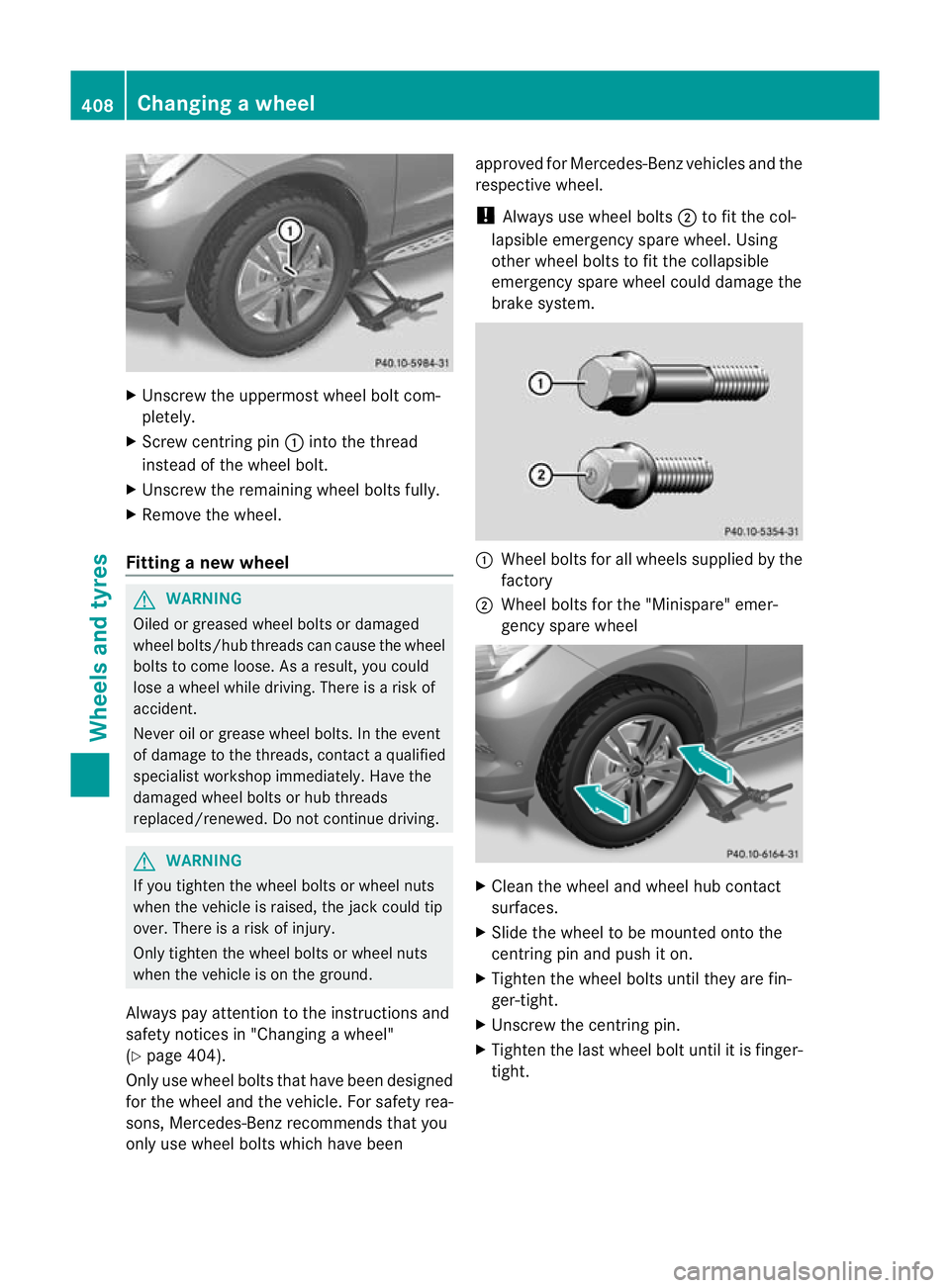
X Screw cen tringpin:into the thread
instead of the wheel bolt.
X Unscrew the remainin gwheel bolts fully.
X Remove the wheel.
Fitting anew wheel G
WARNING
Oiled or greased wheel bolt sordamaged
wheel bolts/hub threads can cause the wheel
bolts to com eloose .Asa result,you could
lose awheel while driving. There is arisk of
accident.
Never oil or grease wheel bolts. In the event
of damage to the threads, contact aqualified
specialist workshop immediately .Have the
damaged wheel bolts or hub threads
replaced/renewed. Do not continue driving. G
WARNING
If you tighten the wheel bolts or wheel nuts
when the vehicle is raised, the jac kcould tip
over .There is arisk of injury.
Only tighten the wheel bolts or wheel nuts
when the vehicle is on the ground.
Always pay attention to the instructions and
safety notices in "Changing awheel"
(Y page 404).
Only use wheel bolts that hav ebeen designed
for the wheel and the vehicle. For safet yrea-
sons, Mercedes-Benz recommends that you
only use wheel bolts which have been approved for Mercedes-Benz vehicles and the
respec
tivewheel.
! Always use wheel bolts ;to fit the col-
lapsibl eemergency spare wheel. Using
othe rwheel bolts to fit the collapsible
emergenc yspare wheel could damage the
brak esystem. :
Wheel bolts for all wheels supplied by the
factory
; Wheel bolts for the "Minispare" emer-
gency spare wheel X
Clean the whee land wheel hub contact
surfaces.
X Slide the wheel to be mounted onto the
centring pin and pus hito n.
X Tighten the wheel bolts until they are fin-
ger-tight.
X Unscrew the centring pin.
X Tighten the last wheel bol tuntil it is finger-
tight. 408
Changin
gawheelWheels and tyres
Page 412 of 441
Lowering th
evehicle G
WARNING
The wheels could work loose if th ewheel nuts
and bolt sare not tightened to the specified
tightening torque. There is arisk of accident.
Have the tightening torque immediately
checked at aqualified specialist workshop
after awheel is changed. X
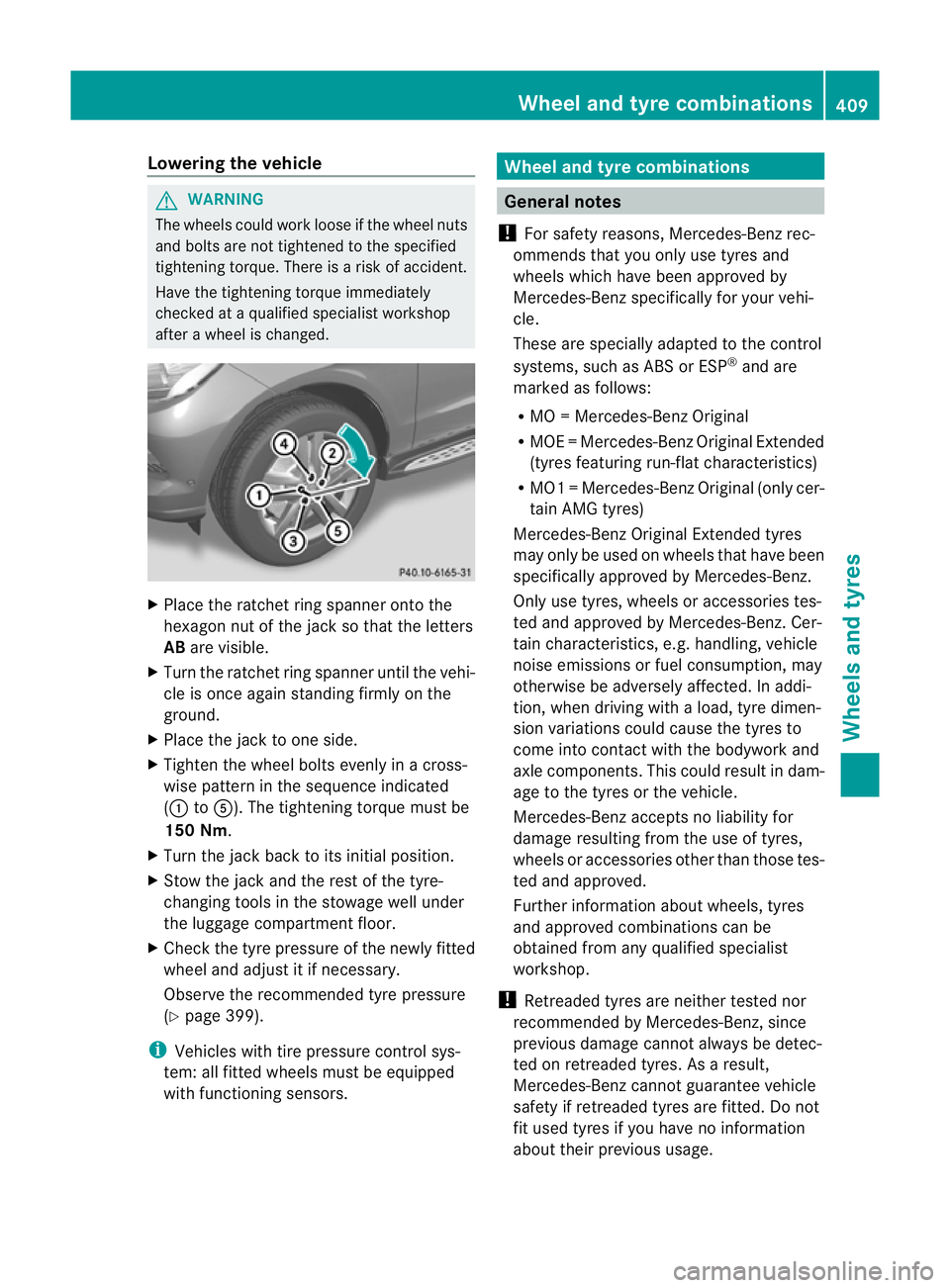
Plac ethe ratchet ring spanner ont othe
hexagon nut of the jac ksothat the letters
AB arev isible.
X Turn the ratchet ring spanner until the vehi-
cle is once again standing firmly on the
ground.
X Place the jack to one side.
X Tighten the wheel bolts evenly in across-
wis epattern in the sequence indicated
(: toA). The tightening torque must be
150 Nm.
X Turn the jack back to its initial position.
X Stow the jack and the rest of the tyre-
changing tools in the stowage well under
the luggag ecompart ment floor.
X Check the tyre pressure of the newly fitted
wheel and adjus titifnecessary.
Observ ethe recommended tyr epressure
(Y page 399).
i Vehicles wit htire pressure control sys-
tem: all fitted wheels must be equipped
with func tionin gsensors. Wheel and ty
recombinations General notes
! For safety reasons, Mercedes-Benz rec-
ommends that you only use tyres and
wheels which have been approved by
Mercedes-Benz specifically for your vehi-
cle.
Thes eare speciall yadapted to the control
systems, such as ABS or ESP ®
and are
marked as follows:
R MO =Mercedes-Ben zOriginal
R MOE =Mercedes-Ben zOriginal Extended
(tyres featuring run-flat characteristics)
R MO1 =Mercedes-Ben zOriginal (only cer-
tain AMG tyres)
Mercedes-Benz Original Extended tyres
may only be use donwheels that hav ebeen
specifically approved by Mercedes-Benz.
Only use tyres, wheels or accessories tes-
ted and approved by Mercedes-Benz. Cer-
tain characteristics, e.g. handling, vehic le
nois eemis sions or fuel consumption, may
otherwise be adv ersely affected. In addi-
tion, when driving with aload, tyr edimen-
sion variations could cause the tyres to
come into contact with the bodywork and
axle components .This could result in dam-
age to the tyres or the vehicle.
Mercedes-Ben zaccept snoliability for
damag eresulting from the use of tyr es,
wheel soraccess orieso the rthan those tes-
ted and approved.
Further information about wheels, tyres
and approved combination scan be
obtained from any qualified specialist
workshop.
! Retreaded tyres are neither tested nor
recommended by Mercedes-Benz, since
previous damage cannot always be detec-
ted on retreaded tyres. As aresult,
Mercedes-Ben zcannot guarantee vehicle
safet yifretreade dtyres are fitted. Do not
fit used tyres if you have no information
about their previous usage. Wheel and tyre combinations
409Wheelsand tyres Z