lock MERCEDES-BENZ GL SUV 2012 Owners Manual
[x] Cancel search | Manufacturer: MERCEDES-BENZ, Model Year: 2012, Model line: GL SUV, Model: MERCEDES-BENZ GL SUV 2012Pages: 441, PDF Size: 10.66 MB
Page 386 of 441
R
Make sur ethat the positive terminal of a
con nected battery doe snot com einto con-
tact with vehicl eparts.
R Never place metal objects or tools on abat-
tery.
R It is important that you observe the descri-
bed order of the battery terminals when
connectin gand disconnectin gabattery.
R When jump-starting, make sure that the
battery poles with identical polarity are
connected.
R It is particularly important to observe the
described order when connectin gand dis-
connectin gthe jum pleads.
R Never connect or disconnect the battery
terminals while the engine is running. G
WARNING
Bat tery acid is caustic. There is arisk of injury.
Avoid contact with the skin, eyes or clothing.
Do not inhale any battery gases. Do not lean
over the battery. Keep children away from
batteries. Wash battery acid immediately with
water and seek medical attention. H
Environmental note Batteries contain pollutants.
It is illegal to dispose of them
with the household rubbish.
They must be collected sep-
arately and dispose
dofinan
environmen tally responsible
recycling system. Dispose of batteries in an
environmentally responsible
manner
.Take discharged
batteries to aqualified spe-
cialist workshop or to acol-
lection point for used batter-
ies.
! Hav ethe battery chec kedr egularly at a
qualified specialist workshop.
Observ ethe service intervals in the Service
Booklet or con tact aq ualified specialist
worksho pfor mor einformation. !
You should have all work involving the
battery carried out at aqualified specialist
workshop. In the exceptional case that it is
necessar yfor you to disconnect th ebattery
yourself, mak esure that:
R you switc hoff the engine and remove the
key. On vehicles with KEYLESS-GO,
ensure that the ig nition is switched off.
Chec kthat all the indicator lamps in the
instrumen tcluster are off. Otherwise,
electronic components, such as the
alternator, may be damaged.
R you first remov ethe negativ eterminal
clam pand then the positive terminal
clamp. Never swap the terminal clamps.
Otherwise, the vehicle's electronic sys-
tem may be damaged.
R the transmissio nislocke dinp osition P
after disconnectin gthe battery .The vehi-
cle is secured against rolling away. You
can then no longer mov ethe vehicle.
The battery and the cover of the positive
termi nalclamp must be fitted securely dur-
ing operation.
Comply with safety precautions and take pro-
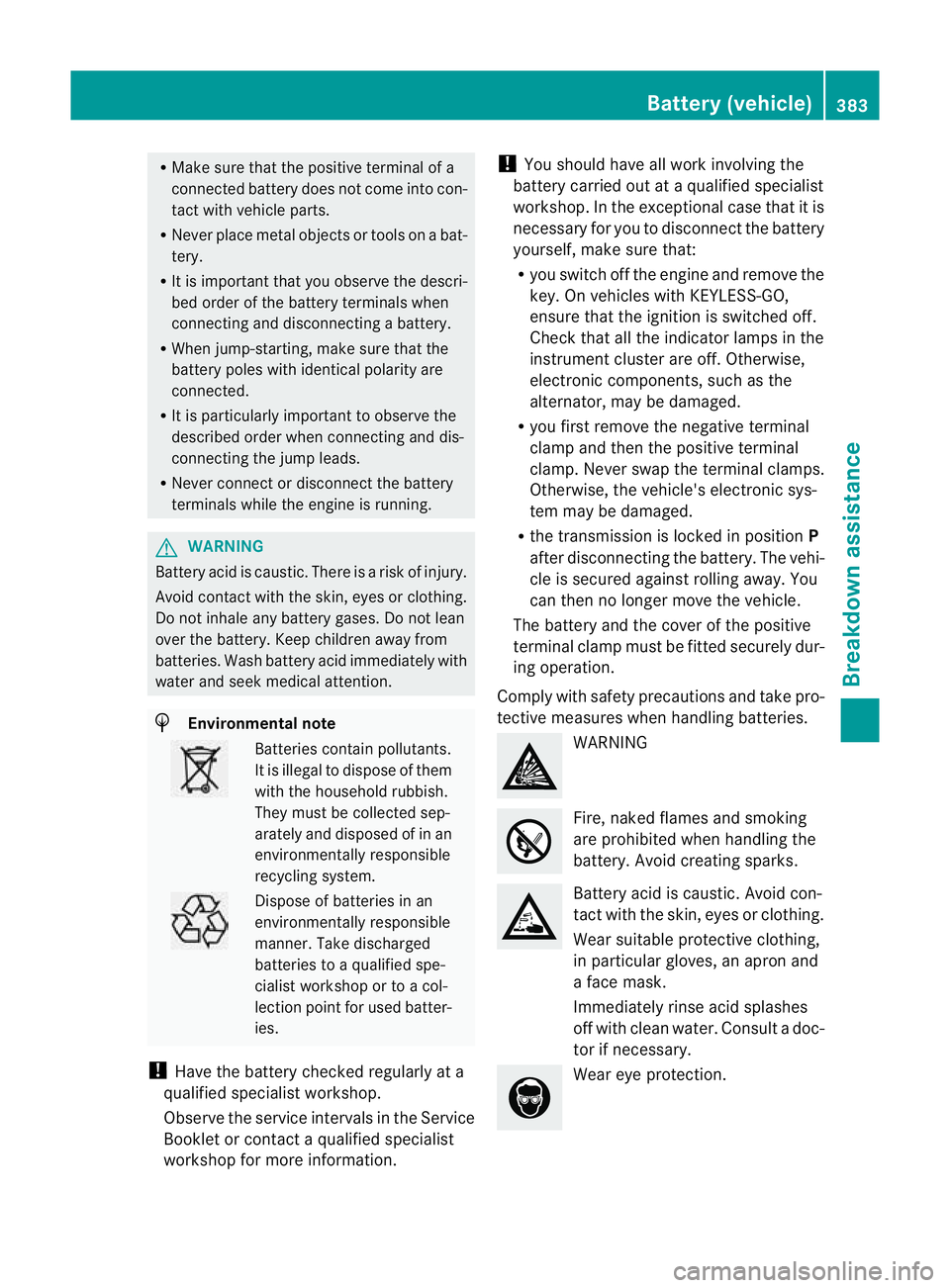
tective measures when handling batteries. WARNING
Fire, naked flames and smoking
are prohibited when handling the
battery
.Avoi dc reating sparks. Battery aci
discaustic. Avoid con-
tact with the skin, eyes or clothing.
Wear suitable protective clothing,
in particular gloves, an apron and
af ace mask.
Immediately rinse acid splashes
off with clean water. Consult adoc-
tor if necessary. Wear eye protection. Ba
ttery (vehicle)
383Breakdown assistance Z
Page 387 of 441
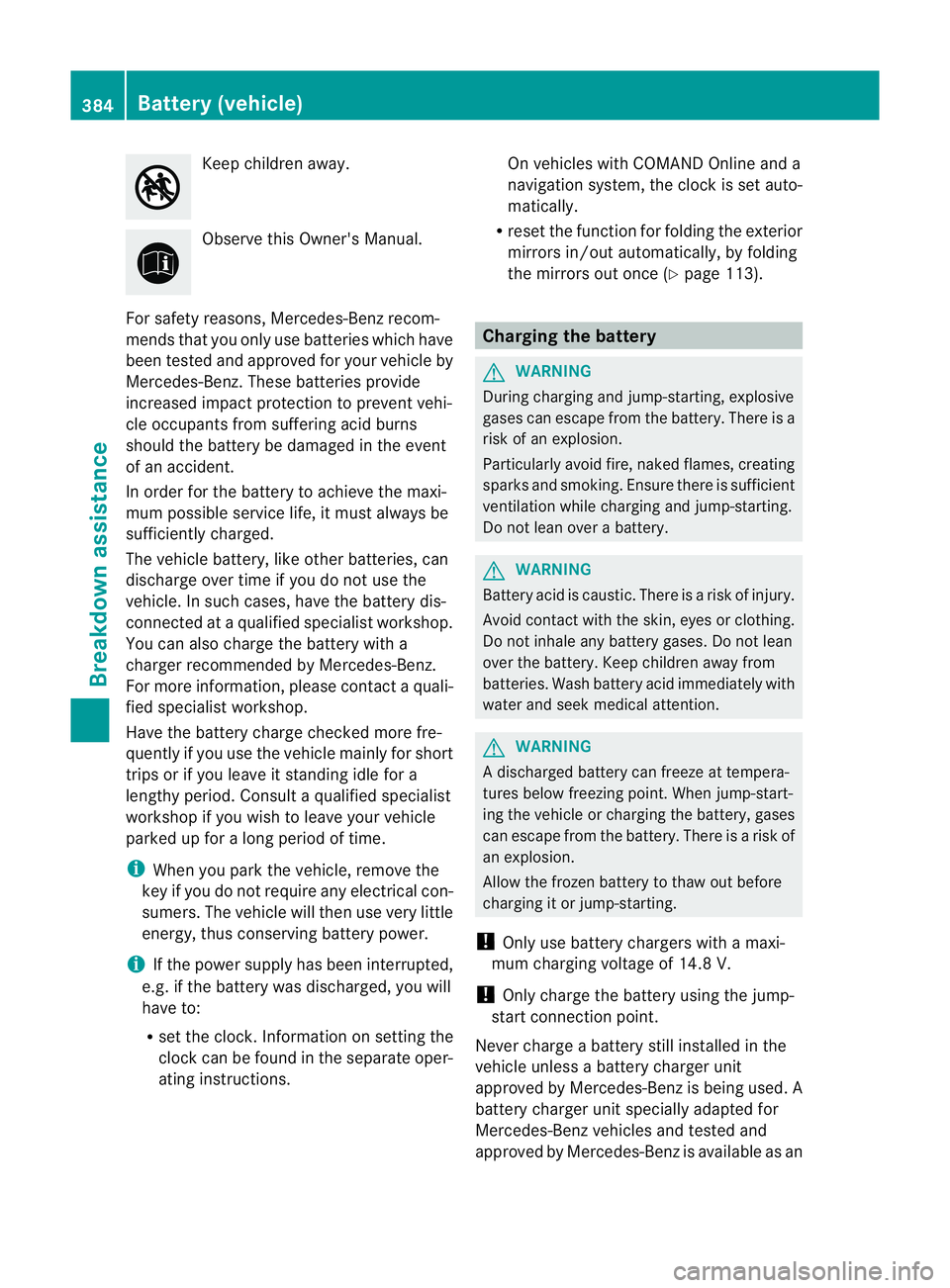
Kee
pchildr en away. Obse
rve this Owner' sManual.
For safet yreasons ,Mercedes-Ben zrecom-
mends that you only use batteries which have
been tested and approved for your vehicle by
Mercedes-Benz. These batteries provide
inc reased impact protection to preven tvehi-
cle occupant sfrom suffering aci dburns
should the batter ybedamaged in the event
of an accident.
In order for the batter ytoachieve the maxi-
mum possibl eservic elife, it must always be
sufficiently charged.
The vehicle battery, like other batteries, can
discharge over time if you do not use the
vehicle. In such cases, have the batter ydis-
connected at aqualified specialist workshop.
You can also charge the batter ywith a
charger recommended by Mercedes-Benz.
For more information ,please contact aquali-
fied specialist workshop.
Have the batter ycharge checked mor efre-
quently if yo uuse the vehicle mainl yfor short
trips or if you leav eitstanding idle for a
lengthy period .Consult aqualified specialist
workshop if you wish to leave your vehicle
parked up for along period of time.
i When you par kthe vehicle, remove the
key if you do not requir eany electrical con-
sumers .The vehicle will then use ver ylittle
energy, thus conservin gbatter ypower.
i If the power supply has been interrupted,
e.g. if the batter ywas discharged ,you will
have to:
R set the cloc k.Informatio nonsetting the
cloc kcan be found in the separate oper-
ating instructions. On vehicles with COMAND Online and a
navigation system, the clock is set auto-
matically.
R reset the function for folding the exterior
mirror sin/out automati cally, by folding
the mirror sout onc e(Ypage 11 3). Charging the battery
G
WARNING
Durin gchargin gand jump-starting, explosive
gases can escap efrom th ebattery. There is a
risk of an explosion.
Particularly avoid fire, naked flames, creating
sparks and smoking. Ensure there is sufficient
ventilation while chargin gand jump-starting.
Do not lean over abattery. G
WARNING
Battery acid is caustic .There is arisk of injury.
Avoid contact with the skin, eyes or clothing.
Do not inhale any battery gases. Do not lean
over the battery. Keep children away from
batteries. Wash battery acid immediately with
water and seek medical attention. G
WARNING
Ad ischarged battery can freeze at tempera-
tures below freezin gpoint .When jump-start-
ing the vehicle or charging the battery ,gases
can escape from the battery. There is arisk of
an explosion.
Allow the frozen battery to thaw out before
charging it or jump-starting.
! Only use battery chargers with amaxi-
mum charging voltage of 14.8 V.
! Only charge the battery using the jump-
start connection point.
Never charge abattery still installed in the
vehicle unless abattery charger unit
approved by Mercedes-Ben zisbeing used. A
batter ycharger uni tspecially adapted for
Mercedes-Benz vehicles and tested and
approved by Mercedes-Benz is available as an 384
Battery (vehicle)Breakdown assistance
Page 390 of 441
Do not us
earapid charging device to start the vehicle. If your vehicle' sbattery is discharg ed,
the engine can be jump-starte dfroma nothe rvehicle or fr omasecon dbattery using jump
leads. Observe the following points:
R the battery is not acce ssiblein allvehicles .Ifthe other vehicle' sbattery is not accessible,
jump-start the vehicle using asecond batter yorajump-star ting device.
R vehicles with apetrol engine: only jump-star tthe vehicle when the engin eand exhaust
system are cold.
R do not start the engine if the battery is frozen. Let the battery thaw first.
R jump-starting may only be performed from batteries with anominal voltage of 12 V.
R only use jum pleads that have asufficient cross-section and insulated terminal clamps.
R if the battery is fully discharged, leave the battery that is being used to jump-start connected
for afew minutes befor eattempting to start. Thi scharges the empty battery alittle.
R make sure that the two vehicles do not touch.
Make sure that:
R the jump leads are not damaged.
R non-insulated parts of the terminal clamps do not come into contact with other metal parts
while the jump leads are connected to the battery.
R the jump leads cannot come into contact with parts such as the V-belt pulle yorthe fan.
These parts mov ewhen the engin eisstarted and whil eitisr unning.
X Secure the vehicle by applying the electric parking brake.
X Shift the transmission to position P.
X Turn the key to position 0in the ignition lock and remove it (Y page 159). On vehicles with
KEYLESS-GO, make sure the ignition is switched off (Y page 159). All indicator lamps in the
instrumen tcluster must be off.
X Switch off all electrical consumer s(e.g. radio, blower, etc.).
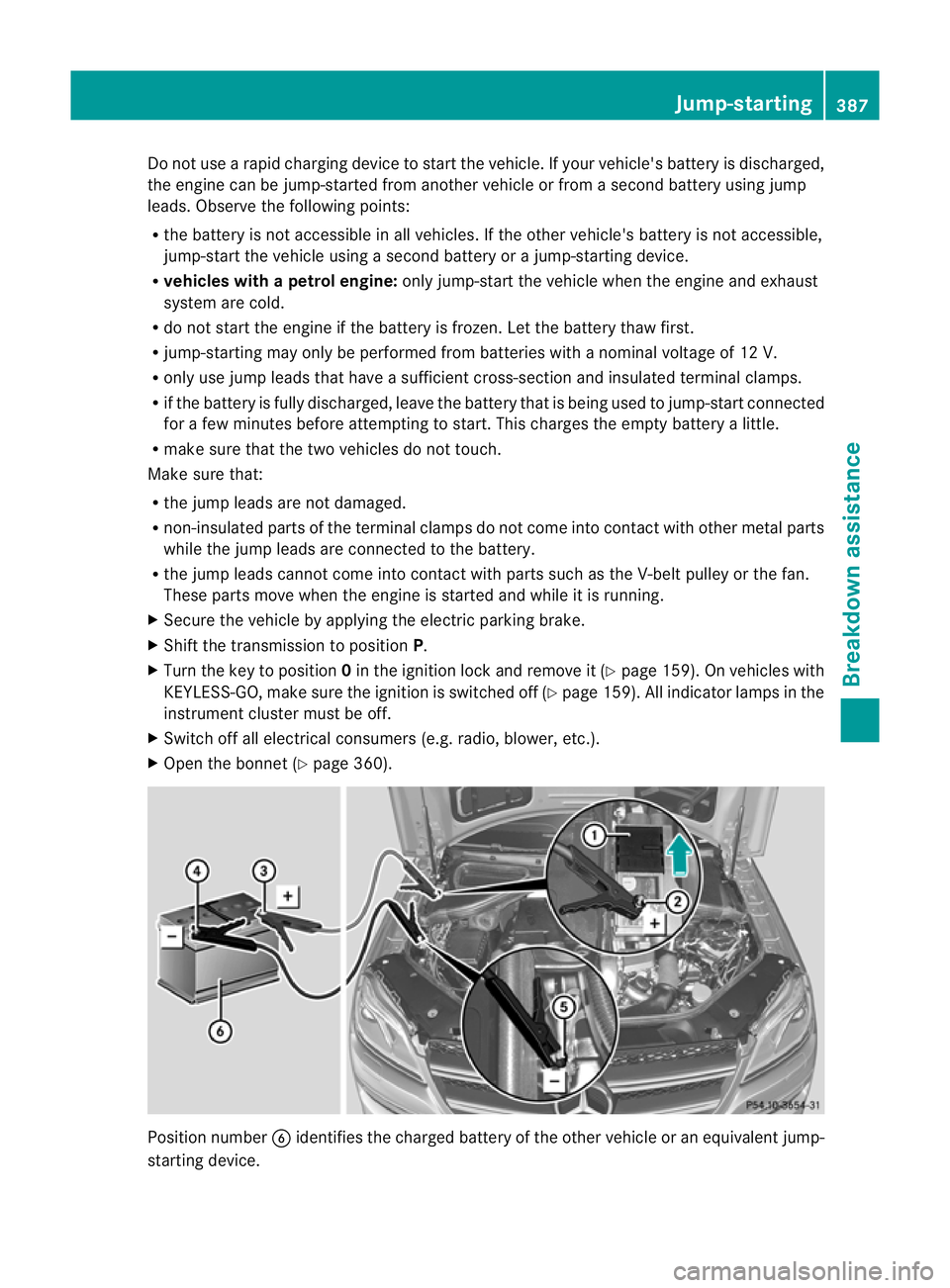
X Open the bonnet (Y page 360).Position number
Bidentifies the charged batter yofthe other vehicle or an equivalent jump-
startin gdevice. Jump-starting
387Breakdown assistance Z
Page 392 of 441
!
Observe the following points when towing
wit hat ow rope:
R secur ethe tow rope on the sam eside on
both vehicles.
R the tow rope must not be longer than is
legally permitted. It should be marked in
the middle, e.g. with awhite cloth
(30 x30c m) so that other roa dusers are
aware that avehicle is being towed.
R the tow rope may only be attached to the
towing eyes.
R observ ethe brake lamps of the towing
vehicle while driving. Always maintain a
distanc esothat the tow rope does not
sag.
R do not use steel cables or chains to tow
your vehicle. The vehicle could be dam-
aged.
! Do not use the towing eye for recovery,
this could damage the vehicle. If in doubt,
recover the vehicle with acrane.
! When towing, pu llaway slowly and
smoothly .Ifthe tractive power is too high,
the vehicles could be damaged.
! To tow vehicles with KEYL ESS-GO,use
the key instead of the Star t/Stop button.
Th ea utomatic transmission may otherwise
switch to position Pwhen you open the
driver' sorfront-passenger door which
could damag ethe transmission.
! Vehicles with differential locks: make
sur ethe differential lock sare in automatic
mode. When towing, th edifferential locks
must not be switched on. The transmission
may otherwise be damaged.
! You may tow the vehicle for amaximum
of 50km .Atowing speed of 50 km/h must
not be exceeded.
For towin gdistances over 50 km, the entire
vehicle must be lifted up and transported.
! If you tow or tow-start another vehicle, its
weight must not exceed the maximum per- missible gross vehicle weight of your vehi-
cle.
Information on your vehicle' sgros svehicle
weight rating can be foun donthe vehicle
identification plat e(Ypage 422).
Observe the legal requirement sfor the rele-
vant countries when towing.
It is bette rtoh ave the vehicle transported
than to have it towed.
If the vehicle has suffered transmission dam-
age, have it transported on atransporter or
trailer.
Th ea utomatic transmission must be in posi-
tion Nwhen the vehicle is being towed.
The battery must be connected and charged.
Otherwise, you:
R cannot turn the key in the ignition lock to
position 2
R cannot release the electric parking brake
R cannot shift the automatic transmission to
position N
i Deactivate the automatic locking feature
(Y page 283). You could otherwis ebe
locked out when pushing or towing the
vehicle.
Deactivate tow-away protection
(Y page 71) before the vehicle is towed. Towing and tow-starting
389Breakdown assistance Z
Page 393 of 441
Fitting/removing th
etowing eye
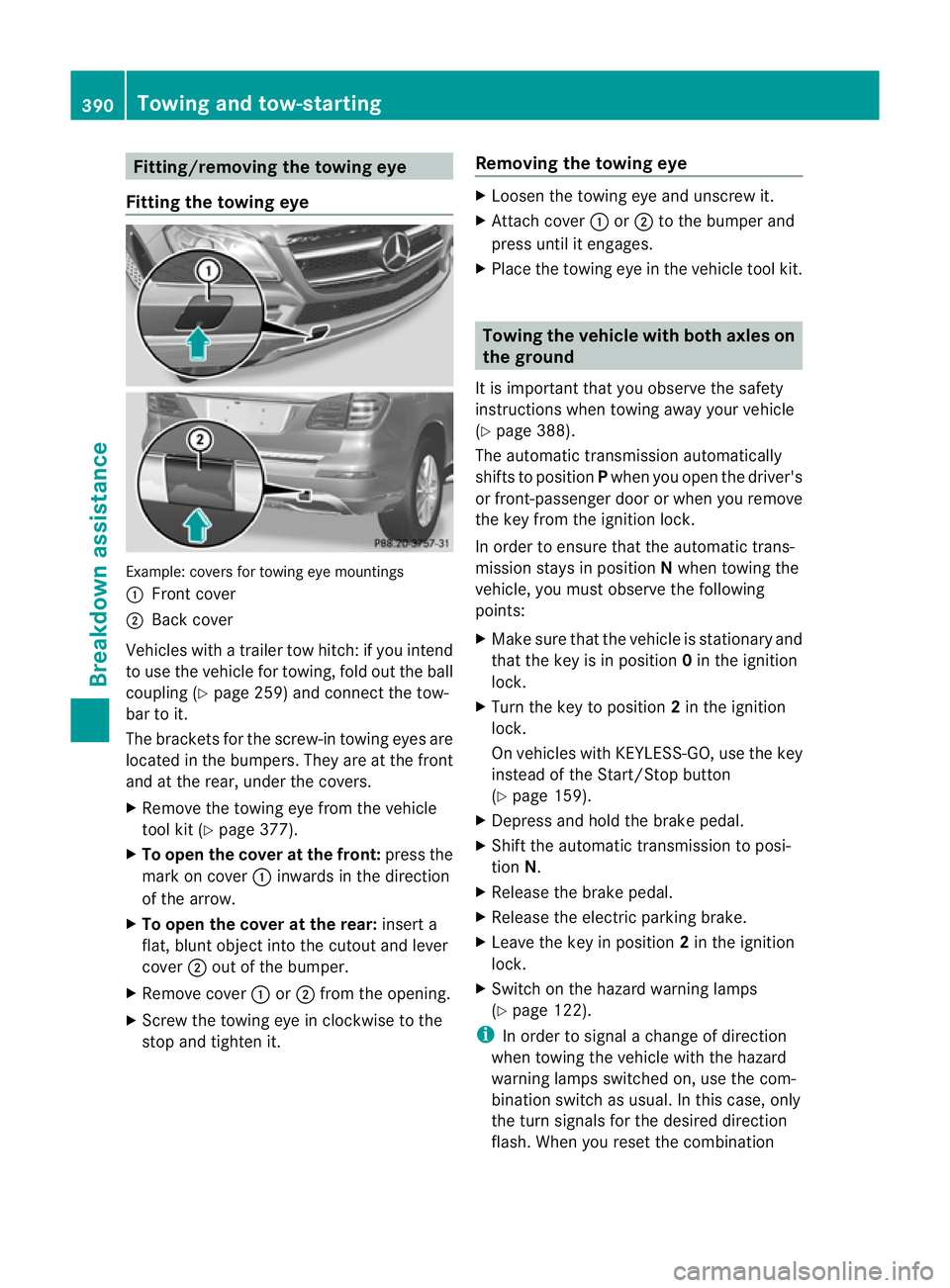
Fitting th etowing eye Example: cover
sfor towin geye mountings
: Front cover
; Bac kcover
Vehicles with atrailer to whitch :ify ou intend
to use the vehicle for towing, fold out the ball
coupling (Y page 259) and con nect the tow-
bar to it.
Th eb rackets for th escrew-i ntowing eyes are
located in the bumpers. They ar eatthe front
and at the rear, under the covers.
X Remove the towing eye from the vehicle
tool kit (Y page 377).
X To ope nthe cover at the front: press the
mark on cover :inwards in th edirection
of the arrow.
X To open the cover at the rear: insert a
flat, blunt object into the cutout and lever
cover ;out of the bumper.
X Remove cover :or; from the opening.
X Screw the towing eye in clockwise to the
stop and tighten it. Removing the towing eye X
Loosen the towing eye and unscrew it.
X Attach cover :or; to the bumper and
press until it engages.
X Place the towing eye in the vehicle tool kit. Towing the vehicle with both axles on
the ground
It is important that you observe the safety
instructions when towing away your vehicle
(Y page 388).
The automatic transmission automatically
shifts to position Pwhen you open the driver's
or front-passenger door or when you remove
the key from the ignition lock.
In order to ensure that the automatic trans-
mission stays in position Nwhen towing the
vehicle, you must observe the following
points:
X Make sure that the vehicle is stationary and
that the key is in position 0in the ignition
lock.
X Turn the key to position 2in the ignition
lock.
On vehicles with KEYL ESS-GO, use the key
instead of the Start/Stop button
(Y pag e159).
X Depres sand hol dthe brake pedal.
X Shif tthe automatic transmission to posi-
tion N.
X Release the brake pedal.
X Release the electric parkin gbrake.
X Leave th ekey in position 2in the ignition
lock.
X Switch on the hazar dwarning lamps
(Y page 122).
i In order to signal achange of direction
when towing the vehicle with the hazard
warnin glamps switched on, use the com-
bination switch as usual .Inthis case ,only
the turn signals for the desired direction
flash .When you reset the combination 390
Towing and tow-startingBreakdown assistance
Page 394 of 441
switch, the hazard warnin
glamps start
flashing again. Transporting the vehicle
! Only lash the vehicle down by the wheels
or wheel rims, not by parts of the vehicle
such as axle or steering components. Oth-
erwise, the vehicle could be damaged.
The towing eyes or trailer tow hitch can be
used to pull the vehicle onto atrailer or trans-
porter if yo uwish to transport it.
X Turn the key to position 2in the ignition
lock.
X Shift the automatic transmission to posi-
tion N.
As soon as the vehicle is loaded:
X Prevent the vehicle from rolling away by
applying the electric parkin gbrake.
X Shift th eautomatic transmission to posi-
tion P.
X Turn the key to position 0in the ignition
lock and remove it.
X Secure the vehicle. Information for 4MATIC vehicles
! Vehicles with 4MATIC must not be towed
with the front or rear axle raised; otherwise,
the transmission may be damaged.
If the vehicle has transmission damage or
damage to the front or rear axle, have it trans-
ported on atransporter or trailer.
In the even tofdamage to the ele ctrical
system
If the battery is defective, the automatic
transmission will be locked in position P.To
shif tthe automatic transmission to position
N,y ou must provide power to the vehicle's
electrical system in the same way as when
jump-starting (Y page 386).
Hav ethe vehicle transported on atransporter
or trailer. Recov
ering avehicle that ha sbecome
stuck
! When recovering atrapped vehicle ,donot
je rk the vehicle or pull it at an angle. If the
tractive powe rist oo high, th evehicles
could be damaged.
If th edrive wheels ge ttrapped on loose or
muddy ground, recover th evehicle with the
utmost care, especially so if the vehicle is
laden.
Never attempt to recover avehicle with a
trailer atta ched.
Pull out the vehicle backwards, if possible,
using the tracks it made when it became
stuck. Tow-starting (emergency engine
starting)
! Vehicles with automatic transmission
must not be tow-star ted. Otherwise, you
could damage the automatic tra nsmission.
You ca nfind information on "Jump-starting"
at (Y page 386). Electrical fuses
Important safet
ynotes G
WARNING
Only use fuses that have been approved for
Mercedes-Benz vehicles and which have the
correct fuse ratin gfor the system scon-
cer ned. Do not attempt to repair or bridge
faulty fuses. Usin gfuses which have not been
approved or attempting to repair or bridge
faulty fuses could cause the fuse to be over-
loaded and result in afire. Have the cause
traced and rectified at aqualified specialist
workshop.
! Only use fuses marked with an "S" for the
fuse box in the engine compartment and
under the rear bench seat. Components or
systems could othe rwise be damaged. Electrical fuses
391Breakdown assistance Z
Page 395 of 441
The fuses in your vehicle serv
etoclose down
faulty circuits .Ifafuse blows, all the compo-
nen tson th ecircuit and their function sstop
operating.
Blown fuse smust be replaced with fuses of
the same rating, which you can recognise by
the colour and fuse rating. The fuse ratings
are listed in the fuse allocation chart.
If the newly inser tedf use also blows ,have the
cause traced and rectified at aqualified spe-
cialist workshop, e.g. aMercedes-Benz
Servic eCentre. Befor
ereplacing afuse
X Secure th evehicle against rollin gaway
(Y page 181).
X Switch off all electrical consumers.
X Turn the key to position 0in the ignition
lock and remove it (Y page 159). On vehi-
cles with KEYLESS-GO, mak esure the igni-
tion is switched off (Y page 159).
All indicator lamps in the instrumen tcluster
must be off.
The fuses are located in various fuse boxes:
R fuse box on the fron t-passenger side of the
dashboard
R fuse box in the engine compartmen tonthe
right-hand side of the vehicle, when viewed
in the direction of travel
R fuse box under the rea rbench seat
The fuse allocation char tisl ocated in the fuse
box under the rea rbench seat (Y page 393). Dashboar
dfuse box
! Do not us eapointed objec tsuch as a
screwdriver to open the cover in the dash-
board. You could damage the dashboard or
the cover.
! Make sure that no moisture can enter the
fuse box when the cover is open.
! When closing the cover, make sure that it
is lying correctly on the fuse box. Moisture seeping in or dirt could otherwis
eimpair
th eo peration of the fuses. X
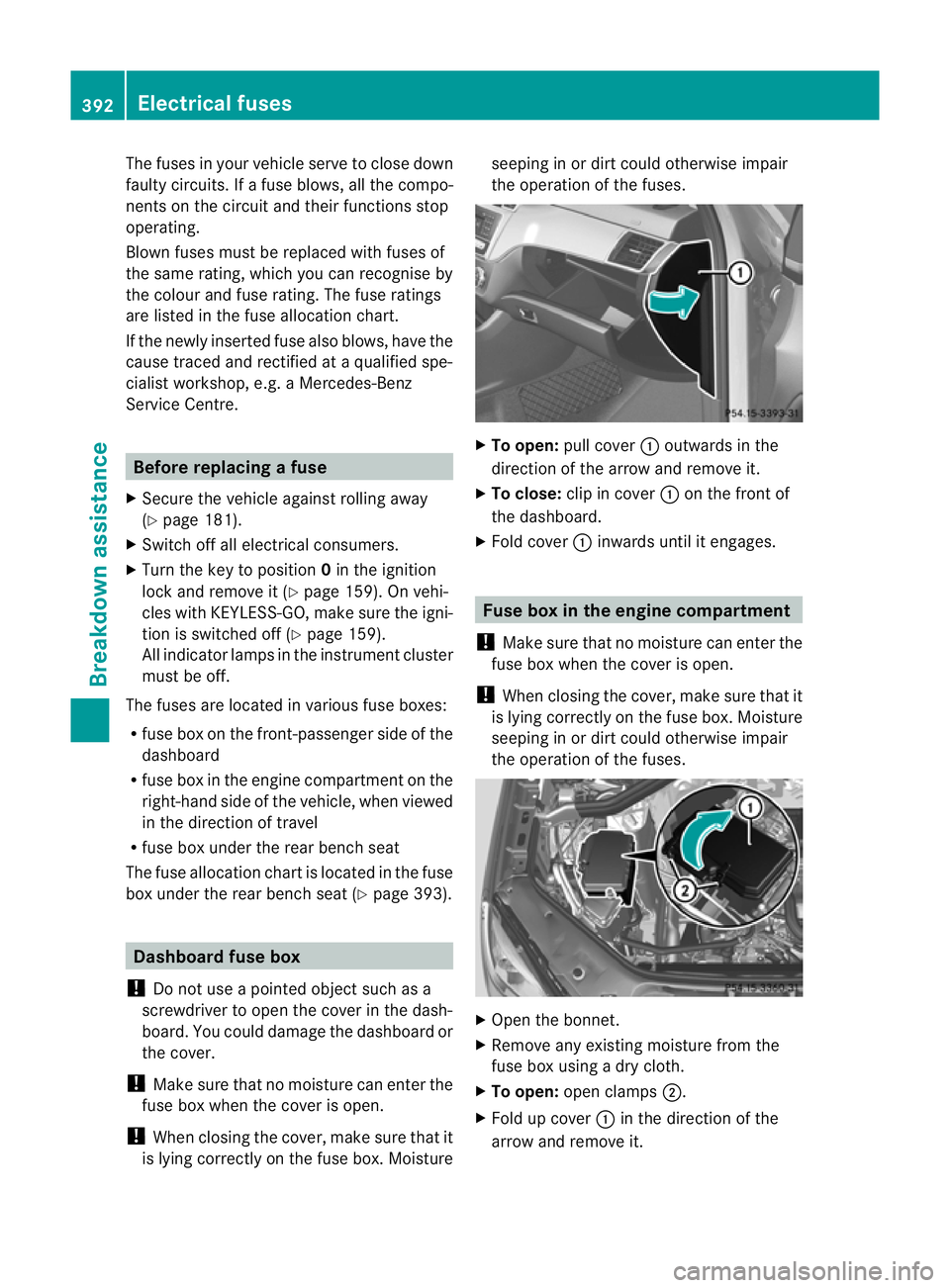
To open: pull cover :outwards in the
direction of the arrow and remove it.
X To close: clip in cover :on the front of
the dashboard.
X Fold cover :inwards unti litengages. Fuse box in the engine compartment
! Make sure that no moisture can enter the
fuse box whe nthe cover is open.
! When closing the cover, make sur ethat it
is lyin gcorrectly on the fuse box. Moisture
seeping in or dir tcould otherwise impair
the operation of the fuses. X
Open the bonnet.
X Remove any existing moistur efrom the
fus eb ox using adry cloth.
X To open: open clamps ;.
X Fol dupc over:in the direction of the
arrow and remove it. 392
Electrical fusesBreakdown assistance
Page 400 of 441
other obstacles. If it is necessary to drive over
kerbs, speed humps or similar elevations, try
to do so slowly and at an obtuse angle .Oth-
erwise ,the tyres, particularly the sidewalls,
ma ybed amaged. Regular checking of wheels and tyres
G
WARNING
Damaged tyres can cause tyre inflation pres-
sure loss .Asaresult,you coul dlose control
of your vehicle. There is arisk of accident.
Check the tyres regularly for signs of damage
and replace any damaged tyres immediately.
Regularly check the wheels and tyres of your
vehicle for damage at least once amonth, as
well as after drivin goff-road or on rough
roads .Damaged wheels can cause aloss of
tyr ep ressure. Pa yparticular attention to
damage such as:
R cuts in the tyres
R punctures
R tears in the tyres
R bulges on tyres
R deformation or severe corrosion on wheels
Regularly check the tyre tread depth and the
condition of the tread across the whole width
of the tyre (Y page 397). If necessary, turn
the front wheelst ofull lock in order to inspect
the inner side of the tyre surface.
All wheel smust have avalve cap to protect
the valve against dirt and moisture. Do not fit
anything onto the valve other than the stand-
ard valve cap or other valve caps approved by
Mercedes-Benz for your vehicle. Do not fit any
other valve caps or systems, e.g. tyre pres-
sure monitoring systems.
Regularly check the pressure of all the tyres,
particularly prior to long trips. Adjust the tyre
pressure as necessary (Y page 399).
Observe the notes on the emergenc yspare
wheel (Y page 414). The service life of tyres depends on various
factors, including the following:
R
driving style
R tyr ep ressure
R tyre mileage Tyre tread
G
WARNING
Insufficient tyre trea dwill reduce tyre trac-
tion. The tyre is no longer able to dissipate
water. This means that on wet road surfaces,
the risk of aquaplaning increases, in particular
where speed is not adapted to suit the driving
conditions. There is arisk of accident.
If the tyre pressure is too high or too low, tyres
may exhibit different levels of wear at differ-
ent locations on the tyre tread. Thus, you
should regularly check the tread depth and
the condition of the tread across the entire
width of all tyres.
Minimum tyre tread depth for:
R summer tyres: 3mm
R M+S tyres: 4mm
For safety reasons ,replace the tyres before
the legally prescribed limi tfor the minimum
tyr etrea ddepth is reached.. Selecting, fitting and replacing ty
res
R Only fi ttyres and wheels of the same type
and make.
R Only fit tyres of the correc tsize ont othe
wheels.
R Run in new tyres at moderate speeds for
the first 10 0km. They onl yreach their full
performanc eafter this distance.
R Do not drive wit htyres which have too little
tread depth .This otherwise significantly
reduce sthe traction on wet roads (aqua-
planing).
R Replace the tyres after six year satthe lat-
est, regardless of wear. Operation
397Wheels and ty res Z
Page 404 of 441
i
The tyr epressure values given for low
load sare minimum values which offe ryou
good rid ecomfor tcharacteristics.
However ,you can also use the values given
for higher loads. These ar epermissible and
will not adversely affect the running of the
vehicle. Ty
re pr essur eloss warning system
Important safety notes While the vehicle is in motion, the tyre pres-
sure loss warnin gsystem monitors the set
tyre pressure using the rotational speed of
the wheels. This enable sthe system to detect
significant pressur eloss in atyre. If the speed
of rotation of awheel changes as aresult of
al oss of pressure, acorrespondin gwarning
message will appea rinthe multifunction dis-
play.
The tyr epressure warning system does not
warn yo uofani ncorrectly set tyre pressure.
Observe the notes on the recommended tyre
pressure (Y page399).
Th et yre pressure los swarning system does
not replace the need to regularly check your
vehicle's tyre pressures, since an even loss of
pressure on several tyres at the same time
cannot be detected by the tyre pressure loss
warning system.
The tyre pressure monitor is not able to warn
you of asudden loss of pressure, e.g. if the
tyre is penetrated by aforeign objec t. Inthe
event of asudden loss of pressure, bring the
vehicle to ahalt by braking carefully. Avoid
abrupt steering manoeuvres.
The function of the tyre pressure loss warning
system is limited or delayed if:
R snow chains are fitted to your vehicle's
tyres.
R road conditions are wintry.
R you are driving on sand or gravel.
R you adopt avery sporty driving style (cor-
nering at high speeds or driving with high
rates of acceleration). R
you are towing avery heavy or large trailer.
R you are driving with aheavy load (in the
vehicle or on the roof).
Resta rting the ty re pressur eloss warn-
ing system Restart the tyre pressure loss warnin
gsystem
if you have:
R changed the tyre pressure
R changed the wheels or tyres
R fitted new wheels or tyres
X Before restarting, make sure that the tyre
pressures are set properly on all four tyres
for the respective operating conditio ns.
The recommended tyr epressures can be
found in th etable on the fuel filler flap.
The tyre pressure loss warning system can
only give reliabl ewarnings if you have set
the correct tyre pressure. If an incorrect
tyre pressure is set, these incorrec tvalues
will be monitored.
X Also observ ethe notes in the sectionon
tyre pressures (Y page 399).
X Make sure tha tthe key is in posi-
tion 2(Ypage 159) in the ignition lock.
X Press the =or; button on the steer-
ing wheel to selec tthe Serv. menu.
X Press the 9or: button to select
Tyre pressure .
X Press the abutton.
The RunF lat Indicator active Restart with OK message appe
arsint he
multifunction display.
If yo uwish to confirm the resta rt:
X Press the abutton.
The Tyre press. no wOK? message
appe arsint he multifunction display.
X Press the 9or: button to select
Yes .
X Press the abutton.
The RunF lat Indicator restarted message appe
arsint he multifunction dis-
play. Ty
re pressure
401Wheelsand ty res Z
Page 405 of 441
After
ateach-in period ,the tyr epressure
loss warning system wil lmonitor the set
tyr ep ressures of all fou rtyres.
If you wish to cancel the restart:
X Press the %button.
or
X If the Tyrepress. now OK? message
appears ,use the 9or: button to
select Cancel .
X Press the abutton.
The tyr epressure values stored at th elast
restar twill continue to be monitored. Tyr
epressur emonitor
Important safet ynotes It is the driver's responsibility to set the tyre
pressure to the recommended cold tyre pres-
sure suitable for the operatin
gsituation
(Y page 399). Note that the correct tyre pres-
sure for the curren toperatin gsituation must
first be taught-in to the tyre pressure monitor.
If ther eisas ubstantial loss of pressure, the
warning threshold for the warning messag eis
aligned to the referenc evalues taught-in.
Restart the tyre pressure monitor after
adjustin gtothe cold tyr epressure
(Y page 403). Th ecurren tpressures are
saved as new referenc evalues. This will
ensure that awarning mess agewillonly
appear if the tyre pressure drops significantly.
The tyre pressure monitor doe snot warn you
of an incorrectly set tyr epressure. Observe
th en otes on the recommended tyr epressure
(Y page 399).
Th et yre press urem onitor is not able to warn
you of asudden loss of pressure, e.g. if the
tyre is penetrated by aforeign object. In the
even tofas udden loss of pressure, bring the
vehicl etoah altbyb raking carefully. Avoid
abrupt stee ringmanoeuvres.
If at yrep ressur emonitor system is fitted, the
vehicle's wheels hav esensor sfitte dthat
mo nito rthe tyre pressures in all four tyres. The tyr
epressur emonitor war nsyou if the
pressur edrops in one or more of the tyres.
Th et yrep ressur emonitor only fu nctionsif
the cor respondin gsensor sare fitte dtoall
wheels.
Information on tyr epressures is displayed in
the multifunctio ndisplay .After afew minutes
of driv ing, the curren ttyre pressure of each
tyre is sho wn inthe multifunction display.
Th et yre pressure values indicated by the on-
board computer may differ from thos emeas-
ured at afilling station using apressure
gauge. Th etyre pressures shown by the on-
board computer refer to thos emeasured at
sea level. At high altitudes, the tyr epressure
values indicated by apressure gaug eare
higher than thos eshown by the on-board
computer. In this case ,donot reduce the tyre
pressures.
The operation of the tyr epressure monitor
can be affecte dbyinterference from radio
transmitting equipment (e.g .radio head-
phones ,two-way radios) that may be being
operated in or near the vehicle.
Checking tyr epressure electronically X
Make sure that the key is in posi-
tion 2(Ypage 159) in the ignitio nlock.
X Press the =or; button on the steer-
ing wheel to select the Serv. menu.
X Press the 9or: button to select
Tyre pressure .
X Press the abutton.
The curren ttyre pressure for each wheel
will be displayed in the multifunction dis-
play.
If the vehicle has been parked for longe rthan
20 minutes ,the Tyre pressures will be
displaye
dafter afew minutes of driving message appe
ars.
After ateach-in period, the tyr epressure
monito rautomatically recognises new
wheel sornew sensors. As long as aclear
allocation of the tyre pressure values to the
individual wheels is not possible ,the Tyre 402
Ty
re pressureWheel sand ty res