ECU MERCEDES-BENZ GL SUV 2012 Repair Manual
[x] Cancel search | Manufacturer: MERCEDES-BENZ, Model Year: 2012, Model line: GL SUV, Model: MERCEDES-BENZ GL SUV 2012Pages: 441, PDF Size: 10.66 MB
Page 349 of 441
cond
itions and drive with partic ularcareift he
roof is laden.
! Mercedes-Benz recommends that you
only us eroof carrier sthat hav ebeen tested
and approved for Mercedes-Ben zvehicles.
This helps to prevent damage to the vehi-
cle.
Position the load on the roof carrier in such
aw ay that the vehicle will not sustain dam-
age even when it is in motion.
Depending on the vehicle equipment,
ensure that when the roof carrier is fitted
you can:
R raise the sliding sunroof fully
R open the panorama sliding sunroof fully
R open the tailgate fully
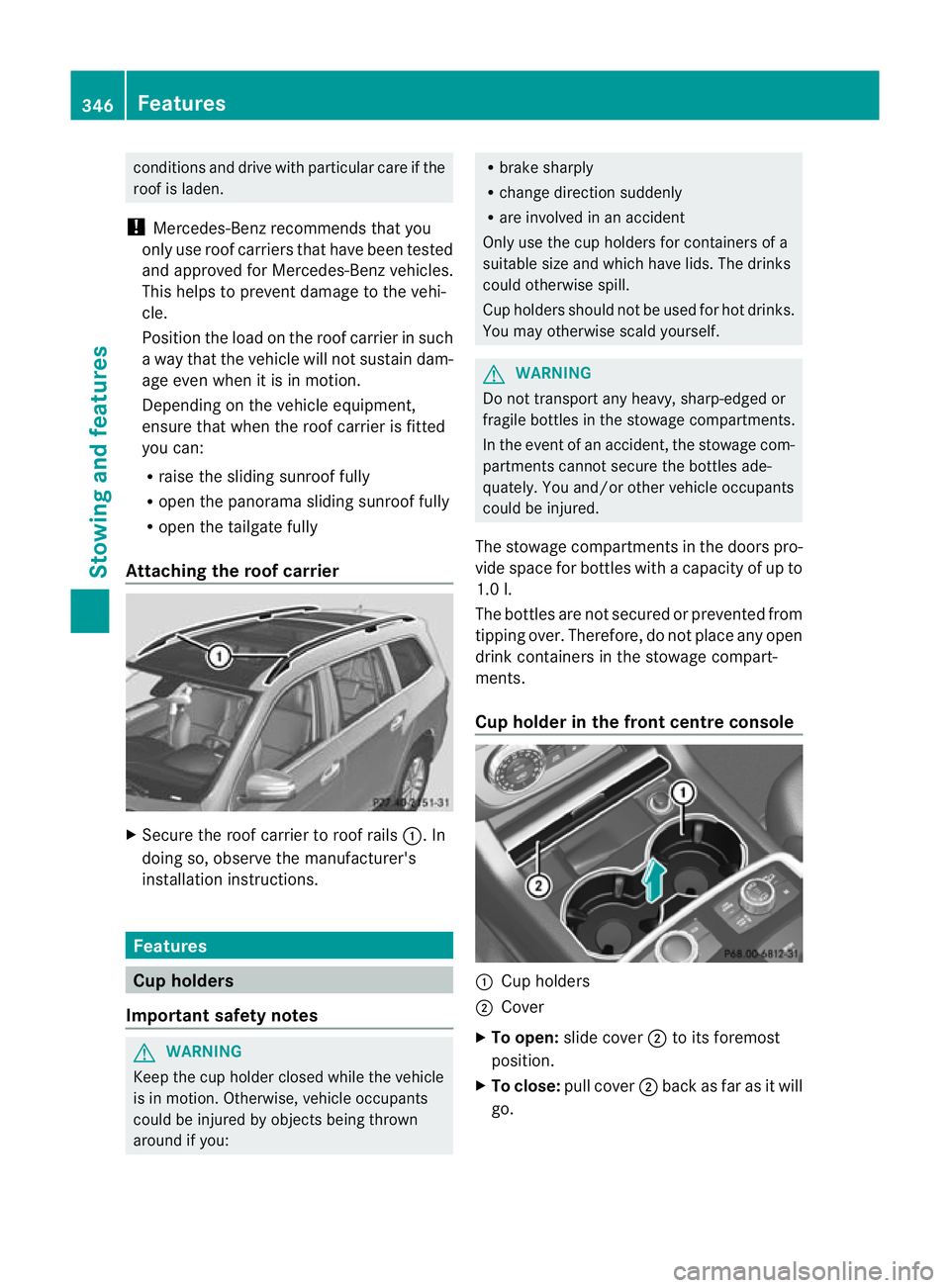
Attaching the roof carrier X
Secure the roof carrier to roof rails :.In
doing so, observe the manufacturer's
installation instructions. Features
Cup holders
Important safety notes G
WARNING
Keep the cup holder closed while the vehicle
is in motion. Otherwise, vehicle occupants
could be injured by object sbeing thrown
around if you: R
brak esharply
R change direction suddenly
R arei nvolved in an accident
Only use the cup holders for containers of a
suitable size and which have lids .The drinks
coul dotherwis espill.
Cup holders should not be used for hot drinks.
You may otherwise scald yourself. G
WARNING
Do not transport any heavy, sharp-edged or
fragile bottles in the stowage compartments.
In the event of an accident, the stowage com-
partment scannot secure the bottles ade-
quately .You and/or other vehicle occupan ts
co uld be injured.
The stowag ecompart ments in the doors pro-
vide space for bottles with acapacity of up to
1.0 l.
The bottles are not secured or prevented from
tipping over. Therefore, do not place any open
drink containers in the stowage compart-
ments.
Cup holder in the front centre console :
Cup holders
; Cover
X To open: slide cover ;to its foremost
position.
X To close: pull cover ;back as far as it will
go. 346
FeaturesStowing and features
Page 350 of 441
You can remove the rubber mat of the cup
holder to clean it. Clean it with clean
,luke-
warm water only.
Temperature-controlled cup holder in
th ef ront-compartment centr econsole G
WARNING
When you use the warmin gfunction ,the metal
insert of thecup holder is heated. Therefore,
do not touch the cup holder inser t.Otherwise,
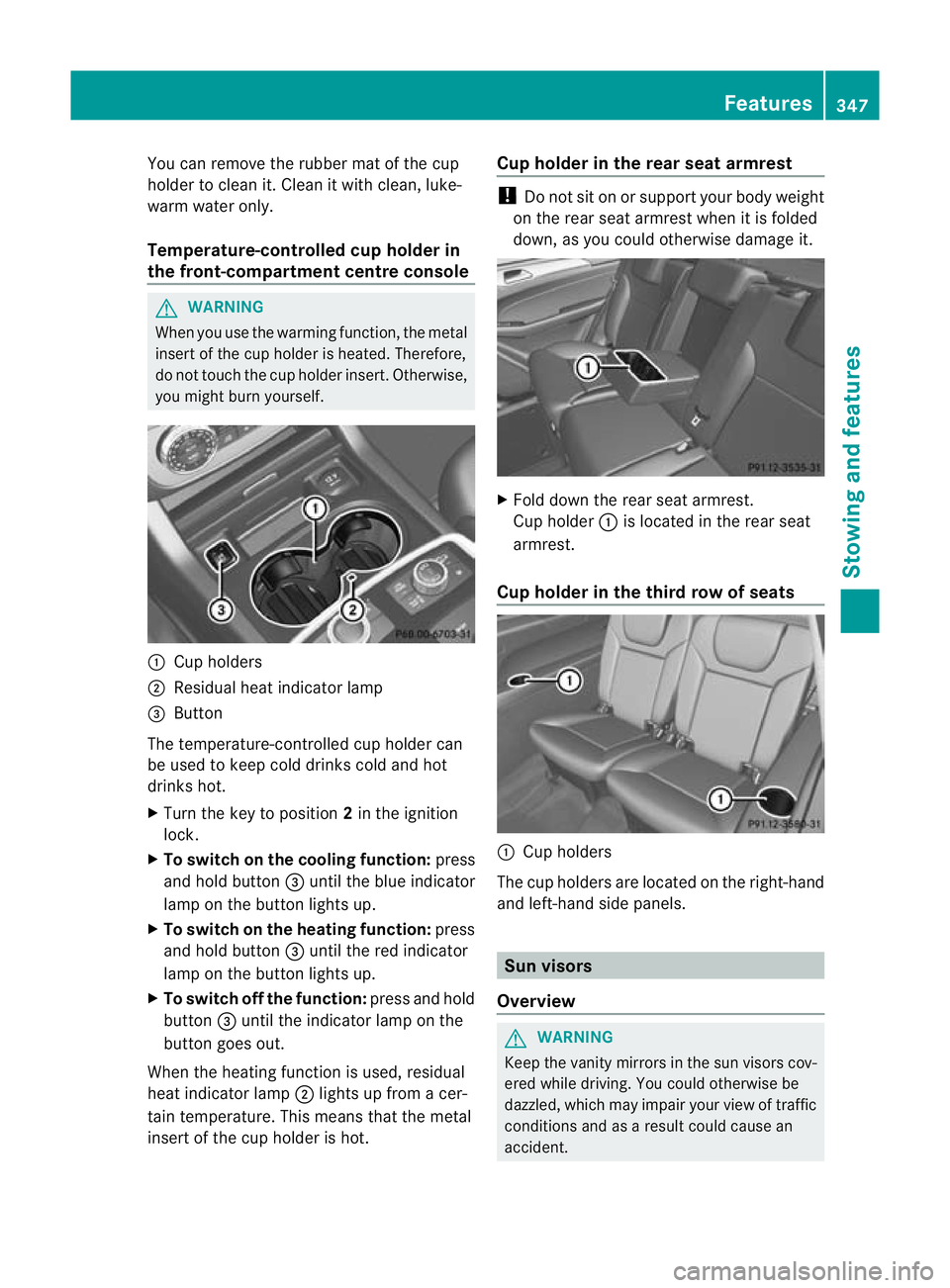
you migh tburny oursel f. :
Cuph olders
; Residual heat indicator lamp
= Button
Th et emperature-c ontrolle dcup holde rcan
be used to keep cold drinks cold and hot
drinks hot.
X Turn the key to position 2in the ignition
lock.
X To switch on th ecooling function: press
and hold button =until th eblue indicator
lamp on th ebutton lights up.
X To switch on th eheating function: press
and hold button =until the red indicator
lamp on the button lights up.
X To switch off th efunc tion: press and hold
button =until the indicator lamp on the
button goes out.
When the heatin gfunction is used, residual
heat indicator lamp ;lights up fro macer-
tain temperature. This mean sthat the metal
insert of the cup holder is hot. Cu
ph older in th erears eat armrest !
Do not sit on or support your body weight
on the rear seat arm rest when it is folded
down ,asy ou coul dotherwise damage it. X
Fold down the rear seat armrest.
Cup holder :is located in the rear seat
armrest.
Cup holder in th ethird row of seats :
Cup holders
The cup holders are located on the right-hand
and left-han dside panels. Sun visors
Overview G
WAR
NING
Keep the vanity mirrors in the sun visors cov-
ered whil edriving.Y ou coul dotherwise be
dazzled, which may impair your view of traffic
conditions and as aresult could cause an
accident. Features
347Stowing and features Z
Page 361 of 441
Australia
Country Radio type approval num-
ber
Frequency range (MHz)
AU (Aus-
tralia) 28 June
MHz
:27,30 ,40, 433, 868 NZ
(New
Zealand) 20 March 06
MHz: 27
,30, 40, 433 Floormats
G
WARNING
Mak esure that there is sufficient clearance
around the pedal swhen floormats are used,
and that the floormats are prope rlys ecured.
The floormat smust be correctly secured at all
times using the securing knob and retainers.
Before you drive off ,chec kthe floormats and
secur ethem if necessary. Afloormat which is
not properly secured can slip and thereby
interfere with the movemen tofthe pedals.
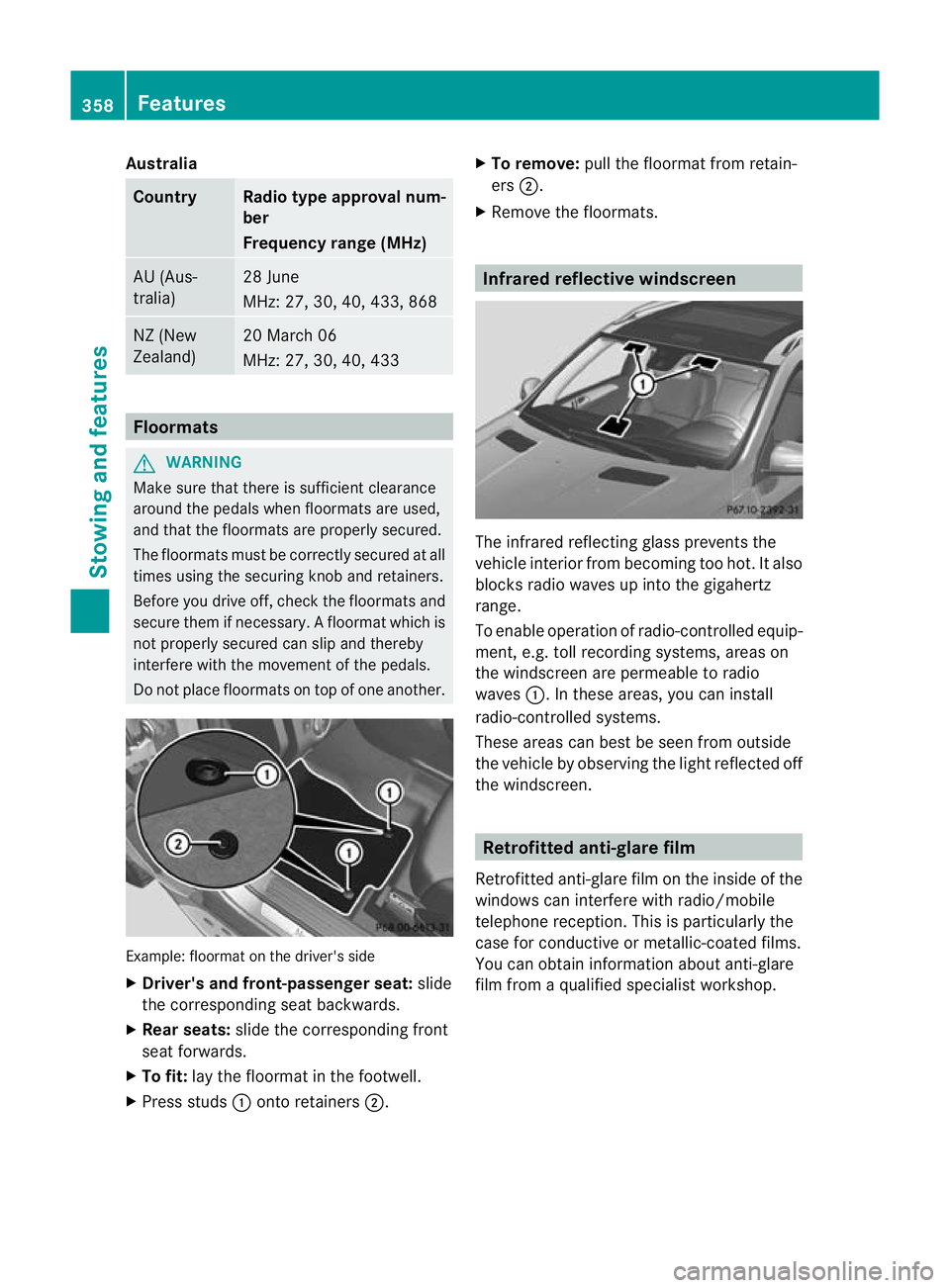
Do not plac efloormats on top of one another. Example: floormat on the driver's side
X
Driver's and front- passenger seat: slide
the corresponding seat backwards.
X Rea rseats: slide the corresponding front
seat forwards.
X To fit: lay the floormat in the footwell.
X Press studs :onto retainers ;. X
To remove: pull the floormat from retain-
ers ;.
X Remove the floormats. Infrared reflective windscreen
The infrared reflectin
gglass prevent sthe
vehicle interior from becoming too hot. It also
blocks radio waves up int othe gigahertz
range.
To enable operation of radio-controlled equip-
ment, e.g. toll recording systems, areas on
the windscreen ar epermeable to radio
waves :.Int hese areas, you can install
radio-controlled systems.
These areas can best be seen from outside
the vehicle by observin gthe light reflected off
the windscreen. Ret
rofi tted anti-glar efilm
Retrofitted anti-glare film on the inside of the
windows can inter ferewith radio/mobile
telephone reception. This is particularly the
case for conductive or metallic-coated films.
You can obtain information about anti-glare
film from aqualified specialist workshop. 358
FeaturesStowin
gand features
Page 366 of 441
H
Environmenta
lnote
When toppin guptheoil, tak ecaren ot to spill
any .Ifo il enters th esoil or waterways, it is
harmful to th eenvironment.
! Only use engine oil sand oil filters that
have bee napproved for vehicles with a
servic esystem. You can obtain alist of the
engine oils and oil filters tested and
approved in accordance with the
Mercedes-Ben zSpecification sfor Service
Product satany Mercedes-Ben zService
Centre.
Damage to th eengine or exhaust sys temis
caused by the following:
R using engine oil sand oil filters that have
not bee nspecifically approved for the
servic esystem
R changing the engine oil and oil filter after
missing the change interval required by
the servic esystem
R using engine oil additives
! Do not add too muc hoil. Toppin gupwith
to om uche ngine oil can resul tindamage
to the engine or to the catalytic converter.
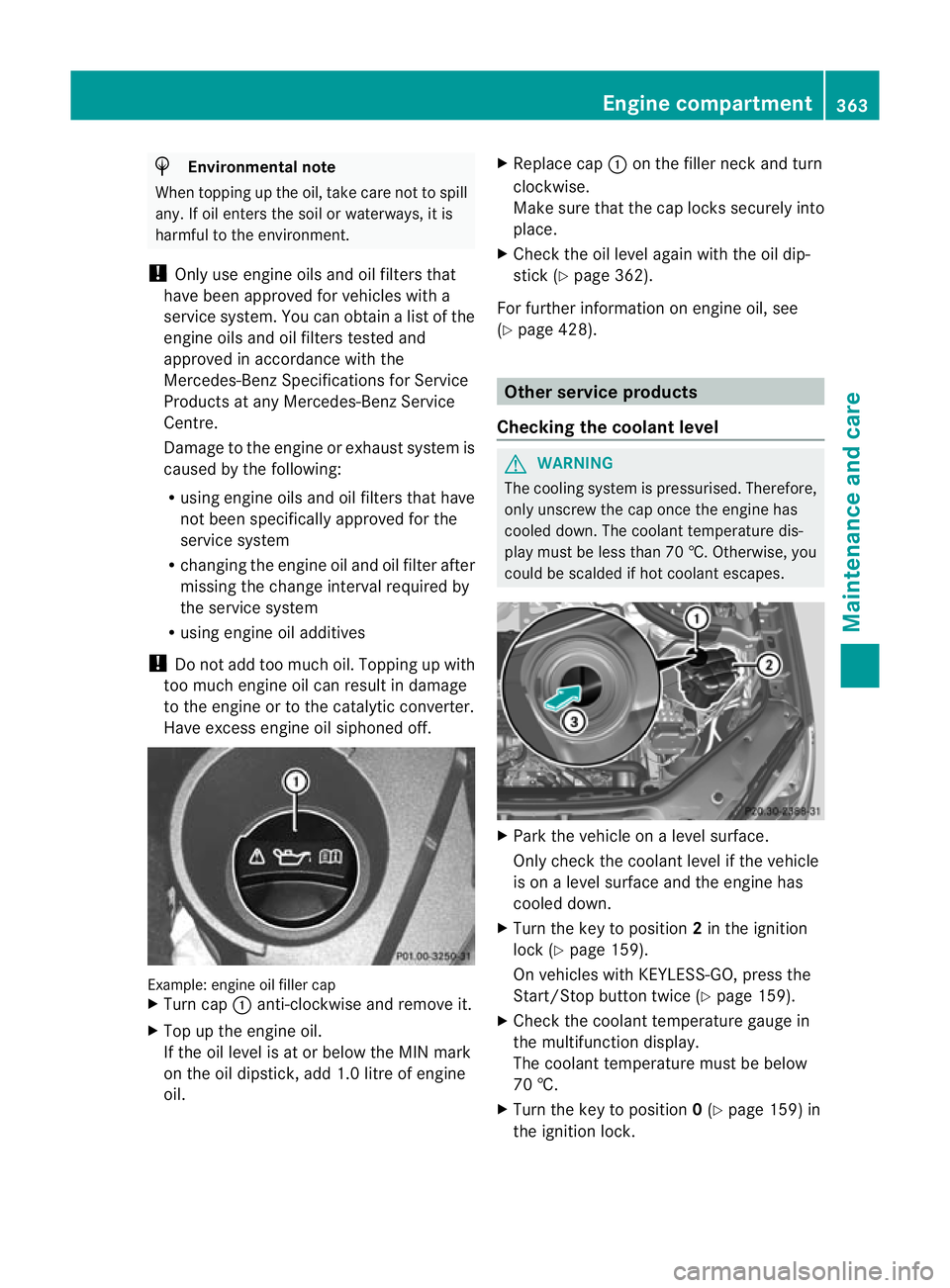
Hav eexcess engine oil siphoned off. Example: engine oil filler cap
X
Turn cap :anti-clockwis eand remove it.
X Top up the engine oil.
If the oil level is at or below the MIN mark
on the oil dipstick ,add 1. 0litreo fengine
oil. X
Replace cap :on the filler nec kand turn
clockwise.
Make sure that the cap locks securely into
place.
X Check the oil level agai nwith the oil dip-
stic k(Ypage 36 2).
For furthe rinformation on engine oil ,see
(Y page 42 8). Other service products
Checking th ecoolant level G
WARNING
The coolin gsystem is pressurised. Therefore,
only unscrew the cap onc ethe engine has
coole ddown. The coolan ttemperatur edis-
play must be less than 70 †. Otherwise, you
could be scalded if hot coolant escapes. X
Park the vehicle on alevel surface.
Only chec kthe coolant level if the vehicle
is on alevel surface and the engine has
cooled down.
X Turn the key to position 2in the ignition
lock (Y page 159).
On vehicles with KEYLESS-GO, press the
Start/Stop button twic e(Ypage 159).
X Check the coolant temperatur egauge in
the multifunction displ ay.
Th ec oolant temperatur emust be below
70 †.
X Turn the key to position 0(Y page 159 )in
the ignition lock. Eng
inecompartment
363Maintenance and care Z
Page 372 of 441
i
The vehicle should preferably be washed
by hand using asoft sponge, car shampoo
and plent yofwater.
i Use only insect remover and car shampoo
from the range of recommended and
approved Mercedes -Benz care products. Cleaning vehicle parts
Cleaning the wheels !
Do not use acidic wheel cleaning products
to remove brake dust. Thi scould damage
wheel bolts and brake components.
! Do not par kupthe vehicle for an extended
period straight after cleanin git, particularly
after having cleaned the wheels with wheel
cleaner. Wheel cleaners could cause
increased corrosion of the brake discs and
brake pads/linings .For this reason, you
should drive for afew minutes after clean-
ing. Brakin gheats the brak ediscs and the
brake pads/linings, thus drying them. The
vehicle can then be parked up.
Cleaning the windows G
WARNING
Switc hoff the windscree nwipers and remove
the key from the ignition lock before cleaning
the windscreen or the wiper blades. On vehi-
cles with KEYL ESS-GO, pres sthe Start/S top
button repeatedly until all indicator lamps in
the instrumen tcluster have gone off. The
windscreen wipers could otherwise move and
injur eyou.
! Do not use dry cloths, abrasive products,
solven tsor cleanin gagents con taining sol-
vent stoc lean the inside of the windows.
Do not touch the insides of the windows
with hard objects, e.g. an ice scraper or
ring. There is otherwise arisk of damaging
the windows.
! Clean the water drainage channels of the
windscreen and the rear window at regular intervals. Deposits such as leaves, petals
and pollen may under certain circumstan-
ces prevent water from drainin
gaway. This
can lead to corrosion damage and damage
to electronic components.
X Clean the inside and outside of the win-
dows with adamp cloth and acleaning
agent that is recommended and approved
by Mercedes-Benz.
Cleanin gthe wiper blades G
WARNING
Switch off the windscree nwipers and remove
the key from the ignition lock before cleaning
the windscreen or the wiper blades. On vehi-
cles with KEYLESS-GO, press the Star t/Stop
butto nrepeatedly unti lall indicator lamps in
the instrumen tcluster have gone off. The
windscreen wipers could otherwise move and
injur eyou.
! Do not pull on the wiper blade. Otherwise,
the wiper blade could be damaged.
! Do not clean wiper blades too often and
do not rub them too hard. Otherwise, the
graphit ecoatin gcould be damaged. This
coul dcause wiper noise.
! Hold the wiper arm securely when folding
back. The windscreen could be damaged if
the wiper arm hits against it suddenly.
X Fold the wiper arms away from the wind-
screen.
X Clea nthe wiper blades carefully usin ga
damp cloth.
X Fold the windscreen wipers back again
befor eswitching on the ignition.
Cleanin gthe exterio rlighting !
Only use cleaning agents or cleaning
cloths that are suitable for plastic lenses.
Unsuitable cleaning agents or cleaning
cloths could scratc hordamage the plastic
lenses of the exterior lighting. Care
369Maintenance and care Z
Page 386 of 441
R
Make sur ethat the positive terminal of a
con nected battery doe snot com einto con-
tact with vehicl eparts.
R Never place metal objects or tools on abat-
tery.
R It is important that you observe the descri-
bed order of the battery terminals when
connectin gand disconnectin gabattery.
R When jump-starting, make sure that the
battery poles with identical polarity are
connected.
R It is particularly important to observe the
described order when connectin gand dis-
connectin gthe jum pleads.
R Never connect or disconnect the battery
terminals while the engine is running. G
WARNING
Bat tery acid is caustic. There is arisk of injury.
Avoid contact with the skin, eyes or clothing.
Do not inhale any battery gases. Do not lean
over the battery. Keep children away from
batteries. Wash battery acid immediately with
water and seek medical attention. H
Environmental note Batteries contain pollutants.
It is illegal to dispose of them
with the household rubbish.
They must be collected sep-
arately and dispose
dofinan
environmen tally responsible
recycling system. Dispose of batteries in an
environmentally responsible
manner
.Take discharged
batteries to aqualified spe-
cialist workshop or to acol-
lection point for used batter-
ies.
! Hav ethe battery chec kedr egularly at a
qualified specialist workshop.
Observ ethe service intervals in the Service
Booklet or con tact aq ualified specialist
worksho pfor mor einformation. !
You should have all work involving the
battery carried out at aqualified specialist
workshop. In the exceptional case that it is
necessar yfor you to disconnect th ebattery
yourself, mak esure that:
R you switc hoff the engine and remove the
key. On vehicles with KEYLESS-GO,
ensure that the ig nition is switched off.
Chec kthat all the indicator lamps in the
instrumen tcluster are off. Otherwise,
electronic components, such as the
alternator, may be damaged.
R you first remov ethe negativ eterminal
clam pand then the positive terminal
clamp. Never swap the terminal clamps.
Otherwise, the vehicle's electronic sys-
tem may be damaged.
R the transmissio nislocke dinp osition P
after disconnectin gthe battery .The vehi-
cle is secured against rolling away. You
can then no longer mov ethe vehicle.
The battery and the cover of the positive
termi nalclamp must be fitted securely dur-
ing operation.
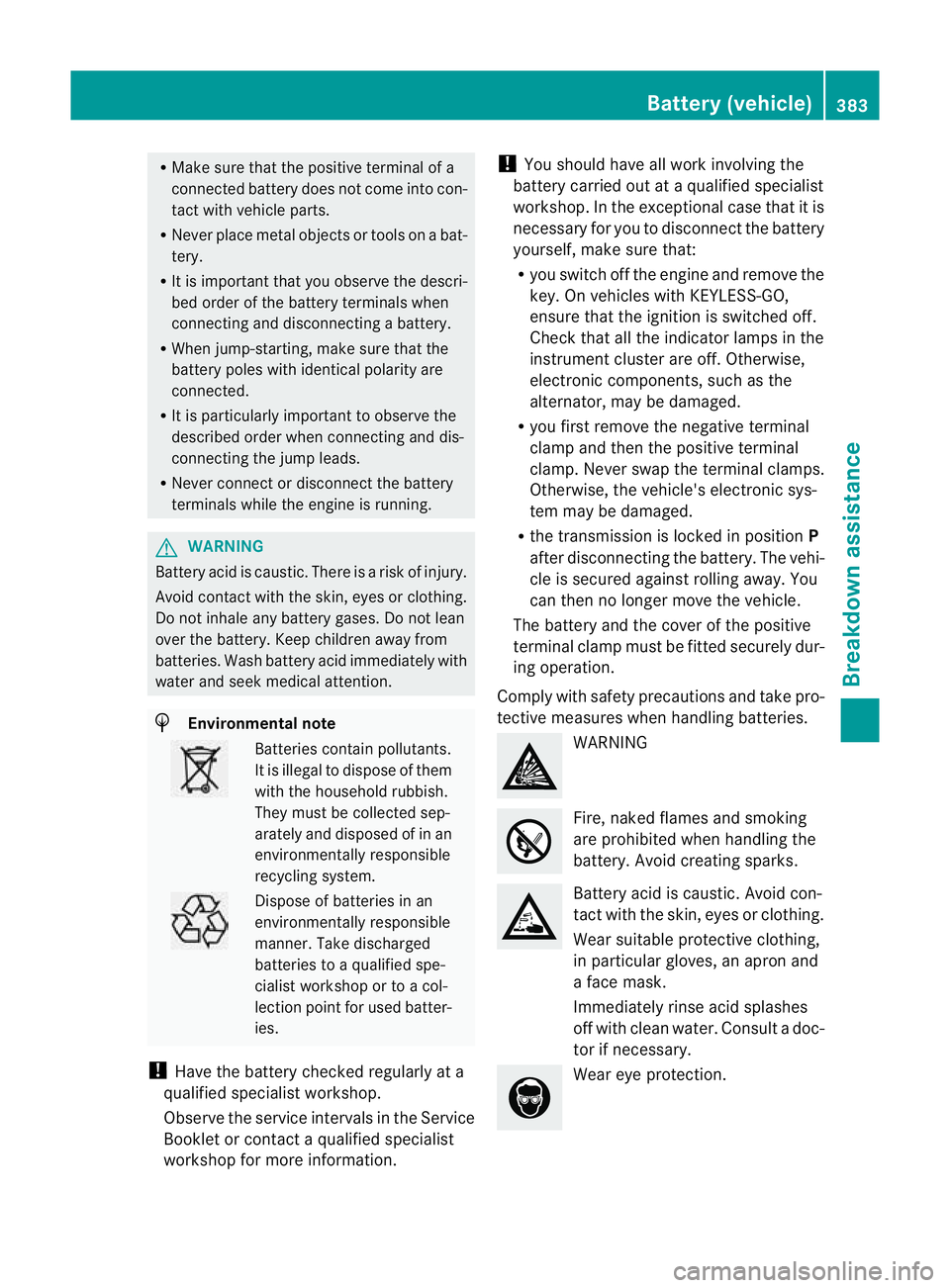
Comply with safety precautions and take pro-
tective measures when handling batteries. WARNING
Fire, naked flames and smoking
are prohibited when handling the
battery
.Avoi dc reating sparks. Battery aci
discaustic. Avoid con-
tact with the skin, eyes or clothing.
Wear suitable protective clothing,
in particular gloves, an apron and
af ace mask.
Immediately rinse acid splashes
off with clean water. Consult adoc-
tor if necessary. Wear eye protection. Ba
ttery (vehicle)
383Breakdown assistance Z
Page 390 of 441
Do not us
earapid charging device to start the vehicle. If your vehicle' sbattery is discharg ed,
the engine can be jump-starte dfroma nothe rvehicle or fr omasecon dbattery using jump
leads. Observe the following points:
R the battery is not acce ssiblein allvehicles .Ifthe other vehicle' sbattery is not accessible,
jump-start the vehicle using asecond batter yorajump-star ting device.
R vehicles with apetrol engine: only jump-star tthe vehicle when the engin eand exhaust
system are cold.
R do not start the engine if the battery is frozen. Let the battery thaw first.
R jump-starting may only be performed from batteries with anominal voltage of 12 V.
R only use jum pleads that have asufficient cross-section and insulated terminal clamps.
R if the battery is fully discharged, leave the battery that is being used to jump-start connected
for afew minutes befor eattempting to start. Thi scharges the empty battery alittle.
R make sure that the two vehicles do not touch.
Make sure that:
R the jump leads are not damaged.
R non-insulated parts of the terminal clamps do not come into contact with other metal parts
while the jump leads are connected to the battery.
R the jump leads cannot come into contact with parts such as the V-belt pulle yorthe fan.
These parts mov ewhen the engin eisstarted and whil eitisr unning.
X Secure the vehicle by applying the electric parking brake.
X Shift the transmission to position P.
X Turn the key to position 0in the ignition lock and remove it (Y page 159). On vehicles with
KEYLESS-GO, make sure the ignition is switched off (Y page 159). All indicator lamps in the
instrumen tcluster must be off.
X Switch off all electrical consumer s(e.g. radio, blower, etc.).
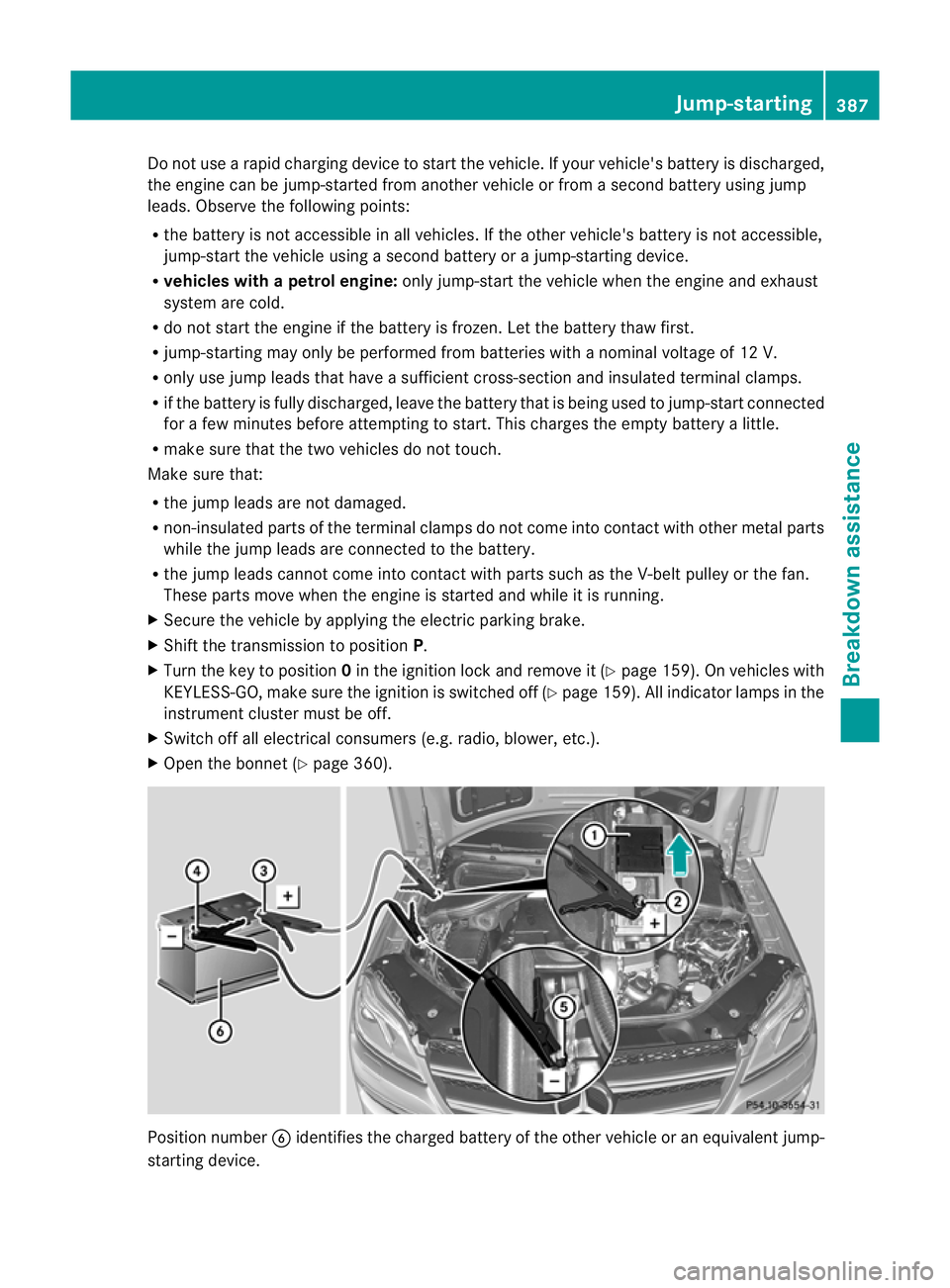
X Open the bonnet (Y page 360).Position number
Bidentifies the charged batter yofthe other vehicle or an equivalent jump-
startin gdevice. Jump-starting
387Breakdown assistance Z
Page 391 of 441
X
Slide cover :of positive terminal ;in the direction of the arro w.
X Connect positive terminal ;on your vehicl etopositive terminal =of donor battery B
using the jum plead. Alway sbegin with positive terminal ;on your own vehicle fir st.
X Start th eengine of the donor vehicle and run it at idling speed.
X Connec tnegativ eterminal ?of donor battery Bto eart hpoint Aof your vehicle using
the jum plead, connectin gthe jum plead to donor battery Bfirst.
X Start the engine.
X Before disconnecting the jum pleads, let the engines run for several minutes.
X First, remove the jum pleads from eart hpoint Aand negative terminal ?,then from pos-
itiv eterminal ;and positiv eterminal =,each time beginning at the contacts on your own
vehicle first.
X Close cover :of positive terminal ;after removing the jump leads.
X Have the battery checked at aqualified specialist workshop.
i Jump-starting is not considered to be anormal operatin gcondition.
i Jump-starting cables and further information regarding jum pstartin gcan be obtained at
any qualified specialis tworkshop. Towing and tow-starting
Important safety notes
G
WARNING
Safety-relevant func tions are restric tedorn ot
available if:
R the engin eisnot running.
R the brake system or the power steering is
malfunctioning
R the voltage supply or the vehicle' selectrical
system is malfunctioning.
If your vehicle is towed, significantly greater
forc emay be required to steer the vehicle or
to brake. There is arisk of an accident.
In such circumstances, use atowing bar.
Make sure that the steering is moving freely
befor etowing. G
WARNING
If the weight of the vehicle to be towed or tow-
started is greater than the permissible gross
weight of your vehicle:
R the towin geye could detach itself
R the vehicle/traile rcombination coul dover-
turn.
There is arisk of an accident.
When towing or tow-startin ganothe rvehicle,
its weight should not be greater than the per-
missible gross weight of your vehicle. G
WARNING
The vehicle is braked when the HOL Dfunction
or DISTRONIC PLUS is activated. Therefore,
deactivate HOLD and DISTRONIC PLUS if the
vehicle is to be towed.
! Make sure that the electric parking brake
is released. If the electric parking brake is
faulty, visit aqualified specialist workshop.
! Only secure the tow rope or towing bar to
the towing eyes. The vehicle may otherwise
be damaged. 388
Towin
gand tow-startingBreakdow nassistance
Page 392 of 441
!
Observe the following points when towing
wit hat ow rope:
R secur ethe tow rope on the sam eside on
both vehicles.
R the tow rope must not be longer than is
legally permitted. It should be marked in
the middle, e.g. with awhite cloth
(30 x30c m) so that other roa dusers are
aware that avehicle is being towed.
R the tow rope may only be attached to the
towing eyes.
R observ ethe brake lamps of the towing
vehicle while driving. Always maintain a
distanc esothat the tow rope does not
sag.
R do not use steel cables or chains to tow
your vehicle. The vehicle could be dam-
aged.
! Do not use the towing eye for recovery,
this could damage the vehicle. If in doubt,
recover the vehicle with acrane.
! When towing, pu llaway slowly and
smoothly .Ifthe tractive power is too high,
the vehicles could be damaged.
! To tow vehicles with KEYL ESS-GO,use
the key instead of the Star t/Stop button.
Th ea utomatic transmission may otherwise
switch to position Pwhen you open the
driver' sorfront-passenger door which
could damag ethe transmission.
! Vehicles with differential locks: make
sur ethe differential lock sare in automatic
mode. When towing, th edifferential locks
must not be switched on. The transmission
may otherwise be damaged.
! You may tow the vehicle for amaximum
of 50km .Atowing speed of 50 km/h must
not be exceeded.
For towin gdistances over 50 km, the entire
vehicle must be lifted up and transported.
! If you tow or tow-start another vehicle, its
weight must not exceed the maximum per- missible gross vehicle weight of your vehi-
cle.
Information on your vehicle' sgros svehicle
weight rating can be foun donthe vehicle
identification plat e(Ypage 422).
Observe the legal requirement sfor the rele-
vant countries when towing.
It is bette rtoh ave the vehicle transported
than to have it towed.
If the vehicle has suffered transmission dam-
age, have it transported on atransporter or
trailer.
Th ea utomatic transmission must be in posi-
tion Nwhen the vehicle is being towed.
The battery must be connected and charged.
Otherwise, you:
R cannot turn the key in the ignition lock to
position 2
R cannot release the electric parking brake
R cannot shift the automatic transmission to
position N
i Deactivate the automatic locking feature
(Y page 283). You could otherwis ebe
locked out when pushing or towing the
vehicle.
Deactivate tow-away protection
(Y page 71) before the vehicle is towed. Towing and tow-starting
389Breakdown assistance Z
Page 394 of 441
switch, the hazard warnin
glamps start
flashing again. Transporting the vehicle
! Only lash the vehicle down by the wheels
or wheel rims, not by parts of the vehicle
such as axle or steering components. Oth-
erwise, the vehicle could be damaged.
The towing eyes or trailer tow hitch can be
used to pull the vehicle onto atrailer or trans-
porter if yo uwish to transport it.
X Turn the key to position 2in the ignition
lock.
X Shift the automatic transmission to posi-
tion N.
As soon as the vehicle is loaded:
X Prevent the vehicle from rolling away by
applying the electric parkin gbrake.
X Shift th eautomatic transmission to posi-
tion P.
X Turn the key to position 0in the ignition
lock and remove it.
X Secure the vehicle. Information for 4MATIC vehicles
! Vehicles with 4MATIC must not be towed
with the front or rear axle raised; otherwise,
the transmission may be damaged.
If the vehicle has transmission damage or
damage to the front or rear axle, have it trans-
ported on atransporter or trailer.
In the even tofdamage to the ele ctrical
system
If the battery is defective, the automatic
transmission will be locked in position P.To
shif tthe automatic transmission to position
N,y ou must provide power to the vehicle's
electrical system in the same way as when
jump-starting (Y page 386).
Hav ethe vehicle transported on atransporter
or trailer. Recov
ering avehicle that ha sbecome
stuck
! When recovering atrapped vehicle ,donot
je rk the vehicle or pull it at an angle. If the
tractive powe rist oo high, th evehicles
could be damaged.
If th edrive wheels ge ttrapped on loose or
muddy ground, recover th evehicle with the
utmost care, especially so if the vehicle is
laden.
Never attempt to recover avehicle with a
trailer atta ched.
Pull out the vehicle backwards, if possible,
using the tracks it made when it became
stuck. Tow-starting (emergency engine
starting)
! Vehicles with automatic transmission
must not be tow-star ted. Otherwise, you
could damage the automatic tra nsmission.
You ca nfind information on "Jump-starting"
at (Y page 386). Electrical fuses
Important safet
ynotes G
WARNING
Only use fuses that have been approved for
Mercedes-Benz vehicles and which have the
correct fuse ratin gfor the system scon-
cer ned. Do not attempt to repair or bridge
faulty fuses. Usin gfuses which have not been
approved or attempting to repair or bridge
faulty fuses could cause the fuse to be over-
loaded and result in afire. Have the cause
traced and rectified at aqualified specialist
workshop.
! Only use fuses marked with an "S" for the
fuse box in the engine compartment and
under the rear bench seat. Components or
systems could othe rwise be damaged. Electrical fuses
391Breakdown assistance Z