brakes MERCEDES-BENZ GL SUV 2012 Owners Manual
[x] Cancel search | Manufacturer: MERCEDES-BENZ, Model Year: 2012, Model line: GL SUV, Model: MERCEDES-BENZ GL SUV 2012Pages: 441, PDF Size: 10.66 MB
Page 9 of 441
Auxiliar
yventila tion
Activating/deac tivating ................. 148
Activating/deactivating (o nthe
centr econsole) .............................. 149
Pro blem (display message) ............153
Remote control .............................. 149
Ax leload, permissible (traile rtow-
ing) ...................................................... 433 B
Ba gh ook ............................................ 343
Ball coupli ng
Folding in ....................................... 261
Fol ding out ..................................... 259
BAS (Brake Assist System) .................62
BAS PL US(Brak eAssist System
PLUS) .................................................... 62
Battery (key) Checking ...... .................................... 79
Important safety note s.................... 79
Replacing ......................................... 79
Battery (v ehicle)
Charging ........................................ 384
Display message ............................ 305
Important safety notes ..................382
Jump starting ................................. 386
Overview ........................................ 382
Belt
seeS eat belt
Belt force limiters (activation) ...........41
Bel ttensioner
Activatio n......................................... 41
Functio n.......................................... .49
Blind Spo tAssist
Activating/deactiva ting ................. 279
Display message ............................ 311
Notes/function .............................. 238
Traile rtowing ................................. 240
se eA ctive Blind Spo tAssist
BlueTEC
Topping up AdBlue ®
...... ................. 178
BlueTE C(AdBlue ®
) ............................. 427
Bon net
Active bonne t(pedestrian protec-
tion) ............................................... 360
Closing ........................................... 361 Display message
............................ 320
Opening ......................................... 360
Boot
seeT ailgate
Brak eAssist System
see BAS (Brake Assist System)
Brake fluid
Display message ............................ 296
Note s............................................. 429
Brake lamps
Ada ptive .......................................... .65
Changin gbulbs .............................. 131
Display message ............................ 301
Brakes
ABS .................................................. 61
Ada ptive Brake Assist ......................64
BAS .................................................. 62
BAS PLUS ........................................ 62
Brake fluid (notes )......................... 429
Display message ............................ 291
Driving tip s.................................... 184
High-performance brake sy stem .... 186
Important safety notes ..................184
Parking brake ................................ 182
Warn ingl am p................................. 326
Breakdown
seeF lat tyre
see Towing away
Bulbs
see Changing bulbs C
Callin gupaf ault
se eD isplay messages
Car
see Vehicle
Care
360 °camera ................................. 370
Automatic car wash .......................366
Carpets .......................................... 373
Display ........................................... 371
Exhaust pi pe.................................. 371
Exterio rlighting ............................. 369
Gea rors electo rlever .................... 372
High-pressure cle aner ...... .............. 368
Interior ........................................... 371
Matt paintwork .............................. 3686
Index
Page 35 of 441
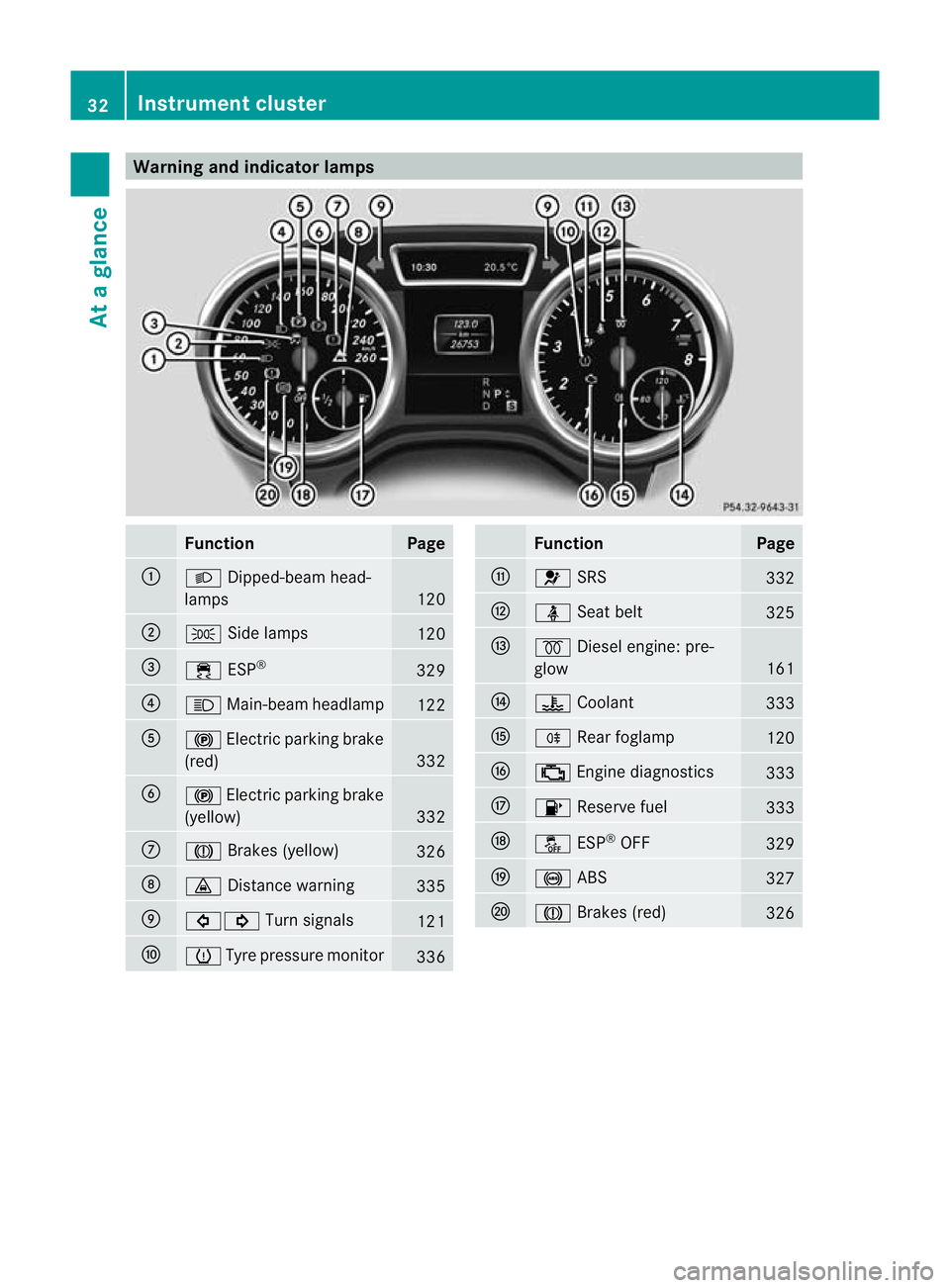
Warnin
gand indicator lamps Fun
ction Page
:
L
Dipped-bea mhead-
lamps 120
;
T
Side lamps 120
=
÷
ESP® 329
?
K
Main-beam headlamp 122
A
!
Electric parkin gbrake
(red) 332
B
!
Electri cparking brake
(yellow) 332
C
J
Brakes (yellow) 326
D
·
Distance warning 335
E
#!
Turn signals 121
F
h
Tyre pressure monitor 336 Function Page
G
6
SRS 332
H
ü
Seat belt 325
I
%
Diesel engine: pre-
glow 161
J
?
Coolant 333
K
R
Rearfoglamp 120
L
;
Engine diagnostics 333
M
8
Reserve fuel 333
N
å
ESP®
OFF 329
O
!
ABS 327
P
J
Brakes (red) 32632
Instru
ment clusterAtag lance
Page 64 of 441
Important safety notes
If you fail to adapt your driving style or
become distracted, th edriving sa fetysys-
tems ca nneith er reduce th erisk of accident
no ro verri dethe law sofphysics. Driving
safety system sare mere ly aids desig nedto
assis tdrivi ng.You ar eresponsible for the dis-
tance to the vehicle in fr ont, forvehicle speed
and for braking in good time. Alway sadapt
your drivin gstyle to suit the prevailing road
and weather condition sand maintain asafe
distance from the vehicle in front .Drive care-
fully.
i Thed riving safet ysystems described only
work as effectively as possibl ewhen there
is adequate con tact betwee nthe tyres and
the roa dsurface. Pleas epay special atten-
tion to the notes on tyres, recommended
minimum tyre tread depths ,etc.
(Y page 396).
In wintry driving conditions, always use
winter tyres (M+S tyres) and if necessary,
snow chains .Only in this way will the driv-
ing safety systems described in this section
work as effectively as possible. ABS (Anti-lock Braking System)
Important safety notes i
Observe the "Important safety notes" sec-
tion (Y page61). G
WARNING
If ABS is faulty, the wheels could lock when
braking .The steerability and brakin gcharac-
teristics ma ybeseverely impaired. Addition-
ally, further driving safet ysystems are deac-
tivated. There is an increased danger of skid-
ding and accidents.
Drive on carefully. Have ABS checked imme-
diatel yata qualified specialist workshop.
When ABS is malfunctioning, other systems,
including driving safety systems, will also
become inoperative. Observe the infor mation on the ABS warning lamp (Y
page 326) and
display messages which may be shown in the
instrument cluster (Y page 291).
ABS regulate sbrake pressure in such away
that the wheels do not lock when you brake.
This allows you to continue steering the vehi-
cle when braking.
ABS works from aspeed of about 8km/h
upwards, regardless of road-surfac econdi-
tions. AB Sworksons lippery surfaces, even
when you only brake gently.
The yellow !ABS warnin glamp in the
instrument cluster lights up when the ignition
is switched on. It goes out when the engine is
running.
Brakes X
If ABS intervenes: continue to depress the
brake pedal with force until the braking sit-
uation is over.
X To mak eafull brake application:
depress th ebrake peda lwith full force.
If ABS intervenes when braking, you will feel
ap ulsing in the brake pedal.
The pulsating brake pedal can be an indica-
tion of hazardous road conditions, and func-
tions as areminder to take extr acare while
driving.
Off-road ABS An ABS system specifically suited to off-road
terrain is activated automatically once the off-
road program is activated on:
R
Vehicles without the ON&OFFROAD pack-
age (Y page 252)
R Vehicles with the ON&OFFROAD package
(Y page 253)
At speeds below 30 km/h, the front wheels
lock cyclically during braking. The digging-in
effect achieved in the process reduces the
stopping distance when driving off-road. This
limits steering capability. Driving safety systems
61Safety Z
Page 65 of 441
BAS (Brak
eAssis tSystem)
i Observet he "Imp ortant safety notes "sec-
tion (Y page 61). G
WARNING
If BAS is malfunctioning, the braking distance
in an emergency braking situation is
increased .There is arisk of accident.
In an emergenc ybraking situa tion, depress
the bra kepedal with full force. AB Sprevents
th ew heels fr om locking.
BAS operate sinemergency brakin gsitua-
tions. If you depress the brake pedal quickly,
BAS automatically boosts the brakin gforce,
thus shortening the stoppin gdistance.
The brakes will func tion as usual onc eyou
release the brake pedal. BA Sisd eactivated. BAS PLUS (Brake Assist Syste
mPlus)
i Observe the "Importan tsafety notes" sec-
tion (Y page 61).
BAS PLUS is only available on vehicles with
DISTRONIC PLUS.
BAS PLUS provides braking assistance in haz-
ardous situations at speeds greater than
7k m/h and uses rad ar sensortechnology to
assess the traffic situation.
With the help of the rada rsensor system ,BAS
PLU Scan detect obstacles that are in the
path of your vehicle for an extended period of
time.
At speeds up to approximately 70 km/ h,BAS
PLUS may also det ects tationar yobstacles,
for example, stopped or parked vehicles.
To prevent afront-en dcollision, BA SPLUS
calculate sthe brake force necessary if:
R you approach an obstacle, and
R BA SP LUS ha sdetected arisk of collision
If you ar edriving at aspeed over
30 km/h:ify ou depress the brake sharply,
BA SP LUS automatically raise sthe brake
pressur etoavalue adapted to the traffic sit-
uation. If you are driving at
aspeed under
30 km/h:ify ou depress the brake, BA SPLUS
is activated. Braking will be carried ou tatthe
last possible moment.
If BA SPLUS demand sparticularly high brak-
ing force, preventative passenger protection
measures (PRE-SAFE ®
)a re activate dsimul-
taneously.
X Keep the brake pedal depressed until the
emergenc ybraking situatio niso ver.
ABS prevents th ewheels from locking.
BA SP LUS is deactivate dand the brakes func-
tion as usual ,if:
R you release th ebrake pedal.
R there is no longe rany danger of arear-end
collision.
R no obstacl eisdetected in front of your
vehicle.
If you have activated DSR (Y page 251), BAS
PLU Sisa lso deactivated.
The radar sensor system is switched off auto-
matically in the vicinit yofradio telescope
facilities in the following vehicles:
R vehicles with COMAND Online and naviga-
tion
R vehicles with Audio 20 and Becker ®
MAP
PILOT
Becker ®
MAP PILOT must be connected;
see the separate operating instructions.
The radar senso rsystem must be switched off
using the on-board computer in the vicinit yof
radio telescop efacilities in the following vehi-
cles:
R vehicles without COMAND Online and nav-
igation
R vehicles without Audio 20 and Becker ®
MAP PILOT
R vehicles for Australia
For information on switching off the radar
senso rsystem using the on-board computer,
see (Y page 283). 62
Driving safety systemsSafety
Page 68 of 441
R
to stationary obstacles
R when cornering
As aresult, Adaptive Br akeA ssist may not
int ervene in al lcritica lconditions .There is a
risk of an accident.
Always pay carefu lattention to the traffic sit-
uation and be ready to brake.
Adaptive Brake Assist aids you in braking dur-
ing hazardous situations at speeds above
30 km/h and uses the radar sensor system
to evaluate the traffic situation.
With the hel pofthe adaptive Brake Assist ,the
distanc ewarning signal can detect obstacles
that are in the path of your vehicle for an
extended period of time.
Should you approach an obstacle and the
adaptive Brake Assis thas detected arisk of
collision, the adaptive Brake Assist calculates
the brakin gforc enecessar ytoavoidac olli-
sion with the vehicle in front .Should you
apply the brakes forcefully ,the adaptive
Brake Assist will automatically increase the
brakin gforc etoal evel suitable for the traffic
conditions.
X Keep the brak epedal depressed until the
emergency braking situation is over.
ABS prevents the wheels from locking.
The brakes will work normally again if:
R you release the brak epedal.
R there is no longer any danger of arear-end
collision.
R no obstacl eisdetected in front of your
vehicle.
Adaptive Brake Assist is then deactivated.
If adaptive Brake Assist demands particularly
high braking force, preventative passenger
protec tion measure s(PRE-SAFE ®
)a re activa-
ted simultaneousl y.
Up to vehicl espeeds of around 25 0km/h,
th ea daptiv eBrake Assist is capable of react-
ing to moving objects that have alread ybeen
recognised as such at least once over the
period of observation .Adaptiv eBrake Assist
does not react to stationary obstacles. If th
eadaptiv eBrake Assist is not available
du et oam alfunction in the radar senso rsys-
tem, the brake syste mremains available with
ful lbrake boostin geffect and BAS.
In particular, th edetection of obstacles can
be impaired if there is:
R dirt on the sensors or anything else cover-
ing the sensors
R snow or heavy rain
R interference by other rada rsources
R the possibility of stron gradar reflections,
for example, in multi-storey car parks
R an arrow vehicle travelling in front ,e.g. a
motorcycle
R av ehicle travelling in front on adifferent
line
Following damage to the front end of the vehi-
cle, have the configuration and operation of
the radar sensor checked at aqualified spe-
cialist workshop. This also applies to colli-
sions at slow speeds where there is no visible
damage to the front of the vehicle. Adaptive brake lamps
If you brake sharply from aspeed of more
than 50 km/ horifbraking is assisted by BAS
or BAS PLUS, th ebrake lamp sflash rapidly.
In this way, traffic travelling behind you is
warned in an even more noticeable manner.
If you brake sharply from aspeed of more
than 70 km/ htoastandstill, the hazard warn-
ing lamps are activated automatically .Ifthe
brakes ar eapplied again, the brak elamps
light up continuously .The hazard warning
lamps switc hoff automatically if you travel
faster than 10 km/h .You can also switc hoff
th eh azard warning lamps using the hazard
warning button (Y page 122). Driving safety systems
65Safety Z
Page 69 of 441
ESP
®
(Electronic Stability Program)
Important safety notes i
Observ ethe "Important safety notes "sec-
tio n(Ypage 61). G
WARNING
If ESP ®
is mal functioning, ESP ®
is unable to
stabilis ethe vehicle. In addition, othe rdriving
safety systems are switche doff. This increa-
se st he risk of skiddi ngand an accident.
Driv eonc arefully. Have ESP ®
checked at a
qualified specialis tworkshop.
! Only operat ethe vehicle for amaximum
of ten seconds on abrake dynamometer.
Switch off th eignition.
Application of the brakes by ESP ®
ma yoth-
erwise destroy the brake system.
! Afunction or performanc etest should
only be carried out on atwin-axle dyna-
mometer .Before you operate th evehicle
on such adynamometer, pleas econsult a
qualified workshop. You coul dotherwise
damage the drive train or the brake system.
ESP ®
is deactivated if the åwarning lamp
in the instrument cluster lights up continu-
ousl ywhen the engin eisrunning.
If the ÷ warning lamp and the åwarn-
ing lamp are lit continuously, ESP ®
is not
available due to amalfunction.
Observe the information on warning lamps
(Y page 329 )and display message swhich
ma ybes hown in the inst rument cluster
(Y page 291).
If ESP ®
detects that th evehicle is deviating
from the direction desired by the driver, one
or mor ewheels ar ebrake dtos tabilise the
vehicle .The engin eoutput is also modified to
keep the vehicle on the desired course within
physical limits. ESP ®
assists the driver when
pulling away on wet or slippery roads. ESP ®
can also stabilise the vehicle during braking.
If ESP ®
intervenes, the ÷ESP®
warning
lamp flashes in the instrument cluster. If ESP
®
intervenes:
X Do not deactivate ESP ®
under any circum-
stances.
X When pulling away ,only depress the accel-
erator pedal as far as is necessary.
X Adapt your driving style to suit the prevail-
ing road and weather condi tions.
i Only use wheels with the recommended
tyr es izes. Only then will ESP ®
func tion
properly.
4ETS (Electronic Traction System) Traction con
trol is par tofESP®
.
Tractio ncontrol brakes the drive wheels indi-
vidually if they spin. This enables you to pull
away and accelerate on slipper ysurfaces, for
example if the road surface is slippery on one
side .Ina ddition, mor edrive torqu eistrans-
ferre dtot he wheel or wheels with traction.
Traction con trol remains active if you deacti-
vate ESP ®
.
In appropriate drivin gsituations, activate the
off-road program:
X Vehicles without the ON&OFFROAD pack-
age (Y page 252)
X Vehicles with the ON&OFFROAD package
(Y page 253)
Off- road 4ETS (Electronic Traction Sys-
tem) A4
ETS syste mspecifically suited to off -road
ter rain is activated automatically onc ethe off-
roa dprogram is acti vated on:
R Vehicle swithout the ON&OFFROA Dpack-
age (Y page 252)
R Vehicles with the ON&OFFROAD package
(Y page 253) 66
Driving safety systemsSafety
Page 72 of 441
X
Brake immediatel yinorder to increas ethe
distanc efrom th evehicle in front.
or
X Take evasive actio nprovided it is safe to do
so.
From aspeed of approxim ately 7km/h ,ifthe
driver and passengers hav efastened their
seat belts, PRE-SAFE ®
Brake can brake the
vehicl eautom atically at speeds up to approx-
imatel y200 km/h.
Due to the nature of the sy stem, particu larly
comp licate ddriving conditions may cause
unneces sary warnings or th eunneces sary
interventi onof PRE-SAFE ®
Brake.
You can stop PRE-SAFE ®
Brake interventi on
at any time by:
R depressing the accelerato rpedal further
R activa ting kickdown
R releasing the brake pedal.
The braking action of PRE-SAFE ®
Brak eis
ended automatically if:
R you manoeuvr etoavoidthe obstacle.
R ther eisnol onger any danger of arear-end
collision.
R ther eisnol onger an obstacle detected in
fron tofy our vehicle.
If you have activa tedD SR (Y page 25 1)PRE-
SAFE ®
Brak eisa lso deactiva ted.
With the help of the rada rsensor system,
PRE- SAFE ®
Brake can detect obstacles that
are in front of your vehicle for an extended
period of time.
At speed suptoapproximately 70 km/h, PRE-
SAFE ®
Brak ecan also detect stationary
obstacles such as stopped or parked vehi-
cles.
If you approach an obstacle and PRE-SAFE ®
Brak edetects arisk of acollision ,the system
will aler tyou both visually and acoustically .If
you do not brake or take evasive action, the
syste mwill warn you by automatically braking
the vehicle gently. If ther eisanincreased risk
of collision, preventativ epassenger protec-
tion measures (PRE-SAFE ®
)a re activated (Y
page 45). If, at speeds ove r30km/h, arisk
of collision remains and you do not brake,
take evasive action or significantly acceler-
ate, automatic brakin gmay be performed up
to alevel of automatic emergency braking.
Automatic emergency brakin gisnot per-
formed until immediately prior to an accident
that can no longer be avoided. G
WARNING
PRE- SAFE®
Brake wil linitiall ybrake your vehi-
cle by apartial application of the brakes if a
danger of collisio nisd etected. There may be
ac ollision unless you also brake. Automatic
emergency brakin gcannot preven tacolli-
sion. There is arisk of an accident.
Always apply the brakes yourself and try to
take evasive action. G
WARNING
PRE-SAFE ®
Brak ecannot alway sclearly iden-
tify objects and complex traf ficc onditions.
In these cases, PRE- SAFE®
Brake may:
R give an unnecessary warning and then
brake the vehicle
R neithe rgive awarning nor intervene
There is arisk of an accident.
Always pay particular attention to the traf fic
situation and be ready to brake, especiall yif
PRE- SAFE®
Brake warns you. Terminate the
intervention in anon-critical driving situation.
In particular, the detection of obstacles can
be impaired if ther eis:
R dir tont he sensor soranything els ecover-
ing the sensors
R snow or heav yrain
R interference by other radar sources
R the possibility of strong radar reflections,
for example, in multi-storey car parks
R an arrow vehicle travellin ginfront, e.g .a
motorcycle
R av ehicle travellin ginfront on adifferent
line Drivin
gsafety systems
69Safety Z
Page 168 of 441
in the multifunction display, automatic
engin eswitch-of fisa gain possible.
i AMGvehicles: times which the engine
can be automatically switched off.
i You can also activat ethe HOL Dfunction
when the vehicle is stationary if the engine
has been switched off automatically. It is
then not necessary to continue depressing
the brak epedal during the automatic stop
phase. When you depress the accelerator
pedal, the engine star tsautomatically and
the braking effect of the HOLD function is
deactivated. Depress the accelerator pedal
gently, as the engine must be started first.
i During automatic engine switch-off ,the
climate con trol system only operates at a
reduced capacity. If you require full climate
con trol capacity, the ECO star t/stopfunc-
tion can be deactivated by pressing the
ECO button (Y page 163).
Automatic engin estart The engine is started automatically if:
R you switch off the ECO start/stop function
by pressing the ECO button
R you releas ethe brakes when in transmis-
sion position Dor N,w hen the HOL Dfunc-
tion is inactive
R you depres sthe accelerator pedal
R you engage reverse gear R
R you mov ethe transmission out of position
P
R you switc htodrive program Sor M(AMG
vehicles)
R yo us witch to an off-road program (except
AMG vehicles)
R you unfasten your seat belt or open the
driver's door
R the vehicle start storoll
R the brake system requires this
R the tempera turein the vehicle interior devi-
ates from the set range R
the system detect smoistur eont he wind-
screen when the air-conditionin gsystem is
switched on
R the battery's charge status is too low
i Shifting the transmission to position P
doe snot star tthe engine. Driving
165Driving and pa rking Z
Page 172 of 441
vehicl
euntil it is stationary and at least one
of the following conditions is fulfilled:
- there is asystem malfunction
- the vehicl eisonasteep uphill or downhill
gradient. The electric parking brake is
then als oengaged.
Engaging reverse gear R !
Only shift the automatic transmission to
R whe nthe vehicle is stationary.
X Push the DIREC TSELECT leve ruppast the
first point of resistance.
Neutra lNwithE CO start/stop function
activated The EC
Ostart/stop functio nswitches the
engin eoffautomatically if:
R the vehicle is braked until stationary while
in neut ralNand
R you continue to depress th ebrake pedal
For further information on th eECO start/stop
function ( Ypag e163).
Shiftin gton eutra l(N) X
Push the DIRECT SELECT leve rupordown
to the first point of resistance.
Drive position Dwith ECO start/stop
function activated The ECO start/stop fun
ction switches the
engin eoff automatically if:
R thev ehicle is braked until stationar ywhile
in transmission position Dand
R you continue to depress the brake pedal
For further information on the ECO star t/stop
function (Y page 163).
Engaging drive position D X
Push the DIRECT SELECT lever down past
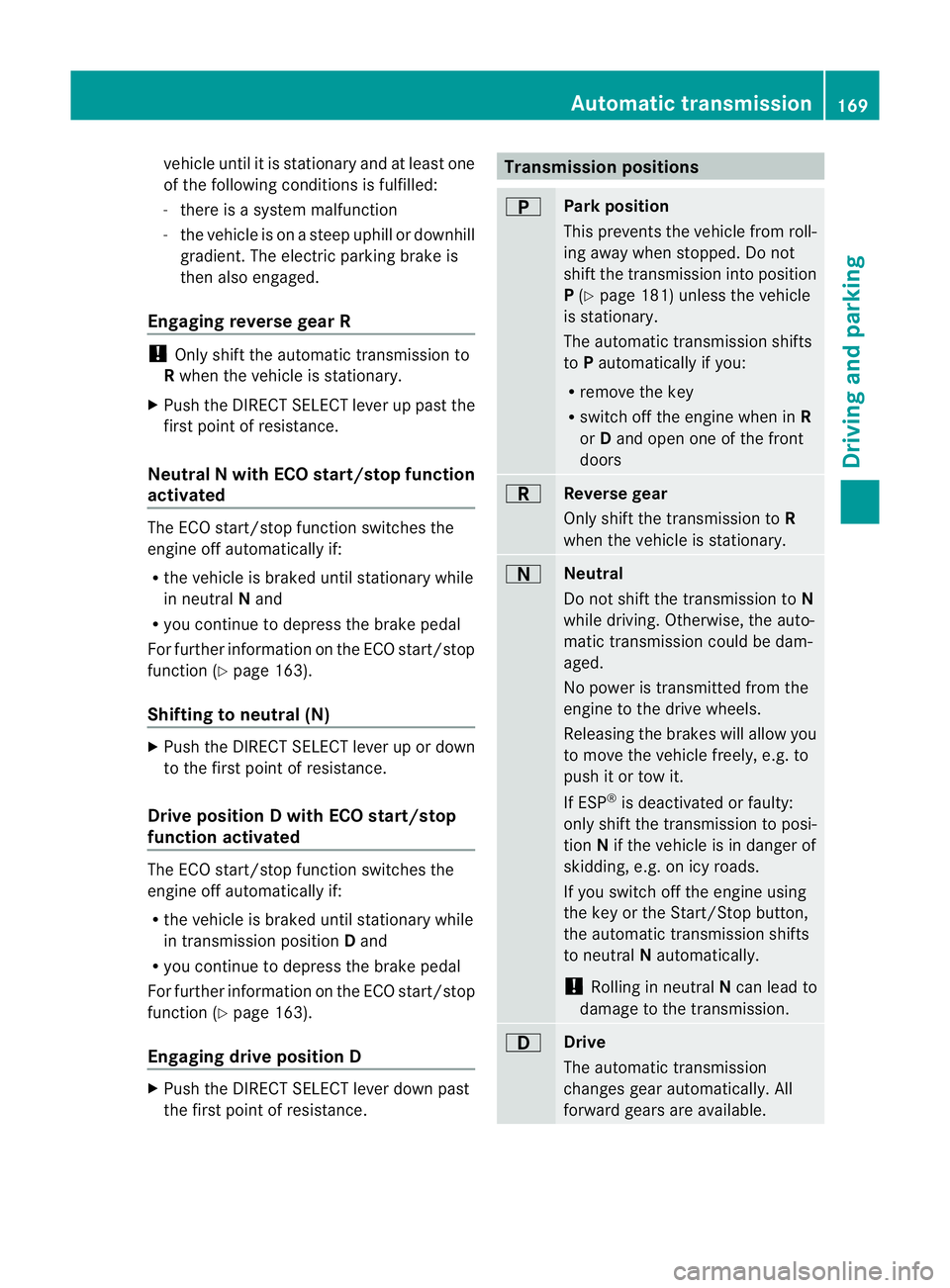
the first point of resistance. Transmission positions
B
Par
kposition
This prevent sthe ve hicle fr om roll-
in ga way when stopped .Donot
shift the transmission int oposition
P (Y page 181) unless the vehicle
is stationary.
The automatic transmission shifts
to Pautomatically if you:
R remove the key
R switc hoff th eengine whe ninR
or Dand open one of the front
doors C
Reverse gear
Only shift the transmission to
R
when the vehicle is stationary. A
Neu
tral
Do not shift the transmission to N
whil edriving. Otherwise, th eauto-
matic transmissio ncould be dam-
aged.
No power is transmit tedf rom the
engine to th edrive wheels.
Releas ingt he brakes will allow you
to mov ethe vehicle freely, e.g. to
push it or tow it.
If ESP ®
is deactivated or faulty:
only shift the transmission to posi-
tion Nif the vehicle is in danger of
skidding, e.g. on icy roads.
If you switc hoff th eengine using
the key or the Start/Stop butto n,
the automatic transmission shifts
to neutral Nautomatically.
! Rolling in neutral Ncan lead to
damage to the transmission. 7
Drive
The automatic transmission
change sgear automatically. All
forwar dgears are available. Automatic transmission
169Driving and parking Z
Page 188 of 441
effect, the driv
ewheels coul dlose their grip.
This inc reases the risk of skidding and having
an accident.
Do not shift down for additional engine brak-
ing on aslippery road surface.
Downhill gradients Do not depress the brake pedal continuously
while the vehicle is in motion ,e.g. causing the
brakes to rub by constantly applying light
pressure to the pedal. This results in exces-
sive and premature wear to the brake pads.
On long and steep downhil lgradients, you
mus tselect shift range 1,2or 3in good time.
Take particular not eofthis when drivin ga
laden vehicle.
i This also applies if you have activated
cruise control, SPEEDTRONIC or DIS-
TRONIC PLUS.
This will use the brakin geffect of the engine,
so les sbraking wil lberequired to prevent the
vehicle from gainin gspeed. This relieves the
load on the brak esystem and prevents the
brakes from overheating and wearing too
quickly.
Heavy and light loads G
WARNING
The braking syste mcan overheat if you leave
your foot on the brake pedal while driving.
This increases the braking distance and could
even cause the braking system to fail. There
is ar isk of an accident.
Never use the brake pedal as afootrest .Do
not simultaneousl ydepress both th ebrake
peda land the accelerato rpedal while driving.
! Depressing the brak epedal constantly
result sinexcessive and premature wear to
the brake pads.
If the brakes have bee nsubjected to aheavy
load, do not stop the vehicle immediately.
Driv eonfor as hort while. This allow sthe air-
flo wtoc ool the brakes mor equickly. If the brakes have been used only moderately,
you should occasionally test their effective-
ness. To do this, brake more firmly from a
higher speed. This improves the grip of the
brakes.
Wet road surfaces
If you have driven for
along tim einheavy rain
without braking ,there ma ybeadelayed reac-
tion from the brakes when braking for the first
time. This may also occu rafter acar wash or
after driving through deep water.
You then have to depress the brake pedal
more firmly. Maintain agreater distance from
th ev ehicle in front.
Af terd riving on awet road or havin gthe vehi-
cle washed, brake firml ywhile paying atten-
tion to the traf ficc onditions. This will warm
up the brake discs, thereby dryin gthem more
quickly and protecting them against corro-
sion.
Limited braking performanc eonsalt-
treated roads If you drive on salte
droads, alaye rofs alt
residue may form on the brake discs and
brake pads. This can result in asignificantly
longer brakin gdistance.
R Brake occasionally to remov eany possible
salt residue. Make sure that you do not
endanger other road users whe ndoing so.
R Carefully depress the brake pedal and the
beginning and end of ajourney.
R Maintain agreater distance to th evehicle
ahead.
New brak epads/linings New and replace
dbrake pads and discs only
reach thei roptimum braking effect after sev-
eral hundred kilometres of driving. Compen-
sate for this by applying greater force to the
brak epedal.
For safet yreasons, Mercedes-Ben zrecom-
mends that you only have brak epads/linings
fitted to your vehicle which have been Driving tips
185Driving and parking Z