wheel MERCEDES-BENZ GLA 2019 Owners Manual
[x] Cancel search | Manufacturer: MERCEDES-BENZ, Model Year: 2019, Model line: GLA, Model: MERCEDES-BENZ GLA 2019Pages: 346, PDF Size: 16.66 MB
Page 286 of 346
when cleaning. This could lead to irreparabledamage to the display.
XBefore cleaning the display, make sure thatit is switched off and has cooled down.
XClean the display surface using a commer-cially available microfiber cloth andTFT/LCD display cleaner.
XDry the display surface using a dry micro-fiber cloth.
Cleaning the plastic trim
GWARNING
Care products and cleaning agents contain-
ing solvents cause surfaces in the cockpit to
become porous. As a result, plastic parts
may come loose in the event of air bag
deployment. There is a risk of injury.
Do not use any care products and cleaning
agents to clean the cockpit.
!Never attach the following to plastic surfa-ces:
Rstickers
Rfilms
Rperfume oil container or similar
You could otherwise damage the plastic.
!Do not allow cosmetics, insect repellent orsunscreen to come into contact with theplastic trim. This maintains the high-qualitylook of the surfaces.
XWipe the plastic trim with a damp, lint-freecloth, e.g. a microfiber cloth.
XHeavy soiling:use care and cleaning prod-ucts recommended and approved byMercedes-Benz.The surface may change color temporarily.Wait until the surface is dry again.
Cleaning the steering wheel and gear
or selector lever
XThoroughly wipe with a damp cloth or useleather care agents that have been recom-mended and approved by Mercedes-Benz.
Cleaning genuine wood and trim ele-
ments
!Do not use solvent-based cleaning agentssuch as tar remover, wheel cleaners, pol-ishes or waxes. There is otherwise a risk ofdamaging the surface.
!Do not use chrome polish on trim pieces.The trim pieces have a chrome look but aremostly made of anodized aluminum and canlose their shine if chrome polish is used.Use a damp, lint-free cloth instead whencleaning the trim pieces.
If the chrome-plated trim pieces are verydirty, you can use a chrome polish. If youare unsure as to whether the trim pieces arechrome-plated or not, consult an authorizedMercedes-Benz Center.
XWipe the wooden trim and trim pieces witha damp, lint-free cloth, e.g. a microfibercloth.
XHeavy soiling:use care and cleaning prod-ucts recommended and approved byMercedes-Benz.
Cleaning the seat covers
General notes
!Do not use a microfiber cloth to clean cov-ers made out of real leather, artificial leatheror DINAMICA. If used often, these can dam-age the cover.
Note that regular care is essential to ensurethat the appearance and comfort of the coversis retained over time.
Genuine leather seat covers
!To retain the natural appearance of theleather, observe the following cleaninginstructions:
RClean genuine leather covers carefullywith a damp cloth and then wipe the cov-ers down with a dry cloth.
RMake sure that the leather does notbecome soaked. It may otherwise becomerough and cracked.
ROnly use leather care agents that havebeen tested and approved by Mercedes-Benz. You can obtain these from a quali-fied specialist workshop.
Leather is a natural product.
284Care
Maintenance and care
Page 289 of 346
so, contact your local waste disposal com-pany.
Vehicle tool kit
General notes
Vehicles with a TIREFIT kit: the TIREFIT kit islocated in the stowage well under the cargocompartment floor.
Vehicles with a tire-change tool kit: the tire-change tool kit is in the stowage well underthe cargo compartment floor.
Apart from certain country-specific variations,the vehicles are not equipped with a tire-change tool kit. Some tools for changing awheel are specific to the vehicle. For moreinformation on which tire changing tools arerequired and approved to perform a wheelchange on your vehicle, consult a qualifiedspecialist workshop.
Tools required for changing a wheel mayinclude, for example:
RJack
RWheel chock
RLug wrench
RAlignment bolt
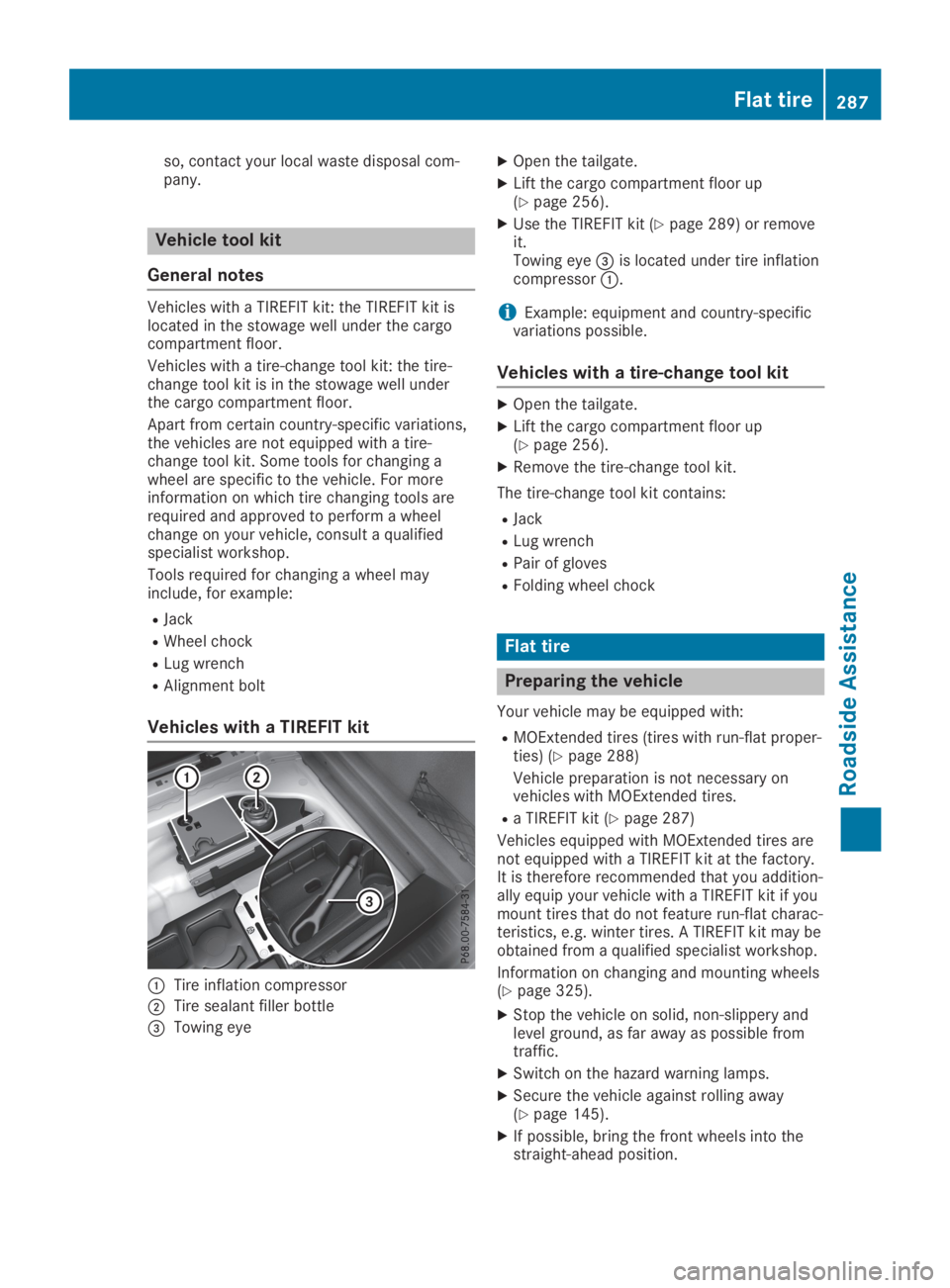
Vehicles with a TIREFIT kit
CTire inflation compressor
DTire sealant filler bottle
Page 290 of 346
XSwitch off the engine.
XVehicles without KEYLESS-GO:removethe SmartKey from the ignition lock.
XVehicles with KEYLESS-GO start-func-tion or KEYLESS-GO:open the driver'sdoor.The vehicle electronics are now in positionZ. This is the same as the SmartKey havingbeen removed.
XVehicles with KEYLESS-GO start-func-tion or KEYLESS-GO:remove the Start/Stop button from the ignition lock(Ypage 125).
XMake sure that the engine cannot be startedvia your smartphone (Ypage 126).
XMake sure that the passengers are notendangered as they do so. Make sure thatno one is near the danger area while awheel is being changed. Anyone who is notdirectly assisting in the wheel changeshould, for example, stand behind the bar-rier.
XGet out of the vehicle. Pay attention to traf-fic conditions when doing so.
XClose the driver's door.
MOExtended tires (tires with run-flat
properties)
General notes
With MOExtended tires (tires with run flatcharacteristics), you can continue to drive yourvehicle even if there is a total loss of pressurein one or more tires. The affected tire must notshow any clearly visible damage.
You can recognize an MOExtended tire by theMOExtended marking which appears on thesidewall of the tire. You will find this markingnext to the tire size designation, the load-bear-ing capacity and the speed index(Ypage 320).
MOExtended tires may be used only in con-junction with an activated tire pressure losswarning system (Canada only) or tire pressuremonitor (USA only).
If a pressure loss warning messageappears in the multifunction display:
Robserve the instructions in the display mes-sages (Ypage 223).
Rcheck the tire for damage
Rif driving on, observe the following notes
The driving distance possible in run-flat modeis approximately 50 miles (80 km) when thevehicle is partially laden. When the vehicle isfully laden it is approximately 19 miles(30 km).
In addition to the vehicle load, the driving dis-tance possible depends upon:
RVehicle speed
RRoad condition
ROutside temperature
The driving distance possible in run-flat modemay be reduced by extreme driving conditionsor maneuvers, or it can be increased through amoderate style of driving.
The driving distance possible in run-flat modeis counted from the moment the tire pressureloss warning appears in the multifunction dis-play.
You must not exceed the maximum permissi-ble speed for limp-home mode of 50 mph(80 km/h).
When replacing one or all tires, please observethe following specifications for your vehicle'stires:
RSize
RType and
RThe "MOExtended" marking
If a tire has gone flat and cannot be replacedwith an MOExtended tire, a standard tire maybe used as a temporary measure. Make surethat you use the proper size and type (summeror winter tire).
Vehicles equipped with MOExtended tires arenot equipped with a TIREFIT kit at the factory.It is therefore recommended that you addition-ally equip your vehicle with a TIREFIT kit if youmount tires that do not feature run-flat charac-teristics, e.g. winter tires. A TIREFIT kit may beobtained from a qualified specialist workshop.
288Flat tire
Roadside Assistance
Page 292 of 346
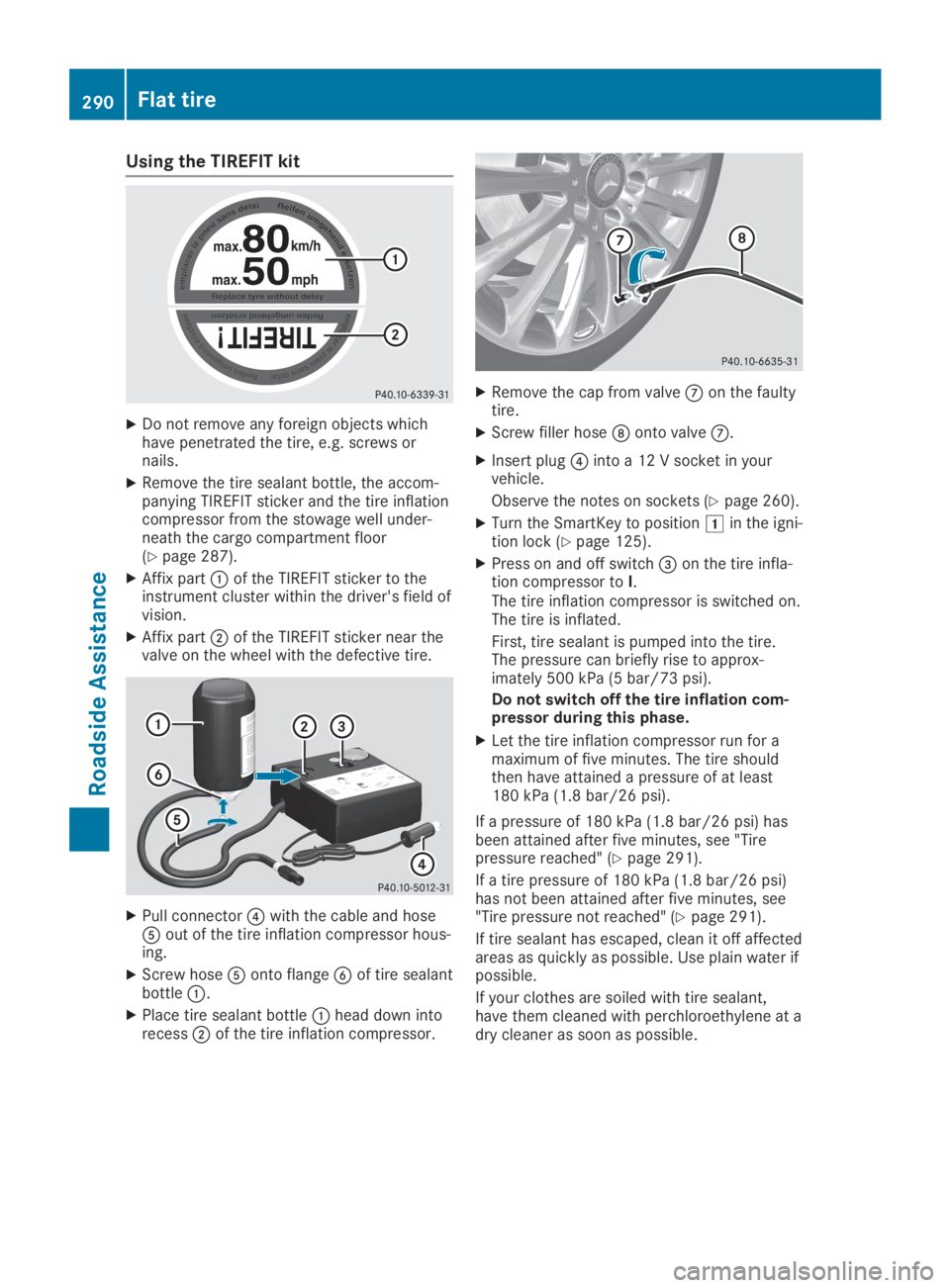
Using the TIREFIT kit
XDo not remove any foreign objects whichhave penetrated the tire, e.g. screws ornails.
XRemove the tire sealant bottle, the accom-panying TIREFIT sticker and the tire inflationcompressor from the stowage well under-neath the cargo compartment floor(Ypage 287).
XAffix partCof the TIREFIT sticker to theinstrument cluster within the driver's field ofvision.
XAffix partDof the TIREFIT sticker near thevalve on the wheel with the defective tire.
XPull connector
Page 300 of 346
Towing and tow-starting
Important safety notes
GWARNING
Functions relevant to safety are restricted or
no longer available if:
Rthe engine is not running
Rthe brake system or the power steering is
malfunctioning
Rthere is a malfunction in the power supply
or the vehicle's electrical system
When your vehicle is towed away or towed
started, you may require considerably more
effort to steer and brake. There is a risk of
an accident.
In such cases, use a tow bar. Before being
towed away or tow started, make sure the
steering moves freely.
GWARNING
You can no longer steer the vehicle if the
steering wheel lock has been engaged.
There is a risk of an accident.
Always switch off the ignition when towing
the vehicle with a tow cable or a tow bar.
GWARNING
When towing or tow-starting another vehicle
and its weight is greater than the permissi-
ble gross weight of your vehicle, the:
Rthe towing eye could detach itself
Rthe vehicle/trailer combination could roll-
over.
There is a risk of an accident.
When towing or tow-starting another vehi-
cle, its weight should not be greater than
the permissible gross weight of your vehicle.
Details on the permissible gross vehicle weightof your vehicle can be found on the vehicleidentification plate (Ypage 333).
!When Active Brake Assist, Active DistanceAssist DISTRONIC or the HOLD function isactivated, the vehicle brakes automaticallyin certain situations.
To avoid damage to the vehicle, deactivatethese systems in the following or similar sit-uations:
Rwhen towing the vehicle
Rin the car wash
!Make sure that the electric parking brakeis released. If the electric parking brake isfaulty, visit a qualified specialist workshop.
!Only secure the tow rope or tow bar at thetowing eyes. Otherwise, the vehicle could bedamaged.
!Do not use the towing eyes for recoverypurposes as this could damage the vehicle.If in doubt, recover the vehicle with a crane.
!When towing, pull away slowly andsmoothly. If the tractive power is too high,the vehicles could be damaged.
!The vehicle can be towed a maximum of30 miles (50km). The towing speed of30 mph (50km/h) must not be exceeded.
If the vehicle has to be towed more than30 miles (50km), the front axle must beraised or the entire vehicle raised and trans-ported.
!Do not tow with sling-type equipment. Thiscould damage the vehicle.
!When towing away vehicles with KEYLESS-GO, use the key instead of the Start/Stopbutton. The automatic transmission mayotherwise shift to position]when youopen the driver's or front-passenger door,which could damage the transmission.
!Vehicles with automatic transmission mustnot be started by tow-starting. This couldotherwise damage the transmission.
It is better to have the vehicle transportedthan to have it towed away.
If the vehicle can no longer be driven becauseof an accident or breakdown, you have the fol-lowing options:
RTransporting the vehicle.
As a rule, you should have the vehicle trans-ported.
RTowing the vehicle with a tow rope or towbar.
Only tow the vehicle in exceptional cases.
298Towing and tow-starting
Roadside Assistance
Page 302 of 346
![MERCEDES-BENZ GLA 2019 Owners Manual XWhen the vehicle is stationary, depress thebrake pedal and keep it depressed.
XShift the automatic transmission to position].
XRelease the brake pedal.
XRelease the electric parking brake.
XSwitch o](/img/4/59079/w960_59079-301.png "MERCEDES-BENZ GLA 2019 Owners Manual XWhen the vehicle is stationary, depress thebrake pedal and keep it depressed.
XShift the automatic transmission to position].
XRelease the brake pedal.
XRelease the electric parking brake.
XSwitch o")
XWhen the vehicle is stationary, depress thebrake pedal and keep it depressed.
XShift the automatic transmission to position].
XRelease the brake pedal.
XRelease the electric parking brake.
XSwitch off the automatic locking(Ypage 199).
XSwitch on the hazard warning lamps(Ypage 104).
XTurn the SmartKey in the ignition lock topositionZand leave the SmartKey in theignition lock.
Towing a vehicle with both axles on
the ground
It is important that you observe the safetyinstructions when towing away your vehicle(Ypage 298).
XOn vehicles with KEYLESS-GO or theKEYLESS-GO start function:you must usethe SmartKey instead of the Start/Stop but-ton (Ypage 126).
The automatic transmission automaticallyshifts to position]when you open the driv-er's or front-passenger door or when youremove the SmartKey from the ignition lock. Inorder to ensure that the automatic transmis-sion stays in position\\when towing awaythe vehicle, you must observe the followingpoints:
XMake sure that the vehicle is stationary.
XTurn the SmartKey to positionHin the igni-tion lock.
XDepress and hold the brake pedal.
XShift the automatic transmission to position\\.
XLeave the SmartKey in positionHin theignition lock.
XRelease the brake pedal.
XRelease the electric parking brake.
XSwitch on the hazard warning lamps(Ypage 104).
iIn order to signal a change of directionwhen towing the vehicle with the hazardwarning lamps switched on, use the combi-nation switch as usual. In this case, only theindicator lamps for the direction of travel
flash. After resetting the combinationswitch, the hazard warning lamp startsflashing again.
Permitted towing methods
Mercedes-Benz recommends transporting yourvehicle in the case of a breakdown, rather thantowing it away.
When towing away, use a towing rope or atowing bar with both axles on the ground. Donot use any tow bar systems.
Transporting the vehicle
Vehicles with automatic transmission
!When the vehicle is loaded for transport,the front and rear axles must be stationaryand on the same transportation vehicle.Positioning over the connection point of thetransport vehicle is not permitted. The drivetrain may otherwise be damaged.
All vehicles
!You may only secure the vehicle by thewheels, not by parts of the vehicle such asaxle or steering components. Otherwise, thevehicle could be damaged.
XTurn the SmartKey to positionHin the igni-tion lock (Ypage 125).
XShift the transmission to position\\.
As soon as the vehicle has been loaded:
XPrevent the vehicle from rolling away byapplying the electric parking brake.
XShift the transmission to position].
300Towing and tow-starting
Roadside Assistance
Page 306 of 346

Important safety notes
GWARNING
If you install wheels and tires with incorrect
dimensions, the service brake or wheel sus-
pension components may be damaged.
There is a risk of an accident.
Always replace wheels and tires with ones
that comply with the specifications of the
original part.
When replacing wheels, pay attention to the:
RDesignation
RModel
When replacing tires, pay attention to the:
RDesignation
RManufacturer
RModel
GWARNING
A flat tire will severely affect the driving
characteristics as well as the steering and
braking of the vehicle. There is a risk of an
accident.
Tires without run-flat characteristics:
RDo not drive on with a flat tire.
RChange the flat tire immediately with an
emergency spare wheel or spare wheel.
Alternatively, consult a qualified specialist
workshop.
Tires with run-flat characteristics:
RObserve the information and warning
notes on MOExtended tires (run-flat tires).
Accessories that are not approved for yourvehicle by Mercedes-Benz or are not beingused correctly can impair the operating safety.
Before purchasing and using non-approvedaccessories, visit a qualified specialist work-shop and inquire about:
Rsuitability
Rlegal stipulations
Rfactory recommendations
Further information regarding wheels and tirescan be found under "Wheel/tire combinations"(Ypage 329).
You can ask for information regarding permit-ted wheel/tire combinations at an authorizedMercedes-Benz Center.
Information on tire pressure can be found:
Ron the Tire and Loading Information placardon the B-pillar on the driver's side(Ypage 316)
Rin the tire pressure table in the fuel filler flap(Ypage 144)
Runder "Tire pressure" (Ypage 307)
Operation
Information on driving
Check the tire pressure when the vehicle isheavily laden and adjust prior to a trip.
While driving, pay attention to vibrations,noises and unusual handling characteristics,e.g. pulling to one side. This may indicate thatthe wheels or tires are damaged. If you sus-pect that a tire is defective, reduce your speedimmediately. Stop the vehicle as soon as pos-sible to check the wheels and tires for dam-age. Hidden tire damage could also be causingthe unusual handling characteristics. If youfind no signs of damage, have the tires andwheels checked at a qualified specialist work-shop.
When parking your vehicle, make sure that thetires do not get deformed by the curb or otherobstacles. If they cannot be avoided, driveover obstacles such as curbs slowly and at anobtuse angle. Otherwise, you may damage thewheels or tires.
Regular checking of wheels and tires
GWARNING
Damaged tires can cause tire inflation pres-
sure loss. As a result, you could lose control
of your vehicle. There is a risk of accident.
Check the tires regularly for signs of dam-
age and replace any damaged tires immedi-
ately.
304Operation
Wheels and ti res
Page 307 of 346
Check wheels and tires for damage at leastonce a month. Check wheels and tires afterdriving off-road or on rough road test tracks.Damaged wheels can cause a loss of tire pres-sure. Pay particular attention to damage suchas:
Rcuts in the tires
Rpunctures in the tires
Rtears in the tires
Rbulges on tires
Rdeformation or severe corrosion on wheels
Regularly check the tire tread depth and thecondition of the tread across the whole widthof all tires (Ypage 305). If necessary, turn thefront wheels to full lock in order to inspect theinner side of the tire surface.
All wheels must have a valve cap to protectthe valve against dirt and moisture. Do notmount anything onto the valve other than thestandard valve cap or other valve capsapproved by Mercedes-Benz for your vehicle.Do not use any other valve caps or systems,e.g. tire pressure monitoring systems.
Regularly check the pressure of all the tiresparticularly prior to long trips. Adjust the tirepressure as necessary (Ypage 307).
Observe the notes on the emergency sparewheel (Ypage 330).
The service life of tires depends, among otherthings, on the following factors:
RDriving style
RTire pressure
RDistance covered
Notes on tire tread
GWARNING
If there is insufficient tire tread, the tire trac-
tion decreases. The tire tread is no longer
able to dissipate water. This increases the
risk of hydroplaning when the road surface
is wet, particularly when the vehicle's speed
is not adapted to the road conditions. There
is a risk of an accident.
When the tire pressure is too high or too
low, tires may wear differently at different
points on the tire tread. Therefore, regularly
check the tire tread depth and the condition
of the tread across the whole width of all
tires.
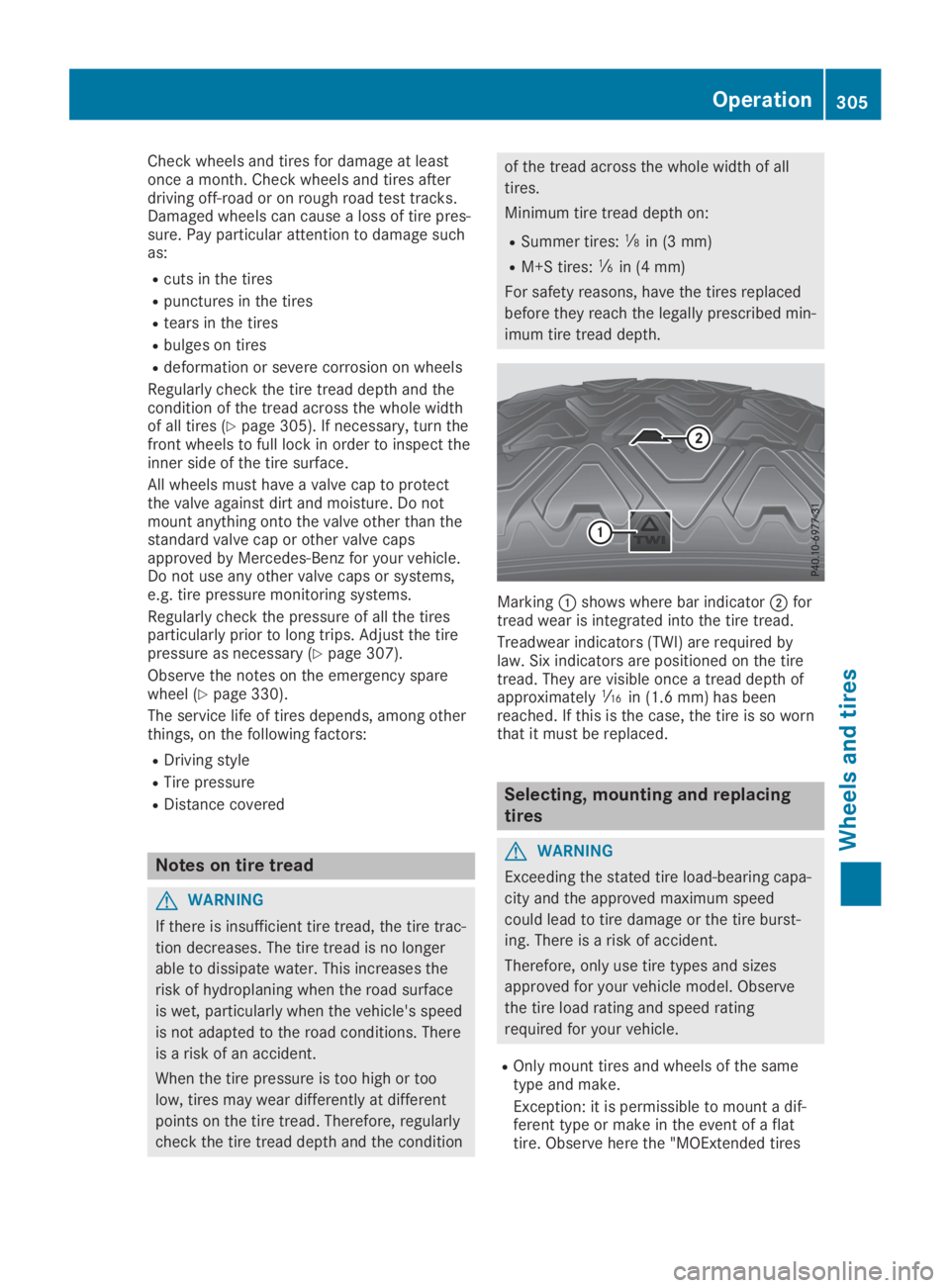
Minimum tire tread depth on:
RSummer tires:
Page 308 of 346
(tires with run-flat characteristics)" section(Ypage 288).
ROnly mount tires of the correct size onto thewheels.
RBreak in new tires at moderate speeds forthe first 60 miles (100 km). The new tiresonly reach their full performance after thisdistance.
RDo not drive with tires which have too littletread depth. This significantly reduces thetraction on wet roads (hydroplaning).
RReplace the tires after six years at the lat-est, regardless of wear.
Observe the notes on the emergency sparewheel (Ypage 330).
MOExtended tires (tires with run-flat
properties)
With MOExtended tires (tires with run flatcharacteristics), you can continue to drive yourvehicle even if there is a total loss of pressurein one or more tires.
MOExtended tires may only be used in con-junction with an activated tire pressure losswarning system (Canada only) or tire pressuremonitor (USA only) and only on wheels specifi-cally tested by Mercedes-Benz.
Notes on driving with MOExtended tires with aflat tire (Ypage 288).
Vehicles equipped with MOExtended tires arenot equipped with a TIREFIT kit at the factory.It is therefore recommended that you addition-ally equip your vehicle with a TIREFIT kit if youmount tires that do not feature run-flat charac-teristics, e.g. winter tires. A TIREFIT kit may beobtained from a qualified specialist workshop.
Winter operation
General notes
Have your vehicle winter-proofed at a qualifiedspecialist workshop at the onset of winter.
Observe the notes in the "Changing a wheel"section (Ypage 325).
Driving with summer tires
At temperatures below 45 ‡ (+7 †), summertires lose elasticity and therefore traction andbraking power. Change the tires on your vehi-cle to M+S tires. Using summer tires at verycold temperatures could cause cracks to form,thereby damaging the tires permanently.Mercedes-Benz cannot accept responsibilityfor this type of damage.
GWARNING
Damaged tires can cause tire inflation pres-
sure loss. As a result, you could lose control
of your vehicle. There is a risk of accident.
Check the tires regularly for signs of dam-
age and replace any damaged tires immedi-
ately.
M+S tires
GWARNING
M+S tires with a tire tread depth of less than
Page 309 of 346
When you have mounted the M+S tires:
XCheck the tire pressures (Ypage 307).
XRestart the tire pressure monitor (USA only)(Ypage 314).
XRestart the tire pressure loss warning sys-tem (Canada) (Ypage 311)
Snow chains
GWARNING
If snow chains are mounted on the rear
wheels, the snow chains could cause abra-
sion to the vehicle body or to chassis com-
ponents. This could cause damage to the
vehicle or the tires. There is a risk of an
accident.
To avoid hazardous situations:
Rnever mount snow chains on the rear
wheels
Ronly mount snow chains in pairs on the
front wheels.
!On some tire sizes there is not enoughspace for snow chains. To avoid damage tothe vehicle or tires, observe the "Wheel andtire combinations" section under "Tires andwheels".
For safety reasons, Mercedes-Benz recom-mends that you only use snow chains thathave been specially approved for your vehicleby Mercedes-Benz, or are of a correspondingstandard of quality. For more information,please contact a qualified specialist workshop.
If you intend to mount snow chains, pleasebear the following points in mind:
RSnow chains may not be mounted on allwheel/tire combinations. Permissiblewheel-tire combinations (Ypage 329).
ROnly use snow chains when driving on roadscompletely covered by snow. Remove thesnow chains as soon as possible when youcome to a road that is not snow-covered.
RLocal regulations may restrict the use ofsnow chains. Observe the appropriate regu-lations if you wish to mount snow chains.
RDo not exceed the maximum permissiblespeed of 30mph (50 km/h).
RIf snow chains are installed, you cannot useActive Parking Assist (Ypage 176).
You may wish to deactivate ESP®when pullingaway with snow chains installed . This allowsthe wheels to spin in a controlled manner, ach-ieving increased propulsive force (cuttingaction).
RDeactivate ESP®(all vehicles exceptMercedes-AMG vehicles) (Ypage 64)
RDeactivate ESP®(Mercedes-AMG vehicles)(Ypage 65)
Information about driving with an emergencyspare wheel (Ypage 330).
Tire pressure
Tire pressure specifications
Important safety notes
GWARNING
Underinflated or overinflated tires pose the
following risks:
Rthe tires may burst, especially as the load
and vehicle speed increase.
Rthe tires may wear excessively and/or
unevenly, which may greatly impair tire
traction.
Rthe driving characteristics, as well as
steering and braking, may be greatly
impaired.
There is a risk of an accident.
Follow recommended tire inflation pressures
and check the pressure of all the tires
including the spare wheel:
Rmonthly, at least
Rif the load changes
Rbefore beginning a long journey
Runder different operating conditions, e.g.
off-road driving
If necessary, correct the tire pressure.
iThe data on the Tire and Loading Informa-tion placard and tire pressure table shownhere are examples. Tire pressure specifica-
Tire pressure307
Wheels and tires
Z