technical data MERCEDES-BENZ GLC 2019 User Guide
[x] Cancel search | Manufacturer: MERCEDES-BENZ, Model Year: 2019, Model line: GLC, Model: MERCEDES-BENZ GLC 2019Pages: 370, PDF Size: 19.55 MB
Page 209 of 370
You will find permissible trailer loads under"Technical data" (Ypage 364).
Loading a trailer
RWhen loading the trailer, make sure that nei-ther the permissible gross trailer weight northe permissible gross vehicle weight areexceeded. The permissible gross vehicleweight is indicated on the identification plateon the B-pillar on the driver's side of the vehi-cle.
You can find the maximum permissible valueson the type plates of your vehicle and thetrailer. When calculating how much weightthe vehicle and trailer may carry, pay atten-tion to the respective lowest values.
RThe trailer drawbar load on the ball couplingmust be added to the rear axle load to avoidexceeding the permissible gross axle weight.The permissible gross vehicle weight is indi-cated on the identification plate on the B-pil-lar on the driver's side of the vehicle.
Mercedes-Benz recommends a trailer loadwhere the trailer drawbar noseweight accountsfor 8% to 15% of the permissible gross trailerweight.
Additional accessories, passengers and loadreduce the permissible trailer load and nose-weight that your vehicle can tow.
Checking the vehicle and trailer weight
RHave the towing vehicle, including the driver,passengers and load, and completely loadedtrailer weighed on a suitable weighingmachine. This will allow you to ensure that theweights of the towing vehicle and trailer com-ply with the maximum permissible values.
RCheck the gross axle weight rating of the frontand rear axles, the gross weight of the trailerand trailer drawbar load.
Towing a trailer207
Driving and parking
Z
Page 358 of 370
Information regarding technical data
iThe data stated here specifically refers to avehicle with standard equipment. Consult anauthorized Mercedes-Benz Center for thedata for all vehicle variants and trim levels.
Vehicle electronics
Installing wireless devices and mobile
phones
GWARNING
The electromagnetic radiation from two-way
radios can interfere with the vehicle electron-
ics if two-way radios are manipulated or ret-
rofitted incorrectly. This could jeopardize the
operating safety of the vehicle. There is a risk
of an accident.
You should have all work on electrical and
electronic components carried out at a quali-
fied specialist workshop.
GWARNING
If you incorrectly operate two-way radios in
the vehicle, the electromagnetic radiation
may interfere with the vehicle electronics, for
example if:
Rthe two-way radio is not connected to an
exterior antenna
Rthe exterior antenna is not correctly moun-
ted or is not low-reflection
This could jeopardize the operating safety of
the vehicle. There is a risk of an accident.
Have the low-reflection exterior antenna
installed at a qualified specialist workshop.
Always connect two-way radios to the low-
reflection exterior antenna when operating in
the vehicle.
!The operating permit may be invalidated ifthe instructions for installation and use oftwo-way radios are not observed.
In particular, the following conditions must becomplied with:
Ronly approved wavebands may be used.
Robserve the maximum permissible outputin these wavebands.
Ronly approved antenna positions may beused.
Excessive levels of electromagnetic radiationmay cause damage to your health and the healthof others. Using an exterior antenna takes intoaccount current scientific discussions relatingto the possible health hazards that may resultfrom electromagnetic fields.
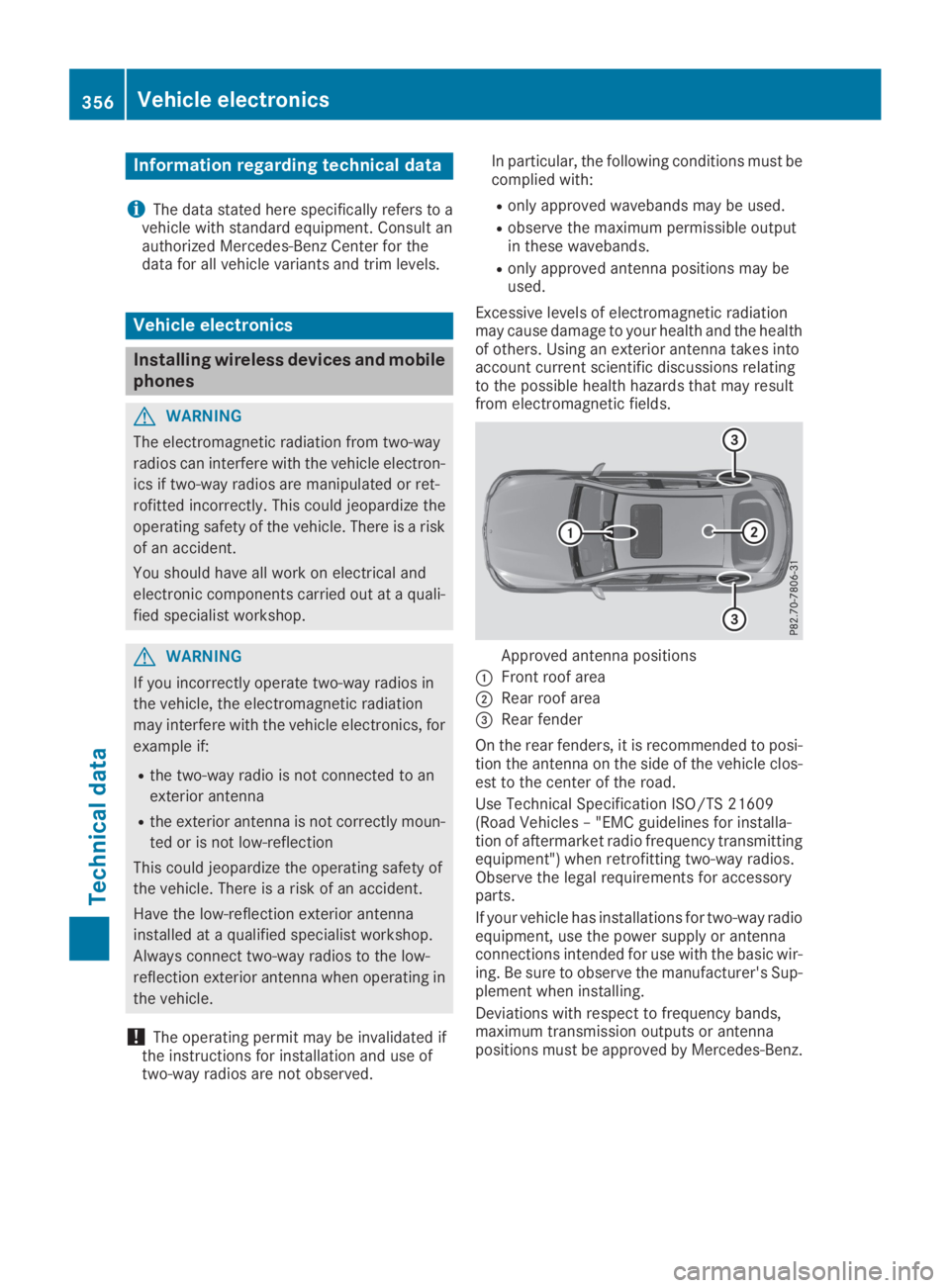
Approved antenna positions
CFront roof area
DRear roof area
Page 359 of 370
The maximum transmission output (PEAK) at thebase of the antenna must not exceed the fol-lowing values:
Frequency bandMaximumtransmissionoutput
Short wave
3 - 54 MHz
100 W
4 m waveband
74 - 88 MHz
30 W
2 m waveband
144 - 174 MHz
50 W
Trunked radio system/Tetra
380 - 460 MHz
10 W
70 cm waveband
400 - 460 MHz
35 W
Mobile communications(2G/3G/4G)10 W
The following can be used in the vehicle withoutrestrictions:
RTwo-way radios with a maximum transmissionoutput of up to 100 mW
RTwo-way radios with transmitter frequenciesin the 380 - 410 MHz waveband and a maxi-mum transmission output of up to 2 W(trunked radio/Tetra)
RMobile phones (2G/3G/4G)
There is no restriction for antenna positions onthe outside of the vehicle for the following fre-quency bands:
RTrunked radio system/Tetra
R70 cm waveband
R2G/3G/4G
Identification plates
Vehicle identification plate with vehi-
cle identification number (VIN)
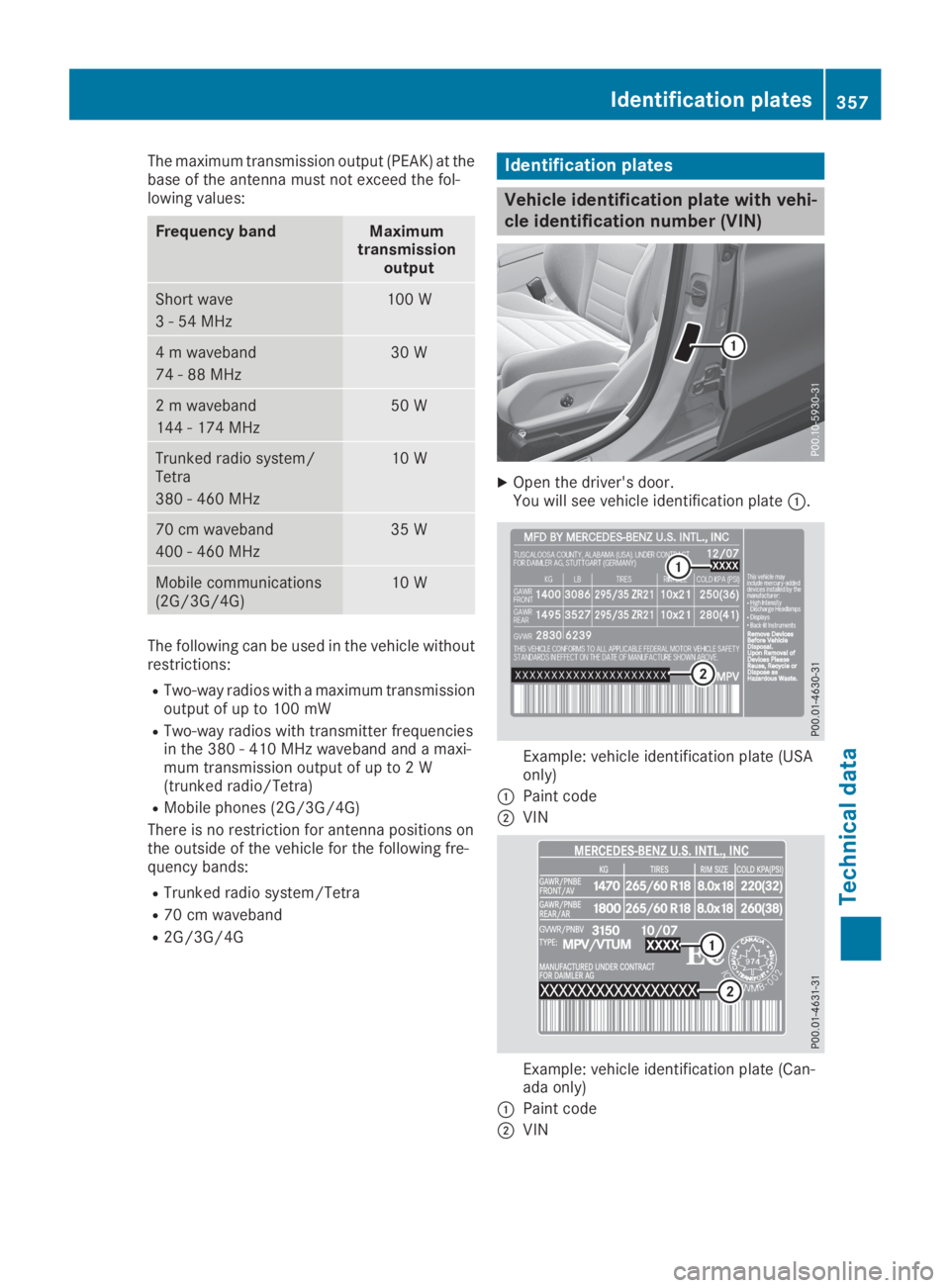
XOpen the driver's door.You will see vehicle identification plateC.
Example: vehicle identification plate (USAonly)
CPaint code
DVIN
Example: vehicle identification plate (Can-ada only)
CPaint code
DVIN
Identification plates357
Technical data
Z
Page 361 of 370
Other designations or recommendations indi-cate a level of quality or a specification inaccordance with an MB Sheet Number (e.g. MB229.5). They have not necessarily beenapproved by Mercedes-Benz.
Other identifications, for example:
R0W-30
R5W-30
R5W-40
Fuel
Important safety notes
GWARNING
Fuel is highly flammable. Risk of fire and
explosion by improper handling of fuel.
You must avoid fire, open flames, smoking
and creating sparks. Switch off the ignition
before refueling and, if present, switch off the
auxiliary heating.
GWARNING
Fuel is poisonous and hazardous to health.
There is a risk of injury.
You must make sure that fuel does not come
into contact with your skin, eyes or clothing
and that it is not swallowed. Do not inhale fuel
vapors. Keep fuel away from children.
If you or others come into contact with fuel,
observe the following:
RWash away fuel from skin immediately
using soap and water.
RIf fuel comes into contact with your eyes,
immediately rinse them thoroughly with
clean water. Seek medical assistance with-
out delay.
RIf fuel is swallowed, seek medical assis-
tance without delay. Do not induce vomit-
ing.
RImmediately change out of clothing which
has come into contact with fuel.
Tank capacity
ModelTotal capacity
All models17.4 US gal(66.0l)
ModelOf whichreserve
Mercedes-AMG GLC 634MATIC+ Coupe
Mercedes-AMG GLC 63S 4MATIC+ Coupe
Approx.2.6 US gal(10.0l)
All other modelsApprox.1.8 US gal (7.0l)
Gasoline
Fuel grade
!Do not use diesel to refuel vehicles with agasoline engine. Do not switch on the ignitionif you accidentally refuel with the wrong fuel.Otherwise, the fuel will enter the fuel system.Even small amounts of the wrong fuel couldresult in damage to the fuel system and theengine. Notify a qualified specialist workshopand have the fuel tank and fuel lines drainedcompletely.
!Only refuel using low-sulfur premium-gradefuel with an octane rating of at least 91 AKI/95 RON.
iE10 fuel contains up to 10% ethanol by vol-ume. Your vehicle is E10-compatible. You canrefuel your vehicle using E10 fuel.
!Only use the fuel recommended. Operatingthe vehicle with other fuels can lead to dam-age to the fuel system, engine and exhaustsystem.
!Never refuel using:
RDiesel
RGasoline with more than 10% ethanol byvolume, e.g. E15, E20, E85, E100
RGasoline with more than 3% methanol byvolume, e.g. M15, M30, M85, M100
RGasoline with metalliferous additives
Do not mix such fuels with the fuel recom-mended for your vehicle.
Service products and filling capacities359
Technical data
Z
Page 362 of 370
!To ensure the longevity and full perform-ance of the engine, only premium-gradeunleaded gasoline may be used.
If premium-grade unleaded gasoline isunavailable and you have to refuel with regu-lar unleaded gasoline, observe the followingprecautions:
ROnly fill the fuel tank to half full with regularunleaded gasoline and add the rest as soonas possible with premium-grade unleadedgasoline.
RDo not drive at the maximum design speed.
RAvoid sudden acceleration and enginespeeds over 3000 rpm.
You will usually find information about the fuelgrade on the fuel pump. If you cannot find thelabel on the fuel pump, ask the gas station staff.
iFor further information, consult a qualifiedspecialist workshop or visithttp://www.mbusa.com (USA only).
As a temporary measure, if the recommendedfuel is not available, you may also use regularunleaded gasoline with an octane rating of87 AKI/91 RON. This may reduce engine per-formance and increase fuel consumption. Avoiddriving at full throttle and sudden acceleration.Never refuel using gasoline with a lower AKI.
Information on refueling (Ypage 151).
Additives
!Operating the engine with fuel additivesadded later can lead to engine failure. Do notmix fuel additives with fuel. This does notinclude additives for the removal and preven-tion of residue buildup. gasoline must only bemixed with additives recommended byMercedes-Benz. Comply with the instructionsfor use on the product label. More informationabout recommended additives can beobtained from any authorized Mercedes-BenzCenter.
Mercedes-Benz recommends that you use bran-ded fuels that have additives.
The fuel quality available in some countries maynot be sufficient. Residue could build up in thefuel injection system as a result. In such cases,and in consultation with an authorizedMercedes-Benz Center, the fuel may be mixedwith the cleaning additive recommended byMercedes-Benz. You must observe the notesand mixing ratios specified on the container.
Engine oil
General notes
!Do not use engine oil or an oil filter withspecifications deviating from those expresslyrequired for the prescribed service intervals.Do not change the engine oil or oil filter inorder to set replacement intervals longer thanthose prescribed. This could otherwise causedamage to the engine or exhaust gas after-treatment.
Follow the instructions on the service intervaldisplay for changing the engine oil. This couldotherwise cause damage to the engine orexhaust gas aftertreatment.
When handling engine oil, observe the importantsafety notes on service products (Ypage 358).
The engine oils are matched to the performanceof Mercedes-Benz engines and service intervals.You should therefore only use engine oils and oilfilters that are approved for vehicles with main-tenance systems.
Information on approved engine oils and oil fil-ters can be obtained at the following places:
Rfrom an authorized Mercedes-Benz Center
Rin the Mercedes-Benz Specifications for Ser-vice Products by entering the designation
-on the Internet athttp://bevo.mercedes-benz.com
-on the Mercedes-Benz BeVo app
The table shows which engine oils have beenapproved for your vehicle.
ModelMB-Freigabe orMB-Approval
Mercedes-AMG vehicles229.5
All other models229.5, 229.6
360Service products and filling capacities
Technical data
Page 363 of 370
Use only SAE 0W-40 or SAE 5W-40 engine oilsfor Mercedes-AMG vehicles.
iMB approval is indicated on the oil contain-ers.
Filling capacities
The following values refer to an oil changeincluding the oil filter.
ModelCapacity
Mercedes-AMGGLC 63 4MATIC+Coupe
Mercedes-AMGGLC 63 S 4MATIC+Coupe
9.5 US qt (9.0l)
All other models6.9 US qt (6.5l)
Additives
!Do not use any additives in the engine oil.This could damage the engine.
Brake fluid
GWARNING
The brake fluid constantly absorbs moisture
from the air. This lowers the boiling point of
the brake fluid. If the boiling point of the brake
fluid is too low, vapor pockets may form in the
brake system when the brakes are applied
hard. This would impair braking efficiency.
There is a risk of an accident.
You should have the brake fluid renewed at
the specified intervals.
When handling brake fluid, observe the impor-tant safety notes on service products(Ypage 358).
The brake fluid change intervals can be found inthe Maintenance Booklet.
Only use brake fluid approved by Mercedes-Benz in accordance with MB-Freigabe or MB-Approval 331.0.
Information on approved brake fluid can beobtained in the following places:
Rfrom an authorized Mercedes-Benz Center
Rin the Mercedes-Benz Specification for Ser-vice Products by entering the designation
-on the Internet athttp://bevo.mercedes-benz.com
-on the Mercedes-Benz BeVo app
iHave the brake fluid regularly replaced at aqualified specialist workshop in accordancewith the replacement intervals and thereplacement confirmed in the MaintenanceBooklet.
Coolant
Important safety notes
GWARNING
If antifreeze comes into contact with hot com-
ponents in the engine compartment, it may
ignite. There is a risk of fire and injury.
Let the engine cool down before you add anti-
freeze. Make sure that antifreeze is not spilled
next to the filler neck. Thoroughly clean the
antifreeze from components before starting
the engine.
!Only add coolant that has been premixedwith the desired antifreeze protection. Youcould otherwise damage the engine.
You can find additional notes on the coolant inthe following places:
Rin the Mercedes-Benz Specifications forService Products, MB BeVo 310.1
-on the Internet athttp://bevo.mercedes-benz.com
-on the Mercedes-Benz BeVo app
Ra qualified specialized workshop
!Always use a suitable coolant mixture, evenin countries where high temperatures prevail.
Otherwise, the engine cooling system is notsufficiently protected from corrosion andoverheating.
iHave the coolant regularly replaced at aqualified specialist workshop and the replace-ment confirmed in the Maintenance Booklet.
Service products and filling capacities361
Technical data
Z
Page 364 of 370
Comply with the important safety notes for ser-vice products when handling coolant(Ypage 358).
The coolant is a mixture of water and anti-freeze/corrosion inhibitor. It performs the fol-lowing tasks:
Ranti-corrosion protection
Rantifreeze protection
Rraising the boiling point
If the coolant has antifreeze protection down to-35 ‡ (-37 †), the boiling point of the coolantduring operation is approximately 266 ‡(130 †).
The antifreeze concentrate/corrosion inhibitorconcentration in the engine cooling systemshould:
Rbe at least 50%. This will protect the enginecooling system against freezing down toapproximately -35 ‡ (-37 †).
Rnot exceed 55% (antifreeze protection downto -49‡[-45 †]). Otherwise, heat will not bedissipated as effectively
Mercedes-Benz recommends an antifreeze/corrosion inhibitor concentrate in accordancewith MB Specifications for Service Products310.1.
iWhen the vehicle is first delivered, it is filledwith a coolant mixture that ensures adequateantifreeze and anti-corrosion protection.
iThe coolant is checked with every mainte-nance interval at a qualified specialist work-shop.
Filling capacities
ModelCapacity
Mercedes-AMGGLC 43 4MATICCoupe
12.2 US qt (11.5l)
Mercedes-AMGGLC 63 4MATIC+Coupe
Mercedes-AMGGLC 63 S 4MATIC+Coupe
11.7 US qt (11.1l)
All other models12.7 US qt (12.0l)
Windshield washer system
Important safety notes
GWARNING
Windshield washer concentrate is highly flam-
mable. If windshield washer concentrate gets
onto hot components of the engine or the
exhaust system, it can ignite. There is a risk of
fire and injury.
Make sure that windshield washer concen-
trate is not spilled in the vicinity of the filler
neck.
!Only use washer fluid which is suitable forlamp lenses, e.g. MB SummerFit or MB Win-terFit. Unsuitable washer fluid may damagethe lamp lenses of the headlamps.
!Only MB SummerFit and MB WinterFitwasher fluid should be mixed together. Thespray nozzles may otherwise becomeblocked.
Do not use distilled or de-ionized water. Other-wise, the level sensor may give a false reading.
When handling washer fluid, observe the impor-tant safety notes on service products(Ypage 358).
At temperatures above freezing:
XFill the washer fluid reservoir with a mixture ofwater and windshield washer fluid, e.g. MBSummerFit.
Add 1 part MB SummerFit to 100 parts water.
At temperatures below freezing:
XFill the washer fluid reservoir with a mixture ofwater and washer fluid, e.g. MB WinterFit.
For the correct mixing ratio refer to the infor-mation on the antifreeze reservoir.
iAdd windshield washer fluid, e.g. MB Sum-merFit or MB WinterFit, to the washer fluid allyear round.
Climate control system refrigerant
Important safety notes
The climate control system of your vehicle is fil-led with refrigerant R‑134a.
362Service products and filling capacities
Technical data
Page 366 of 370
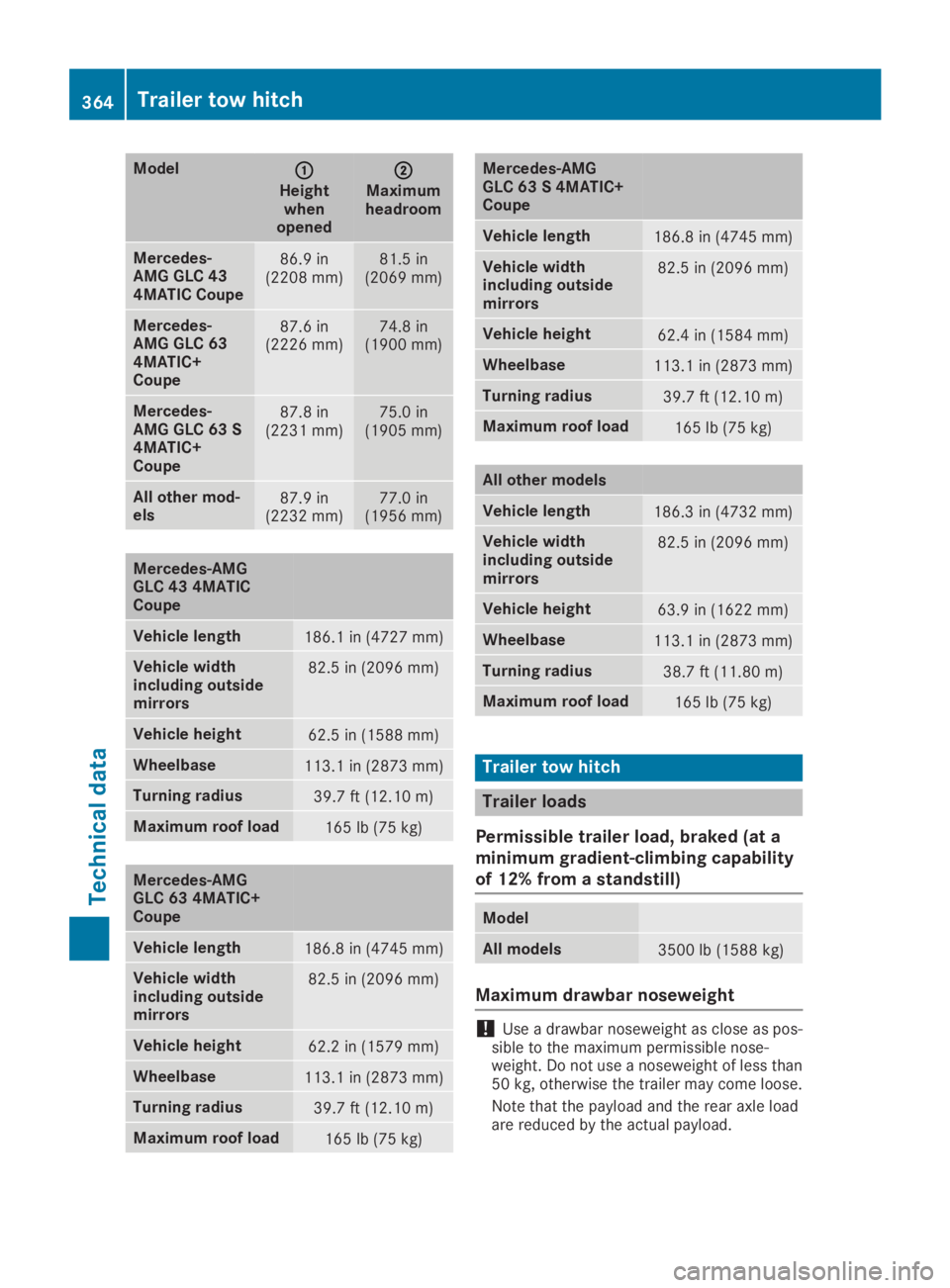
ModelCC
Heightwhenopened
DD
Maximumheadroom
Mercedes-AMG GLC 434MATIC Coupe
86.9 in(2208 mm)81.5 in(2069 mm)
Mercedes-AMG GLC 634MATIC+Coupe
87.6 in(2226 mm)74.8 in(1900 mm)
Mercedes-AMG GLC 63 S4MATIC+Coupe
87.8 in(2231 mm)75.0 in(1905 mm)
All other mod-els87.9 in(2232 mm)77.0 in(1956 mm)
Mercedes-AMGGLC 43 4MATICCoupe
Vehicle length186.1 in (4727 mm)
Vehicle widthincluding outsidemirrors
82.5 in (2096 mm)
Vehicle height62.5 in (1588 mm)
Wheelbase113.1 in (2873 mm)
Turning radius39.7 ft (12.10m)
Maximum roof load165 lb (75 kg)
Mercedes-AMGGLC 63 4MATIC+Coupe
Vehicle length186.8 in (4745 mm)
Vehicle widthincluding outsidemirrors
82.5 in (2096 mm)
Vehicle height62.2 in (1579 mm)
Wheelbase113.1 in (2873 mm)
Turning radius39.7 ft (12.10m)
Maximum roof load165 lb (75 kg)
Mercedes-AMGGLC 63 S 4MATIC+Coupe
Vehicle length186.8 in (4745 mm)
Vehicle widthincluding outsidemirrors
82.5 in (2096 mm)
Vehicle height62.4 in (1584 mm)
Wheelbase113.1 in (2873 mm)
Turning radius39.7 ft (12.10m)
Maximum roof load165 lb (75 kg)
All other models
Vehicle length186.3 in (4732 mm)
Vehicle widthincluding outsidemirrors
82.5 in (2096 mm)
Vehicle height63.9 in (1622 mm)
Wheelbase113.1 in (2873 mm)
Turning radius38.7 ft (11.80m)
Maximum roof load165 lb (75 kg)
Trailer tow hitch
Trailer loads
Permissible trailer load, braked (at a
minimum gradient-climbing capability
of 12% from a standstill)
Model
All models3500 lb (1588 kg)
Maximum drawbar noseweight
!Use a drawbar noseweight as close as pos-sible to the maximum permissible nose-weight. Do not use a noseweight of less than50 kg, otherwise the trailer may come loose.
Note that the payload and the rear axle loadare reduced by the actual payload.
364Trailer tow hitch
Technical data