reset MERCEDES-BENZ GLK-CLASS SUV 2013 Owners Manual
[x] Cancel search | Manufacturer: MERCEDES-BENZ, Model Year: 2013, Model line: GLK-CLASS SUV, Model: MERCEDES-BENZ GLK-CLASS SUV 2013Pages: 380, PDF Size: 19.54 MB
Page 6 of 380
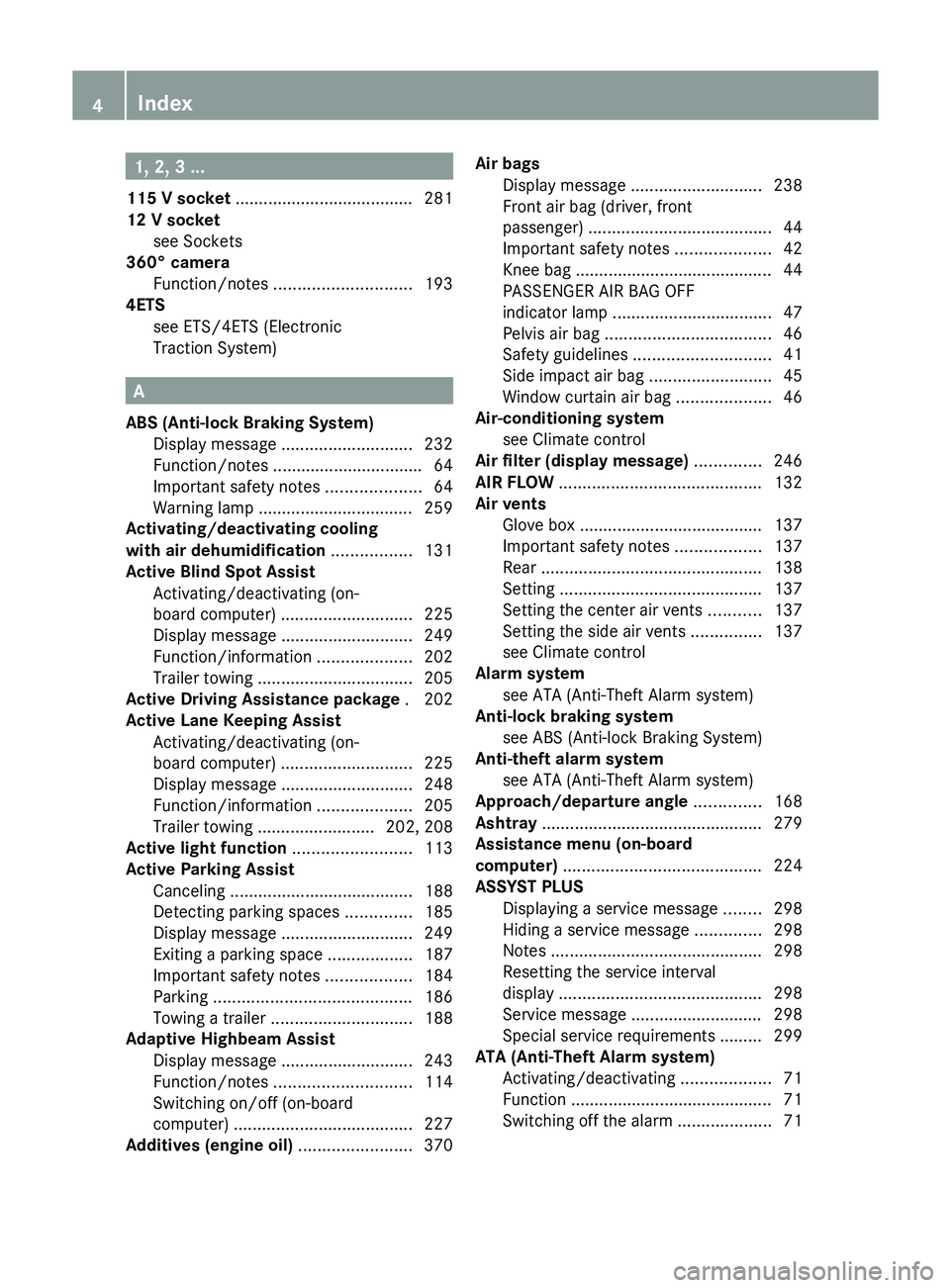
1, 2, 3 ...
115 V socket ...................................... 281
12 V socket see Sockets
360° camera
Function/notes ............................. 193
4ETS
see ETS/4ETS (Electronic
Traction System)
A
ABS (Anti-lock Braking System) Display message ............................ 232
Function/notes ................................ 64
Important safety notes
....................64
Warning lamp ................................. 259
Activating/deactivating cooling
with air dehumidification ................. 131
Active Blind Spot Assist Activating/deactivating (on-
board computer) ............................ 225
Display message ............................ 249
Function/information .................... 202
Trailer towing ................................. 205
Active Driving Assistance package . 202
Active Lane Keeping Assist Activating/deactivating (on-
board computer) ............................ 225
Display message ............................ 248
Function/information .................... 205
Trailer towing ......................... 202, 208
Active light function .........................113
Active Parking Assist Canceling ....................................... 188
Detecting parking spaces .............. 185
Display message ............................ 249
Exiting a parking space .................. 187
Important safety notes .................. 184
Parking .......................................... 186
Towing a trailer .............................. 188
Adaptive Highbeam Assist
Display message ............................ 243
Function/notes ............................. 114
Switching on/off (on-board
computer) ...................................... 227
Additives (engine oil) ........................370Air bags
Display message ............................ 238
Front air bag (driver, front
passenger) ....................................... 44
Important safety notes .................... 42
Knee bag .......................................... 44
PASSENGER AIR BAG OFF
indicator lamp .................................. 47
Pelvis air bag
................................... 46
Safety guidelines ............................. 41
Side impact air bag .......................... 45
Window curtain air bag ....................46
Air-conditioning system
see Climate control
Air filter (display message) ..............246
AIR FLOW ........................................... 132
Air vents Glove box ....................................... 137
Important safety notes .................. 137
Rear ............................................... 138
Setting ........................................... 137
Setting the center air vents ...........137
Setting the side air vents ............... 137
see Climate control
Alarm system
see ATA (Anti-Theft Alarm system)
Anti-lock braking system
see ABS (Anti-lock Braking System)
Anti-theft alarm system
see ATA (Anti-Theft Alarm system)
Approach/departure angle ..............168
Ashtray ............................................... 279
Assistance menu (on-board
computer) .......................................... 224
ASSYST PLUS Displaying a service message ........ 298
Hiding a service message .............. 298
Notes ............................................. 298
Resetting the service interval
display ........................................... 298
Service message ............................ 298
Special service requirements ......... 299
ATA (Anti-Theft Alarm system)
Activating/deactivating ................... 71
Function ........................................... 71
Switching off the alarm .................... 714
Index
Page 15 of 380
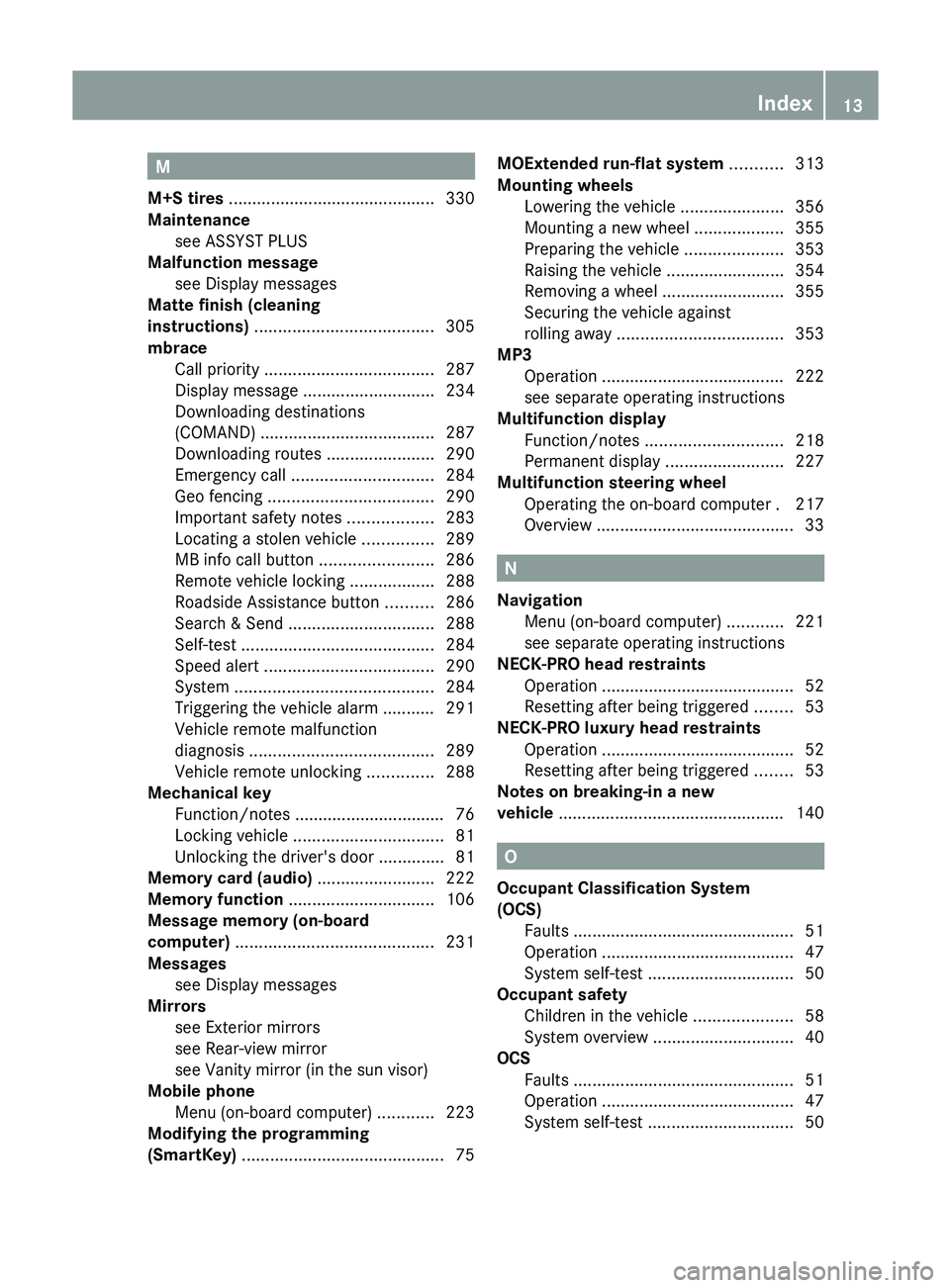
M
M+S tires ............................................ 330
Maintenance see ASSYST PLUS
Malfunction message
see Display messages
Matte finish (cleaning
instructions) ...................................... 305
mbrace Call priority .................................... 287
Display message ............................ 234
Downloading destinations
(COMAND) ..................................... 287
Downloading routes .......................290
Emergency call .............................. 284
Geo fencing ................................... 290
Important safety notes .................. 283
Locating a stolen vehicle ............... 289
MB info call button ........................ 286
Remote vehicle locking .................. 288
Roadside Assistance button .......... 286
Search & Send ............................... 288
Self-test ......................................... 284
Speed alert .................................... 290
System .......................................... 284
Triggering the vehicle alarm ........... 291
Vehicle remote malfunction
diagnosis ....................................... 289
Vehicle remote unlocking .............. 288
Mechanical key
Function/notes ................................ 76
Locking vehicle ................................ 81
Unlocking the driver's door ..............81
Memory card (audio) ......................... 222
Memory function ............................... 106
Message memory (on-board
computer) .......................................... 231
Messages see Display messages
Mirrors
see Exterior mirrors
see Rear-view mirror
see Vanity mirror (in the sun visor)
Mobile phone
Menu (on-board computer) ............ 223
Modifying the programming
(SmartKey) ........................................... 75MOExtended run-flat system
...........313
Mounting wheels Lowering the vehicle ......................356
Mounting a new wheel ................... 355
Preparing the vehicle .....................353
Raising the vehicle .........................354
Removing a wheel
.......................... 355
Securing the vehicle against
rolling away ................................... 353
MP3
Operation ....................................... 222
see separate operating instructions
Multifunction display
Function/notes ............................. 218
Permanent display ......................... 227
Multifunction steering wheel
Operating the on-board computer . 217
Overview .......................................... 33 N
Navigation Menu (on-board computer) ............ 221
see separate operating instructions
NECK-PRO head restraints
Operation ......................................... 52
Resetting after being triggered ........ 53
NECK-PRO luxury head restraints
Operation ......................................... 52
Resetting after being triggered ........ 53
Notes on breaking-in a new
vehicle ................................................ 140 O
Occupant Classification System
(OCS) Faults ............................................... 51
Operation ......................................... 47
System self-test ............................... 50
Occupant safety
Children in the vehicle .....................58
System overview .............................. 40
OCS
Faults ............................................... 51
Operation
......................................... 47
System self-test ............................... 50 Index
13
Page 16 of 380
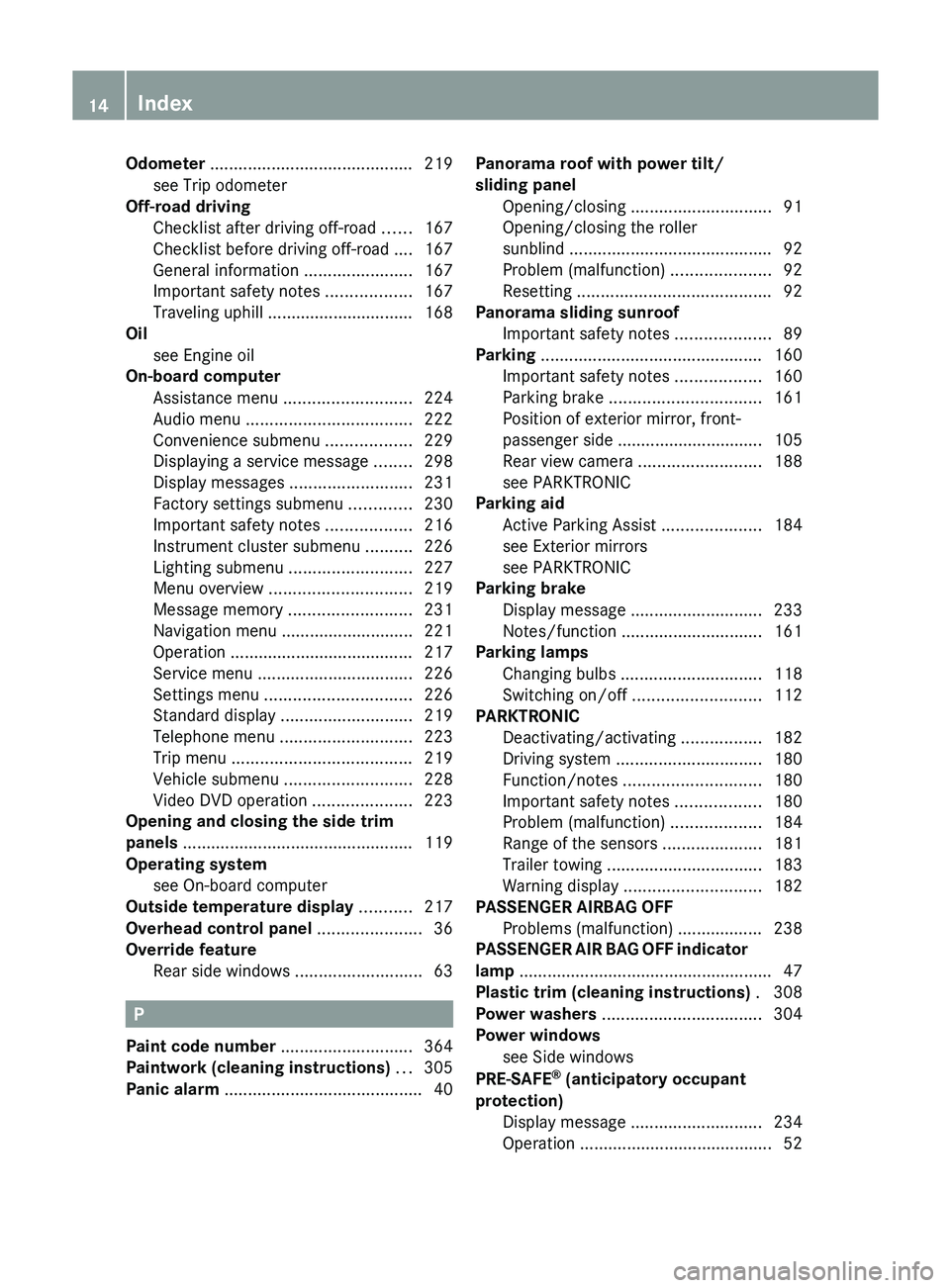
Odometer ...........................................
219
see Trip odometer
Off-road driving
Checklist after driving off-road ...... 167
Checklist before driving off-road .... 167
General information ....................... 167
Important safety notes .................. 167
Traveling uphill ............................... 168
Oil
see Engine oil
On-board computer
Assistance menu ........................... 224
Audio menu ................................... 222
Convenience submenu .................. 229
Displaying a service message ........ 298
Display messages ..........................231
Factory settings submenu ............. 230
Important safety notes .................. 216
Instrument cluster submenu ..........226
Lighting submenu .......................... 227
Menu overview .............................. 219
Message memory .......................... 231
Navigation menu ............................ 221
Operation ....................................... 217
Service menu ................................. 226
Settings menu ............................... 226
Standard display ............................ 219
Telephone menu ............................ 223
Trip menu ...................................... 219
Vehicle submenu ........................... 228
Video DVD operation ..................... 223
Opening and closing the side trim
panels ................................................. 119
Operating system see On-board computer
Outside temperature display ...........217
Overhead control panel ......................36
Override feature Rear side windows ........................... 63P
Paint code number ............................ 364
Paintwork (cleaning instructions) ...305
Panic alarm .......................................... 40Panorama roof with power tilt/
sliding panel
Opening/closing .............................. 91
Opening/closing the roller
sunblind ........................................... 92
Problem (malfunction) .....................92
Resetting ......................................... 92
Panorama sliding sunroof
Important safety notes .................... 89
Parking ............................................... 160
Important safety notes
..................160
Parking brake ................................ 161
Position of exterior mirror, front-
passenger side ............................... 105
Rear view camera .......................... 188
see PARKTRONIC
Parking aid
Active Parking Assist .....................184
see Exterior mirrors
see PARKTRONIC
Parking brake
Display message ............................ 233
Notes/function .............................. 161
Parking lamps
Changing bulbs .............................. 118
Switching on/off ........................... 112
PARKTRONIC
Deactivating/activating ................. 182
Driving system ............................... 180
Function/notes ............................. 180
Important safety notes .................. 180
Problem (malfunction) ...................184
Range of the sensors ..................... 181
Trailer towing ................................. 183
Warning display ............................. 182
PASSENGER AIRBAG OFF
Problems (malfunction) .................. 238
PASSENGER AIR BAG OFF indicator
lamp ...................................................... 47
Plastic trim (cleaning instructions) . 308
Power washers .................................. 304
Power windows see Side windows
PRE-SAFE ®
(anticipatory occupant
protection) Display message ............................ 234
Operation ......................................... 5214
Index
Page 18 of 380
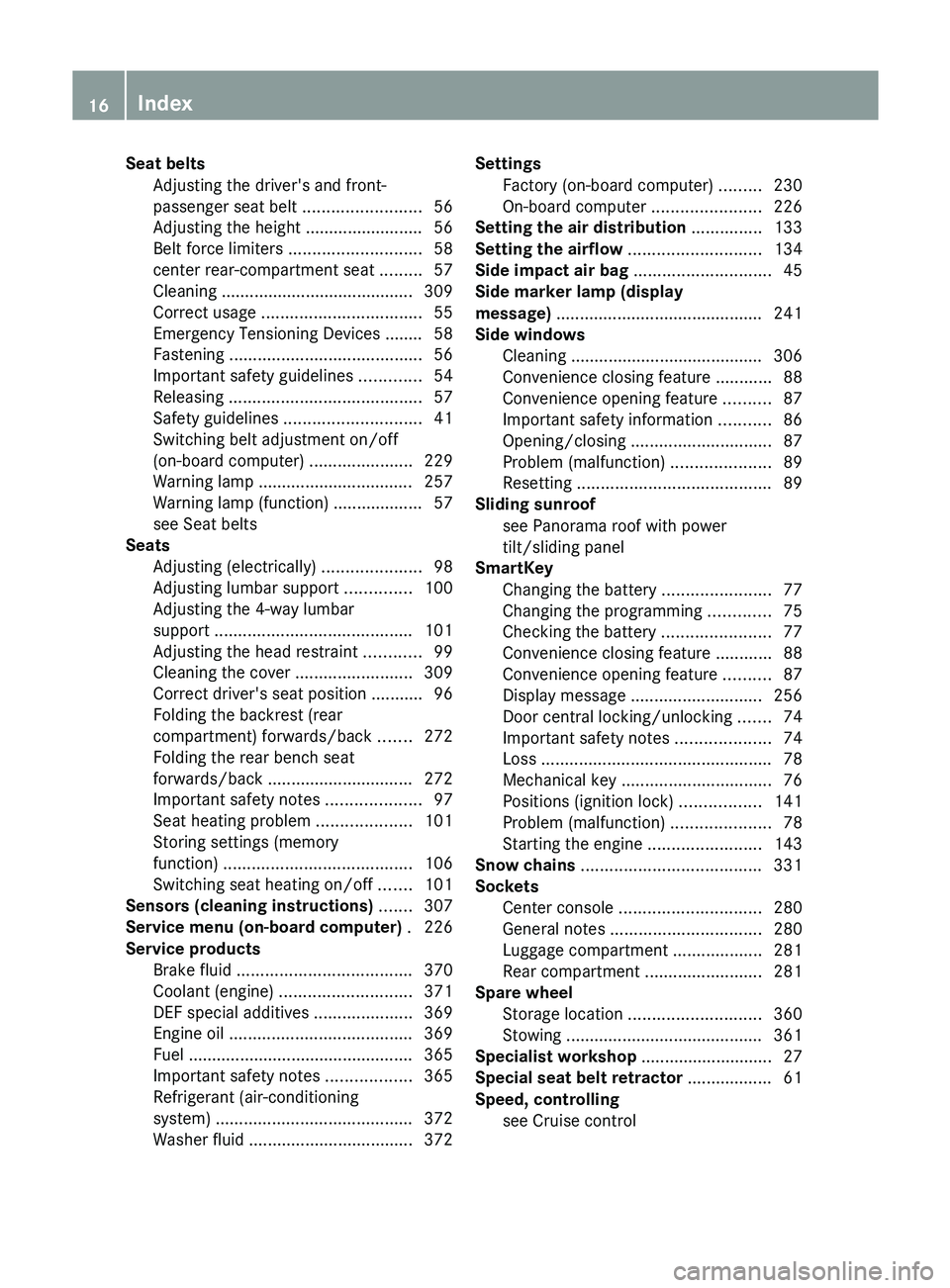
Seat belts
Adjusting the driver's and front-
passenger seat belt .........................56
Adjusting the height ......................... 56
Belt force limiters ............................ 58
center rear-compartment seat .........57
Cleaning .........................................
309
Correct usage .................................. 55
Emergency Tensioning Devices ........ 58
Fastening ......................................... 56
Important safety guidelines .............54
Releasing ......................................... 57
Safety guidelines ............................. 41
Switching belt adjustment on/off
(on-board computer) ...................... 229
Warning lamp ................................. 257
Warning lamp (function) ................... 57
see Seat belts
Seats
Adjusting (electrically) .....................98
Adjusting lumbar support ..............100
Adjusting the 4-way lumbar
support .......................................... 101
Adjusting the head restraint ............ 99
Cleaning the cover ......................... 309
Correct driver's seat position ........... 96
Folding the backrest (rear
compartment) forwards/back .......272
Folding the rear bench seat
forwards/back ............................... 272
Important safety notes .................... 97
Seat heating problem .................... 101
Storing settings (memory
function) ........................................ 106
Switching seat heating on/off ....... 101
Sensors (cleaning instructions) .......307
Service menu (on-board computer) . 226
Service products Brake fluid ..................................... 370
Coolant (engine) ............................ 371
DEF special additives .....................369
Engine oil ....................................... 369
Fuel ................................................ 365
Important safety notes .................. 365
Refrigerant (air-conditioning
system) .......................................... 372
Washer fluid ................................... 372Settings
Factory (on-board computer) ......... 230
On-board computer ....................... 226
Setting the air distribution ...............133
Setting the airflow ............................ 134
Side impact air bag ............................. 45
Side marker lamp (display
message) ............................................ 241
Side windows Cleaning ......................................... 306
Convenience closing feature ............ 88
Convenience opening feature .......... 87
Important safety information
...........86
Opening/closing .............................. 87
Problem (malfunction) .....................89
Resetting ......................................... 89
Sliding sunroof
see Panorama roof with power
tilt/sliding panel
SmartKey
Changing the battery ....................... 77
Changing the programming ............. 75
Checking the battery ....................... 77
Convenience closing feature ............ 88
Convenience opening feature .......... 87
Display message ............................ 256
Door central locking/unlocking ....... 74
Important safety notes .................... 74
Loss ................................................. 78
Mechanical key ................................ 76
Positions (ignition lock) ................. 141
Problem (malfunction) .....................78
Starting the engine ........................ 143
Snow chains ...................................... 331
Sockets Center console .............................. 280
General notes ................................ 280
Luggage compartment ................... 281
Rear compartment ......................... 281
Spare wheel
Storage location ............................ 360
Stowing .......................................... 361
Specialist workshop ............................ 27
Special seat belt retractor .................. 61
Speed, controlling see Cruise control 16
Index
Page 21 of 380
Structure and characteristics
(definition) .....................................
349
Summer tires ................................. 330
Temperature .................................. 345
TIN (Tire Identification Number)
(definition) ..................................... 351
Tire bead (definition) ......................351
Tire pressure (definition) ................ 351
Tire pressures (recommended)
......349
Tire size (data) ............................... 357
Tire size designation, load-bearing
capacity, speed rating .................... 346
Tire tread ....................................... 329
Tire tread (definition) .....................351
Total load limit (definition) ............. 352
Traction ......................................... 344
Traction (definition) ....................... 351
Tread wear ..................................... 344
TWR (permissible trailer drawbar
noseweight) (definition) .................351
Uniform Tire Quality Grading
Standards ...................................... 344
Uniform Tire Quality Grading
Standards (definition) .................... 349
Unladen weight (definition) ............ 350
Wear indicator (definition) .............352
Wheel rim (definition) .................... 349
see Flat tire
Top Tether ............................................ 62
Towing Important safety guidelines ...........320
Installing the towing eye ................ 321
Removing the towing eye ...............321
With the rear axle raised ................ 322
Towing a trailer
Active Parking Assist .....................188
Cleaning the trailer tow hitch ......... 308
Coupling up a trailer ......................210
Decoupling a trailer ....................... 212
Driving tips .................................... 208
Important safety notes .................. 208
Installing the ball coupling .............210
Lights display message .................. 239
Mounting dimensions .................... 374
Power supply ................................. 213
Removing the ball coupling ............213
Shift range ..................................... 151Storing the ball coupling
................213
Trailer loads ................................... 374
Towing away
With both axles on the ground ....... 322
Tow-starting
Emergency engine starting ............ 323
Important safety notes
..................320
Trailer coupling
see Towing a trailer
Trailer loads and drawbar
noseweights ...................................... 212
Trailer towing Active Blind Spot Assist ................. 205
Active Lane Keeping Assist .... 202, 208
Blind Spot Assist ............................ 200
PARKTRONIC ................................. 183
Permissible trailer loads and
drawbar noseweights .....................212
Transfer case ..................................... 154
Transmission see Automatic transmission
Transmission position display .........149
Transmission position display
(DIRECT SELECT lever) ......................149
Transporting the vehicle .................. 322
Traveling uphill Brow of hill ..................................... 169
Driving downhill ............................. 169
Maximum gradient-climbing
capability ....................................... 169
Trim pieces (cleaning instructions) . 309
Trip computer (on-board
computer) .......................................... 219
Trip odometer Calling up ....................................... 219
Resetting (on-board computer) ...... 220
see Trip odometer
Turn signals
Changing bulbs (front) ................... 119
Display message ............................ 240
Switching on/off ........................... 112
see Turn signals
TWR (Tongue Weight Rating)
(definition) ......................................... 351
Type identification plate see Vehicle identification plate Index
19
Page 29 of 380
Make sure that all objects in the vehicle are
stowed correctly, and that they cannot enter
the driver's footwell. Install the floormats
securely and as specified in order to ensure
sufficient clearance for the
pedals.
Do not use
loose floormats.
! If the engine is switched off and
equipment on the diagnostics connection
is used, the starter battery may discharge.
Connecting equipment to the diagnostics
connection can lead to emissions monitoring
information being reset, for example. This
may lead to the vehicle failing to meet the
requirements of the next emissions test
during the main inspection. Qualified specialist workshop
An authorized Mercedes-Benz Center is a
qualified specialist workshop. It has the
necessary specialist knowledge, tools and
qualifications to correctly carry out the work
required on your vehicle. This
is especially the
case for work relevant to safety.
Observe the notes in the Maintenance
Booklet.
Always have the following work carried out at
an authorized Mercedes-Benz Center:
R work relevant to safety
R service and maintenance work
R repair work
R alterations, installation work and
modifications
R work on electronic components Problems with your vehicle
If you should experience a
problem with your
vehicle, particularly one that you believe may
affect its safe operation, we urge you to
contact an authorized Mercedes-Benz Center
immediately to have the problem diagnosed
and rectified. If the problem is not resolved to
your satisfaction, please discuss the problem again with a Mercedes-Benz Center or
contact us at one
of
the following addresses.
In the USA
Customer Assistance Center
Mercedes-Benz USA, LLC
One Mercedes Drive
Montvale, NJ 07645-0350
In Canada
Customer Relations Department
Mercedes-Benz Canada, Inc.
98 Vanderhoof Avenue
Toronto, Ontario M4G 4C9 Reporting safety defects
USA only:
The following text is published
as required of
manufacturers under Title 49, Code of U.S.
Federal Regulations, Part 575 pursuant to the
"National Traffic and Motor Vehicle Safety Act
of 1966".
If you believe that your vehicle has a defect
which could cause a crash or could cause
injury or death, you should immediately
inform the National Highway Traffic Safety
Administration (NHTSA) in addition to
notifying Mercedes-Benz USA, LLC.
If NHTSA receives similar complaints, it may
open an investigation, and if it finds that a
safety defect exists in a group of vehicles, it
may order a recall and remedy campaign.
However, NHTSA cannot become involved in
individual problems between you, your
dealer, or Mercedes-Benz USA, LLC.
To contact NHTSA, you may call the Vehicle
Safety Hotline toll-free at
1-888-327-4236(TTY: 1-800-424-9153); go
to http://www.safercar.gov ; or write to:
Administrator, NHTSA, 400 Seventh Street,
SW., Washington, DC 20590.
You can also obtain other information about
motor vehicle safety from
http://www.safercar.gov Introduction
27 Z
Page 47 of 380
Driver's knee bag 0043 deploys under the
steering column. If, during a frontal collision,
the system determines that air bag
deployment can offer additional
protection
to
that provided by the seat belt, driver's knee
bag 0043 is deployed along with the driver's air
bag. Driver's knee bag 0043 operates best in
conjunction with correctly positioned and
fastened seat belts.
Side impact air bags G
WARNING
The pressure sensors for side impact air bag
control are located in the doors. Do not
modify any components of the doors or door
trim panels including, for example, the
addition of door speakers.
Improper repair work on the doors or the
modification or addition of components
to the
doors create a risk of rendering the side
impact air bags inoperative or causing
unintended air bag deployment. Work on the
doors must therefore only be performed by
qualified technicians. Contact an authorized
Mercedes-Benz Center. G
WARNING
Only use seat covers which have been tested
and approved by Mercedes-Benz for your
vehicle model. Using seat covers
or other seat
coverings can cause a malfunction of the side
impact air bags and/or the pelvis air bags.
Contact an authorized Mercedes-Benz Center
for availability.
When deployed, the side impact air bags offer
additional protection for the thorax of the
vehicle occupants on the side of the vehicle
on which the impact occurs. However, they
do not protect the:
R head
R neck
R arms Side impact air bags
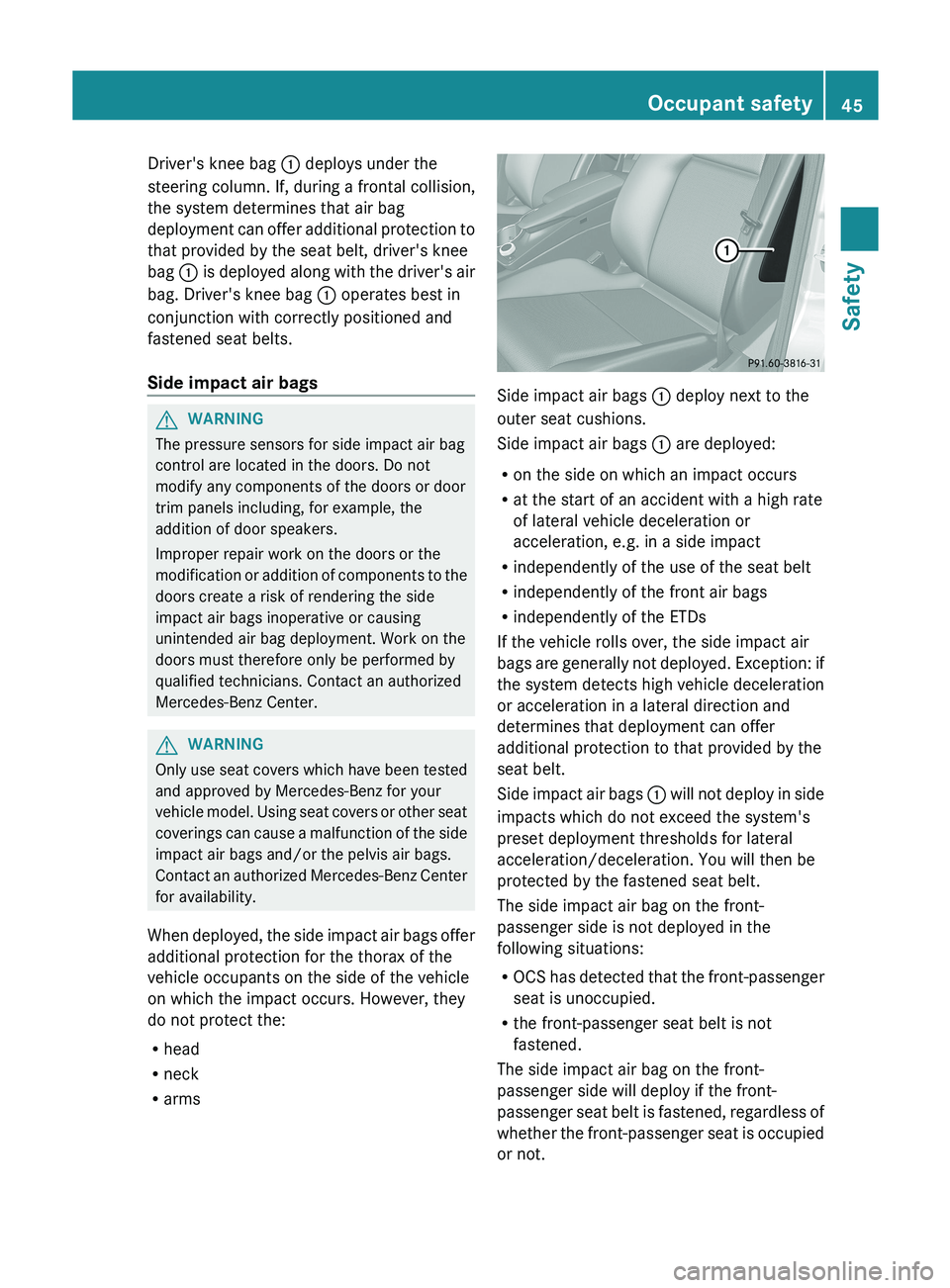
0043 deploy next to the
outer seat cushions.
Side impact air bags 0043 are deployed:
R on the side on which an impact occurs
R at the start of an accident with a high rate
of lateral vehicle deceleration or
acceleration, e.g. in a side impact
R independently of the use of the seat belt
R independently of the front air bags
R independently of the ETDs
If the vehicle rolls over, the side impact air
bags are generally not
deployed.
Exception: if
the system detects high vehicle deceleration
or acceleration in a lateral direction and
determines that deployment can offer
additional protection to that provided by the
seat belt.
Side impact air bags 0043 will not deploy in side
impacts which do not exceed the system's
preset deployment thresholds for lateral
acceleration/deceleration. You will then be
protected by the fastened seat belt.
The side impact air bag on the front-
passenger side is not deployed in the
following situations:
R OCS has detected that the front-passenger
seat is unoccupied.
R the front-passenger seat belt is not
fastened.
The side impact air bag on the front-
passenger side will deploy if the front-
passenger seat belt is fastened, regardless of
whether the front-passenger seat is occupied
or not. Occupant safety
45
Safety Z
Page 48 of 380
Pelvis air bags
G
WARNING
Only use seat covers which have been tested
and approved by Mercedes-Benz for your
vehicle model. Using seat covers
or other seat
coverings can cause a malfunction of the side
impact air bags and/or the pelvis air bags.
Contact an authorized Mercedes-Benz Center
for availability.
Pelvis air bag deployment enhances the level
of protection of the vehicle occupants on the
side of the vehicle on which the impact
occurs. Pelvis air bags
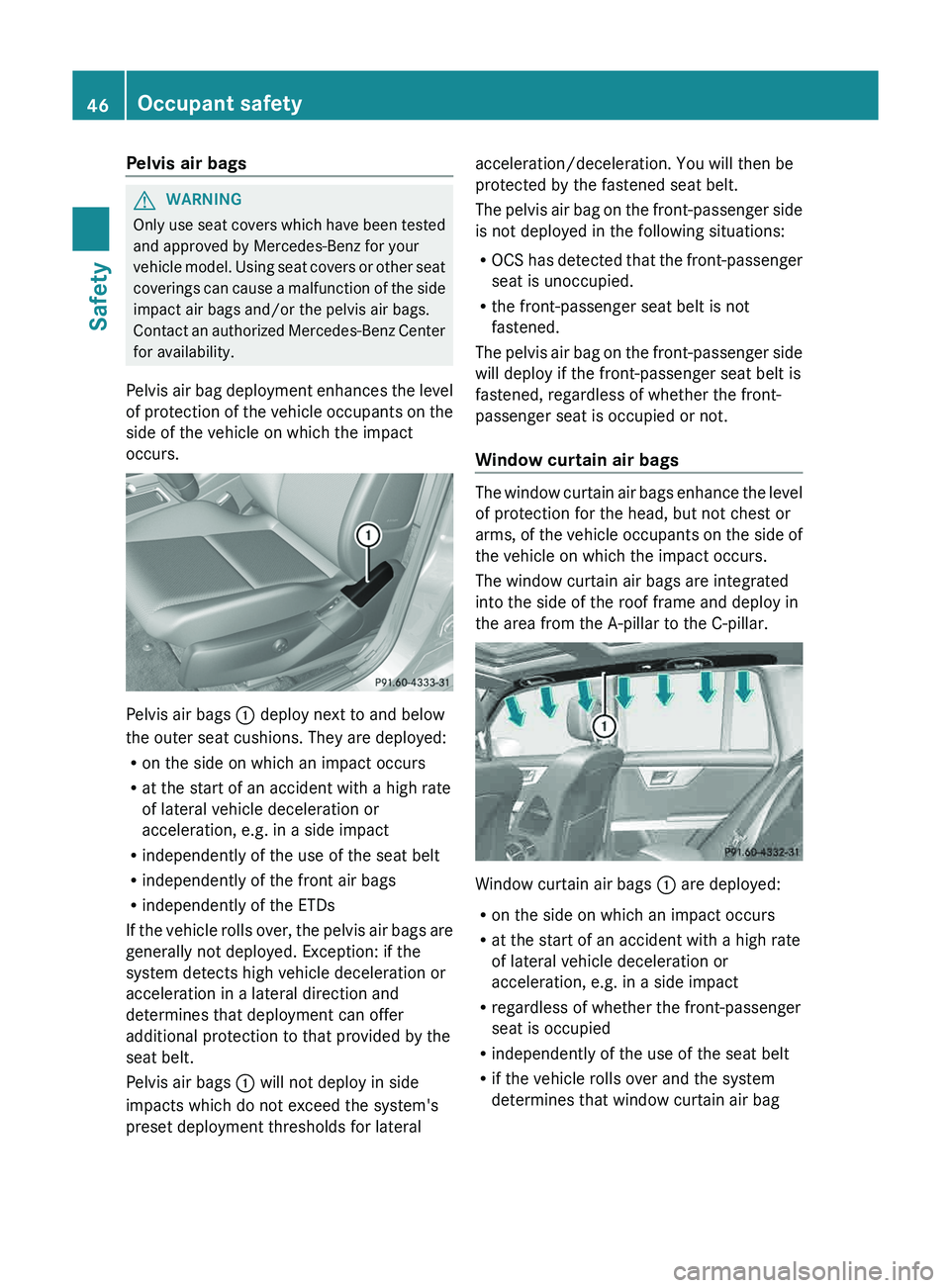
0043 deploy next to and below
the outer seat cushions. They are deployed:
R on the side on which an impact occurs
R at the start of an accident with a high rate
of lateral vehicle deceleration or
acceleration, e.g. in a side impact
R independently of the use of the seat belt
R independently of the front air bags
R independently of the ETDs
If the vehicle rolls over,
the pelvis air bags are
generally not deployed. Exception: if the
system detects high vehicle deceleration or
acceleration in a lateral direction and
determines that deployment can offer
additional protection to that provided by the
seat belt.
Pelvis air bags 0043 will not deploy in side
impacts which do not exceed the system's
preset deployment thresholds for lateral acceleration/deceleration. You will then be
protected by the fastened seat belt.
The
pelvis
air bag
on
the front-passenger side
is not deployed in the following situations:
R OCS has detected that the front-passenger
seat is unoccupied.
R the front-passenger seat belt is not
fastened.
The pelvis air bag on the front-passenger side
will deploy if the front-passenger seat belt is
fastened, regardless of whether the front-
passenger seat is occupied or not.
Window curtain air bags The window curtain air bags enhance the level
of protection for the head, but not chest or
arms, of the vehicle
occupants
on the side of
the vehicle on which the impact occurs.
The window curtain air bags are integrated
into the side of the roof frame and deploy in
the area from the A-pillar to the C-pillar. Window curtain air bags
0043 are deployed:
R on the side on which an impact occurs
R at the start of an accident with a high rate
of lateral vehicle deceleration or
acceleration, e.g. in a side impact
R regardless of whether the front-passenger
seat is occupied
R independently of the use of the seat belt
R if the vehicle rolls over and the system
determines that window curtain air bag46
Occupant safety
Safety
Page 49 of 380
deployment can offer additional protection
to that provided by the seat belt
R independently of the front air bags
Window curtain air bags 0043
will not deploy in
the event of impacts which do not exceed the
system's preset deployment thresholds for
vehicle acceleration/deceleration. You will
then be protected by the fastened seat belt. Occupant Classification System
(OCS)
How the Occupant Classification
System works The Occupant Classification System (OCS)
categorizes the occupant on the front-
passenger
seat
by means
of
a weight sensor.
The front-passenger front air bag is
deactivated automatically for certain weight
categories. The 00730074 indicator lamp
shows you the current status. If the
00730074 indicator lamp lights up, the front-
passenger air bag is disabled.
The system does not deactivate:
R the side impact air bag
R the pelvis air bag
R the window curtain air bag
R the Emergency Tensioning Devices
To be classified correctly, the front passenger
must sit:
R with the seat belt fastened correctly
R in a position that is as upright as possible
with their back against the seat backrest
R with their feet on the floor
If the front-passenger's weight is transferred
to another object in the vehicle (e.g. by
leaning on armrests), OCS may not be able to
approximate the occupant's weight category.
If the front-passenger seat, the seat cover or
the seat cushion are damaged, have the
necessary repair work carried out at an
authorized Mercedes-Benz Center. For safety reasons, Mercedes-Benz
recommends that you only use seat
accessories that have been approved by
Mercedes-Benz.
Both the driver and the front passenger
should always observe the
00730074
indicator lamp to determine whether or not
the front passenger is positioned correctly. G
WARNING
If the 00730074 indicator lamp illuminates
when an adult or someone
larger than a small
individual is in the front-passenger seat, have
the front passenger reposition himself or
herself in the seat until the 00730074
indicator lamp goes out.
In the event of a collision, the air bag control
unit will not allow front-passenger front air
bag deployment when the OCS has classified
the front-passenger seat occupant as
weighing as much as or less than a typical 12-
month-old child in a standard child restraint
or if the front-passenger seat is classified as
being empty.
When the OCS senses that the front-
passenger seat occupant is classified as
being up to or less than the weight of a typical
12-month-old child in a standard child
restraint, the 00730074 indicator lamp will
illuminate when the engine is started and
remain illuminated, indicating that the front-
passenger front air bag is deactivated.
When the OCS senses that the front-
passenger seat is classified as being empty,
the 00730074 indicator lamp will illuminate
when the engine is started and remain
illuminated, indicating that the front-
passenger front air bag is deactivated.
When the OCS senses that the front-
passenger seat occupant is classified as
being heavier than the weight of a typical 12-
month-old child seated in a standard child
restraint or as being a small individual (such
as a young teenager or a small adult), the
00730074 indicator lamp will illuminate for
approximately 6 seconds when the engine is
started and then, depending on occupant Occupant safety
47
Safety
Z
Page 50 of 380
weight sensor readings from the front-
passenger seat, remain illuminated
or
go out.
With the 00730074 indicator lamp
illuminated, the front-passenger front air bag
is deactivated. With the 00730074 indicator
lamp out, the front-passenger front air bag is
activated.
When the OCS senses that the front-
passenger seat occupant is classified as an
adult or someone larger than a small
individual, the 00730074 indicator lamp will
illuminate for approximately 6 seconds when
the engine is started and then go out,
indicating that the front-passenger front air
bag is activated.
If the 00730074 indicator lamp is illuminated,
the front-passenger front air bag is
deactivated and will not be deployed.
If the 00730074 indicator lamp is not
illuminated, the front-passenger front air bag
is activated and will be deployed:
R in the event of certain frontal impacts
R if impact exceeds a preset deployment
threshold
R independently of the side impact air bags
If the front-passenger front air bag is
deployed, the rate of inflation will be
influenced by:
R the rate of relevant vehicle deceleration as
assessed by the air bag control unit
R the front passenger's weight category as
identified by OCS
For further information, see "Air bag display
messages" ( Y page 238).G
WARNING
According to accident statistics, children are
safer when properly restrained on the rear
seats than on the front-passenger
seat. Thus,
we strongly recommend that children be
placed in the rear seats whenever possible.
Regardless of seating position, children 12
years old and under must be seated and
properly secured in an appropriate infant
restraint, toddler restraint, or booster seat recommended for the size and weight of the
child.
The infant or child restraint must be properly
secured with the vehicle's seat belt, the seat
belt and Top Tether strap, or lower anchors
and Top Tether strap,
fully
in accordance with
the child seat manufacturer's instructions.
Occupants, especially children, should always
sit as upright as possible, wear the seat belt
properly and use an appropriately sized infant
restraint, toddler restraint, or booster seat
recommended for the size and weight of the
child.
Children can be killed or seriously injured by
an inflating air bag. Note the following
important information when circumstances
require you to place a child in the front-
passenger seat:
R Your vehicle is equipped with air bag
technology designed to deactivate the
front-passenger front air bag in your vehicle
when the system senses the weight of a
typical 12-month-old child or less along
with the weight of a standard appropriate
child restraint on the front-passenger seat.
R A child in a rear-facing child restraint on the
front-passenger seat will be seriously
injured or even killed if the front-passenger
front air bag inflates in a collision which
could occur under some circumstances,
even with the air bag technology installed
in your vehicle. The only means to eliminate
this risk completely is never to place a child
in a rear-facing child restraint in the front-
passenger seat. We therefore strongly
recommend that you always place a child
in a rear-facing child restraint on the rear
seat.
R If you install a rear-facing child restraint on
the front-passenger seat, make sure the
00730074 indicator lamp is illuminated,
indicating that the front-passenger front air
bag is deactivated. Should the 00730074
indicator lamp not illuminate or go out while
the restraint is installed, please check
installation. Periodically check the 48
Occupant safety
Safety