Level MERCEDES-BENZ M-Class 2011 W164 Repair Manual
[x] Cancel search | Manufacturer: MERCEDES-BENZ, Model Year: 2011, Model line: M-Class, Model: MERCEDES-BENZ M-Class 2011 W164Pages: 372, PDF Size: 16.23 MB
Page 341 of 372
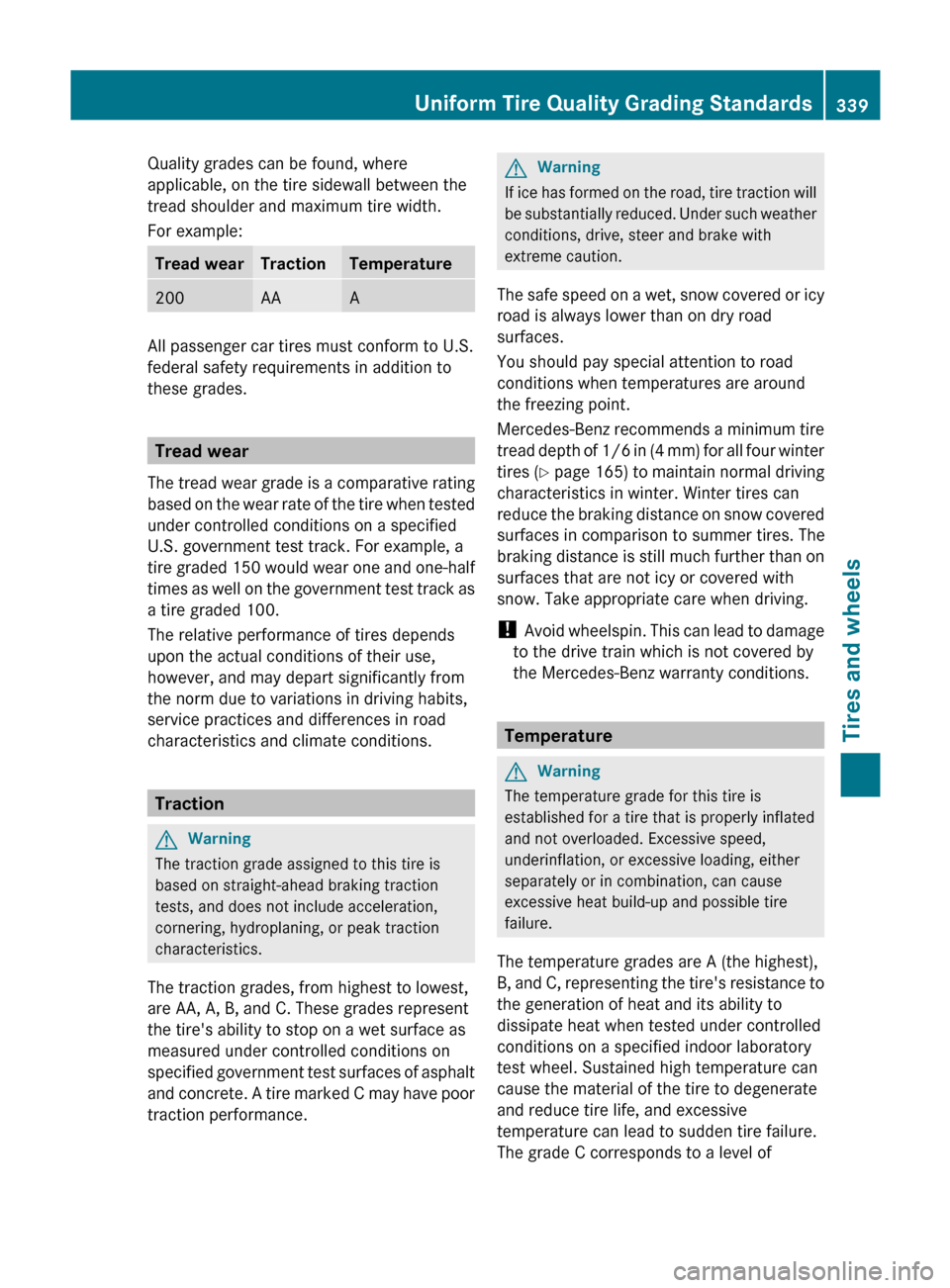
Quality grades can be found, where
applicable, on the tire sidewall between the
tread shoulder and maximum tire width.
For example:Tread wearTractionTemperature200AAA
All passenger car tires must conform to U.S.
federal safety requirements in addition to
these grades.
Tread wear
The tread wear grade is a comparative rating
based on the wear rate of the tire when tested
under controlled conditions on a specified
U.S. government test track. For example, a
tire graded 150 would wear one and one-half
times as well on the government test track as
a tire graded 100.
The relative performance of tires depends
upon the actual conditions of their use,
however, and may depart significantly from
the norm due to variations in driving habits,
service practices and differences in road
characteristics and climate conditions.
Traction
GWarning
The traction grade assigned to this tire is
based on straight-ahead braking traction
tests, and does not include acceleration,
cornering, hydroplaning, or peak traction
characteristics.
The traction grades, from highest to lowest,
are AA, A, B, and C. These grades represent
the tire's ability to stop on a wet surface as
measured under controlled conditions on
specified government test surfaces of asphalt
and concrete. A tire marked C may have poor
traction performance.
GWarning
If ice has formed on the road, tire traction will
be substantially reduced. Under such weather
conditions, drive, steer and brake with
extreme caution.
The safe speed on a wet, snow covered or icy
road is always lower than on dry road
surfaces.
You should pay special attention to road
conditions when temperatures are around
the freezing point.
Mercedes-Benz recommends a minimum tire
tread depth of 1/6 in (4 mm) for all four winter
tires ( Y page 165) to maintain normal driving
characteristics in winter. Winter tires can
reduce the braking distance on snow covered
surfaces in comparison to summer tires. The
braking distance is still much further than on
surfaces that are not icy or covered with
snow. Take appropriate care when driving.
! Avoid wheelspin. This can lead to damage
to the drive train which is not covered by
the Mercedes-Benz warranty conditions.
Temperature
GWarning
The temperature grade for this tire is
established for a tire that is properly inflated
and not overloaded. Excessive speed,
underinflation, or excessive loading, either
separately or in combination, can cause
excessive heat build-up and possible tire
failure.
The temperature grades are A (the highest),
B, and C, representing the tire's resistance to
the generation of heat and its ability to
dissipate heat when tested under controlled
conditions on a specified indoor laboratory
test wheel. Sustained high temperature can
cause the material of the tire to degenerate
and reduce tire life, and excessive
temperature can lead to sudden tire failure.
The grade C corresponds to a level of
Uniform Tire Quality Grading Standards339Tires and wheelsBA 164.1 USA, CA Edition B 2011; 1; 2, en-USd2mskotVersion: 3.0.3.52010-04-21T17:25:06+02:00 - Seite 339Z
Page 342 of 372

performance which all passenger car tires
must meet under the Federal Motor Vehicle
Safety Standard No. 109. Grades B and A
represent higher levels of performance on the
laboratory test wheel than the minimum
required by law.
Interchanging the wheels
GWarning
Rotate front and rear wheels only if the tires
are of the same dimension.
If your vehicle is equipped with mixed-size
tires (different tire dimensions front vs. rear),
tire rotation is not possible.
GWarning!
Have the tightening torque checked after
changing a wheel. The wheels could come
loose if they are not tightened to a torque of
110 lb-ft (150 Nm).
Only use genuine Mercedes-Benz wheel bolts
specified for your vehicle’s rims.
The wear patterns on the front and rear tires
differ, depending on the operating conditions.
Rotate the wheels before a clear wear pattern
has formed on the tires. Front tires typically
wear more on the shoulders and the rear tires
in the center.
If your vehicle's tire configuration allows, you
can rotate the wheels according to the
intervals in the tire manufacturer's warranty
book in your vehicle documents. If no
warranty book is available, the tires should be
rotated every 3000 to 6000 miles
(5000 to 10000 km), or earlier if tire wear
requires. Do not change the direction of
wheel rotation.
Clean the contact surfaces of the wheel and
the brake disc thoroughly every time a wheel
is rotated. Check the tire pressures.
Information on changing a wheel and
mounting the spare wheel ( Y page 305).
Tire labeling
Overview of tire labeling
The following markings are on the tire in
addition to the tire name (sales designation)
and the manufacturer's name:
:Uniform Tire Quality Grading Standard
( Y page 344);DOT, Tire Identification Number
( Y page 343)=Maximum tire load ( Y page 338)?Maximum tire pressure ( Y page 334)AManufacturerBTire material ( Y page 344)CTire size designation, load-bearing
capacity and speed index ( Y page 341)DLoad index ( Y page 343)ETire name
i
Tire data is vehicle-specific and may
deviate from the data in the example.
340Tire labelingTires and wheels
BA 164.1 USA, CA Edition B 2011; 1; 2, en-USd2mskotVersion: 3.0.3.52010-04-21T17:25:06+02:00 - Seite 340
Page 348 of 372

Maximum tire load
The maximum tire load in kilograms or
pounds is the maximum weight for which a
tire is approved.
Maximum permissible tire pressure
Maximum permissible tire pressure for one
tire.
Maximum load on one tire
Maximum load on one tire. This is calculated
by dividing the maximum axle load of one axle
by two.
PSI (pounds per square inch)
Standard unit of measurement for tire
pressure.
Aspect ratio
Relationship between tire height and tire
width in percent.
Tire pressure
Pressure inside the tire applying an outward
force to every square inch of the tire's
surface. The tire pressure is specified in
pounds per square inch (psi), in kilopascal
(kPa) or in bar. The tire pressure should only
be corrected when the tires are cold. For this,
the vehicle must have been stationary for at
least three hours or not have traveled more
than 1.6 km (1 mile) in this time.
Tire tread
The part of the tire that comes into contact
with the road.
Tire bead
The tire bead contains steel wire which is
bound by steel cords that hold the tire on the
wheel rim.
Sidewall
The part of the tire between the tread and the
tire bead.
Weight of optional extras
The combined weight of those optional extras
that weigh more than the replaced standard
part and more than 2.3 kilograms (5 lbs).
These optional extras, such as high-
performance brakes, level control, a roof rack
or a high-performance battery, are not
included in the unladen weight and the weight
of the accessories.
TIN (Tire Identification Number)
A unique identification number which can be
used by a tire manufacturer to identify tires,
for example for a product recall, and thus
identify the purchasers. The TIN is made up
of the manufacturer's identity code, tire size,
tire type code and the manufacturing date.
Load bearing index
The load bearing index (also load index) is a
code that contains the maximum load bearing
capacity of a tire.
Traction
Traction is the result of friction between the
tires and the road surface.
346Definitions for tires and loadingTires and wheels
BA 164.1 USA, CA Edition B 2011; 1; 2, en-USd2mskotVersion: 3.0.3.52010-04-21T17:25:06+02:00 - Seite 346
Page 349 of 372

TWR (permissible trailer drawbar
noseweight)
The TWR is the maximum permissible weight
that the ball coupling of the trailer tow hitch
can support.
Wear indicator
Narrow bars (tread wear bars) that are
distributed over the tire tread. If the tire tread
is level with the bars, the wear limit of 1
/ 16 in
(1.6 mm) has been reached.
Distribution of the vehicle occupants
Distribution of vehicle occupants over
designated seat positions in a vehicle.
Maximum permissible payload
weight
Nominal load and luggage load plus
68 kilograms (150 lb) multiplied by the
number of seats in the vehicle.
Wheel/tire combinations
Points to remember
GWarning
Observe the "Important safety information"
( Y page 324).
! For safety reasons, Mercedes-Benz
recommends that you only use tires,
wheels and accessories which have been
approved by Mercedes-Benz specifically
for your vehicle. These tires have been
specially adapted for use with the control
systems, such as ABS or ESP ®
, and are
marked as follows:
R MO = Mercedes-Benz Original
R MOE = Mercedes-Benz Original Extended
(tires with run-flat characteristics)
R MO1 = Mercedes-Benz Original (AMG)
Only use Mercedes-Benz Original Extended
tires on wheels that have been specifically
approved by Mercedes-Benz.
If you use other tires, wheels and
accessories, Mercedes-Benz cannot
accept any responsibility for damage that
may result from this. Further information
about tires, wheels and approved
combinations can be obtained from any
authorized Mercedes-Benz Center.
! If you mount tires other than those tested
and recommended by Mercedes-Benz,
characteristics such as handling, noise
levels and fuel consumption, etc. may be
adversely affected. In addition, when
driving with a load, tire dimensional
variations could cause the tires to come
into contact with the bodywork and axle
components. This could result in damage
to the tires or the vehicle.
i Further information about tires and
wheels can be obtained from any
authorized Mercedes-Benz Center.
i The Tire and Load Information placard
with the recommended tire pressures is
attached to the B-pillar on the driver's side.
Further information about driving at high
speeds or driving with vehicle loads that are
lighter than the maximum vehicle load can
be found in the tire pressure table on the
inside of the fuel filler flap. Check tire
pressures regularly, and only when the tires
are cold. Comply with the maintenance
recommendations of the tire manufacturer
in the vehicle document wallet.
Further information on the recommended tire
inflation pressure and on tire pressures for
specific driving conditions, see (Y page 326).
i Notes on the vehicle equipment:
R always mount tires of the same size on a
given axle (left/right).
R always mount the same type of tires on
your vehicle at a given time (summer
tires, winter tires, MOExtended tires).Wheel/tire combinations347Tires and wheelsBA 164.1 USA, CA Edition B 2011; 1; 2, en-USd2mskotVersion: 3.0.3.52010-04-21T17:25:06+02:00 - Seite 347Z
Page 365 of 372
overheating. In the Service Booklet, you can
find information on the intervals for renewal.
The renewal interval is determined by the
coolant type and the cooling system design.
The renewal interval in the Service Booklet is
only valid if the coolant is added or renewed
with Mercedes-Benz approved products.
Therefore, only use MB 326.0 antifreeze/
corrosion inhibitor or another Mercedes-Benz
approved product of the same specification.
Information on other Mercedes-Benz
approved products of the same specification
can be obtained at any authorized Mercedes-
Benz Center or on the Internet at
http://bevo.mercedes-benz.com .
The coolant is checked at every service date
at an authorized Mercedes-Benz Center.
The antifreeze/corrosion inhibitor
concentration in the cooling system should:
R be at least 50%. This will protect the cooling
system against freezing down to around
-35 ‡ (-37 †).
R not exceed 55% (antifreeze protection
down to -49 ‡ (-45 †); otherwise, heat will
not be dissipated as effectively.
If the coolant level is too low, MB 326.0
antifreeze/corrosion inhibitor should be
added. Have the cooling system checked for
leaks.
Windshield and headlamp cleaning
system
GWarning
Washer solvent/antifreeze is highly
flammable. Do not spill washer solvent/
antifreeze on hot engine parts, because it may
ignite and burn. You could be seriously
burned.
XUse MB Windshield Washer Concentrate
MB SummerFit.XAt temperatures above freezing: add 1
part MB SummerFit to 100 parts water, e.g.
1.34 fl oz (40 ml) MB SummerFit to 1 gal
(4.0 l) of water.XAt temperatures below freezing: add 1
part MB SummerFit to 100 parts washer
fluid, e.g. 1.34 fl oz (40 ml) MB SummerFit
to 1 gal (4.0 l) of water.
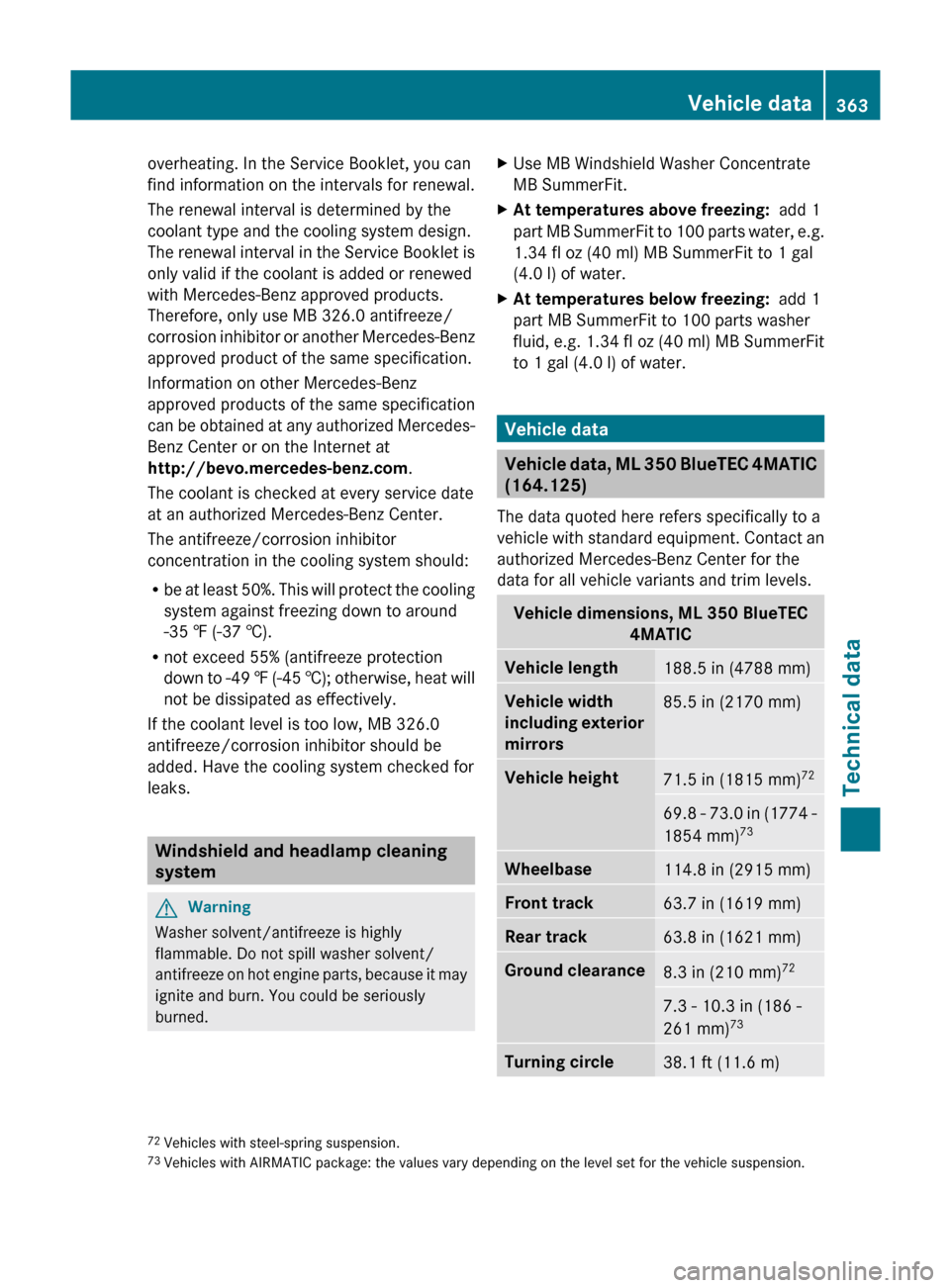
Vehicle data
Vehicle data, ML 350 BlueTEC 4MATIC
(164.125)
The data quoted here refers specifically to a
vehicle with standard equipment. Contact an
authorized Mercedes-Benz Center for the
data for all vehicle variants and trim levels.
Vehicle dimensions, ML 350 BlueTEC 4MATICVehicle length188.5 in (4788 mm)Vehicle width
including exterior
mirrors85.5 in (2170 mm)Vehicle height71.5 in (1815 mm) 7269.8 - 73.0 in (1774 -
1854 mm) 73Wheelbase114.8 in (2915 mm)Front track63.7 in (1619 mm)Rear track63.8 in (1621 mm)Ground clearance8.3 in (210 mm) 727.3 - 10.3 in (186 -
261 mm) 73Turning circle38.1 ft (11.6 m)72
Vehicles with steel-spring suspension.
73 Vehicles with AIRMATIC package: the values vary depending on the level set for the vehicle suspension.Vehicle data363Technical dataBA 164.1 USA, CA Edition B 2011; 1; 2, en-USd2mskotVersion: 3.0.3.52010-04-21T17:25:06+02:00 - Seite 363Z
Page 366 of 372
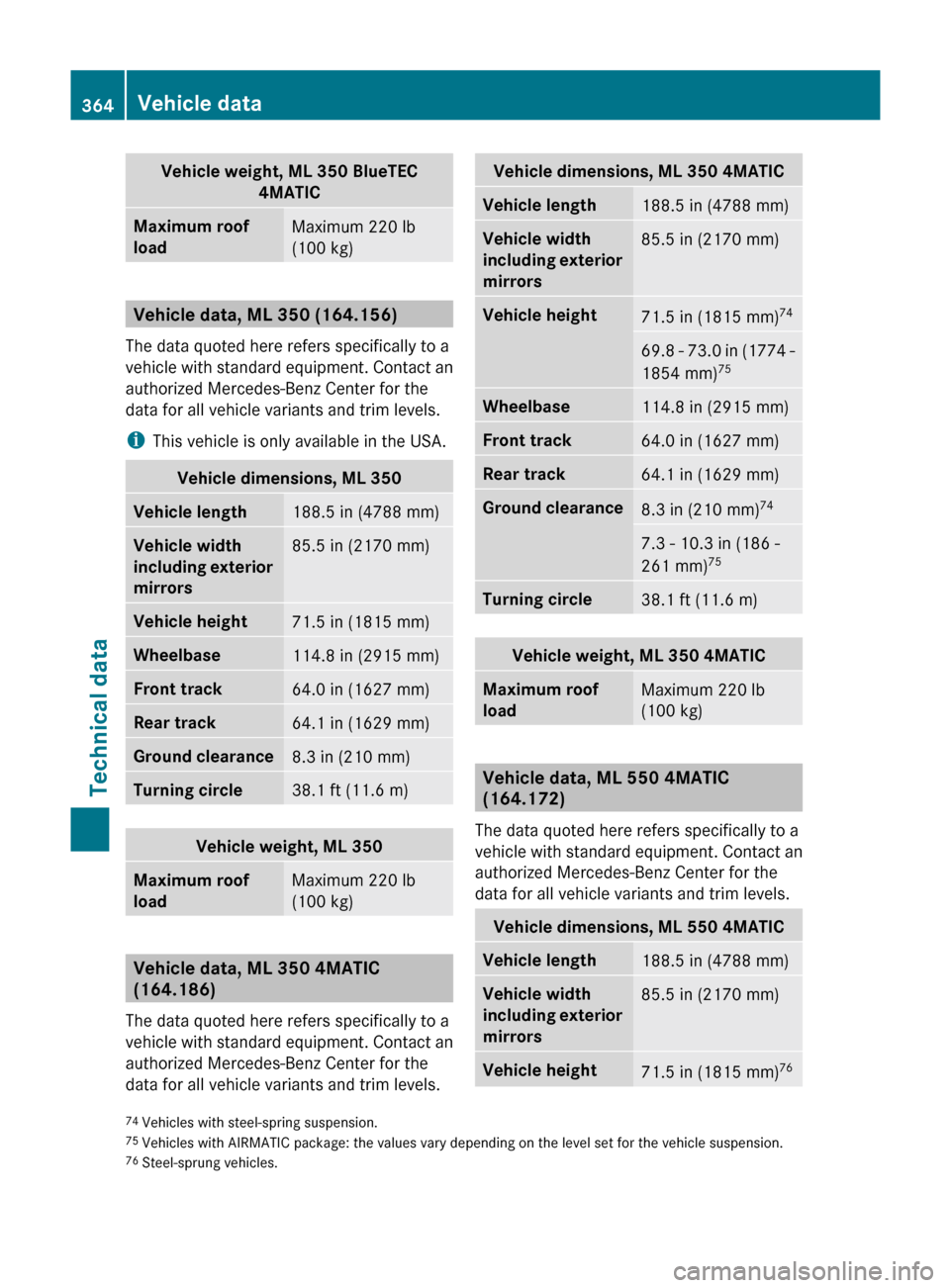
Vehicle weight, ML 350 BlueTEC4MATICMaximum roof
loadMaximum 220 lb
(100 kg)
Vehicle data, ML 350 (164.156)
The data quoted here refers specifically to a
vehicle with standard equipment. Contact an
authorized Mercedes-Benz Center for the
data for all vehicle variants and trim levels.
i This vehicle is only available in the USA.
Vehicle dimensions, ML 350Vehicle length188.5 in (4788 mm)Vehicle width
including exterior
mirrors85.5 in (2170 mm)Vehicle height71.5 in (1815 mm)Wheelbase114.8 in (2915 mm)Front track64.0 in (1627 mm)Rear track64.1 in (1629 mm)Ground clearance8.3 in (210 mm)Turning circle38.1 ft (11.6 m)Vehicle weight, ML 350Maximum roof
loadMaximum 220 lb
(100 kg)
Vehicle data, ML 350 4MATIC
(164.186)
The data quoted here refers specifically to a
vehicle with standard equipment. Contact an
authorized Mercedes-Benz Center for the
data for all vehicle variants and trim levels.
Vehicle dimensions, ML 350 4MATICVehicle length188.5 in (4788 mm)Vehicle width
including exterior
mirrors85.5 in (2170 mm)Vehicle height71.5 in (1815 mm) 7469.8 - 73.0 in (1774 -
1854 mm) 75Wheelbase114.8 in (2915 mm)Front track64.0 in (1627 mm)Rear track64.1 in (1629 mm)Ground clearance8.3 in (210 mm) 747.3 - 10.3 in (186 -
261 mm) 75Turning circle38.1 ft (11.6 m)Vehicle weight, ML 350 4MATICMaximum roof
loadMaximum 220 lb
(100 kg)
Vehicle data, ML 550 4MATIC
(164.172)
The data quoted here refers specifically to a
vehicle with standard equipment. Contact an
authorized Mercedes-Benz Center for the
data for all vehicle variants and trim levels.
Vehicle dimensions, ML 550 4MATICVehicle length188.5 in (4788 mm)Vehicle width
including exterior
mirrors85.5 in (2170 mm)Vehicle height71.5 in (1815 mm) 7674
Vehicles with steel-spring suspension.
75 Vehicles with AIRMATIC package: the values vary depending on the level set for the vehicle suspension.
76 Steel-sprung vehicles.364Vehicle dataTechnical data
BA 164.1 USA, CA Edition B 2011; 1; 2, en-USd2mskotVersion: 3.0.3.52010-04-21T17:25:06+02:00 - Seite 364
Page 367 of 372
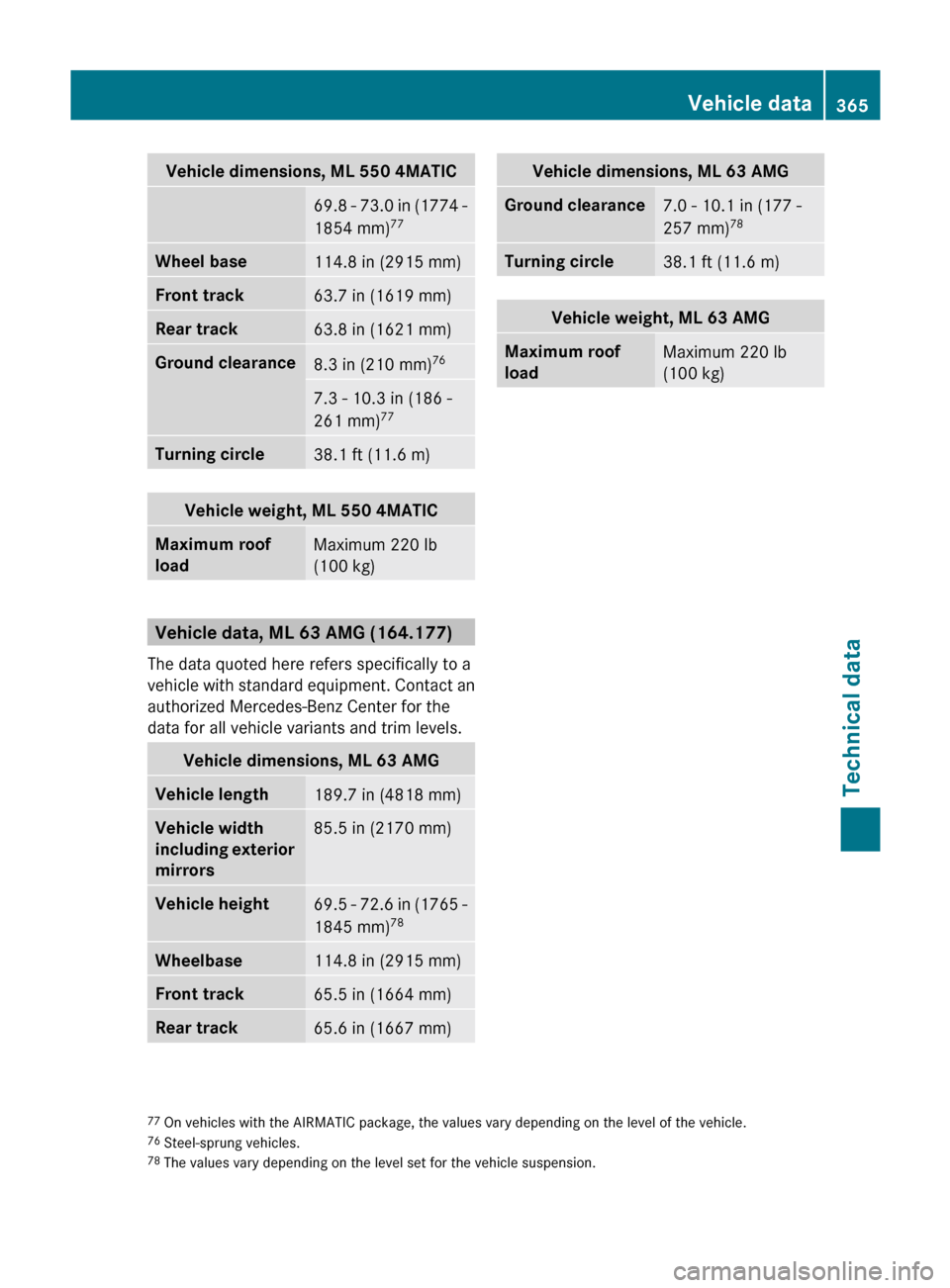
Vehicle dimensions, ML 550 4MATIC69.8 - 73.0 in (1774 -
1854 mm) 77Wheel base114.8 in (2915 mm)Front track63.7 in (1619 mm)Rear track63.8 in (1621 mm)Ground clearance8.3 in (210 mm) 767.3 - 10.3 in (186 -
261 mm) 77Turning circle38.1 ft (11.6 m)Vehicle weight, ML 550 4MATICMaximum roof
loadMaximum 220 lb
(100 kg)
Vehicle data, ML 63 AMG (164.177)
The data quoted here refers specifically to a
vehicle with standard equipment. Contact an
authorized Mercedes-Benz Center for the
data for all vehicle variants and trim levels.
Vehicle dimensions, ML 63 AMGVehicle length189.7 in (4818 mm)Vehicle width
including exterior
mirrors85.5 in (2170 mm)Vehicle height69.5 - 72.6 in (1765 -
1845 mm) 78Wheelbase114.8 in (2915 mm)Front track65.5 in (1664 mm)Rear track65.6 in (1667 mm)Vehicle dimensions, ML 63 AMGGround clearance7.0 - 10.1 in (177 -
257 mm) 78Turning circle38.1 ft (11.6 m)Vehicle weight, ML 63 AMGMaximum roof
loadMaximum 220 lb
(100 kg)77 On vehicles with the AIRMATIC package, the values vary depending on the level of the vehicle.
76 Steel-sprung vehicles.
78 The values vary depending on the level set for the vehicle suspension.Vehicle data365Technical dataBA 164.1 USA, CA Edition B 2011; 1; 2, en-USd2mskotVersion: 3.0.3.52010-04-21T17:25:06+02:00 - Seite 365Z