warning MERCEDES-BENZ METRIS 2016 MY16 Operator’s Manual
[x] Cancel search | Manufacturer: MERCEDES-BENZ, Model Year: 2016, Model line: METRIS, Model: MERCEDES-BENZ METRIS 2016Pages: 310, PDF Size: 7.28 MB
Page 30 of 310
Operating conditions:
Ravoid short trips as these increase fuel con-
sumption.
Ralways make sure that the tire pressures
are correct.
Rdo not carry any unnecessary weight.
Rremove roof racks once you no longer need
them.
Raregularly serviced vehicle will contribute
to environmental protection. You should
therefore adhere to the service intervals.
Ralways have service work carried out at a
qualified specialist workshop.
Personal driving style:
Rdo not depress the accelerator pedal when
starting the engine.
Rdo not warm up the engine when the vehicle
is stationary.
Rdrive carefully and maintain asafe distance
from the vehicle in front.
Ravoid frequent, sudden acceleration and
braking.
Rchange gear in good time and use each gear
only up to Ôof its maximum engine speed.
Rswitch off the engine in stationary traffic.
Rkeep an eye on the vehicle's fuel consump-
tion.
Environmental issues and recommen-
dations
When prompted by this Operator's Manual to
dispose of materials, please try to regenerate
and recycle these materials. Observe all rele-
vant environmental guidelines and regulations
when disposing of materials. This helps to pro-
tect the environment.
Operating safety and vehiclea pproval
Important safety notes
GWARNING
If you do not have the prescribed service/
maintenance work or any required repairs
carried out, this can result in malfunctions or system failures. There is arisk of an accident.
Alwaysh ave the prescribed service/mainte-
nance work as well as any required repairs
carried out at aqualified specialist workshop.
Air bags and pyrotechnic EmergencyT ensioning
Devices (ETDs) contain perchlorate material,
which may require special handling and regard
for the environment.T he guidelines must be
observed during disposal.
In California, you can find more information on
the Internet at www.dtsc.ca.gov.
Notes on operating the vehicle
There isarisk of damage to the vehicle if:
Rthe vehicle makes contact with the ground,
e.g. on ahigh curb or aloose road surface
Ryou drive too quickly over an obstacle, e.g. a
curb or apothole
Raheavy object hits the underbody or chassis
component
In these or similars ituations, the vehicle body/
frame, the underbody,c hassis components,
wheels or tires could be damaged even if this is
not visible from the outside. Components that
have been damaged in this way can unexpect-
edly fail or no longer be able to assimilate the
loads occurring in the event of an accident. If the underbody paneling is damaged,f lammable
material, such as leaves, grass or twigs, could
collect between the underbody and underbody
paneling. These materials could ignite if they
remain in contact with hot componentsoft he
exhaust system for an extended period.
GWARNING
Flammable material such as leaves, grass or
twigs may ignite if they come into contact with
hot parts of the exhaust system. There is arisk
of fire.
28Introduction
Page 31 of 310
When driving off road or on unpaved roads,
check the vehicle's underside regularly. In
particular, remove parts of plants or other
flammable materials which have become
trapped. In the case of damage, contact a
qualified specialist workshop.
Have the vehicle checked and repaired immedi-
ately at aqualified specialist workshop. If you
become aware when continuing the journey that
driving safety has been effected, stop as soon as
possible in accordance with the traffic condi-
tions .Insuch cases, consult aqualified special-
ist workshop.
Declaration of conformity
Radio-based vehicle components
USA: "The wireless devices of this vehicle com-
ply with Part 15 of the FCC Rules. Operation is
subject to the following two conditions: 1) These
devices may not cause harmful interference. 2.
This device must accept any interference
received, including interference that may cause
undesired operation. Changes or modifications
not expressly approved by the party responsible
for complianc ecould void the user’s authority to
operate the equipment."
Canada: "The wireless devices of this vehicle
comply with Industry Canada license-exempt
RSS standard(s). Operation is subject to the fol-
lowing two conditions: 1) These devices may not
cause interference, and 2) these devices must
accept any interference received, including
interference that may cause undesired opera-
tion of the device".
Diagnostics connection
The diagnostic sconnection is only intended for
the connection of diagnostic equipment at a
qualified specialist workshop.
GWARNING
If you connect equipment to the diagnostics
connection in the vehicle, it may affect the
operation of the vehicle systems. As aresult,
the operating safety of the vehicle could be
affected. There is arisk of an accident.
Do not connect any equipment to adiagnos-
tics connection in the vehicle.
Changing the engine power output
!
Increases in engine power can:
Rchange the emission values
Rcause malfunctions
Rcause consequential damage
The operating reliability of the engine is not
guaranteed in all cases.
An ytamperin gwith the engine management
system in order to increase the engine power
output will lead to the loss of the New Vehicle
Limited Warrant yand other warranty entitle-
ments.
If you sell the vehicle, inform the purchaser
about the changes to the engine power output of
the vehicle. If you do not inform the buyer, this
may constitut eapunishable offense under
national legislation.
Qualified specialist workshops
AM ercedes-Benz Commercial Van Center is a
qualified specialist workshop.
Aq ualified specialist workshop has the neces-
sary specialist knowledge, tools and qualifica-
tions to correctly carry out the work required on
the vehicle.
This is especially the case for work relevant to
safety. Observe the notes in the Maintenance or
ServiceB ooklet.
The following work should alwaysbec arried out
at qualified specialist workshop:
Rwork relevant to safety
Rservice and maintenance work
Rrepair work
Rmodifications as well as installations and
alterations
Rwork on electronic components
Mercedes-Benz recommends that you use a
Mercedes-Benz Commercial Van Center.
!Only have work carried out on the engine
electronics and its associated parts, such as
control units, sensors, actuatin gcomponents
and connecto rleads, at aqualified specialist
workshop. Vehicle componentsm ay other-
Introduction29
Z
Page 33 of 310
Please observe the information concerning
Mercedes-Benz Genuine Parts (Ypage 31).
You can obtain further information from any
Mercedes-Benz Commercial Van Center.
GWARNING
The function of systems or components can
be affected by conversions or modifications
to the vehicle. They might not function prop-
erly anymore and/or jeopardize the opera-
tional safety of the vehicle. There is an
increased risk of an accident and injury.
Conversion sormodification sshould always
be carried out at qualified specialist work-
shop.
If you inten dtomake modification stoyour vehi-
cle, we strongly recommend that you contact
the distributor named on the inside of the front
cover. There you will receive all the necessary
information and acharge may be levied.
You alone accept the responsibility if body man-
ufacturers or dealers make modification sthat
affect the final certification of the engine, the
vehicle or the equipment. This also applies to
the identification and documentation of modifi-
cation stothe affected vehicle components.
You are responsible for certification and confir-
mation that:
Rall the applicable standards and regulations
that are affected by the vehicle modification
are met
Rthe modified vehicle fulfills the vehicle safety standards and emissions laws and regula-
tions
Rthe modification sorinstallation of accesso-
ries does not affect the safety of the vehicle
We are not responsible for the final certification,
product liability or warranty claims which result
from the modifications. This applies to:
Rthe modified components ,assemblies or sys-
tems
Rany resulting noncompliance with any of the
emissions laws and regulations or the motor
vehicle safety standards
Rany consequences arising from the changes
that make the vehicle less safe or even render it defective
We do not assume responsibility as the final-
stage manufacturer or for the consequential
product liability.
Notes on the radiator
Even seemingly small changes to the vehicle,
such as attaching aradiator trim for winter driv-
ing, is not permitted. Do not cover up the radi-
ator. Do not use thermal mats, insect protection
covers or anything similar.
Otherwise, the values of the diagnostic system
may be affected. Some of these values are
legally prescribed and must alwaysbec orrect.
Genuine Mercedes-Benz parts
!
Air bags and Emergency TensioningD evi-
ces, as well as control units and sensors for
these restraint systems, may be installed in
the following areas of your vehicle:
Rdoors
Rdoor pillars
Rdoor sills
Rseats
Rcockpit
Rinstrument cluster
Rcenter console
Do not install accessories such as audio sys-
tems in these areas. Do not carry out repairs or welding. You could impair the operating
efficiency of the restraint systems.
Have aftermarket accessories installed at a
qualified specialist workshop.
HEnvironmenta lnote
We supply reconditioned assemblies and
parts which are of the same quality as new
parts. The same New Vehicle Limited War-
rantya pplies as for new parts.
The operating safety of the vehicle could be
jeopardized if you use parts, tires and wheels as
well as accessories relevant to safety which
have not been approved by Mercedes-Benz.T his
could lead to malfunctions in safety-relevant
systems, e.g. the brake system. Only use genu-
ine Mercedes-Benz parts or parts of equal qual-
ity. Only use tires, wheels and accessories that
have been specifically approved for your vehi-
cle.
Introduction31
Z
Page 36 of 310
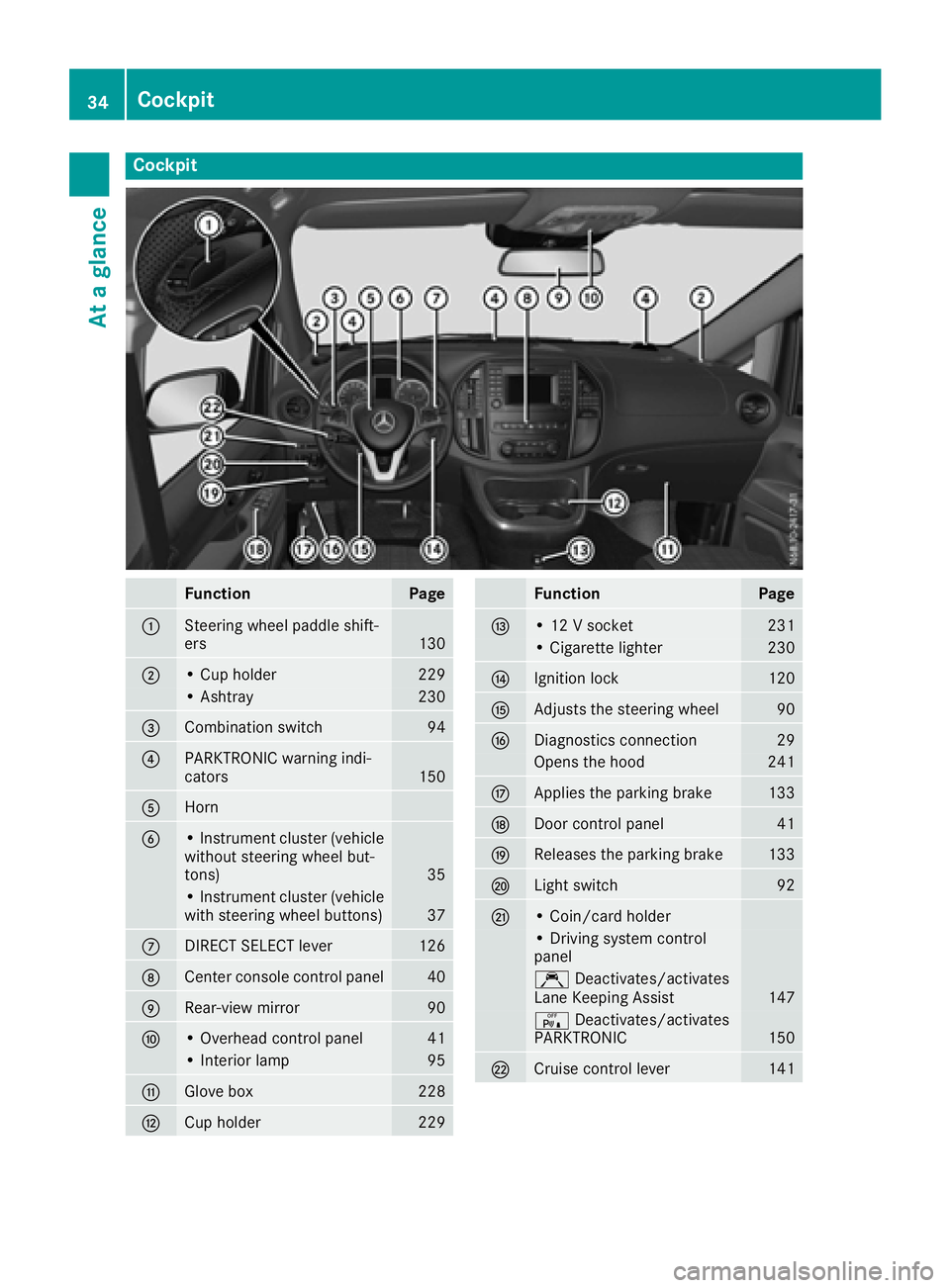
Cockpit
FunctionPage
:Steering wheel paddle shift-
ers130
;•Cup holder229
•Ashtr ay230
=Combination switch94
?PARKTRONIC warning indi-
cators150
AHorn
B•Instr umentc luster(vehicle
without steering wheel but-
tons)
35
•I nstr umentc luster(vehicle
withs teering wheel buttons)37
CDIRECT SELECT lever126
DCente rconsole control panel40
ERear-view mirror90
F•O verhead control panel41
•Inter ior lamp95
GGlove box228
HCup holder229
FunctionPage
I•12Vs ocket231
•Cigarett elighter230
JIgnition lock120
KAdjusts th esteering wheel90
LDiagnostics connection29
Openst hehood241
MApplies th eparking brake133
NDoor control panel41
OReleasest heparking brake133
PLights witch92
Q•Coin/card holder
•D rivin gs ystem control
panel
Ç Deactivates/activates
LaneK eeping Assist147
cDeactivates/activates
PARKTRONIC150
RCruis econtrol lever141
34Cockpit
At ag lance
Page 38 of 310
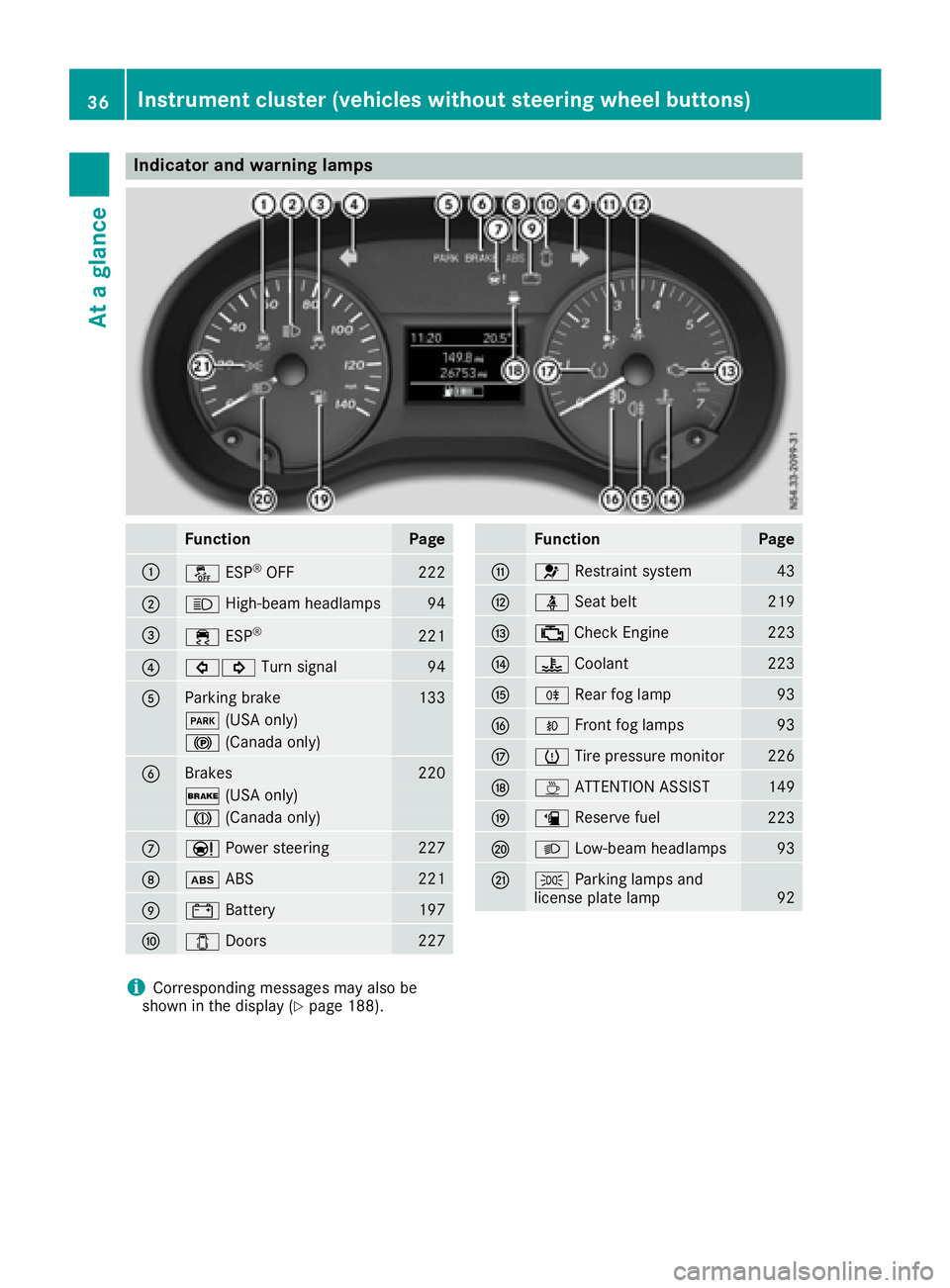
Indicator and warning lamps
FunctionPage
:å ESP®OF F222
;K High-beam headlamps94
=÷ESP®22 1
?#! Turn signal94
AParking brak e133
F (USAonly)
! (Canada only)
BBrakes220
$ (USAonly)
J (Canada only)
CÐPowersteering22 7
Dò ABS221
E# Battery197
F1 Doors227
FunctionPag e
G6 Restrain tsystem43
Hü Seat belt219
I; CheckEngine22 3
J? Coolan t223
KR Rear fog lamp93
LOFrontfog lamp s93
MhTirep ressur emonitor226
NÀ ATTENTION ASSIST149
Oæ Reserve fuel223
PL Low-beam headlamps93
QTParking lamp sand
license plat elamp92
iCorresponding message smay also be
shown in th edisplay (Ypage 188).
36Instrumen tcluster (vehicles without steering wheel buttons)
At ag lance
Page 40 of 310
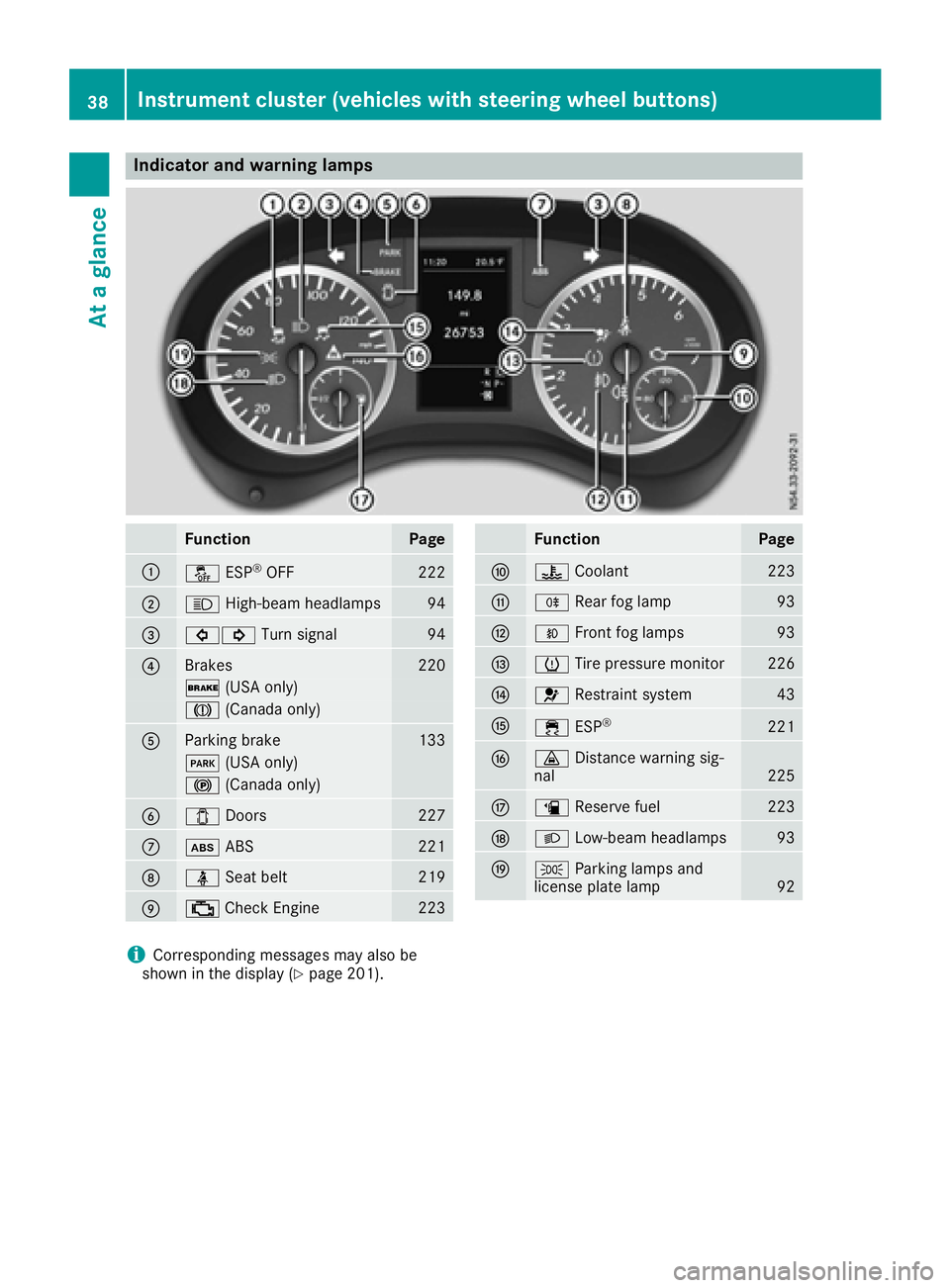
Indicator and warning lamps
FunctionPage
:å ESP®OF F222
;K High-beam headlamps94
=#! Turn signal94
?Brakes220
$ (USAonly)
J (Canada only)
AParking brak e133
F (USAonly)
! (Canada only)
B1Doors227
Cò ABS221
Dü Seat belt219
E; CheckEngine22 3
FunctionPag e
F? Coolan t223
GR Rear fog lamp93
HOFrontfog lamp s93
IhTirep ressur emonitor226
J6 Restrain tsystem43
K÷ ESP®22 1
L· Distanc ewarning sig-
nal22 5
Mæ Reserve fuel223
NL Low-beam headlamps93
OTParking lamp sand
license plat elamp92
iCorresponding message smay also be
shown in th edisplay (Ypage 201).
38Instrumen tcluster (vehicles with steering wheel buttons)
At ag lance
Page 45 of 310
Useful information
This Operator's Manual describes all models as
well as standard and optional equipment of your
vehicle that were available at the time of going
to print.Country-specific variation sare possi-
ble. Note that your vehicle may not be equipped
with all of the described functions. This also
applies to system sand function srelevantt o
safety.
Read the information on qualified specialist
workshops (
Ypage 29).
Occupant safety
Restraint system introduction
The restraint system can reduce the risk of vehi- cle occupants comingi ntoc ontact with parts of
the vehicle' sinterior in the eventofana ccident.
Furthermore, the restraint system may also
reduce the forces exerted on the vehicle occu-
pant swhen an acciden toccurs.
The restraint system includes:
RSeat belt system
RAir bags
RChild restraint system
RChild seat securings ystem
The components of the restraint system work in
conjunction with each other .They can only offer
the intended level of protection if all vehicle
occupants:
Rare correctly wearing their seat belts.
(Ypage 45)
Radjust their seat and head restraint properly
(Ypage 83).
The driver is also responsible for ensurin gthat
the steering wheel has been correctly posi-
tioned. Observet he information relatin gtothe
correct driver'ss eat position (
Ypage 83).
Always ensure the air bag can inflat eproperly if
deployed (
Ypage 48).
An air bag supplement sacorrectly fastened
seat belt. As an additional safetyd evice, the air
bag increases the level of protection for vehicle
occupants in the eventofana ccident. For exam-
ple, if the protection already provided by acor-
rectly fastened seat belt will suffice, the air bags
are not deployed. Furthermore, only the air bags
that would increase the degree of protection
afforded to the vehicle occupants in the evento fan acciden
tare deployed. Seat belts and air
bags generally do not protect against objects
penetratin gthe vehicle from the outside.
Information on restraint system operatio ncan
be found under "TriggeringofE mergencyTen-
sionin gDevices and air bags" (
Ypage 54).
See “Children in the vehicle” for information on children traveling with you as well as vehicle
restraint system s(
Ypage 56).
Important safetyn otes
GWARNING
If the restraint system is modified, it may no
longer work as intended. The restraint system
may then not performi ts intended protective
function by failing in an acciden tortriggering
unexpectedly, for example. There is an
increased risk of injury, possibly even fatal.
Never modify parts of the restraint system .Do
not attempt to modify the wiring as well as
electronic components or their software.
If it is necessary to modify an air bag system to
accommodate aperson with disabilities, con-
tact aMercedes-Benz Commercial Van Cen-
ter for details. USA only: contact our
Mercedes-Benz Customer Assistance Center
at 1-877-762-8267 for details.
Restraint system warning lamp
The restraint system sfunction sare checked
after the ignition is switched on and at regular
intervals when the engin eisrunning. This allows
malfunction stobedetected in good time.
The 6 restraint system warnin glamp in the
instrumentc luster lights up when the ignition is
switched on. It goes out no later than afew sec-
onds after the vehicle is started. The compo-
nents of the restraint system are on standby.
Am alfunction has occurred if the 6restraint
system warnin glamp:
Rdoes not light up after the ignition is switched
on.
Rdoes not go out after afew seconds when the
engin eisrunning.
Rlights up again when the engin eisrunning.
Occupant safety43
Safety
Z
Page 46 of 310
GWARNING
If restraint system is malfunctioning, restraint
system components may be triggere dunin-
tentionall yormight not be triggere datall in
the event of an accident with ahigh rate of
vehicled eceleration. This can affect the Emer-
gency Tensioning Device or air bag ,for exam-
ple.T his poses an increased risk of injury or
even fatal injury.
Have the restraint system checked and
repaired in aqualified specialist worksho pas
soon as possible.
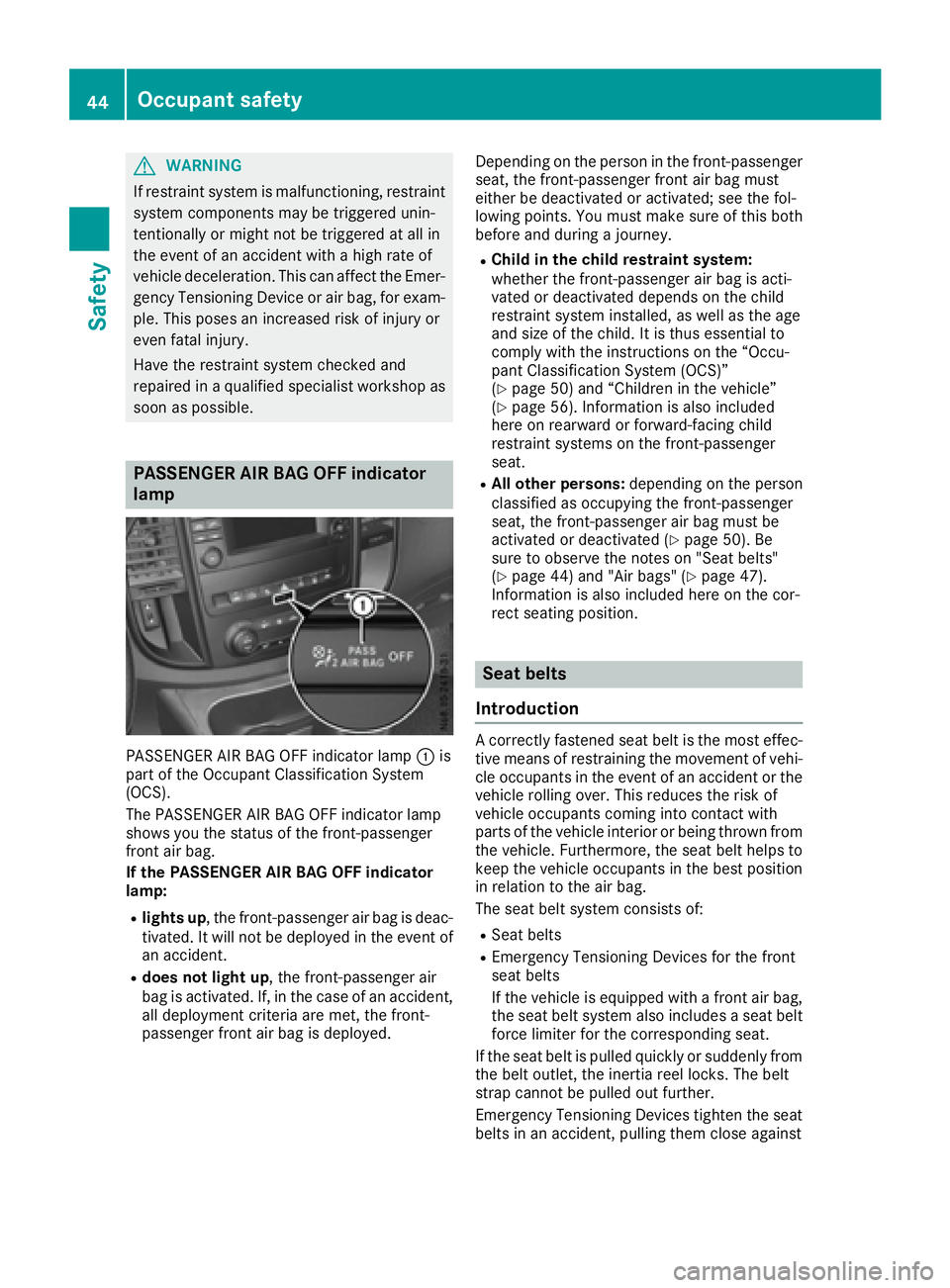
PASSENGER AI RBAG OFF indicator
lamp
PASSENGER AIR BAG OFF indicator lamp :is
part of the Occupant Classification System
(OCS).
The PASSENGER AIR BAG OFF indicator lamp
showsy ou the status of the front-passenger
front air bag.
If the PASSENGER AI RBAG OFF indicator
lamp:
Rlights up,t he front-passenge rair bag is deac-
tivated. It wil lnot be deploye dinthe event of
an accident.
Rdoes not light up,t he front-passengerair
bag is activated. If, in the case of an accident,
all deployment criteria are met, the front-
passenger front air bag is deployed. Depending on the personint
he front-passenger
seat, the front-passenge rfront air bag must
either be deactivated or activated; see the fol-
lowing points. You must make sure of this both
before and during ajourney.
RChil dint he chil drestraint system:
whethe rthe front-passenge rair bag is acti-
vated or deactivated depends on the child
restraint system installed, as wel lasthe age
and size of the child .Itisthus essentialt o
comply with the instructions on the “Occu-
pant Classification System (OCS)”
(
Ypag e50) and “Childre ninthe vehicle”
(Ypag e56). Information is als oincluded
here on rearward or forward-facing child
restraint systems on the front-passenger
seat.
RAll other persons: depending on the person
classifie dasoccupying the front-passenger
seat, the front-passenge rair bag must be
activated or deactivated (
Ypag e50). Be
sure to observe the notes on "Sea tbelts"
(
Ypag e44) and "Air bags" (Ypag e47).
Information is als oincluded here on the cor-
rect seating position.
Seat belts
Introduction
Ac orrectly fastened seat beltist he most effec-
tive means of restraining the movement of vehi- cle occupants in the event of an accident or the
vehicler olling over. This reduces the risk of
vehicleo ccupants coming into contact with
parts of the vehiclei nterior or being thrown from
the vehicle. Furthermore ,the seat belth elpsto
keep the vehicleo ccupants in the best position
in relation to the air bag.
The seat belts ystem consists of:
RSeat belts
REmergency Tensioning Devices for the front
seat belts
If the vehicleise quipped withafront air bag,
the seat belts ystem alsoincludes aseat belt
force limiter for the corresponding seat.
If the seat beltisp ulled quickly or suddenly from
the belto utlet, the inertia reel locks. The belt
strap cannot be pulled out further.
Emergency Tensioning Devices tighten the seat belts in an accident, pulling them close against
44Occupant safety
Safety
Page 47 of 310
the occupant's body.The ydon ot, however, pull
vehicl eoccupants back towards the backrest.
Emergency Tensioning Devices do not correct
an incorrect seat positio norincorrectly worn
seat belts.
When triggered ,the seat belt force limiter
reduce sthe force exerted by the seat belt on the
vehicl eoccupant.
The seat belt force limiters for the front seats are
synchronize dwitht he front ai rbags, which
absor bpartoft he deceleratio nforce. This
makes it possibl etoreduce the forces to which
vehicl eoccupants ar esubjected durin ganacci-
dent.
!If the front-passenge rseatisu noccupied,
do not insert the belt tongue into the buckle of
the front-passenge rseat. Thi smayotherwise
lead to the triggerin gofthe Emergency Ten-
sioning Device in the event of an accident,
which will thenn eedtober eplaced.
Important safety notes
GWARNING
If the seat belt is incorrectly fastened ,itcan-
not protect as intended. Furthermore, an
incorrectly fastened seat belt can cause addi-
tional injury,f or example, in an accident, dur-
ing braking or when abruptl ychanging direc-
tion. Thi sposes an increasedr iskofi njury or
eve nfatal injury.
Make sure thata llvehicl eoccupants are
seate dproperly with acorrectl yfas tened seat
belt.
GWARNING
The seat belt does not offer the intende dlev el
of protection if yo uhaven ot moved the back-
res ttoana lmostvertica lposit ion. When brak-
ing or in the event of an accident, yo ucould
slid eunderneath the seat belt and sustain
abdomen or neck injuries, for example. This
posesani ncreasedr iskofi njury or eve nfatal
injury.
Adjust the seat properly befor ebeginning
your journey .Alway sensur ethatt he backrest
is in an almos tvertica lposit iona nd thatt he
shoulde rsectio nofy ours eatb eltisr outed
across the cente rofyours houlder. If
ac hild younger thant welve yearsoldand
under 5ft(1.50 m) in height is traveling in the
vehicle:
Ralways secur ethe child in achild restraint
systems uitabl efor thisM ercedes-Benz vehi-
cle .The child restraint systemm ustbea ppro-
priate to the age, weight and size of the child
Ralways observe the instructions and safety
note sint he "Children in the vehicle" section
of thisO perator' sManual(
Ypage 56 )in
additio ntothe child restraint systemm anu-
facturer' sinstallatio ninstructions
Rbe sure to observe the instructions and safety
note sont he "Occupant classification system
( O
CS) "(Ypage 50)
GWARNING
The seat belts mayn ot perform their intended
protective functio nif:
Rtheya redamaged, modified ,extremely
dirty,b leachord yed
Rthe seat belt buckle is damage dor
extremel ydirty
Rthe Emergency Tensioning Devices ,belt
anchorage sorinertia reels have been modi-
fied
Sea tbelts mays ustain non-visibl edamag ein
an accident, e.g .due to glas ssplint ers.Modi-
fie dord amaged seat belts mayt earorf ail,
e.g .inana ccident. Modified Emergency Ten-
sioning Devices could accidentall ytrigge ror
fail to deploy when necessary.T hisp oses an
increasedr iskofi njury or eve nfatal injury.
Never modify the seat belts ,Emergency Ten-
sioning Devices ,belta nchorage sorinertia
reels .Makes uret hatt he seat belts are
undamaged ,not worn ou tand clean. Follow-
ing an accident, have the seat belts checked
immediatel yataqualified specialis twork-
shop.
Onlyu seseat belts thath aveb eena pproved for
your vehicl ebyMercedes-Benz.
Proper use of the seat belts
Pa ya ttentio ntothe safety note sabout the seat
belt (Ypage 45).
Occupant safety45
Safety
Z
Page 49 of 310
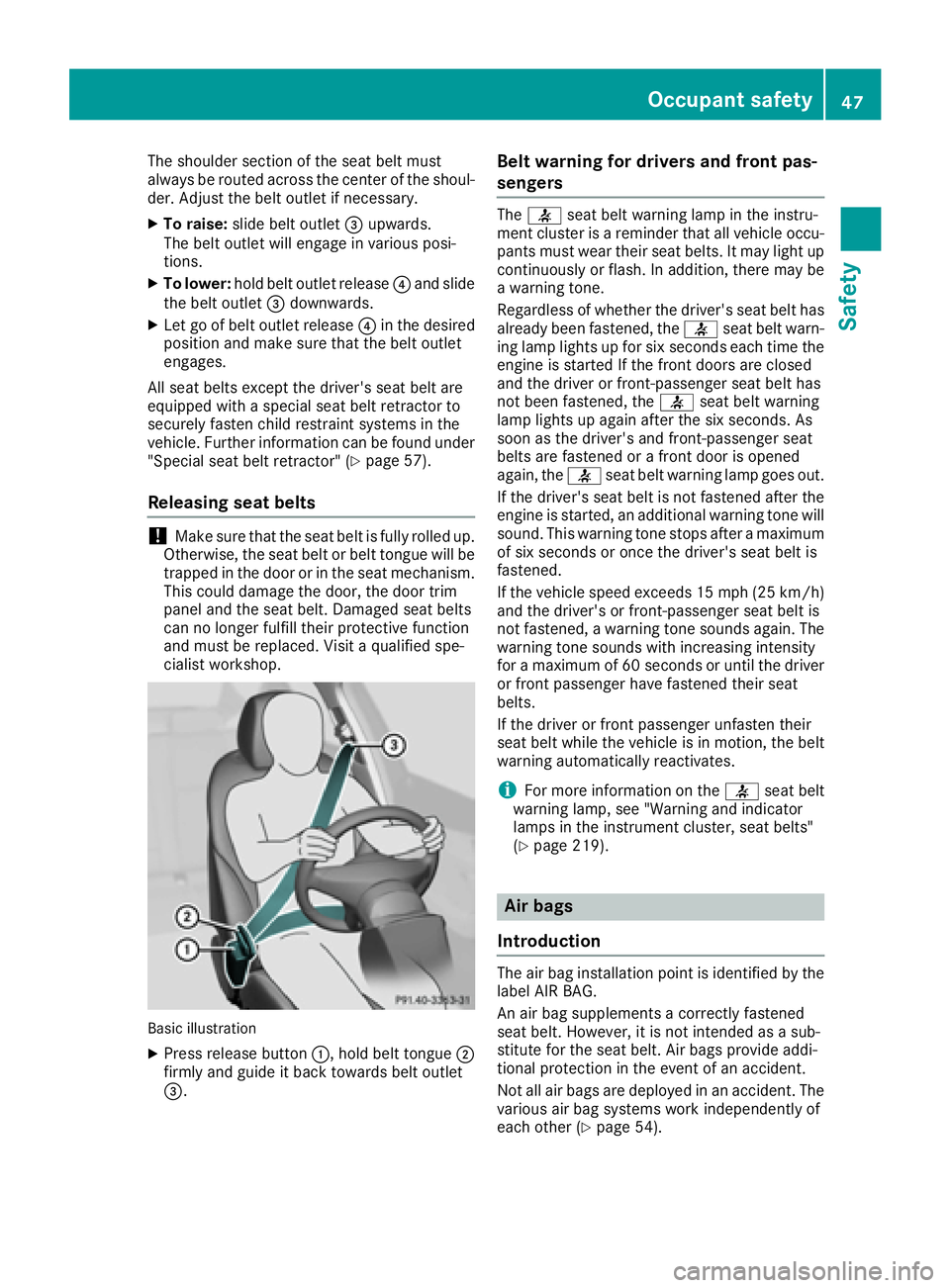
The shoulder section of the seat belt must
alwaysberouted across the center of the shoul-
der. Adjust the belt outlet if necessary.
XTo raise: slide belt outlet =upwards.
The belt outlet will engage in various posi-
tions.
XTo lower: hold belt outlet release ?and slide
the belt outlet =downwards.
XLet go of belt outlet release ?in the desired
position and make sure that the belt outlet
engages.
All seat belts except the driver's seat belt are
equipped with aspecial seat belt retractor to
securely fasten child restraint systems in the
vehicle. Further information can be found under
"Special seat belt retractor" (
Ypage 57).
Releasing seat belts
!Make sure that the seat belt is fully rolled up.
Otherwise, the seat belt or belt tongue will be
trapped in the door or in the seat mechanism.
This could damage the door, the door trim
panel and the seat belt. Damaged seat belts
can no longer fulfill their protective function
and must be replaced. Visit aqualified spe-
cialist workshop.
Basic illustration
XPress release button :,hold belt tongue ;
firmly and guide it back towards belt outlet
=.
Belt warning for driver sand front pas-
sengers
The 7 seat belt warning lamp in the instru-
ment cluster is areminder that all vehicle occu-
pants must wear their seat belts. It may light up
continuously or flash. In addition, there may be
aw arning tone.
Regardless of whether the driver's seat belt has
already been fastened, the 7seat belt warn-
ing lamp lights up for six seconds each time the engine is started If the front doors are closed
and the driver or front-passenger seat belt has
not been fastened, the 7seat belt warning
lamp lights up again after the six seconds. As
soon as the driver's and front-passenger seat
belts are fastened or afront door is opened
again, the 7seat belt warning lamp goes out.
If the driver's seat belt is not fastened after the
engine is started, an additional warning ton ewill
sound. This warning ton estops after amaximum
of six seconds or once the driver's seat belt is
fastened.
If the vehicle speed exceeds 15 mph (2 5km/ h)
and th edriver'sorf ront-passenger seat belt is
no tfastened, awarning tone sounds again.T he
warning tone sounds with increasing intensity
for am aximum of 60 seconds or until th edriver
or frontp assenger have fastene dtheir seat
belts.
If th edriver or frontp assenger unfasten their
seat belt while th evehicle is in motion,t hebelt
warning automatically reactivates.
iFor morei nformationonthe7 seat belt
warning lamp, see "Warning and indicator
lamps in th einstrumentc luster, seat belts"
(
Ypage 219).
Air bags
Introduction
The air bag installatio npointisi dentified by the
label AI RBAG.
An air bag supplements acorrectly fastened
seat belt.H owever,itisnotintended as asub-
stitut efor th eseat belt.A ir bags provide addi-
tional protection in th eeven tofana ccident.
Not all air bags are deployed in an accident. The
various air bag systems work independently of
each other (
Ypage 54).
Occupant safety47
Safety
Z