brake MERCEDES-BENZ METRIS 2020 MY20 Operator’s Manual
[x] Cancel search | Manufacturer: MERCEDES-BENZ, Model Year: 2020, Model line: METRIS, Model: MERCEDES-BENZ METRIS 2020Pages: 320, PDF Size: 26.38 MB
Page 276 of 320
X
Push contact protection cover : of the
jump-starting connection point backwards
against the spring force as far as it will go.
The jump-starting connection point is visi-
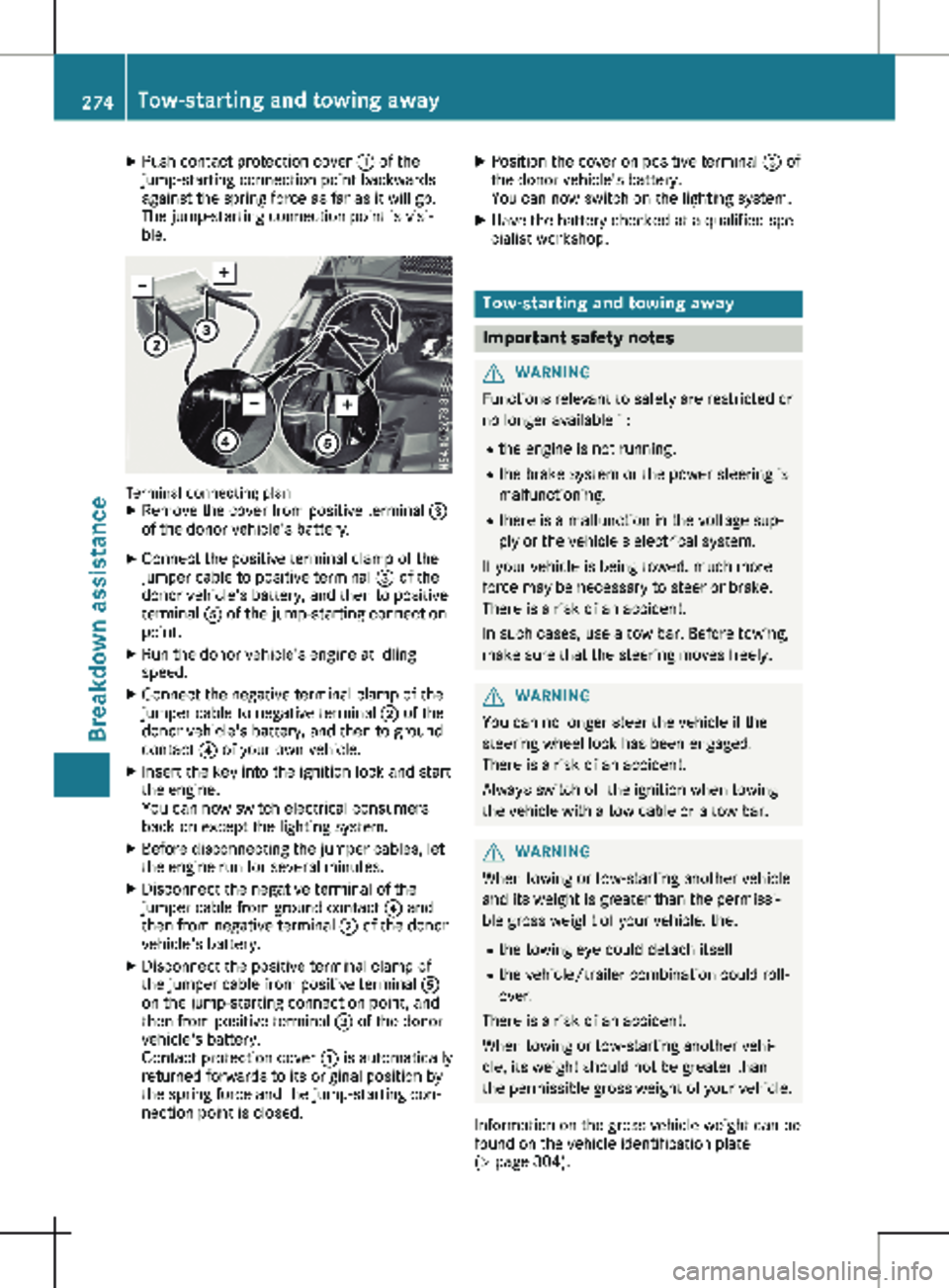
ble. Terminal connecting plan
X Remove the cover from positive terminal =
of the donor vehicle's battery.
X Connect the positive terminal clamp of the
jumper cable to positive terminal = of the
donor vehicle's battery, and then to positive
terminal A of the jump-starting connection
point.
X Run the donor vehicle's engine at idling
speed.
X Connect the negative terminal clamp of the
jumper cable to negative terminal ; of the
donor vehicle's battery, and then to ground
contact ? of your own vehicle.
X Insert the key into the ignition lock and start
the engine.
You can now switch electrical consumers
back on except the lighting system.
X Before disconnecting the jumper cables, let
the engine run for several minutes.
X Disconnect the negative terminal of the
jumper cable from ground contact ? and
then from negative terminal ; of the donor
vehicle's battery.
X Disconnect the positive terminal clamp of
the jumper cable from positive terminal A
on the jump-starting connection point, and
then from positive terminal = of the donor
vehicle's battery.
Contact protection cover : is automatically
returned forwards to its original position by
the spring force and the jump-starting con-
nection point is closed. X
Position the cover on positive terminal = of
the donor vehicle's battery.
You can now switch on the lighting system.
X Have the battery checked at a qualified spe-
cialist workshop. Tow-starting and towing away
Important safety notes
G
WARNING
Functions relevant to safety are restricted or
no longer available if:
R the engine is not running.
R the brake system or the power steering is
malfunctioning.
R there is a malfunction in the voltage sup-
ply or the vehicle's electrical system.
If your vehicle is being towed, much more
force may be necessary to steer or brake.
There is a risk of an accident.
In such cases, use a tow bar. Before towing,
make sure that the steering moves freely. G
WARNING
You can no longer steer the vehicle if the
steering wheel lock has been engaged.
There is a risk of an accident.
Always switch off the ignition when towing
the vehicle with a tow cable or a tow bar. G
WARNING
When towing or tow-starting another vehicle
and its weight is greater than the permissi-
ble gross weight of your vehicle, the:
R the towing eye could detach itself
R the vehicle/trailer combination could roll-
over.
There is a risk of an accident.
When towing or tow-starting another vehi-
cle, its weight should not be greater than
the permissible gross weight of your vehicle.
Information on the gross vehicle weight can be
found on the vehicle identification plate
(Y page
304).274
Tow-starting and towing away
Breakdown assistance
Page 278 of 320
X
Unscrew the towing eye.
X Insert cover : with the lug at the top and
press it in at the bottom until it engages.
X Stow the towing eye and the screwdriver
with the vehicle tool kit (Y page
270).Towing with the rear axle raised
! Vehicles with automatic transmission must
not be towed with the rear axle raised. The
vehicle/trailer combination may otherwise
swerve or even roll over.
! The ignition must be switched off if the
vehicle is being towed with the front or rear
axle raised. Otherwise, ESP ®
may intervene
and damage the brake system.
X Switch on the hazard warning lamps
(Y page
101).
X Turn the front wheels to the straight-ahead
position.
X Release the parking brake.
X If necessary, turn the key in the ignition lock
to position g and remove the key from the
ignition lock.
X Take the key with you when leaving the vehi-
cle.
X Do not exceed the towing speed of 30 mph
(50 km/h
).
Please observe the important safety instruc-
tions when towing your vehicle with the rear
axle raised
(Y page 274). Towing the vehicle with both axles
on the ground
Important safety notes G
WARNING
You can no longer steer the vehicle if the
steering wheel lock has been engaged.
There is a risk of an accident.
Always switch off the ignition when towing
the vehicle with a tow cable or a tow bar.
! Do not exceed the towing speed of
30 mph
(50 km/h). You could otherwise
damage the transmission. Please observe the important safety notes
before towing your vehicle
(Y page 274).
Towing vehicles with automatic trans-
mission X
Turn the key to position 2 in the ignition
lock.
X Depress the brake pedal and keep it
depressed.
X Shift the automatic transmission to position
i.
X Leave the key in position 2 in the ignition
lock.
X Switch on the hazard warning lamps
(Y page
101).
X Release the parking brake.
X Release the brake pedal.
X Do not exceed the towing speed of 30 mph
(50 km/h
). Recovering a vehicle that is stuck
! When recovering a vehicle that has
become stuck, pull it as smoothly and
evenly as possible. If the tractive power is
too high, the vehicles could be damaged.
If the drive wheels get trapped on loose or
muddy ground, recover the vehicle with the
utmost care. This is especially the case if the
vehicle is laden.
Never attempt to recover a vehicle with a
trailer attached.
Pull out the vehicle backwards, if possible,
using the tracks it made when it became
stuck. Transporting the vehicle
! You may only secure the vehicle by the
wheels, not by parts of the vehicle such as
axle or steering components. Otherwise, the
vehicle could be damaged.
The towing eye or trailer tow hitch can be used
to pull the vehicle onto a trailer or transporter
if you wish to transport it. 276
Tow-starting and towing away
Breakdown assistance
Page 279 of 320
X
Turn the key to position 2 in the ignition
lock.
X Shift the transmission to position i.
X Release the parking brake.
If the vehicle is loaded: X Shift the transmission to position j.
X Turn the key to position u in the ignition
lock and remove it.
X Make sure the parking brake is applied.
X Lash down the vehicle. Tow-starting (emergency engine
starting)
General notes !
Vehicles with automatic transmission must
not be tow-started. You could otherwise
damage the automatic transmission.
You can find information on jump-starting
under "Jump-starting“
(Y page 272).Electrical fuses
The fuse allocation chart and important safety
information on the fuses can be found in the
"Fuse allocation chart" supplement. Electrical fuses
277
Breakdown assistance Z
Page 280 of 320
Useful information
This Operator's Manual describes all models
as well as standard and optional equipment of
your vehicle that were available at the time of
going to print. Country-specific variations are
possible. Note that your vehicle may not be
equipped with all of the described functions.
This also applies to systems and functions rel-
evant to safety.
Read the information on qualified specialist
workshops (Y page
32).Important safety notes
G
Warning
A flat tire severely impairs the driving, steer-
ing and braking characteristics of the vehi-
cle. There is a risk of an accident.
do not drive with a flat tire. Immediately
replace the flat tire with your spare wheel,
or consult a qualified specialist workshop. G
WARNING
If you install wheels and tires with incorrect
dimensions, the service brake or wheel sus-
pension components may be damaged.
There is a risk of an accident.
Always replace wheels and tires with ones
that comply with the specifications of the
original part.
When replacing wheels, pay attention to the:
R Designation
R Model
When replacing tires, pay attention to the:
R Designation
R Manufacturer
R Model
Accessories that are not approved for your
vehicle by Mercedes-Benz or are not being
used correctly can impair operating safety. Before purchasing and using non-approved
accessories, visit a qualified specialist work-
shop and inquire about the following points:
R
suitability
R legal stipulations
R factory recommendations
Information on the dimensions and types of
wheels and tires for your vehicle can be found
under "Wheel and tire combinations"
( Y page
301).
Information on your vehicle's tire pressures
can be found in the following locations:
R in the Tire and Loading Information placard
on the B-pillar, driver's side
R in the tire pressure table inside the fuel filler
flap ( Y page 282)
R under "Tire pressure tables" (Y page 289)
R under "Tire pressure" (Y page 282)
Modifications to the brake system or wheels
are not permitted. The use of spacers or brake
dust shields is not permitted. This invalidates
the general operating permit for the vehicle.
Further information on wheels and tires can be
obtained at any qualified specialist workshop. Operation
Information for a journey
If the vehicle is heavily laden, check the tire
pressures, and correct them, if necessary
( Y page
282).
While driving, pay attention to vibrations,
noises and unusual handling characteristics,
e.g. pulling to one side. This may indicate that
the wheels or tires are damaged. If you sus-
pect that a tire is defective, reduce your speed
immediately. Stop the vehicle as soon as pos-
sible to check the wheels and tires for dam-
age. Hidden tire damage could also be causing
the unusual handling characteristics. If you
find no signs of damage, have the tires and
wheels checked at a qualified specialist work-
shop.
When parking your vehicle, make sure that the
tires do not get deformed by the curb or other
obstacles. If it is necessary to drive over curbs,
speed humps or similar elevations, try to do so
slowly and not at a sharp angle. Otherwise, the
tires, particularly the sidewalls, can get dam-
aged. 278
Operation
Wheels and tires
Page 288 of 320
For further information on displaying the cur-
rent tire pressures, refer to "Checking the tire
pressure electronically"
(Y page 287).
Important safety notes G
WARNING
Risk of accident due to incorrect tire
pressure
Each tire, including the spare (if provided),
should be checked monthly when cold and
inflated to the inflation pressure recommen-
ded by the vehicle manufacturer on the vehi-
cle placard or tire inflation pressure label. (If
your vehicle has tires of a different size than
the size indicated on the vehicle placard or
the tire inflation pressure label, you should
determine the proper tire inflation pressure
for those tires.)
As an added safety feature, your vehicle has
been equipped with a tire pressure monitor-
ing system (TPMS) that illuminates a low tire
pressure telltale when one or more of your
tires is significantly under-inflated. Accord-
ingly, when the low tire pressure telltale illu-
minates, you should stop and check your
tires as soon as possible, and inflate them to
the proper pressure. Driving on a signifi-
cantly under-inflated tire causes the tire to
overheat and can lead to tire failure. Under-
inflation also reduces fuel efficiency and tire
tread life, and may affect the vehicle's han-
dling and stopping ability.
Please note that the TPMS is not a substi-
tute for proper tire maintenance, and it is
the driver's responsibility to maintain cor-
rect tire pressure, even if under-inflation has
not reached the level to trigger illumination
of the TPMS low tire pressure telltale.
Your vehicle has also been equipped with a
TPMS malfunction indicator to indicate
when the system is not operating properly.
The TPMS malfunction indicator is combined
with the low tire pressure telltale. When the
system detects a malfunction, the telltale
will flash for approximately one minute and
then remain continuously illuminated. This sequence will continue upon subsequent
vehicle start-ups as long as the malfunction
exists.
When the malfunction indicator is illumina-
ted, the system may not be able to detect or
signal low tire pressure as intended. TPMS
malfunctions may occur for a variety of rea-
sons, including the installation of replace-
ment or alternate tires or wheels on the
vehicle that prevent the TPMS from func-
tioning properly.
Always check the TPMS malfunction telltale
after replacing one or more tires or wheels
on your vehicle to ensure that the replace-
ment or alternate tires and wheels allow the
TPMS to continue to function properly.
It is the driver's responsibility to set the tire
pressure to the recommended cold tire pres-
sure suitable for the operating conditions
(Y page
282).
Note that the correct tire pressure for the cur-
rent operating conditions must first be pro-
gramed into the tire pressure monitor. If a sub-
stantial pressure loss occurs, the warning
threshold for the warning message is aligned
to the taught-in reference values. Restart the
tire pressure monitor after adjusting the cold
tire pressure ( Y page 288). The current pres-
sures are saved as new reference values. This
will ensure that a warning message will only
appear if the tire pressure drops significantly.
The tire pressure monitor does not warn you if
a tire pressure is incorrect. Observe the notes
on the recommended tire pressure
(Y page 282).
The tire pressure monitor is not able to warn
you of a sudden loss of pressure, e.g. following
penetration by a foreign object. In this event,
brake the vehicle until it comes to a standstill.
Avoid sudden steering movements.
The tire pressure monitor has a yellow h
warning lamp in the instrument cluster for indi-
cating pressure loss/malfunctions (USA) or
pressure loss (Canada). Depending on how the
warning lamp flashes or lights up, an underin-
flated tire or a malfunction in the tire pressure
monitor is displayed:
R if the h warning lamp is lit continuously,
the tire pressure on one or more tires is sig- 286
Tire pressure
Wheels and tires
Page 291 of 320
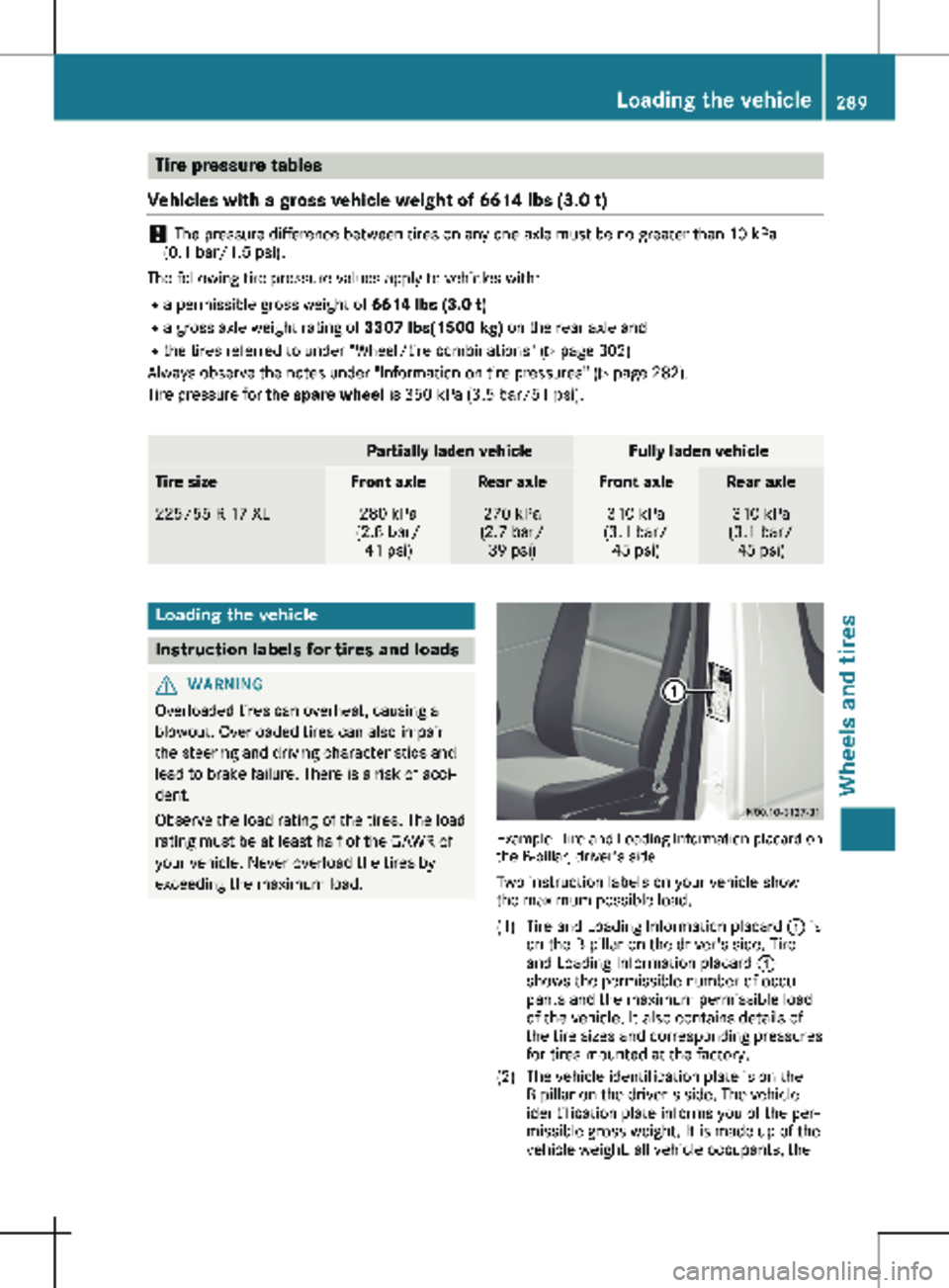
Tire pressure tables
Vehicles with a gross vehicle weight of 6614 lbs (3.0 t)!
The pressure difference between tires on any one axle must be no greater than
10 kPa
(0.1 bar/1.5 psi).
The following tire pressure values apply to vehicles with: R a permissible gross weight of 6614 lbs (3.0 t)
R a gross axle weight rating of 3307 lbs(1500 kg) on the rear axle and
R the tires referred to under "Wheel/tire combinations" (Y page 302)
Always observe the notes under "Information on tire pressures" (Y page 282).
Tire pressure for the spare wheel is 350 kPa (3.5 bar/51 psi).
Partially laden vehicle Fully laden vehicle
Tire size Front axle Rear axle Front axle Rear axle
225/55 R 17 XL 280 kPa
(2.8 bar/ 41 psi) 270 kPa
(2.7 bar/ 39 psi) 310 kPa
(3.1 bar/ 45 psi) 310 kPa
(3.1 bar/ 45 psi) Loading the vehicle
Instruction labels for tires and loads
G
WARNING
Overloaded tires can overheat, causing a
blowout. Overloaded tires can also impair
the steering and driving characteristics and
lead to brake failure. There is a risk of acci-
dent.
Observe the load rating of the tires. The load
rating must be at least half of the GAWR of
your vehicle. Never overload the tires by
exceeding the maximum load. Example: Tire and Loading Information placard on
the B-pillar, driver's side
Two instruction labels on your vehicle show
the maximum possible load.
(1) Tire and Loading Information placard : is
on the
B-pillar on the driver's side. Tire
and Loading Information placard :
shows the permissible number of occu-
pants and the maximum permissible load
of the vehicle. It also contains details of
the tire sizes and corresponding pressures
for tires mounted at the factory.
(2) The vehicle identification plate is on the B-pillar on the driver's side. The vehicle
identification plate informs you of the per-
missible gross weight. It is made up of the
vehicle weight, all vehicle occupants, the Loading the vehicle
289
Wheels and tires Z
Page 299 of 320
Tire tread
The part of the tire that comes into contact
with the road.
Tire bead
The tire bead ensures that the tire sits
securely on the wheel. There are several steel
wires in the bead to prevent the tire from com-
ing loose from the wheel rim.
SidewallThe part of the tire between the tread and the
tire bead.
Weight of optional extras The combined weight of those optional extras
that weigh more than the replaced standard
parts and more than 2.3 kg
(5 lbs). These
optional extras, such as high-performance
brakes, a roof rack or a high-performance bat-
tery, are not included in the curb weight and
the weight of the accessories.
TIN (Tire Identification Number) A unique identification number which can be
used by a tire manufacturer to identify tires,
for example for a product recall, and thus iden-
tify the purchasers. The TIN is composed of
the manufacturer identification code, tire size,
tire model code and manufacturing date.
Load bearing index
The load bearing index (also load index) is a
code that contains the maximum load bearing
capacity of a tire.
Traction
Traction is the result of friction between the
tires and the road surface.
TWR (permissible trailer drawbar load)
The TWR is the maximum permissible weight
that may act on the ball coupling of the trailer
tow hitch.
Wear indicator Narrow bars (tread wear bars) that are distrib-
uted over the tire tread. If the tire tread is level
with the bars, the wear limit of á in (1.6 mm)
has been reached. Distribution of the vehicle occupants
The distribution of vehicle occupants over des-
ignated seat positions in a vehicle.
Maximum permissible payload weightNominal load and goods/luggage load plus
68 kg (150 lbs) multiplied by the number of
seats in the vehicle. Changing wheels
Rotating the wheels
! On vehicles equipped with a tire pressure
monitor, electronic components are located
in the wheel.
Tire-mounting tools should not be used near
the valve. This could damage the electronic
components.
Only have tires changed at a qualified spe-
cialist workshop.
Always observe the instructions and safety
notes under "Mounting a wheel"
(Y page
298).
The wear patterns on the front and rear tires
differ, depending on the operating conditions.
Rotate the wheels before a clear wear pattern
has formed on the tires. Front tires typically
wear more on the shoulders and the rear tires
in the center.
If your vehicle's tire configuration allows, you
can rotate the tires according to the intervals
in the tire manufacturer's warranty book in
your vehicle documents. If no warranty book is
available, the tires should be rotated every
3,000 to 6,000 miles (5,000 to 10,000 km) or
earlier if tire wear requires. Do not change the
direction of rotation.
Clean the contact surfaces of the wheel and
the brake disc thoroughly every time a wheel
is rotated. Avoid oily or greasy cleaning
agents.
Check the tire pressure and reactivate the tire
pressure monitor if necessary. Direction of rotation
Tires with a specified direction of rotation have
additional benefits, e.g. if there is a risk of
hydroplaning. You will only gain these benefits
if the correct direction of rotation is observed. Changing wheels
297
Wheels and tires Z
Page 300 of 320
An arrow on the sidewall of the tire indicates
its correct direction of rotation.
You may mount a spare wheel against the
direction of rotation. Observe the time restric-
tion on use as well as the speed limitation
specified on the spare wheel. Storing wheels
Store wheels that are not being used in a cool,
dry and preferably dark place. Protect the tires
from contact with oil, grease and fuel. Mounting a wheel
Vehicle preparation X
Stop the vehicle as far away as possible
from traffic and on a level, firm and non-slip
surface.
X If your vehicle poses a risk to approaching
traffic, switch on the hazard warning lamps.
X Apply the parking brake.
X Turn the front wheels to the straight-ahead
position.
X Shift the transmission to position j.
X Switch off the engine.
X Passengers should leave the vehicle. Make
sure that the passengers are not endan-
gered as they do so.
X Make sure that no one is near the danger
area while the wheel is being changed. Any-
one who is not directly assisting in the
wheel change should, for example, stand
behind the barrier.
X Place the warning triangle or warning lamp
at a suitable distance.
Observe the legal requirements on the cor-
rect use of the warning triangle or warning
lamp for the country in which you are cur-
rently driving
X Secure the vehicle to prevent it from rolling
away.
Observe the safety notes on parking under
"Driving and parking"
(Y page 138)
X On level terrain: place chocks or other suit-
able objects under the front and rear of the
wheel that is diagonally opposite the wheel
to be changed. X
On slight inclines: place chocks or other
suitable objects under the wheels on the
front and rear axles opposite the wheel to
be changed.
X If included in the vehicle equipment, take
the tire-changing tool kit out of the vehicle
tool kit (Y page
270).
Apart from some country-specific variants,
vehicles are not equipped with tire-changing
tools. Some tools for changing a wheel are
specific to the vehicle. Consult a qualified
specialist workshop for more information on
which tools are required to perform a wheel
change on your vehicle.
X If included in the vehicle equipment, remove
the spare wheel from the spare wheel
bracket
(Y page 303). Observe the safety
notes listed under "Spare wheel"
(Y page 302).
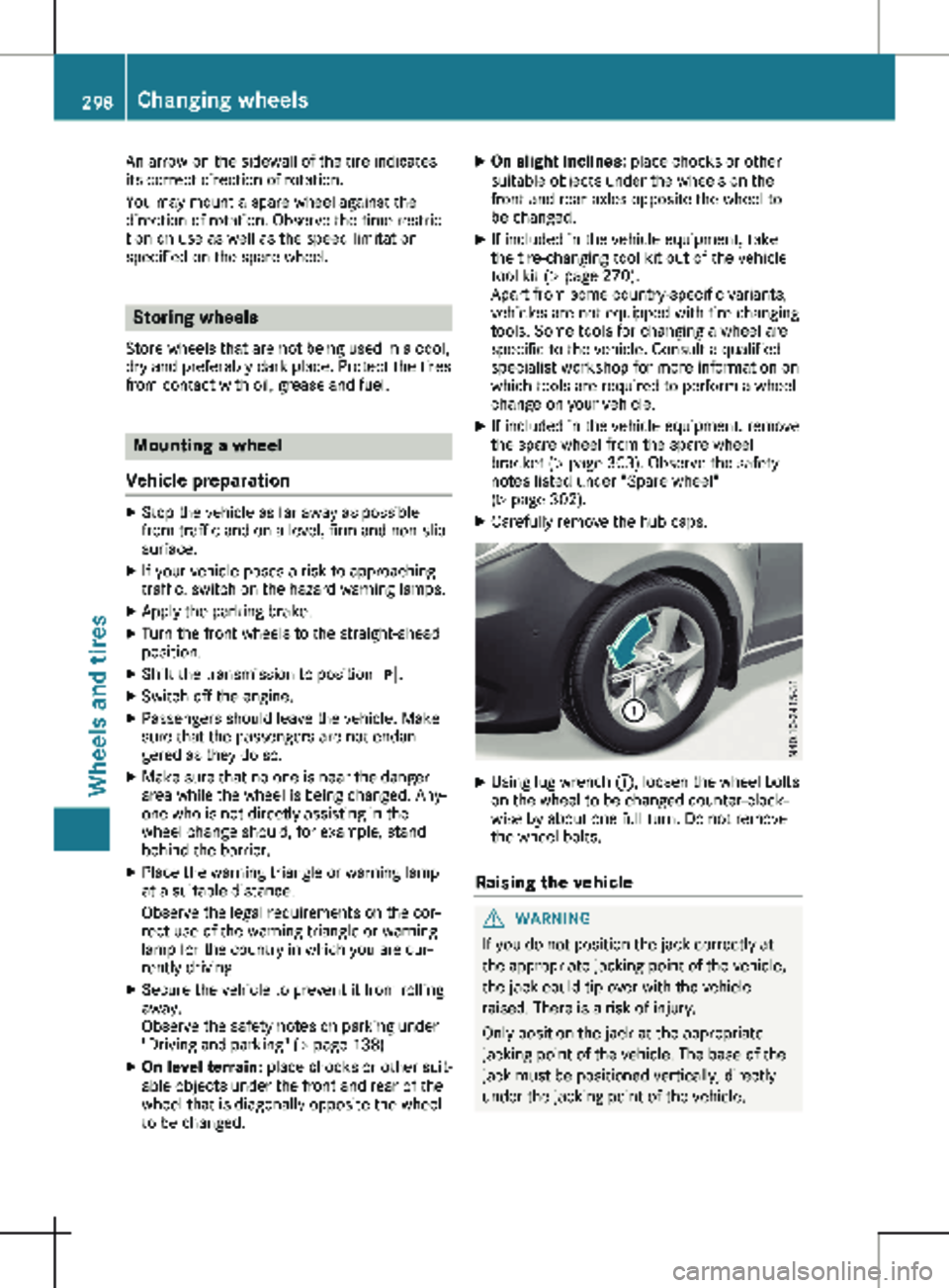
X Carefully remove the hub caps. X
Using lug wrench :, loosen the wheel bolts
on the wheel to be changed counter-clock-
wise by about one full turn. Do not remove
the wheel bolts.
Raising the vehicle G
WARNING
If you do not position the jack correctly at
the appropriate jacking point of the vehicle,
the jack could tip over with the vehicle
raised. There is a risk of injury.
Only position the jack at the appropriate
jacking point of the vehicle. The base of the
jack must be positioned vertically, directly
under the jacking point of the vehicle. 298
Changing wheels
Wheels and tires
Page 301 of 320
G
WARNING
On uphill and downhill slopes, the jack could
tip over with the vehicle raised. There is a
risk of injury.
Do not change wheels on uphill or downhill
gradients. Notify a qualified specialist work-
shop.
! Only position the jack on the jacking
points intended for this purpose. You could
otherwise damage the vehicle.
Observe the following when raising the vehi-
cle:
R To raise the vehicle, only use the vehicle-
specific jack that has been tested and
approved by Mercedes-Benz. If the jack is
used incorrectly, it could tip over while the
vehicle is raised.
R The vehicle's jack is intended only to raise
the vehicle for a short time when changing a
wheel. It is not suited for performing mainte-
nance work under the vehicle.
R Avoid changing the wheel on uphill and
downhill slopes.
R Before raising the vehicle, secure it from
rolling away by applying the parking brake
and inserting wheel chocks. Never disen-
gage the parking brake while the vehicle is
raised.
R The jack must be placed on a firm, flat and
non-slip surface. On a loose surface, a large,
load-bearing underlay must be used. On a
slippery surface, a non-slip underlay must
be used, e.g. rubber mats.
R Make sure that the distance between the
underside of the tires and the ground does
not exceed
1.2 in(3 cm).
R Never place your hands or feet under the
raised vehicle.
R Never lie under the raised vehicle.
R Never start the engine when the vehicle is
raised.
R Never open or close a door or the tailgate/
door when the vehicle is raised.
R Make sure that no persons are present in
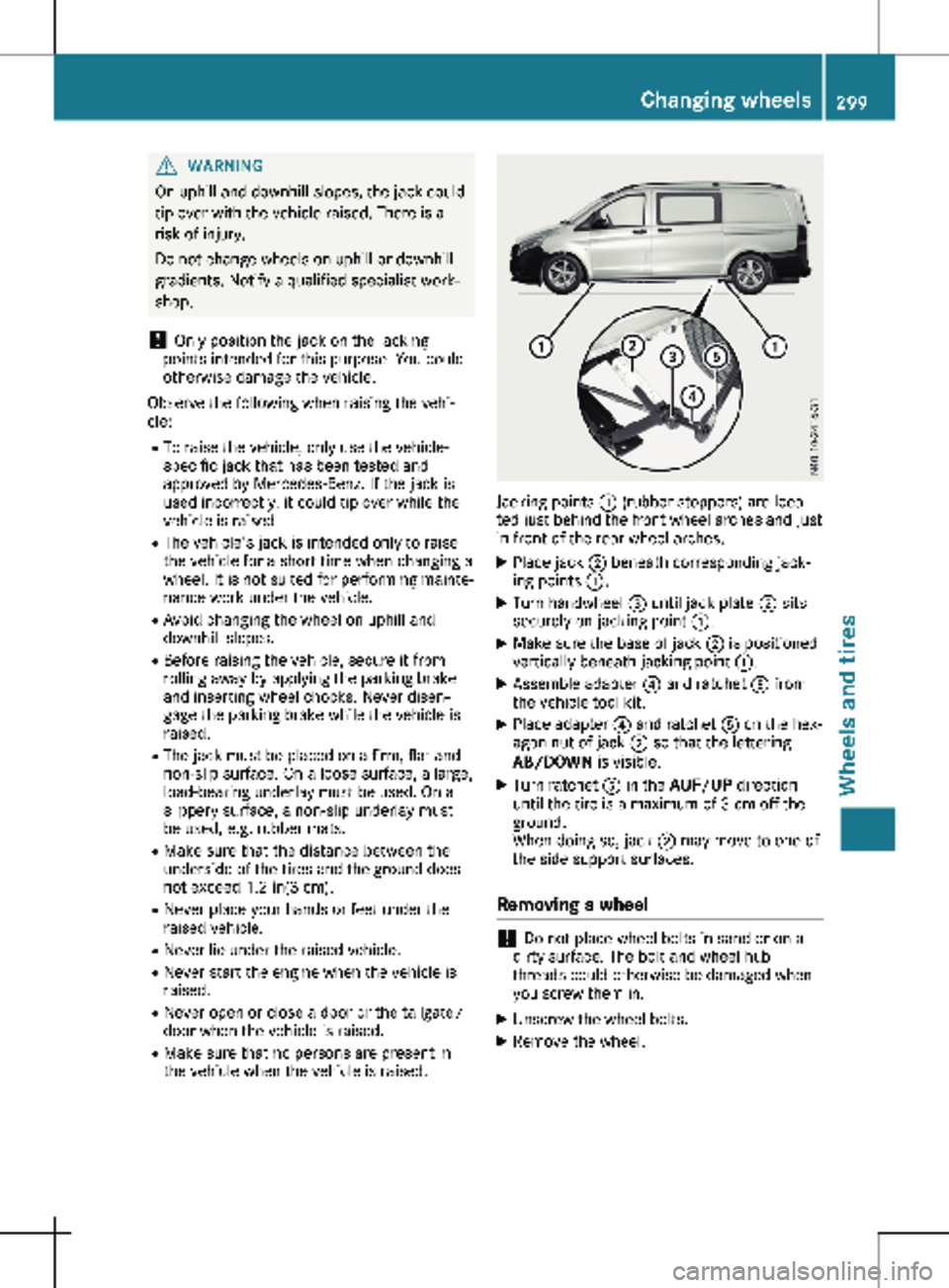
the vehicle when the vehicle is raised. Jacking points : (rubber stoppers) are loca-
ted just behind the front wheel arches and just
in front of the rear wheel arches.
X Place jack ; beneath corresponding jack-
ing points :.
X Turn handwheel = until jack plate ; sits
securely on jacking point :.
X Make sure the base of jack ; is positioned
vertically beneath jacking point :.
X Assemble adapter ? and ratchet A from
the vehicle tool kit.
X Place adapter ? and ratchet A on the hex-
agon nut of jack ; so that the lettering
AB/DOWN is visible.
X Turn ratchet A in the AUF/UP direction
until the tire is a maximum of 3 cm off the
ground.
When doing so, jack ; may move to one of
the side support surfaces.
Removing a wheel !
Do not place wheel bolts in sand or on a
dirty surface. The bolt and wheel hub
threads could otherwise be damaged when
you screw them in.
X Unscrew the wheel bolts.
X Remove the wheel. Changing wheels
299
Wheels and tires Z
Page 307 of 320
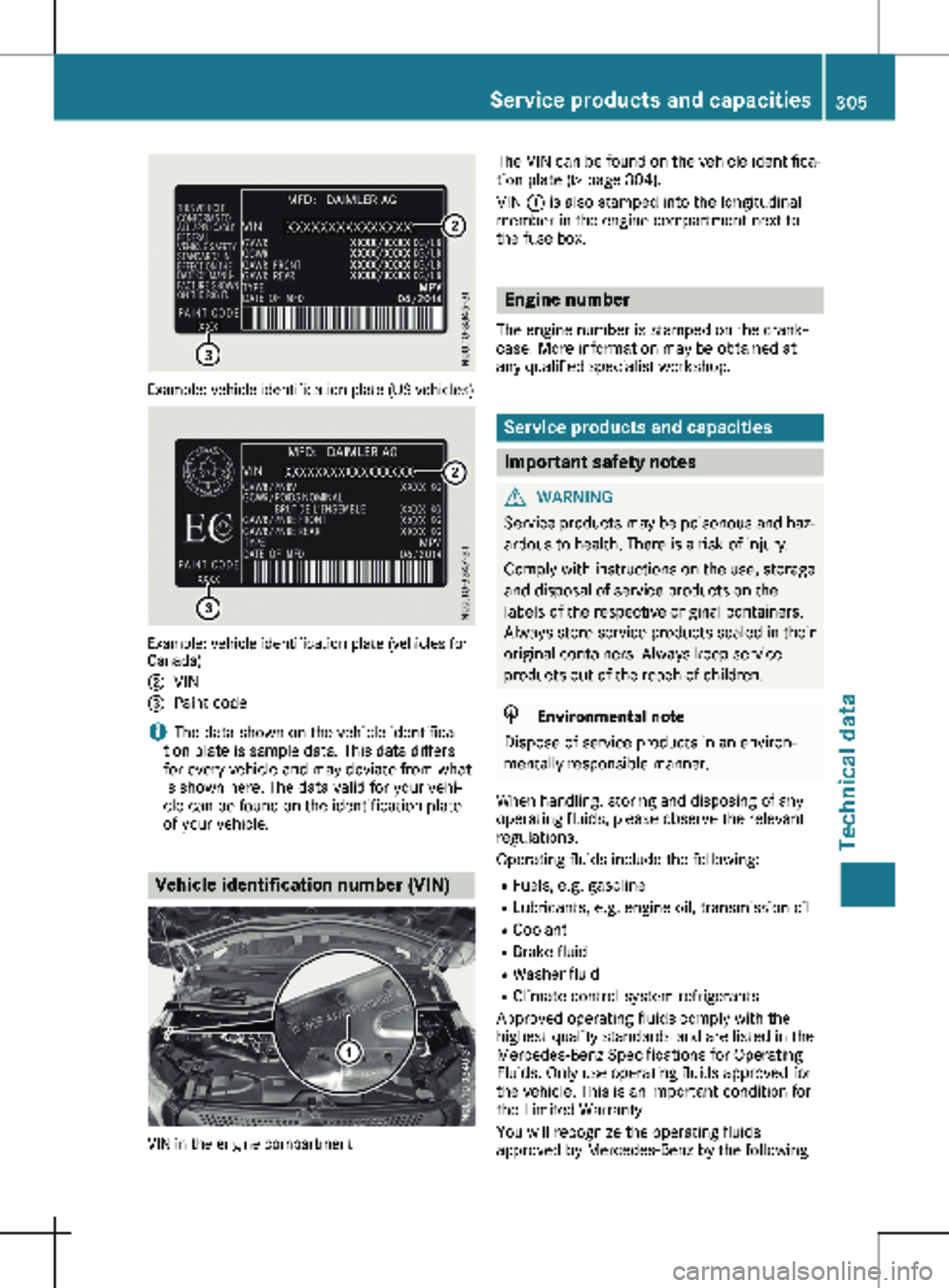
Example: vehicle identification plate (US vehicles)
Example: vehicle identification plate (vehicles for
Canada)
; VIN
= Paint code
i The data shown on the vehicle identifica-
tion plate is sample data. This data differs
for every vehicle and may deviate from what
is shown here. The data valid for your vehi-
cle can be found on the identification plate
of your vehicle. Vehicle identification number (VIN)
VIN in the engine compartment The VIN can be found on the vehicle identifica-
tion plate (Y page
304).
VIN : is also stamped into the longitudinal
member in the engine compartment next to
the fuse box. Engine number
The engine number is stamped on the crank-
case. More information may be obtained at
any qualified specialist workshop. Service products and capacities
Important safety notes
G
WARNING
Service products may be poisonous and haz-
ardous to health. There is a risk of injury.
Comply with instructions on the use, storage
and disposal of service products on the
labels of the respective original containers.
Always store service products sealed in their
original containers. Always keep service
products out of the reach of children. H
Environmental note
Dispose of service products in an environ-
mentally responsible manner.
When handling, storing and disposing of any
operating fluids, please observe the relevant
regulations.
Operating fluids include the following:
R Fuels, e.g. gasoline
R Lubricants, e.g. engine oil, transmission oil
R Coolant
R Brake fluid
R Washer fluid
R Climate control system refrigerants
Approved operating fluids comply with the
highest quality standards and are listed in the
Mercedes-Benz Specifications for Operating
Fluids. Only use operating fluids approved for
the vehicle. This is an important condition for
the Limited Warranty.
You will recognize the operating fluids
approved by Mercedes-Benz by the following Service products and capacities
305
Technical data Z