clock MERCEDES-BENZ METRIS 2020 MY20 Operator’s Manual
[x] Cancel search | Manufacturer: MERCEDES-BENZ, Model Year: 2020, Model line: METRIS, Model: MERCEDES-BENZ METRIS 2020Pages: 320, PDF Size: 26.38 MB
Page 257 of 320
X
Turn cap : further and remove it from cool-
ant expansion tank ;.
X Check the coolant level.
If the coolant is up to marker bar =
in the
filler neck when cold, there is a sufficient
amount of coolant in coolant expansion
tank ;.
If the coolant is approximately 0.59 in
(1.5 cm) above marker bar = in the filler
neck when warm, there is a sufficient
amount of coolant in coolant expansion
tank ;.
Adding coolant X If the coolant drops under marker bar = in
the filler neck, add coolant.
Observe the information on the correct cool-
ant mixture ratio and the required water
quality under "Service products and capaci-
ties" ( Y page
310). To prevent damage to
the engine cooling system, use only
approved corrosion inhibitor/antifreeze that
complies with the Mercedes-Benz Specifica-
tions for Service Products.
X Replace cap : and tighten in a clockwise
direction.
X Start the engine.
X Set the temperature in the vehicle interior to
the maximum output on the air-conditioning
system control panel.
X After approximately five minutes, switch off
the engine again and allow it to cool down.
X Check the coolant level again and add cool-
ant if necessary.
X Close the hood. Brake fluid
G
WARNING
Service products may be poisonous and haz-
ardous to health. There is a risk of injury.
Comply with instructions on the use, storage
and disposal of service products on the
labels of the respective original containers.
Always store service products sealed in their
original containers. Always keep service
products out of the reach of children. G
WARNING
Opening the hood when the engine is over-
heated or when there is a fire in the engine
compartment could expose you to hot gases
or other service products. There is a risk of
injury.
Let an overheated engine cool down before
opening the hood. If there is a fire in the
engine compartment, keep the hood closed
and contact the fire department. G
WARNING
Certain components in the engine compart-
ment, such as the engine, radiator and parts
of the exhaust system, can become very
hot. Working in the engine compartment
poses a risk of injury.
Where possible, let the engine cool down
and touch only the components described in
the following.
Brake fluid is hazardous to health. Also
observe the safety notes under "Service prod-
ucts and capacities"
(Y page 305). G
WARNING
The brake fluid constantly absorbs moisture
from the air. This lowers the boiling point of
the brake fluid. If the boiling point of the
brake fluid is too low, vapor pockets may
form in the brake system when the brakes
are applied hard. This would impair braking
efficiency. There is a risk of an accident.
You should have the brake fluid renewed at
the specified intervals.
! If the brake fluid level in the brake fluid
reservoir has fallen to the MIN mark or
below, check the brake system immediately
for leaks. Also check the thickness of the
brake linings. Visit a qualified specialist
workshop immediately.
Do not add brake fluid. This does not cor-
rect the malfunction.
! Brake fluid corrodes paint, plastic and rub-
ber. If paint, plastic or rubber has come into
contact with brake fluid, rinse with water
immediately. Engine compartment
255
Maintenance and care Z
Page 273 of 320
Stowage compartment in the rear
compartment
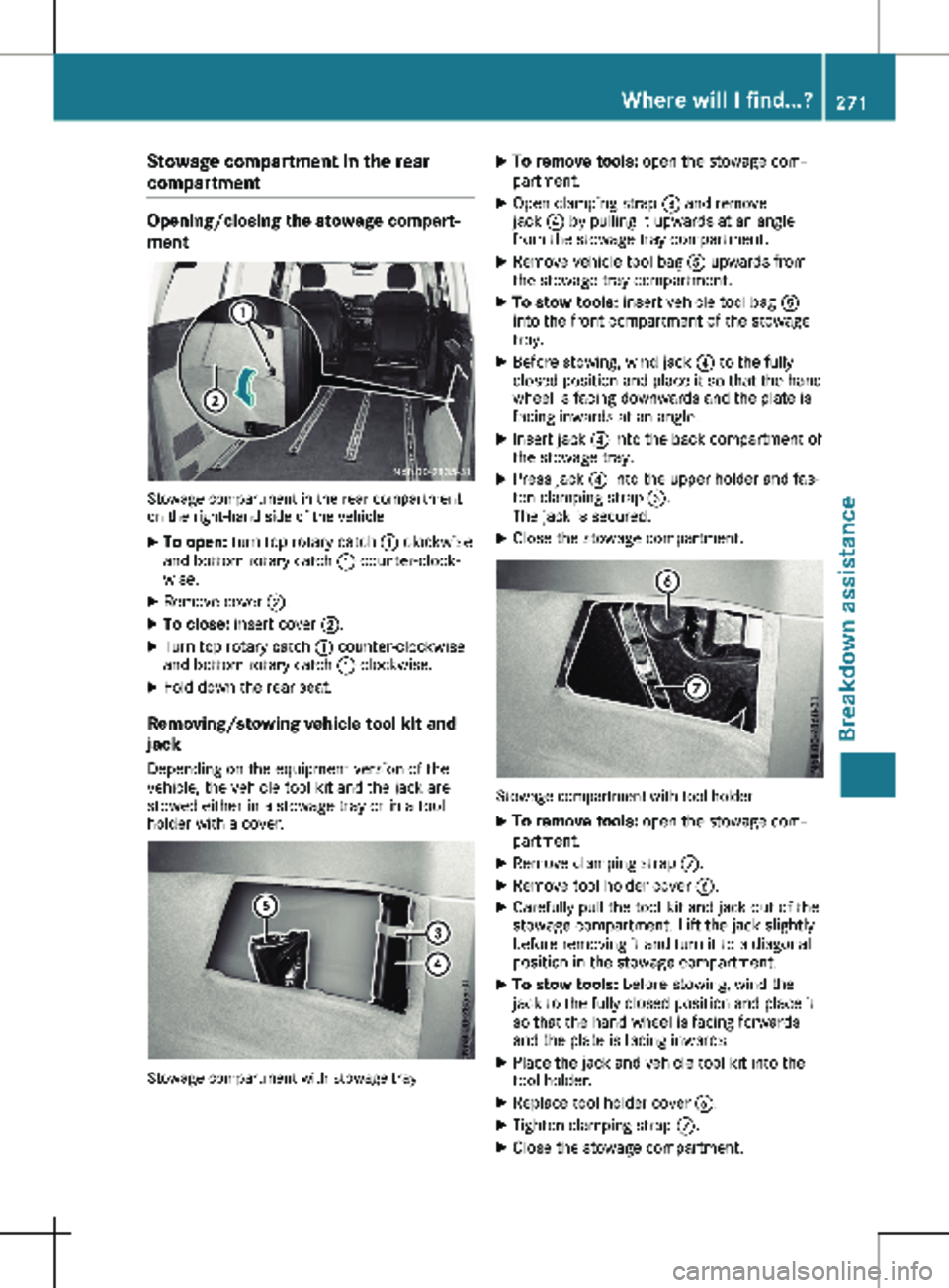
Opening/closing the stowage compart-
ment
Stowage compartment in the rear compartment
on the right-hand side of the vehicle
X To open: turn top rotary catch : clockwise
and bottom rotary catch : counter-clock-
wise.
X Remove cover ;.
X To close: insert cover ;.
X Turn top rotary catch : counter-clockwise
and bottom rotary catch : clockwise.
X Fold down the rear seat.
Removing/stowing vehicle tool kit and
jack
Depending on the equipment version of the
vehicle, the vehicle tool kit and the jack are
stowed either in a stowage tray or in a tool
holder with a cover. Stowage compartment with stowage tray X
To remove tools: open the stowage com-
partment.
X Open clamping strap = and remove
jack ? by pulling it upwards at an angle
from the stowage tray compartment.
X Remove vehicle tool bag A upwards from
the stowage tray compartment.
X To stow tools: insert vehicle tool bag A
into the front compartment of the stowage
tray.
X Before stowing, wind jack ? to the fully
closed position and place it so that the hand
wheel is facing downwards and the plate is
facing inwards at an angle.
X Insert jack ? into the back compartment of
the stowage tray.
X Press jack ? into the upper holder and fas-
ten clamping strap =.
The jack is secured.
X Close the stowage compartment. Stowage compartment with tool holder
X To remove tools: open the stowage com-
partment.
X Remove clamping strap C.
X Remove tool holder cover B.
X Carefully pull the tool kit and jack out of the
stowage compartment. Lift the jack slightly
before removing it and turn it to a diagonal
position in the stowage compartment.
X To stow tools: before stowing, wind the
jack to the fully closed position and place it
so that the hand wheel is facing forwards
and the plate is facing inwards.
X Place the jack and vehicle tool kit into the
tool holder.
X Replace tool holder cover B.
X Tighten clamping strap C.
X Close the stowage compartment. Where will I find...?
271Breakdown assistance
Page 277 of 320
!
Secure the tow rope or tow bar to the tow-
ing eye or trailer tow hitch only. Otherwise,
the vehicle could become damaged.
! Do not use the towing eye for recovery,
this could damage the vehicle. If in doubt,
recover the vehicle with a crane.
! Drive slowly and smoothly when towing.
Excessive tractive power could otherwise
damage the vehicles.
! Shift the automatic transmission to posi-
tion i and do not open the driver's or front
passenger's door during towing. The auto-
matic transmission may otherwise shift to
position j, which could damage the trans-
mission.
! You may tow the vehicle for a maximum
distance of 30 miles (50 kilometers). A tow-
ing speed of
30 mph (50 km/h) must not be
exceeded.
For towing distances over 30 miles
(50 kilometers), the entire vehicle must be
raised and transported.
When towing away, you must observe the legal
requirements for the country in which you are
currently driving.
It is better to have the vehicle transported
than to have it towed.
Have the vehicle transported on a transporter
or trailer if it has transmission damage.
The automatic transmission must be in posi-
tion i when the vehicle is being towed away.
If the automatic transmission cannot be shif-
ted to position i, have the vehicle transpor-
ted on a transporter or trailer.
The battery must be connected and charged.
Otherwise, you:
R cannot turn the key to position 2 in the
ignition lock.
R cannot shift the transmission to position i.
Before the vehicle is towed, switch off the
automatic locking feature (Y page 76). You could otherwise lock yourself out of the vehi-
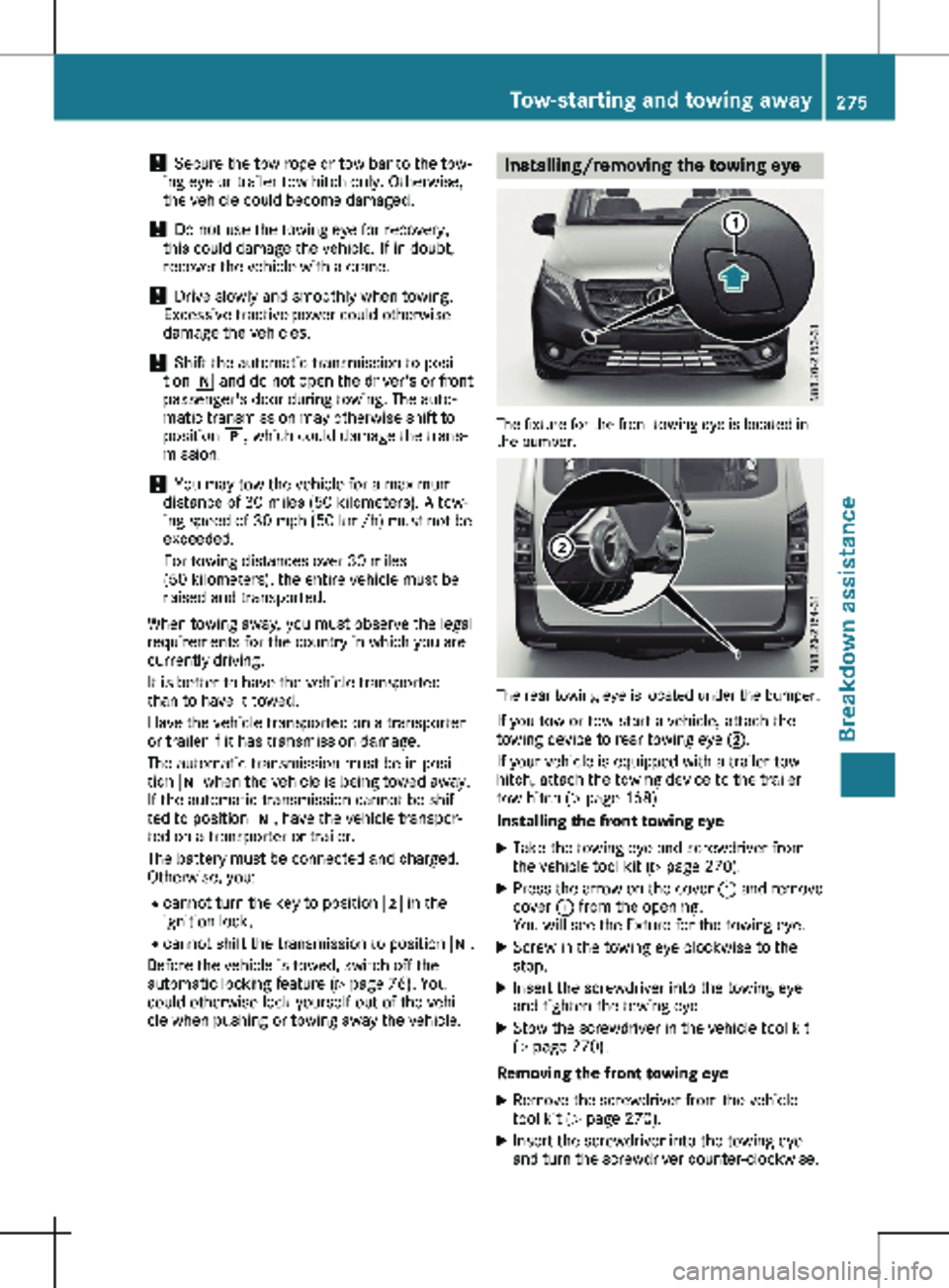
cle when pushing or towing away the vehicle. Installing/removing the towing eye
The fixture for the front towing eye is located in
the bumper. The rear towing eye is located under the bumper.
If you tow or tow-start a vehicle, attach the
towing device to rear towing eye
;.
If your vehicle is equipped with a trailer tow
hitch, attach the towing device to the trailer
tow hitch (Y page
168).
Installing the front towing eye
X Take the towing eye and screwdriver from
the vehicle tool kit (Y page
270).
X Press the arrow on the cover : and remove
cover : from the opening.
You will see the fixture for the towing eye.
X Screw in the towing eye clockwise to the
stop.
X Insert the screwdriver into the towing eye
and tighten the towing eye.
X Stow the screwdriver in the vehicle tool kit
(Y page
270).
Removing the front towing eye
X Remove the screwdriver from the vehicle
tool kit
(Y page 270).
X Insert the screwdriver into the towing eye
and turn the screwdriver counter-clockwise. Tow-starting and towing away
275
Breakdown assistance Z
Page 300 of 320
An arrow on the sidewall of the tire indicates
its correct direction of rotation.
You may mount a spare wheel against the
direction of rotation. Observe the time restric-
tion on use as well as the speed limitation
specified on the spare wheel. Storing wheels
Store wheels that are not being used in a cool,
dry and preferably dark place. Protect the tires
from contact with oil, grease and fuel. Mounting a wheel
Vehicle preparation X
Stop the vehicle as far away as possible
from traffic and on a level, firm and non-slip
surface.
X If your vehicle poses a risk to approaching
traffic, switch on the hazard warning lamps.
X Apply the parking brake.
X Turn the front wheels to the straight-ahead
position.
X Shift the transmission to position j.
X Switch off the engine.
X Passengers should leave the vehicle. Make
sure that the passengers are not endan-
gered as they do so.
X Make sure that no one is near the danger
area while the wheel is being changed. Any-
one who is not directly assisting in the
wheel change should, for example, stand
behind the barrier.
X Place the warning triangle or warning lamp
at a suitable distance.
Observe the legal requirements on the cor-
rect use of the warning triangle or warning
lamp for the country in which you are cur-
rently driving
X Secure the vehicle to prevent it from rolling
away.
Observe the safety notes on parking under
"Driving and parking"
(Y page 138)
X On level terrain: place chocks or other suit-
able objects under the front and rear of the
wheel that is diagonally opposite the wheel
to be changed. X
On slight inclines: place chocks or other
suitable objects under the wheels on the
front and rear axles opposite the wheel to
be changed.
X If included in the vehicle equipment, take
the tire-changing tool kit out of the vehicle
tool kit (Y page
270).
Apart from some country-specific variants,
vehicles are not equipped with tire-changing
tools. Some tools for changing a wheel are
specific to the vehicle. Consult a qualified
specialist workshop for more information on
which tools are required to perform a wheel
change on your vehicle.
X If included in the vehicle equipment, remove
the spare wheel from the spare wheel
bracket
(Y page 303). Observe the safety
notes listed under "Spare wheel"
(Y page 302).
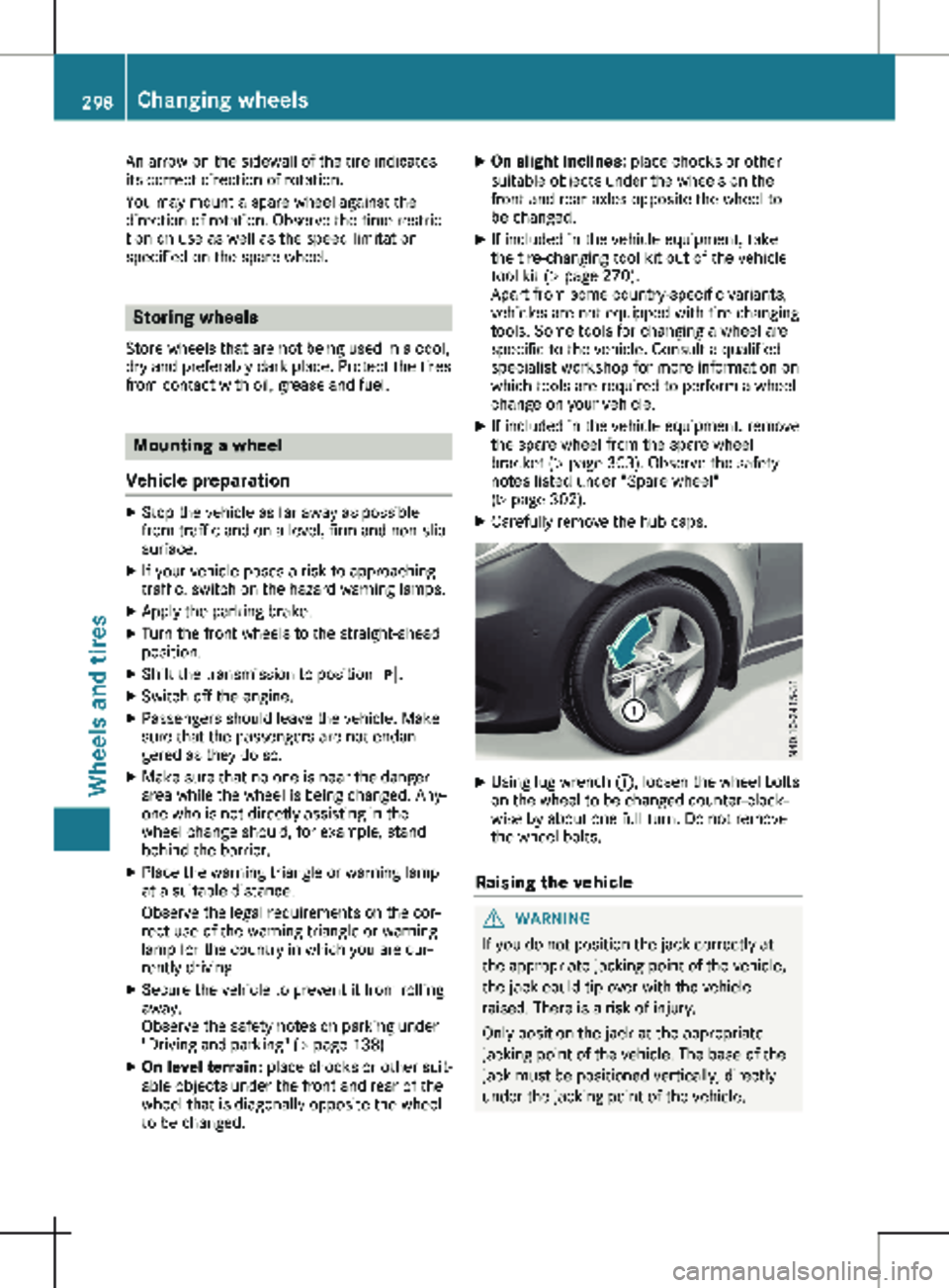
X Carefully remove the hub caps. X
Using lug wrench :, loosen the wheel bolts
on the wheel to be changed counter-clock-
wise by about one full turn. Do not remove
the wheel bolts.
Raising the vehicle G
WARNING
If you do not position the jack correctly at
the appropriate jacking point of the vehicle,
the jack could tip over with the vehicle
raised. There is a risk of injury.
Only position the jack at the appropriate
jacking point of the vehicle. The base of the
jack must be positioned vertically, directly
under the jacking point of the vehicle. 298
Changing wheels
Wheels and tires