weight MERCEDES-BENZ METRIS 2020 MY20 Operator’s Manual
[x] Cancel search | Manufacturer: MERCEDES-BENZ, Model Year: 2020, Model line: METRIS, Model: MERCEDES-BENZ METRIS 2020Pages: 320, PDF Size: 26.38 MB
Page 287 of 320

Maximum tire pressures
:
Maximum permitted tire pressure (exam-
ple)
Never exceed the maximum permissible tire
inflation pressure. When adjusting the tire
pressures always observe the recommended
tire pressure for your vehicle
(Y page 282).
i The actual values for tires are specific to
each vehicle and may deviate from the val-
ues in the illustration. Tire valve (snap-in valve)
Important safety notes G
WARNING
Tire valve that are not approved for your
vehicle by the distributor named on the
inside cover page may result in a loss of tire
pressure. This may affect road safety. There
is a risk of an accident.
Only use tire valve that are approved for
your vehicle by the distributor named on the
inside cover page. Always make sure you
have the correct tire valve type for the tires
on your vehicle.
! Do not screw additional weights (check
valves, etc.) onto the tire valves. The elec-
tronic components could thus be damaged.
i For safety reasons, Mercedes-Benz recom-
mends that you only use tire valves that
have been tested for use on your vehicle. Checking the tire pressure manually
In order to determine and adjust the tire pres-
sures, proceed as follows: X Remove the valve cap of the tire you wish to
check.
X Press the tire pressure gauge securely onto
the valve.
X Read the tire pressure and compare it with
the recommended value on the loading
information table or the tire pressure table
( Y page
282).
X If the tire pressure is too low, increase it to
the recommended value.
X If the tire pressure is too high, release air by
pressing down the metal pin in the valve.
Use the tip of a pen, for example. Then,
check the tire pressure again using the tire
pressure gauge.
X Screw the valve cap onto the valve.
X Repeat the steps for the other tires. Tire pressure monitor
General notes In vehicles with a tire pressure monitor sys-
tem, the vehicle's wheels have sensors instal-
led which monitor the tire pressure in all four
tires. The tire pressure monitor warns you if
the pressure drops in one or more of the tires.
The tire pressure monitor only functions if the
corresponding sensors are installed on all
wheels.
Tire pressure display (only on vehicles with steer-
ing wheel buttons)
On vehicles with steering-wheel buttons, the
current pressure of the individual wheels in the
display can be shown via the Service menu. Tire pressure
285
Wheels and tires Z
Page 291 of 320
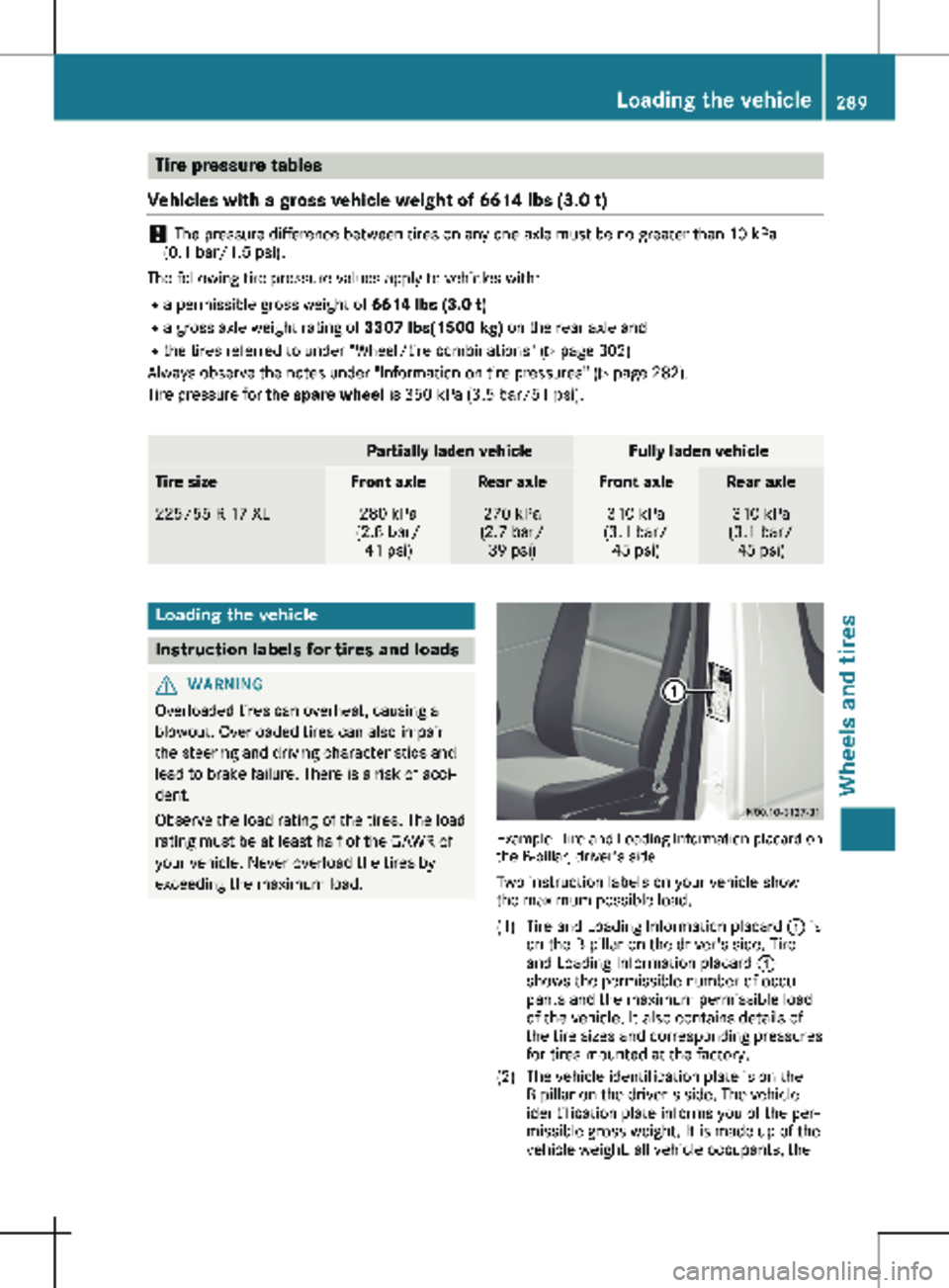
Tire pressure tables
Vehicles with a gross vehicle weight of 6614 lbs (3.0 t)!
The pressure difference between tires on any one axle must be no greater than
10 kPa
(0.1 bar/1.5 psi).
The following tire pressure values apply to vehicles with: R a permissible gross weight of 6614 lbs (3.0 t)
R a gross axle weight rating of 3307 lbs(1500 kg) on the rear axle and
R the tires referred to under "Wheel/tire combinations" (Y page 302)
Always observe the notes under "Information on tire pressures" (Y page 282).
Tire pressure for the spare wheel is 350 kPa (3.5 bar/51 psi).
Partially laden vehicle Fully laden vehicle
Tire size Front axle Rear axle Front axle Rear axle
225/55 R 17 XL 280 kPa
(2.8 bar/ 41 psi) 270 kPa
(2.7 bar/ 39 psi) 310 kPa
(3.1 bar/ 45 psi) 310 kPa
(3.1 bar/ 45 psi) Loading the vehicle
Instruction labels for tires and loads
G
WARNING
Overloaded tires can overheat, causing a
blowout. Overloaded tires can also impair
the steering and driving characteristics and
lead to brake failure. There is a risk of acci-
dent.
Observe the load rating of the tires. The load
rating must be at least half of the GAWR of
your vehicle. Never overload the tires by
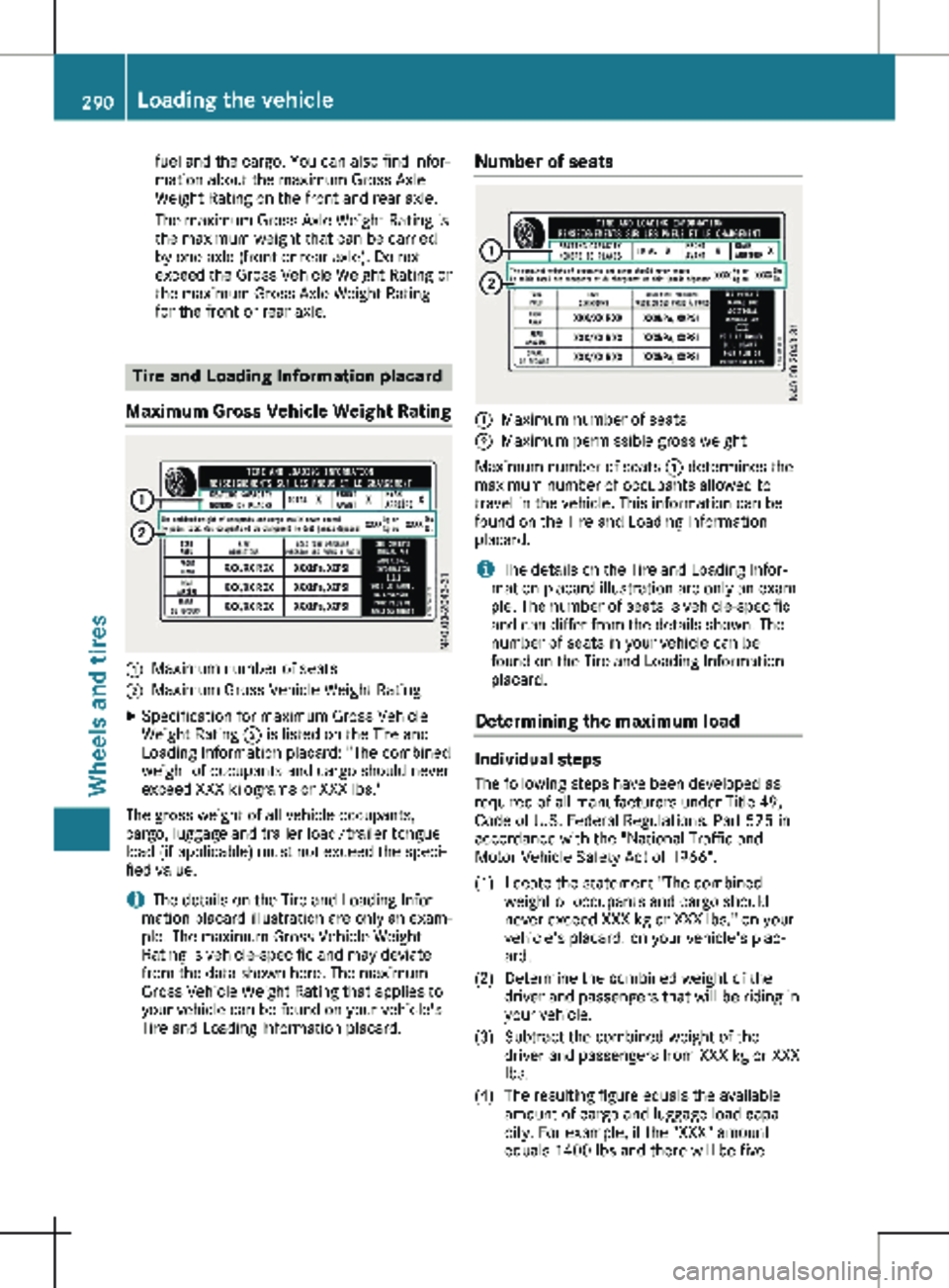
exceeding the maximum load. Example: Tire and Loading Information placard on
the B-pillar, driver's side
Two instruction labels on your vehicle show
the maximum possible load.
(1) Tire and Loading Information placard : is
on the
B-pillar on the driver's side. Tire
and Loading Information placard :
shows the permissible number of occu-
pants and the maximum permissible load
of the vehicle. It also contains details of
the tire sizes and corresponding pressures
for tires mounted at the factory.
(2) The vehicle identification plate is on the B-pillar on the driver's side. The vehicle
identification plate informs you of the per-
missible gross weight. It is made up of the
vehicle weight, all vehicle occupants, the Loading the vehicle
289
Wheels and tires Z
Page 292 of 320
fuel and the cargo. You can also find infor-
mation about the maximum Gross Axle
Weight Rating on the front and rear axle.
The maximum Gross Axle Weight Rating is
the maximum weight that can be carried
by one axle (front or rear axle). Do not
exceed the Gross Vehicle Weight Rating or
the maximum Gross Axle Weight Rating
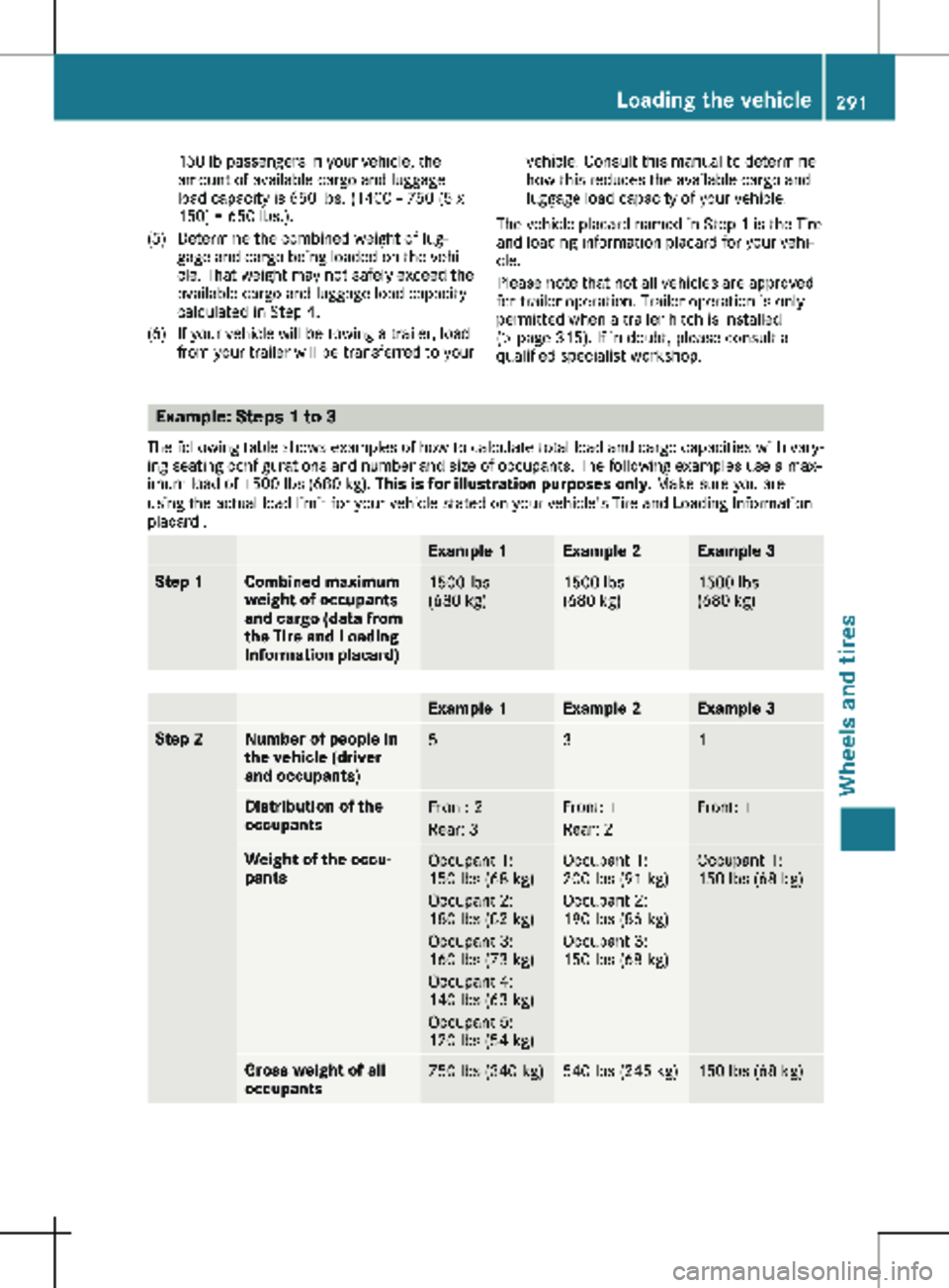
for the front or rear axle. Tire and Loading Information placard
Maximum Gross Vehicle Weight Rating :
Maximum number of seats
; Maximum Gross Vehicle Weight Rating
X Specification for maximum Gross Vehicle
Weight Rating ; is listed on the Tire and
Loading Information placard: "The combined
weight of occupants and cargo should never
exceed XXX kilograms or XXX lbs."
The gross weight of all vehicle occupants,
cargo, luggage and trailer load/trailer tongue
load (if applicable) must not exceed the speci-
fied value.
i The details on the Tire and Loading Infor-
mation placard illustration are only an exam-
ple. The maximum Gross Vehicle Weight
Rating is vehicle-specific and may deviate
from the data shown here. The maximum
Gross Vehicle Weight Rating that applies to
your vehicle can be found on your vehicle's
Tire and Loading Information placard. Number of seats
:
Maximum number of seats
; Maximum permissible gross weight
Maximum number of seats : determines the
maximum number of occupants allowed to
travel in the vehicle. This information can be
found on the Tire and Loading Information
placard.
i The details on the Tire and Loading Infor-
mation placard illustration are only an exam-
ple. The number of seats is vehicle-specific
and can differ from the details shown. The
number of seats in your vehicle can be
found on the Tire and Loading Information
placard.
Determining the maximum load Individual steps
The following steps have been developed as
required of all manufacturers under Title 49,
Code of U.S. Federal Regulations, Part 575 in
accordance with the "National Traffic and
Motor Vehicle Safety Act of 1966".
(1) Locate the statement "The combined weight of occupants and cargo should
never exceed XXX kg or XXX lbs." on your
vehicle's placard. on your vehicle's plac-
ard.
(2) Determine the combined weight of the driver and passengers that will be riding in
your vehicle.
(3) Subtract the combined weight of the driver and passengers from XXX kg or XXX
lbs.
(4) The resulting figure equals the available amount of cargo and luggage load capa-
city. For example, if the "XXX" amount
equals
1400 lbs and there will be five290
Loading the vehicle
Wheels and tires
Page 293 of 320
150 lb passengers in your vehicle, the
amount of available cargo and luggage
load capacity is
650 lbs. (1400 Ò 750 (5 x
150) = 650 lbs.).
(5) Determine the combined weight of lug- gage and cargo being loaded on the vehi-
cle. That weight may not safely exceed the
available cargo and luggage load capacity
calculated in Step 4.
(6) If your vehicle will be towing a trailer, load from your trailer will be transferred to your vehicle. Consult this manual to determine
how this reduces the available cargo and
luggage load capacity of your vehicle.
The vehicle placard named in Step 1 is the Tire
and loading information placard for your vehi-
cle.
Please note that not all vehicles are approved
for trailer operation. Trailer operation is only
permitted when a trailer hitch is installed
(Y page
315). If in doubt, please consult a
qualified specialist workshop. Example: Steps 1 to 3
The following table shows examples of how to calculate total load and cargo capacities with vary-
ing seating configurations and number and size of occupants. The following examples use a max-
imum load of
1500 lbs (680 kg). This is for illustration purposes only. Make sure you are
using the actual load limit for your vehicle stated on your vehicle's Tire and Loading Information
placard . Example 1 Example 2 Example 3
Step 1 Combined maximum
weight of occupants
and cargo (data from
the Tire and Loading
Information placard)
1500 lbs
(680 kg
) 1500 lbs
(680 kg
) 1500 lbs
(680 kg
) Example 1 Example 2 Example 3
Step 2 Number of people in
the vehicle (driver
and occupants)
5 3 1
Distribution of the
occupants
Front: 2
Rear: 3 Front: 1
Rear: 2 Front: 1
Weight of the occu-
pants
Occupant 1:
150 lbs (68 kg
)
Occupant 2:
180 lbs (82 kg)
Occupant 3:
160 lbs (73 kg)
Occupant 4:
140 lbs (63 kg)
Occupant 5:
120 lbs (54 kg) Occupant 1:
200 lbs (91 kg
)
Occupant 2:
190 lbs (86 kg)
Occupant 3:
150 lbs (68 kg) Occupant 1:
150 lbs (68 kg
) Gross weight of all
occupants
750 lbs (340 kg) 540 lbs (245 kg) 150 lbs (68 kg)Loading the vehicle
291
Wheels and tires Z
Page 294 of 320
Example 1 Example 2 Example 3
Step 3 Permissible load and
trailer load/trailer
tongue load (maxi-
mum permissible
gross weight from
the Tire and Loading
Information placard
minus the gross
weight of all occu-
pants)
1500 lbs
(680 kg
) Ò
750 lbs (340 kg)
= 750 lbs
(340 kg) 1500 lbs
(680 kg
) Ò
540 lbs (245 kg)
= 960 lbs
(435 kg) 1500 lbs
(680 kg
) Ò
150 lbs (68 kg)
= 1350 lbs
(612 kg) The greater the combined weight of the occupants, the lower the maximum luggage load.
You can find further information under: "Trailer tow hitch"
(Y page 315).Vehicle identification plate
Even if you have calculated the total load care-
fully, you should still make sure that the per-
missible gross weight and the gross axle
weight rating of your vehicle are not exceeded.
This data can be found on the vehicle identifi-
cation plate on the B-pillar of your vehicle
(Y page
304).
Gross Vehicle Weight Rating (GVWR): the
gross weight of the vehicle, all occupants, load
and trailer load/trailer tongue load (if applica-
ble) must not exceed the permissible gross
vehicle weight.
Gross Axle Weight Rating (GAWR): the maxi-
mum permissible load that can be carried by
one axle (front or rear axle).
To ensure that your vehicle does not exceed
the maximum permissible values (gross vehi-
cle weight and maximum gross axle weight rat-
ing), have your loaded vehicle (including driver,
occupants, load, and full trailer load if applica-
ble) weighed on a suitable vehicle weigh-
bridge. Trailer load/trailer tongue load
The trailer load/trailer tongue load affects the
gross weight of the vehicle. If a trailer is
attached, the trailer load/trailer tongue load is
included in the load along with occupants and
luggage. The trailer load/trailer tongue load is
usually approximately
10% of the gross weight
of the trailer and its load. What you should know about wheels
and tires
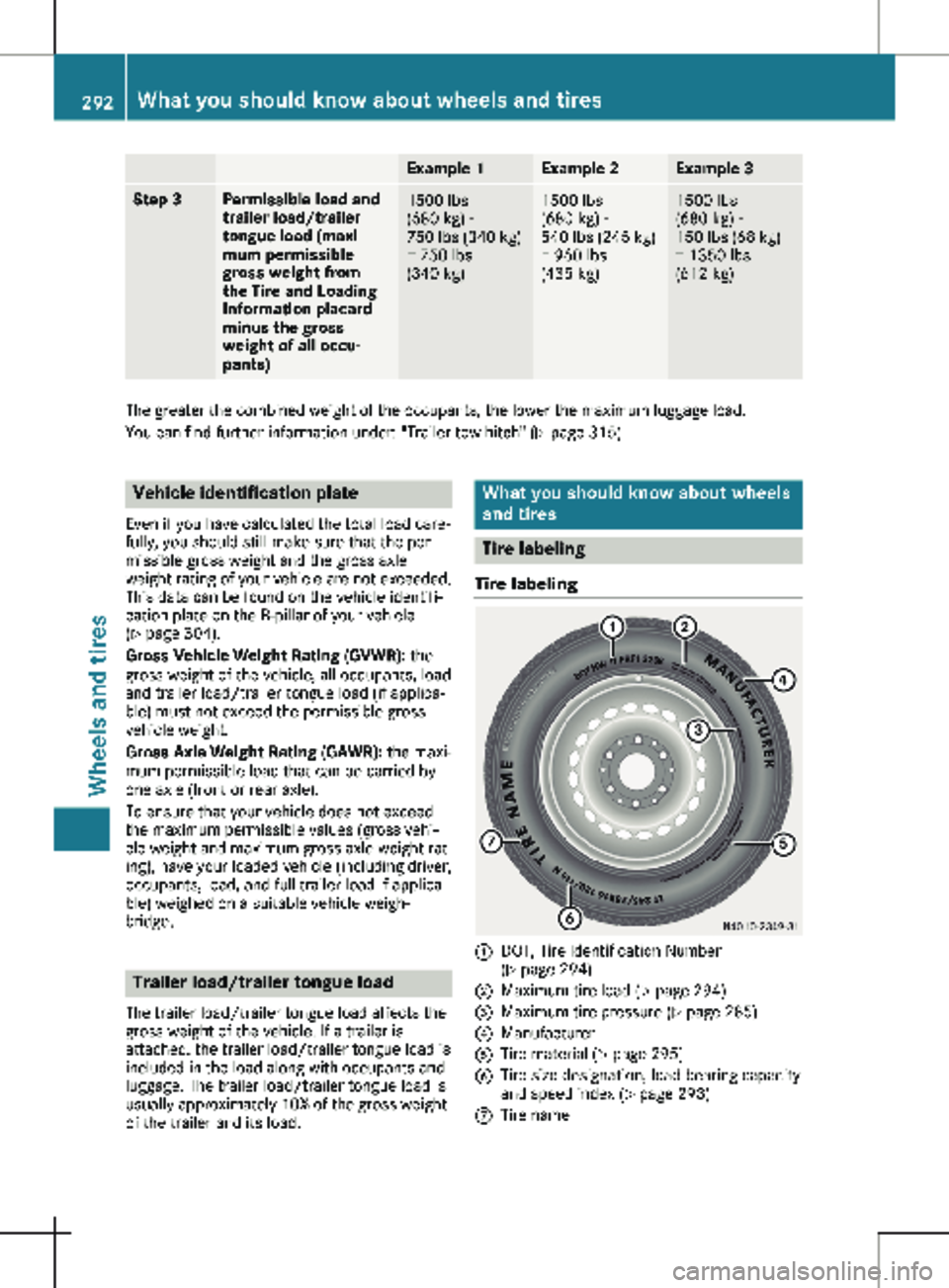
Tire labeling
Tire labeling :
DOT, Tire Identification Number
(Y page
294)
; Maximum tire load (Y page
294)
= Maximum tire pressure ( Y page
285)
? Manufacturer
A Tire material ( Y page
295)
B Tire size designation, load-bearing capacity
and speed index
(Y page 293)
C Tire name292
What you should know about wheels and tires
Wheels and tires
Page 296 of 320
ing the tire traction on snow. They have
been especially developed for driving on
snow.
Further information on the reading of tire infor-
mation can be obtained at any qualified spe-
cialist workshop.
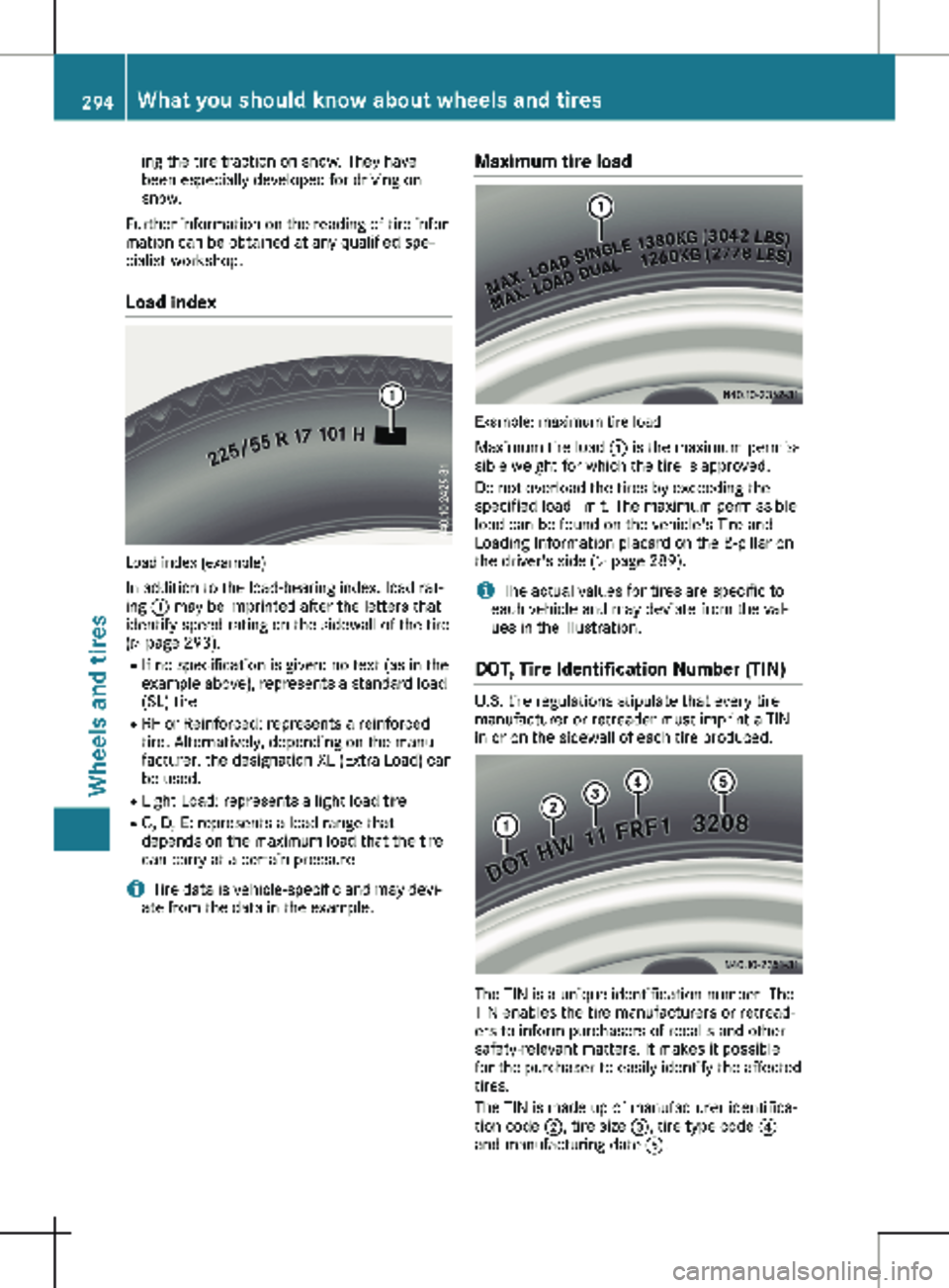
Load index Load index (example)
In addition to the load-bearing index, load rat-
ing : may be imprinted after the letters that
identify speed rating on the sidewall of the tire
(Y page
293).
R If no specification is given: no text (as in the
example above), represents a standard load
(SL) tire
R RF or Reinforced: represents a reinforced
tire. Alternatively, depending on the manu-
facturer, the designation XL (Extra Load) can
be used.
R Light Load: represents a light load tire
R C, D, E: represents a load range that
depends on the maximum load that the tire
can carry at a certain pressure
i Tire data is vehicle-specific and may devi-
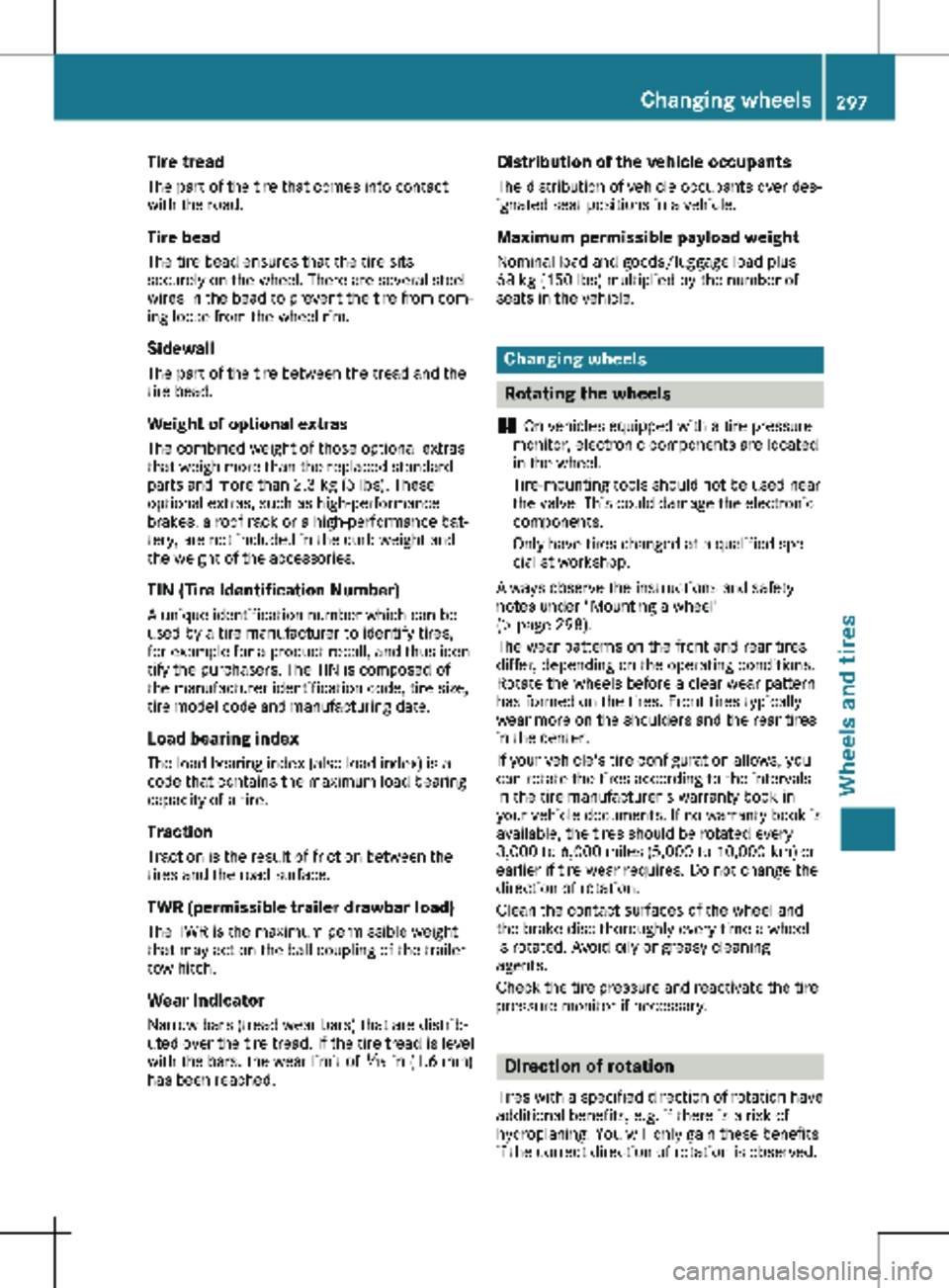
ate from the data in the example. Maximum tire load Example: maximum tire load
Maximum tire load : is the maximum permis-
sible weight for which the tire is approved.
Do not overload the tires by exceeding the
specified load limit. The maximum permissible
load can be found on the vehicle's Tire and
Loading Information placard on the B-pillar
on
the driver's side (Y page 289).
i The actual values for tires are specific to
each vehicle and may deviate from the val-
ues in the illustration.
DOT, Tire Identification Number (TIN) U.S. tire regulations stipulate that every tire
manufacturer or retreader must imprint a TIN
in or on the sidewall of each tire produced. The TIN is a unique identification number. The
TIN enables the tire manufacturers or retread-
ers to inform purchasers of recalls and other
safety-relevant matters. It makes it possible
for the purchaser to easily identify the affected
tires.
The TIN is made up of manufacturer identifica-
tion code ;, tire size =, tire type code ?
and manufacturing date A. 294
What you should know about wheels and tires
Wheels and tires
Page 297 of 320
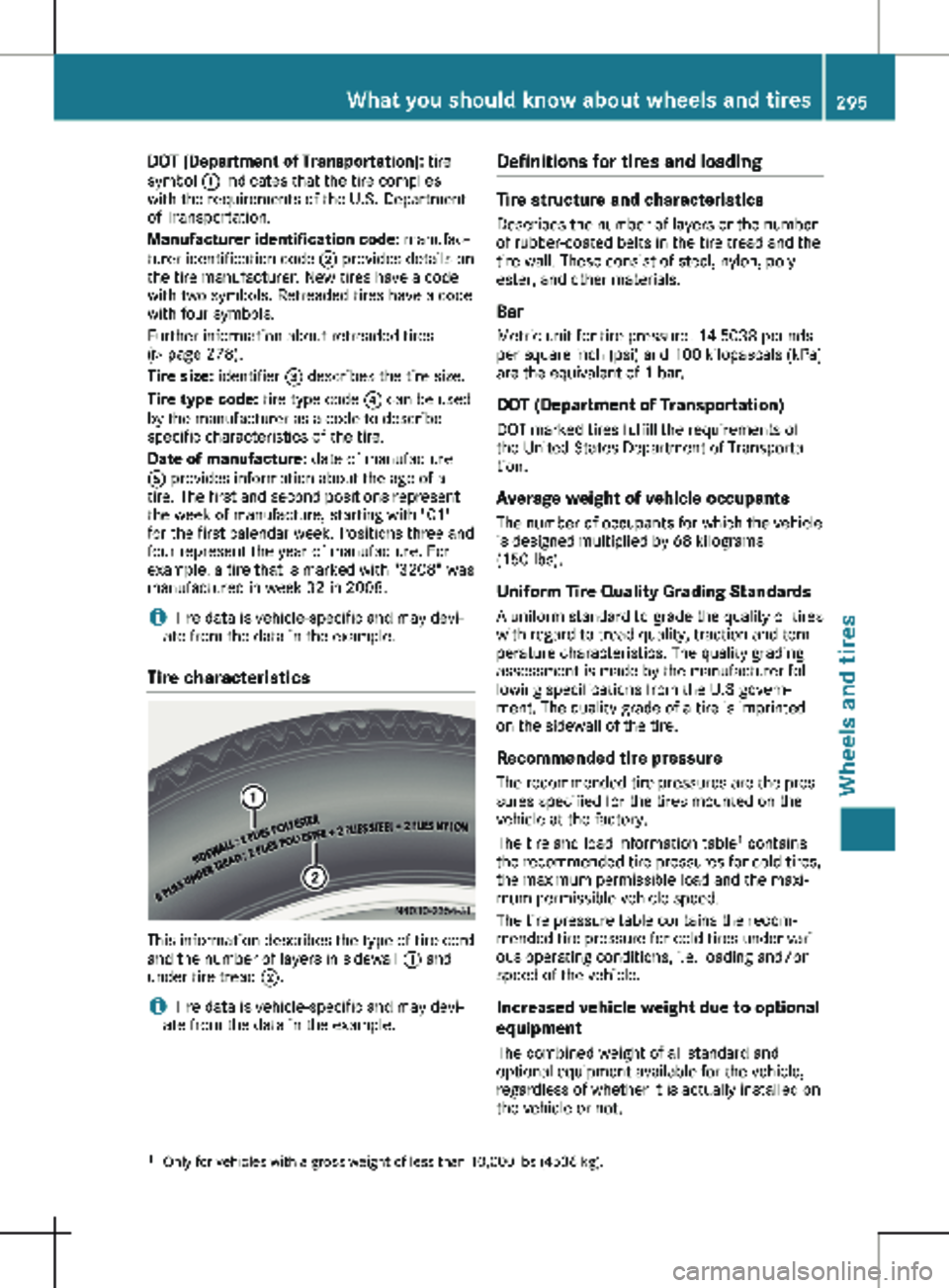
DOT (Department of Transportation):
tire
symbol : indicates that the tire complies
with the requirements of the U.S. Department
of Transportation.
Manufacturer identification code: manufac-
turer identification code ; provides details on
the tire manufacturer. New tires have a code
with two symbols. Retreaded tires have a code
with four symbols.
Further information about retreaded tires
(Y page
278).
Tire size: identifier = describes the tire size.
Tire type code: tire type code ? can be used
by the manufacturer as a code to describe
specific characteristics of the tire.
Date of manufacture: date of manufacture
A provides information about the age of a
tire. The first and second positions represent
the week of manufacture, starting with "01"
for the first calendar week. Positions three and
four represent the year of manufacture. For
example, a tire that is marked with "3208" was
manufactured in week 32 in 2008.
i Tire data is vehicle-specific and may devi-
ate from the data in the example.
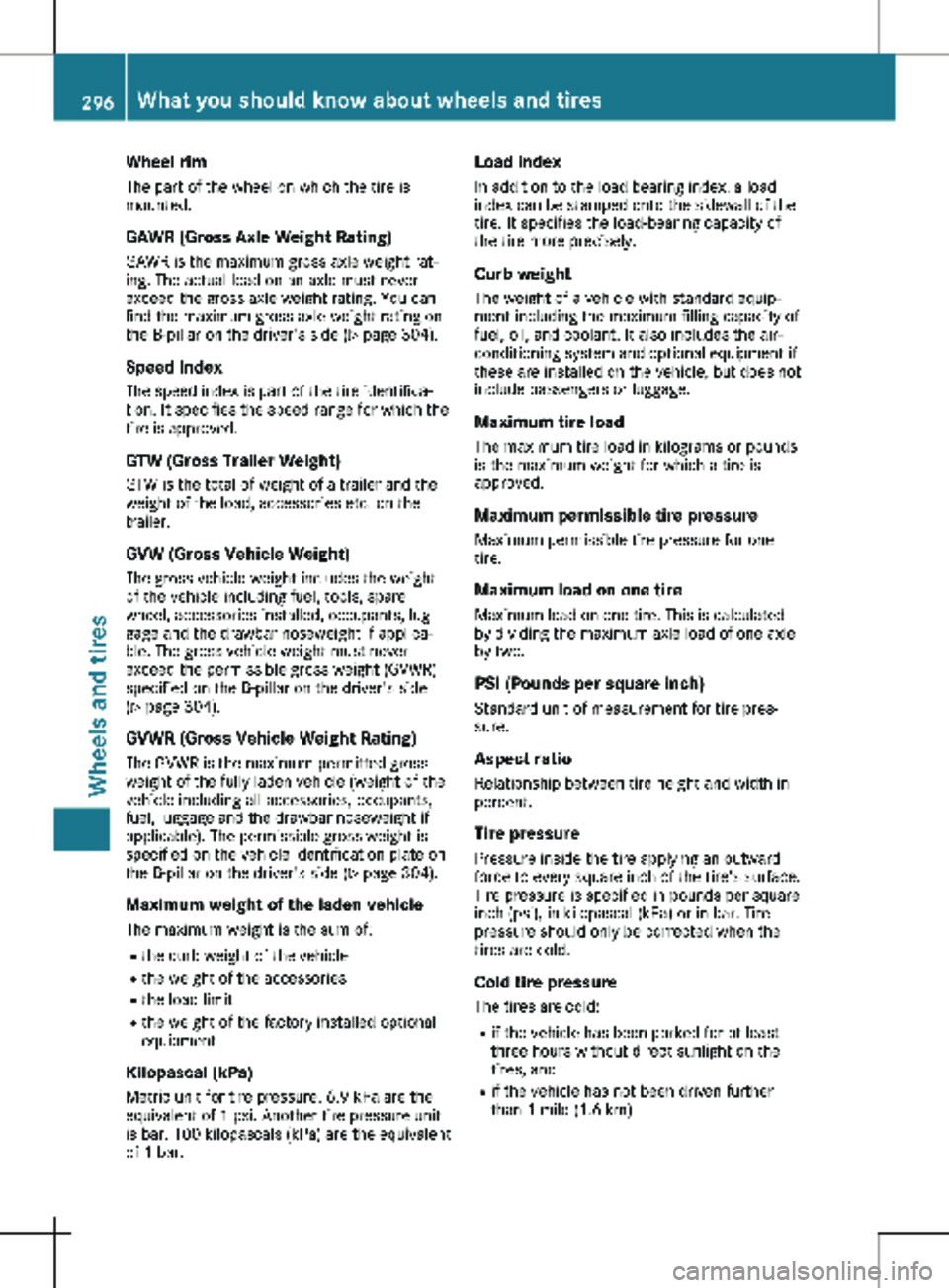
Tire characteristics This information describes the type of tire cord
and the number of layers in sidewall : and
under tire tread ;.
i Tire data is vehicle-specific and may devi-
ate from the data in the example. Definitions for tires and loading Tire structure and characteristics
Describes the number of layers or the number
of rubber-coated belts in the tire tread and the
tire wall. These consist of steel, nylon, poly-
ester, and other materials.
Bar
Metric unit for tire pressure.
14.5038 pounds
per square inch (psi) and 100 kilopascals (kPa)
are the equivalent of 1 bar.
DOT (Department of Transportation)
DOT marked tires fulfill the requirements of
the United States Department of Transporta-
tion.
Average weight of vehicle occupantsThe number of occupants for which the vehicle
is designed multiplied by 68 kilograms
(150 lbs).
Uniform Tire Quality Grading Standards A uniform standard to grade the quality of tires
with regard to tread quality, traction and tem-
perature characteristics. The quality grading
assessment is made by the manufacturer fol-
lowing specifications from the U.S govern-
ment. The quality grade of a tire is imprinted
on the sidewall of the tire.
Recommended tire pressure
The recommended tire pressures are the pres-
sures specified for the tires mounted on the
vehicle at the factory.
The tire and load information table 1
contains
the recommended tire pressures for cold tires,
the maximum permissible load and the maxi-
mum permissible vehicle speed.
The tire pressure table contains the recom-
mended tire pressure for cold tires under vari-
ous operating conditions, i.e. loading and/or
speed of the vehicle.
Increased vehicle weight due to optional
equipment
The combined weight of all standard and
optional equipment available for the vehicle,
regardless of whether it is actually installed on
the vehicle or not.
1 Only for vehicles with a gross weight of less than
10,000 lbs (4536 kg).What you should know about wheels and tires
295
Wheels and tires Z
Page 298 of 320
Wheel rim
The part of the wheel on which the tire is
mounted.
GAWR (Gross Axle Weight Rating) GAWR is the maximum gross axle weight rat-
ing. The actual load on an axle must never
exceed the gross axle weight rating. You can
find the maximum gross axle weight rating on
the
B-pillar on the driver's side ( Y page 304).
Speed index The speed index is part of the tire identifica-
tion. It specifies the speed range for which the
tire is approved.
GTW (Gross Trailer Weight) GTW is the total of weight of a trailer and the
weight of the load, accessories etc. on the
trailer.
GVW (Gross Vehicle Weight)
The gross vehicle weight includes the weight
of the vehicle including fuel, tools, spare
wheel, accessories installed, occupants, lug-
gage and the drawbar noseweight if applica-
ble. The gross vehicle weight must never
exceed the permissible gross weight (GVWR)
specified on the B-pillar on the driver's side
(Y page 304).
GVWR (Gross Vehicle Weight Rating) The GVWR is the maximum permitted gross
weight of the fully laden vehicle (weight of the
vehicle including all accessories, occupants,
fuel, luggage and the drawbar noseweight if
applicable). The permissible gross weight is
specified on the vehicle identification plate on
the B-pillar on the driver's side (Y page 304).
Maximum weight of the laden vehicle
The maximum weight is the sum of:
R the curb weight of the vehicle
R the weight of the accessories
R the load limit
R the weight of the factory installed optional
equipment
Kilopascal (kPa) Metric unit for tire pressure. 6.9 kPa are the
equivalent of 1 psi. Another tire pressure unit
is bar. 100 kilopascals (kPa) are the equivalent
of 1 bar. Load index
In addition to the load bearing index, a load
index can be stamped onto the sidewall of the
tire. It specifies the load-bearing capacity of
the tire more precisely.
Curb weight The weight of a vehicle with standard equip-
ment including the maximum filling capacity of
fuel, oil, and coolant. It also includes the air-
conditioning system and optional equipment if
these are installed on the vehicle, but does not
include passengers or luggage.
Maximum tire load
The maximum tire load in kilograms or pounds
is the maximum weight for which a tire is
approved.
Maximum permissible tire pressure
Maximum permissible tire pressure for one
tire.
Maximum load on one tire
Maximum load on one tire. This is calculated
by dividing the maximum axle load of one axle
by two.
PSI (Pounds per square inch)
Standard unit of measurement for tire pres-
sure.
Aspect ratioRelationship between tire height and width in
percent.
Tire pressure
Pressure inside the tire applying an outward
force to every square inch of the tire's surface.
Tire pressure is specified in pounds per square
inch (psi), in kilopascal (kPa) or in bar. Tire
pressure should only be corrected when the
tires are cold.
Cold tire pressure The tires are cold:
R if the vehicle has been parked for at least
three hours without direct sunlight on the
tires, and
R if the vehicle has not been driven further
than
1 mile (1.6 km)296
What you should know about wheels and tires
Wheels and tires
Page 299 of 320
Tire tread
The part of the tire that comes into contact
with the road.
Tire bead
The tire bead ensures that the tire sits
securely on the wheel. There are several steel
wires in the bead to prevent the tire from com-
ing loose from the wheel rim.
SidewallThe part of the tire between the tread and the
tire bead.
Weight of optional extras The combined weight of those optional extras
that weigh more than the replaced standard
parts and more than 2.3 kg
(5 lbs). These
optional extras, such as high-performance
brakes, a roof rack or a high-performance bat-
tery, are not included in the curb weight and
the weight of the accessories.
TIN (Tire Identification Number) A unique identification number which can be
used by a tire manufacturer to identify tires,
for example for a product recall, and thus iden-
tify the purchasers. The TIN is composed of
the manufacturer identification code, tire size,
tire model code and manufacturing date.
Load bearing index
The load bearing index (also load index) is a
code that contains the maximum load bearing
capacity of a tire.
Traction
Traction is the result of friction between the
tires and the road surface.
TWR (permissible trailer drawbar load)
The TWR is the maximum permissible weight
that may act on the ball coupling of the trailer
tow hitch.
Wear indicator Narrow bars (tread wear bars) that are distrib-
uted over the tire tread. If the tire tread is level
with the bars, the wear limit of á in (1.6 mm)
has been reached. Distribution of the vehicle occupants
The distribution of vehicle occupants over des-
ignated seat positions in a vehicle.
Maximum permissible payload weightNominal load and goods/luggage load plus
68 kg (150 lbs) multiplied by the number of
seats in the vehicle. Changing wheels
Rotating the wheels
! On vehicles equipped with a tire pressure
monitor, electronic components are located
in the wheel.
Tire-mounting tools should not be used near
the valve. This could damage the electronic
components.
Only have tires changed at a qualified spe-
cialist workshop.
Always observe the instructions and safety
notes under "Mounting a wheel"
(Y page
298).
The wear patterns on the front and rear tires
differ, depending on the operating conditions.
Rotate the wheels before a clear wear pattern
has formed on the tires. Front tires typically
wear more on the shoulders and the rear tires
in the center.
If your vehicle's tire configuration allows, you
can rotate the tires according to the intervals
in the tire manufacturer's warranty book in
your vehicle documents. If no warranty book is
available, the tires should be rotated every
3,000 to 6,000 miles (5,000 to 10,000 km) or
earlier if tire wear requires. Do not change the
direction of rotation.
Clean the contact surfaces of the wheel and
the brake disc thoroughly every time a wheel
is rotated. Avoid oily or greasy cleaning
agents.
Check the tire pressure and reactivate the tire
pressure monitor if necessary. Direction of rotation
Tires with a specified direction of rotation have
additional benefits, e.g. if there is a risk of
hydroplaning. You will only gain these benefits
if the correct direction of rotation is observed. Changing wheels
297
Wheels and tires Z
Page 306 of 320
Useful information
This Operator's Manual describes all models
as well as standard and optional equipment of
your vehicle that were available at the time of
going to print. Country-specific variations are
possible. Note that your vehicle may not be
equipped with all of the described functions.
This also applies to systems and functions rel-
evant to safety.
Read the information on qualified specialist
workshops (Y page
32).Vehicle electronics
Tampering with the engine electron-
ics
! Have work carried out on the engine elec-
tronics and its associated parts, such as
control units, sensors, actuating compo-
nents and fuel lines, only at a qualified spe-
cialist workshop. Vehicle components may
otherwise wear more quickly. This can lead
to the loss of the New Vehicle Limited War-
ranty. Installing electrical or electronic
equipment
You and others can suffer health-related dam-
age through electromagnetic radiation. By
using an exterior antenna, a possible health
risk caused by electromagnetic fields, as dis-
cussed in scientific circles, is taken into
account. Only have the exterior antenna instal-
led by a qualified specialist workshop.
Electrical and electronic devices may have a
detrimental effect on both the comfort and the
operating safety of the vehicle. If equipment of
this kind is installed, its electromagnetic com-
patibility must be checked and verified.
If these devices are linked to functions associ-
ated with resistance to interference, they must
have type approval. This applies to the device
or its interfaces to the vehicle electronics, e.g.
charging brackets.
A telephone or two-way radio to be installed in
the vehicle must be approved. You can obtain
further information from any Mercedes-Benz
Commercial Van Center. For operation of mobile phones and two-way
radios, Mercedes-Benz recommends connec-
tion to an approved exterior antenna. This is
the only way to ensure optimum reception
quality inside the vehicle and to minimize
mutual interference between the vehicle elec-
tronics, mobile phones and two-way radios.
The transmission output of the mobile phone
or two-way radio may not exceed the following
maximum transmission output (PEAK): Frequency range Maximum trans-
mission output
(PEAK)
Shortwave
(f < 50 MHz
) 100 W
4 m waveband 30 W
2 m waveband 50 W
Trunked radio/Tetra 35 W
70 cm waveband 35 W
GSM/UMTS/LTE 10 W
Identification plates
Vehicle identification plate with
vehicle identification number (VIN)
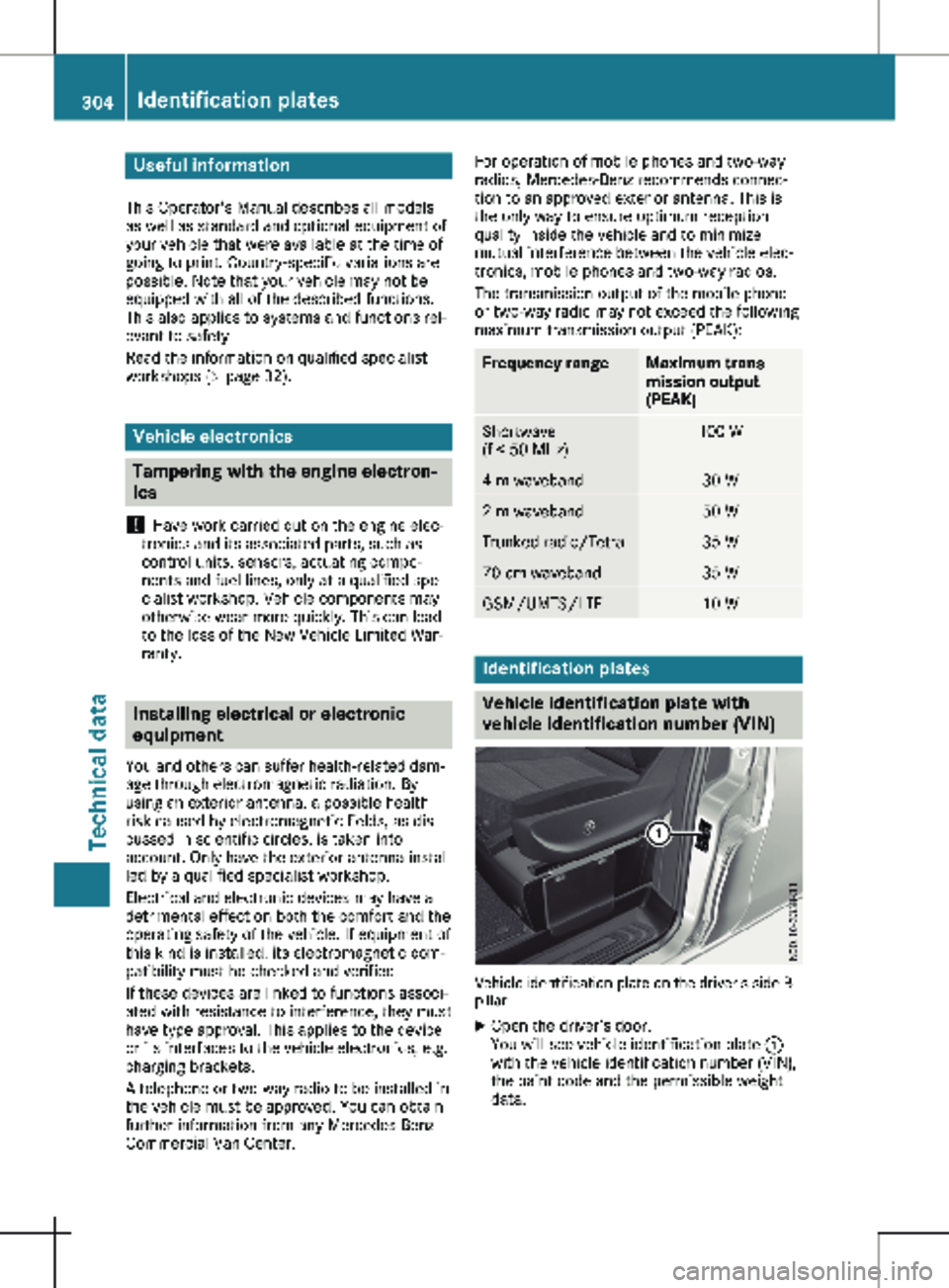
Vehicle identification plate on the driver's side B-
pillar
X Open the driver’s door.
You will see vehicle identification plate :
with the vehicle identification number (VIN),
the paint code and the permissible weight
data. 304
Identification plates
Technical data