weight MERCEDES-BENZ METRIS 2020 MY20 Operator’s Manual
[x] Cancel search | Manufacturer: MERCEDES-BENZ, Model Year: 2020, Model line: METRIS, Model: MERCEDES-BENZ METRIS 2020Pages: 320, PDF Size: 26.38 MB
Page 314 of 320
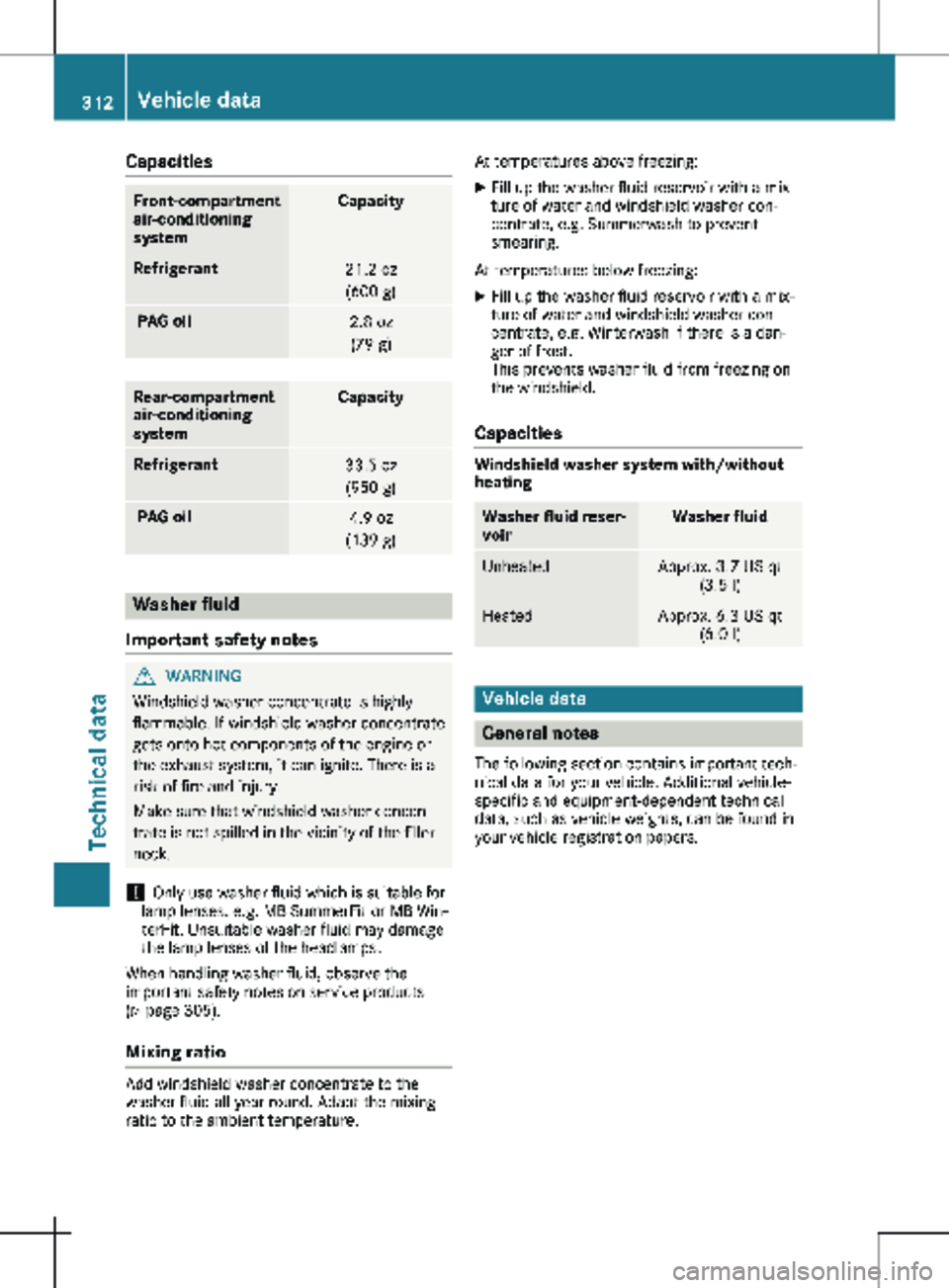
Capacities
Front-compartment
air-conditioning
system Capacity
Refrigerant
21.2 oz
(600 g) PAG oil
2.8 oz
( 79 g) Rear-compartment
air-conditioning
system Capacity
Refrigerant
33.5 oz
(950 g) PAG oil
4.9 oz
(139 g) Washer fluid
Important safety notes G
WARNING
Windshield washer concentrate is highly
flammable. If windshield washer concentrate
gets onto hot components of the engine or
the exhaust system, it can ignite. There is a
risk of fire and injury.
Make sure that windshield washer concen-
trate is not spilled in the vicinity of the filler
neck.
! Only use washer fluid which is suitable for
lamp lenses, e.g. MB SummerFit or MB Win-
terFit. Unsuitable washer fluid may damage
the lamp lenses of the headlamps.
When handling washer fluid, observe the
important safety notes on service products
(Y page
305).
Mixing ratio Add windshield washer concentrate to the
washer fluid all year round. Adapt the mixing
ratio to the ambient temperature. At temperatures above freezing:
X Fill up the washer fluid reservoir with a mix-
ture of water and windshield washer con-
centrate, e.g. Summerwash to prevent
smearing.
At temperatures below freezing:
X Fill up the washer fluid reservoir with a mix-
ture of water and windshield washer con-
centrate, e.g. Winterwash if there is a dan-
ger of frost.
This prevents washer fluid from freezing on
the windshield.
Capacities Windshield washer system with/without
heating
Washer fluid reser-
voir Washer fluid
Unheated Approx. 3.7 US qt
(3.5 l) Heated Approx. 6.3 US qt
(6.0 l) Vehicle data
General notes
The following section contains important tech-
nical data for your vehicle. Additional vehicle-
specific and equipment-dependent technical
data, such as vehicle weights, can be found in
your vehicle registration papers. 312
Vehicle data
Technical data
Page 316 of 320
If you brake hard, for example, the forces
acting could be up to several times the
weight force of the load. Always use multi-
ple cargo tie-down points in order to distrib-
ute the force absorption. Load the ancho-
rages evenly.
You will find additional information about
cargo tie-down points and cargo tie-down rings
in the "Securing loads" section
(Y page 244).
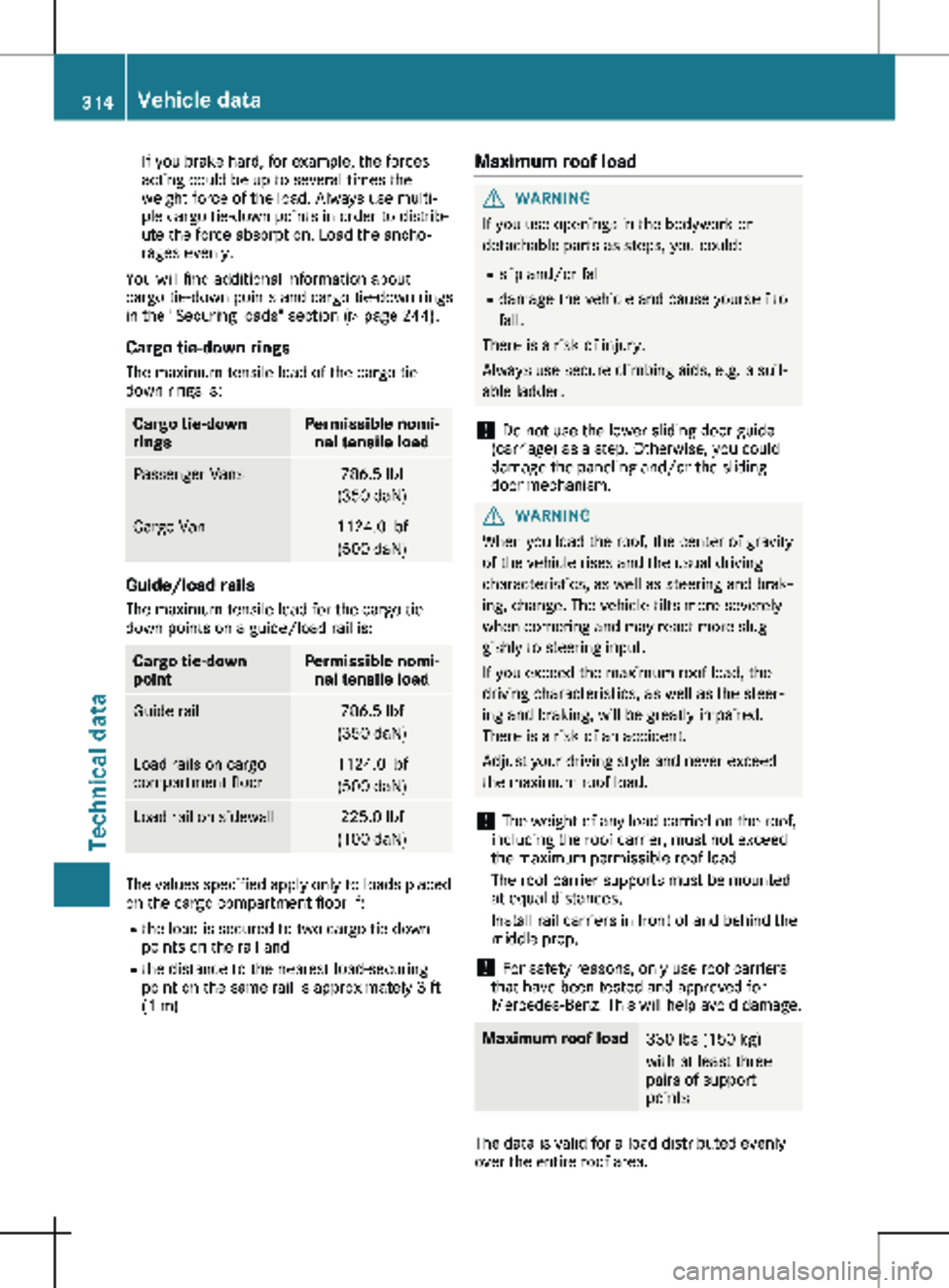
Cargo tie-down rings
The maximum tensile load of the cargo tie-
down rings is: Cargo tie-down
rings Permissible nomi-
nal tensile load Passenger Vans 786.5 lbf
(350 daN) Cargo Van 1124.0 lbf
(500 daN) Guide/load rails
The maximum tensile load for the cargo tie-
down points on a guide/load rail is: Cargo tie-down
point Permissible nomi-
nal tensile load Guide rail 786.5 lbf
(350 daN) Load rails on cargo
compartment floor 1124.0 lbf
(500 daN) Load rail on sidewall 225.0 lbf
(100 daN) The values specified apply only to loads placed
on the cargo compartment floor if:
R the load is secured to two cargo tie-down
points on the rail and
R the distance to the nearest load-securing
point on the same rail is approximately
3 ft
(1 m) Maximum roof load G
WARNING
If you use openings in the bodywork or
detachable parts as steps, you could:
R slip and/or fall
R damage the vehicle and cause yourself to
fall.
There is a risk of injury.
Always use secure climbing aids, e.g. a suit-
able ladder.
! Do not use the lower sliding door guide
(carriage) as a step. Otherwise, you could
damage the paneling and/or the sliding
door mechanism. G
WARNING
When you load the roof, the center of gravity
of the vehicle rises and the usual driving
characteristics, as well as steering and brak-
ing, change. The vehicle tilts more severely
when cornering and may react more slug-
gishly to steering input.
If you exceed the maximum roof load, the
driving characteristics, as well as the steer-
ing and braking, will be greatly impaired.
There is a risk of an accident.
Adjust your driving style and never exceed
the maximum roof load.
! The weight of any load carried on the roof,
including the roof carrier, must not exceed
the maximum permissible roof load.
The roof carrier supports must be mounted
at equal distances.
Install rail carriers in front of and behind the
middle prop.
! For safety reasons, only use roof carriers
that have been tested and approved for
Mercedes-Benz. This will help avoid damage. Maximum roof load
330 lbs (150 kg)
with at least three
pairs of support
points
The data is valid for a load distributed evenly
over the entire roof area. 314
Vehicle data
Technical data
Page 317 of 320
Reduce the load on shorter roof carriers pro-
portionately. The maximum load per pair of
roof carrier supports is
110 lbs (50 kg). The
maximum load of a rail carrier bar is 220 lbs
(100 kg).
Loading guidelines and other information con-
cerning load distribution and load securing can
be found in the "Transporting" section
(Y page 242). Trailer tow hitch
General notes Mercedes-Benz recommends having a trailer
tow hitch retrofitted at an authorized
Mercedes-Benz Van Dealer.
Use only a trailer tow hitch that has been tes-
ted and approved specially for your vehicle by
the distributor named on the inside of the
front cover. Only use a ball coupling for your
Metris trailer tow hitch if it has been approved
for your vehicle. You can also find information
on the permitted dimensions of the ball cou-
pling on the identification plate of the trailer
tow hitch.
You can obtain advice from a qualified special-
ist workshop. Also observe the information on
towing a trailer in the "Driving and parking"
section (Y page
168).
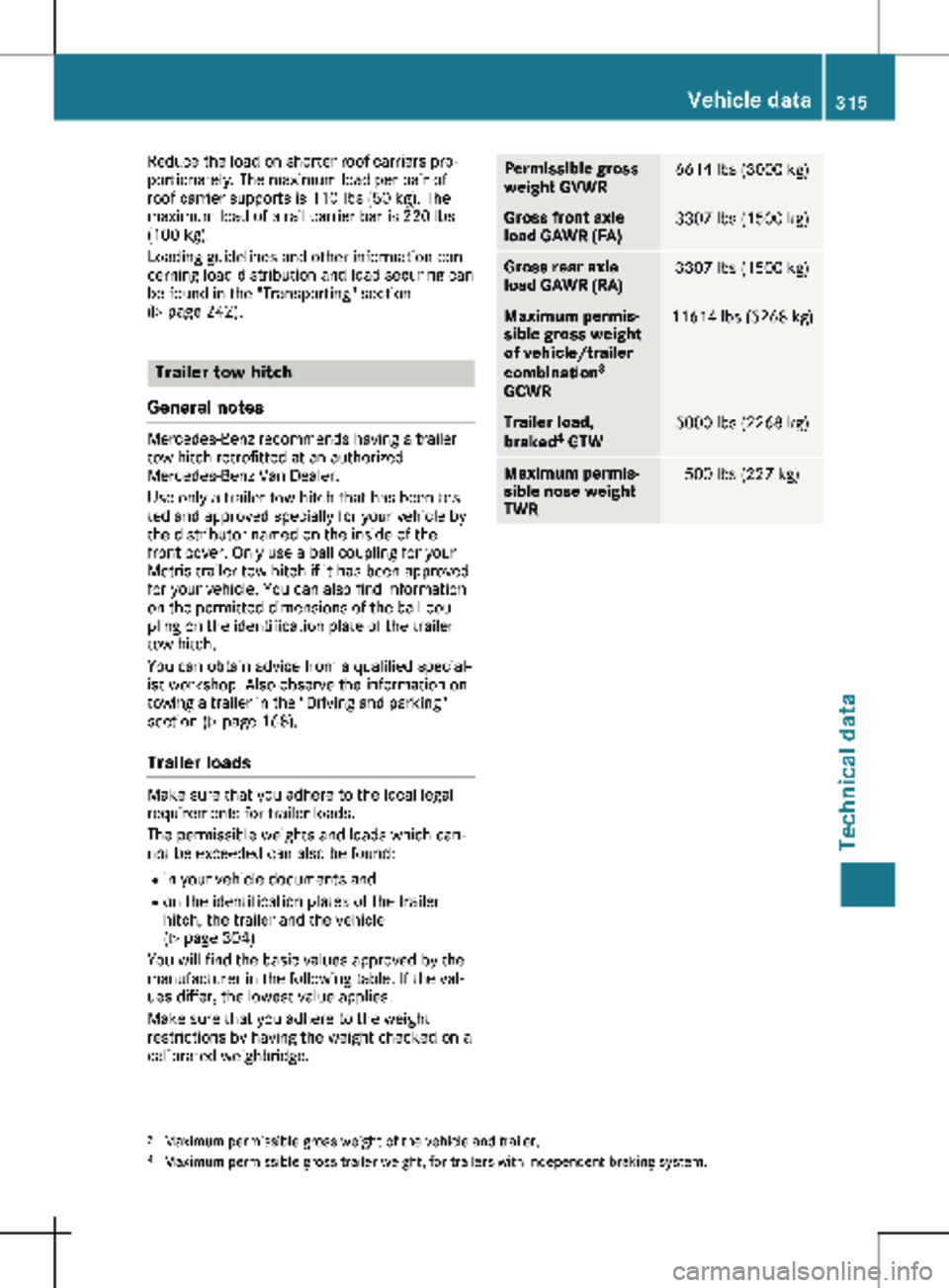
Trailer loads Make sure that you adhere to the local legal
requirements for trailer loads.
The permissible weights and loads which can-
not be exceeded can also be found:
R in your vehicle documents and
R on the identification plates of the trailer
hitch, the trailer and the vehicle
(Y page
304)
You will find the basic values approved by the
manufacturer in the following table. If the val-
ues differ, the lowest value applies.
Make sure that you adhere to the weight
restrictions by having the weight checked on a
calibrated weighbridge. Permissible gross
weight GVWR
6614 lbs (3000 kg)
Gross front axle
load GAWR (FA)
3307 lbs (1500 kg)
Gross rear axle
load GAWR (RA)
3307 lbs (1500 kg)
Maximum permis-
sible gross weight
of vehicle/trailer
combination
3
GCWR 11614 lbs (5268 kg)
Trailer load,
braked
4
GTW 5000 lbs (2268 kg)
Maximum permis-
sible nose weight
TWR
500 lbs (227 kg)
3
Maximum permissible gross weight of the vehicle and trailer.
4 Maximum permissible gross trailer weight, for trailers with independent braking system. Vehicle data
315
Technical data Z