weight MERCEDES-BENZ METRIS 2020 MY20 Operator’s Manual
[x] Cancel search | Manufacturer: MERCEDES-BENZ, Model Year: 2020, Model line: METRIS, Model: MERCEDES-BENZ METRIS 2020Pages: 320, PDF Size: 26.38 MB
Page 70 of 320
EBD (electronic brake force distribu-
tion)
General notes EBD monitors and controls the brake pressure
to the rear wheels. This enables EBD to
improve handling during braking.
Important safety notes Observe the important safety guidelines for
the driving safety system
(Y page 66).G
WARNING
If EBD is malfunctioning, the rear wheels can
lock, e.g. under full braking. This increases
the risk of skidding and an accident.
You should therefore adapt your driving
style to the different handling characteris-
tics. Have the brake system checked at a
qualified specialist workshop.
If EBD is malfunctioning, the $ warning
lamp
(Y page 229) lights up while the engine
is running and the display shows a message:
R on vehicles without steering wheel buttons
(Y page 199)
R on vehicles with steering wheel buttons
(Y page 213)
Other driving systems and driving safety sys-
tems then also fail. ESP
®
(Electronic Stability Program)
General notes ESP
®
monitors driving stability and detects a
tendency of the vehicle to understeer or over-
steer (skidding) in good time. If ESP ®
detects
that the vehicle is deviating from the direction
desired by the driver, one or more wheels are
braked to stabilize the vehicle. The engine out-
put is also modified to keep the vehicle on the
desired course within physical limits. ESP ®
can
also stabilize the vehicle during braking.
ESP ®
also monitors traction, i.e. power trans-
mission between the tires and the road sur-
face. The integrated traction control supports
you when pulling away or accelerating on wet,
slippery or slick roads. Should the drive
wheels spin, traction control brakes them indi- vidually. In addition, greater drive torque is
transmitted to the wheel or wheels with trac-
tion. If traction on the road surface is not suffi-
cient, even ESP
®
will not allow you to pull
away without difficulty. The type of tires and
total weight of the vehicle as well as the gradi-
ent of the road also play a crucial role. Trac-
tion control remains active if you deactivate
ESP ®
.
If the h warning lamp in the instrument
cluster goes out before beginning the journey,
ESP ®
is automatically active.
The h warning lamp in the instrument clus-
ter flashes when ESP ®
intervenes:
X do not deactivate ESP ®
under any circum-
stances.
X when driving off, apply as little throttle as
possible.
X adapt your speed and driving style to the
prevailing road conditions.
Important safety notes Observe the important safety guidelines for
the driving safety system (
Y page
66). G
WARNING
If ESP ®
is malfunctioning it will not provide
any vehicle stabilization. There is an
increased risk of skidding or of an accident.
Exercise caution when continuing to drive.
Have ESP ®
checked at a qualified specialist
workshop.
! Do not run the vehicle on a roller dyna-
mometer (e.g. for performance tests). If you
must operate the vehicle on a roller dyna-
mometer, please consult a qualified special-
ist workshop in advance. You could other-
wise damage the drive train or the brake
system.
If ESP ®
is malfunctioning, the h warning
lamp
(Y page 230) lights up continuously
while the engine is running and the display
shows a message.
R on vehicles without steering wheel buttons
(Y page 200)
R on vehicles with steering wheel buttons
(Y page 214) 68
Driving safety systems
Safety
Page 171 of 320
Ensure that the following weights are not
exceeded:
R the permissible noseweight
R the permissible trailer load
R the permissible rear axle load of the towing
vehicle
R the maximum permissible gross vehicle
weight of both the towing vehicle and the
trailer
R the maximum permissible gross weight of
vehicle/trailer combination
The applicable permissible values that may not
be exceeded can be found:
R in your vehicle documents
R on the type plates for the trailer tow hitch
R on the type plates for the trailer
R on the vehicle identification plate
(Y page
304)
Where the values differ, the lowest is valid.
You will find the values approved by the manu-
facturer on the vehicle identification plates
and those for the towing vehicle in the "Tech-
nical data" section (Y page 315).
Your vehicle behaves differently with a trailer
than without one.
The vehicle/trailer combination:
R is heavier
R is restricted in its acceleration and gradient-
climbing capability
R has an increased braking distance
R is more susceptible to strong crosswinds
R requires more sensitive steering
R has a larger turning radius
This may impair the handling characteristics.
When towing a trailer, always adjust your
speed to suit the road and weather conditions.
Drive carefully. Maintain a safe distance.
If you require any further explanation regard-
ing the information contained in the Operating
Instructions, please contact a Mercedes-Benz
Commercial Van Center.
General notes R
Observe the legally permitted maximum
speed for vehicle/trailer combinations in
the relevant country, state or Canadian
province. Before beginning the journey,
check the trailer's documents for the maxi-
mum permitted speed of your trailer. This reduces the risk of accidents.
R Install only an approved trailer coupling on
your vehicle. Only use a ball coupling for
your Metris trailer tow hitch if it has been
approved for your vehicle. More information
on the availability, mounting and installation
of the trailer electrics is available at any
qualified specialist workshop.
R The trailer coupling is one of the most
important vehicle parts with regard to road
safety. Observe the notes on operation, care
and maintenance of the trailer tow hitch
(see the manufacturer's operating instruc-
tions).
R The bumpers of your vehicle are not suitable
for installing detachable trailer couplings.
R Do not attach rented trailer tow hitches or
other detachable trailer tow hitches to the
bumper.
R Minimize the risk of damage to the ball cou-
pling. If you do not require the ball coupling,
remove it from the ball coupling recess.
You will find weight information under "Techni-
cal data"
(Y page 315).
The height of the ball neck changes according
to the load on the vehicle. If this is case, use a
trailer with a height-adjustable trailer drawbar.
Driving tips The maximum permissible speed for vehicle/
trailer combination depends on the type of
trailer. Before beginning the journey, check
the trailer's documents for the maximum per-
mitted speed of your trailer. Observe the
legally permitted maximum speed in the rele-
vant country, state or Canadian province.
When towing a trailer, your vehicle's handling
characteristics will be different in comparison
to when driving without a trailer and it will con-
sume more fuel.
On long and steep downhill gradients, select a
lower gear.
i This also applies if cruise control is activa-
ted.
This enables you to utilize the engine's braking
effect and you do not need to brake so heavily
to keep the correct speed. This relieves the
load on the brake system and prevents the
brakes from overheating and wearing too
quickly. If you need to brake additionally, to Towing a trailer
169
Driving and parking Z
Page 172 of 320
not depress the brake pedal constantly, but
periodically.
Observe the notes on ESP
®
trailer stabilization
( Y page
69).
Driving tips If the trailer begins to swing from side to side:
X Do not accelerate.
X Do not counter-steer.
X Brake if necessary.
i You can reduce the risk of the trailer
swinging and rocking by retrofitting anti-roll
bars or trailer stability programs. Further
information is available at your authorized
Mercedes-Benz Van Dealer.
R Maintain a greater distance than you would
when driving without towing a trailer.
R Avoid sudden braking. Apply the brakes gen-
tly at first to allow the trailer brake to over-
run. Then, increase the brake force quickly.
R The figures for the gradient climbing capa-
bilities from a standstill refer to sea level.
When driving in mountainous areas, note
that the power output of the engine, and
with it its gradient climbing capability,
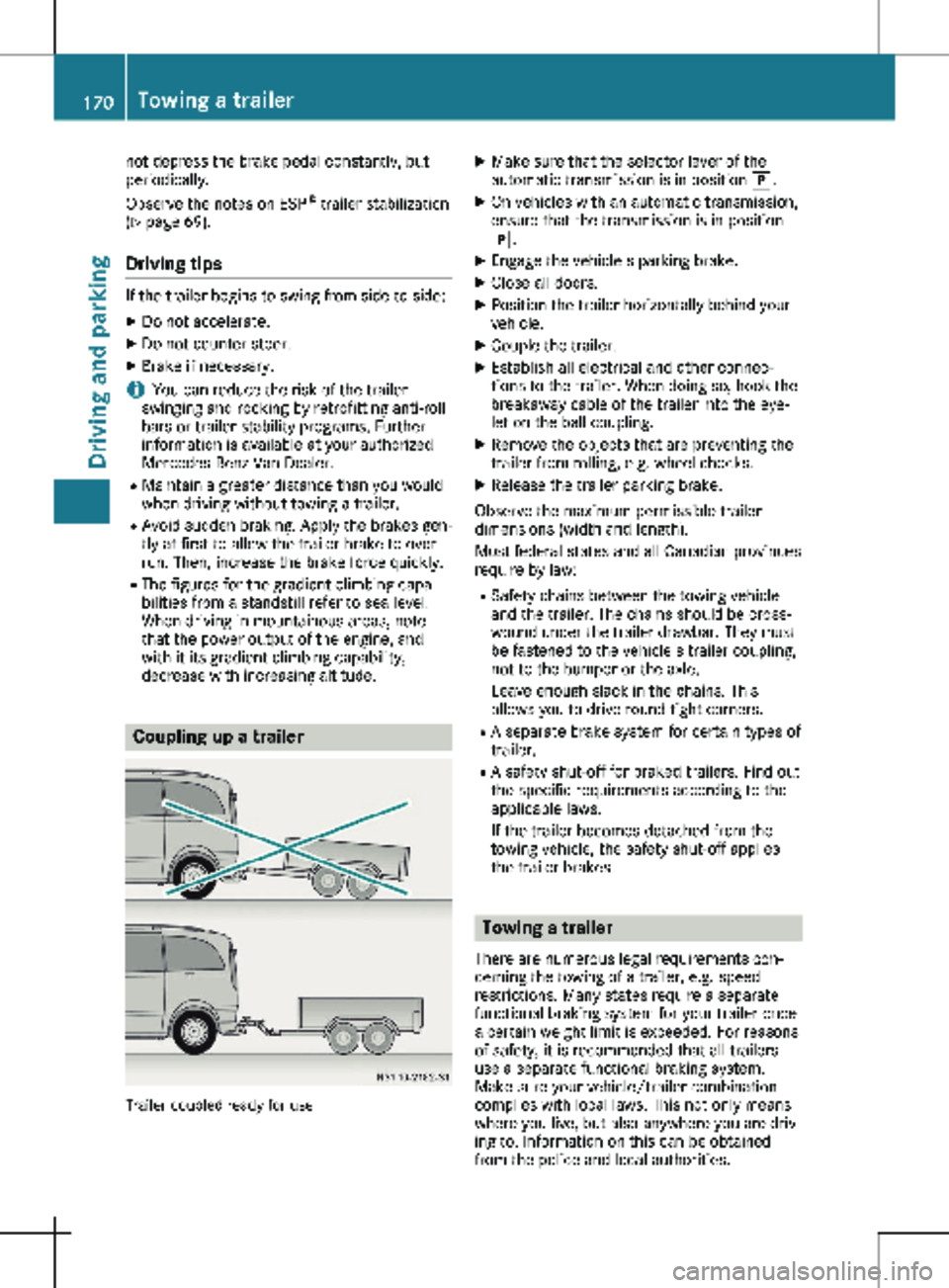
decrease with increasing altitude. Coupling up a trailer
Trailer coupled ready for use X
Make sure that the selector lever of the
automatic transmission is in position j.
X On vehicles with an automatic transmission,
ensure that the transmission is in position
j.
X Engage the vehicle's parking brake.
X Close all doors.
X Position the trailer horizontally behind your
vehicle.
X Couple the trailer.
X Establish all electrical and other connec-
tions to the trailer. When doing so, hook the
breakaway cable of the trailer into the eye-
let on the ball coupling.
X Remove the objects that are preventing the
trailer from rolling, e.g. wheel chocks.
X Release the trailer parking brake.
Observe the maximum permissible trailer
dimensions (width and length).
Most federal states and all Canadian provinces
require by law: R Safety chains between the towing vehicle
and the trailer. The chains should be cross-
wound under the trailer drawbar. They must
be fastened to the vehicle's trailer coupling,
not to the bumper or the axle.
Leave enough slack in the chains. This
allows you to drive round tight corners.
R A separate brake system for certain types of
trailer.
R A safety shut-off for braked trailers. Find out
the specific requirements according to the
applicable laws.
If the trailer becomes detached from the
towing vehicle, the safety shut-off applies
the trailer brakes. Towing a trailer
There are numerous legal requirements con-
cerning the towing of a trailer, e.g. speed
restrictions. Many states require a separate
functional braking system for your trailer once
a certain weight limit is exceeded. For reasons
of safety, it is recommended that all trailers
use a separate functional braking system.
Make sure your vehicle/trailer combination
complies with local laws. This not only means
where you live, but also anywhere you are driv-
ing to. Information on this can be obtained
from the police and local authorities. 170
Towing a trailer
Driving and parking
Page 174 of 320
Permissible trailer loads and trailer
drawbar noseweights
Weight information !
For vehicles with a permissible gross vehi-
cle weight of 6614 lbs (3000 kg), the per-
missible gross combination mass is less
than the sum of the permissible gross vehi-
cle weight plus the permissible trailer load.
Exceeding the permissible gross combina-
tion mass can lead to damage to the drive-
train, to the transmission or to the trailer
hitch.
If either the vehicle or the trailer is fully
laden, the permitted gross vehicle weight or
the permitted trailer load values are reduced
accordingly. In this case, you may only parti-
ally load the trailer or the vehicle.
The gross trailer weight (GTW) is calculated by
adding the weight of the trailer to the weight
of the load and equipment. If the trailer is
installed with a separate functional braking
system, then the maximum gross trailer weight
is 5000 lbs (2268 kg). G
WARNING
If you tow a trailer without a separate func-
tional braking system and a gross trailer
weight (GTW) of more than
1635 lbs
(750 kg), then the vehicle brake system may
overheat. This increases the braking dis-
tance and the brake system may even fail.
There is an increased risk of accident and
injury, possibly even fatal.
Always use a trailer with a separate func-
tional braking system when towing a trailer
with a gross trailer weight (GTW) of more
than 1635 lbs (750 kg).
The maximum noseweight of the trailer draw-
bar on the ball coupling is 500 lbs (227 kg).
The actual noseweight may not exceed the
value given on the identification plates of the
trailer tow hitch or the trailer. If the values
vary, the lowest value always applies.
The gross combination weight rating (GCWR) is
calculated by adding the gross weight of the
trailer to the gross vehicle weight including a
driver's weight of approximately 150 lbs
(68 kg). The permissible Gross Combination Weight Rating is vehicle-specific and depends
on the equipment level.
When driving with a trailer, you should not
exceed the permitted Gross Combination
Weight Rating (GCWR).
The permissible values, which must not be
exceeded, can be found in your vehicle docu-
ments and on the trailer tow hitch type plates
for the trailer and the vehicle (
Y page
304).
The basic values approved by the manufac-
turer can also be found in the "Technical data"
section ( Y page 315). If the values vary, the
lowest value always applies.
Loading a trailer !
Utilize the maximum permissible nose-
weight as fully as possible. Do not allow the
weight to fall below the minimum permissi-
ble noseweight, otherwise the trailer may
come loose.
R The load must be distributed over the vehi-
cle and the trailer so as not to exceed either
the maximum permissible values for the
gross vehicle weight rating (GVWR) and
gross trailer weight (GTW), the gross combi-
nation weight rating (GCWR), nor the maxi-
mum permissible gross axle weight rating
(GAWR) and trailer drawbar noseweight rat-
ing of your vehicle.
R Add the drawbar noseweight on the ball
coupling (TWR) to the rear axle load. This
will prevent you from exceeding the permis-
sible gross axle weight (GAWR).
R Add the drawbar noseweight on the ball
coupling (TWR) to the vehicle payload. This
will ensure that you do not exceed the per-
missible gross vehicle weight rating (GVWR).
Checking the vehicle and trailer
weight R
Make sure the weights of the towing vehicle
and the trailer comply with the maximum
permissible values. Have the vehicle/trailer
combination weighed on a calibrated weigh-
bridge. The vehicle/trailer combination con-
sists of the towing vehicle including the
driver, passengers and load, as well as the
loaded trailer.
R Check the maximum permissible gross axle
weight rating of the front and rear axles
(GAWR), the gross trailer weight (GTW), the
gross combination weight rating (GCWR) 172
Towing a trailer
Driving and parking
Page 175 of 320
and the noseweight of the trailer drawbar
(TWR).
Trailer power supply
! Incorrect wiring of the connector plug
could, under certain circumstances, cause
malfunctions in the vehicle's other elec-
tronic systems. We therefore recommend
having the connector plug wired at a quali-
fied specialist workshop.
! You can connect accessories with a maxi-
mum power consumption of 240 W
to the
permanent power supply.
You must not charge a trailer battery using
the power supply.
Your vehicle may be equipped with various
electrical installations for trailer towing.
Depending on your trailer, you may need an
adapter to connect the electrical system of the
trailer with that of the vehicle.
The trailer socket of your vehicle is equipped
at the factory with a permanent power supply.
The permanent power supply is on the trailer
socket pin assignment 4.
Note that the permanent power supply of the
trailer is not switched off when the on-board
voltage is low. This can completely discharge
the starter battery of your vehicle.
Further information on the electrical equip-
ment currently installed on your vehicle and on
installing trailer electrics can be obtained at
any qualified specialist workshop. Towing a trailer
173
Driving and parking Z
Page 199 of 320
Display messages
Possible causes/consequences and
M SolutionsFront Passenger
Airbag Disabled
+ The co-driver's air bag is deactivated during the journey even
though the co-driver's seat is occupied by an adult or a person with
a stature corresponding to that of an adult.
If additional forces are applied to the seat or the occupant is not sit-
ting on the seat properly (Y page
54), the weight the system
detects may be too low.
G WARNING
The co-driver's front air bag will not deploy in the event of an acci-
dent.
There is an increased risk of injury.
X Stop the vehicle immediately, paying attention to road and traffic
conditions.
X Secure the vehicle to prevent it from rolling away ( Y page
138).
X Switch off the ignition.
X The co-driver must get out of the vehicle.
X Make sure that the co-driver's seat is unoccupied, close the co-
driver's door and switch on the ignition.
X Observe the PASSENGER AIRBAG OFF indicator lamp in the cen-
ter console and the display messages and check the following:
Seat unoccupied and ignition switched on: R The PASSENGER AIRBAG OFF indicator lamp must light up contin-
uously. If the indicator lamp is on, the Occupant Classification
System (OCS) has disabled the co-driver's air bag
(Y page 54).
R The display must not show the messages Front Passenger
Airbag Enabled or Front Passenger Airbag Disabled.
X Wait for at least one minute until the necessary system checks
have been completed.
X Ensure that the display does not show either of the two display
messages about the co-driver's front air bag.
If these conditions are met, the co-driver's seat can be occupied
again.
If these conditions are not met, the Occupant Classification System
(OCS) is malfunctioning.
X Visit a qualified specialist workshop immediately.
Further information on the Occupant Classification System (OCS)
can be found under "Occupant Classification System (OCS)"
(Y page
54). Display messages (vehicles without steering wheel buttons)
197
On-board computer and displays Z
Page 200 of 320
Display messages
Possible causes/consequences and
M SolutionsFront Passenger
Airbag Enabled
+ The co-driver's front air bag is enabled during the journey even
though the co-driver's seat:
R is occupied by a child in a child restraint system, or a person of
small stature
or
R is not occupied.
The system may detect objects or forces that are adding to the
weight applied to the seat.
G WARNING
The co-driver's air bag may deploy unintentionally.
There is an increased risk of injury.
X Stop the vehicle immediately, paying attention to road and traffic
conditions.
X Secure the vehicle to prevent it from rolling away ( Y page 138).
X Switch off the ignition.
X Open the front-passenger door.
X Remove the child and the child restraint system from the co-driv-
er's seat.
X Make sure there are no objects applying additional weight to the
seat.
The system may otherwise detect the additional weight and inter-
pret the vehicle seat occupant's weight as greater than it actually
is.
X Make sure that the co-driver's seat is unoccupied, close the co-
driver's door and switch on the ignition.
X Observe the PASSENGER AIRBAG OFF indicator lamp in the cen-
ter console and the display and check the following:
Seat unoccupied and ignition switched on:
R The PASSENGER AIRBAG OFF indicator lamp must light up contin-
uously. If the indicator lamp is on, the Occupant Classification
System (OCS) has disabled the co-driver's air bag
(Y page 54).
R The display must not show the messages Front Passenger
Airbag Enabled or Front Passenger Airbag Disabled.
X Wait for at least one minute until the necessary system checks
have been completed.
X Ensure that the display does not show either of the two display
messages about the co-driver's front air bag.
If these conditions are met, the co-driver's seat can be occupied
again. Observe the notes on the Occupant Classification System
(OCS)
(Y page 54).
If these conditions are not met, the Occupant Classification System
(OCS) is malfunctioning.
X Install the child restraint system on a suitable rear seat.
or X Seat a person of smaller stature on a suitable rear seat.198
Display messages (vehicles without steering wheel buttons)
On-board computer and displays
Page 213 of 320
Display messages
Possible causes/consequences and
M SolutionsFront Passenger
Airbag Disabled
See Operator's Man‐
ual The co-driver's air bag is deactivated during the journey even
though the co-driver's seat is occupied by an adult or a person with
a stature corresponding to that of an adult.
If additional forces are applied to the seat or the occupant is not sit-
ting on the seat properly (Y page
54), the weight the system
detects may be too low.
G WARNING
The co-driver's front air bag will not deploy in the event of an acci-
dent.
There is an increased risk of injury.
X Stop the vehicle immediately, paying attention to road and traffic
conditions.
X Secure the vehicle to prevent it from rolling away ( Y page
138).
X Switch off the ignition.
X The co-driver must get out of the vehicle.
X Make sure that the co-driver's seat is unoccupied, close the co-
driver's door and switch on the ignition.
X Observe the PASSENGER AIRBAG OFF indicator lamp in the cen-
ter console and the display messages and check the following:
Seat unoccupied and ignition switched on: R The PASSENGER AIRBAG OFF indicator lamp must light up contin-
uously. If the indicator lamp is on, the Occupant Classification
System (OCS) has disabled the co-driver's air bag
(Y page 54).
R The display must not show the messages Front Passenger
Airbag Enabled See Operator's Manual or Front
Passenger Airbag Disabled See Operator's Manual.
X Wait for at least one minute until the necessary system checks
have been completed.
X Ensure that the display does not show either of the two display
messages about the co-driver's front air bag.
If these conditions are met, the co-driver's seat can be occupied
again.
If these conditions are not met, the Occupant Classification System
(OCS) is malfunctioning.
X Visit a qualified specialist workshop immediately.
Further information on the Occupant Classification System (OCS)
can be found under "Occupant Classification System (OCS)"
(Y page
54). Display messages (vehicles with steering wheel buttons)
211
On-board computer and displays Z
Page 214 of 320
Display messages
Possible causes/consequences and
M SolutionsFront Passenger
Airbag Enabled See
Operator's Manual The co-driver's front air bag is enabled during the journey even
though the co-driver's seat:
R is occupied by a child in a child restraint system, or a person of
small stature
or
R is not occupied.
The system may detect objects or forces that are adding to the
weight applied to the seat.
G WARNING
The co-driver's air bag may deploy unintentionally.
There is an increased risk of injury.
X Stop the vehicle immediately, paying attention to road and traffic
conditions.
X Secure the vehicle to prevent it from rolling away ( Y page 138).
X Switch off the ignition.
X Open the front-passenger door.
X Remove the child and the child restraint system from the co-driv-
er's seat.
X Make sure there are no objects applying additional weight to the
seat.
The system may otherwise detect the additional weight and inter-
pret the vehicle seat occupant's weight as greater than it actually
is.
X Make sure that the co-driver's seat is unoccupied, close the co-
driver's door and switch on the ignition.
X Observe the PASSENGER AIRBAG OFF indicator lamp in the cen-
ter console and the display and check the following:
Seat unoccupied and ignition switched on:
R The PASSENGER AIRBAG OFF indicator lamp must light up contin-
uously. If the indicator lamp is on, the Occupant Classification
System (OCS) has disabled the co-driver's air bag
(Y page 54).
R The display must not show the messages Front Passenger
Airbag Enabled See Operator's Manual or Front
Passenger Airbag Disabled See Operator's Manual.
X Wait for at least one minute until the necessary system checks
have been completed.
X Ensure that the display does not show either of the two display
messages about the co-driver's front air bag.
If these conditions are met, the co-driver's seat can be occupied
again. Observe the notes on the Occupant Classification System
(OCS) ( Y page
54).212
Display messages (vehicles with steering wheel buttons)
On-board computer and displays
Page 241 of 320
X
To open: briefly press cover of eyeglasses
compartment :.
The eyeglasses compartment opens down-
wards.
X To close: press the cover of the eyeglasses
compartment : into the overhead control
panel until it engages.
Make sure that the eyeglasses compartment is
always closed while the vehicle is in motion. Stowage net
You can use the stowage nets on the back of
the seat backrests to store small, lightweight
items.
Observe the loading directions ( Y page
242)
and the safety information about the stowage
spaces (Y page 238). Sun visors
Overview
G
WARNING
If the mirror cover of the vanity mirror is fol-
ded up when the vehicle is in motion, you
could be blinded by incident light. There is a
risk of an accident.
Always keep the mirror cover folded down
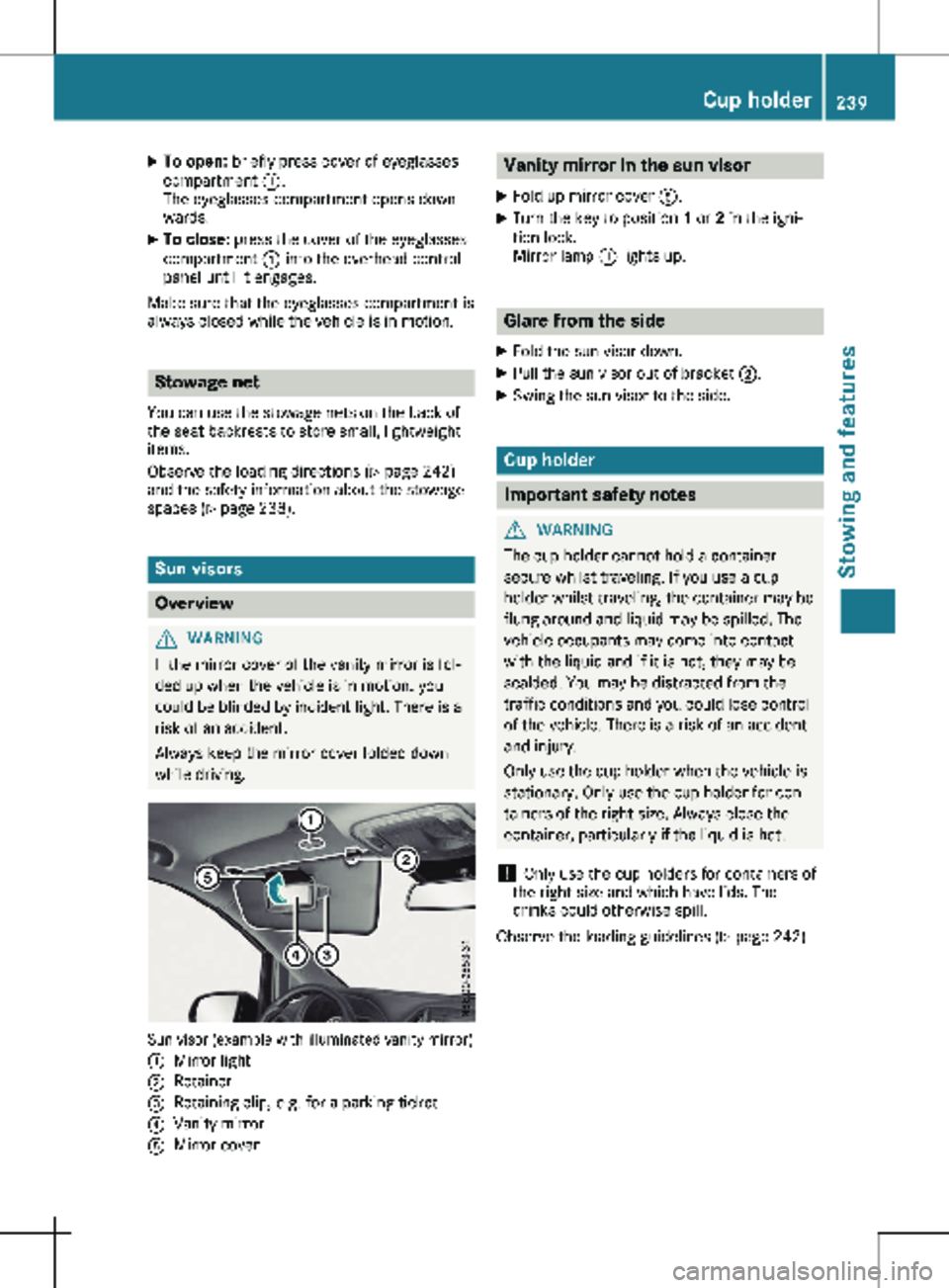
while driving. Sun visor (example with illuminated vanity mirror)
:
Mirror light
; Retainer
= Retaining clip, e.g. for a parking ticket
? Vanity mirror
A Mirror cover Vanity mirror in the sun visor
X Fold up mirror cover A.
X Turn the key to position 1 or 2 in the igni-
tion lock.
Mirror lamp : lights up. Glare from the side
X Fold the sun visor down.
X Pull the sun visor out of bracket ;.
X Swing the sun visor to the side. Cup holder
Important safety notes
G
WARNING
The cup holder cannot hold a container
secure whilst traveling. If you use a cup
holder whilst traveling, the container may be
flung around and liquid may be spilled. The
vehicle occupants may come into contact
with the liquid and if it is hot, they may be
scalded. You may be distracted from the
traffic conditions and you could lose control
of the vehicle. There is a risk of an accident
and injury.
Only use the cup holder when the vehicle is
stationary. Only use the cup holder for con-
tainers of the right size. Always close the
container, particularly if the liquid is hot.
! Only use the cup holders for containers of
the right size and which have lids. The
drinks could otherwise spill.
Observe the loading guidelines
(Y page 242). Cup holder
239Stowing and features Z