change wheel MERCEDES-BENZ METRIS 2020 MY20 Operator’s Manual
[x] Cancel search | Manufacturer: MERCEDES-BENZ, Model Year: 2020, Model line: METRIS, Model: MERCEDES-BENZ METRIS 2020Pages: 320, PDF Size: 26.38 MB
Page 220 of 320
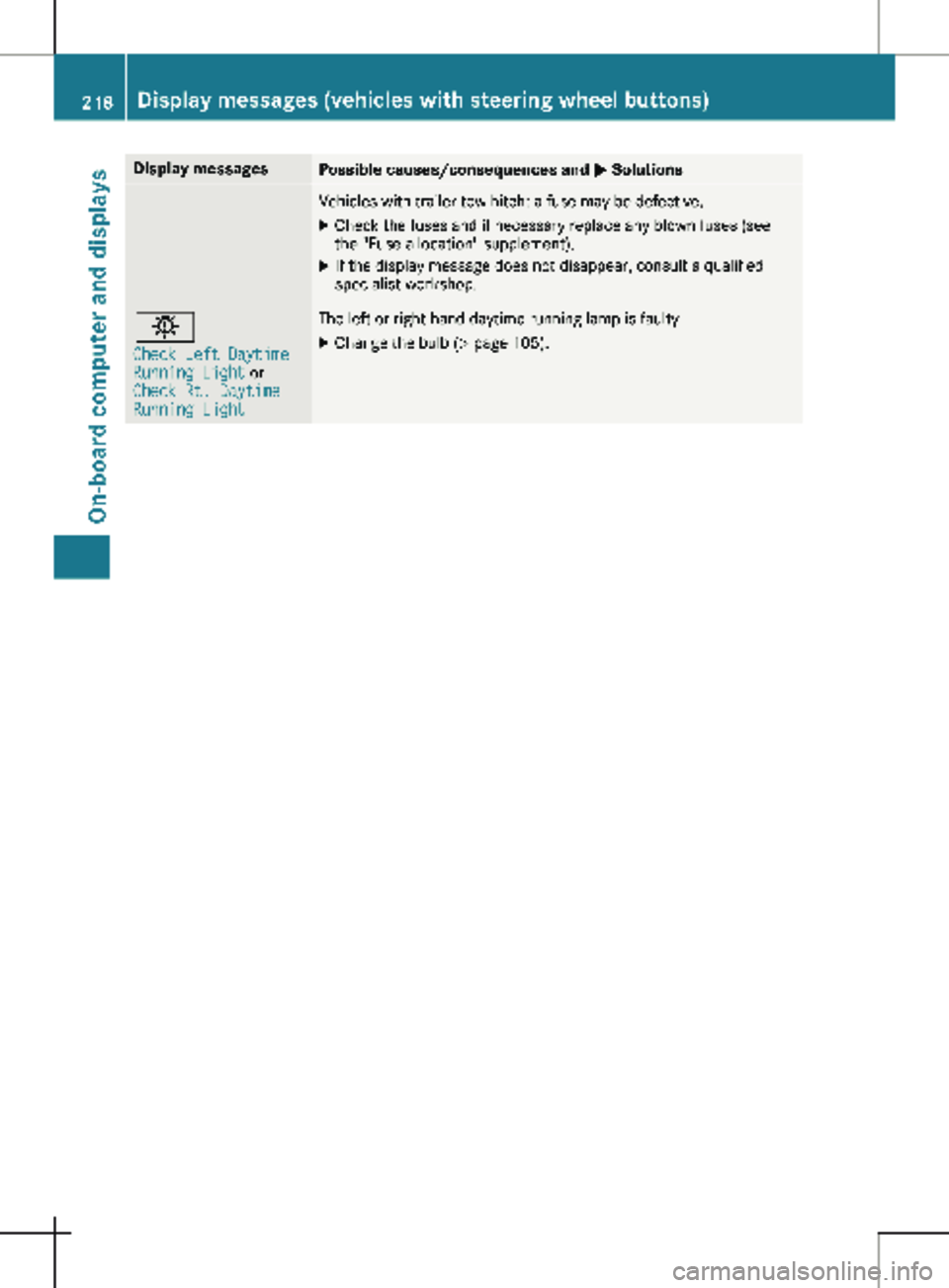
Display messages
Possible causes/consequences and
M SolutionsVehicles with trailer tow hitch: a fuse may be defective.
X Check the fuses and if necessary replace any blown fuses (see
the "Fuse allocation" supplement).
X If the display message does not disappear, consult a qualified
specialist workshop. b
Check Left Daytime
Running Light or
Check Rt. Daytime
Running Light The left or right-hand daytime running lamp is faulty.
X Change the bulb (Y page 105).218
Display messages (vehicles with steering wheel buttons)
On-board computer and displays
Page 226 of 320
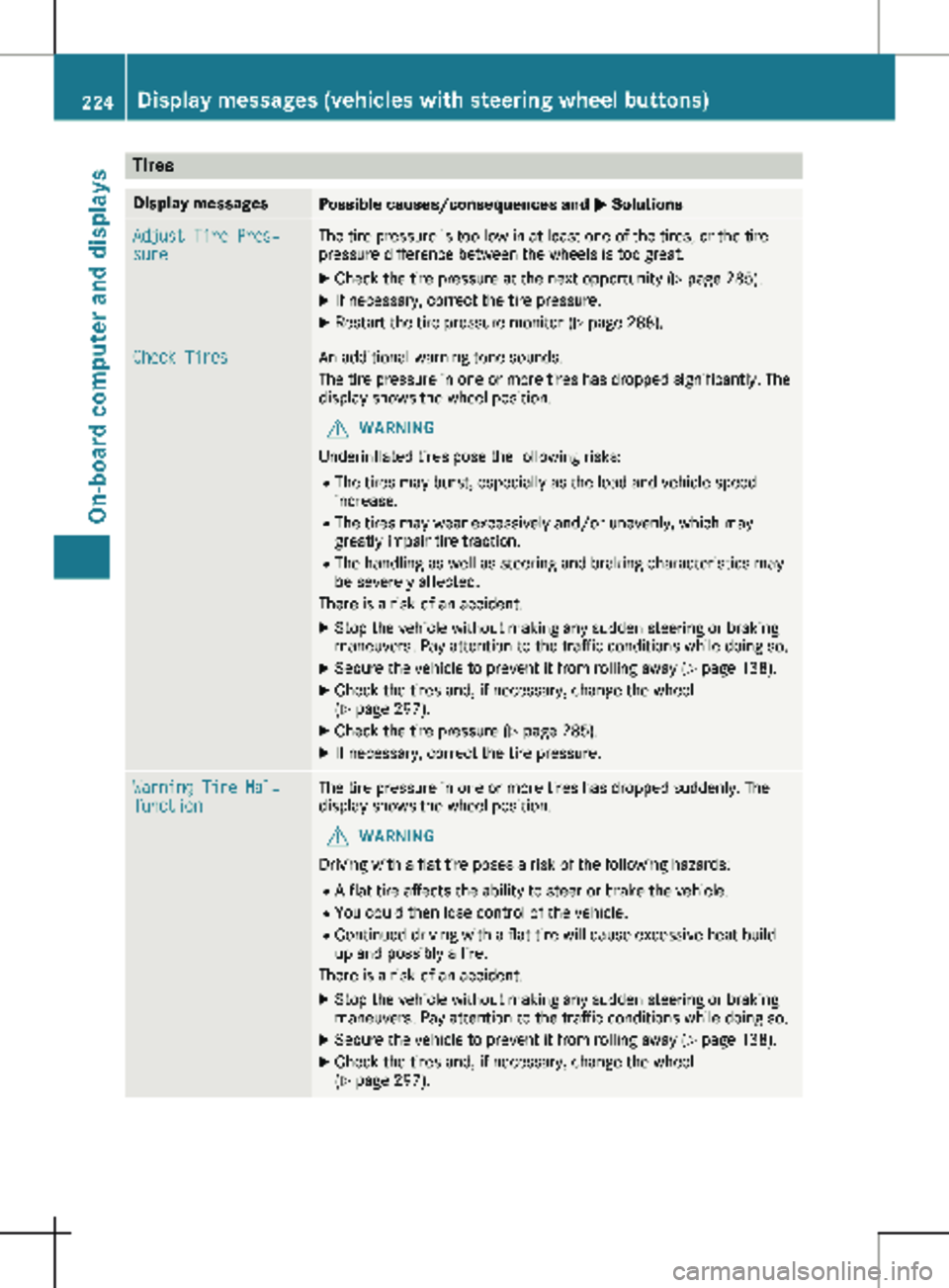
Tires
Display messages
Possible causes/consequences and
M SolutionsAdjust Tire Pres‐
sure The tire pressure is too low in at least one of the tires, or the tire
pressure difference between the wheels is too great.
X Check the tire pressure at the next opportunity (Y page 285).
X If necessary, correct the tire pressure.
X Restart the tire pressure monitor ( Y page
288).Check Tires An additional warning tone sounds.
The tire pressure in one or more tires has dropped significantly. The
display shows the wheel position.
G WARNING
Underinflated tires pose the following risks:
R The tires may burst, especially as the load and vehicle speed
increase.
R The tires may wear excessively and/or unevenly, which may
greatly impair tire traction.
R The handling as well as steering and braking characteristics may
be severely affected.
There is a risk of an accident.
X Stop the vehicle without making any sudden steering or braking
maneuvers. Pay attention to the traffic conditions while doing so.
X Secure the vehicle to prevent it from rolling away (Y page
138).
X Check the tires and, if necessary, change the wheel
(Y page
297).
X Check the tire pressure (Y page
285).
X If necessary, correct the tire pressure. Warning Tire Mal‐
function The tire pressure in one or more tires has dropped suddenly. The
display shows the wheel position.
G WARNING
Driving with a flat tire poses a risk of the following hazards: R A flat tire affects the ability to steer or brake the vehicle.
R You could then lose control of the vehicle.
R Continued driving with a flat tire will cause excessive heat build-
up and possibly a fire.
There is a risk of an accident.
X Stop the vehicle without making any sudden steering or braking
maneuvers. Pay attention to the traffic conditions while doing so.
X Secure the vehicle to prevent it from rolling away (Y page
138).
X Check the tires and, if necessary, change the wheel
(Y page
297).224
Display messages (vehicles with steering wheel buttons)
On-board computer and displays
Page 228 of 320
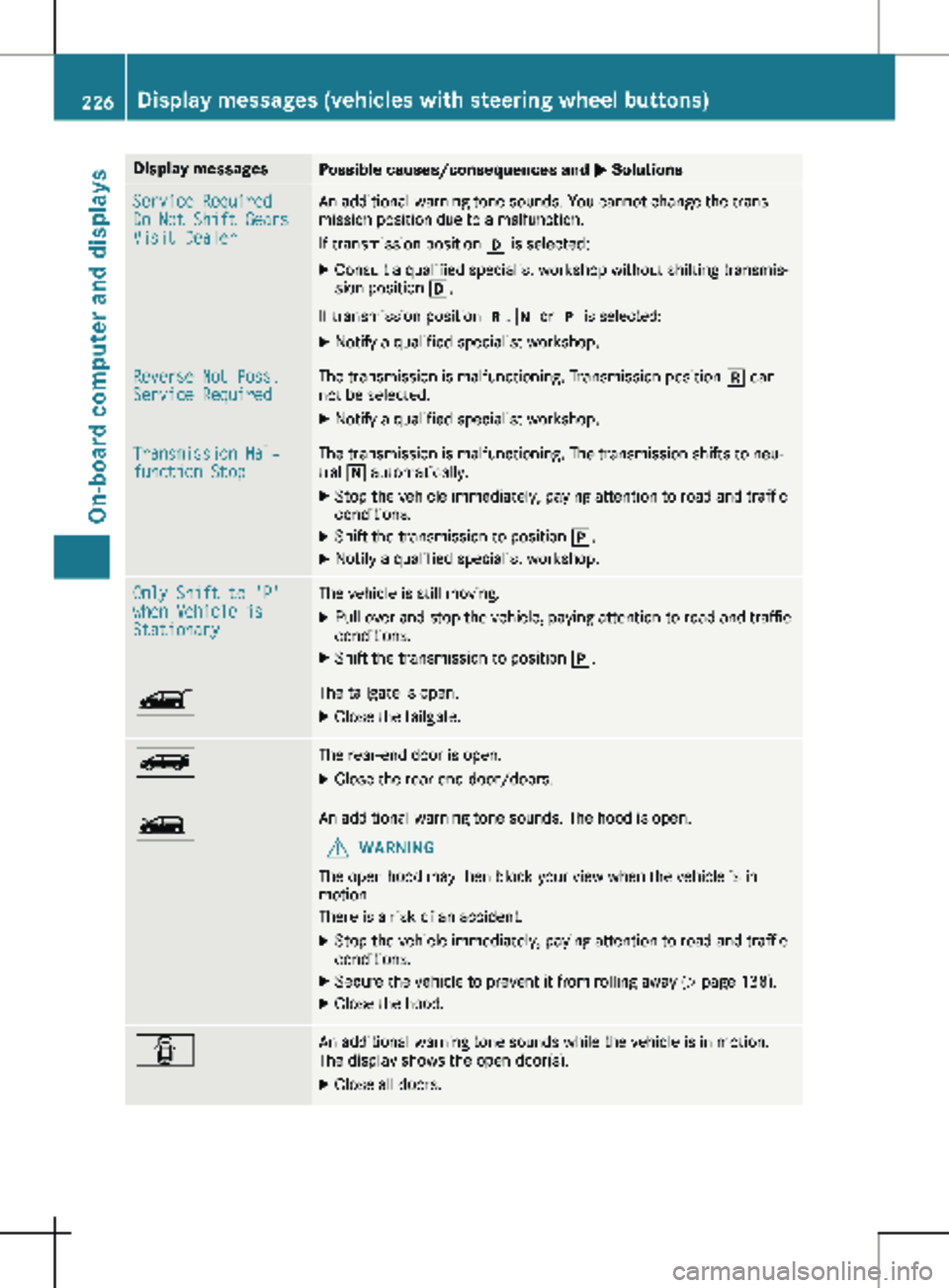
Display messages
Possible causes/consequences and
M SolutionsService Required
Do Not Shift Gears
Visit Dealer An additional warning tone sounds. You cannot change the trans-
mission position due to a malfunction.
If transmission position h is selected:
X Consult a qualified specialist workshop without shifting transmis-
sion position h.
If transmission position k, i or j is selected:
X Notify a qualified specialist workshop. Reverse Not Poss.
Service Required The transmission is malfunctioning. Transmission position k can-
not be selected.
X Notify a qualified specialist workshop. Transmission Mal‐
function Stop The transmission is malfunctioning. The transmission shifts to neu-
tral i automatically.
X Stop the vehicle immediately, paying attention to road and traffic
conditions.
X Shift the transmission to position j.
X Notify a qualified specialist workshop. Only Shift to 'P'
when Vehicle is
Stationary The vehicle is still moving.
X Pull over and stop the vehicle, paying attention to road and traffic
conditions.
X Shift the transmission to position j.Ò The tailgate is open.
X Close the tailgate. Ñ The rear-end door is open.
X Close the rear-end door/doors. Ó An additional warning tone sounds. The hood is open.
G WARNING
The open hood may then block your view when the vehicle is in
motion.
There is a risk of an accident.
X Stop the vehicle immediately, paying attention to road and traffic
conditions.
X Secure the vehicle to prevent it from rolling away (Y page 138).
X Close the hood. C An additional warning tone sounds while the vehicle is in motion.
The display shows the open door(s).
X Close all doors.226
Display messages (vehicles with steering wheel buttons)
On-board computer and displays
Page 238 of 320
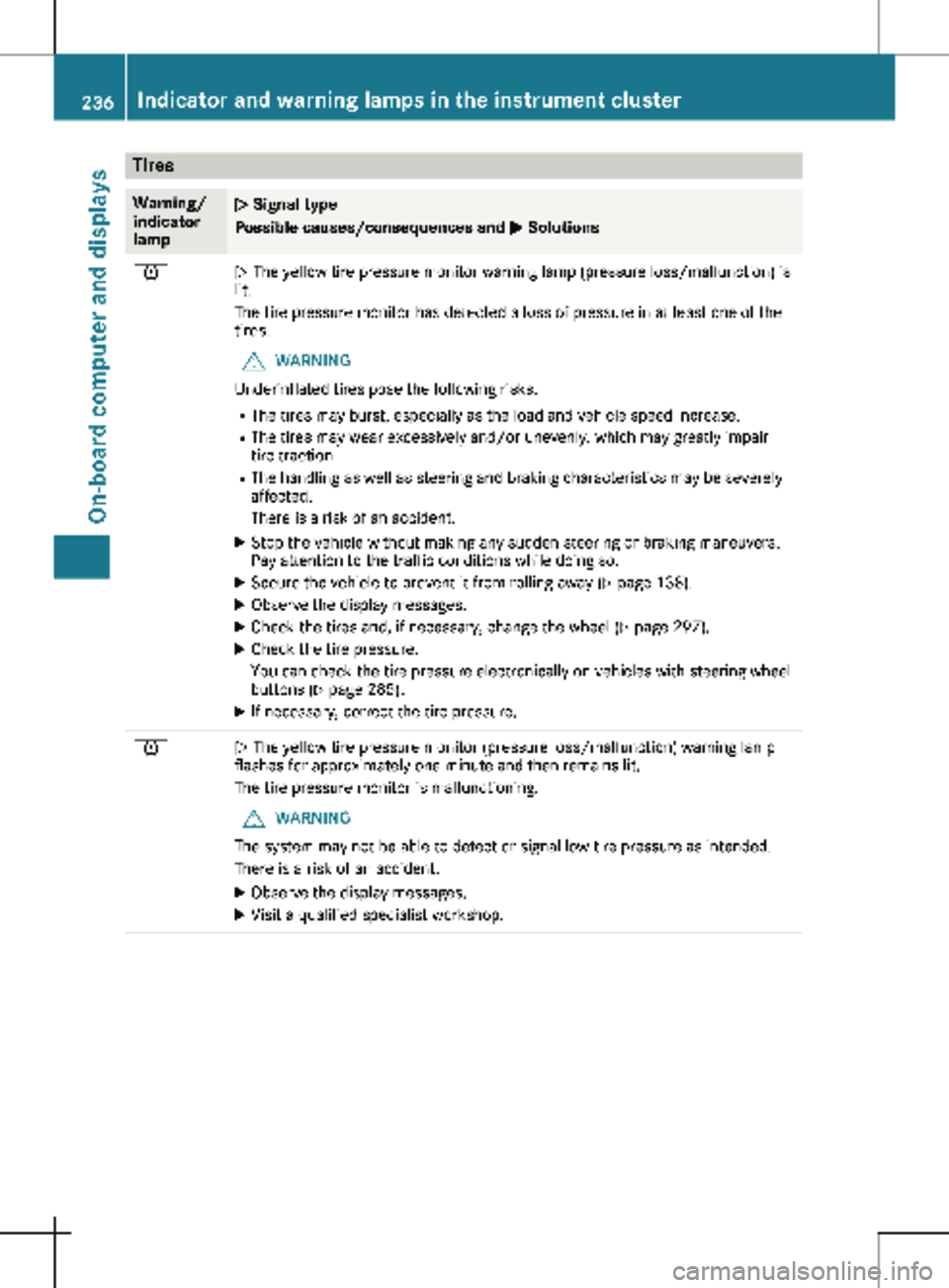
Tires
Warning/
indicator
lamp
N Signal type
Possible causes/consequences and
M Solutionsh
N The yellow tire pressure monitor warning lamp (pressure loss/malfunction) is
lit.
The tire pressure monitor has detected a loss of pressure in at least one of the
tires.
G WARNING
Underinflated tires pose the following risks:
R The tires may burst, especially as the load and vehicle speed increase.
R The tires may wear excessively and/or unevenly, which may greatly impair
tire traction.
R The handling as well as steering and braking characteristics may be severely
affected.
There is a risk of an accident.
X Stop the vehicle without making any sudden steering or braking maneuvers.
Pay attention to the traffic conditions while doing so.
X Secure the vehicle to prevent it from rolling away (Y page 138).
X Observe the display messages.
X Check the tires and, if necessary, change the wheel (Y page
297).
X Check the tire pressure.
You can check the tire pressure electronically on vehicles with steering wheel
buttons
(Y page 285).
X If necessary, correct the tire pressure. h
N The yellow tire pressure monitor (pressure loss/malfunction) warning lamp
flashes for approximately one minute and then remains lit.
The tire pressure monitor is malfunctioning.
G WARNING
The system may not be able to detect or signal low tire pressure as intended.
There is a risk of an accident.
X Observe the display messages.
X Visit a qualified specialist workshop.236
Indicator and warning lamps in the instrument cluster
On-board computer and displays
Page 244 of 320
Useful information
This Operator's Manual describes all models
as well as standard and optional equipment of
your vehicle that were available at the time of
going to print. Country-specific variations are
possible. Note that your vehicle may not be
equipped with all of the described functions.
This also applies to systems and functions rel-
evant to safety.
Read the information on qualified specialist
workshops (Y page
32).Loading guidelines
Important safety notes
G
WARNING
When objects are unsecured or inadequately
secured, they can slip, turn over or be
thrown about, striking vehicle occupants.
This also applies to:
R luggage or loads
R seats which have been removed and are
being transported in the vehicle in an
exceptional case.
There is a risk of injury, particularly in the
event of a braking maneuver or abrupt
change in direction.
Always stow objects in such a way that they
cannot be tossed about. Before traveling,
secure objects, luggage or loads to prevent
them slipping or tipping over. If you remove
a seat, store it preferably outside the vehi-
cle. G
WARNING
As a result of improperly placed or unevenly
distributed loads, the center of gravity of the
load being transported may be too high or
too far back. This can significantly impair
handling as well as steering and braking
characteristics. There is a risk of an acci-
dent. Always make sure that the center of gravity
of the load is:
R between the axles
and
R as low as possible, near the rear axle. G
WARNING
When the permissible wheel loads, axle
loads and/or the maximum permissible
gross vehicle weight are exceeded, driving
safety is compromised. The handling as well
as steering and braking characteristics may
be significantly impaired. Overloaded tires
may overheat, causing them to burst. There
is a risk of an accident.
When transporting a load, always observe
the permissible wheel loads, axle loads and
the maximum permissible gross vehicle
weight for the vehicle (including occupants).
! If you are using a roof carrier, observe the
maximum roof load and maximum roof car-
rier load.
R Do not stack luggage or loads higher than
the backrests.
R Objects to be transported should preferably
be stowed in the cargo compartment.
R When transporting luggage, always use the
cargo tie-down rings for securing loads and
a cargo net, if installed.
R Use cargo tie-down rings and fasteners
which are suitable for the weight and size of
the load.
When using suitable load securing aids and tie
downs, always follow the manufacturer's oper-
ating instructions, in particular the notes on
discard criteria contained therein.
Load securing aids or tie downs must not be
used if:
R identification marks are missing or illegible
R there are yarn breakages, damage to bear-
ing seams or other signs of tearing
R there are signs of shearing, deformation,
pinching or other damage
R there is damage to clamping or connecting
elements
Load securing aids and tie downs in this condi-
tion are ready for discard and must be 242
Loading guidelines
Transporting loads
Page 246 of 320
X
Always transport loads in the cargo com-
partment and with the seat backrests folded
up and properly locked in position.
X Always place the load against the backrests
of the front or rear seats.
X Move large and heavy loads as far towards
the front of the vehicle as possible against
the front or rear seats. Stow the load flush
with the rear or front seats.
X Always additionally secure the load with
suitable load-securing aids or tie downs.
Observe the following notes:
R Do not stack loads higher than the upper
edge of the backrests.
R Transport loads behind seats that are not
occupied.
R If the rear bench seat is not occupied, insert
the seat belts crosswise into the buckle of
the opposite seat belt. Cargo compartment variations
You can vary the cargo compartment accord-
ing to your transportation requirements as fol-
lows:
R by folding the seat backrests forward to the
table position.
R by removing the rear bench seat.
You will find information about rear bench
seats in the "Rear bench seats" section
( Y page
89). Securing loads
Important safety notes
G
WARNING
If you attach the tie-down incorrectly when
securing the load, the following may occur in
the event of abrupt changes in direction,
braking maneuvers or an accident:
R the cargo tie-down rings may become
detached or the tie-down may tear if the
permissible load is exceeded
R the load may not be restrained. This may cause the load to slip, tip over or
be tossed about, striking vehicle occupants.
There is a risk of an accident and injury.
Always tension the tie-downs in the proper
manner and only between the described
cargo tie-down rings. Always use tie-downs
designed specifically for the loads.
! Observe the information on the maximum
loading capacity of the individual cargo tie-
down points.
If you use several cargo tie-down points to
secure a load, you must always take the
maximum loading capacity of the weakest
cargo tie-down point into account.
If you brake hard, for example, the forces
acting could be up to several times the
weight force of the load. Always use multi-
ple cargo tie-down points in order to distrib-
ute the force absorption. Load the ancho-
rages evenly.
As the driver, you are responsible for ensuring
that: R The load is secured against slipping, tipping,
rolling or falling off in normal traffic condi-
tions, should the vehicle swerve to avoid an
obstacle, in the event of maximum full-stop
braking and on poor road surfaces
R The applicable requirements and guidelines
relating to load-securing practices are met
If this is not the case, this may constitute a
punishable offense, depending on local leg-
islation and any ensuing consequences.
Always observe the legal requirements for
the country you are currently in.
Make sure that the load is secure before every
journey and at regular intervals during a long
journey. Correct an incorrectly or inadequately
secured load if necessary.
Always observe the operating instructions or
the notes of the lashing strap manufacturer for
the operation of the lashing strap.
You can obtain information about securing the
load correctly from the manufacturer of the
load securing aids or tie down for securing the
load. Also observe the safety information in
the loading directions ( Y page 242).
X Fill spaces between the load and the cargo
compartment walls or wheel housings (form-244
Securing loads
Transporting loads
Page 272 of 320
Useful information
This Operator's Manual describes all models
as well as standard and optional equipment of
your vehicle that were available at the time of
going to print. Country-specific variations are
possible. Note that your vehicle may not be
equipped with all of the described functions.
This also applies to systems and functions rel-
evant to safety.
Read the information on qualified specialist
workshops (Y page
32).Where will I find...?
Vehicle tool kit
General notes Depending on the equipment version of the
vehicle, the vehicle tool kit is:
R in the seat base of the left front seat
R in the rear compartment stowage compart-
ment
R in the tool holder in the cargo compartment
Apart from some country-specific variants,
vehicles without a spare wheel are not equip-
ped with tire-changing tools. If your vehicle is
equipped with tire-changing tools, these are in
the vehicle tool kit. If the vehicle tool kit is
stowed in the driver's seat base, the jack is in
a separate holder in the cargo compartment
on the right-hand side of the vehicle next to
the tailgate/rear-end door
(Y page 272).
Some tools for changing a wheel are specific
to the vehicle. For more information on which
tools are required and approved to perform a
wheel change on your vehicle, consult a quali-
fied specialist workshop.
Necessary tire-changing tools can include, for
example:
R Jack
R Lug wrench
R Ratchet wrench
i The jack has a maximum weight of 7.5 kg
depending on the vehicle's equipment.
The maximum payload of the jack can be
found on the sticker on the jack itself. The jack is maintenance-free. In the event of
a malfunction, please contact a qualified
specialist workshop.
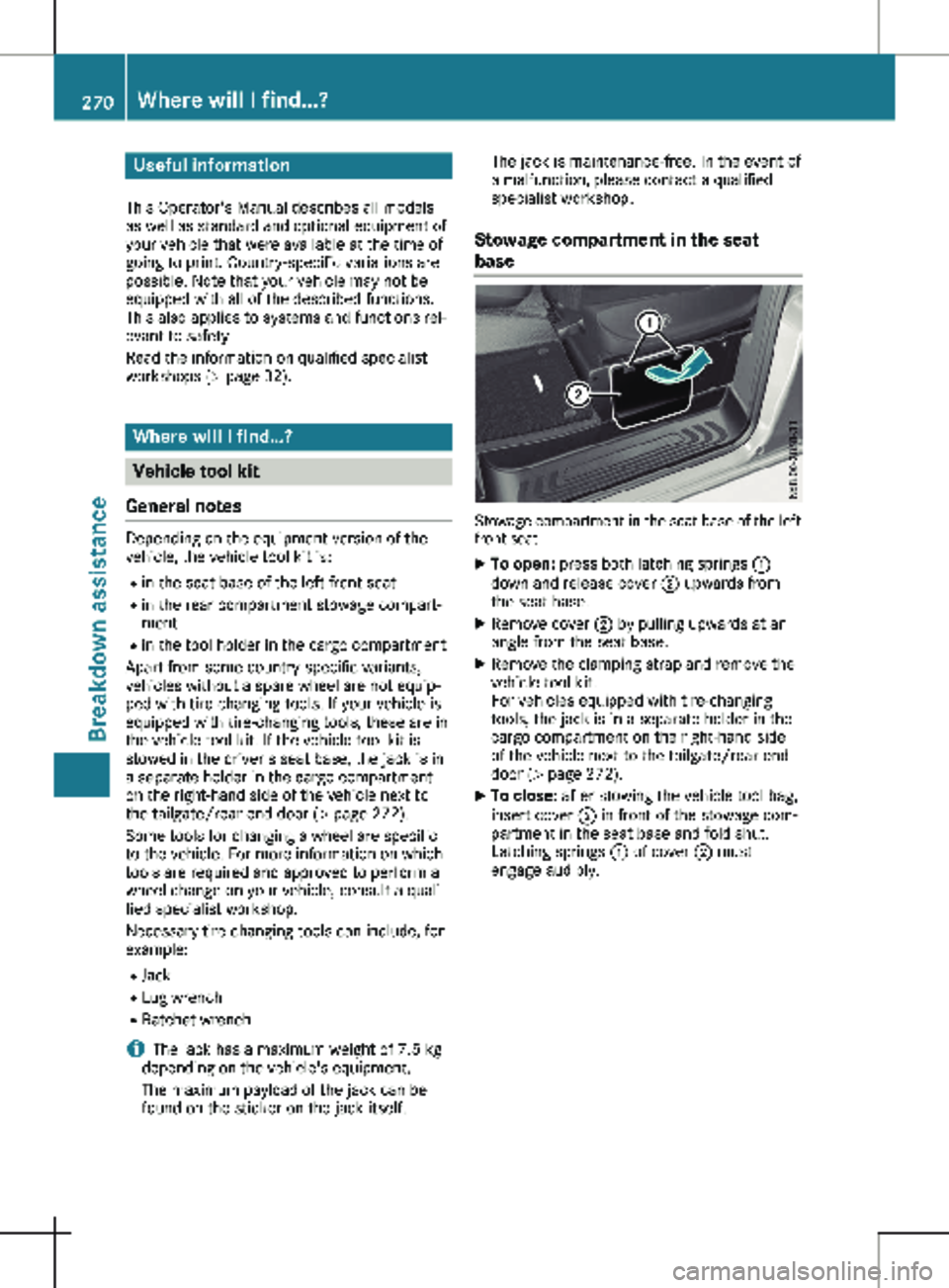
Stowage compartment in the seat
base Stowage compartment in the seat base of the left
front seat
X To open: press both latching springs :
down and release cover ; upwards from
the seat base.
X Remove cover ; by pulling upwards at an
angle from the seat base.
X Remove the clamping strap and remove the
vehicle tool kit.
For vehicles equipped with tire-changing
tools, the jack is in a separate holder in the
cargo compartment on the right-hand side
of the vehicle next to the tailgate/rear-end
door (Y page
272).
X To close: after stowing the vehicle tool bag,
insert cover ; in front of the stowage com-
partment in the seat base and fold shut.
Latching springs : of cover ; must
engage audibly. 270
Where will I find...?
Breakdown assistance
Page 282 of 320
R
Break in new tires at moderate speeds for
the first
65 miles (100 km).
R Do not drive with tires which have too little
tread depth, as this significantly reduces the
traction on wet roads (hydroplaning).
R Replace the tires after six years at the lat-
est, regardless of wear. This also applies to
the spare wheel. Operation in winter
General notes
Have your vehicle winterized at a qualified spe-
cialist workshop at the onset of winter.
Only use wheels with tire sizes approved for
Mercedes-Benz.
Prior to the onset of winter, ensure that snow
chains are stowed in the vehicle
(Y page
281). Snow chains cannot be moun-
ted on all wheel/tire combinations. Observe
the restrictions on the use of snow chains
under "Wheel/tire combinations"
(Y page 302).
Also observe the notes in the "Changing a
wheel" section ( Y page 297).Driving with summer tires
At temperatures below 45 ‡
(+7 †), summer
tires lose elasticity and therefore traction and
braking power. Change the tires on your vehi-
cle to M+S tires. Using summer tires at very
cold temperatures could cause tears to form,
thereby damaging the tires permanently.
Mercedes-Benz cannot accept responsibility
for this type of damage. M+S tires
G
WARNING
Wheel and tire dimensions as well as the
type of tire can vary between the spare
wheel and the wheel to be replaced. When
the spare wheel is mounted, driving charac-
teristics may be severely affected. There is a
risk of an accident. In order to reduce risks:
R you should therefore adapt your driving
style and drive carefully.
R never mount more than one spare wheel
that differs from the wheel to be replaced.
R only use a spare wheel that differs from
the wheel to be replaced for a short time.
R have a spare wheel that differs from the
wheel that has been changed replaced at
the nearest qualified specialist workshop.
You must observe the correct wheel and
tire dimensions as well as the wheel type. G
WARNING
M+S tires with a tire tread depth of less than
ã in
(4 mm) are not suitable for use in win-
ter and do not provide sufficient traction.
There is a risk of an accident.
M+S tires with a tread depth of less than ã
in (4 mm) must be replaced immediately.
Use winter tires or all-season tires at tempera-
tures below 45 ‡ (+7 †). Both types of tire
are identified by the M+S marking.
Only winter tires bearing the i snowflake
symbol in addition to the M+S marking provide
the best possible grip in wintry road condi-
tions.
Only these tires will allow driving safety sys-
tems such as ABS and ESP ®
to function opti-
mally in winter. These tires have been devel-
oped specifically for driving in snow.
For safe driving, use M+S tires of the same
make and tread pattern on all wheels.
Always observe the maximum permissible
speed specified for the M+S tires you have
mounted.
If you mount M+S tires that have a lower maxi-
mum permissible speed than the maximum
design speed of the vehicle, affix a corre-
sponding warning label in the driver's field of
vision. You can obtain this at a qualified spe-
cialist workshop.
Once you have mounted the winter tires:
X Check the tire pressure (Y page
282).
X Restart the tire pressure monitor
(Y page
288).280
Operation in winter
Wheels and tires
Page 284 of 320
Tire pressure
Tire pressure specifications
Important safety notes G
WARNING
Underinflated or overinflated tires pose the
following risks:
R the tires may burst, especially as the load
and vehicle speed increase.
R the tires may wear excessively and/or
unevenly, which may greatly impair tire
traction.
R the driving characteristics, as well as
steering and braking, may be greatly
impaired.
There is a risk of an accident.
Follow recommended tire inflation pressures
and check the pressure of all the tires
including the spare wheel:
R monthly, at least
R if the load changes
R before beginning a long journey
R under different operating conditions, e.g.
off-road driving
If necessary, correct the tire pressure.
The tire pressure monitor will not warn you of: R an incorrectly set tire pressure
R sudden loss of tire pressure, for example
caused through intrusion from a foreign
object G
WARNING
If you fit unsuitable accessories onto tire
valves, the tire valves may be overloaded
and malfunction, which can cause tire pres-
sure loss. Due to their design, retrofitted tire
pressure monitors keep the tire valve open.
This can also result in tire pressure loss.
There is a risk of an accident.
Only screw the standard valve cap or other
valve caps approved by Mercedes-Benz for
your vehicle onto the tire valve. !
The pressure difference between tires on
any one axle must be no greater than
10 kPa
(0.1 bar/1.5 psi).
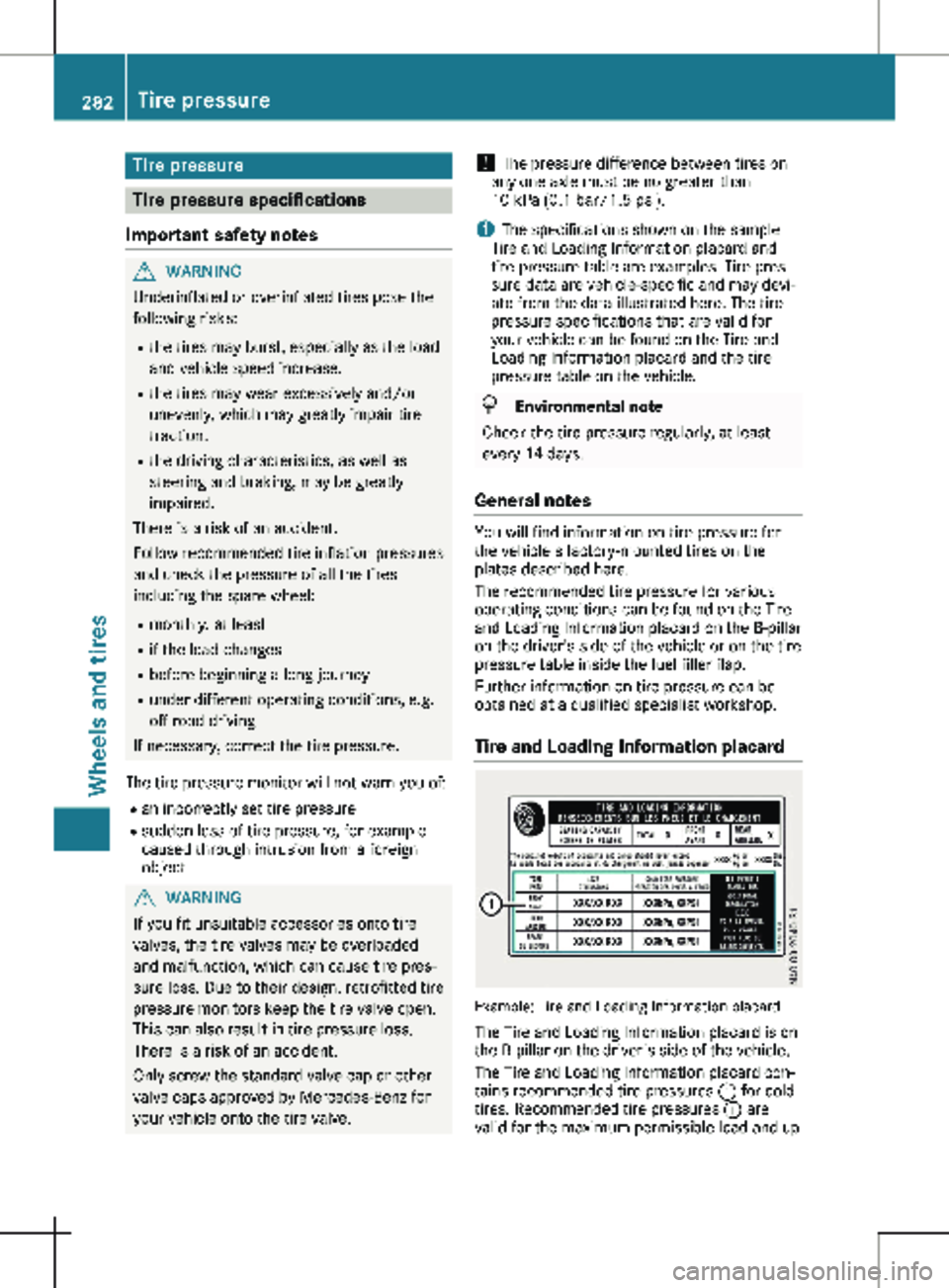
i The specifications shown on the sample
Tire and Loading Information placard and
tire pressure table are examples. Tire pres-
sure data are vehicle-specific and may devi-
ate from the data illustrated here. The tire
pressure specifications that are valid for
your vehicle can be found on the Tire and
Loading Information placard and the tire
pressure table on the vehicle. H
Environmental note
Check the tire pressure regularly, at least
every
14 days.
General notes You will find information on tire pressure for
the vehicle's factory-mounted tires on the
plates described here.
The recommended tire pressure for various
operating conditions can be found on the Tire
and Loading Information placard on the B-pillar
on the driver's side of the vehicle or on the tire
pressure table inside the fuel filler flap.
Further information on tire pressure can be
obtained at a qualified specialist workshop.
Tire and Loading Information placard Example: Tire and Loading Information placard
The Tire and Loading Information placard is on
the B-pillar on the driver's side of the vehicle.
The Tire and Loading Information placard con-
tains recommended tire pressures : for cold
tires. Recommended tire pressures : are
valid for the maximum permissible load and up 282
Tire pressure
Wheels and tires
Page 286 of 320
Important notes on tire pressure
G
WARNING
If the tire pressure drops repeatedly, the
wheel, valve or tire may be damaged. Tire
pressure that is too low may result in a tire
blow-out. There is a risk of an accident. R Check the tire for foreign objects.
R Check whether the wheel is losing air or
the valve is leaking.
If you are unable to rectify the damage, con-
tact a qualified specialist workshop.
Use a suitable pressure gauge to check the
tire pressure. The outer appearance of a tire
does not permit any reliable conclusion about
the tire pressure. On vehicles equipped with
the electronic tire pressure monitor, the tire
pressure can be checked using the on-board
computer.
The tire temperature and pressure increase
when the vehicle is in motion. This is depend-
ent on the driving speed and the load.
Therefore, you should only correct tire pres-
sure when the tires are cold.
The tires are cold: R if the vehicle has been parked for at least
three hours without direct sunlight on the
tires, and
R if the vehicle has not been driven further
than
1 mile (1.6 km)
Tire temperature changes depending on the
ambient temperature, driving speed and tire
load. If the tire temperature changes by 18 ‡
(10 †), the tire pressure changes by approx-
imately 10 kPa (0.1 bar/1.5 psi). Take this into
account when checking the pressure of warm
tires. Only correct the tire pressure if it is too
low for the current operating conditions. If you
check the tire pressure when the tires are
warm, it results in a higher value than when
the tires are cold. This is normal. Do not under
any circumstances release the air in order to
adjust the pressure to the prescribed value for
cold tires. The tire pressure would otherwise
be too low.
Observe the recommended tire pressure for
cold tires on the tire pressure table in the fuel
filler flap. Driving with tire pressure that is too high or
too low can:
R shorten the service life of the tires
R cause increased tire damage
R have a negative effect on handling charac-
teristics and thus the driving safety (e.g.
hydroplaning) Underinflated or overinflated tires
Underinflated tires: G
WARNING
Tires with pressure that is too low can over-
heat and burst as a consequence. In addi-
tion, they also suffer from excessive and/or
irregular wear, which can severely impair the
braking properties and the driving character-
istics. There is a risk of an accident.
Avoid tire pressures that are too low in all
the tires, including the spare wheel.
Underinflated tires can:
R fail from being overheated
R adversely affect handling
R wear excessively and/or unevenly
R have an adverse effect on fuel consumption
Overinflated tires G
WARNING
Tires with excessively high pressure can
burst because they are damaged more eas-
ily by road debris, potholes etc. In addition,
they also suffer from irregular wear, which
can severely impair the braking properties
and the driving characteristics. There is a
risk of an accident.
Avoid tire pressures that are too high in all
the tires, including the spare wheel.
Overinflated tires can:
R increase the braking distance
R adversely affect handling
R wear excessively and/or unevenly
R adversely affect ride comfort
R be more susceptible to damage284
Tire pressure
Wheels and tires