key MERCEDES-BENZ METRIS 2020 MY20 Operator’s Manual
[x] Cancel search | Manufacturer: MERCEDES-BENZ, Model Year: 2020, Model line: METRIS, Model: MERCEDES-BENZ METRIS 2020Pages: 320, PDF Size: 26.38 MB
Page 129 of 320
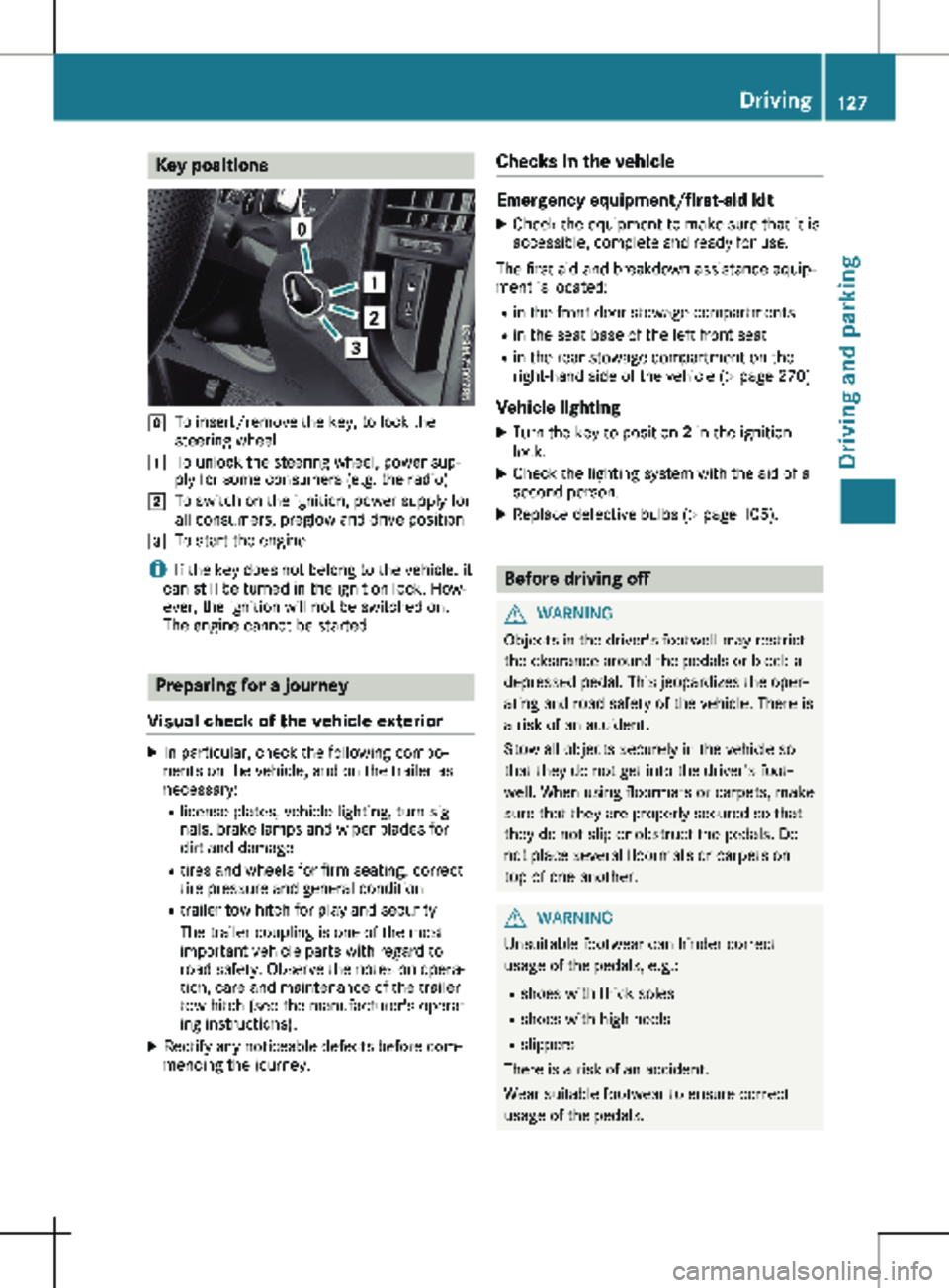
Key positions
g
To insert/remove the key, to lock the
steering wheel
1 To unlock the steering wheel, power sup-
ply for some consumers (e.g. the radio)
2 To switch on the ignition, power supply for
all consumers, preglow and drive position
3 To start the engine
i If the key does not belong to the vehicle, it
can still be turned in the ignition lock. How-
ever, the ignition will not be switched on.
The engine cannot be started. Preparing for a journey
Visual check of the vehicle exterior X
In particular, check the following compo-
nents on the vehicle, and on the trailer as
necessary:
R
license plates, vehicle lighting, turn sig-
nals, brake lamps and wiper blades for
dirt and damage
R tires and wheels for firm seating, correct
tire pressure and general condition
R trailer tow hitch for play and security
The trailer coupling is one of the most
important vehicle parts with regard to
road safety. Observe the notes on opera-
tion, care and maintenance of the trailer
tow hitch (see the manufacturer's operat-
ing instructions).
X Rectify any noticeable defects before com-
mencing the journey. Checks in the vehicle Emergency equipment/first-aid kit
X Check the equipment to make sure that it is
accessible, complete and ready for use.
The first aid and breakdown assistance equip-
ment is located:
R in the front door stowage compartments
R in the seat base of the left front seat
R in the rear stowage compartment on the
right-hand side of the vehicle
(Y page 270)
Vehicle lighting
X Turn the key to position 2 in the ignition
lock.
X Check the lighting system with the aid of a
second person.
X Replace defective bulbs (Y page
105). Before driving off
G
WARNING
Objects in the driver's footwell may restrict
the clearance around the pedals or block a
depressed pedal. This jeopardizes the oper-
ating and road safety of the vehicle. There is
a risk of an accident.
Stow all objects securely in the vehicle so
that they do not get into the driver's foot-
well. When using floormats or carpets, make
sure that they are properly secured so that
they do not slip or obstruct the pedals. Do
not place several floormats or carpets on
top of one another. G
WARNING
Unsuitable footwear can hinder correct
usage of the pedals, e.g.:
R shoes with thick soles
R shoes with high heels
R slippers
There is a risk of an accident.
Wear suitable footwear to ensure correct
usage of the pedals. Driving
127
Driving and parking Z
Page 130 of 320
X
Stow luggage items securely. Secure the
load as per the loading guidelines
(Y page
242).
X Make sure that the floormats and carpets
are properly secured so that they cannot
slip and obstruct the pedals.
X Close all doors. Starting the engine
Important safety notes G
DANGER
Combustion engines emit poisonous
exhaust gases such as carbon monoxide.
Inhaling these exhaust gases is hazardous to
health and can result in poisoning. There is a
risk of fatal injury. Therefore, never leave the
engine running an enclosed space without
adequate ventilation.
! Do not depress the accelerator when start-
ing the engine.
X Before starting the engine, ensure the fol-
lowing:
R all the doors are closed.
R all the vehicle occupants are wearing their
seat belts correctly.
R the parking brake is applied.
i If you depress the brake pedal before
starting the engine, the pedal travel may be
shorter and pedal resistance higher.
If you depress the brake pedal again after
starting the engine, pedal travel and resist-
ance will be back to normal again.
Automatic transmission X
Shift the transmission to position j
(Y page
131).
The transmission position indicator in the
display shows j.
You can also start the engine in neutral posi-
tion i. Starting the engine X
Turn the key to position 3 in the ignition
lock
(Y page 127) and release it as soon as
the engine is running. Driving off
Automatic transmission G
WARNING
The vehicle can suddenly accelerate if the
engine speed is above the engine idling
speed and you then select transmission
position h or k. There is a risk of an acci-
dent.
When engaging transmission position h or
k at a standstill, always keep the brake
pedal depressed firmly and do not depress
the accelerator pedal at the same time.
! Only shift into reverse gear when the vehi-
cle is stationary k. Otherwise, you could
damage the transmission.
X Depress the brake pedal and keep it
depressed.
X Shift the transmission to position h or k.
On vehicles with a reverse warning feature,
when reverse gear k is engaged a warning
tone sounds to alert other road users
(Y page
129).
X Release the parking brake (Y page
138).
The F (only USA) or J (only Canada)
indicator lamp in the instrument cluster
goes out.
X Release the brake pedal.
Hill start assist automatically maintains the
brake pressure for about another two sec-
onds after the brake pedal is released. This
makes it possible to pull away without the
vehicle immediately rolling back
(Y page
129).
X Carefully depress the accelerator pedal.
i It is only possible to shift the transmission
from position j to the desired transmis-
sion position if you depress the brake pedal.
If the brake pedal is not depressed, the
DIRECT SELECT lever can still be moved but
the j position remains engaged. 128
Driving
Driving and parking
Page 132 of 320
Problems with the engine
Problem
Possible causes/consequences and
M SolutionsThe engine does not
start.
The starter motor can
be heard. There is a malfunction in the fuel supply.
X
Turn the key back to position g in the ignition lock before
attempting to start the engine again.
X Start the engine again.
Please bear in mind that lengthy and frequent starting attempts
will drain the battery.
If the engine does not start after several attempts: X Consult a qualified specialist workshop. The engine does not
start.
The starter motor can
be heard. The reserve
fuel warning lamp is lit
and the fuel gauge is at
0. The fuel tank has been run dry.
X Refuel the vehicle. The engine does not
start.
The starter motor can-
not be heard. The on-board voltage is too low. The battery is too weak or dis-
charged.
X Jump-start the vehicle ( Y page 272).
If the engine cannot be jump-started, the starter motor is faulty.
X Consult a qualified specialist workshop. The engine does not
start.
The starter motor can-
not be heard. The battery is discharged or faulty.
X
Check the battery for damage.
X Charge the battery (Y page
262).The engine is not run-
ning smoothly and is
misfiring. There is a malfunction in the engine electronics or a mechanical
component of the engine management system.
X Only depress the accelerator pedal slightly.
Unburnt fuel may otherwise get into the catalytic converter and
damage it.
X Have the cause rectified immediately at a qualified specialist
workshop. Automatic transmission
Important safety notes
G
WARNING
The vehicle can suddenly accelerate if the
engine speed is above the engine idling
speed and you then select transmission position h or k. There is a risk of an acci-
dent.
When engaging transmission position
h or
k at a standstill, always keep the brake
pedal depressed firmly and do not depress
the accelerator pedal at the same time. 130
Automatic transmission
Driving and parking
Page 133 of 320
G
WARNING
The automatic transmission switches to neu-
tral position N when you switch off the
engine. The vehicle may roll away. There is a
risk of an accident.
Before switching off the engine, always
switch to parking position P. Prevent the
parked vehicle from rolling away by applying
the parking brake.
! When the engine is switched off, rolling in
idle i can damage the power transmission
and result in transmission damage.
Always observe the instructions and safety
notes under "Tow starting and towing away"
( Y page
274).
Bear in mind that power transmission between
the engine and the transmission is interrupted
when the engine is switched off. For this rea-
son, shift the automatic transmission to trans-
mission position j before switching off the
engine when the vehicle is stationary. Apply
the parking brake to prevent the vehicle from
rolling away. DIRECT SELECT lever
Overview of the transmission shift
system j
Park position with parking lock
k Reverse gear
i Neutral
h Drive
The DIRECT SELECT lever is on the right of the
steering column.
The DIRECT SELECT lever always returns to its
original position. The display in the instrument cluster shows the current transmission posi-
tion j, k, i or h (Y page
132).
Selecting transmission positions !
If the engine speed is too high or the vehi-
cle is coasting, do not shift the automatic
transmission directly from h to k, from
k to h or directly to j. Otherwise, the
automatic transmission may be damaged.
! Only move the automatic transmission to
k when the vehicle is stationary.
X If park position j is selected, depress the
brake pedal to change the transmission
position.
X Drive position h: push the DIRECT
SELECT lever down beyond the 1st point of
resistance.
X Reverse gear k: push the DIRECT SELECT
lever upwards beyond the 1st point of
resistance.
X Neutral i: push the DIRECT SELECT lever
up or down as far as the 1st point of resist-
ance.
i When you switch off the engine, the auto-
matic transmission automatically shifts into
neutral i.
X Park position j: push the button of the
DIRECT SELECT lever in the direction of the
arrow j.
Park position j is engaged automatically in
the following situations:
R if you pull out the key.
R if you open the driver's door when the vehi-
cle is stationary or when driving at a very
low speed and the transmission is in posi-
tion h or k.
To maneuver with an open driver's door, open
the driver's door while stationary and engage
transmission position h or k again.
If you want the automatic transmission to
remain in neutral i after you switch off the
engine, you must leave the key in the ignition
lock. Automatic transmission
131
Driving and parking Z
Page 134 of 320
Transmission positions
B Park position
This prevents the vehicle from roll-
ing away when stopped. Only shift
the transmission to
j when the
vehicle is stationary.
The automatic transmission shifts
to j automatically in the following
situations:
R if you pull out the key.
R if you open the driver's door
when the vehicle is stationary or
when driving at a very low speed
and the transmission is in posi-
tion h or k.
The parking lock should not be used
as a brake when parking. Always
apply the parking brake as well
once you have parked the vehicle. C Reverse gear
Only shift the transmission to
k
when the vehicle is stationary. A Neutral
No power is transmitted from the
engine to the drive wheels. Releas-
ing the brakes will allow you to
move the vehicle freely, e.g. by
pushing or towing.
If ESP
®
is deactivated or faulty: shift
the transmission to position i if
the vehicle is in danger of skidding,
e.g. on icy roads.
When you switch off the engine, the
automatic transmission automati-
cally shifts into neutral i.
! When the engine is switched
off, rolling in idle i can damage
the power transmission and
result in transmission damage. 7 Drive
The automatic transmission
changes gear itself. All forward
gears are available.
You can influence gearshifts with
your choice of drive program. You
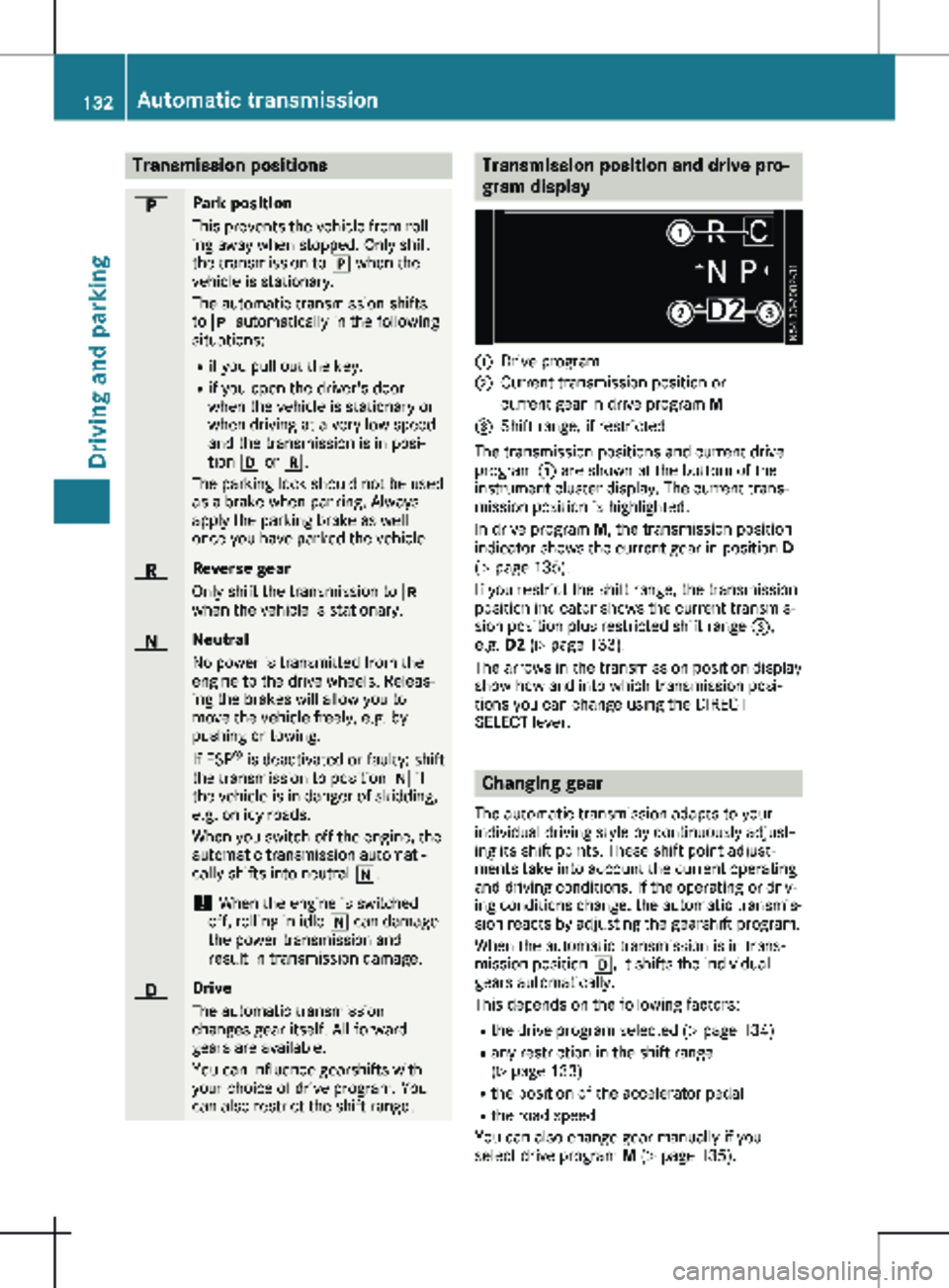
can also restrict the shift range. Transmission position and drive pro-
gram display
:
Drive program
; Current transmission position or
current gear in drive program M
= Shift range, if restricted
The transmission positions and current drive
program : are shown at the bottom of the
instrument cluster display. The current trans-
mission position is highlighted.
In drive program M, the transmission position
indicator shows the current gear in position D
( Y page
135).
If you restrict the shift range, the transmission
position indicator shows the current transmis-
sion position plus restricted shift range =,
e.g. D2 ( Y page 133).
The arrows in the transmission position display
show how and into which transmission posi-
tions you can change using the DIRECT
SELECT lever. Changing gear
The automatic transmission adapts to your
individual driving style by continuously adjust-
ing its shift points. These shift point adjust-
ments take into account the current operating
and driving conditions. If the operating or driv-
ing conditions change, the automatic transmis-
sion reacts by adjusting the gearshift program.
When the automatic transmission is in trans-
mission position h, it shifts the individual
gears automatically.
This depends on the following factors:
R the drive program selected ( Y page 134)
R any restriction in the shift range
(Y page
133)
R the position of the accelerator pedal
R the road speed
You can also change gear manually if you
select drive program M (Y page 135).132
Automatic transmission
Driving and parking
Page 139 of 320
If you or others come into contact with fuel,
observe the following points:
R Immediately rinse the fuel off your skin
with soap and water.
R If you get fuel into your eyes, immediately
rinse your eyes throughly with clean
water. Seek medical attention immedi-
ately.
R Seek medical attention immediately if fuel
has been swallowed. Do not induce vomit-
ing.
R Immediately change out of clothing which
has come into contact with fuel. G
WARNING
Electrostatic charging can lead to the crea-
tion of sparks and ignite fuel vapor. There is
a risk of fire and explosion.
Touch the metallic body of the vehicle
before you open the fuel filler cap or handle
the pump nozzle. Any possible electrostatic
charge present will in this way be depleted.
Do not get into the vehicle again during the
refueling process. Otherwise, electrostatic
charge could build up again. H
Environmental note
If fuels are handled improperly, they pose a
danger to persons and the environment. Do
not allow fuels to run into the sewage sys-
tem, the surface waters, the ground water or
into the ground.
! Do not switch on the ignition if you acci-
dentally refuel with the wrong fuel. Other-
wise, the fuel will enter the fuel lines. Notify
a qualified specialist workshop and have the
fuel tank and fuel lines drained completely.
! Overfilling the fuel tank could damage the
fuel system.
! Take care not to spill any fuel on painted
surfaces. You could otherwise damage the
paintwork.
! Use a filter when adding fuel from a fuel
can. The fuel lines and/or the fuel injection system could otherwise be blocked by parti-
cles from the fuel can.
You will find further information about fuel and
fuel grades under "Service products and
capacities"
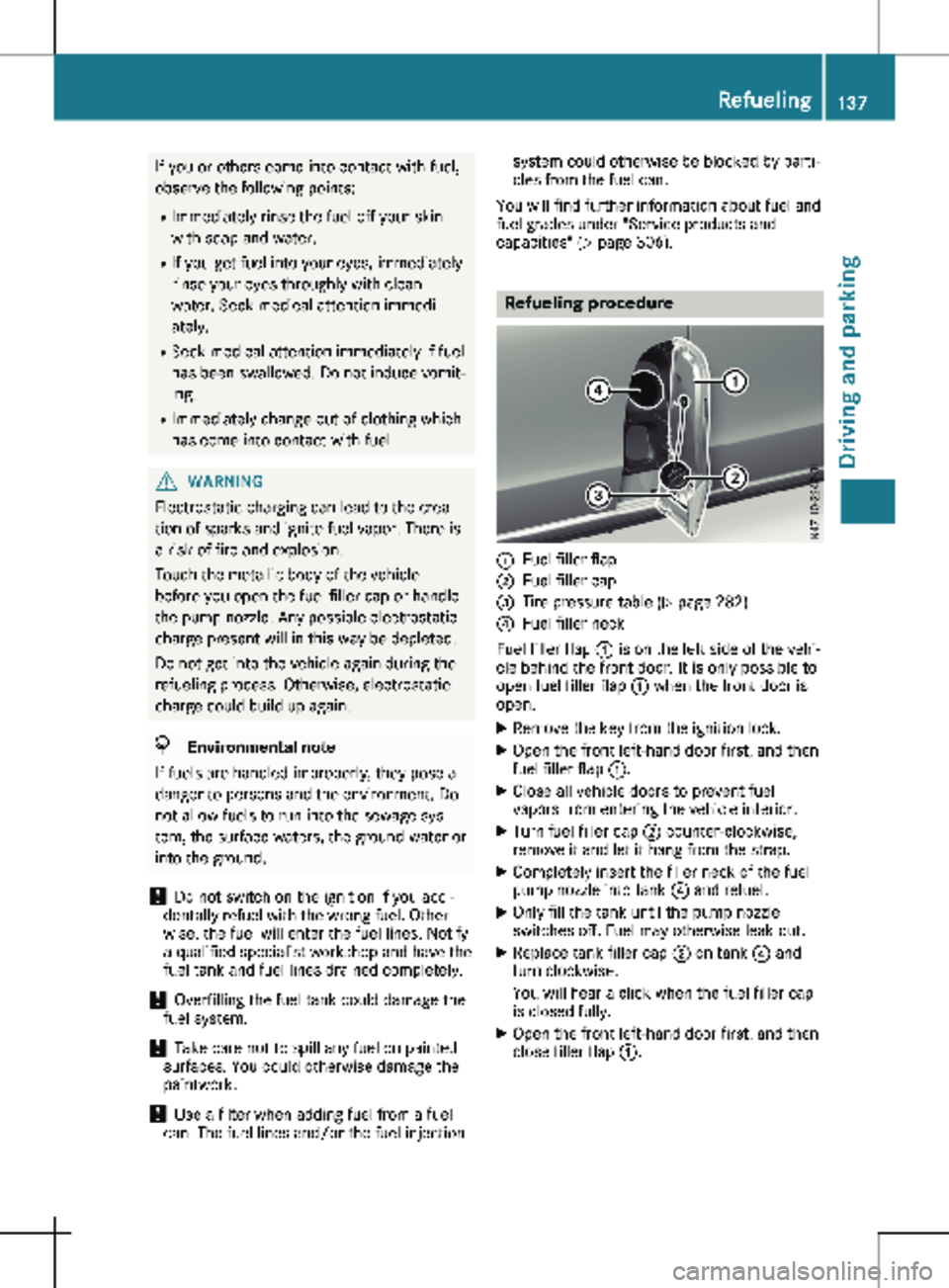
(Y page 306). Refueling procedure
:
Fuel filler flap
; Fuel filler cap
= Tire pressure table (Y page
282)
? Fuel filler neck
Fuel filler flap : is on the left side of the vehi-
cle behind the front door. It is only possible to
open fuel filler flap : when the front door is
open.
X Remove the key from the ignition lock.
X Open the front left-hand door first, and then
fuel filler flap :.
X Close all vehicle doors to prevent fuel
vapors from entering the vehicle interior.
X Turn fuel filler cap ; counter-clockwise,
remove it and let it hang from the strap.
X Completely insert the filler neck of the fuel
pump nozzle into tank ? and refuel.
X Only fill the tank until the pump nozzle
switches off. Fuel may otherwise leak out.
X Replace tank filler cap ; on tank ? and
turn clockwise.
You will hear a click when the fuel filler cap
is closed fully.
X Open the front left-hand door first, and then
close filler flap :. Refueling
137
Driving and parking Z
Page 140 of 320
Problems with the fuel and fuel tank
If your vehicle is losing fuel, the fuel lines or
the fuel tank are defective. X Turn the key immediately to position 0 in
the ignition lock and remove it.
X Do not restart the engine under any circum-
stances.
X Consult a qualified specialist workshop. Parking
Important safety notes
G
WARNING
Flammable material such as leaves, grass or
twigs may ignite if they come into contact
with hot parts of the exhaust system or
exhaust gas flow. There is a risk of fire.
Park the vehicle so that no flammable mate-
rials come into contact with parts of the
vehicle which are hot. Take particular care
not to park on dry grassland or harvested
grain fields. G
WARNING
If you leave children unsupervised in the
vehicle, they could set it in motion by, for
example:
R release the parking brake.
R shift the automatic transmission out of
the parking position P.
R start the engine.
In addition, they may operate vehicle equip-
ment and become trapped. There is a risk of
an accident and injury.
When leaving the vehicle, always take the
SmartKey with you and lock the vehicle.
Never leave children unsupervised in the
vehicle. G
WARNING
If you park the vehicle with the transmission
in park position j and the parking brake is
not engaged, the vehicle may roll away.
Engaging park position j is not a fully ade- quate replacement for the parking brake.
There is a risk of accident and injury.
Secure the vehicle against rolling away as
described below.
! Always secure the vehicle correctly against
rolling away. Otherwise, the vehicle or its
drivetrain could be damaged.
! When the vehicle is parked, always remove
the key to prevent the battery from becom-
ing discharged.
Always park your vehicle safely and secure it
against rolling away. When parking, observe
the legal requirements of the country in which
you are currently driving.
Observe the following to ensure that the vehi-
cle is secured correctly to prevent it from roll-
ing away unintentionally: R the parking brake is applied.
R the transmission is in position j and the
key has been removed.
R on uphill or downhill gradients, the front
wheels are turned towards the curb. Parking brake
G
WARNING
If you leave children unsupervised in the
vehicle, they could set it in motion by, for
example:
R release the parking brake.
R shift the automatic transmission out of
the parking position P.
R start the engine.
In addition, they may operate vehicle equip-
ment and become trapped. There is a risk of
an accident and injury.
When leaving the vehicle, always take the
SmartKey with you and lock the vehicle.
Never leave children unsupervised in the
vehicle. G
WARNING
If you must brake the vehicle with the park-
ing brake, the braking distance is considera-
bly longer and the wheels could lock. There 138
ParkingDriving and parking
Page 141 of 320
is an increased danger of skidding and acci-
dents.
Only use the parking brake to brake the
vehicle when the service brake is faulty. Do
not apply the parking brake too firmly. If the
wheels lock, release the parking brake until
the wheels begin turning again. The brake lamps are not illuminated when you
brake the vehicle using the parking brake.
As a rule, you may only apply the parking
brake when the vehicle is stationary.
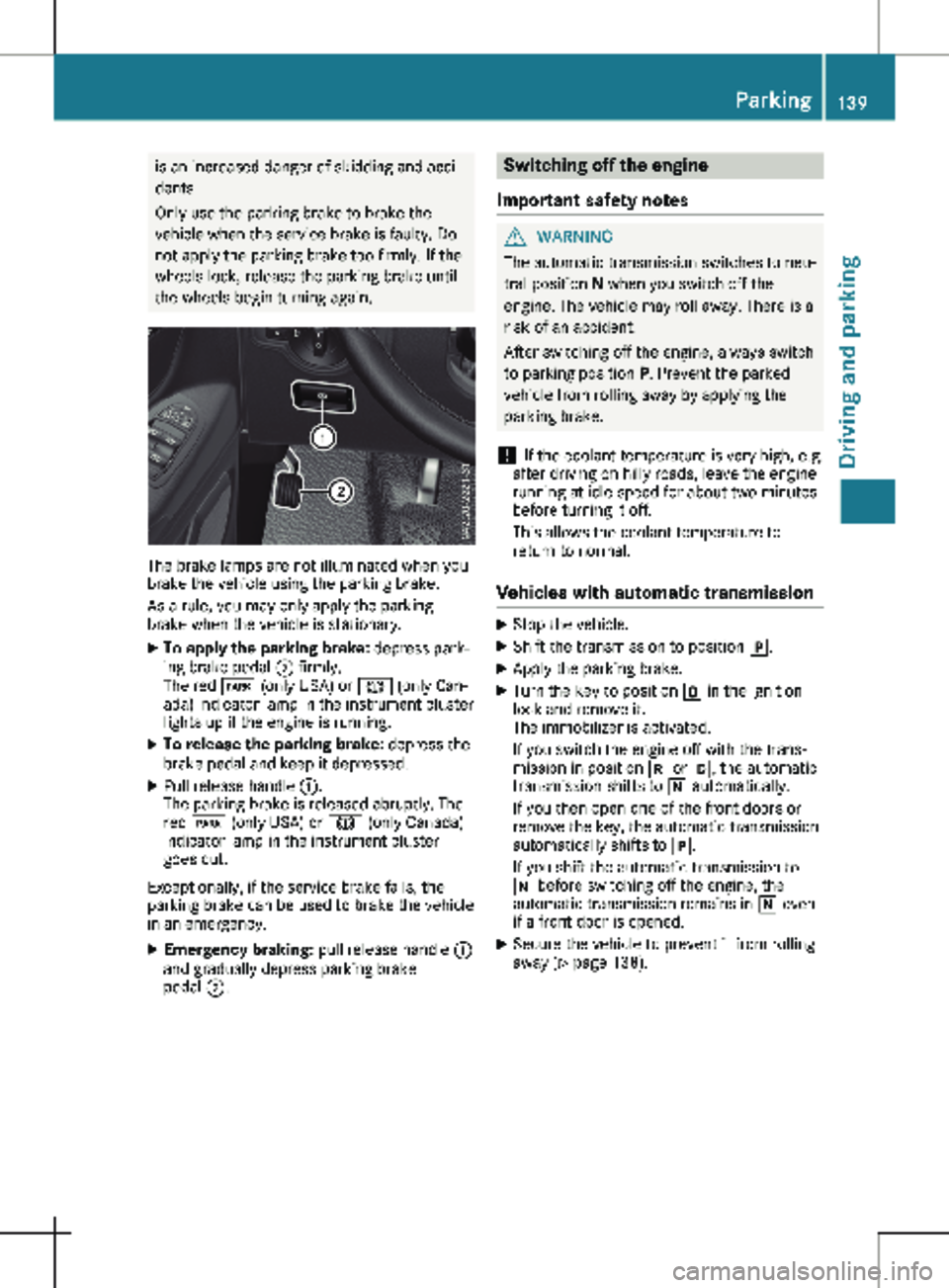
X To apply the parking brake: depress park-
ing brake pedal ; firmly.
The red F (only USA) or J (only Can-
ada) indicator lamp in the instrument cluster
lights up if the engine is running.
X To release the parking brake: depress the
brake pedal and keep it depressed.
X Pull release handle :.
The parking brake is released abruptly. The
red F (only USA) or J (only Canada)
indicator lamp in the instrument cluster
goes out.
Exceptionally, if the service brake fails, the
parking brake can be used to brake the vehicle
in an emergency.
X Emergency braking: pull release handle :
and gradually depress parking brake
pedal ;. Switching off the engine
Important safety notes G
WARNING
The automatic transmission switches to neu-
tral position N when you switch off the
engine. The vehicle may roll away. There is a
risk of an accident.
After switching off the engine, always switch
to parking position P. Prevent the parked
vehicle from rolling away by applying the
parking brake.
! If the coolant temperature is very high, e.g.
after driving on hilly roads, leave the engine
running at idle speed for about
two minutes
before turning it off.
This allows the coolant temperature to
return to normal.
Vehicles with automatic transmission X
Stop the vehicle.
X Shift the transmission to position j.
X Apply the parking brake.
X Turn the key to position u in the ignition
lock and remove it.
The immobilizer is activated.
If you switch the engine off with the trans-
mission in position k or h, the automatic
transmission shifts to i automatically.
If you then open one of the front doors or
remove the key, the automatic transmission
automatically shifts to j.
If you shift the automatic transmission to
i before switching off the engine, the
automatic transmission remains in i even
if a front door is opened.
X Secure the vehicle to prevent it from rolling
away
(Y page 138). Parking
139
Driving and parking Z
Page 155 of 320
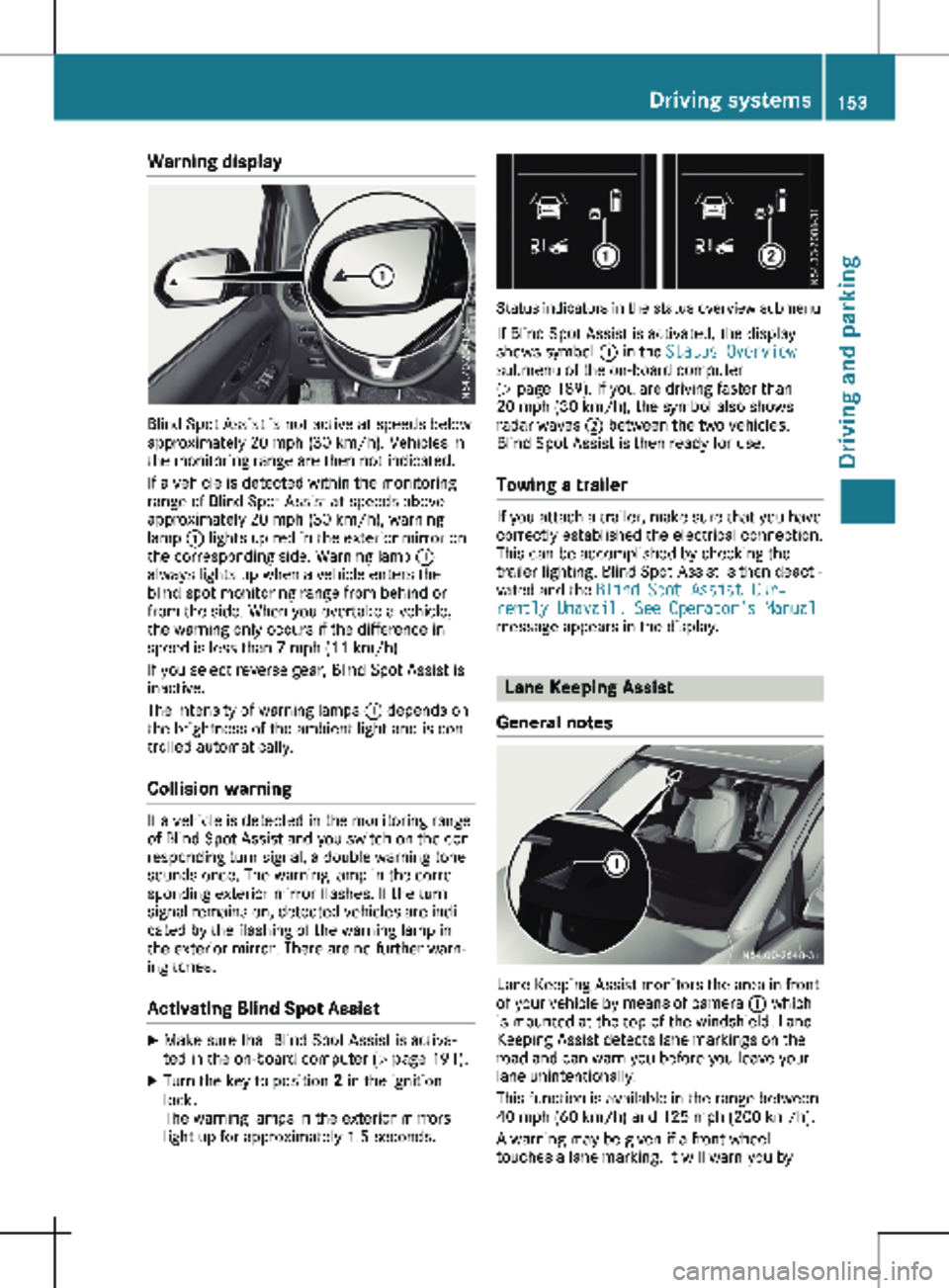
Warning display
Blind Spot Assist is not active at speeds below
approximately
20 mph (30 km/h). Vehicles in
the monitoring range are then not indicated.
If a vehicle is detected within the monitoring
range of Blind Spot Assist at speeds above
approximately 20 mph (30 km/h), warning
lamp : lights up red in the exterior mirror on
the corresponding side. Warning lamp :
always lights up when a vehicle enters the
blind spot monitoring range from behind or
from the side. When you overtake a vehicle,
the warning only occurs if the difference in
speed is less than 7 mph (11 km/h).
If you select reverse gear, Blind Spot Assist is
inactive.
The intensity of warning lamps : depends on
the brightness of the ambient light and is con-
trolled automatically.
Collision warning If a vehicle is detected in the monitoring range
of Blind Spot Assist and you switch on the cor-
responding turn signal, a double warning tone
sounds once. The warning lamp in the corre-
sponding exterior mirror flashes. If the turn
signal remains on, detected vehicles are indi-
cated by the flashing of the warning lamp in
the exterior mirror. There are no further warn-
ing tones.
Activating Blind Spot Assist X
Make sure that Blind Spot Assist is activa-
ted in the on-board computer (Y page
191).
X Turn the key to position 2 in the ignition
lock.
The warning lamps in the exterior mirrors
light up for approximately
1.5 seconds. Status indicators in the status overview submenu
If Blind Spot Assist is activated, the display
shows symbol : in the Status Overview
submenu of the on-board computer
(Y page
189). If you are driving faster than
20 mph (30 km/h), the symbol also shows
radar waves ; between the two vehicles.
Blind Spot Assist is then ready for use.
Towing a trailer If you attach a trailer, make sure that you have
correctly established the electrical connection.
This can be accomplished by checking the
trailer lighting. Blind Spot Assist is then deacti-
vated and the Blind Spot Assist Cur‐
rently Unavail. See Operator's Manual
message appears in the display. Lane Keeping Assist
General notes Lane Keeping Assist monitors the area in front
of your vehicle by means of camera : which
is mounted at the top of the windshield. Lane
Keeping Assist detects lane markings on the
road and can warn you before you leave your
lane unintentionally.
This function is available in the range between
40 mph (60 km/h
) and 125 mph (200 km/h).
A warning may be given if a front wheel
touches a lane marking. It will warn you by Driving systems
153
Driving and parking Z
Page 158 of 320
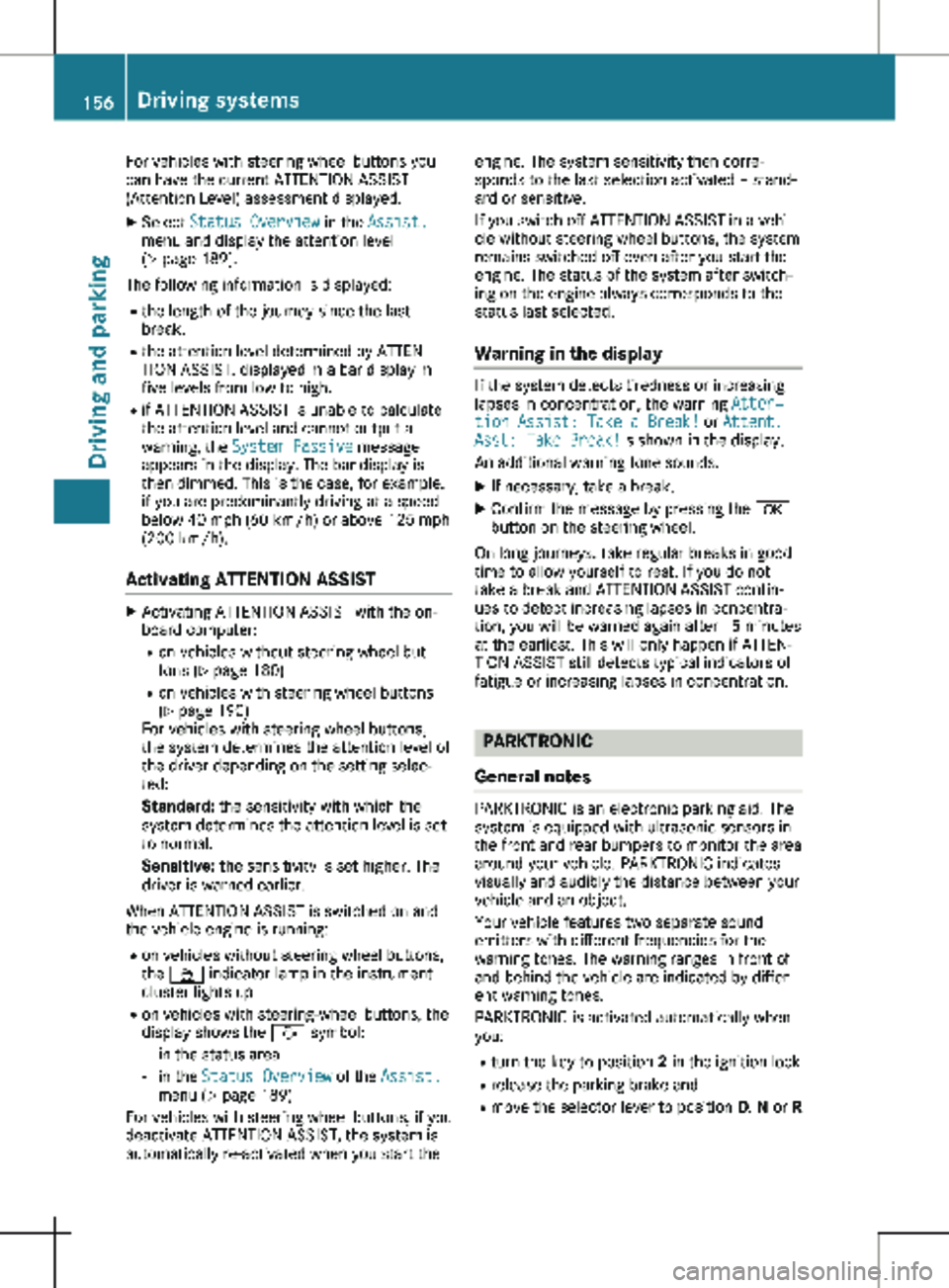
For vehicles with steering wheel buttons you
can have the current ATTENTION ASSIST
(Attention Level) assessment displayed.
X Select Status Overview in the Assist.
menu and display the attention level
(Y page
189).
The following information is displayed: R the length of the journey since the last
break.
R the attention level determined by ATTEN-
TION ASSIST, displayed in a bar display in
five levels from low to high.
R if ATTENTION ASSIST is unable to calculate
the attention level and cannot output a
warning, the System Passive message
appears in the display. The bar display is
then dimmed. This is the case, for example,
if you are predominantly driving at a speed
below
40 mph (60 km/h) or above 125 mph
(200 km/h).
Activating ATTENTION ASSIST X
Activating ATTENTION ASSIST with the on-
board computer:
R on vehicles without steering wheel but-
tons
(Y page 180)
R on vehicles with steering wheel buttons
(Y page 190)
For vehicles with steering wheel buttons,
the system determines the attention level of
the driver depending on the setting selec-
ted:
Standard: the sensitivity with which the
system determines the attention level is set
to normal.
Sensitive: the sensitivity is set higher. The
driver is warned earlier.
When ATTENTION ASSIST is switched on and
the vehicle engine is running: R on vehicles without steering wheel buttons,
the À indicator lamp in the instrument
cluster lights up
R on vehicles with steering-wheel buttons, the
display shows the À symbol:
- in the status area
- in the Status Overview of the Assist.
menu (Y page
189)
For vehicles with steering wheel buttons, if you
deactivate ATTENTION ASSIST, the system is
automatically re-activated when you start the engine. The system sensitivity then corre-
sponds to the last selection activated – stand-
ard or sensitive.
If you switch off ATTENTION ASSIST in a vehi-
cle without steering wheel buttons, the system
remains switched off even after you start the
engine. The status of the system after switch-
ing on the engine always corresponds to the
status last selected.
Warning in the display If the system detects tiredness or increasing
lapses in concentration, the warning
Atten‐
tion Assist: Take a Break! or Attent.
Asst: Take Break!is shown in the display.
An additional warning tone sounds.
X If necessary, take a break.
X Confirm the message by pressing the a
button on the steering wheel.
On long journeys, take regular breaks in good
time to allow yourself to rest. If you do not
take a break and ATTENTION ASSIST contin-
ues to detect increasing lapses in concentra-
tion, you will be warned again after
15 minutes
at the earliest. This will only happen if ATTEN-
TION ASSIST still detects typical indicators of
fatigue or increasing lapses in concentration. PARKTRONIC
General notes PARKTRONIC is an electronic parking aid. The
system is equipped with ultrasonic sensors in
the front and rear bumpers to monitor the area
around your vehicle. PARKTRONIC indicates
visually and audibly the distance between your
vehicle and an object.
Your vehicle features two separate sound
emitters with different frequencies for the
warning tones. The warning ranges in front of
and behind the vehicle are indicated by differ-
ent warning tones.
PARKTRONIC is activated automatically when
you:
R turn the key to position 2 in the ignition lock
R release the parking brake and
R move the selector lever to position D, N or R156
Driving systems
Driving and parking