esp MERCEDES-BENZ S CLASS 2019 Owners Manual
[x] Cancel search | Manufacturer: MERCEDES-BENZ, Model Year: 2019, Model line: S CLASS, Model: MERCEDES-BENZ S CLASS 2019Pages: 578, PDF Size: 23.31 MB
Page 402 of 578
RParkthevehicle on a level surface.
RLeavethe enginerunning at idle speed.
On-board computer:
,Service.Engine Oil Level
You will see one ofthefollowing messages inthe multifunction display:
#Measuring Engine Oil Level...: measurementofthe oil level is notyet possible.Repeattherequest after a maximum of 30 minutes' driv‐ing.
#Engine Oil Level OKandthe bar displayforindicatingthe oil level inthe multifunctiondisplay is green and is between "min" and"max":the oil level is correct.
#Engine Oil Level Add 1.0 landthe bar displayfor indicatingthe oil level inthe multifunctiondisplay is orange and is below "min": add1.1 US qt (1 liter) of engine oil.
#Reduce Engine Oil Levelandthe bar displayfor indicatingthe oil level inthe multifunctiondisplay is orange and is above"max": drain
offtheexcess engine oil. Consult aqualifiedspecialistworkshop.
#For Engine Oil Level Switch Ignition On:switch onthe ignitiontocheckthe engine oillevel.
#Engine Oil Level System Inoperative: sensordefective or not inserted. Consult aqualifiedspecialistworkshop.
#Engine Oil Level System Currently Unavail.:closethe hood.
Adding engine oil
&WARNINGRisk of burns from hot com‐ponent parts inthe engine compartment
Certain components inthe engine compart‐ment can beveryhot, e.g.the engine,theradiator and parts oftheexhaust system.
#Allowthe enginetocool down and onlytouch component parts described inthefollowing.
&WARNINGRisk offireand injury fromengine oil
If engine oil comes into contact withhotcomponent parts inthe engine compart‐ment, it may ignite.
#Make surethat no engine oil is spillednexttothefiller opening.
#Allowthe enginetocool off andthor‐oughly cleanthe engine oil from compo‐nent parts beforestartingthevehicle.
*NOTEEngine damagecausedbyanincorrect oilfilter, incorrect oil or addi‐tives
#Do not use engine oils or oilfilterswhich do not correspondtothe specifi‐cationsexplicitly prescribedfortheservice intervals.
#Do not alterthe engine oil or oilfilter inordertoachievelongerchange intervalsthan prescribed.
#Do not use additives.
400Maintenance and care
Page 408 of 578
Cleaning and careAvoiding paintwork damage
MattefinishROnly use care products approvedfor Mercedes-Benz.RDo not polishthevehicle and alloy wheels.
ROnly use carwashesthat correspondtothe latest engi‐neeringstandards.
RDo not use carwash programs with afinal hotwax treat‐ment.
RDo not use paint cleaners, buffing or polishing products,gloss preservers, e.g.wax.
RAlways havepaintworkrepairs carried out at aqualifiedspecialistworkshop.
Notes on cleaning decorativefoils
Observethe notes on mattefinish care inthechapter "Notes on paintwork/mattefinish paint‐
workcare" (→page405). They also applytomatte decorativefoils.
406Maintenance and care
Page 415 of 578
Emergency
Removing the safetyvest
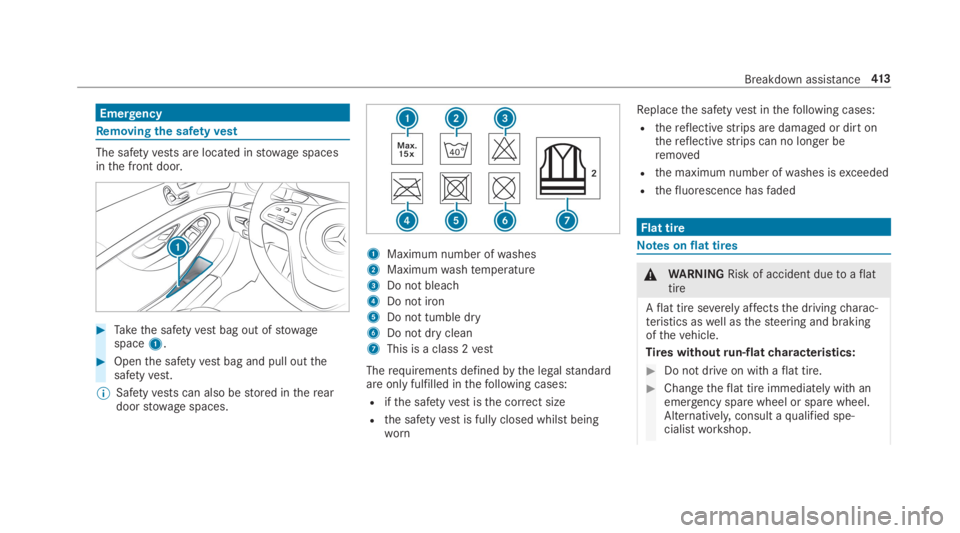
The safetyvests are located instowage spacesinthe front door.
#Takethe safetyvestbag out ofstowagespace1.
#Openthe safetyvestbag and pull outthesafetyvest.
%Safetyvests can also bestored inthereardoorstowage spaces.
1Maximum number ofwashes
2Maximumwashtemperature
3Do not bleach
4Do not iron
5Do not tumble dry
6Do not dry clean
7This is a class 2vest
Therequirements definedbythe legalstandardare only fulfilled inthefollowing cases:
Rifthe safetyvestisthe correct size
Rthe safetyvestis fully closed whilst beingworn
Replacethe safetyvestinthefollowing cases:
Rthereflectivestrips are damaged or dirt onthereflectivestrips can no longer beremoved
Rthe maximum number ofwashes isexceeded
Rthefluorescence hasfaded
Flat tire
Notes on flat tires
&WARNINGRisk of accident duetoaflattire
Aflat tire severelyaffectsthe drivingcharac‐teristics aswell asthesteering and brakingofthevehicle.
Tires withoutrun-flatcharacteristics:
#Do not drive on with aflat tire.
#Changetheflat tire immediately with anemergency sparewheel or spare wheel.Alternatively,consult aqualified spe‐cialistworkshop.
Breakdown assistance413
Page 416 of 578
Tires withrun-flatcharacteristics:
#Observethe information andwarningnotes on MOExtended tires (run-flattires).
Intheevent of aflat tire,thefollowing optionsareavailable depending onyourvehicle's equip‐ment:
RVehicles with MOExtended tires:it is pos‐sibletocontinuethe journeyfor a shortperiod of time. Make sureyou observethenotes on MOExtended tires (run-flat tire)(→page414).
RVehicles with a TIREFIT kit:you canrepairthe tires sothat it is possibletocontinuethejourneyfor a short period of time.Todothis,usethe TIREFIT kit (→page415).
RVehicles with Mercedes me connect:youcan make a callforRoadside Assistance viatheoverhead control panel inthe case of abreakdown (→page 344).
RAllvehicles:changethe wheel(→page 458).
Notes on MOExtended tires (run-flat tire)
&WARNINGRisk of accident when drivingin emergency mode
When driving in emergency mode,the han‐dlingcharacteristics are impaired. e.g. whencornering, when acceleratingstronglyandwhen braking.
#Do notexceedthe permissible maxi‐mum speedfor MOExtended tires.
#Avoid any abruptsteering and drivingmaneuvers aswell as drivingoverobstacles (curbs, pot holes, off-road).This applies, in particular,toa loadedvehicle.
#Stop driving inthe emergency mode ifyou notice:
Rbanging noise
Rvehicle vibration
Rsmoke which smells likerubber
Rcontinuous ESP®intervention
Rcracksin tire sidewalls
#After driving in emergency mode havetherimscheckedbyaqualified special‐istworkshop withregardtotheir furtheruse.
#The defective tire must bereplaced ineverycase.
WithMOExtended tires (run-flat tire),you cancontinuetodriveyourvehicleeven ifthere is atotal loss of pressure in one or more tires. How‐ever,the tire affected must not show any clearlyvisible damage.
You canrecognize MOExtended tiresbytheMOExtended marking which appearsonthe sidewall ofthe tire.
Vehicles with tire pressure monitoring sys‐tem:MOExtended tires may only be used in con‐junction withan activated tire pressure monitor‐ing system.
If a pressure losswarning message appears inthe multifunction display,proceed asfollows:
RCheckthe tirefor damage.
RIf driving on, observethefollowing notes.
414Breakdown assistance
Page 419 of 578
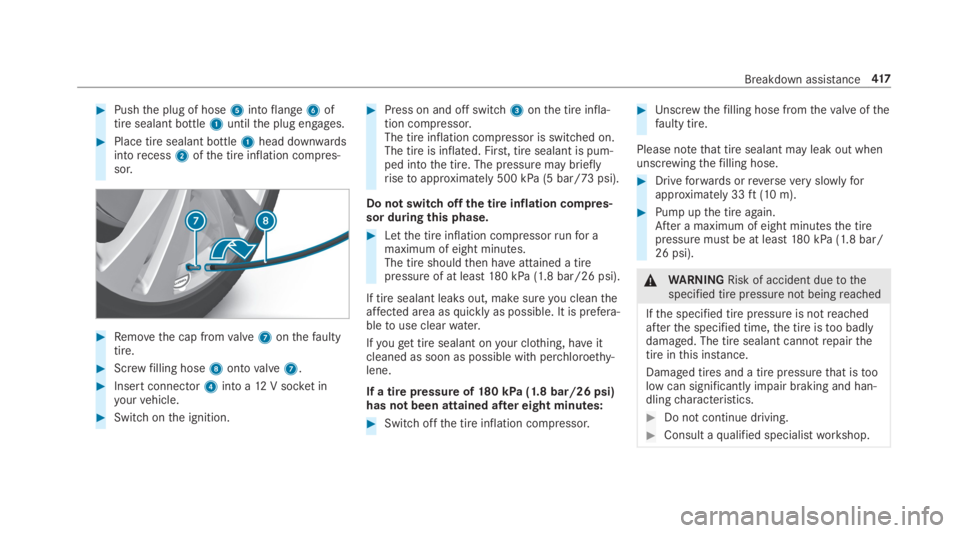
#Pushthe plug of hose5intoflange6oftire sealant bottle1untilthe plug engages.
#Place tire sealant bottle1head downwardsintorecess2ofthe tire inflation compres‐sor.
#Removethe cap fromvalve7onthefaultytire.
#Screwfilling hose8ontovalve7.
#Insert connector4into a12V socket inyourvehicle.
#Switch onthe ignition.
#Press on and off switch3onthe tire infla‐tion compressor.The tire inflation compressor is switched on.The tire is inflated. First, tire sealant is pum‐ped intothe tire. The pressure may brieflyrisetoapproximately 500 kPa (5 bar/73 psi).
Do not switch offthe tire inflation compres‐sor duringthis phase.
#Letthe tire inflation compressorrunfor amaximum of eight minutes.The tire shouldthen haveattained a tirepressure of at least180 kPa (1.8 bar/26 psi).
If tire sealant leaksout, make sureyou cleantheaffected area asquickly as possible. It is prefera‐bletouse clearwater.
Ifyouget tire sealant onyour clothing, haveitcleaned as soon as possible with perchloroethy‐lene.
If a tirepressure of180 kPa (1.8 bar/26 psi)has not been attained after eight minutes:
#Switch offthe tire inflation compressor.
#Unscrewthefilling hose fromthevalve ofthefaulty tire.
Please notethat tire sealant may leak out whenunscrewingthefilling hose.
#Driveforwards orreverseveryslowlyforapproximately 33ft(10 m).
#Pump upthe tire again.After a maximum of eight minutesthe tirepressure must be at least180 kPa (1.8 bar/26 psi).
&WARNINGRisk of accident duetothespecified tire pressure not beingreached
Ifthe specified tire pressure is notreachedafterthe specified time,the tire istoo badlydamaged. The tire sealant cannotrepairthetire inthis instance.
Damaged tires and a tire pressurethat istoolow can significantly impair braking and han‐dlingcharacteristics.
#Do not continue driving.
#Consult aqualified specialistworkshop.
Breakdown assistance417
Page 420 of 578
If a tire pressureof180 kPa (1.8 bar/26 psi)has been attained after eight minutes:
&WARNINGRisk of accident from drivingwithsealed tires
A tiretemporarily sealed with tire sealantimpairs drivingcharacteristics and is notsuitablefor higher speeds.
#Adaptyour drivingstyle accordinglyanddrive carefully.
#Do notexceedthe maximum speedlimit with a tirethat has beenrepairedusing tire sealant.
Observethe maximum permissible speedfor atire sealed with tire sealant 50mph (80 km/h).#Affixthe upper section ofthe TIREFITstickertothe instrument cluster in a location whereit will be easilyseenbythe driver.
*NOTEStaining causedbyleaking tiresealant
After use,excess tire sealant may leak outfromthefilling hose.
#Therefore, placethefilling hose intheplastic bagthat containedthe TIREFITkit.
+ENVIRONMENTALNOTEEnvironmentalpollution causedbyenvironmentally irre‐sponsible disposal
Tiresealant contains pollutants.
#Havethe tire sealant bottle disposed ofprofessionally,e.g. at an authorizedMercedes-Benz Center.
#Switch offthe tire inflation compressor.
#Unscrewthefilling hose fromthevalve ofthefaulty tire.
#Stow the tire sealant bottle,the tire inflationcompressor andthewarning triangle.
#Pullawayimmediately.
#Stop driving after approximatelyten minutesandcheckthe tire pressure usingthe tireinflation compressor.The tire pressure must now be at least130 kPa (1.3 bar/19 psi).
&WARNINGRisk of accident duetothespecified tire pressure not beingreached
Ifthe specified tire pressure is notreachedafter a brief drive,the tire istoo badly dam‐aged. The tire sealant cannotrepairthe tireinthis instance.
Damaged tires and tire pressurethat istoolow can significantly impairthe braking prop‐erties andthe handlingcharacteristics.
#Do not continue driving.
#Consult aqualified specialistworkshop.
In cases such asthe one mentioned above, con‐tact an authorized Mercedes-Benz Center. Orcall 1-800-FOR-MERCedes (inthe USA) or1-800-387-0100(in Canada).
#Correctthe tire pressure if it isstill at least130 kPa (1.3 bar/19 psi).You willfindthevalues intheTireand Loading Informationplacard onthe B-pillar onthe driver's side orinthe tire pressuretable inthe fuelfillerflap.
#Toincreasethe tire pressure:switchonthe tire inflation compressor.
41 8Breakdown assistance
Page 421 of 578
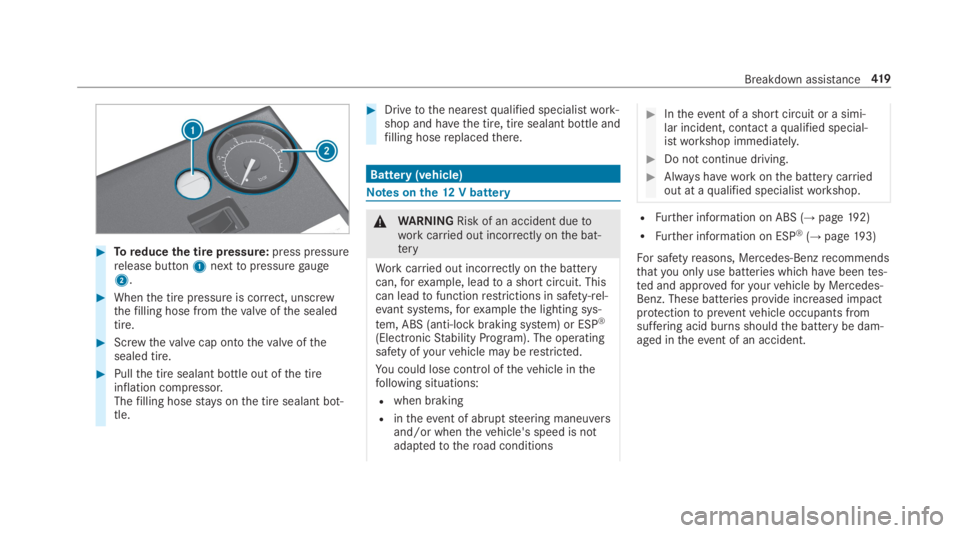
#Toreduce the tire pressure:press pressurerelease button1nexttopressuregauge2.
#Whenthe tire pressure is correct, unscrewthefilling hose fromthevalve ofthe sealedtire.
#Screwthevalve cap ontothevalve ofthesealed tire.
#Pullthe tire sealant bottle out ofthe tireinflation compressor.Thefilling hosestays onthe tire sealant bot‐tle.
#Drivetothe nearestqualified specialistwork‐shop and havethe tire, tire sealant bottle andfilling hosereplacedthere.
Battery(vehicle)
Notes onthe12V battery
&WARNINGRisk of an accident duetoworkcarried out incorrectly onthe bat‐tery
Workcarried out incorrectly onthe batterycan,forexample, leadtoa short circuit. Thiscan leadtofunctionrestrictions in safety-rel‐evant systems,forexamplethe lighting sys‐
tem, ABS (anti-lockbraking system) or ESP®
(ElectronicStability Program). The operatingsafety ofyourvehicle may berestricted.
You could lose control ofthevehicle inthefollowing situations:
Rwhen braking
Rintheevent of abruptsteering maneuversand/or whenthevehicle's speed is notadaptedtotheroad conditions
#Intheevent of a shortcircuit or a simi‐lar incident, contact aqualified special‐istworkshop immediately.
#Do not continue driving.
#Always haveworkonthe battery carriedout at aqualified specialistworkshop.
RFurther information on ABS (→page192)
RFurther information on ESP®(→page193)
For safetyreasons, Mercedes-Benzrecommendsthatyou onlyuse batteries which havebeentes‐ted and approvedforyourvehiclebyMercedes-Benz. These batteries provide increased impactprotectiontopreventvehicle occupants fromsuffering acid burns shouldthe battery be dam‐aged intheevent of an accident.
Breakdown assistance419
Page 422 of 578
Allvehiclesexceptvehicles with a lithium-ion battery
&WARNINGRisk ofexplosion duetoelec‐trostaticcharge
Electrostaticchargecan cause sparks whichmay ignitethe highlyflammablegas mixtureinthe battery.
#Todischargeany electrostaticchargethat may havebuilt up,touchthe metalvehicle body before handlingthe bat‐tery.
The highlyflammablegas mixture is createdwhilethe battery ischarging and duringstartingassistance.
&WARNINGDanger ofchemical burnsfromthe battery acid
Battery acid is caustic.
#Avoid contact withthe skin,eyes orclothing.
#Do not leanoverthe battery.
#Do not inhale batterygases.
#Keepchildrenawayfromthe battery.
#Immediatelyrinse battery acid offthor‐oughly with plenty of cleanwater andseek medical attention immediately.
Allvehicles
+ENVIRONMENTALNOTEEnvironmentaldamagecausedbyimproper disposal ofbatteries
Batteries contain pollutants. It isillegaltodispose ofthem withthe householdrubbish.
#
Dispose of batteries in anenvironmentallyresponsible manner.Takedischarged batteriestoaqualified
specialistworkshop ortoa collectionpointfor used batteries.
Ifyou havetodisconnectthe12V battery,con‐tact aqualified specialistworkshop.
Comply with safety notes andtakeprotectivemeasures when handling batteries.
Risk ofexplosion.
Fire, openflames and smoking areprohibited when handlingthe battery.Avoid creating sparks.
Electrolyteor battery acid is corro‐sive.Avoid contact withthe skin,eyesor clothing.Wear suitable protectiveclothing, in particulargloves, anapron and aface mask.Immediatelyrinse electrolyteor acid splashes offwith cleanwater.Consult a doctor ifnecessary.
420Breakdown assistance
Page 424 of 578
#When givingstarting assistance, alwaysmake surethatyou onlyconnect bat‐teryterminals with identical polarity.
#Duringstarting assistance,you mustobservethe described orderfor con‐necting and disconnectingthe jumpercables.
#Do not connect or disconnectthe bat‐teryclamps whilethe engine isrunning.
&WARNINGRisk ofexplosion duringcharging process andstarting assistance
Duringthecharging process andstartingassistance,the battery mayrelease anexplo‐sivegas mixture.
#Avoidfire, openflames, creating sparksand smoking.
#Make surethatthere is sufficientventi‐lation duringthecharging process andduringstarting assistance.
#Do not leanover a battery.
&WARNINGRisk ofexplosion from a fro‐zen battery
A discharged battery may freeze attempera‐tures slightly aboveor below freezing point.
Duringstarting assistance or batterycharg‐ing, batterygas may bereleased.
#Alwaysthawa frozen batteryoutfirstbeforecharging it or performingstart‐ing assistance.
Ifthe indicator/warning lamps inthe instrumentcluster do not light up at lowtemperatures, it isverylikelythatthe discharged battery has fro‐zen. Inthis caseyou may neither jump-startthevehicle norchargethe battery.
The service life of a batterythat has beenthawed may be dramatically shortened. Thestartingcharacteristics may be impaired, espe‐cially at lowtemperatures.
It isrecommendedthatyou haveathawed bat‐terychecked at aqualified specialistworkshop.
Allvehicles
*NOTEDamagecausedbynumerous orextended attemptstostartthe engine
Numerous orextended attemptstostarttheengine may damagethe catalytic converterduetonon-combusted fuel.
#Avoid numerous andextended attemptstostartthe engine.
Observethefollowing points duringstartingassistance and whenchargingthe battery:
ROnly use undamaged jumper cables/charg‐ing cables with a sufficient cross-section andinsulatedterminal clamps.
RNon-insulated parts oftheterminal clampsmust not come into contact withother metalparts whilethe jumper cable/charging cableis connectedtothe battery/jump-startcon‐nection point.
RThe jumper cable/charging cable must notcome into contact withany parts which maymovewhenthe engine isrunning.
422Breakdown assistance
Page 426 of 578
#Duringstarting assistance:starttheengine ofthe donorvehicle andrun at idlespeed.
#Connectthe negative pole ofthe donor bat‐teryandground point5ofyourownvehiclebyusingthe jumper cable/charging cable.Begin withthe donor batteryfirst.
#Duringstarting assistance:starttheengine ofyourownvehicle.
#Duringthecharging process:startthecharging process.
#Duringstarting assistance:letthe enginesrunfor several minutes.
#Duringstarting assistance:before discon‐nectingthe jumper cable, switch on an elec‐trical consumer inyourownvehicle, e.g.therear windowdefroster or lighting.
Whenthestarting assistance/charging processis complete:
#First,removethe jumper cable/chargingcable from ground point5and negativepole ofthe donor battery,then from positiveclamp4and positive pole ofthe donor bat‐
tery. Begin eachtime with the contacts onyourownvehiclefirst.
#Afterremovingthe jumper cable/chargingcable, close cover3of positive clamp4.
Further information can be obtained at aquali‐fied specialistworkshop.
Replacing the12V battery
#Observethe notes onthe12V battery(→page419).
Mercedes-Benzrecommendsthatyou havethe12V batteryreplaced at aqualified specialistworkshop, e.g. at an authorized Mercedes-BenzCenter.
Observethefollowing notes ifyouwanttoreplacethe batteryyourself:
RAlwaysreplace afaulty batterywith a batterywhich meetsthe specificvehiclerequire‐ments.
Thevehicle is equipped with anAGMtechnol‐ogy battery (Absorbent Glass Mat) or a lith‐ium-ion battery.Fullvehicle functionality is
only guaranteed with anAGM battery or lith‐ium-ion battery.For safetyreasons,Mercedes-Benzrecommendsthatyou onlyuse batteries which havebeentested andapprovedforyourvehiclebyMercedes-Benz.
RCarryover detachable parts, such asventhoses, elbowfitting orterminal coversfromthe battery beingreplaced.
RMake surethatthevent hose is alwayscon‐nectedtothe original opening onthe side ofthe battery.
Install anyexisting or supplied cell caps.
Otherwise,gases or battery acid couldescape.
RMake surethat detachable parts arerecon‐nected inthe sameway.
Towstarting ortowingaway
Permittedtowing methods
Plug-inhybrid:observethe notes inthe Supple‐ment. Otherwise,you may notrecognize dan‐gers.
424Breakdown assistance