lock MERCEDES-BENZ S CLASS 2019 Workshop Manual
[x] Cancel search | Manufacturer: MERCEDES-BENZ, Model Year: 2019, Model line: S CLASS, Model: MERCEDES-BENZ S CLASS 2019Pages: 578, PDF Size: 23.31 MB
Page 174 of 578
&WARNINGRisk of accident when switch‐ing offthe ignition when driving
Ifyou switchoffthe ignition while driving,safety functions arerestricted or no longeravailable. This may affectthe powersteeringsystem andthe brakeforce boosting,forexample.
You willthen needtouse considerably moreforcetosteer and brake.
#Do not switch offthe ignition while driv‐ing.
&DANGERRisk offatal injuries duetoexhaustgases
Combustion engines emit poisonousexhaustgases such as carbon monoxide. Inhalingtheseexhaustgases is hazardoustohealthand can leadtopoisoning.
#Never leavethe enginerunning in anenclosed space without sufficientventi‐lation.
&WARNINGRisk of skidding and of anaccident duetoshifting down on slipperyroad surfaces
Ifyou shift down on slipperyroad surfacestoincreasethe engine braking effect,the drivewheels may lose traction.
#Do not shift down on slipperyroad sur‐facestoincreasethe engine brakingeffect.
&DANGERRisk offatal injury duetopoi‐sonousexhaustgases
Ifthetailpipe is blocked or sufficientventila‐tion is not possible, poisonousexhaustgasessuch as carbon monoxide may enterthevehi‐cle. This isthe case ifthevehiclegetsstuckin snow,forexample.
#Keepthetailpipe andthe area aroundthevehicle free from snow whentheengine orthestationary heater arerun‐ning.
#Open a window onthe windward side ofthevehicletoensure an adequate sup‐ply of fresh air.
&WARNINGRisk of accident and injuryduetobeing underthe influence of alco‐hol and drugs while driving
Driving when underthe influence of alcoholand/or drugs is anextremelydangerouscombination. Even smallquantities of alcoholor drugs may affectyourreflexes, perceptionand judgment.
The probability of a serious orevenfatal acci‐dent greatly increases ifyou drive whenunderthe influence of alcohol or drugs.
#Do not drink alcohol ortakedrugs whiledriving, and do not allow anyonetodrive who has been drinking alcohol ortaking drugs.
17 2Driving and parking
Page 179 of 578
Automatic transmission
DIRECT SELECT lever
Function ofthe DIRECT SELECT lever
&WARNINGRisk of accident and injuryduetochildren left unattended inthevehicle
Ifchildren are left unattended inthevehicle,theycould:
Ropen doors,thereby endangeringotherpersons orroad users.
Rget out ofthevehicle and be hitbyoncoming traffic.
Roperate vehicle equipment and becometrapped,forexample.
In addition,children could also setthevehi‐cle in motion,forexample,by:
Rreleasingthe parking brake.
Rshiftingthe automatic transmission out ofpark position].
Rstartingthe engine
#Never leavechildren and animals unat‐tended inthevehicle.
#When leavingthevehicle, alwaystakethe SmartKeywithyou and lockthevehicle.
#Keepthe SmartKeyout ofthereach ofchildren.
&WARNINGRisk of accident duetoincor‐rectgearshifting
Ifthe engine speed is higherthanthe idlespeed andyou engagethe transmission posi‐tion[or^,thevehicle may acceleratesharply.
#Ifyou engagethe transmission position[or^always depressthe brakepedalfirmlyand do not accelerate atthe same time.
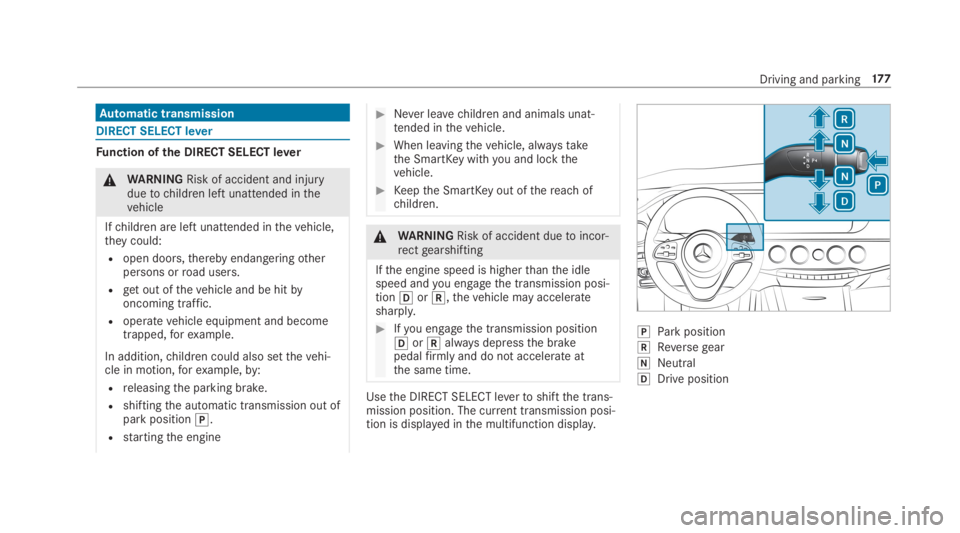
Usethe DIRECT SELECT levertoshiftthe trans‐mission position. The current transmission posi‐tion is displayed inthe multifunction display.
]Parkposition
^Reversegear
\\Neutral
[Drive position
Driving and parking17 7
Page 184 of 578
#Havethe fueltank and fuel linesdrained completely.
*NOTEDamagetothe fuel system causedbyoverfilled fueltanks.
#Onlyfillthe fueltank untilthe pumpnozzle switches off.
*NOTEFuel may sprayout whenyouremovethe fuel pump nozzle.
#Onlyfillthe fueltank untilthe pumpnozzle switches off.
Requirements:RThevehicle is unlocked.
%Do notget intothevehicle again duringtherefueling process. Otherwise, electrostaticchargecould build up again.
Observethe notes on operatingfluids(→page 468).
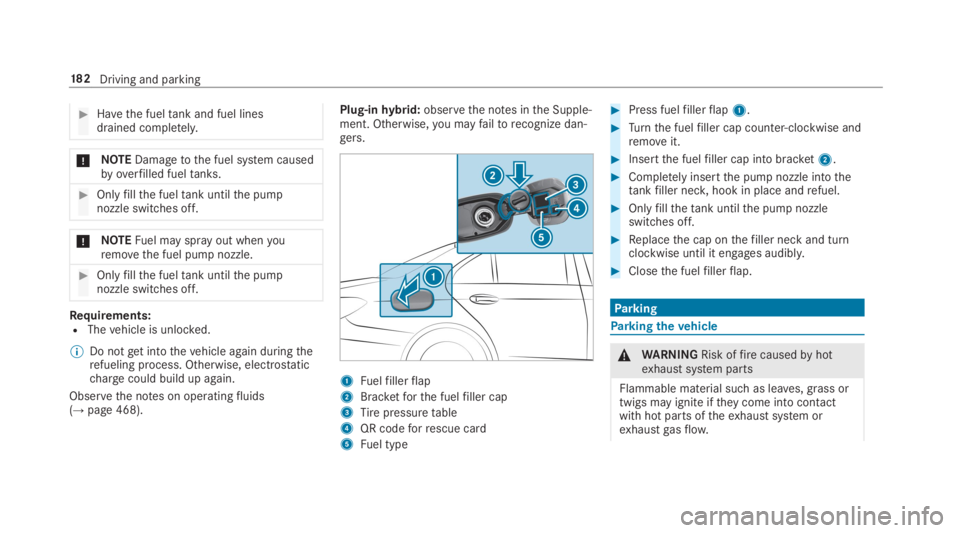
Plug-inhybrid:observethe notes inthe Supple‐ment. Otherwise,you mayfailtorecognize dan‐gers.
1Fuelfillerflap
2Bracketforthe fuelfiller cap
3Tirepressuretable
4QR codeforrescue card
5Fuel type
#Press fuelfillerflap1.
#Turnthe fuelfiller cap counter-clockwise andremoveit.
#Insertthe fuelfiller cap into bracket2.
#Completelyinsertthe pump nozzle intothetankfiller neck,hook in place andrefuel.
#Onlyfillthetank untilthe pump nozzleswitches off.
#Replacethe cap onthefiller neck and turnclockwise until it engages audibly.
#Closethe fuelfillerflap.
Parking
Parkingthevehicle
&WARNINGRisk offirecausedbyhotexhaust system parts
Flammable material such as leaves, grass ortwigs may ignite iftheycome into contactwithhot parts oftheexhaust system orexhaustgasflow.
18 2Driving and parking
Page 185 of 578

#Parkthevehicle sothat noflammablematerial can come into contact withhotvehicle components.
#In particular, do not park on dry grass‐land or harvested grainfields.
&WARNINGRisk of accident and injuryduetochildren left unattended inthevehicle
Ifyou leavechildren unattended inthevehi‐cle,theymay be abletosetthevehicle inmotion,forexampleby:
RReleasingthe parking brake.
RShiftingthe automatic transmission outof park position].
RStartingthe engine.
In addition,theymay operatevehicle equip‐ment and become trapped.
#Never leavechildren unattended inthevehicle.
#When leavingthevehicle, alwaystakethe SmartKeywithyou and lockthevehicle.
*NOTEDamagetothevehicle duetoitrollingaway
#Always securethevehicle againstroll‐ingaway.
1Start/stop button
#On uphill or downhill inclines, turnthe frontwheelstowardsthe curb.
#Applythe electric parking brake.
#Select transmission position].
#Switchthe ignition off.
#Lockthevehicle.
Driving and parking18 3
Page 190 of 578
CountryRadio equipment approvalnumber
MexicoRCPGEMU15-0448
Monaco CE
New Zea‐landR-NZ
NorwayCE
RussianFedera‐tion
Notrequired
Saudi Ara‐biaTA10525
Switzer‐landCE
SouthAfrica
TA-2015/1386
CountryRadio equipment approvalnumber
TurkeyNotrequired
UnitedArab Emi‐rates
ER41849/15
Dealer No:DA35176/14
UnitedStatesFCC ID: NZLMUAHL5
Further information onthe declaration of con‐formityfor wirelessvehicle components(→page 23).
Electric parking brake
Electric parking brake function (applyingautomatically)
&WARNINGRisk of accident and injuryduetochildren and animals left unatten‐ded inthevehicle
Ifyou leavechildren and animals unattendedinthevehicle,theymay be abletosetthevehicle in motion,forexampleby:
RReleasingthe parking brake.
RShiftingthe automatic transmission outof park position].
RStartingthe engine.
In addition,theymay operatevehicle equip‐ment and become trapped.
#Never leavechildren and animals unat‐tended inthevehicle.
#When leavingthevehicle, alwaystakethe SmartKeywithyou and lockthevehicle.
18 8Driving and parking
Page 194 of 578
Overview of driving systems and drivingsafety systems
Inthis section,you willfind information aboutthefollowing driving systems and driving safetysystems:
R360° Camera (→page 228)
RABS (Anti-lockBrakingSystem)(→page192)
RActive Distance AssistDISTRONIC(→page203)
RAIRBODYCONTROL (→page215)
RActive Brake Assist (→page196)
RActive LaneKeeping Assist (→page246)
RATTENTION ASSIST (→page 237)
RBAS (BrakeAssistSystem) (→page192)
RHillStart Assist (→page214)
REBD (ElectronicBrakeforceDistribution)(→page196)
RESP®(ElectronicStabilityProgram)(→page193)
RActive Speed Limit Assist (→page 206)
RHOLD function (→page214)
RSTEER CONTROL (→page196)
RActiveSteering Assist (→page 208)
RMAGICBODYCONTROL (→page217)
RNightViewAssist (→page240)
RActiveParking Assist (→page 231)
RParking AssistPARKTRONIC (→page 222)
RRear view camera (→page 226)
RCruise control (→page 200)
RBlind Spot Assist andActive Blind Spot Assist(→page243)
RTraffic Sign Assist (→page 239)
Function of ABS (Anti-lock Braking System)
ABSregulatesthe brake pressure in critical driv‐ing situations:
RDuring braking, e.g. at full brake applicationor insufficient tire traction,the wheels areprevented from locking.
RVehiclesteerability while braking is ensured.
If ABS intervenes when braking,you willfeel apulsing inthe brake pedal. The pulsating brakepedal can be an indication of hazardousroadconditions and can serveas aremindertotakeextra care while driving.
System limitationsRABS is active from speeds of approx. 5mph(8 km/h).
RABS may be impaired or may not function if amalfunction has occurred andtheyel‐low%ABSwarning lamp lights up contin‐uously inthe instrument cluster aftertheengine isstarted.
Function ofBAS (Brake Assist System)
&WARNINGRisk of an accident causedbya malfunction inBAS (Brake AssistSys‐tem)
IfBAS is malfunctioning,the braking distancein an emergency braking situation isincreased.
19 2Driving and parking
Page 195 of 578
#Depressthe brake pedal with fullforcein emergency braking situations. ABSpreventsthe wheels from locking.
BAS supportsyour emergency braking situationwith additional brakeforce.
Ifyou depressthe brake pedalquickly,BAS isactivated:
RBAS automaticallybooststhe brake pres‐sure.
RBAS can shortenthe braking distance.
RABS preventsthe wheels from locking.
The brakes will function as usual onceyoureleasethe brake pedal.BAS is deactivated.
Function of ESP®(ElectronicStability Pro‐gram)
&WARNINGRisk of skidding if ESP®ismalfunctioning
If ESP®is malfunctioning, ESP®cannot carryoutvehiclestabilization. In addition,otherdriving safety systems are switched off.
#Drive on carefully.
#HaveESP®checked at aqualified spe‐cialistworkshop.
&WARNINGRisk of skidding if ESP®isdeactivated
Ifyou deactivate ESP®, ESP®cannot carryoutvehiclestabilization.
#ESP®should onlybe deactivated inthefollowing situations.
Mercedes‑AMGvehicles:observethe notes inthe Supplement. Otherwise,you may notrecog‐nize dangers.
ESP®can monitor and improvedrivingstabilityand traction inthefollowing situations, withinphysical limits:
RWhen pullingawayonwet or slipperyroad‐way.
RWhen braking.
RInstrong side winds whenyou are drivingfasterthan 50mph (80 km/h).
Ifthevehicle deviates fromthe direction desired
bythe driver, ESP®canstabilizethevehiclebyintervening inthefollowingways:
ROne or more wheels are braked.
RThe engine output is adapted accordingtothe situation.
ESP®is deactivated ifthe
Page 214 of 578
Activating/deactivatingActive Lane ChangeAssistMultimedia system:
,Vehicle.kAssistance
#SelectLane Change Assist.
#Activatesor deactivateSthe function.
Function ofActive EmergencyStop AssistIfthe driver continually ignoresthe visual oracousticwarningtoputtheir hands onthesteer‐ing wheel,theBeginning Emergency Stopmes‐sage appears inthe multifunction display.Ifthedriverstill does notrespond,Active DistanceAssistDISTRONICreducesthe speed. Thevehi‐cle is decelerated instagestoastandstill.Atspeeds below 40mph (60 km/h)the hazardwarning lights switch on automatically.
Whenthevehicle isstationary,thefollowingactions are carried out:
RThevehicle is secured withthe electric park‐ing brake
RActive Distance AssistDISTRONIC is ended
RThevehicle is unlocked
RIf possible, an emergency call is placedtothe Mercedes-Benz emergency call center
The driver can cancelthe deceleration at anytimebyperforming one ofthefollowing actions:
RSteering
RBraking or accelerating
RPressing asteering wheel button
ROperatingTouch Control
RActivating or deactivatingActive DistanceAssistDISTRONIC
OverviewofActive Distance AssistDISTRONIC displaysinthe instrument clus‐ter
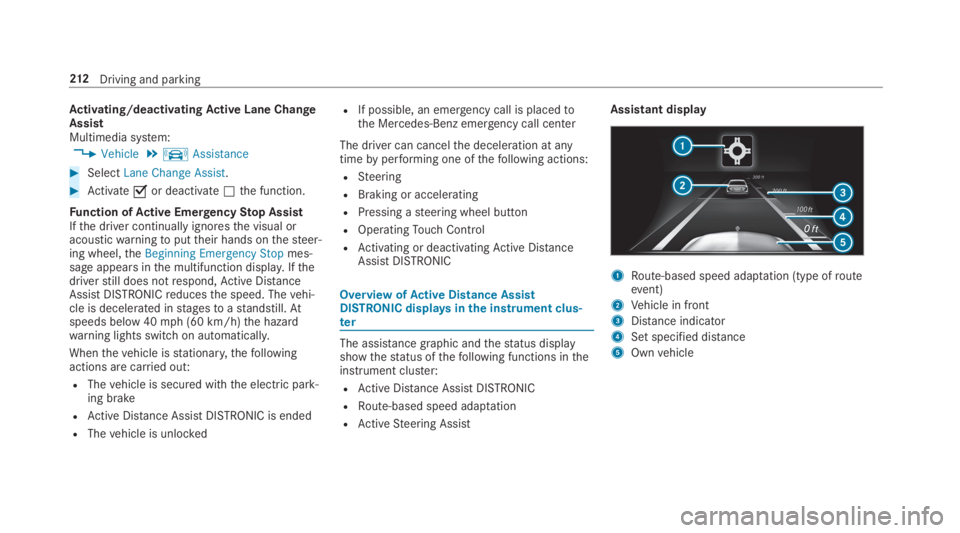
The assistance graphic andthestatus displayshowthestatus ofthefollowing functions intheinstrument cluster:
RActive Distance AssistDISTRONIC
RRoute-based speed adaptation
RActiveSteering Assist
Assistant display
1Route-based speed adaptation (type ofrouteevent)
2Vehicle in front
3Distance indicator
4Set specified distance
5Ownvehicle
212Driving and parking
Page 219 of 578
#Make sure no one is underneaththevehicle or inthe immediate vicinity ofthe wheel arches whenyou lowerthevehicle.
&WARNINGRisk of entrapment fromvehi‐cle lowering
Vehicles with AIRMATIC or level control:Whenyou unload luggage or leavethevehi‐cle,thevehiclefirstrises slightly andthenreturnstothe set level shortly afterwards.
You or anyone else inthe vicinity ofthewheel arches orthe underbody couldthusbecome trapped.
Thevehicle can also be lowered after beinglocked.
#When leavingthevehicle, make surethat nobody is inthe vicinity ofthewheel arches orthe underbody.
Requirements:RThevehicle has beenstarted.
RThevehicle must not be movingfasterthan50mph (80 km/h).
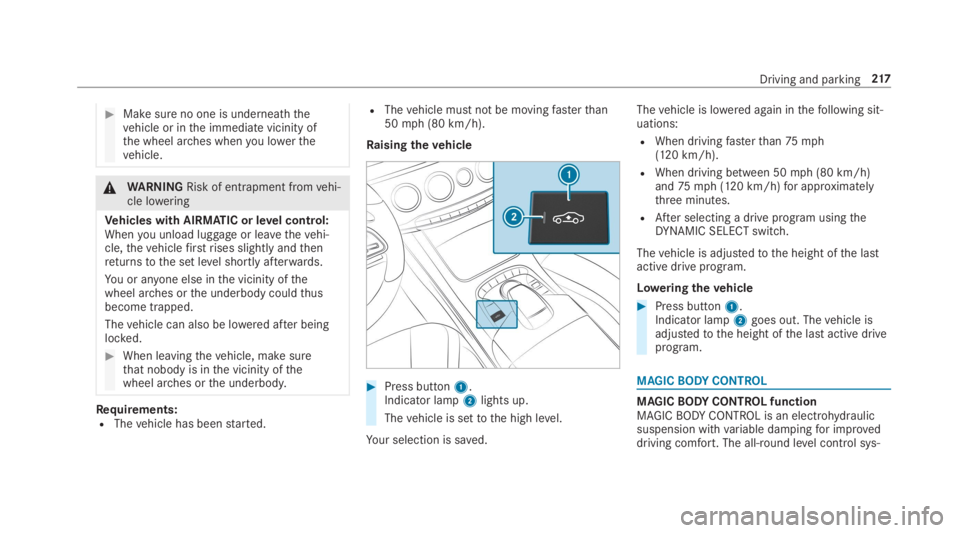
Raisingthevehicle
#Press button1.Indicator lamp2lights up.
Thevehicle is settothe high level.
Your selection is saved.
Thevehicle is lowered again inthefollowing sit‐uations:
RWhen drivingfasterthan75mph(120 km/h).
RWhen driving between 50mph (80 km/h)and75mph (120 km/h)for approximatelythree minutes.
RAfter selecting a drive program usingtheDYNAMIC SELECT switch.
Thevehicle is adjustedtothe height ofthe lastactive drive program.
Loweringthevehicle
#Press button1.Indicator lamp2goes out. Thevehicle isadjustedtothe height ofthe last active driveprogram.
MAGICBODYCONTROL
MAGICBODYCONTROL functionMAGICBODYCONTROL is an electrohydraulicsuspension withvariable dampingfor improveddriving comfort. The all-round level control sys‐
Driving and parking217
Page 223 of 578
Observethe notes on cleaningthe multifunctioncamera (→page 409).
Settingthevehicle level
&WARNINGRisk of accident becausevehicle level istoo high
Ifyou drive at a highervehicle level,the driv‐ingcharacteristics may be impaired duetothe highervehicle center of gravity.
Thevehicle can drift outwards,forexample,whensteering or cornering.
#Alwayschoose avehicle level which issuitedtothe drivingstyle andtheroadsurface conditions.
&WARNINGRisk of entrapment fromvehi‐cle lowering
When loweringthevehicle, people couldbecome trapped iftheir limbs are betweenthevehicle body andthe tires or underneaththevehicle.
#Make sure no one is underneaththevehicle or inthe immediate vicinity of
the wheel arches whenyou lowerthevehicle.
&WARNINGRisk of entrapment fromvehi‐cle lowering
Vehicles with AIRBODYCONTROL orlevel control system:Whenyou unload lug‐gageor leavethevehicle,thevehiclefirstrises slightly andthenreturnstothe set levelshortly afterwards.
You or anyone else inthe vicinity ofthewheel arches orthe underbody couldthusbecome trapped.
Thevehicle can also be lowered after beinglocked.
#When leavingthevehicle, make surethat nobody is inthe vicinity ofthewheel arches orthe underbody.
Requirements:RThevehicle has beenstarted.
RThevehicle must not be movingfasterthan75mph (120 km/h).
ROnly lower thevehicle:whenthevehicle isstationary,allthe doors havetobe closed.
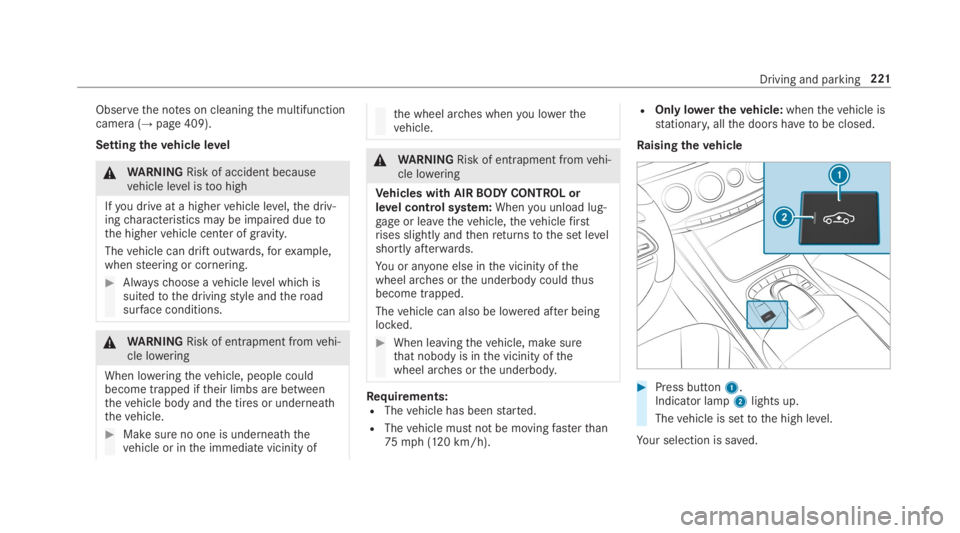
Raisingthevehicle
#Press button1.Indicator lamp2lights up.
Thevehicle is settothe high level.
Your selection is saved.
Driving and parking221