lock MERCEDES-BENZ S CLASS 2019 Manual PDF
[x] Cancel search | Manufacturer: MERCEDES-BENZ, Model Year: 2019, Model line: S CLASS, Model: MERCEDES-BENZ S CLASS 2019Pages: 578, PDF Size: 23.31 MB
Page 385 of 578
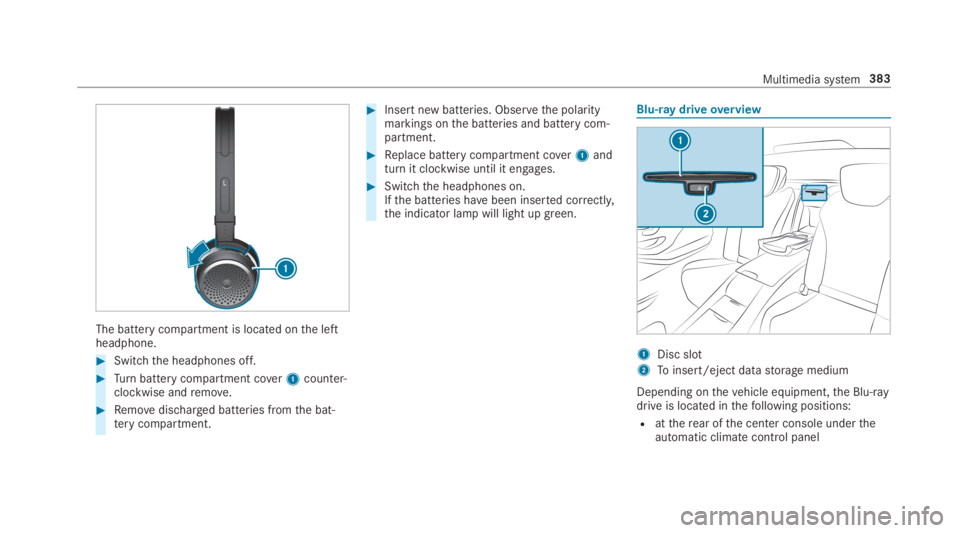
The battery compartment is located onthe leftheadphone.
#Switchthe headphones off.
#Turnbattery compartment cover1counter-clockwise andremove.
#Removedischarged batteries fromthe bat‐terycompartment.
#Insert new batteries. Observethe polaritymarkings onthe batteries and battery com‐partment.
#Replace battery compartment cover1andturn it clockwise until it engages.
#Switchthe headphones on.Ifthe batteries havebeen inserted correctly,the indicator lamp will light up green.
Blu-ray driveoverview
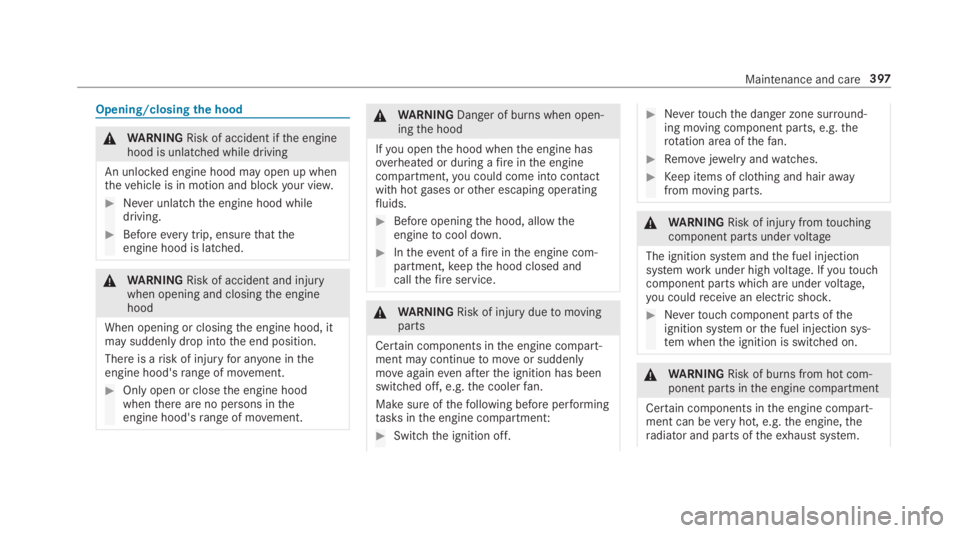
1Disc slot
2Toinsert/eject datastorage medium
Depending onthevehicle equipment,the Blu-raydrive is located inthefollowing positions:
Rattherear ofthe center console undertheautomatic climate control panel
Multimedia system383
Page 399 of 578
Opening/closingthe hood
&WARNINGRisk of accident ifthe enginehood is unlatched while driving
An unlocked engine hood may open up whenthevehicle is in motion and blockyour view.
#Never unlatchthe engine hood whiledriving.
#Beforeevery trip, ensurethattheengine hood is latched.
&WARNINGRisk of accident and injurywhen opening and closingthe enginehood
When opening or closingthe engine hood, itmay suddenly drop intothe end position.
There is arisk of injuryfor anyone intheengine hood'srange of movement.
#Only open or closethe engine hoodwhenthere are no persons intheengine hood'srange of movement.
&WARNINGDanger of burns when open‐ingthe hood
Ifyou openthe hood whenthe engine hasoverheated or during afireinthe enginecompartment,you could come into contactwith hotgases orother escaping operatingfluids.
#Before openingthe hood, allowtheenginetocool down.
#Intheevent of afireinthe engine com‐partment,keepthe hood closed andcallthefireservice.
&WARNINGRisk of injuryduetomovingparts
Certain components inthe engine compart‐ment may continuetomoveor suddenlymoveagaineven afterthe ignition has beenswitched off, e.g.the coolerfan.
Makesure ofthefollowing before performingtasks inthe engine compartment:
#Switchthe ignition off.
#Nevertouchthe danger zone surround‐ing moving component parts, e.g.therotation area ofthefan.
#Removejewelry andwatches.
#Keep items of clothing and hairawayfrom moving parts.
&WARNINGRisk of injuryfromtouchingcomponent parts undervoltage
The ignition system andthe fuel injectionsystemworkunder highvoltage. Ifyoutouchcomponent parts which are undervoltage,you couldreceivean electric shock.
#Nevertouch component parts oftheignition system orthe fuel injection sys‐tem whenthe ignition is switched on.
&WARNINGRisk of burns from hot com‐ponent parts inthe engine compartment
Certain components inthe engine compart‐ment can beveryhot, e.g.the engine,theradiator and parts oftheexhaust system.
Maintenance and care397
Page 403 of 578
#Followthe instructions inthe serviceinterval displayregardingthe oilchange.
*NOTEDamagecausedbyaddingtoomuch engine oil
Too much engine oil can damagethe engineorthe catalytic converter.
#Haveexcess engine oilremoved at aqualified specialistworkshop.
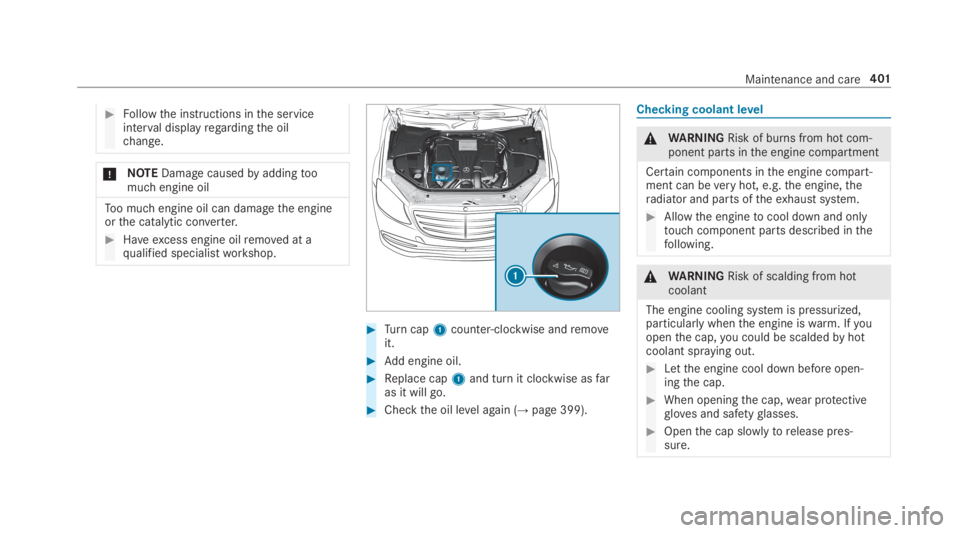
#Turncap1counter-clockwise andremoveit.
#Add engine oil.
#Replace cap1and turn it clockwise asfaras it will go.
#Checkthe oil level again (→page 399).
Checking coolant level
&WARNINGRisk of burns from hot com‐ponent parts inthe engine compartment
Certain components inthe engine compart‐ment can beveryhot, e.g.the engine,theradiator and parts oftheexhaust system.
#Allowthe enginetocool down and onlytouch component parts described inthefollowing.
&WARNINGRisk of scalding from hotcoolant
The engine cooling system is pressurized,particularly whenthe engine iswarm. Ifyouopenthe cap,you could be scaldedbyhotcoolant spraying out.
#Letthe engine cool down before open‐ingthe cap.
#When openingthe cap,wear protectivegloves and safetyglasses.
#Openthe cap slowlytorelease pres‐sure.
Maintenance and care401
Page 404 of 578
#Parkthevehicle on a level surface.
#Checkthe coolanttemperature display intheinstrument cluster.The coolanttemperature must be below158 °F (70 °C).
#If necessary,removethe cover.
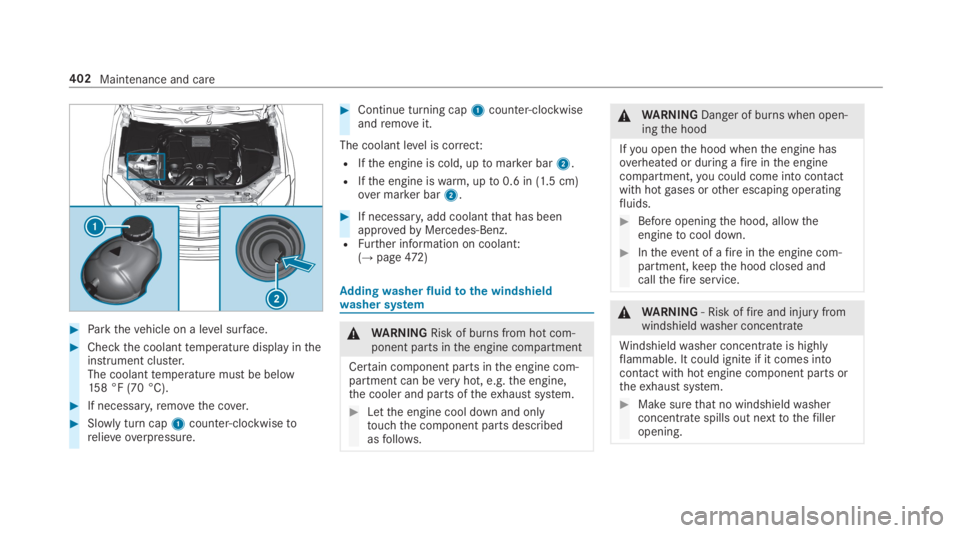
#Slowly turn cap1counter-clockwisetorelieve overpressure.
#Continue turning cap1counter-clockwiseandremoveit.
The coolant level is correct:
RIfthe engine is cold, uptomarker bar2.
RIfthe engine iswarm, upto0.6 in (1.5 cm)over marker bar2.
#If necessary,add coolantthat has beenapprovedbyMercedes-Benz.RFurther information on coolant:(→page472)
Addingwasherfluidtothe windshieldwasher system
&WARNINGRisk of burns from hot com‐ponent parts inthe engine compartment
Certain component parts inthe engine com‐partment can beveryhot, e.g.the engine,the cooler and parts oftheexhaust system.
#Letthe engine cool down and onlytouchthe component parts describedasfollows.
&WARNINGDanger of burns when open‐ingthe hood
Ifyou openthe hood whenthe engine hasoverheated or during afireinthe enginecompartment,you could come into contactwith hotgases orother escaping operatingfluids.
#Before openingthe hood, allowtheenginetocool down.
#Intheevent of afireinthe engine com‐partment,keepthe hood closed andcallthefireservice.
&WARNING‑ Risk offireand injury fromwindshieldwasher concentrate
Windshieldwasher concentrate is highlyflammable. It could ignite if it comes intocontact withhot engine component parts ortheexhaust system.
#Make surethat no windshieldwasherconcentrate spills out nexttothefilleropening.
402Maintenance and care
Page 421 of 578
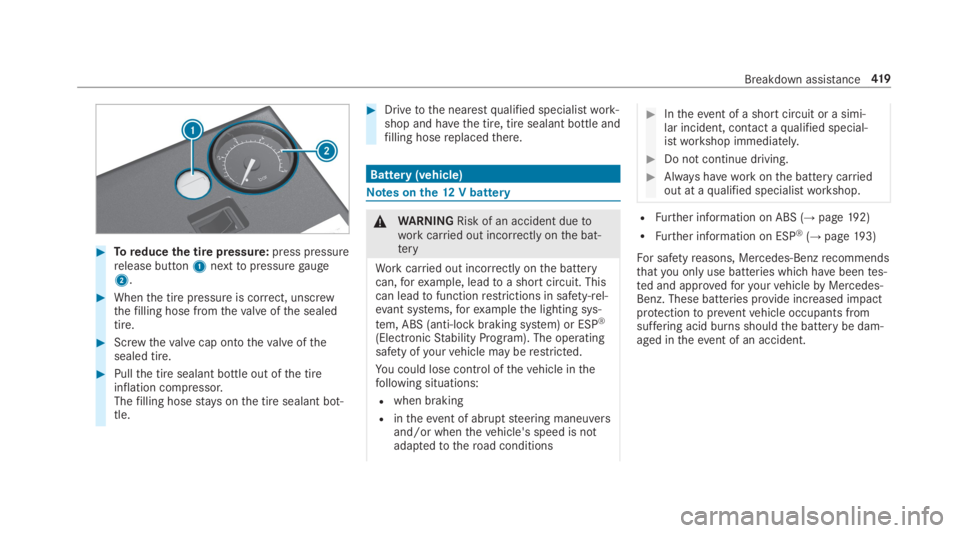
#Toreduce the tire pressure:press pressurerelease button1nexttopressuregauge2.
#Whenthe tire pressure is correct, unscrewthefilling hose fromthevalve ofthe sealedtire.
#Screwthevalve cap ontothevalve ofthesealed tire.
#Pullthe tire sealant bottle out ofthe tireinflation compressor.Thefilling hosestays onthe tire sealant bot‐tle.
#Drivetothe nearestqualified specialistwork‐shop and havethe tire, tire sealant bottle andfilling hosereplacedthere.
Battery(vehicle)
Notes onthe12V battery
&WARNINGRisk of an accident duetoworkcarried out incorrectly onthe bat‐tery
Workcarried out incorrectly onthe batterycan,forexample, leadtoa short circuit. Thiscan leadtofunctionrestrictions in safety-rel‐evant systems,forexamplethe lighting sys‐
tem, ABS (anti-lockbraking system) or ESP®
(ElectronicStability Program). The operatingsafety ofyourvehicle may berestricted.
You could lose control ofthevehicle inthefollowing situations:
Rwhen braking
Rintheevent of abruptsteering maneuversand/or whenthevehicle's speed is notadaptedtotheroad conditions
#Intheevent of a shortcircuit or a simi‐lar incident, contact aqualified special‐istworkshop immediately.
#Do not continue driving.
#Always haveworkonthe battery carriedout at aqualified specialistworkshop.
RFurther information on ABS (→page192)
RFurther information on ESP®(→page193)
For safetyreasons, Mercedes-Benzrecommendsthatyou onlyuse batteries which havebeentes‐ted and approvedforyourvehiclebyMercedes-Benz. These batteries provide increased impactprotectiontopreventvehicle occupants fromsuffering acid burns shouldthe battery be dam‐aged intheevent of an accident.
Breakdown assistance419
Page 427 of 578
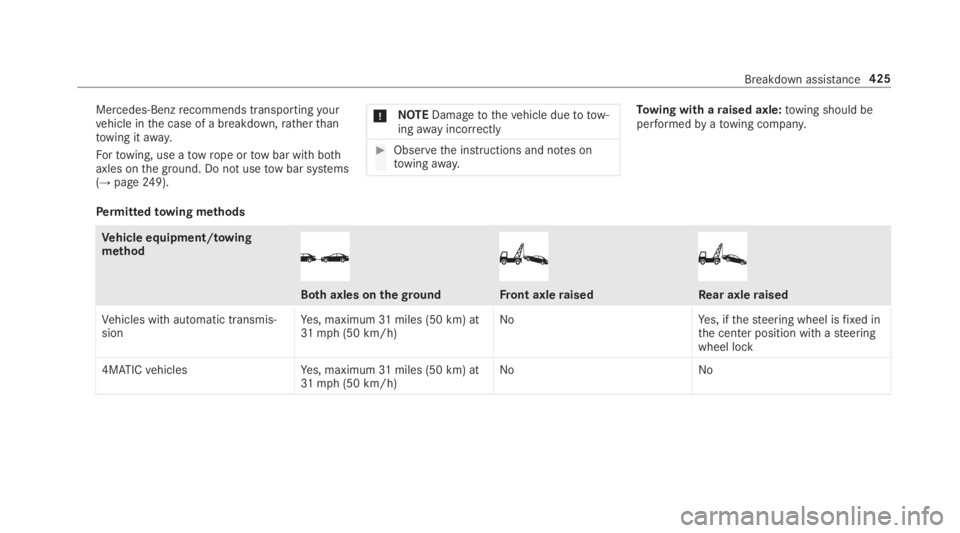
Mercedes-Benzrecommends transportingyourvehicle inthe case of a breakdown,ratherthantowing itaway.
Fortowing, use atowrope ortow bar with bothaxles onthe ground. Do not usetow bar systems(→page249).
*NOTEDamagetothevehicle dueto tow‐ingawayincorrectly
#Observethe instructions and notes ontowingaway.
Towing with araised axle:towing should beperformedbyatowing company.
Permittedtowing methods
Vehicle equipment/towingmethod
Bothaxles onthegroundFront axleraisedRear axleraised
Vehicles with automatic transmis‐sionYes, maximum31miles (50 km) at31mph (50 km/h)NoYes, ifthesteering wheel isfixed inthe center position with asteeringwheel lock
4MATICvehiclesYes, maximum31miles (50 km) at31mph (50 km/h)NoNo
Breakdown assistance425
Page 428 of 578
Towingthevehicle with bothaxles ontheground
#Observethe notes onthe permittedtowingmethods (→page 424).
#Make surethatthe battery is connected andcharged.
Whenthe battery is discharged,thefollowingactions cannot be performed:
Rthe engine cannotbestarted
Rthe electric parking brake cannotbereleasedor applied
Rthe automatic transmission cannotbe shiftedtoposition\\or]
%Ifthe automatic transmission cannotbe shif‐tedtoposition\\, orthe multifunction dis‐play inthe instrument cluster does not showanything, havethevehicle transportedaway(→page 427). Atowingvehicle with liftingequipment isrequiredforvehicle transporta‐tion.
*NOTEDamagedueto towingawayatexcessively high speeds orover long dis‐tances
The drivetrain could be damaged whentow‐ing atexcessively high speeds orover longdistances.
#Atowing speed of 30mph (50 km/h)must not beexceeded.
#Atowing distance of 30 miles (50 km)mustnot beexceeded.
&WARNINGRisk of accident whentowingavehicle which istoo heavy
Ifthevehicle beingtow-started ortowedawayis heavierthanthe permissible grossmass ofyourvehicle,thefollowing situationscan occur:
RThetowingeye may become detached.
RThevehicle/trailer combination mayswerveorevenoverturn.
#If anothervehicle istow-started ortowedaway, itsweight must notexceed
the permissible gross mass ofyourownvehicle.
If avehicle must betow-started ortowedaway,itsweight must notexceedthe permissible grossmass ofthetowingvehicle.
#Information onthe permissible gross mass ofthevehicle can befound onthevehicle iden‐tification plate (→page 466).
#Do not openthe driver's door or frontpassenger door,otherwisethe automatictransmission automatically shiftstoposition].#Installthetowingeye (→page 429).
#Fastenthetow bar.
*NOTEDamageduetoincorrect connec‐tion
#Only connectthetowrope ortow bartothetowingeyes.
#Deactivatethe automatic locking mechanism(→page 68).
426Breakdown assistance
Page 429 of 578
#Do not activatethe HOLD function.
#DeactivateActive Brake Assist (→page 200).
#Shiftthe automatic transmissiontoposition\\.
#Releasethe electric parking brake.
&WARNINGRisk of accident duetolimi‐ted safety-related functions duringthetowing process
Safety-related functions are limited or no lon‐geravailable inthefollowing situations:
Rthe ignition is switched off.
Rthe brake system or powersteering sys‐tem is malfunctioning.
Rthe energy supply orthe on-board electri‐cal system is malfunctioning.
Whenyourvehicle isthentowedaway, signif‐icantly more effortmay berequiredtosteerand brakethan is normallyrequired.
#Use atow bar.
#Make surethatthesteering wheel canmovefreely, beforetowingthevehicleaway.
*NOTEDamageduetoexcessive tractivepower
Ifyou pullawaysharply,the tractive powermay betoo high andthevehicles could bedamaged.
#Pullawayslowly and smoothly.
Loading thevehiclefor transport
#Observethe notes ontowingaway(→page 426).
#Connectthetow bartothetowingeyetoloadthevehicle.
#Shiftthe automatic transmissiontoposition\\.
%The automatic transmission may be lockedin position]intheevent of damagetotheelectrics.Toshiftto\\, providethe on-
board electrical system with power(→page 423).
#Loadthevehicle ontothe transporter.
#Shiftthe automatic transmissiontoposition].
#Usethe electric parking braketosecurethevehicle againstrollingaway.
#Only securethevehiclebythe wheels.
Vehicles with ADS PLUS (Adaptive DampingSystem PLUS)
&WARNINGRisk of an accident whentransportingvehicles withAdaptiveDamping System PLUS
Thereduced dampingforces onthevehiclebeing transported can causethevehicle/trailer combinationtostarttoswing.
As aresult, when transportingvehicles withtheAdaptive Damping System PLUS,thevehicle/trailer combination maystarttoskid.Consequently,you could lose control ofyourvehicle.
#When transporting, ensurethat:
Breakdown assistance427
Page 431 of 578
#Press and hold button1for at leastfiveseconds.Thevehicle is adjustedtothe height ofthelast active drive program. Indicator lamp2goes out.
#Drivethevehicle offthe transporter.
4MATICvehicles
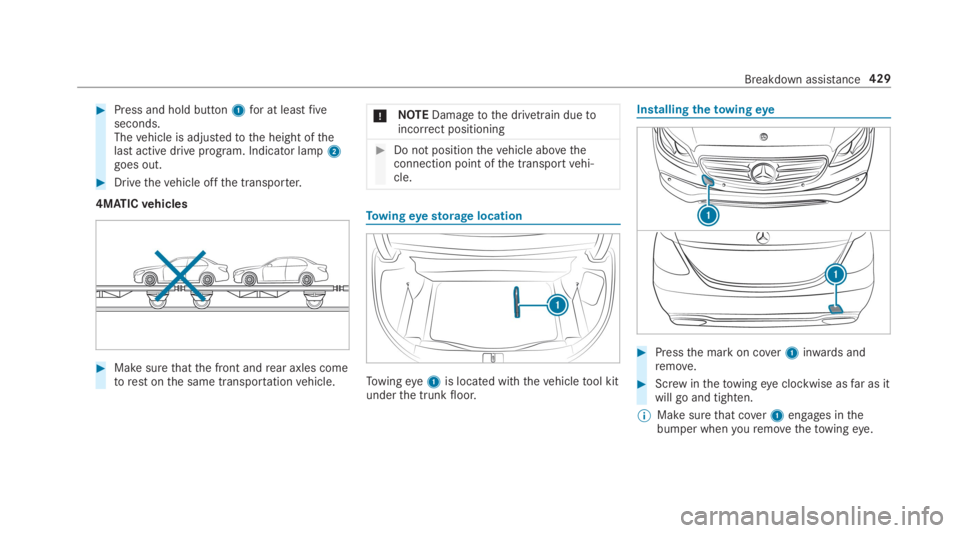
#Make surethatthe front andrear axles cometorestonthe same transportationvehicle.
*NOTEDamagetothe drivetrain duetoincorrect positioning
#Do not positionthevehicle abovetheconnection point ofthe transportvehi‐cle.
Towingeyestoragelocation
Towingeye1is located withthevehicletool kitunderthe trunkfloor.
Installingthetowingeye
#Pressthe mark on cover1inwards andremove.
#Screwinthetowingeyeclockwise asfar as itwill go and tighten.
%Make surethat cover1engages inthebumper whenyouremovethetowingeye.
Breakdown assistance429
Page 460 of 578
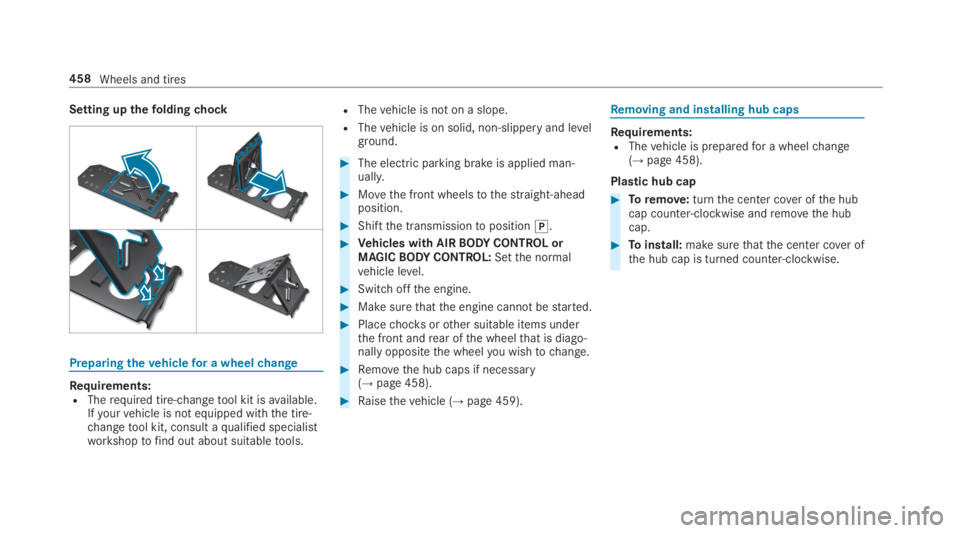
Setting upthefoldingchock
Preparingthevehiclefor a wheelchange
Requirements:RTherequired tire-changetool kit isavailable.Ifyourvehicle is not equipped withthe tire-changetool kit, consult aqualified specialistworkshoptofind out about suitabletools.
RThevehicle is not on a slope.
RThevehicle is on solid, non-slippery and levelground.
#The electric parking brake is applied man‐ually.
#Movethe front wheelstothestraight-aheadposition.
#Shiftthe transmissiontoposition].
#Vehicles with AIRBODYCONTROL orMAGICBODYCONTROL:Setthe normalvehicle level.
#Switchoffthe engine.
#Make surethatthe engine cannotbestarted.
#Placechocksorother suitable items underthe front andrear ofthe wheelthat is diago‐nally oppositethe wheelyou wishtochange.
#Removethe hub caps if necessary(→page 458).
#Raisethevehicle (→page 459).
Removing and installing hub caps
Requirements:RThevehicle is preparedfor a wheelchange(→page 458).
Plastic hub cap
#Toremove:turnthe center cover ofthe hubcap counter-clockwise andremovethe hubcap.
#Toinstall:make surethatthe center cover ofthe hub cap is turned counter-clockwise.
458Wheels and tires