warning MERCEDES-BENZ SPRINTER 2011 MY11 Operator’s Manual
[x] Cancel search | Manufacturer: MERCEDES-BENZ, Model Year: 2011, Model line: SPRINTER, Model: MERCEDES-BENZ SPRINTER 2011Pages: 292, PDF Size: 6.75 MB
Page 151 of 292
Make sure that locking mechanism 0046 is
always engaged in a recess.
G
Warning
If not firmly anchored in the loading rail, the
cargo tie-down ring
may slip or be torn out of
the loading rail in the event of sudden braking.
The load would no longer be secured,
resulting in a risk of serious injury being
caused by the load slipping. For this reason,
always check the cargo tie-down ring for firm
seating after installing.
X Check the cargo tie-down ring for firm
seating.
X To remove:
pull locking
mechanism 0046 up
and pull the cargo tie-down ring towards
the locking mechanism and out of the
loading rail through a recess. Carrier systems
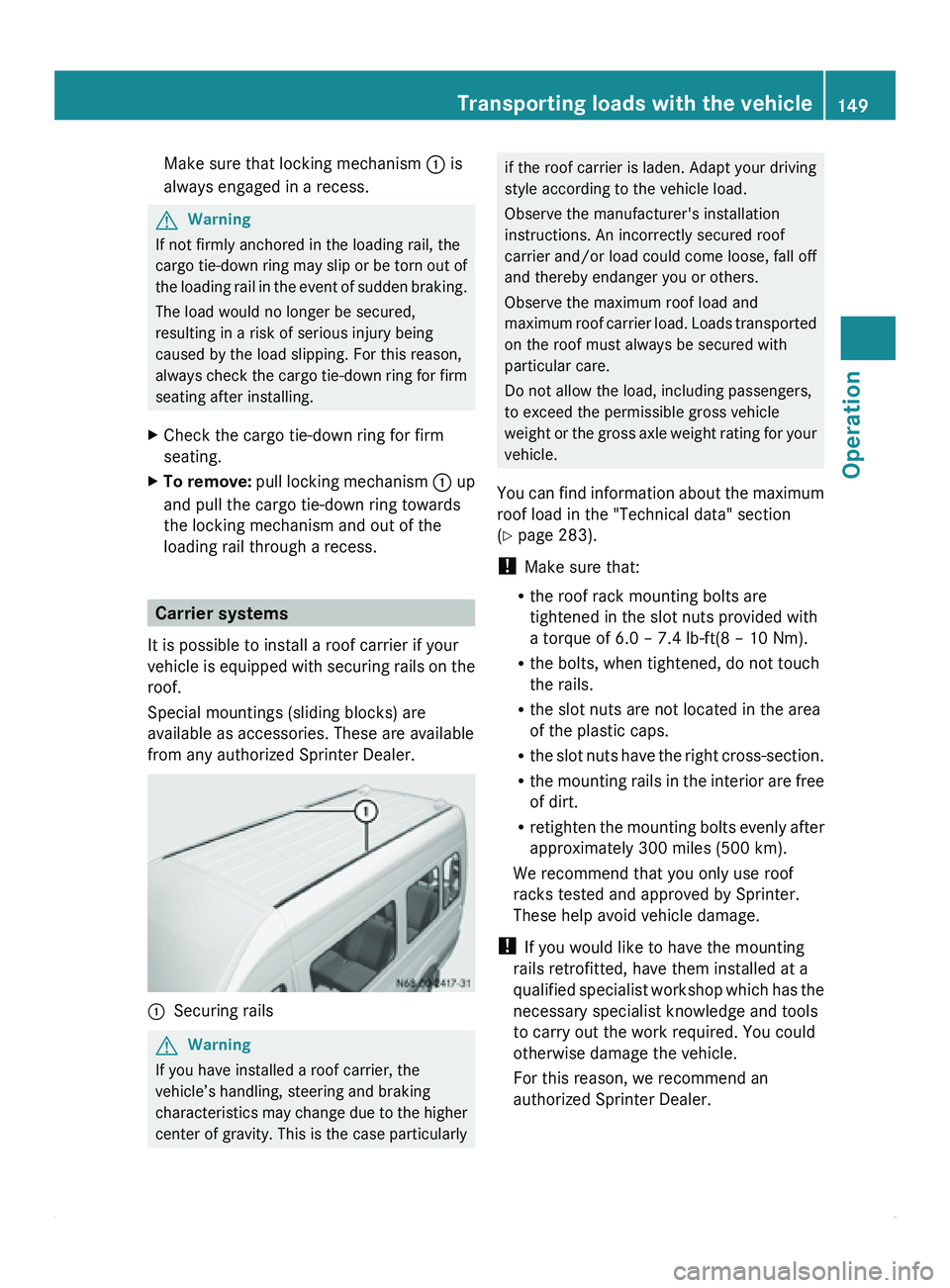
It is possible to install a roof carrier if your
vehicle is equipped
with securing rails on the
roof.
Special mountings (sliding blocks) are
available as accessories. These are available
from any authorized Sprinter Dealer. 0046
Securing rails G
Warning
If you have installed a roof carrier, the
vehicle’s handling, steering and braking
characteristics may change
due to the higher
center of gravity. This is the case particularly if the roof carrier is laden. Adapt your driving
style according to the vehicle load.
Observe the manufacturer's installation
instructions. An incorrectly secured roof
carrier and/or
load
could come loose, fall off
and thereby endanger you or others.
Observe the maximum roof load and
maximum roof carrier load. Loads transported
on the roof must always be secured with
particular care.
Do not allow the load, including passengers,
to exceed the permissible gross vehicle
weight or the gross axle weight rating for your
vehicle.
You can find information about the maximum
roof load in the "Technical data" section
(Y page 283).
! Make sure that:
R the roof rack mounting bolts are
tightened in the slot nuts provided with
a torque of 6.0 – 7.4 lb-ft(8 – 10 Nm).
R the bolts, when tightened, do not touch
the rails.
R the slot nuts are not located in the area
of the plastic caps.
R the slot nuts have the right cross-section.
R the mounting rails in the interior are free
of dirt.
R retighten the mounting bolts evenly after
approximately 300 miles (500 km).
We recommend that you only use roof
racks tested and approved by Sprinter.
These help avoid vehicle damage.
! If you would like to have the mounting
rails retrofitted, have them installed at a
qualified specialist workshop which has the
necessary specialist knowledge and tools
to carry out the work required. You could
otherwise damage the vehicle.
For this reason, we recommend an
authorized Sprinter Dealer. Transporting loads with the vehicle
149
Operation Z
Page 152 of 292
Towing a trailer
Notes on trailer towing Important safety notes
The trailer coupling is one of the most
important vehicle parts with regard to road
safety. The notes on operation, care and
maintenance issued by the manufacturer
should be observed.
G
Warning!
Improper equipment or driving technique
while driving with a trailer can cause you to
lose control of your vehicle.
Improper towing or failure to observe the
Operator's Manual can lead to vehicle
damage and/or serious
injuries. Observe the
following guidelines in order to guarantee safe
driving with trailers.
Contact an authorized Sprinter Dealer if you
require any explanation of the information
contained in the Operator's Manual.
General notes
R Install only an approved trailer coupling on
your vehicle.
Further information about availability and
installation of trailer couplings can be
obtained from any authorized Sprinter
Dealer.
R The bumpers of your vehicle are not
suitable for installing detachable trailer
couplings.
R Do not install rented trailer couplings or
other detachable trailer couplings to the
bumpers.
R To reduce the risk of damage to the ball
coupling when using a detachable trailer
coupling, remove the ball coupling from its
mounting when it is not needed.
Coupling up a trailer Observe the maximum permissible trailer
dimensions (width and length). Most federal states and all Canadian
provinces require by law:
R
safety chains between the towing vehicle
and the
trailer.
The chains should be cross-
wound under the trailer drawbar. They must
be fastened to the vehicle's trailer
coupling, not to the bumper or the axle.
Allow for enough play in the chains to
facilitate turning tight corners.
R a separate brake system for certain types
of trailer.
R a safety switch for braked trailers. Check
the specific legal requirements applicable
to your federal state.
If the trailer detaches from the towing
vehicle, the safety switch applies the
trailer's brakes.
i The vehicle's subharness has an electric
cable to the brake light indicator lamp. G
Warning
Follow the manufacturer's operating
instructions for the trailer tow hitch when
using a detachable trailer tow hitch.
Couple and decouple the trailer carefully. A
trailer which is incorrectly coupled to the
towing vehicle could break away. A correctly
coupled trailer must be positioned
horizontally behind the vehicle.
Ensure that the following weights are not
exceeded:
R the permissible noseweight
R the permissible trailer load
R the permissible rear
axle load of the towing
vehicle
R the permissible gross weight for both the
towing vehicle and the trailer
The permissible values, which must not be
exceeded, can be found in your vehicle
documents and on the trailer tow hitch type
plates for the trailer and the vehicle. Where
the values differ, the lowest is valid. 150
Transporting loads with the vehicle
Operation
Page 154 of 292
Coolant heat can additionally be dissipated
by opening
the
windows and by setting the
blower fan and the interior temperature to
maximum.
R When overtaking, pay particular attention
to the extended length of your vehicle/
trailer combination.
Due to the length of your vehicle/trailer
combination, you will have to travel an
additional distance beyond the vehicle you
are overtaking before returning to the
original lane.
If the trailer begins to swing from side to side:
X do not accelerate.
X do not counter-steer.
X brake if necessary. G
Warning
Under no circumstances try to straighten the
vehicle/trailer combination by
increasing the
speed.
i You can reduce the risk of the trailer
swinging and snaking by retrofitting anti-
roll bars or trailer stability programs. You
can obtain further information from an
authorized Sprinter Dealer.
Uncoupling a trailer X
Make sure that the automatic transmission
is set to position P.
X Engage the vehicle's parking brake.
X Remove the trailer cable and uncouple the
trailer.
X Engage the trailer's parking brake.
Load distribution The Gross Trailer Weight (GTW) is the
combined weight of the trailer together with
the cargo and equipment loaded on the
trailer. The maximum permissible gross
weight is
vehicle-specific
and depends on the
equipment level: 5000 lbs (2268 kg) or
7500 lbs (3402 kg). The permissible Trailer drawbar Weight
Rating (TWR) is the maximum weight
permitted on the trailer drawbar: 750 lbs
(340 kg) or 500 lbs (227 kg) is the limit for
trailer couplings approved by the vehicle
distributor named on the inside of the front
cover.
The Gross Combined Weight Rating (GCWR)
is
the
sum of the Gross Trailer Weight and the
vehicle weight, including a driver weight of
approximately 150 lbs (68 kg). The
permissible GCWR is vehicle-specific and
depends on the equipment level.
When driving with a trailer, you should not
exceed the permitted Gross Combination
Weight Rating (GCWR).
You must distribute the load on the vehicle
and trailer so that the permitted maximum
values for the vehicle (GCWR) and trailer
(GTW) weight as well as permitted axle loads
(GAWR) and noseweight (TWR) of your vehicle
are not exceeded.
i Take into account that the vehicle's
permissible payload must be reduced to
compensate for the noseweight.
The applicable permissible values, which
must not be exceeded, can be found in your
vehicle documents and on the type plates for
the trailer tow hitch, trailer and vehicle
(Y page 277). You will also find a list of the
permissible values in the "Technical data"
(Y page 284) section. Where the values
differ, the lowest is valid.
! The permissible gross combination
weight is less than the sum of the
permissible gross vehicle weight plus the
permissible trailer load. Exceeding the
permissible gross combination weight can
lead to damage to the drivetrain, to the
transmission or to the trailer tow hitch.
For this reason, applicable values for the
permissible gross vehicle weight or the
permissible trailer load are reduced
accordingly if either the vehicle or the
trailer is fully loaded. In this case, the trailer
or the vehicle may only be partially loaded. 152
Transporting loads with the vehicle
Operation
Page 155 of 292
Verify compliance with weight limitations on
a weighbridge.
Trailer power supply
Your vehicle may be equipped with various
electrical fittings for trailer towing.
Depending on your trailer, you may need an
adapter to allow your trailer to be connected
to the vehicle. Information about your
vehicle's electrical equipment is available
from any authorized Sprinter Dealer.
!
Faulty wiring of the connector plug could
in certain circumstances cause other
electronic systems to
malfunction. For this
reason, we recommend having the wiring
of the connector plug performed at an
authorized Sprinter Dealer. Operation in winter
General notes
Have your vehicle winterized at a qualified
specialist workshop, e.g. an authorized
Sprinter Dealer, at the onset of winter.
This service includes the following:
R oil change, if the engine oil currently used
does not have adequate low temperature
characteristics or if these are no longer
sufficient due to aging
R the antifreeze/anticorrosion
concentration in the coolant is checked.
R the addition of a concentrated cleaning
agent to the water in the windshield
washer/headlamp cleaning system
R battery check
R a tire change
Prior to the
onset of winter, ensure that snow
chains are available in the vehicle.
Do not cover the surface of the radiator or the
radiator grill, even in winter. Doing so could
cause the engine diagnostics to record false
or incorrect data. Recording of engine
diagnostic data is legally prescribed and must therefore be correct, clear and
comprehensible at all times.
You
will find
information about diesel fuel for
use at low outside temperatures in the
"Operation" section ( Y page 154).
Please also observe the information about
winter driving (Y page 111).
You will find information about winter tires
and about driving with snow chains in the
"Wheel and tires" section (Y page 153). Service products
Fuel
G
Warning
Fuel is highly flammable. Fire, naked flames
and smoking as well as the use of auxiliary
heaters (sparks) are therefore prohibited
when handling fuel.
Switch off the
engine and the auxiliary heating
before refueling. G
Warning
Avoid any contact with fuels.
You can damage your health if your skin
comes into direct contact with fuel or if you
inhale fuel vapors.
! Filter the fuel
before transferring it to the
vehicle if you are refueling the vehicle from
barrels or containers.
This will prevent malfunctions in the fuel
system due to contaminated fuel.
! Refuel only with commercially available
vehicle diesel fuel, ULTRA-LOW SULFUR
DIESEL with a sulfur content no greater
than 15 ppm. Fuels such as fatty acid
methyl ester FAME (bio-diesel fuels),
marine diesel, heating oil etc. may not be
used as a diesel fuel mixture.
Refuel with B5 bio-diesel only if it fulfills the
requirements listed under "Fuel quality". Service products
153
Operation Z
Page 157 of 292
!
Do not use fuel additives (with the
exception of flow improvers), since this
could lead to malfunctions or engine
damage. Damage caused by the use of
such additives is not covered by the New
Vehicle Limited Warranty.
! Do not add
gasoline or kerosene to diesel
fuel to improve its flow characteristics.
Gasoline or kerosene impairs the
lubricating properties of the diesel fuel.
This may cause damage to the injection
system, for example.
At outside temperatures below
14 ‡(–10 †) and with less cold-resistant
winter diesel fuel, add the amount of flow
improver appropriate to the outside
temperature.
Add this additive to the diesel in time, i.e.
before the flow properties of the diesel are
affected by paraffin separation. Malfunctions
caused by paraffin separation can only be
rectified by heating the entire fuel system,
e.g. by parking the vehicle in a heated garage. G
Warning
If you heat up the fuel system with a heat gun,
for example, you
may damage parts of the fuel
system. Fuel could escape, be ignited, and
cause a fire.
Never heat the fuel system with a heat gun or
with a naked flame. Diesel Exhaust Fluid (DEF)
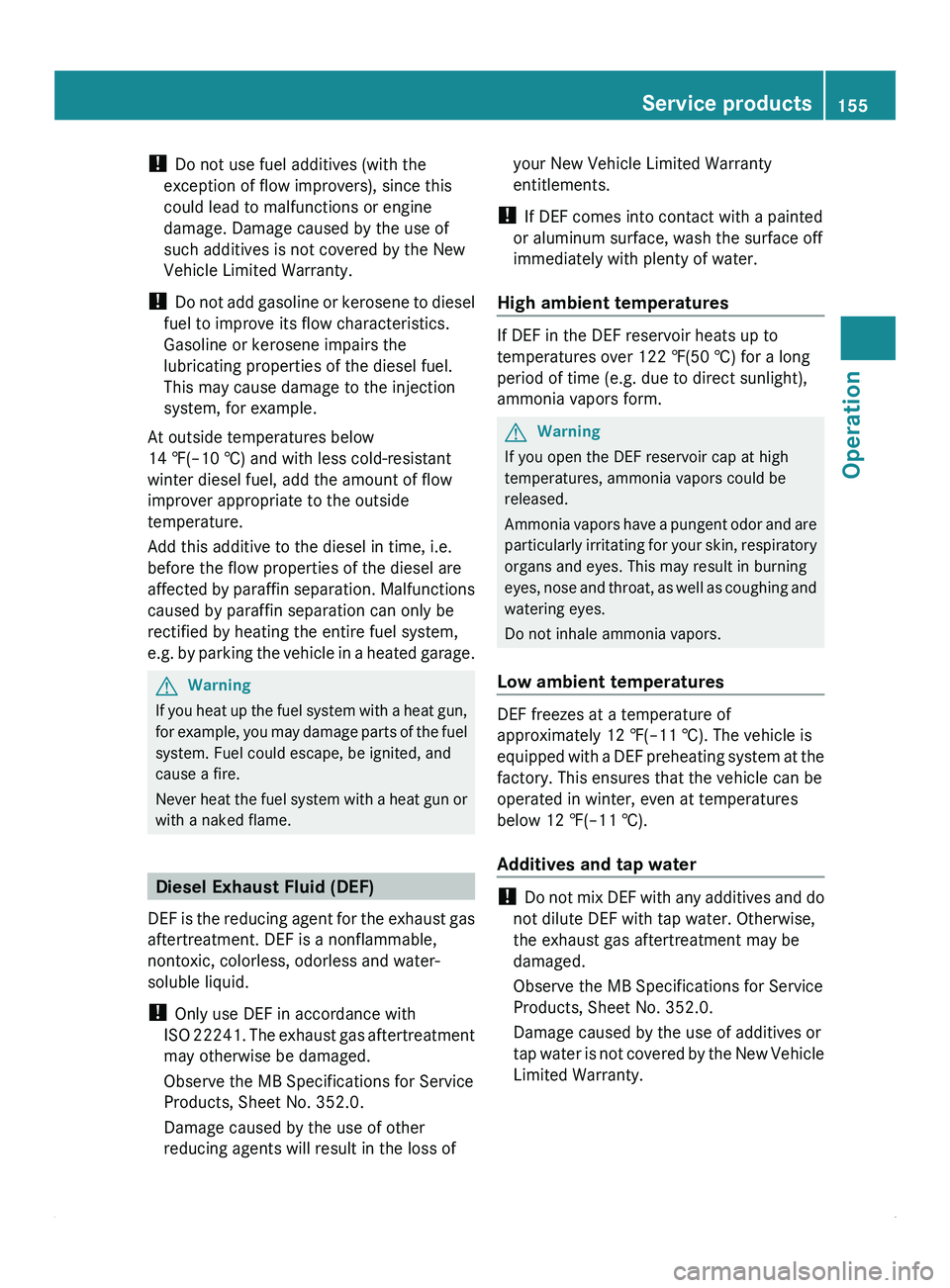
DEF is the
reducing agent for the exhaust gas
aftertreatment. DEF is a nonflammable,
nontoxic, colorless, odorless and water-
soluble liquid.
! Only use DEF in accordance with
ISO 22241. The exhaust gas aftertreatment
may otherwise be damaged.
Observe the MB Specifications for Service
Products, Sheet No. 352.0.
Damage caused by the use of other
reducing agents will result in the loss of your New Vehicle Limited Warranty
entitlements.
! If DEF comes into contact with a painted
or aluminum surface, wash the surface off
immediately with plenty of water.
High ambient temperatures If DEF in the DEF reservoir heats up to
temperatures over 122 ‡(50 †) for a long
period of time (e.g. due to direct sunlight),
ammonia vapors form.
G
Warning
If you open the DEF reservoir cap at high
temperatures, ammonia vapors could be
released.
Ammonia vapors have
a pungent odor and are
particularly irritating for your skin, respiratory
organs and eyes. This may result in burning
eyes, nose and throat, as well as coughing and
watering eyes.
Do not inhale ammonia vapors.
Low ambient temperatures DEF freezes at a temperature of
approximately
12 ‡(–11 †
). The vehicle is
equipped
with a DEF preheating system at the
factory. This ensures that the vehicle can be
operated in winter, even at temperatures
below 12 ‡(–11 †).
Additives and tap water !
Do not mix
DEF with any additives and do
not dilute DEF with tap water. Otherwise,
the exhaust gas aftertreatment may be
damaged.
Observe the MB Specifications for Service
Products, Sheet No. 352.0.
Damage caused by the use of additives or
tap water is not covered by the New Vehicle
Limited Warranty. Service products
155
Operation Z
Page 161 of 292
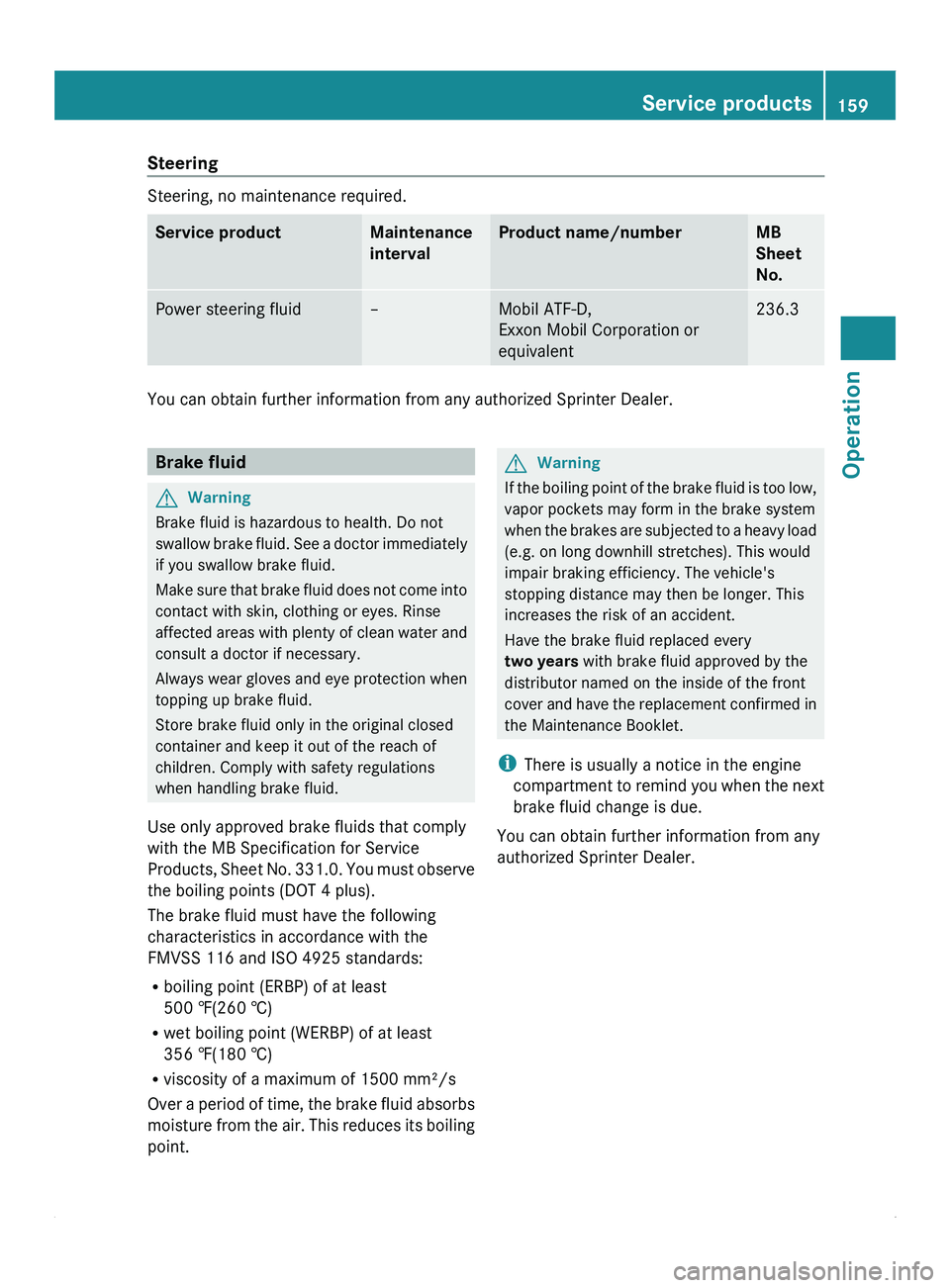
Steering
Steering, no maintenance required.
Service product Maintenance
interval Product name/number MB
Sheet
No.
Power steering fluid – Mobil ATF-D,
Exxon Mobil Corporation or
equivalent 236.3
You can obtain further information from any authorized Sprinter Dealer.
Brake fluid
G
Warning
Brake fluid is hazardous to health. Do not
swallow brake fluid.
See a doctor immediately
if you swallow brake fluid.
Make sure that brake fluid does not come into
contact with skin, clothing or eyes. Rinse
affected areas with plenty of clean water and
consult a doctor if necessary.
Always wear gloves and eye protection when
topping up brake fluid.
Store brake fluid only in the original closed
container and keep it out of the reach of
children. Comply with safety regulations
when handling brake fluid.
Use only approved brake fluids that comply
with the MB Specification for Service
Products, Sheet No. 331.0. You must observe
the boiling points (DOT 4 plus).
The brake fluid must have the following
characteristics in accordance with the
FMVSS 116 and ISO 4925 standards:
R boiling point (ERBP) of at least
500 ‡(260 †)
R wet boiling point (WERBP) of at least
356 ‡(180 †)
R viscosity of a maximum of 1500 mm²/s
Over a period of time, the brake fluid absorbs
moisture from the air. This reduces its boiling
point. G
Warning
If the boiling point of the brake fluid is too low,
vapor pockets may form in the brake system
when the brakes
are subjected to a heavy load
(e.g. on long downhill stretches). This would
impair braking efficiency. The vehicle's
stopping distance may then be longer. This
increases the risk of an accident.
Have the brake fluid replaced every
two years with brake fluid approved by the
distributor named on the inside of the front
cover and have the replacement confirmed in
the Maintenance Booklet.
i There is usually a notice in the engine
compartment to remind you when the next
brake fluid change is due.
You can obtain further information from any
authorized Sprinter Dealer. Service products
159Operation Z
Page 162 of 292
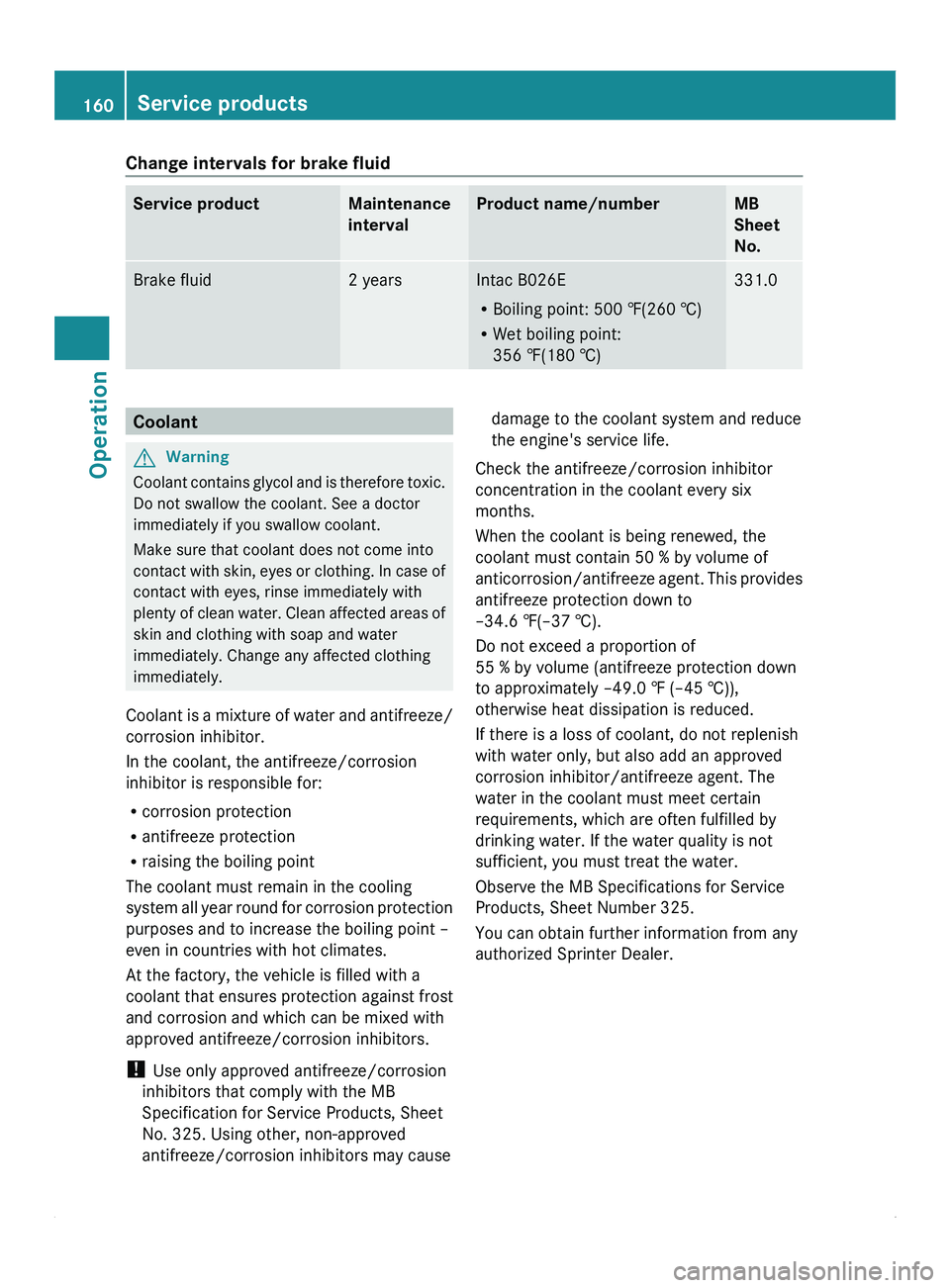
Change intervals for brake fluid
Service product Maintenance
interval Product name/number MB
Sheet
No.
Brake fluid 2 years Intac B026E
R
Boiling point: 500 ‡(260 †)
R Wet boiling point:
356 ‡ (180 †) 331.0
Coolant
G
Warning
Coolant contains glycol and is therefore toxic.
Do not swallow the coolant. See a doctor
immediately if you swallow coolant.
Make sure that coolant does not come into
contact with skin,
eyes or clothing. In case of
contact with eyes, rinse immediately with
plenty of clean water. Clean affected areas of
skin and clothing with soap and water
immediately. Change any affected clothing
immediately.
Coolant is a mixture of water and antifreeze/
corrosion inhibitor.
In the coolant, the antifreeze/corrosion
inhibitor is responsible for:
R corrosion protection
R antifreeze protection
R raising the boiling point
The coolant must remain in the cooling
system all year round for corrosion protection
purposes and to increase the boiling point –
even in countries with hot climates.
At the factory, the vehicle is filled with a
coolant that ensures protection against frost
and corrosion and which can be mixed with
approved antifreeze/corrosion inhibitors.
! Use only approved antifreeze/corrosion
inhibitors that comply with the MB
Specification for Service Products, Sheet
No. 325. Using other, non-approved
antifreeze/corrosion inhibitors may cause damage to the coolant system and reduce
the engine's service life.
Check the antifreeze/corrosion inhibitor
concentration in the coolant every six
months.
When the coolant is being renewed, the
coolant must contain 50 % by volume of
anticorrosion/antifreeze
agent. This provides
antifreeze protection down to
–34.6 ‡(–37 †).
Do not exceed a proportion of
55 % by volume (antifreeze protection down
to approximately –49.0 ‡ (–45 †)),
otherwise heat dissipation is reduced.
If there is a loss of coolant, do not replenish
with water only, but also add an approved
corrosion inhibitor/antifreeze agent. The
water in the coolant must meet certain
requirements, which are often fulfilled by
drinking water. If the water quality is not
sufficient, you must treat the water.
Observe the MB Specifications for Service
Products, Sheet Number 325.
You can obtain further information from any
authorized Sprinter Dealer. 160
Service products
Operation
Page 163 of 292
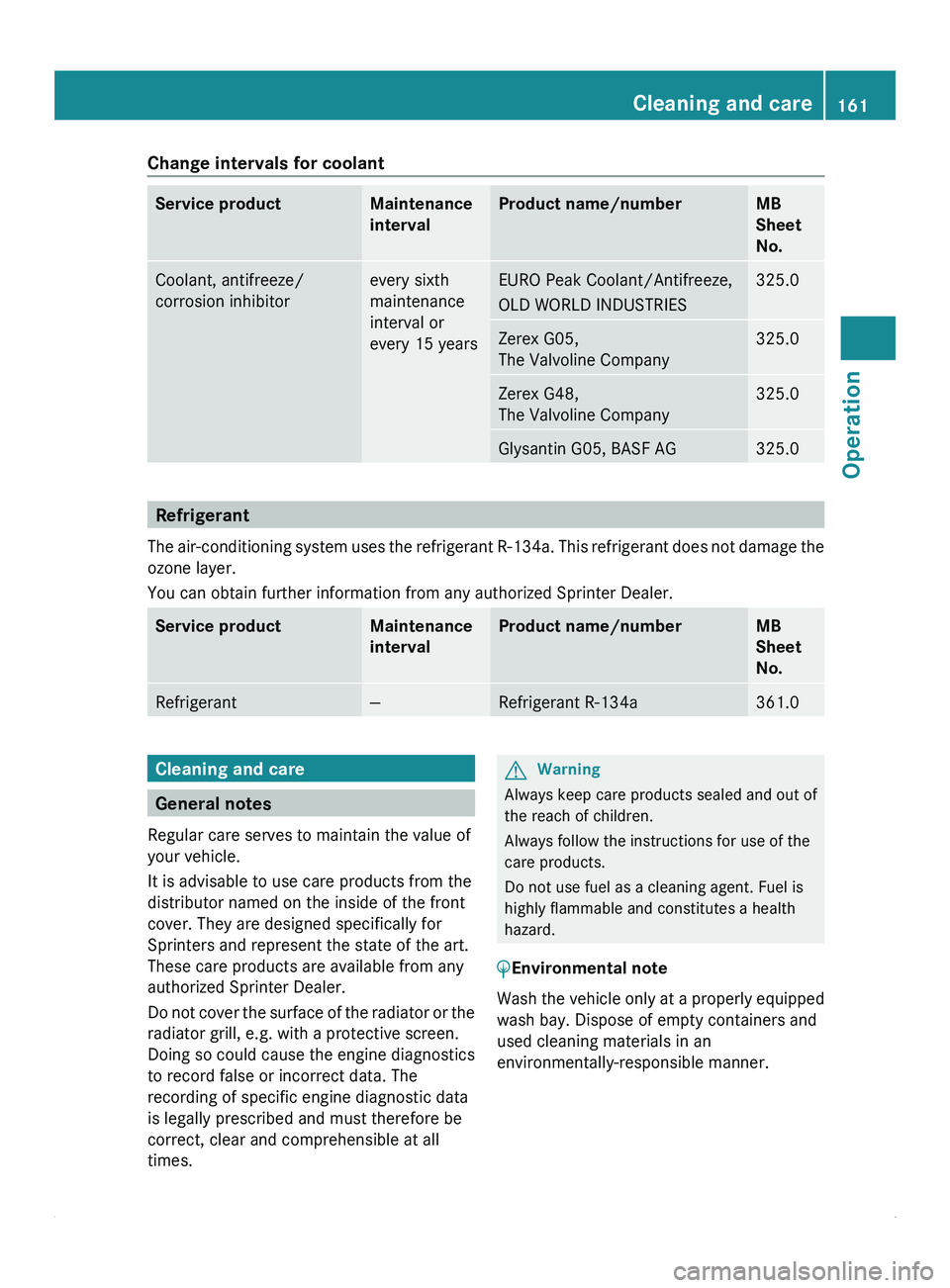
Change intervals for coolant
Service product Maintenance
interval Product name/number MB
Sheet
No.
Coolant, antifreeze/
corrosion inhibitor every sixth
maintenance
interval or
every 15 years EURO Peak Coolant/Antifreeze,
OLD WORLD INDUSTRIES 325.0
Zerex G05,
The Valvoline Company 325.0
Zerex G48,
The Valvoline Company 325.0
Glysantin G05, BASF AG 325.0
Refrigerant
The air-conditioning system
uses the refrigerant R-134a. This refrigerant does not damage the
ozone layer.
You can obtain further information from any authorized Sprinter Dealer. Service product Maintenance
interval Product name/number MB
Sheet
No.
Refrigerant — Refrigerant R-134a 361.0
Cleaning and care
General notes
Regular care serves to maintain the value of
your vehicle.
It is advisable to use care products from the
distributor named on the inside of the front
cover. They are designed specifically for
Sprinters and represent the state of the art.
These care products are available from any
authorized Sprinter Dealer.
Do not cover
the surface of the radiator or the
radiator grill, e.g. with a protective screen.
Doing so could cause the engine diagnostics
to record false or incorrect data. The
recording of specific engine diagnostic data
is legally prescribed and must therefore be
correct, clear and comprehensible at all
times. G
Warning
Always keep care products sealed and out of
the reach of children.
Always follow the instructions for use of the
care products.
Do not use fuel as a cleaning agent. Fuel is
highly flammable and constitutes a health
hazard.
0040Environmental note
Wash the vehicle only at a properly equipped
wash bay. Dispose of empty containers and
used cleaning materials in an
environmentally-responsible manner. Cleaning and care
161
Operation Z
Page 164 of 292
G
Warning
Never use openings in the bodywork as steps.
You may otherwise
damage the vehicle or lose
your footing and injure yourself or others.
If you have to clean the upper areas of the
vehicle, always use suitable ladders or other
secure climbing aids. G
Warning
Dirty or
iced-up steps and entrances create a
risk of slipping or falling.
Keep steps, entrances
and footwear free from
dirt (e.g. mud, clay, snow and ice). Cleaning the interior of the vehicle
Seat belts !
Observe the following notes on cleaning
the seat belts:
R Remove any stains or dirt immediately.
This will avoid residue or damage.
R Do not bleach
or dye the seat belts. This
could impair the function of the seat
belts.
R Do not dry the seat belts in direct
sunlight or at temperatures above
176 ‡ (80 †).
Steering wheel boss and cockpit G
Warning!
When cleaning the steering wheel boss and
dashboard, do not use cockpit sprays or
cleaning agents containing
solvents. Cleaning
agents containing solvents cause the surface
to become porous, and as a result, plastic
parts may break away and be thrown around
the interior when an air bag is deployed, which
may result in severe injuries.
Use a damp, clean and lint-free cloth to clean
the plastic components and the cockpit. If
particularly dirty, use a mild detergent. !
Do not use
dry, coarse or hard cloths and
do not scrub. You could otherwise scratch
or damage the surfaces.
Radio and monitor display X
Switch off the radio or rear-view camera
monitor and let it cool.
X Clean the display surface with a
commercially available microfiber cloth
and cleaner for TFT/LCD displays.
X After drying,
polish the display surface with
a dry microfiber cloth, applying only light
pressure.
! Do not use dry, rough or hard cloths or
abrasive products, solvents or cleaning
agents containing solvents. Do not scrub.
Only apply light pressure when cleaning.
Otherwise, you will damage the display
surface, as it is sensitive to pressure and
susceptible to scratches.
Windows !
Do not use
dry cloths, abrasive products,
solvents or cleaning agents containing
solvents to clean the inside of the windows.
Clean the inside of the windows with a
damp cloth or a commercially available
glass cleaner.
Do not touch the inside of the rear and side
windows with hard objects, e.g. an ice
scraper or ring. You could otherwise
damage the windows or the rear window
defroster. Cleaning the exterior of the vehicle
General notes Scratches, corrosive
deposits, areas affected
by corrosion and damage caused by neglect
or inadequate care cannot always be
completely remedied. In this case, visit a
qualified specialist workshop, e.g. the
nearest authorized Sprinter Dealer. 162
Cleaning and care
Operation
Page 165 of 292
!
In order to avoid consequential damage,
repair damage caused by loose chippings
and remove any dirt immediately, in
particular:
R insect remains
R bird droppings
R flash rust
R tree resin
R oils and grease
R fuels
R tar stains
R salt residue
Wash your vehicle
more frequently if it gets
dirty more often.
! Do not park the vehicle for an extended
period right after cleaning it, particularly
after having cleaned the wheels with wheel
cleaner. Wheel cleaners could cause
increased corrosion of the brake discs and
brake pads/linings. Generally, park the
vehicle at operating temperature after
cleaning.
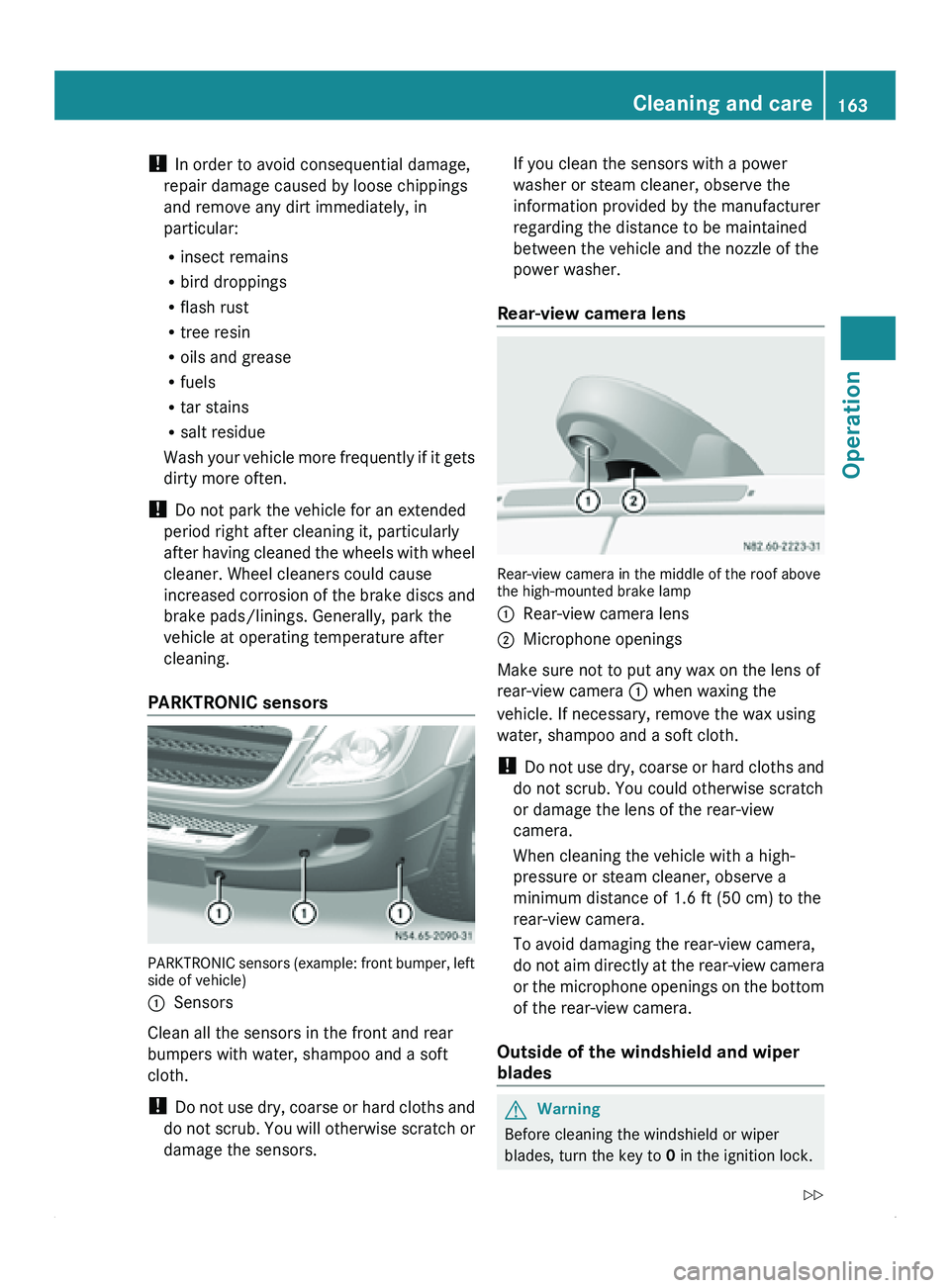
PARKTRONIC sensors PARKTRONIC sensors (example: front bumper, left
side of vehicle)
0046
Sensors
Clean all the sensors in the front and rear
bumpers with water, shampoo and a soft
cloth.
! Do not
use
dry, coarse or hard cloths and
do not scrub. You will otherwise scratch or
damage the sensors. If you clean the sensors with a power
washer or steam cleaner, observe the
information provided by the manufacturer
regarding the distance to be maintained
between the vehicle and the nozzle of the
power washer.
Rear-view camera lens Rear-view camera in the middle of the roof above
the high-mounted brake lamp
0046
Rear-view camera lens
0047 Microphone openings
Make sure not to put any wax on the lens of
rear-view camera 0046 when waxing the
vehicle. If necessary, remove the wax using
water, shampoo and a soft cloth.
! Do not
use
dry, coarse or hard cloths and
do not scrub. You could otherwise scratch
or damage the lens of the rear-view
camera.
When cleaning the vehicle with a high-
pressure or steam cleaner, observe a
minimum distance of 1.6 ft (50 cm) to the
rear-view camera.
To avoid damaging the rear-view camera,
do not aim directly at the rear-view camera
or the microphone openings on the bottom
of the rear-view camera.
Outside of the windshield and wiper
blades G
Warning
Before cleaning the windshield or wiper
blades, turn the key to 0 in the ignition lock. Cleaning and care
163
Operation
Z